


Quick answer
Augmented reality books add sound, animation and 3D scenes to a printed page when a phone or tablet camera sees it. In peer-reviewed studies of 38 to 153 readers (as of November 2026), AR raised motivation and some comprehension scores. Gains shrink when side games pull attention from the story, so check story fit, captions and the privacy notice first.
Augmented reality books look like ordinary picture books until a tablet camera points at a page and a dragon lifts off it. An augmented reality book is a printed book that an app recognizes through the camera, then layers sound, animation or 3D models over the page. If you teach young readers or buy books for your kids, you're asking one thing: does the screen help a child read, or pull their eyes off the words?
We start with how an augmented reality book works, what studies say AR adds to reading and where AR books fall short. Then come privacy under COPPA, the AAP's screen time policy, accessibility, our tested checklist and when one's worth it.
Key takeaways
- AR books with story tasks beat plain AR on comprehension in a 40-child trial.
- COPPA counts a saved photo or voice clip of your child as personal information.
- Hotspots and games in digital stories distracted children across 43 studies.
- Parents' dialogic talk fell 47.9% with enhanced e-books versus print books.
- Public schools' AR apps must meet WCAG 2.1 AA by 2027 or 2028.
What is an augmented reality book?
Every AR book has two parts: the printed page and an app that watches it through the camera. The app looks for something it knows, then pins its animation to that spot.
Most picture books use the page picture itself as the trigger. Developers call that image tracking, or a marker. Google's guide to ARCore Augmented Images says the toolkit "can track up to 20 unique images simultaneously and each database can store up to 1,000 reference images." Images "must be flat and fill at least 25% of the camera frame for initial detection," the guide adds. That's why a curled page can stall the scene. Apple's ARKit image tracking documentation describes the same idea: a configuration that "tracks known images using the rear-facing camera."
Markerless AR skips the printed trigger and maps the room instead. Google's ARCore fundamentals page says the phone finds "feature points" in the camera image. It then turns flat areas like tables into "geometric planes," so a character can stand beside your cereal bowl. That character is a 3D model, the kind our 3D animation career guide covers. Light and texture can break it. Google warns that "flat surfaces without texture, such as a white wall, may not be detected properly." So before you buy, open the book under normal room light and hold the tablet back until the whole page fits on screen.
| Type | What the app looks for | What can stop it |
|---|---|---|
| Marker (image tracking) | A known page picture, at least 300 x 300 pixels in the app's database | A curled page, or a page that fills under 25% of the camera frame |
| Markerless (world tracking) | Feature points and flat surfaces such as a table or floor | Flat surfaces without texture, such as a white wall |
That 300-pixel floor is for the picture stored in the app, and Google notes "Using images with high resolution does not improve performance."
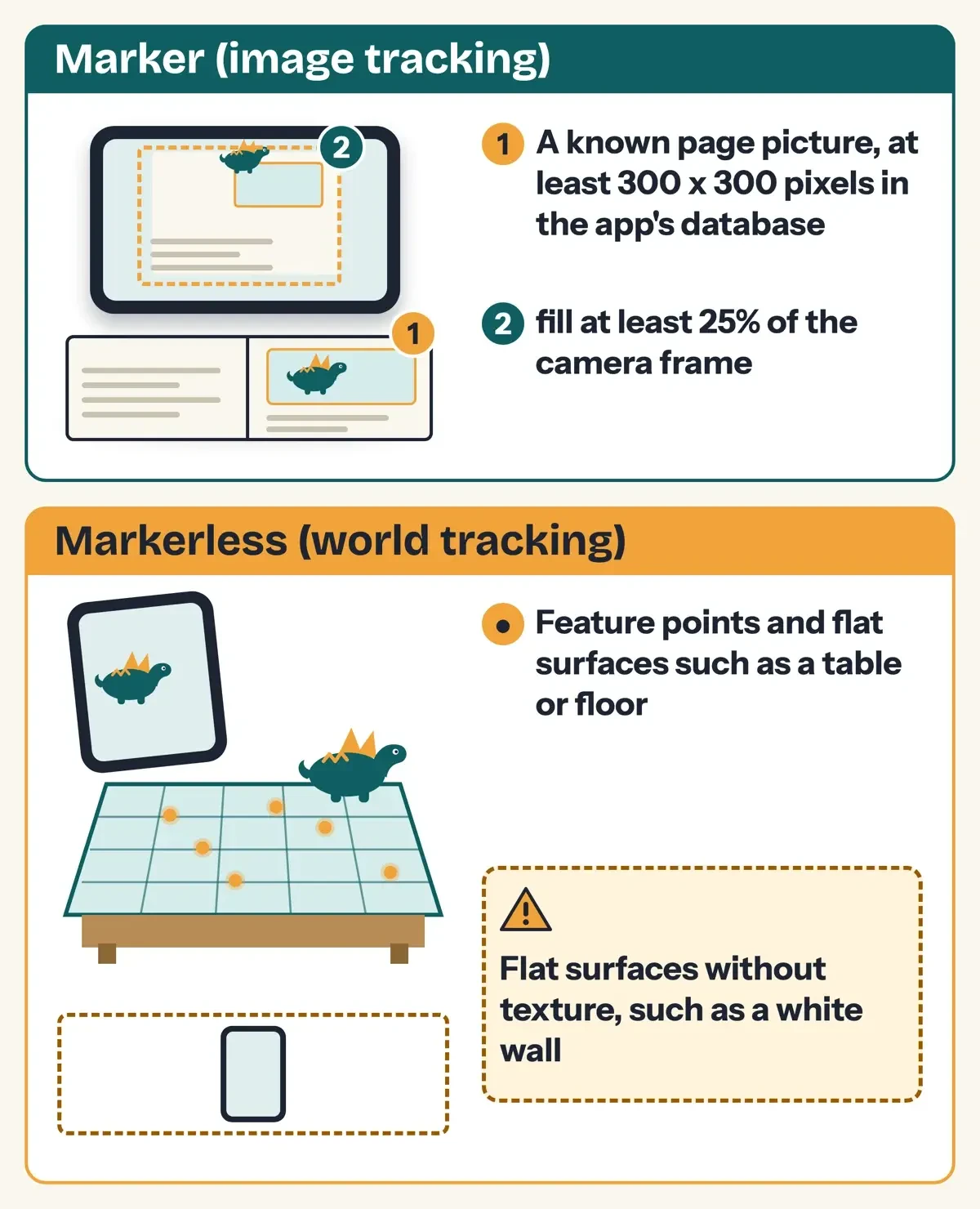 Diagram by DigitalTreed: marker and markerless AR books, from Google ARCore and Apple ARKit developer docs.
What the studies say AR adds to reading
So far, peer-reviewed studies of AR books haven't been large, and only two name a place: Turkey and the UK. We read the UK study in full; for the other five, we had only the abstract.
| Study | Children | What they compared | Main result |
|---|---|---|---|
| Simsek and Direkci, 2023 | 120, ages 11-12 | AR texts on tablets vs the same course-book texts | Higher overall comprehension; no gain on literal comprehension |
| Zhang and others, 2026 | 62, ages 5-6 | AR vs electronic picture books, 4 readings over 2 weeks | E-book group learned more target vocabulary; AR group stronger on motivation |
| Yang and others, 2025 | 40, ages 8-10 | AR storybooks with vs without story tasks | Task group: more engagement, retelling and comprehension |
| Yilmaz, Kucuk and Goktas, 2017 | 92, ages 5-6 | No comparison group in the abstract; attitude form and story test | Children enjoyed AR books; happiness tracked comprehension |
| Alhamad, Manches and McGeown, 2024 | 38, ages 8-10 | Interviews after reading one AR book | Most found AR books easy to use |
| Cheng, 2017 | 153 students | Survey after an AR book reading activity | Less felt cognitive load, stronger motivation |
In the largest trial, the ERIC abstract by Simsek and Direkci reports that "the experimental group's overall comprehension scores were much higher than those of the control group." Those were 120 students aged 11 and 12. On literal comprehension, the recall of facts stated in the text, the two groups matched. The AR readers pulled ahead on inference, evaluation and appreciation, where a child has to think past the words.
In the newest study, Zhang and colleagues randomly assigned 62 children aged 5 and 6 to AR or electronic picture books. They tested the children after the first and fourth readings. The e-book group did better at "learning target popular science vocabulary, explicit reading comprehension." The AR group was stronger in "implicit reading comprehension, intrinsic reading motivation," the abstract on the journal article page reports. For a child who's learning new words, that test favored the plain e-book.
In a 40-child trial, the ERIC abstract by Yang and colleagues says "a large part of that engagement is driven by children's focus on AR elements." Adding story tasks changed the pattern: "interactive tasks shift children's engagement more toward the story content." The task group also beat the plain-AR group on retelling and comprehension, and that's why our checklist asks for story tasks.
Using the app isn't usually the hard part. In a UK study of 38 children, nine had teacher-reported reading difficulties, yet "The majority of children found AR books easy to use," the Frontiers in Psychology version reports.
Cheng's survey of 153 students found they "perceived less cognitive load, stronger motivation, and more positive attitudes," per the abstract on the AJET article page.
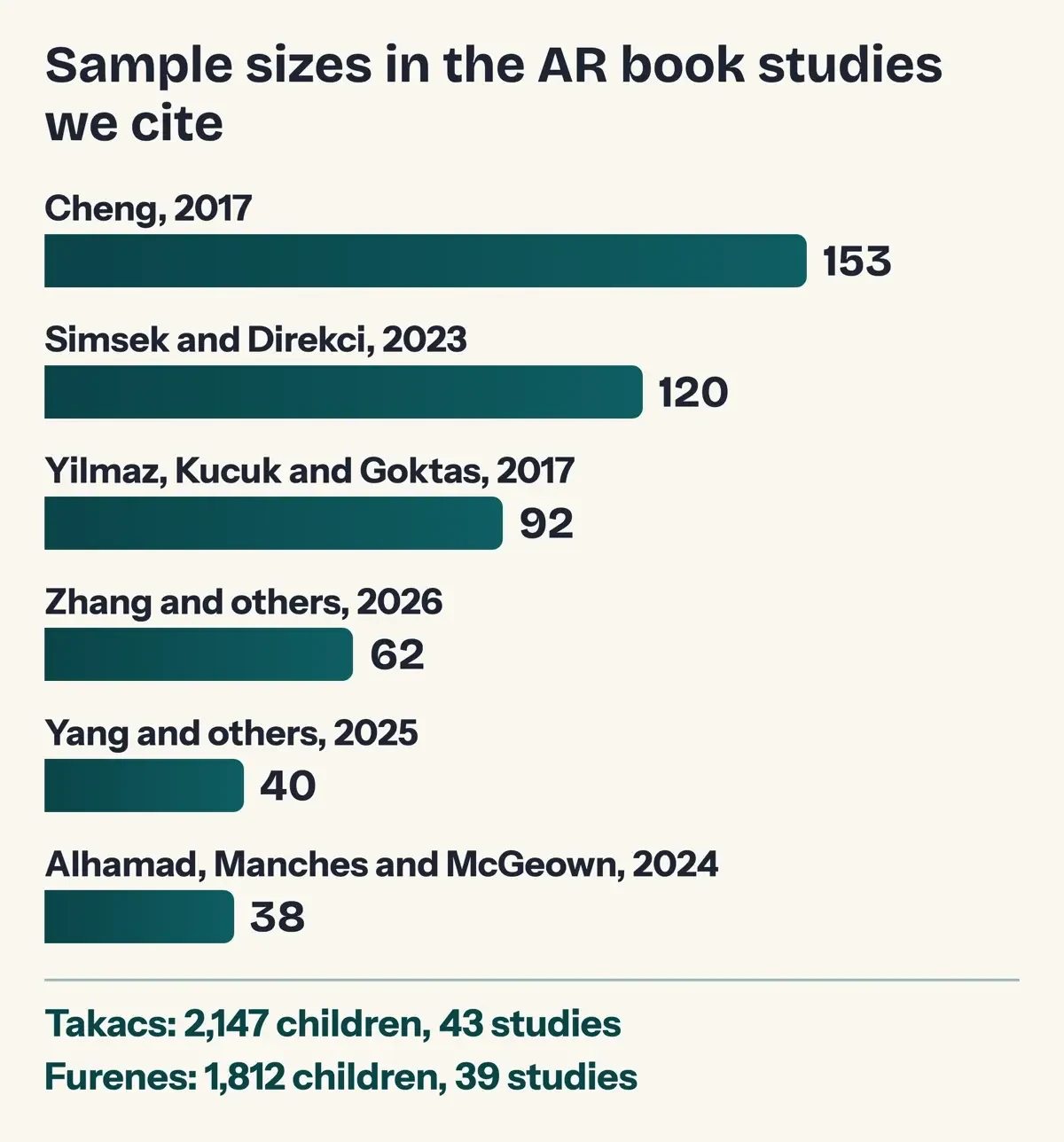 Drawn by us: sample sizes in the AR book studies we cite, from ERIC and PubMed Central records.
Where AR books fall short
Still, the larger evidence base covers e-books with extras, not AR books. AR books often copy e-book features, per a 2019 review below, so treat these findings as a guide. They aren't proof.
Takacs, Swart and Bus pooled 43 studies with 2,147 children. They found a small benefit from technology-enhanced stories: g+ = 0.17 for story comprehension and 0.20 for expressive vocabulary. The next step is our own math. Using U3 = Phi(g) and assuming normal scores, the average child with the technology beat about 56.7% of the comparison group, where 50% would mean no effect. For vocabulary the same math gives 57.9%. That's a modest edge. The ERIC record notes a split inside it: "interactive elements like hotspots, games, and dictionaries were found to be distracting."
Furenes, Kucirkova and Bus pooled 39 studies of paper versus screen reading in 2021, with 1,812 children aged 1 to 8. Their ERIC abstract makes a similar point. They found that "with story-congruent enhancements, digital books outperformed paper books." They also found that "Adults' mediation during print books' reading was more effective than the enhancements in digital books read by children independently." A dragon that acts out the sentence fits the first finding. A coin hunt in the margins doesn't. Built-in dictionaries cut both ways, since "An embedded dictionary had no or negative effect on children's story comprehension but positively affected children's vocabulary learning."
Adult talk drops too, at least when it's an e-book. Munzer and colleagues filmed 37 parent-toddler pairs reading in a lab and counted the 10-second intervals with dialogic talk from the parent. That talk showed up in 11.9 intervals with print books but only 6.2 with enhanced e-books. That's a 47.9% drop, by (6.2 - 11.9) / 11.9. The authors' conclusion: "Parents and toddlers verbalized less with electronic books, and collaboration was lower."
In Cheng's 2019 interviews with 47 parent-child pairs, the ERIC abstract lists parents' reactions that included "guiding, distracting, and antipathy" next to novelty and playfulness. The ERIC abstract of a review of commercial AR picture books by Green and colleagues says "Most of the AR graphics simply duplicate the graphics found in the books."
No peer-reviewed study of AR in adult fiction turned up in our ERIC and Europe PMC searches, so claims about AR thrillers for grown-ups don't have evidence yet.
Kids' privacy: what COPPA covers when the camera is on
An AR book app needs the camera to see the page. This section reads the federal rule plainly, and it's not legal advice.
The FTC's COPPA Rule page says the rule covers operators of sites and apps "directed to children under 13." It also covers general sites that know they're collecting data from kids that age. Covered apps must "notify parents directly and get their approval before they collect, use, or disclose a child's personal information," says the FTC's COPPA page for parents. Camera and voice data sit inside that rule. The FTC COPPA FAQ lists "A photograph, video, or audio file, where such file contains a child's image or voice" as personal information. The rule text at 16 CFR 312.2 also names biometric identifiers, such as voiceprints and faceprints.
So a saved clip of your child waving at a dinosaur counts, and so does a saved read-aloud of your child's voice.
The FTC's FAQ notes "The COPPA Rule was amended on April 22, 2025." Its January 2025 announcement says covered apps now need separate parental consent to share kids' data with third parties for targeted advertising. Operators can keep data only as long as the purpose needs it. They "cannot retain the information indefinitely."
You've got rights as a parent, too. You can review what an app collected, withdraw consent and have the data deleted, and you can report a violation to the FTC at ReportFraud.ftc.gov.
For risks beyond data, see our guides on protecting children from online predators and AI companions and the new rules. App makers can start with data collection ethics in digital marketing.
Screen time and the AAP's 2026 guidance
If you've been counting a child's screen minutes, the American Academy of Pediatrics now asks a different question: how the screen gets used, and who sits beside the child.
In January 2026, the AAP released a policy statement titled "Digital Ecosystems, Children, and Adolescents." It ran in the February 2026 issue of Pediatrics and replaces the academy's earlier media guidance, per the AAP announcement on HealthyChildren.org. The family explainer says the goal is to "move beyond simple screen-time limits and focus on quality, context and conversation." Age still matters. The same explainer says "Infants under 18 months learn best from real-world interactions." It also tells parents to "Watch and play alongside your kids." For an AR book, that means one tablet held between you and your child while you read the words aloud, which answers the drop in talk Munzer's study measured.
The AAP wants app makers to ship child-safe defaults, too. Its list includes turning off autoplay and "not using targeted advertising on minors." The Family Media Plan page adds two steps for an AR app's settings: "Turn off autoplay and notifications" and "Check privacy settings" before kids use a new app. The explainer also says "Having a shared family tablet instead of separate tablets for everyone can encourage co-watching," which suits an AR book read together.
Accessibility checks for AR books
AR asks a child to hold up a device, aim it and move it.
The W3C's XR Accessibility User Requirements, a Working Group Note from August 25, 2021, flags that as a barrier for some readers. In AR, "the user may be expected to scan the environment, or scan physical objects." The note's answer: "The user should be able to perform these actions in a motion agnostic way," so in practice there's a button to tap instead of tilting the tablet.
WCAG 2.2 sets the same bar for the screens around the AR scene. It became a W3C Recommendation on October 5, 2023, and the current version is dated December 12, 2024. Success criterion 2.5.4 says features worked by device motion must also work through on-screen controls, and criterion 1.2.2 asks for captions on prerecorded audio. A deaf or hard-of-hearing child needs those captions to follow a narrated page. If a seller cites the newer standard, that's fine: the W3C says "Content that conforms to WCAG 2.2 also conforms to WCAG 2.0 and WCAG 2.1."
There's a legal deadline for public schools and public libraries. The Justice Department's ADA Title II web rule requires their web content and mobile apps to meet WCAG 2.1 Level AA. That list also covers community colleges and public universities. A school district uses its city's or county's population. An interim final rule published April 20, 2026 moved the compliance dates. Entities serving 50,000 or more people now have until April 26, 2027, and smaller ones until April 26, 2028, the ada.gov first steps page says. A district buying an AR reading app can ask the seller for a WCAG conformance report first.
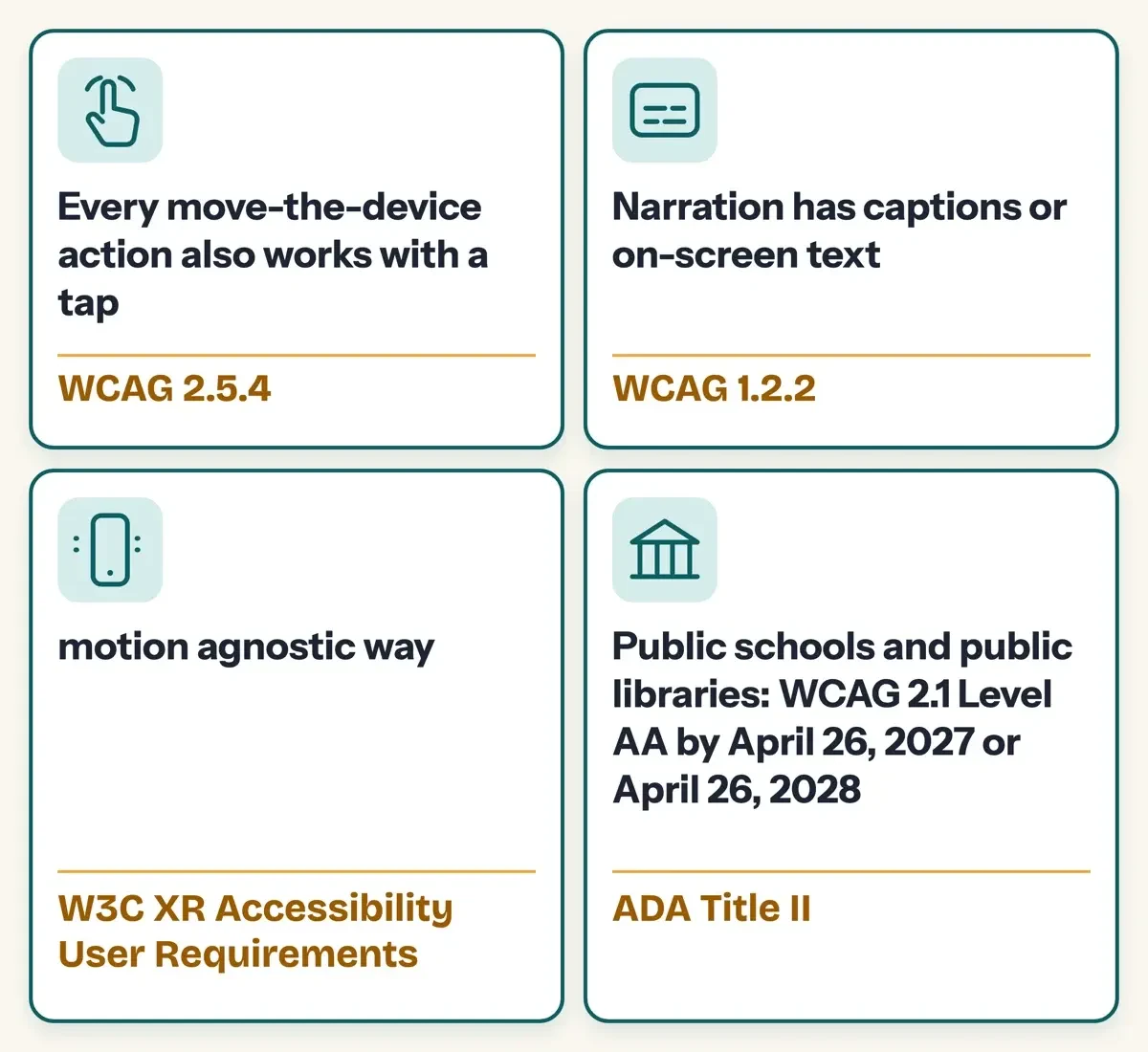 Diagram by DigitalTreed: four accessibility checks for AR books, from W3C and ada.gov.
How to pick an AR book: an 8-point checklist
Each check traces to a finding or rule above, from the Yang and Furenes studies to W3C and COPPA. Read the app's store page and privacy notice before you buy the print book, since the app is where most problems sit.
- AR scenes match the story on the page
- Interactive parts are story tasks, not side games or hotspots
- Narration has captions or on-screen text
- Every move-the-device action also works with a tap
- No child account needed to read
- Privacy notice says camera frames stay on the device
- No third-party ads and no voice recording
- A shared-reading mode lets an adult read along
Score one point per check. We'd skip any title that fails the camera line or the ads line, whatever its total. Those two are about your child's data rather than the reading, and a title that fails only the shared-reading check can still work if you sit beside your child.
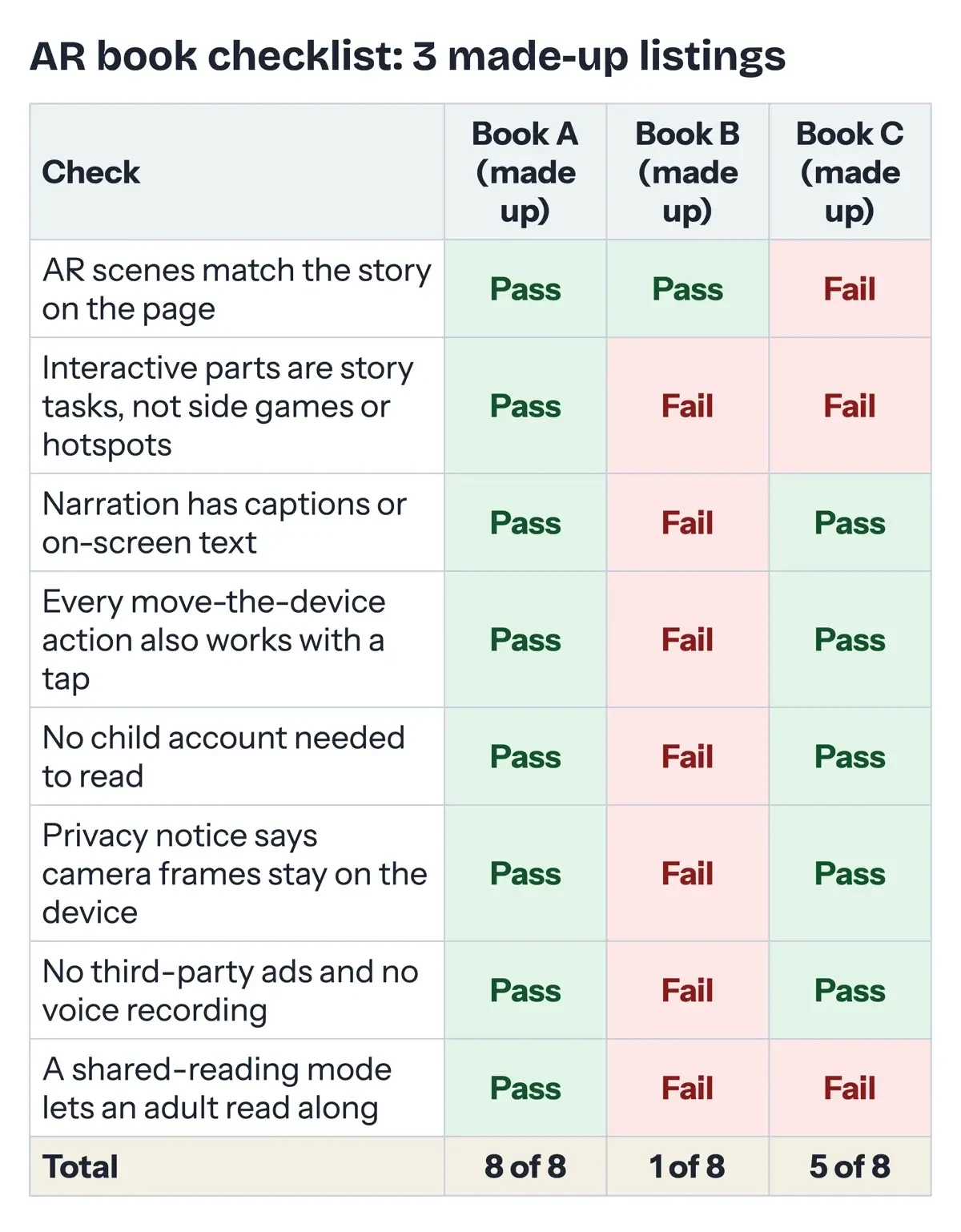 Diagram by DigitalTreed: results from our local test page at 127.0.0.1, scoring three made-up AR book listings.
What we tested
On November 6, 2026, we scored three listings we'd made up, Book A, Book B and Book C, with a small Python version of the checklist. Book A passed 8 of 8, Book C 5 of 8 and Book B 1 of 8. Book C lost points for 3D models that didn't match the story, no story tasks and no shared-reading mode. Book B passed only the story-match check. Served as a local page at 127.0.0.1, the results returned 200 with the same totals, showing Pass or Fail per check and a Total row.
A second script recomputed the Takacs U3 figures (56.7% and 57.9%) and the 47.9% drop in parent talk. Neither test touches a real book or app.
When an AR book is worth buying
We'd buy one when the extras act out the page and an adult reads along. If the app wants an account, shows ads or asks for the microphone, we'd buy a plain picture book from the same shelf and read it together instead. For reading apps without AR, see our look at the Mahatma ELA reading app and Wordle Junior for kids. If you write children's stories, our guide to publishing a short story on Amazon KDP covers the print side.
Frequently asked
Do augmented reality books help struggling readers?
The evidence isn't strong yet. The Takacs meta-analysis found that for children from "less stimulating family environments, multimedia features were helpful and interactive features were detrimental," per the PubMed Central article.
Do AR books work on any phone or tablet?
No. Many Android AR apps use Google's ARCore, and a supported device is one that "has passed our certification process," per Google's ARCore supported devices page.
Can a school sign kids up for an AR app without asking parents?
Only for school use. The FTC COPPA FAQ says "the school's ability to consent for the parent is limited to the educational context." Schools should also have apps delete student data once it's no longer needed.
Is an AR book better than reading aloud to my child?
It isn't a substitute. Cheng and Tsai's ERIC abstract says parents who saw AR books "as being a substitute for them reading to their children" didn't often interact with their kids during reading.
How we made this guide: We found twelve peer-reviewed studies through ERIC and Europe PMC and quoted only what each abstract or open article says. We've read three of them in full on PubMed Central. A script matched every quote against pages saved on November 6, 2026. Facts checked by the DigitalTreed team on November 6, 2026. The privacy and ADA sections explain rules and aren't legal advice.
First published April 2025 as an essay on AR storytelling with no sources. Rewritten November 6, 2026: study results with sample sizes, how marker and markerless AR work, COPPA, the AAP's 2026 policy, accessibility rules and a tested checklist.
Sources
- ERIC: Simsek and Direkci, The Effects of Augmented Reality Storybooks on Student's Reading Comprehension, BJET (2023)
- ERIC: Zhang, Wang, Wang and Zhuang, AR and electronic popular science picture books, ETR&D (2026)
- Springer: Zhang and others, ETR&D article page (2026)
- ERIC: Yang, Yan, Guo and Wei, Interactive tasks in AR storybooks, IEEE TLT (2025)
- ERIC: Yilmaz, Kucuk and Goktas, Are AR picture books magic or real, BJET (2017)
- PubMed Central: Alhamad, Manches and McGeown, Augmented reality books and reading engagement (2024)
- Frontiers in Psychology: Alhamad, Manches and McGeown (2024)
- ERIC: Cheng, Reading an Augmented Reality Book, AJET (2017)
- AJET: Cheng (2017) article page
- ERIC: Cheng, Parents' user experiences of AR book reading, ETR&D (2019)
- ERIC: Cheng and Tsai, Child-parent shared reading with an AR picture book, BJET (2016)
- ERIC: Green, McNair, Pierce and Harvey, An investigation of AR picture books, JEMH (2019)
- PubMed Central: Takacs, Swart and Bus, Technology-enhanced storybooks meta-analysis (2015)
- ERIC: Takacs, Swart and Bus (2015) record
- ERIC: Furenes, Kucirkova and Bus, Reading on paper versus screen meta-analysis (2021)
- PubMed Central: Munzer and others, Parent-toddler interactions with electronic versus print books (2019)
- Google ARCore: Augmented Images
- Google ARCore: Fundamental concepts
- Google ARCore: Supported devices
- Apple Developer: ARImageTrackingConfiguration
- FTC: Children's Online Privacy Protection Rule (COPPA)
- FTC: Complying with COPPA, frequently asked questions
- FTC: Changes to the children's privacy rule finalized (January 2025)
- FTC Consumer Advice: Protecting your child's privacy online
- LII: 16 CFR 312.2, Definitions
- HealthyChildren.org (AAP): New media recommendations (January 20, 2026)
- HealthyChildren.org (AAP): Helping kids thrive in a digital world
- HealthyChildren.org (AAP): How to make a Family Media Plan
- W3C: XR Accessibility User Requirements (2021)
- W3C: Web Content Accessibility Guidelines 2.2
- ADA.gov: Fact sheet on the web and mobile app rule for state and local governments
- ADA.gov: First steps toward complying with the web rule


Comments
No comments yet. Start the conversation below.