
Quick answer
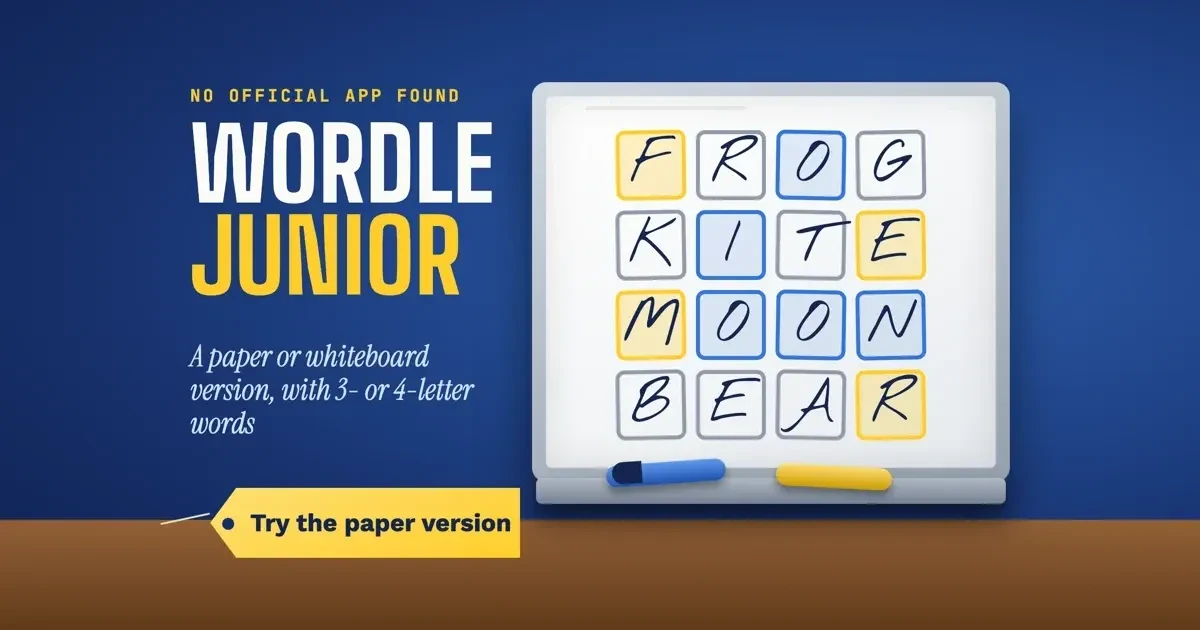
We found no official game called Wordle Junior as of November 2, 2026. The New York Times owns Wordle, which gives six tries at a five-letter word to players 13 and older in the US. For younger kids, a paper or whiteboard version with three- or four-letter words is the honest route.
You may be looking for a Wordle Junior app for a young child. Wordle is a daily word game owned by The New York Times, with six tries to guess a hidden five-letter word. Our 2023 post on this URL described a Wordle Junior app we couldn't verify, so this one sticks to official pages.
We checked NYT's game list, its Help Center and Apple's US App Store for a junior edition, then read NYT's age terms. Instead, we've drawn up a home paper board with shorter words, a second-grade class routine and COPPA checks for kids' word sites.
Key takeaways
- NYT's terms say US Wordle players must be 13 or older.
- No NYT help page or App Store result we checked offers Wordle Junior.
- A whiteboard Wordle for young kids needs no app, account or data.
- Create Your Wordle lets subscribers set a four- to seven-letter word.
- Child-directed sites need a parent's consent before collecting personal information.
Is there an official Wordle Junior?
No, not that we could find. On November 2, 2026 we started with the New York Times Games page. It has 13 entries, from The Crossword and Spelling Bee to Wordle, Connections, Strands and Sudoku, but not one is a junior or kids edition. The same menu sits on the Create Your Wordle Puzzle page, where NYT lets subscribers make their own puzzles. In the NYT Help Center, a search for "wordle junior" returned 11 articles, including the NYT Help Center Wordle article, subscription pages and a policy for custom puzzles. None of the 11 used the word junior. Searches for "junior" and "kids" on their own came back empty.
Then we sent one request to Apple's public App Store catalog lookup for the US, with the term wordle junior. It listed 41 apps, but none was titled Wordle Junior or Wordle Jr, and none was sold by The New York Times Company. A few were word games from independent studios, one of them aimed at young children. We don't name them, because we didn't install or test any. We didn't search Google Play, since checking it would have meant scripting a store search, which we don't do.
An app sold as Wordle Junior on either store isn't NYT's. No NYT Help Center article mentions one. Read the seller name and the privacy policy before you tap install.
How the official Wordle works
The NYT Help Center Wordle article says "Wordle is a daily word game where players have six attempts to guess a five letter word."
A January 31, 2022 press release on the Wordle acquisition says Josh Wardle, a Brooklyn software engineer, released it to the public in October 2021. NYT announced that it had bought the game in that same release.
Tiles change color after each guess, as NYT's help article defines:
- Green: "The letter is in the daily word and in the correct position."
- Yellow: "The letter is in the daily word, but in a different position."
- Gray: "The letter is not in the daily word."
A new puzzle drops at midnight in your time zone, and you can play it in the NYT Games app, on the web or in the NYT News app. The official Wordle page puts it in one line: "Guess the hidden word in 6 tries." The daily game doesn't cost anything, and NYT's Games subscription help page lists Wordle among the "daily puzzles and games for free." One rule trips up young spellers, though. Plurals made by adding S or ES don't count, and NYT's own example is "GEESE can be an answer; DATES and BOXES cannot."
Three settings in the help article help a new player. Hard mode means "Any revealed hints must be used in the subsequent guesses," so leave it off at first. High Contrast Mode is "for contrast and color blindness improvements," which helps a child who mixes up green and yellow. Onscreen Keyboard Input Only is "Most helpful for users using speech recognition or other assistive devices," per the same article.
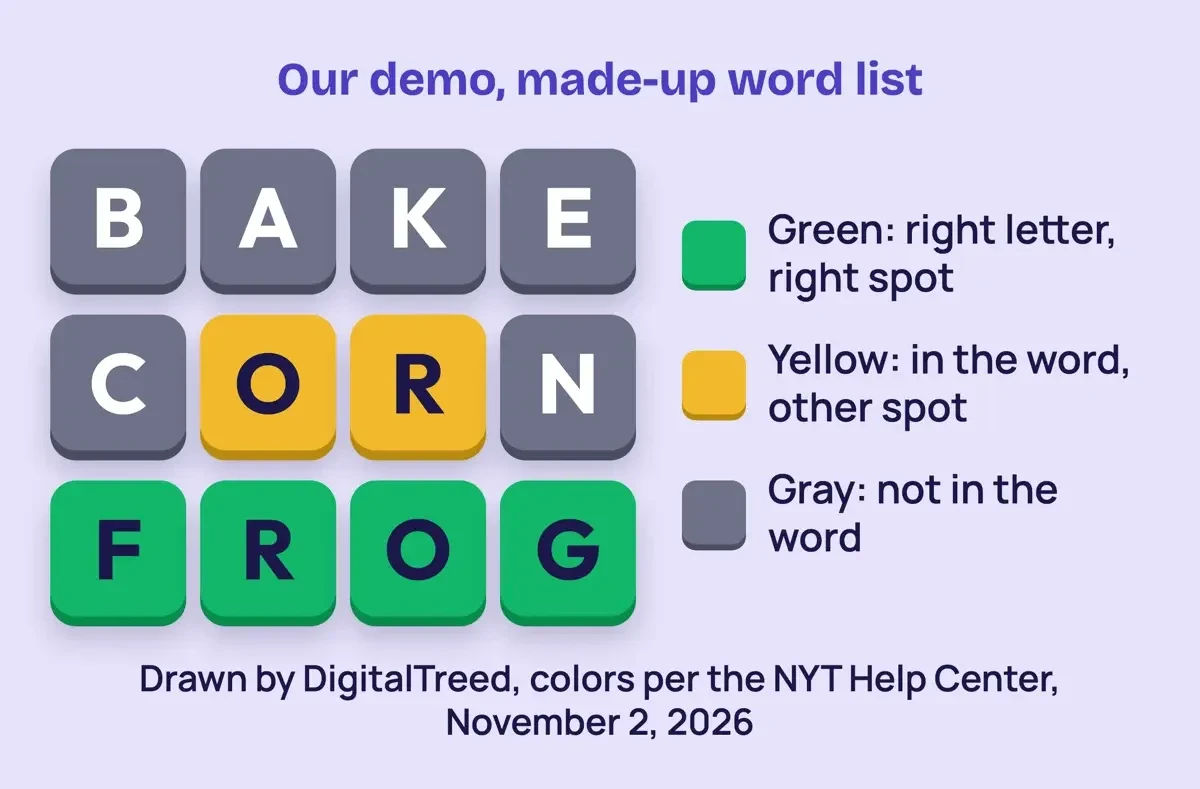 Drawn by us: one round from our 4-letter demo (made-up word list), colored with the green, yellow and gray rules in the NYT Help Center Wordle article, November 2, 2026.
Age limits on NYT Wordle and Create Your Wordle
The age rule sits in section 6.3 of the New York Times Terms of Service. It says "You must be 13 years or older to use any part of the Services in the USA and the UK, and 16 years or older anywhere else."
Teens get one more condition: if you're under 18, the terms expect that "your parent or legal guardian has read these Terms of Service" and agreed to them.
On the data side, NYT's privacy policy says "Times Services are intended for a general audience and are not directed at children under (13) years of age." A parent who thinks NYT collected a child's data can write to [email protected]. The 13-and-up rule also covers puzzles people make themselves. The Create Your Wordle Puzzle Acceptable Use Policy, effective February 11, 2026, says "you must be 13 years or older to play CYWP in the USA and the UK." Put together, a US player aged 13 to 17 can use the official game once a parent or legal guardian has read the terms and agreed to them. A seven-year-old can't use it at all.
For that younger child, draw the board on paper or a whiteboard. It doesn't need an account or send data. You're the one who picks every hidden word.
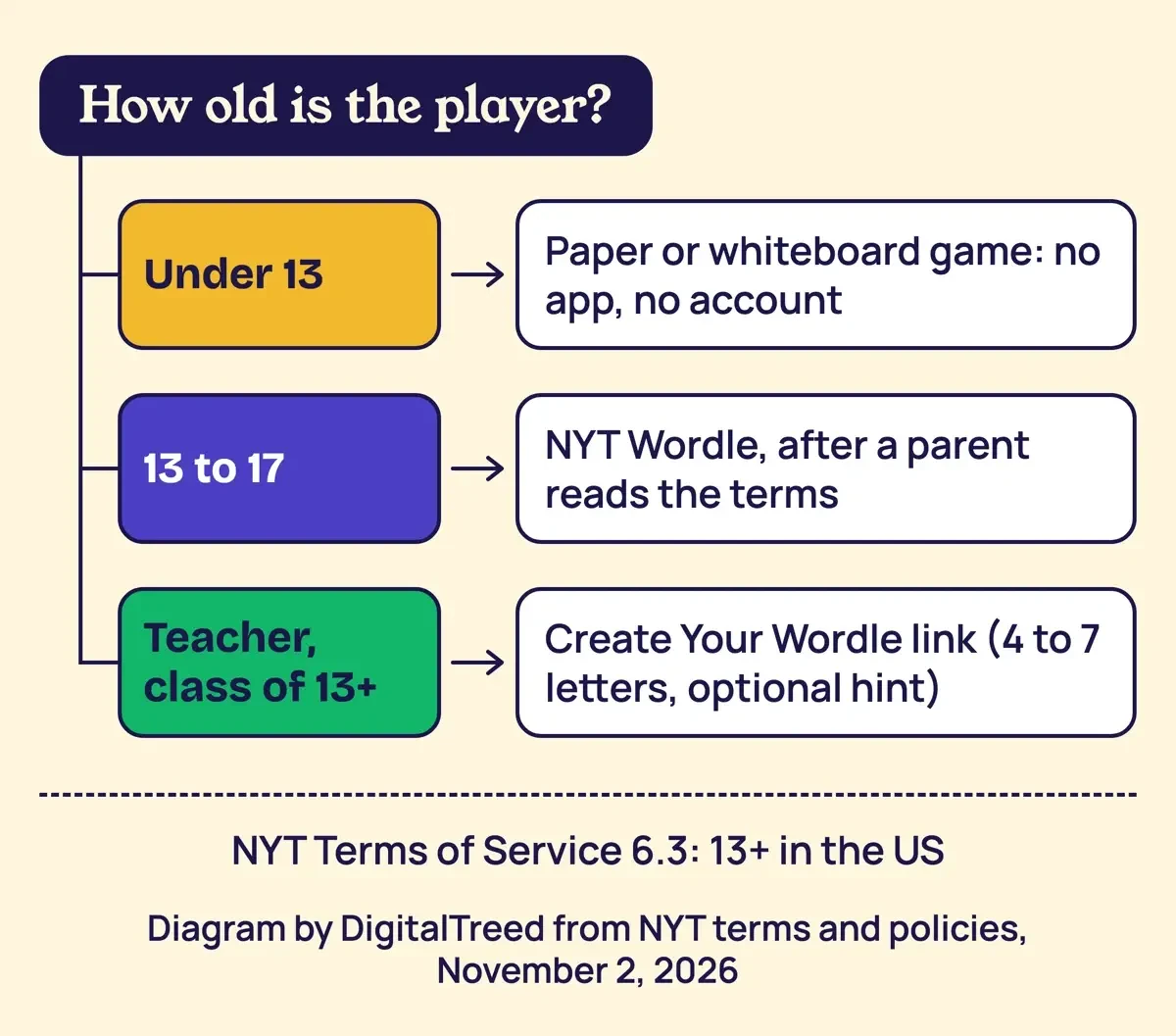 Diagram by DigitalTreed, from the New York Times Terms of Service, privacy policy and Create Your Wordle Puzzle policy, November 2, 2026.
Make it easier: shorter words and hints
A paper board can shrink three ways. NYT and teachers both use them: fewer letters per word, a hint before the first guess, or a letter bank that's smaller than the alphabet.
For 13 and up, the Wordle help article explains that "Subscribers can choose their own four to seven letter word with an optional hint and their display name." That hint can run to 50 characters, and "Only dictionary words are accepted." Anyone can solve a shared link without an account, but the 13-and-up rule still applies to players, so this suits a high school class better than a second-grade one. A teacher could turn the puzzle link into a code with our QR code maker and put it on a slide.
Younger kids need the whiteboard. An Edutopia article on adapting Wordle for phonics, published September 16, 2026, comes from a literacy coach who ran a weekly game for second graders. The class started with three-letter words. The coach would "supply a controlled set of eight to 12 letters" rather than the whole alphabet. Later the class moved to four- and five-letter words, and finally all 26 letters.
Running a paper version at home
At home you need paper, two colored pencils and a handful of words your child can already read, not a projector. Draw four blank boxes per row and six rows, then pick the hidden word in secret. After each guess, color a box green when the letter's in the right spot and yellow when it's in the word but somewhere else, and leave the rest plain. If a round stalls after three rows, give the first letter, which is the hint our demo tested below.
Doubled letters need a rule of their own. In our demo, a letter turns green or yellow only as many times as it appears in the hidden word. So BOOK against MOON gives two greens for the O's, and B and K stay plain.
Once your child can score that case, swap roles. They hide a word and color your guesses, the way the coach's students later ran the board.
What we tested
To measure what a short list and a hint change, we wrote a small demo. It's a 4-letter Wordle-style scorer in Python, with a made-up list of 40 easy words like FROG and MOON. It passed all 6 scorer checks we wrote by hand, doubled letters included. A scripted player then solved every word twice, always guessing the first word alphabetically that fit the clues.
| No hint | 40 of 40 | 1 | 18 | 16 | 5 | 2.62 (105 / 40) |
| First letter given | 40 of 40 | 15 | 20 | 3 | 2 | 1.8 (72 / 40) |
The hint cut total tries from 105 to 72, and no round took more than 4. Our scripted player knows all 40 answers, though, and a child guessing from memory doesn't.
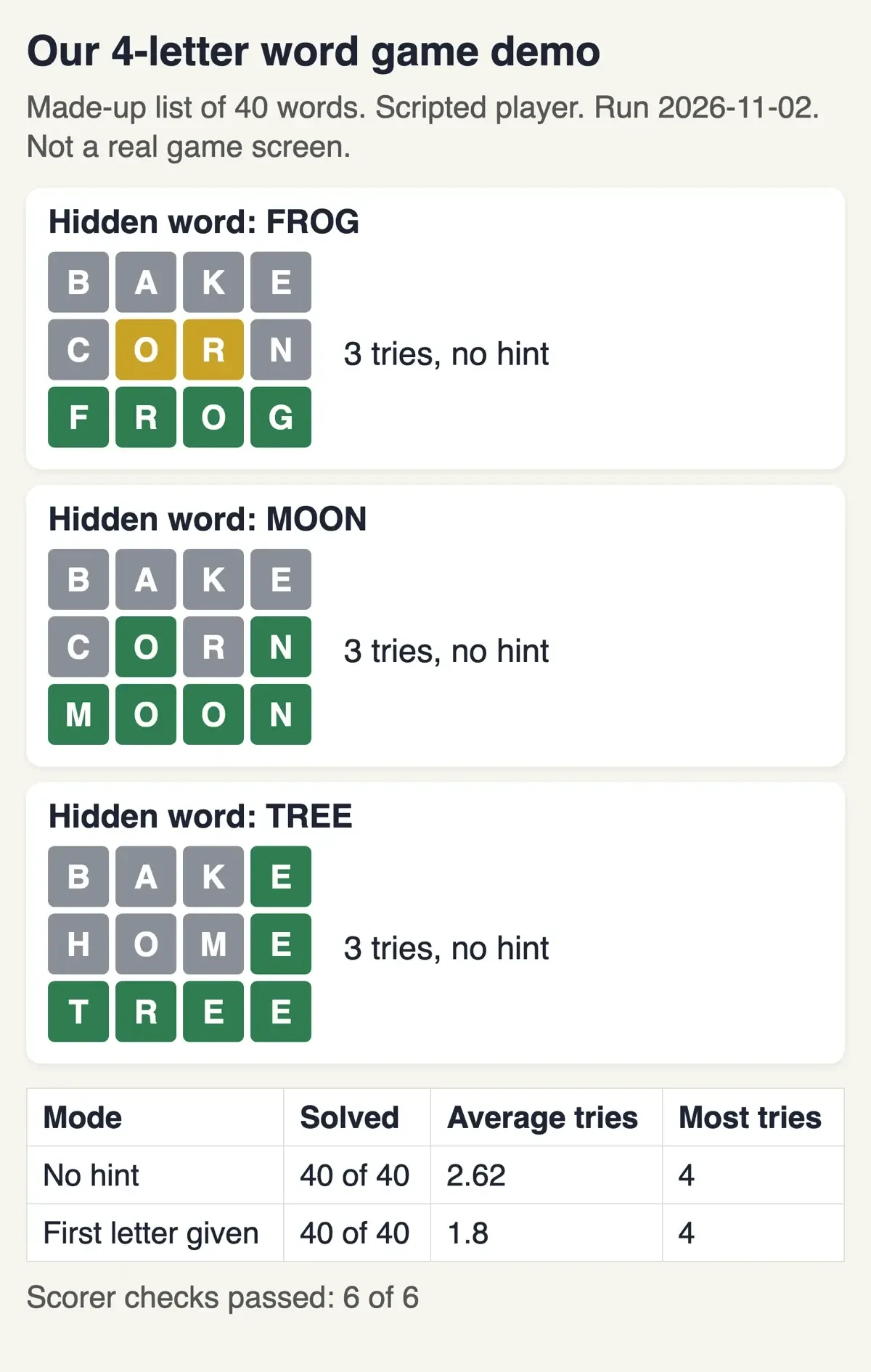 Screenshot: our demo page (made-up words) on 127.0.0.1, November 2, 2026. Not a real game.
How teachers use Wordle-style games in class
The Edutopia coach calls the class version a "10-minute, weekly Wordle-type game," played on a whiteboard or a projected grid, with green and yellow markers. The hidden word matches the week's phonics focus, such as dream for vowel teams. In the coach's order, the routine runs like this:
- Draw a grid with one box per letter and six rows.
- Pick a decodable hidden word that fits this week's phonics lesson.
- Write a limited letter bank on the board, such as eight to 12 letters.
- Students suggest words together, and the teacher colors each box green or yellow.
- After the reveal, the class looks back at which guesses helped and why.
Later the coach handed over the marker. One student picked the hidden word and ran the board, which meant comparing each guess with the real spelling before coloring a box.
Reading research backs the skills involved, though it doesn't mention Wordle. The What Works Clearinghouse foundational reading skills guide, written for kindergarten through 3rd grade, recommends "Teach students to decode words, analyze word parts, and write and recognize words." Linking that to a guessing game is our reading, not the guide's. Still, the coach's routine has kids sound out guesses, spell them and then talk about why a letter turned yellow, which is decoding and spelling practice in game form. We'd keep the words decodable and the round under 10 minutes, as the coach did.
Math classes use the game differently. In Edutopia's piece on Wordle in the math classroom, a middle school teacher writes "If our students are playing Wordle, they are reading a histogram every day." That's the Guess Distribution bar graph. The same piece has students tally the letters on one page of a novel to find a smart first guess.
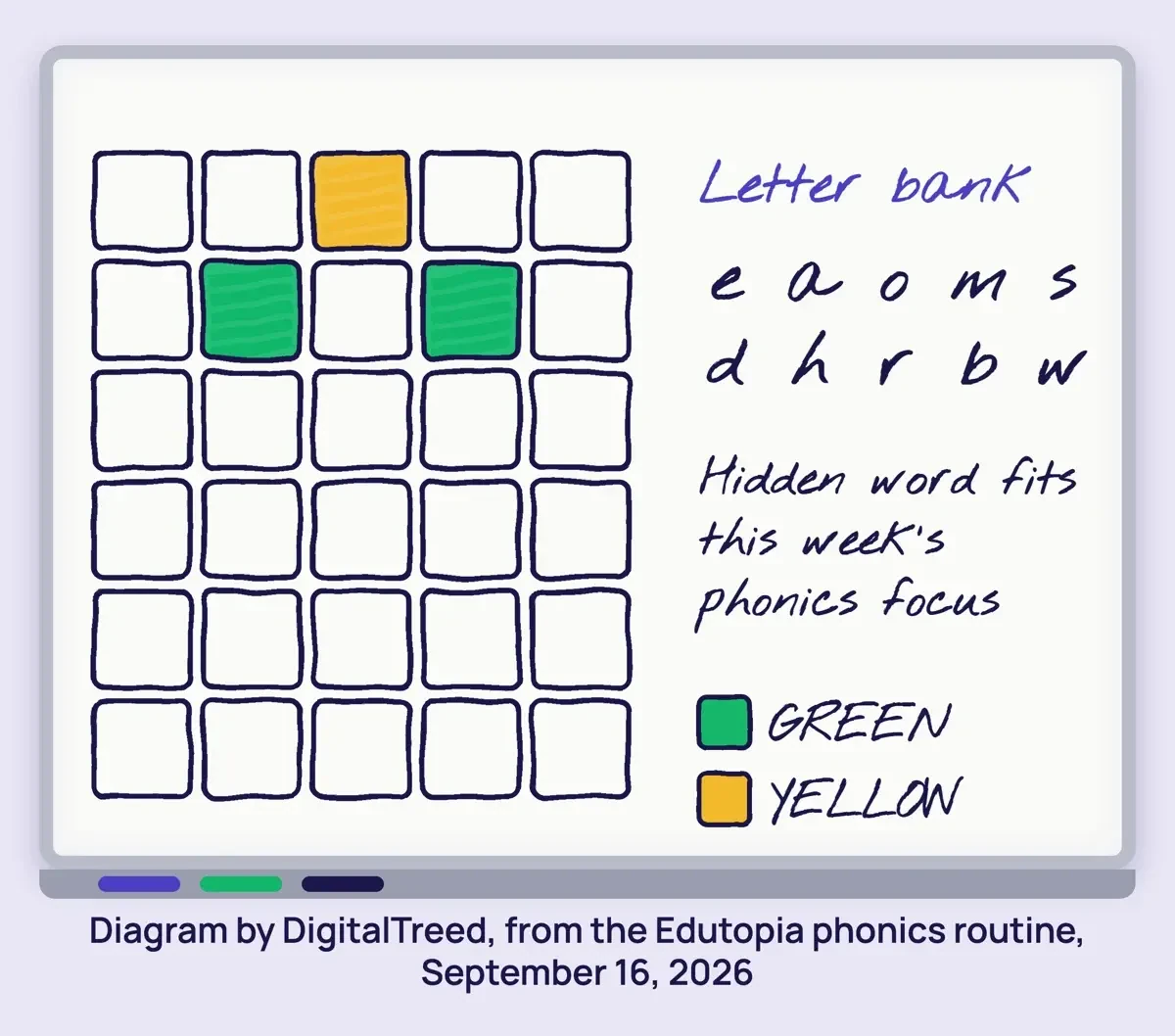 Diagram by DigitalTreed, drawn from the routine in the Edutopia article on adapting Wordle for phonics, September 16, 2026.
Other kids' word-game sites and COPPA
Beyond NYT, our one App Store lookup listed 41 apps from 34 different sellers. For any of them, or any kids' word site, the federal children's privacy law is COPPA. The FTC's COPPA rule page says it applies to "operators of websites or online services directed to children under 13 years of age." It also reaches other sites that know they're collecting data from a child under 13. The core duty is consent: the FTC's parent privacy guide says a covered site "has to get your consent before collecting personal information from your child."
Whether a word game counts as child-directed depends on its look and audience. The FTC COPPA FAQ lists factors including "the subject matter; visual content; the use of animated characters or child-oriented activities and incentives." Personal information isn't just a name, either. The parent guide says it "includes a kid's full name, address, phone number or email address," plus persistent identifiers like IP addresses. The rule also got stricter in 2025. The FAQ notes "The COPPA Rule was amended on April 22, 2025." The FTC's January 2025 press release on the COPPA changes adds that "The final rule requires parents to opt in to third-party advertising." Before a child plays any kids' word site, we'd check four things:
- Does it ask for a name, email or photo before the first puzzle?
- Does its privacy policy say what it collects from children and how a parent can reach it?
- Does it show ads, and does it ask a parent before personalized ones?
- Who is the seller or owner, and is there a real contact page?
The easy case is a site that collects nothing personal at all, which means no name or email and no persistent identifiers like IP addresses either. Per the parent guide, "If the site or service doesn't collect your child's personal information, COPPA is not a factor." If a site seems to break the rules, the FTC says to report it at ReportFraud.ftc.gov. This section only paraphrases the FTC's pages for parents, so an app maker with a COPPA question should ask a lawyer. For games at school, our Gimkit code guide covers COPPA in class. Our Screen Time passcode guide helps with app limits on a family iPhone.
Our plan for home and class
Under 13, run a whiteboard or paper version with three- or four-letter words and a small letter bank. Give the first letter when a round stalls. From 13 to 17, play the free daily Wordle, with High Contrast on if the colors blur, after a parent reads the terms. A teacher with a Games subscription can share a four-letter custom puzzle with a 13-plus class by link or QR code. Anything sold as Wordle Junior gets the kids'-app check. Who sells it, what does it collect, and is a parent asked first?
For the paper version, our demo list is a fair start: BAKE, BEAR, DUCK, FISH, FROG, KITE, MOON, SOCK and TREE are all on it.
If your family likes a one-puzzle-a-day habit, our guides to the Poeltl NBA guessing game, Qourdle and how to play it and the Google Memory Game have more. Older kids building word lists can try our post on WordHippo 5-letter words. For the keyboard side, see our computer tricks for students.
Wordle questions from parents and teachers
Frequently asked
Is Wordle free for kids to play?
The daily puzzle is free, but per NYT's Games subscription page, "Wordle Bot and Cross Bot are not available without a subscription."
Can you play old Wordle puzzles?
Subscribers can. The Wordle help article says the archive goes back to June 19, 2021.
Who picks the Wordle words?
Per the Help Center, "Daily words are curated by editors using the Oxford Dictionary."
What happens if a kids' site breaks COPPA?
The FTC's COPPA FAQ says operators can face "civil penalties of up to $53,088 per violation" (as of November 2026).
How we made this guide: On November 2, 2026 a script saved the NYT, FTC, IES and Edutopia pages linked here, ran one Apple catalog lookup and ran our demo. We didn't play NYT Wordle, make a custom puzzle or install any app. Facts checked by the DigitalTreed team on November 2, 2026.
First published November 2023 describing a Wordle Junior app we couldn't verify. Rewritten November 2, 2026 around the official Wordle rules, NYT's age terms, classroom versions and COPPA.
Sources
- The New York Times Help Center: Wordle
- The New York Times Help Center: New York Times Games Subscription
- New York Times Games
- Wordle, The New York Times
- Create Your Wordle Puzzle, The New York Times
- Create Your Wordle Puzzle Acceptable Use Policy (effective February 11, 2026)
- The New York Times Terms of Service (effective January 20, 2026)
- The New York Times Company Privacy Policy (effective October 23, 2026)
- The New York Times Company: Wordle Is Joining The New York Times Games (January 31, 2022)
- FTC: Children's Online Privacy Protection Rule (COPPA)
- FTC: Complying with COPPA, Frequently Asked Questions
- FTC Consumer Advice: Protecting Your Child's Privacy Online
- FTC press release: FTC Finalizes Changes to Children's Privacy Rule (January 16, 2025)
- IES What Works Clearinghouse: Foundational Skills to Support Reading for Understanding in Kindergarten Through 3rd Grade
- Edutopia: Adapting Wordle to Improve Elementary Students' Phonics Skills (September 16, 2026)
- Edutopia: Using Wordle in the Math Classroom (March 31, 2022)

Comments
No comments yet. Start the conversation below.