
Quick answer
Thermalite blocks are UK aircrete blocks, a form of autoclaved aerated concrete (AAC), made by Forterra. As of November 2026, the maker's June and August 2026 data sheets list strengths of 2.9 to 7.3 N/mm², or 421 to 1,059 psi. In the US you'd buy AAC made to ASTM C1693, and Turbo converts to about R-1.3 per inch. See the conversion table.
Thermalite blocks turn up in UK house plans and self-build videos, with data sheets in N/mm² and W/m·K. Thermalite is a UK brand owned by Forterra. A Thermalite block is a lightweight masonry unit Forterra sells in the UK for walls, foundations and floors. In the US you'd ask for AAC.
We converted Forterra's six 2026 data sheets to psi, lb/ft³ and R per inch. Then we checked them against ASTM C1693, building department sign-off and the FTC rule on R-value claims, and we close with seven questions to ask before you buy.
Key takeaways
- Turbo, the lightest Thermalite block, converts to about R-1.3 per inch.
- Thermalite strengths of 2.9 to 7.3 N/mm² equal about 421 to 1,059 psi.
- ASTM C1693, active as C1693-11R25, is the US spec for AAC.
- UK conductivity figures are not FTC R-value Rule test results.
- The 2022 brochure lists Hi-Strength 7 at 0.18; the 2026 sheet says 0.185.
What are Thermalite blocks?
Thermalite is a brand of Forterra, a UK maker of bricks, blocks and precast concrete based in Northampton, England. Its Thermalite brand page says the name "might have been around for 70 years or so." Forterra makes them at its Thatcham and Hams Hall plants, and it says they're up to 80% recycled content, including pulverised fuel ash from UK power stations. The August 2022 Thermalite brochure repeats that 80% figure.
The material is aircrete, the UK name for autoclaved aerated concrete. Forterra's environmental product declaration for Thermalite Shield lists the mix. It says the blocks are "made of a very fine-grained mixture of cement, quicklime, pulverised fly ash (PFA), anhydrite and water along with finely powdered aluminium." The aluminum makes hydrogen gas. That gas aerates the mix into cakes. They're cut to size and then cured under high-pressure steam. That's the autoclave in the name. The same EPD, last updated October 10, 2026, puts fossil carbon for the product stage (modules A1 to A3) at 168 kg CO2e per cubic meter of Shield. Our roundup of sustainable tech covers other ways makers try to cut that number.
Each data sheet says the blocks are made to BS EN 771-4 and lists a BBA certificate, number 00/3720 for most of the range. BBA is the British Board of Agrément, a UK product certifier.
As of November 7, 2026, the BBA homepage carries a notice: "The BBA's accreditations are currently suspended." It says it's working with UKAS to fix that. Neither paper is a US approval, and a US permit office won't go by them; it works from ASTM standards and the locally adopted ICC code.
Thermalite block specs from the 2026 data sheets
Forterra publishes one technical data sheet per block, each with a version number and a publish date. We saved six on November 7, 2026: Turbo Block 2.9, Shield Block 3.6, Party Wall Block 4, Floor Block, Hi-Strength 7 Block and Trenchblock 3.6. Every block face is 440 by 215 mm.
| Block (sheet date) | Mean compressive strength | Gross dry density | Design conductivity, protected (3%) |
|---|---|---|---|
| Turbo Block 2.9 (June 24, 2026) | 2.9 N/mm² | 470 kg/m³ | 0.110 W/m·K |
| Shield Block 3.6 (August 21, 2026) | 3.6 N/mm² | 600 kg/m³ | 0.150 W/m·K |
| Party Wall Block 4 (June 24, 2026) | 4 N/mm² | 660 kg/m³ | 0.160 W/m·K |
| Floor Block (August 21, 2026) | 4 N/mm² | 660 kg/m³ | 0.160 W/m·K |
| Hi-Strength 7 Block (August 21, 2026) | 7.3 N/mm² | 730 kg/m³ | 0.185 W/m·K |
| Trenchblock 3.6 (August 21, 2026) | 3.6 N/mm² | 600 kg/m³ | NPD |
On the sheets, "Protected (3%)" is the design value for a block kept dry. The Turbo sheet puts moisture at about 3% when protected and 5% when exposed, where its value rises to 0.120 W/m·K. NPD stands for No Performance Declaration. That's why Trenchblock has no design conductivity, only a dry 0.130 and a 15% moisture value of 0.24 W/m·K. The Turbo sheet also lists calculated sound reduction for unfinished blocks, from 36.8 dB at 100 mm up to 46.0 dB at 215 mm. It warns that "On-site testing values may be lower." Ask which test a US supplier's sound figure comes from before a party wall depends on it.
Check the date on any sheet you're handed. The August 2022 brochure lists Hi-Strength 7 at 0.18 W/m·K, but the August 21, 2026 sheet says 0.185. If a supplier sends a scanned sheet, our guide to turning a scanned PDF into editable text lets you search it for the version line and publish date.
All six sheets list reaction to fire class A1 under BS EN 13501, a European class you won't see on a US block label. Turbo claims 4 hours of fire resistance for non-load-bearing walls at every width, taken from the UK National Annex to BS EN 1996-1-2. Those hours come from a European design method; they aren't a US fire rating. On an outer leaf, Turbo blocks need "a suitable impervious coating or finish applied," and the sheet rules Turbo out for render or cladding. It also calls for vertical movement joints at 6 m centers, which works out to 19.7 ft (6 ÷ 0.3048), and at most half that from a corner.
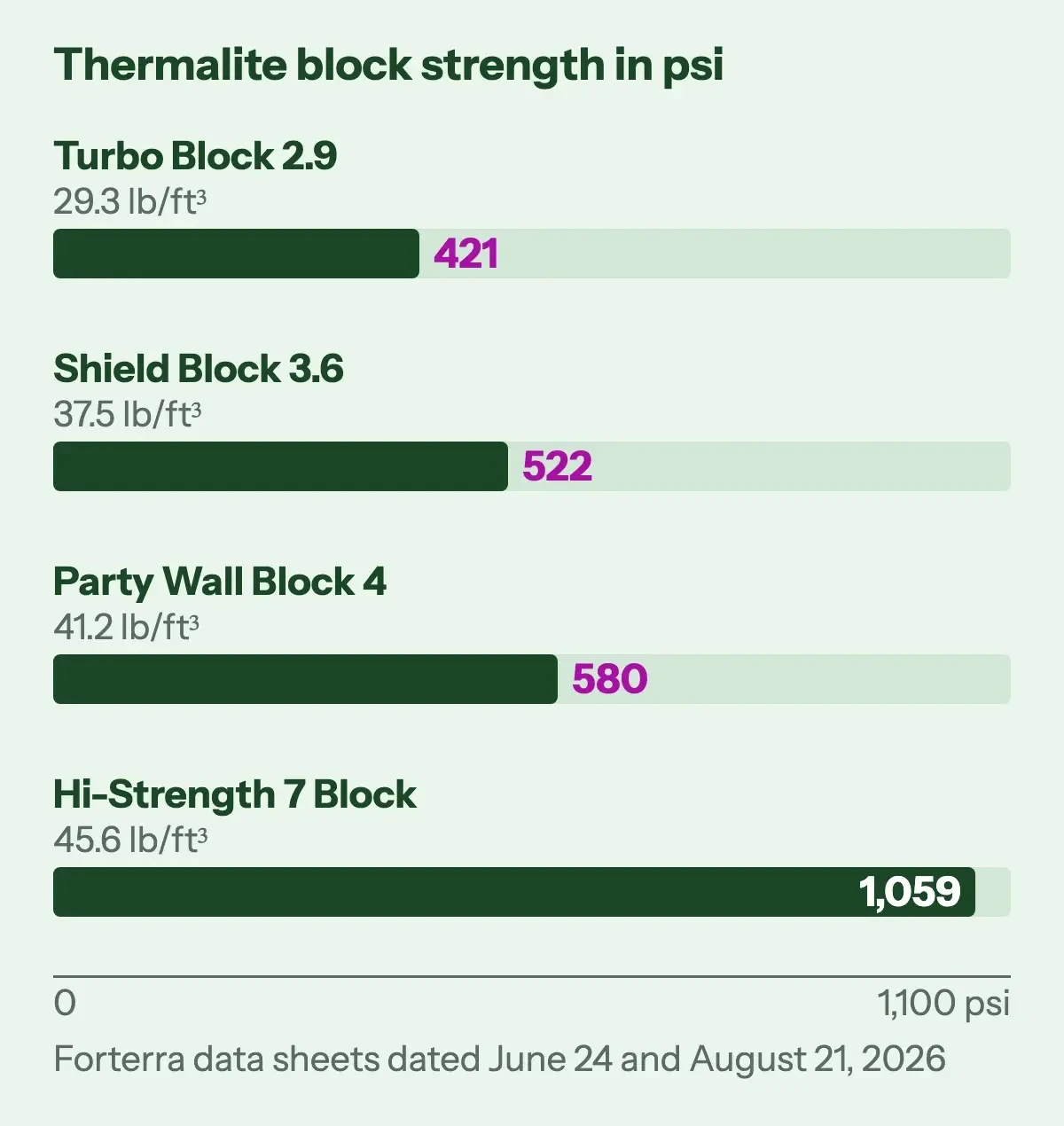 Diagram by DigitalTreed: strength and dry density from Forterra data sheets dated June 24 and August 21, 2026, in psi and lb/ft³.
Converting the specs to US units
US documents state AAC properties in inch-pound units, so a UK sheet needs converting before you compare it with anything sold here. We used the factors in NIST's SP 811 table of conversion factors.
- R per inch = 0.1442279 ÷ W/m·K. Turbo: 0.1442279 ÷ 0.110 = 1.31.
- Block R-value = m²·K/W ÷ 0.1761102. Turbo 100 mm: 0.90 ÷ 0.1761102 = 5.1.
- psi = N/mm² × 1,000,000 ÷ 6,894.757. Hi-Strength 7: 7.3 × 1,000,000 ÷ 6,894.757 = 1,059.
- lb/ft³ = kg/m³ ÷ 16.01846. Shield: 600 ÷ 16.01846 = 37.5.
- inches = mm ÷ 25.4 (215 ÷ 25.4 = 8.46); pounds = kg ÷ 0.4535924 (5.5 ÷ 0.4535924 = 12.1).
Turbo is the lightest block, at 29.3 lb/ft³. Floor Block isn't a row of its own because it matches Party Wall at 100 mm, and Trenchblock has no design conductivity to convert.
| Block | Strength (psi) | Dry density (lb/ft³) | R per inch (protected) | R-value, 100 mm (3.94 in) | R-value, 215 mm (8.46 in) |
|---|---|---|---|---|---|
| Turbo Block 2.9 | 421 | 29.3 | 1.31 | 5.1 | 11.1 |
| Shield Block 3.6 | 522 | 37.5 | 0.96 | 3.7 | 8.1 |
| Party Wall Block 4 | 580 | 41.2 | 0.90 | 3.5 | 7.6 |
| Hi-Strength 7 Block | 1,059 | 45.6 | 0.78 | 3.1 | 6.6 |
These R-values are for the block alone, at the 3% moisture design value each sheet uses, such as the Turbo sheet. They leave out mortar joints, plaster and the air films that a full wall calculation adds, so they're fine for ranking blocks but don't rate a wall. Hi-Strength 7 is about 2.5 times as strong as Turbo (7.3 ÷ 2.9), yet it gives about 40% less R per inch (0.78 ÷ 1.31 = 0.60). Even 215 mm Turbo, at R-11.1, means building a new wall, so for a lower bill now our list of energy-saving tips starts smaller.
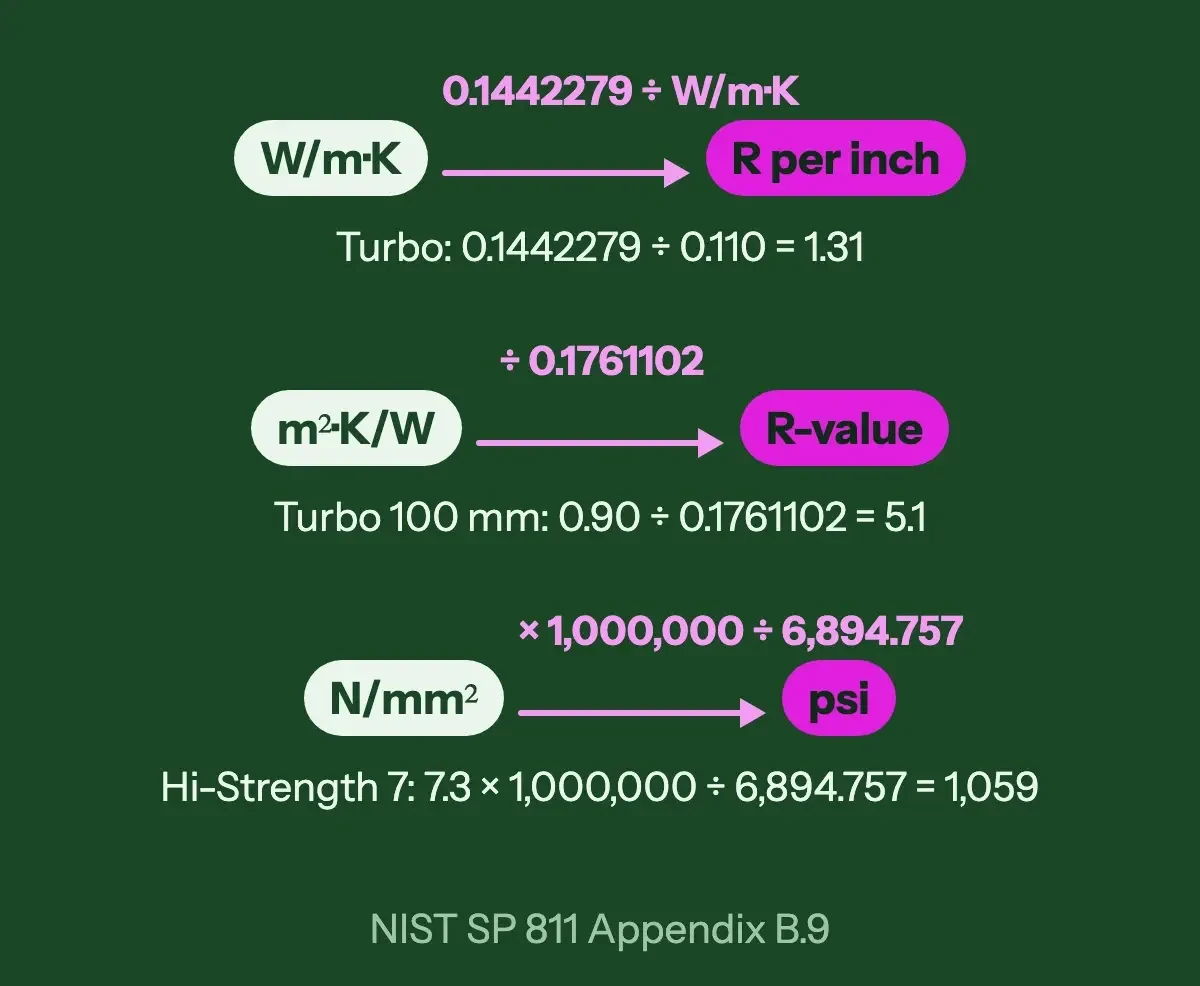 Diagram by DigitalTreed: the three main conversions, with factors from NIST SP 811 Appendix B.9.
What we tested
Our script, test/convert.py, ran on local files on November 7, 2026, reading the six saved sheets and converting each declared value with the NIST factors above. All 22 width rows with a declared thermal resistance matched width ÷ design conductivity within 0.01. Four of six sheets (Turbo, Shield, Hi-Strength 7 and Floor) print W/m²K in the summary text and W/m.K in the table. We've used the table values. The brochure matched density and strength for all four blocks it covers, and conductivity for three. The Shield EPD matched its sheet's 600 kg/m³ and 0.13 W/mK, and it prints the strength as 3.6 B/mm2.
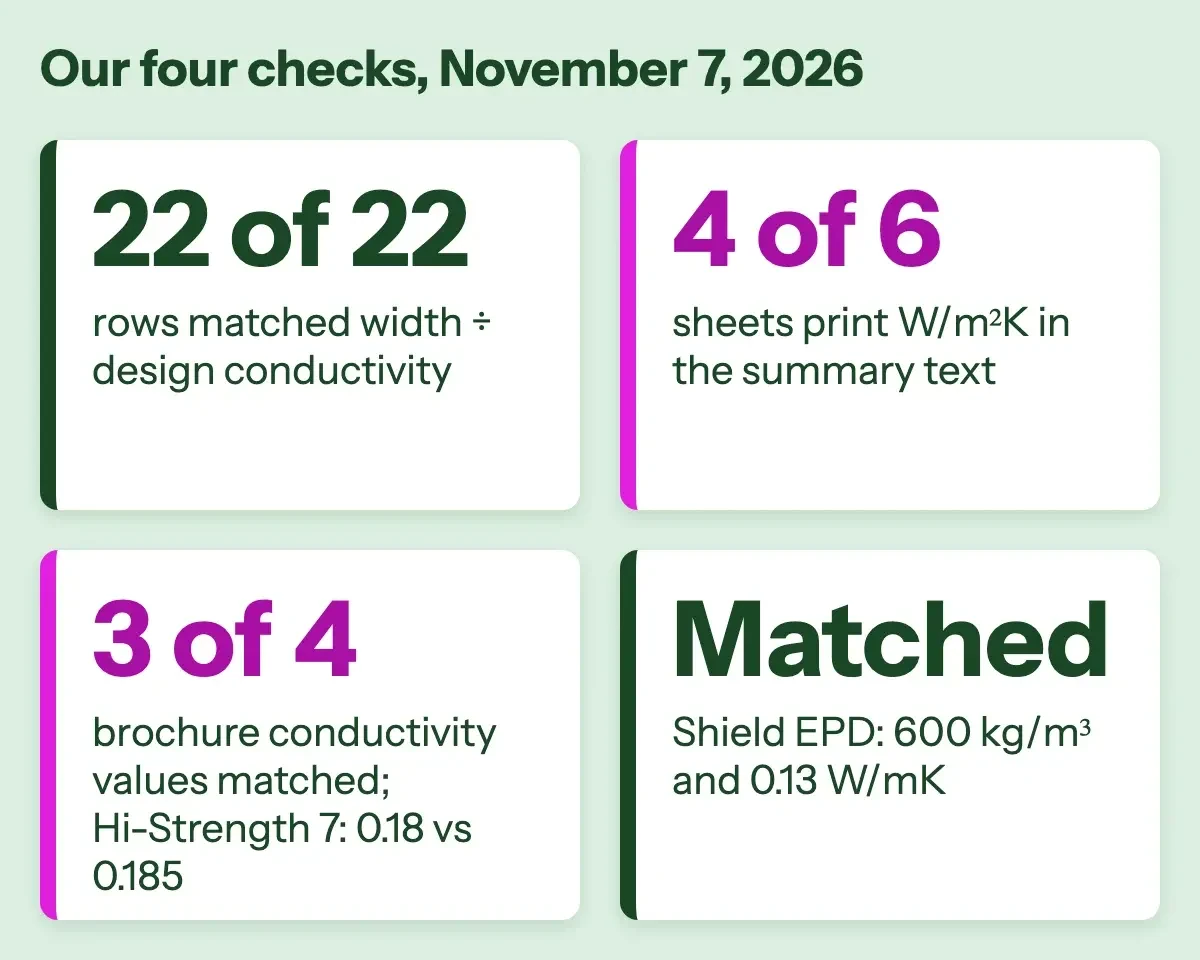 Diagram by DigitalTreed: our four checks, November 7, 2026.
The US equivalent: AAC under ASTM C1693
In the US, the material Thermalite sells is called autoclaved aerated concrete, or AAC, and the material spec you'll see quoted is ASTM C1693. Its scope covers a calcium silicate product with "macroscopic voids" in which "curing is carried out using high-pressure steam," the process Forterra's EPD describes.
Listed raw materials include portland cement, quartz sand, lime and gypsum or anhydrite, and fly ash may replace the sand, much like Forterra's mix. As of November 2026, ASTM's store lists C1693-11R25 as the active version, last updated January 12, 2026, and it marks the 2017 reapproval as historical. The scope also says "The values stated in inch-pound units are to be regarded as standard." SI values sit in parentheses, for information only. That's why our table leads with psi.
ASTM C1386 covered precast AAC wall construction units, but ASTM's C1386 page shows it withdrawn in 2013 with no replacement. If a product sheet still cites it, ask which current standard the units are tested to. For reinforced AAC panels, the American Concrete Institute published ACI 523.4R-09, an 81-page guide to design and construction. ACI's store now marks it historical. We'd read it as background and ask the engineer which current document they design to.
We haven't seen a federal count of US buildings or plants that use AAC, so we won't guess at a market share.
Will a US building department accept AAC?
That sign-off is local, and it's done under a code your state or city has adopted. ICC says the International Building Code is "in use or adopted in 50 states," and the International Residential Code in 49. Some jurisdictions amend the code when they adopt it, ICC adds, which is why your city's version is the one that counts.
Both ICC pages say the codes reference "nationally developed consensus standards," and ASTM C1693 is one for AAC.
We couldn't read the code text itself, because codes.iccsafe.org and The Masonry Society's site both returned 403 errors to our checker on November 7, 2026. So this post doesn't name the IBC or IRC sections that cover AAC masonry; your building official or engineer can. ICC Evaluation Service describes its work as "technical evaluations of building products, materials and systems for code compliance." Ask an AAC supplier for a current report number, then look it up in the ICC-ES directory and show it to your building department before you order. Our guide to solar on an older home follows one product through permit, inspection and sign-off, as an AAC wall would.
This is background from ICC and ASTM pages, not legal advice. Your building official decides the permit.
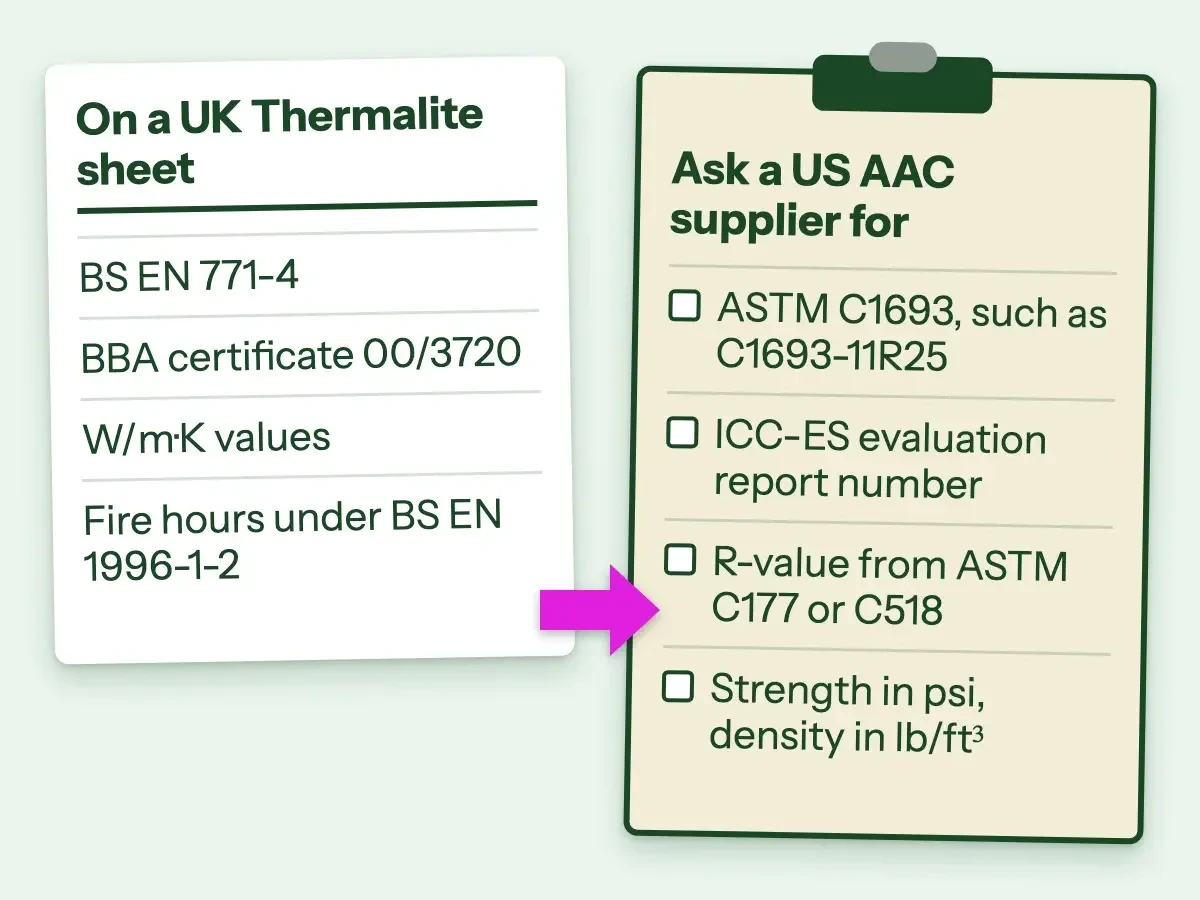 Diagram by DigitalTreed: the papers on a UK data sheet and the US papers to ask an AAC supplier for.
R-value claims and the FTC rule
The FTC's R-value Rule page says the rule covers home insulation makers, installers, new home sellers and retailers, who must "provide R-value information, based on the results of standard tests." A higher R-value, the page adds, means more insulating power. Who's covered turns on what counts as insulation. Under 16 CFR 460.2, "Insulation is any material mainly used to slow heat flow." A structural block's main job is to carry a wall. Whether a given AAC product falls under the rule is a question for the seller's lawyer, and nothing here is legal advice.
16 CFR 460.5 says R-values in labels, fact sheets and ads must come from tests such as ASTM C177 or C518. Those tests must be done "at a mean temperature of 75 degrees Fahrenheit and with a temperature difference of 50 degrees Fahrenheit plus or minus 10 degrees Fahrenheit." Thermalite's figures are European declared and design values, not ASTM results. Our R-1.31 per inch for Turbo is a conversion. It isn't an R-value a US label could carry. If a US supplier quotes an R-value for AAC, ask for the ASTM C177 or C518 report behind it, with its mean temperature and moisture content.
Without one, the number can't be checked, so we wouldn't price a wall on it. If the real aim is a smaller winter bill, our tips to cut monthly gas bills start with changes much smaller than a new wall.
Questions to ask before you buy AAC in the US
Send these seven example questions to any US AAC supplier before you order. A dated document can answer each.
- Which ASTM standard and edition are the units tested to?
- What is the strength in psi and the dry density in lb/ft³?
- Which ASTM test gave the R-value, at what temperature and moisture?
- Is there a current ICC-ES evaluation report, and what is its number?
- Which US test or listing backs the fire and sound ratings?
- What coating or finish do exterior walls need?
- What is the date and version of the data sheet you quote from?
Our take: we'd use a Thermalite data sheet to learn what aircrete can do, then buy nothing in the US on the strength of it. A UK sheet, a UK certificate and a converted R-value won't carry a US permit, and they can't stand in for a US test report. A US AAC unit with an ASTM C1693 test report and your building official's yes will. Turbo's sheet calls for a coating on any outer leaf, so price that finish coat with the blocks. Our guide to a detailed painting estimate shows what a line-item quote lists. If AAC is off the table, our notes on durable materials for a tiny house cover other wall materials.
Frequently asked
Are Thermalite blocks the same as breeze blocks?
No. Forterra's site lists Thermalite aircrete and Conbloc aggregate blocks as separate products.
Can you buy Thermalite blocks in the US?
Forterra's brand page says it's "available from builders' merchants nationwide," meaning the UK, and lists no US channel as of November 2026.
Can Thermalite blocks go below ground?
Some can. The Trenchblock 3.6 sheet is for foundations and rates soil class DS1-4.
How heavy is a Thermalite block?
A 100 mm Turbo block is 5.5 kg (12.1 lb) at 23% moisture, per its data sheet; a 215 mm Hi-Strength 7 block is 18.3 kg (40.3 lb).
How we made this guide: Every Thermalite number comes from six Forterra data sheets dated June 24 and August 21, 2026. The 2022 brochure and Shield EPD were saved with them on November 7, 2026, with the US pages. A script did the strength, density, R-value and weight conversions. Facts checked by the DigitalTreed team on November 7, 2026.
First published in November 2023, a short piece promoting a UK builders' merchant, with no sources. Rewritten November 7, 2026: the merchant plug is gone; maker specs, US unit conversions and ASTM, code and R-value rule facts are new.
Sources
- Forterra: Thermalite aircrete blocks
- Forterra: home page and product ranges
- Forterra: Thermalite Turbo Block 2.9 technical data sheet (version 3, June 24, 2026)
- Forterra: Thermalite Shield Block 3.6 technical data sheet (version 4, August 21, 2026)
- Forterra: Thermalite Party Wall Block 4 technical data sheet (version 3, June 24, 2026)
- Forterra: Thermalite Floor Block technical data sheet (version 3, August 21, 2026)
- Forterra: Thermalite Hi-Strength 7 Block technical data sheet (version 6, August 21, 2026)
- Forterra: Thermalite Trenchblock 3.6 technical data sheet (version 4, August 21, 2026)
- Forterra: Thermalite brochure (August 2022)
- EPD Hub: Environmental product declaration HUB-5483, Thermalite Shield (updated October 10, 2026)
- British Board of Agrément: homepage notice on UKAS accreditation
- ASTM International: C1693-11R25, Standard Specification for Autoclaved Aerated Concrete (AAC)
- ASTM International: C1693-11R17 (historical)
- ASTM International: C1386-07, precast AAC wall construction units (withdrawn 2013)
- American Concrete Institute: ACI 523.4R-09, Guide for Design and Construction with AAC Panels
- International Code Council: International Building Code overview and adoptions
- International Code Council: International Residential Code overview and adoptions
- ICC Evaluation Service: building product evaluation and certification
- FTC: R-Value Rule, 16 CFR 460
- LII: 16 CFR 460.2, What is home insulation
- LII: 16 CFR 460.5, R-value tests
- NIST: SP 811 Appendix B.9, conversion factors by kind of quantity


Comments
No comments yet. Start the conversation below.