
Quick answer
No, a free people search by Social Security number can't lawfully pull a stranger's SSA or credit records as of October 2026. The SSA needs the person's written consent, and the 3 nationwide bureaus release a file only for a purpose 15 U.S.C. 1681b lists. The number you can check is your own, starting with free weekly credit reports and a freeze at each bureau.
An ad that offers a name and address for any nine digits is selling something federal law closes off. A people search by Social Security number is a lookup that tries to turn that number into a name, an address or a credit file. This covers federal rules, not legal advice; a dispute a bureau won't fix can go to the CFPB complaint line, a state consumer protection office or a licensed attorney.
We start with whether a Social Security number lookup is public and who may pull a consumer report. Then come our test, your own credit reports, and a credit freeze or fraud alert. Your Social Security record, E-Verify and the IRS PIN follow, and the end covers a number that's being misused.
Key takeaways
- As of October 2026, SSA records need consent; bureau files need a 1681b purpose.
- Free credit reports came weekly from all 3 bureaus in October 2026.
- Bureaus had to lift a phone or online freeze within 1 hour (October 2026).
- Extended fraud alerts last 7 years and need an identity theft report (October 2026).
- Our October 30, 2026 checker flagged 7 of 10 made-up SSN lookup ads.
Is a Social Security number lookup public?
No, and the reason sits in one federal statute. The Social Security Administration holds the record that ties each number to a name, and the Privacy Act decides who sees it. Under 5 U.S.C. 552a(b), an agency can't disclose a record "to any person" without the subject's "written request" or "prior written consent" (as of October 2026). Exceptions exist, such as a court order, but a curious stranger isn't one. The SSA's Privacy Act request page applies the rule: "you may provide consent for the Social Security Administration to disclose" your records to another person or entity. A site offering free lookups of any number has no route to those files.
Even asking for your own original card application takes a signed statement. In it, you confirm you understand "there are criminal penalties for making a knowing and willful request for access to records concerning another individual under false pretenses."
The one official name-and-number match belongs to employers, and it's narrow. The SSA's Social Security Number Verification Service lets a business check its workers' names and numbers against SSA records. An employer can enter up to 10 names and numbers per screen online, or upload files of up to 250,000. The SSA says checking lets it "give the proper credit to your employees' earnings record." The SSA says it "can only be used to verify current or former employees and only for wage reporting (Form W-2) purposes." A payroll clerk can't use it on a job applicant they haven't hired, and you can't use it at all, since the public has no access to it.
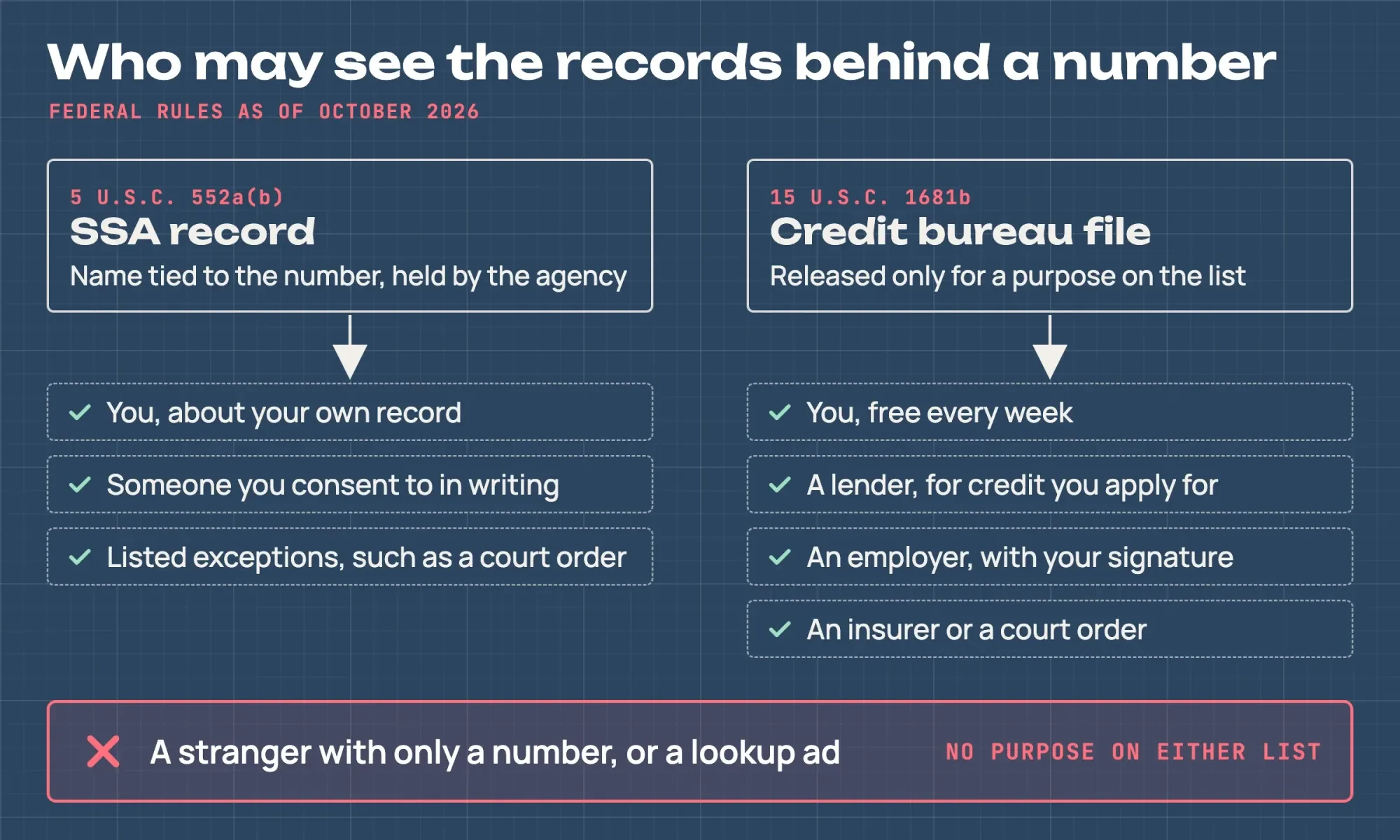 Our blueprint of two federal gates: the Privacy Act's 552a(b) and the FCRA's 1681b, as published on govinfo and read October 30, 2026. Diagram by DigitalTreed.
Who may pull a consumer report, and why the law asks for a reason
Credit files are the other place a number might lead, and the Fair Credit Reporting Act guards them. Section 1681b(a) lets a bureau furnish a report "under the following circumstances and no other" (as of October 2026). The list opens with a court order and "the written instructions of the consumer to whom it relates." Then come, among others, people the bureau believes will use it for credit with you, "for employment purposes," for insurance underwriting, or for some government licenses. The CFPB's summary of your FCRA rights says a bureau may share your file "only to people with a valid need." That's usually after you've applied to "a creditor, insurer, employer, landlord, or other business."
A lender you've applied to fits the credit purpose on that list, so its request for your number is expected. If it's an online payday shop, though, confirming its state license before you apply comes before the form.
The rule binds the person asking, too. Under section 1681b(f), "A person shall not use or obtain a consumer report for any purpose unless" that purpose is on the list. The user also has to certify it to the bureau under section 1681e. Lying to get one is a crime. The penalty in section 1681q is a fine, prison of "not more than 2 years, or both." It applies to anyone who "knowingly and willfully obtains information on a consumer from a consumer reporting agency under false pretenses." Employers sit on the list only with your signature, since the CFPB summary says "You must give your consent for reports to be provided to employers."
Our FCRA background check steps for US employers cover that consent form and the notices that follow it. A neighbor or an ex holding your number has no listed purpose.
Ten made-up SSN lookup ads, run through our checker
Lookup ads aimed at a stranger's number make a good test of that purpose list. On October 30, 2026, we wrote ten ad lines that copy no real ad or company. A Python checker ran them against five warning rules and two own-record checks, and its marks were read in a browser page served on 127.0.0.1. No Social Security number went in.
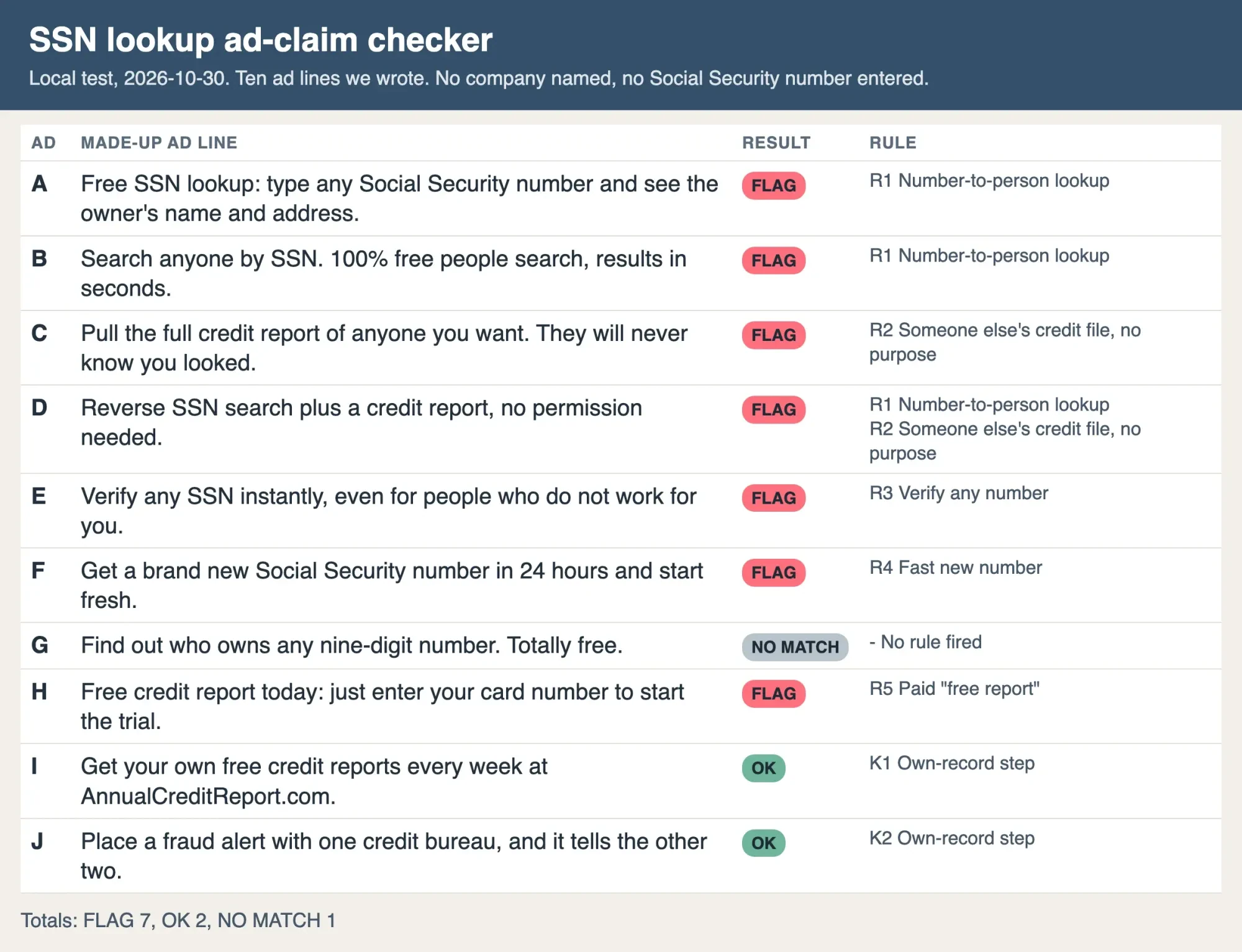 Screenshot of our ad-claim checker page, 127.0.0.1, October 30, 2026.
What we tested, ad by ad
Seven lines got flagged. A, B and D promised a number-to-person lookup, C and D sold someone else's credit report, and E would verify any number. F sold a new number in 24 hours, and H wanted a card number for a "free" report. I and J matched own-record steps. G, "Find out who owns any nine-digit number," slipped through, since it never says SSN.
Your own credit reports, free every week
Your own number is the one search the law opens fully. Under 15 U.S.C. 1681j, each nationwide bureau must give you your file once a year "without charge to the consumer" (as of October 2026). The bureaus now go further. According to the FTC's free credit reports page, each report can be checked "once a week for free" at AnnualCreditReport.com, and phone orders go to 1-877-322-8228. Paste an ad's link into our Redirect Checker to see its final address before you type anything. Fake report sites can differ by a single letter. The page on how copied finance addresses swap a letter or two explains how to compare an address letter by letter before you type into it.
Ordering your own file is the one time it's sensible to hand over your number. The CFPB summary says "You will be required to provide proper identification, which may include your Social Security number." The yearly copy runs through a "centralized source," which section 1681j ties to the Fair and Accurate Credit Transactions Act of 2003. That's why one site serves all three bureaus. Weekly checks allow up to 156 copies a year (3 bureaus × 52 weeks), against the 3 the statute requires (3 bureaus × 1). IdentityTheft.gov points the same way: "Get your free credit reports from AnnualCreditReport.com." Its lost or stolen information page adds, "You can check your reports online every week for free."
Some people get extra copies. The CFPB's rights summary lists one when "a person has taken adverse action against you because of information in your credit report." Identity theft victims who place a fraud alert get one too. Section 1681j(c) adds three cases you certify in writing. You're unemployed and plan to apply for work "in the 60-day period," you get public welfare assistance, or your file has errors "due to fraud." Each comes once a year, beside the weekly copies. Example: someone denied an apartment over a report who also lost a job could qualify under both lists, though the weekly copies already cover most people.
Once a report is open, the FTC's identity theft warning signs put it bluntly: "Accounts in your name that you don't recognize could be a sign of identity theft." Card and loan accounts deserve the closest look, since a new one you never opened is the clearest sign. The CFPB summary states the right plainly: "You have the right to dispute incomplete or inaccurate information." If something's wrong, the FTC says to "dispute the mistakes on your report," and the CFPB summary says the bureau "must investigate unless your dispute is frivolous." If a bureau won't correct a fraudulent account after you dispute it, the CFPB's site lists (855) 411-2372 beside its "Submit a Complaint" link.
Single purchases on a card you already hold don't show on a credit report; they appear on the card statement. A processor name you can't place there calls for tracing an unfamiliar card charge back to the merchant.
Credit freeze or fraud alert: which fits your situation?
A freeze or an alert guards the next account. A credit or security freeze "prevents prospective creditors from accessing your credit file," says the CFPB's credit freeze page. Here's how the three options compare under 15 U.S.C. 1681c-1 as of October 2026.
| Security freeze | Blocks new creditors from your file | Until you remove it | At each of the 3 bureaus; in place within 1 business day by phone or online, 3 business days by mail | Free by law |
| Initial fraud alert | Lenders must verify your identity before new credit | At least 1 year, and you can renew it | At one bureau, which must tell the other two | Free |
| Extended fraud alert | The same identity check, for proven identity theft | 7 years | At a bureau, with an identity theft report | Free |
Alerts are softer. The FTC's freeze and alert guide says alerts "make lenders verify your identity before they grant new credit in your name." A freeze runs on a tight clock. A bureau has to remove one within 1 hour of a phone or online request, or within 3 business days of a mailed one. It's also required to confirm a new freeze in writing within 5 business days. Example: you ask online at 2:00 p.m. to lift a freeze before a car loan, so it's off by 3:00 p.m. (2:00 p.m. + 1 hour). An initial alert placed October 30, 2026 lasts until at least October 30, 2027 (placement date + 1 year).
A freeze takes three requests, since the CFPB says "you must contact each nationwide credit reporting company separately." Equifax's security freeze page says "Placing, temporarily lifting, or removing a security freeze is free." It also notes "You must be 18 to create a myEquifax™ account," and it lists other ways to place a freeze for anyone under 18. The Experian freeze center lets you freeze and unfreeze "in real time" online. TransUnion's credit freeze page says a change by phone or online "typically takes effect almost immediately." Every nationwide bureau's webpage "must also allow you to request a security freeze, an initial fraud alert, an extended fraud alert, and an active-duty fraud alert," the CFPB says.
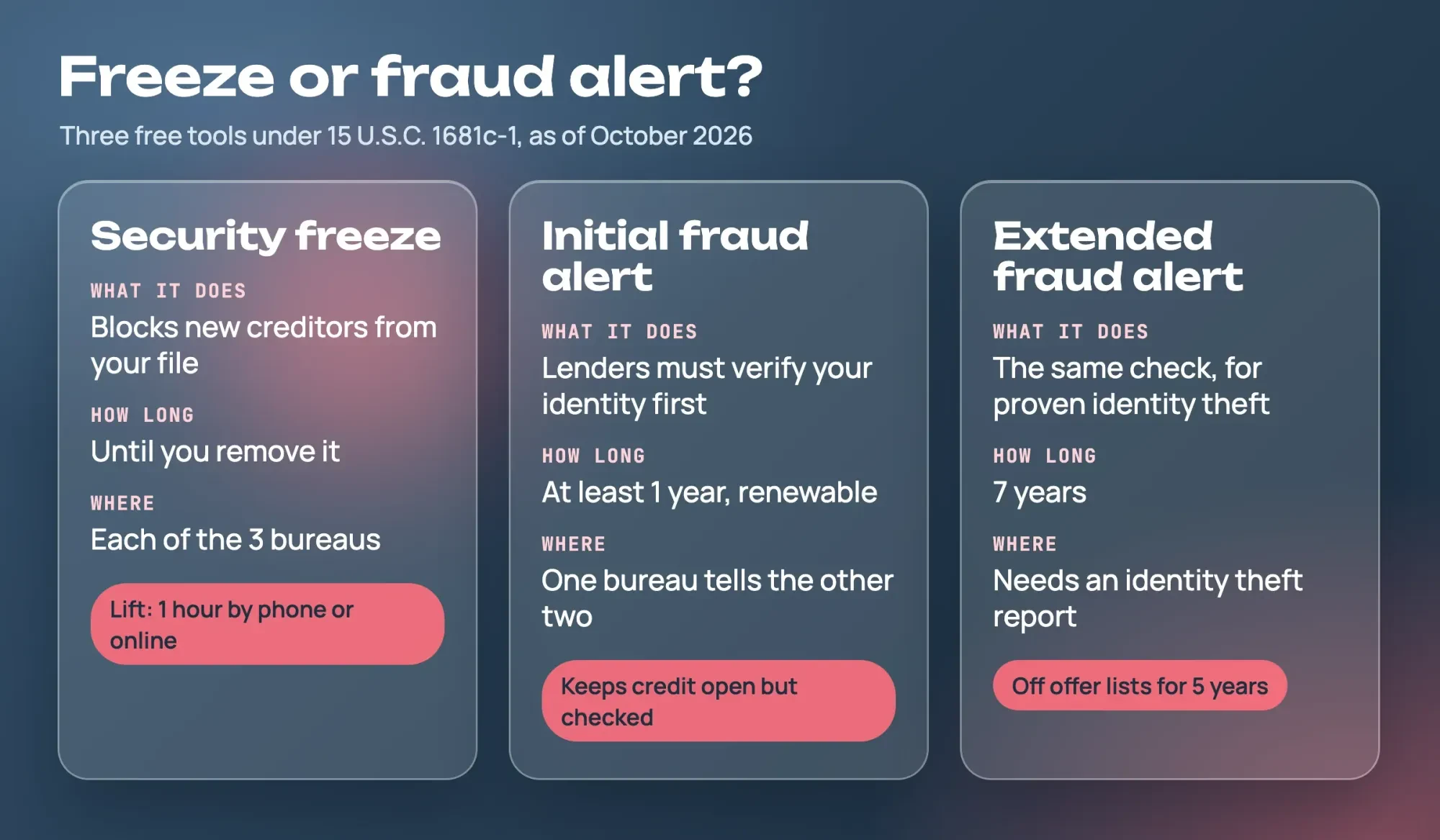 Source: 15 U.S.C. 1681c-1, the CFPB freeze page and the FTC alert guide, read October 30, 2026; card wording shortened by DigitalTreed.
Phones work too. IdentityTheft.gov lists the freeze lines as 888-397-3742 for Experian, 888-909-8872 for TransUnion and 800-685-1111 for Equifax, each printed beside that bureau's own web address (October 2026).
An extended alert carries one more effect beyond the identity check. Under section 1681c-1(b), it also has the bureau "exclude the consumer from any list" of credit or insurance offers you didn't start. It lasts for "the 5-year period beginning on the date of such request."
A freeze doesn't hide your file from everyone. Per the CFPB, "Creditors of accounts you currently hold" and "Certain government entities, such as child support agencies" are among those who can still see a frozen file.
The difference shows at the next application. With an alert, a lender can still pull your file but must verify your identity first. With a freeze, the pull fails until you lift it, which a bureau must do within 1 hour of a phone or online request.
Some checks get past a freeze anyway. The free-freeze law "does not apply to someone who requests your credit report for employment, tenant-screening, or insurance purposes," the CFPB notes.
Your Social Security record: earnings, E-Verify and the IRS PIN
A credit report won't show someone working or filing taxes under your number, so the next checks happen at federal agencies. A personal my Social Security account lists "Review earnings for accuracy" and "Monitor for unusual activity" among its tools. The page sums up their job: "Review your earnings history and secure your account to help prevent misuse." Sign-in runs through Login.gov, which asks for an "Email address, government-issued photo ID and a phone number." The SSA says it "uses Login.gov to allow you to sign in" to my Social Security. Look for wages from a job you never held or an employer you don't know. IdentityTheft.gov says, "If you find errors, contact your local SSA office."
Job fraud has its own block, and it matters because someone else's wages "could be reported in your name" to the IRS and the SSA, the E-Verify site warns. The E-Verify Self Lock puts a lock on your number inside E-Verify, so an employer who enters it gets "an E-Verify Tentative Nonconfirmation (mismatch)." It's "only available to myE-Verify account holders," and you can lift the lock when a new employer needs to confirm you. Tax filing is the third misuse. The IRS's Identity Protection PIN page says an IP PIN "prevents someone else from filing a tax return using your Social Security number (SSN)" or ITIN. Its IP PIN FAQ adds, "A new IP PIN will be generated each year."
Anyone with an SSN or ITIN who can verify their identity can enroll in the IP PIN program, even if they aren't required to file a return. Parents and guardians can request one for a dependent.
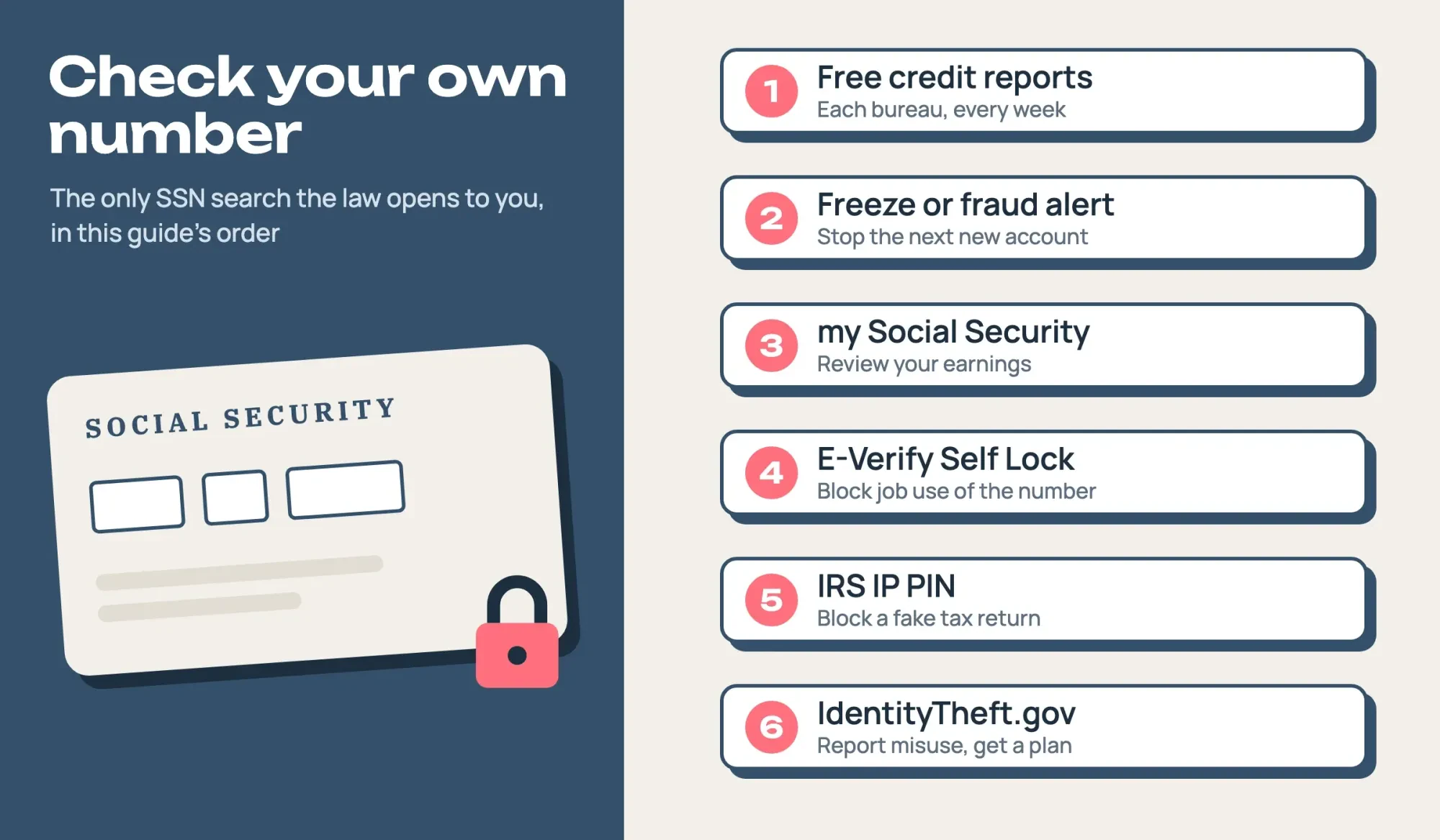 Drawn by us: the order of the own-record checks in this guide, from FTC, CFPB, SSA, E-Verify and IRS pages read October 30, 2026.
If your number is being misused
When those checks turn up a loan, a job or a tax return that isn't yours, the report goes to the FTC. The SSA's stolen number page says "Report a stolen Social Security number to the Federal Trade Commission if you think you're a victim of identity theft." The SSA adds, "We're not involved in this process, but they'll be able to support you." At IdentityTheft.gov, "You'll get a free personal recovery plan with next steps," the FTC says. The site also prints pre-filled letters for the bureaus. An extended alert needs an "identity theft report," which 15 U.S.C. 1681a(q)(4) defines as one filed "with an appropriate Federal, State, or local law enforcement agency."
Don't count on a new number. The SSA's page on requesting a new number opens with "In rare cases, you may qualify for a new Social Security number." IdentityTheft.gov adds that "a new number likely won't solve all your problems."
Scammers chase the number directly, so don't answer a surprise call, text or email asking for it. Reach the agency through a website or phone number you look up yourself instead. Tapped a link already? Our steps for the first hour after a suspicious link cover your phone and accounts.
Questions about SSN searches and your own records
Frequently asked
Does a credit freeze hurt my credit score?
No. The FTC says placing or lifting one "doesn't affect your credit score," and TransUnion's freeze page says the same.
Can I freeze my child's credit?
Yes, if the child is under 16. Section 1681c-1(j) covers a "protected consumer" who is "under the age of 16 years" when the freeze is requested.
Is a credit lock the same as a credit freeze?
No. The CFPB says locks often carry a fee and "are no more effective than security freezes."
How long does an active duty alert last?
At least 12 months under section 1681c-1(c), as of October 2026. The FTC says "An active duty fraud alert lasts one year."
How we made this guide: We read the Privacy Act and FCRA on govinfo, then the agency and bureau pages. AnnualCreditReport.com wouldn't load for us on October 30, 2026, so its address and phone line come from the FTC's page instead. Facts checked by the DigitalTreed team on October 30, 2026.
First published April 21, 2024 as a short note on free people searches. Rewritten October 30, 2026 around the federal limits on SSN lookups and the free checks on your own number.
Sources
- 5 U.S.C. 552a: Records maintained on individuals (Privacy Act), govinfo
- 15 U.S.C. 1681b: Permissible purposes of consumer reports, govinfo
- 15 U.S.C. 1681c-1: Identity theft prevention; fraud alerts and active duty alerts, govinfo
- 15 U.S.C. 1681a: Definitions (identity theft report), govinfo
- 15 U.S.C. 1681j: Charges for certain disclosures, govinfo
- 15 U.S.C. 1681q: Obtaining information under false pretenses, govinfo
- CFPB: What is a credit freeze or security freeze on my credit report?
- CFPB: A Summary of Your Rights Under the Fair Credit Reporting Act (PDF)
- FTC: Free credit reports
- FTC: What to know about credit freezes and fraud alerts
- FTC: What to know about identity theft
- IdentityTheft.gov: What to do if your information was lost or stolen
- AnnualCreditReport.com
- SSA: Submit a Privacy Act request for your or another person's records
- SSA: my Social Security
- SSA: Report stolen Social Security number
- SSA: Requesting a new number
- SSA: Social Security Number Verification Service
- E-Verify: Self Lock
- IRS: Get an Identity Protection PIN
- IRS: Frequently asked questions about the IP PIN
- Equifax: Security freeze
- Experian: Freeze center
- TransUnion: Credit freeze


Comments
No comments yet. Start the conversation below.