

Quick answer
An online payday lender check starts with two steps: its state license, then its APR, where $15 per $100 over two weeks is 391% (FTC, as of October 2026). A $30 fee on the same loan works out to 782% by our math. Check the license first; the lookup steps and the fee table are both below.
Maybe you searched a lender's name, say Eloanwarehouse, and you're one form away from sharing a bank account number. A payday loan is a short-term, high-cost loan, usually $500 or less, due on your next payday, as the CFPB describes it (as of October 2026). This guide explains the rules; it isn't financial or legal advice. For your case, ask the CFPB, your state regulator or attorney general, or a legal aid lawyer.
First up is the fee as an APR, and how rollovers raise it. Next come the license check, the red flags of a fee before the loan, and stopping automatic debits from your bank. Last: servicemembers and where to complain. Our view: check the license before the money, since the CFPB says you may have more protections when a lender must be licensed in your state.
Key takeaways
- A $15 fee per $100 on a 14-day loan is a 391% APR.
- Each rollover charges the whole fee again and leaves the balance untouched.
- Your state regulator or NMLS Consumer Access shows whether a lender is licensed.
- The FTC flags any loan guaranteed only after you pay a fee.
- To stop a debit, tell your bank at least three business days before it.
What an online payday loan costs as an APR
The fee looks small because it's quoted per $100 for a couple of weeks, not as a yearly rate like a card or car loan. The FTC's payday and car title loan guide says lenders usually charge $10 to $30 for every $100 borrowed. On a two-week loan, it puts a $15 fee per $100 at 391% APR. The CFPB's payday costs and fees page gives the same range and calls that $15 fee almost 400% APR. We read both pages on October 29, 2026, and they agree to within rounding. That's why a $15 fee can't be compared with a card's APR until you've converted it to a yearly rate first.
Doing the math yourself takes one line. APR is the fee divided by the amount borrowed, times 365, divided by the days until it's due, times 100. Take the FTC's own example of a $75 fee on $500 for 14 days and run it through. That's $75 / $500 x 365 / 14 x 100, or 391.07%. Here's the whole fee range on the same 14-day term:
| Fee per $100 (example) | Days | APR by the formula |
| $10 | 14 | 260.71% |
| $15 | 14 | 391.07% |
| $20 | 14 | 521.43% |
| $25 | 14 | 651.79% |
| $30 | 14 | 782.14% |
| $15 | 30 | 182.50% |
Look at the last row. It's the same $15 fee stretched over 30 days, so the APR drops to 182.50% while you still pay $15 for each $100. A longer term changes the yearly rate, not the dollars.
Federal law also makes the lender print both numbers, and you'll see them before you sign. Under 12 CFR 1026.18, the finance charge is shown as "the dollar amount the credit will cost you." The APR is shown as "the cost of your credit as a yearly rate." The FTC's guide adds that you get this disclosure in writing, before you sign the loan agreement, not as a verbal quote. Keep that page, because it's the one document that shows what the loan was supposed to cost. Our guide to credit card financing and its interest math runs the same kind of check on a card balance.
The fee isn't always the only charge, either. That same CFPB costs page also lists late or returned check fees and a bank's NSF charge when a debit fails. Prepaid cards that hold the loan money can add their own fees. The CFPB's rollover page adds another fee each time the due date is pushed back. None of those show up in a 391% headline. Read the whole agreement before you sign, not just the first number on the screen, and keep a copy of it. If a fee schedule isn't in the agreement you're shown, ask the lender for it in writing.
Test that printed APR. If it's missing, or it doesn't match your own math, ask the lender why before you sign.
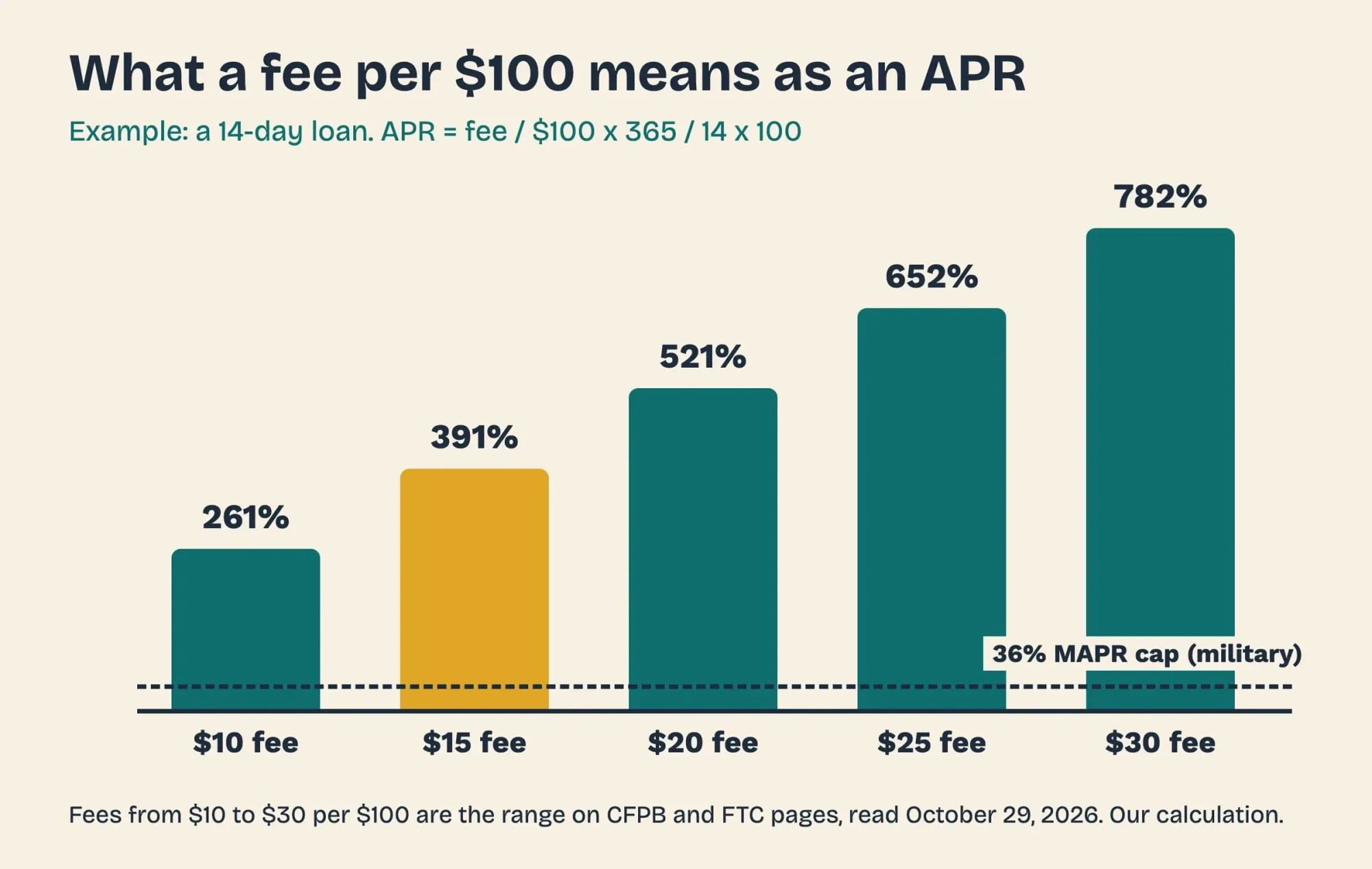 Diagram by DigitalTreed. Our calculation from the $10 to $30 per $100 range on CFPB and FTC pages, read October 29, 2026. Example inputs.
What we tested
Our short script ran the formula on fees from $10 to $30, both agency examples and four rollovers. All four checks passed. A calculator page on 127.0.0.1 uses the same math.
$15 per $100, 14 days: APR 391.07%
Checks: ftc_391=True, cfpb_almost_400=True, cfpb_rollover_90=True, ftc_rollover_150=True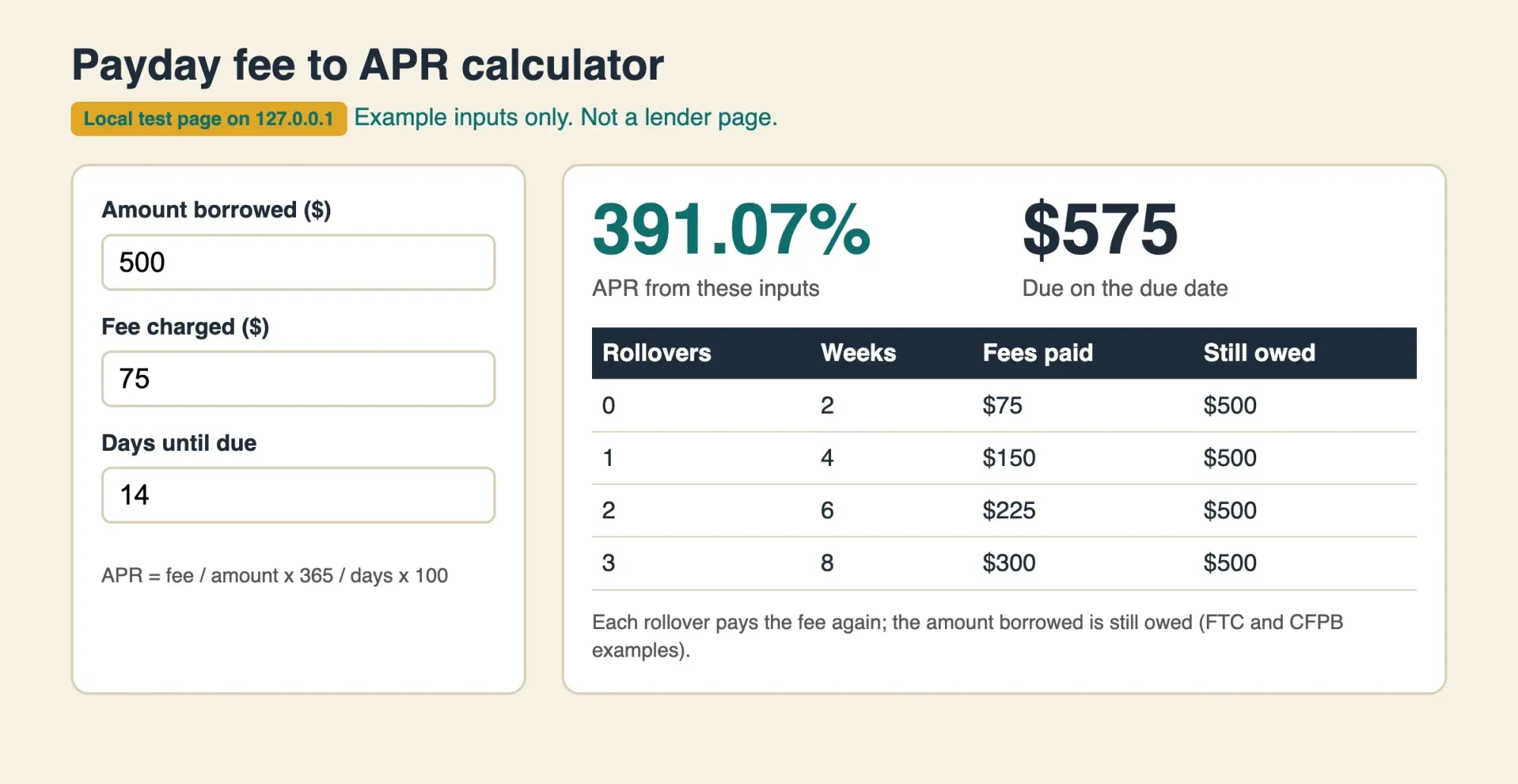 Screenshot: our calculator on 127.0.0.1, October 29, 2026. Not a lender page.
How rollovers raise the cost
That APR assumes you repay on the due date, and a rollover, which some lenders call a renewal, is where the cost starts to climb fast. The CFPB's rollover explainer says you pay a fee to push back the due date, and "This fee does not reduce the amount you owe."
Its example is a $300 loan with a $45 fee. Roll it once, and the cost of that loan "has gone from $45 to $90."
Same math, bigger loan. The FTC's guide shows the same thing with $500: fees go from $75 to $150 after one rollover.
We carried the FTC example further in our script. The first $75 fee plus four rollovers at $75 each comes to $375 over ten weeks, and the full $500 is still owed.
So the rollover itself is the cost to watch, and your state may not allow it at all. The CFPB says "many states limit or ban these renewals or rollovers," and its payday loan explainer notes that some states don't permit payday lending at all. Your state regulator knows the local rule. Already worried about the due date? The CFPB's page on payday loans you cannot repay says to contact your lender right away and ask for an extended repayment plan. Whether you get one depends on your state law or the lender's policy. It may be free, or it may carry a fee, so ask before the debit bounces, when you've still got room to talk.
How do you check a payday lender's license?
Cost is only half the check, because a license decides which protections you keep. The CFPB's licensing answer says to verify the lender with your state regulator or attorney general. Then comes this line: "In some states, if a payday loan is made by a business that is not licensed in that state, the payday loan may be void." The FTC's advance-fee loan page is just as direct: "Lenders must register where they do business."
If the site doesn't name the states where the lender holds a license, ask in writing, and call your state regulator before you apply if no answer comes.
Start with your own state. The CFPB keeps a list of state bank and lending regulators with each one's website, phone number and complaint steps. You can also search NMLS Consumer Access, which calls itself "a free service for consumers to confirm" that a company is authorized in their state. The Conference of State Bank Supervisors calls NMLS the system of record for non-depository financial services licensing or registration in participating state agencies. If a lender doesn't show up in either place, call the regulator before you apply. When a record does turn up, note the license number and the exact company name it shows, since you'll want both if a problem comes up later.
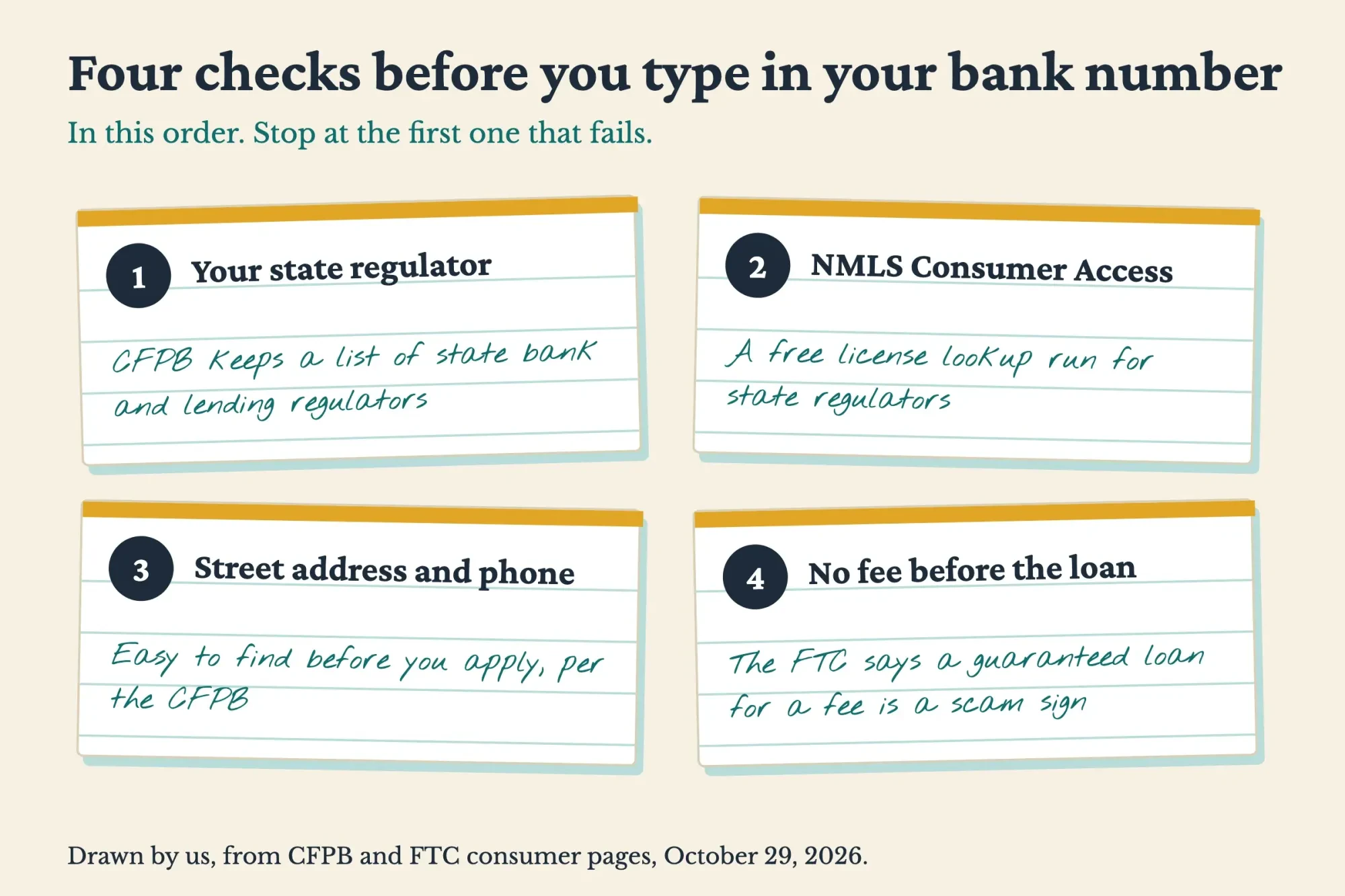 Drawn by us, from CFPB and FTC consumer pages, read October 29, 2026.
Next, check who is really behind the page. The CFPB's online payday loan questions warn that "Many websites advertising payday loans are not actual lenders." They're lead generators that pass your details on to a network of lenders. Phrases like "matching you with lenders" are one sign.
Contact details matter too. The CFPB asks whether the street address, phone number and email are easy to find. You'll need them later if you ever revoke bank access, and that's hard when a lender can't be reached.
Privacy is the other half of that CFPB page. It suggests asking whether the site will protect your Social Security number, checking account number and other personal information, and whether you can stop it from selling them. It also notes that "Some online payday lenders will pull a credit report" before lending, for example to confirm your identity or check for a past bankruptcy. Lead generators raise the stakes, because the CFPB says your application is sold to the lender that offers you a loan. That "may not stop other lenders or service providers from calling or emailing you." Read the privacy policy before you apply.
The browser padlock only tells you the connection is encrypted, not who runs the site. Our SSL checker shows a site's certificate details, but nothing in a certificate says the lender holds a license.
As for the name in this post's title, we couldn't get that far. On October 29, 2026, eloanwarehouse.com and its www address returned no website address from our machine. They had mail records only, and our connection attempt failed, so we couldn't read its pages or terms.
The company name on the loan page also has to match the license record. So compare the exact name and street address with what your state regulator or NMLS Consumer Access shows. For copied web addresses, our walkthrough on telling a lookalike finance site from the real one covers them.
Red flags: a fee before the loan
Some fakes give themselves away before you even reach a license check. The FTC's advance-fee loan guide says "nobody legit will tell you that paying a fee guarantees that you'll get a loan." Real lenders "can require an application or appraisal fee before they consider your loan application," the FTC notes. What it calls a scam is a guarantee tied to a fee paid first. These are the signs to watch for, in the FTC's terms:
- A lender that promises a loan without knowing your credit history but demands you pay first.
- An up-front fee the lender wants before granting the loan, especially one called insurance, processing or paperwork.
- A phone pitch for a loan that asks for payment up front, which the FTC says is illegal for telemarketers.
- A lender that won't say where it's registered, since the FTC says lenders must register where they do business.
Then trace the link itself. When a loan ad bounces you through several sites before a form, our redirect checker lists each hop, and the last one tells you whose form it is.
The same upfront-fee trick turns up in job offers, as our guide to legit work-from-home jobs and scams shows. Already paid? Report it at ReportFraud.ftc.gov the same day.
Stopping automatic debits from your bank account
Once a lender has your bank details, it can pull payments on its own schedule, and a failed pull can cost you a bank fee as well. The CFPB notes that online lenders may not take a check and may ask you to authorize automatic electronic payments instead. You keep the right to stop them, and the CFPB says that's true even if you already signed a payment authorization when you took the loan. The CFPB's guide to stopping payday debits lists three moves:
- Tell the lender, by phone and in writing, that you revoke the payment authorization.
- Tell your bank or credit union you revoked it. Some banks offer an online form.
- Give your bank a stop payment order, even if you never revoked anything with the lender.
Timing matters most for the third one. Under Regulation E, 12 CFR 1005.10, you tell the bank "at least three business days before the scheduled date of the transfer," by phone or in writing. After a phone call, the bank may require written confirmation within 14 days, and it has to tell you that and give you the address when you call. Miss that, and the oral order stops binding the bank. Banks commonly charge a fee for stop payment orders, the CFPB adds.
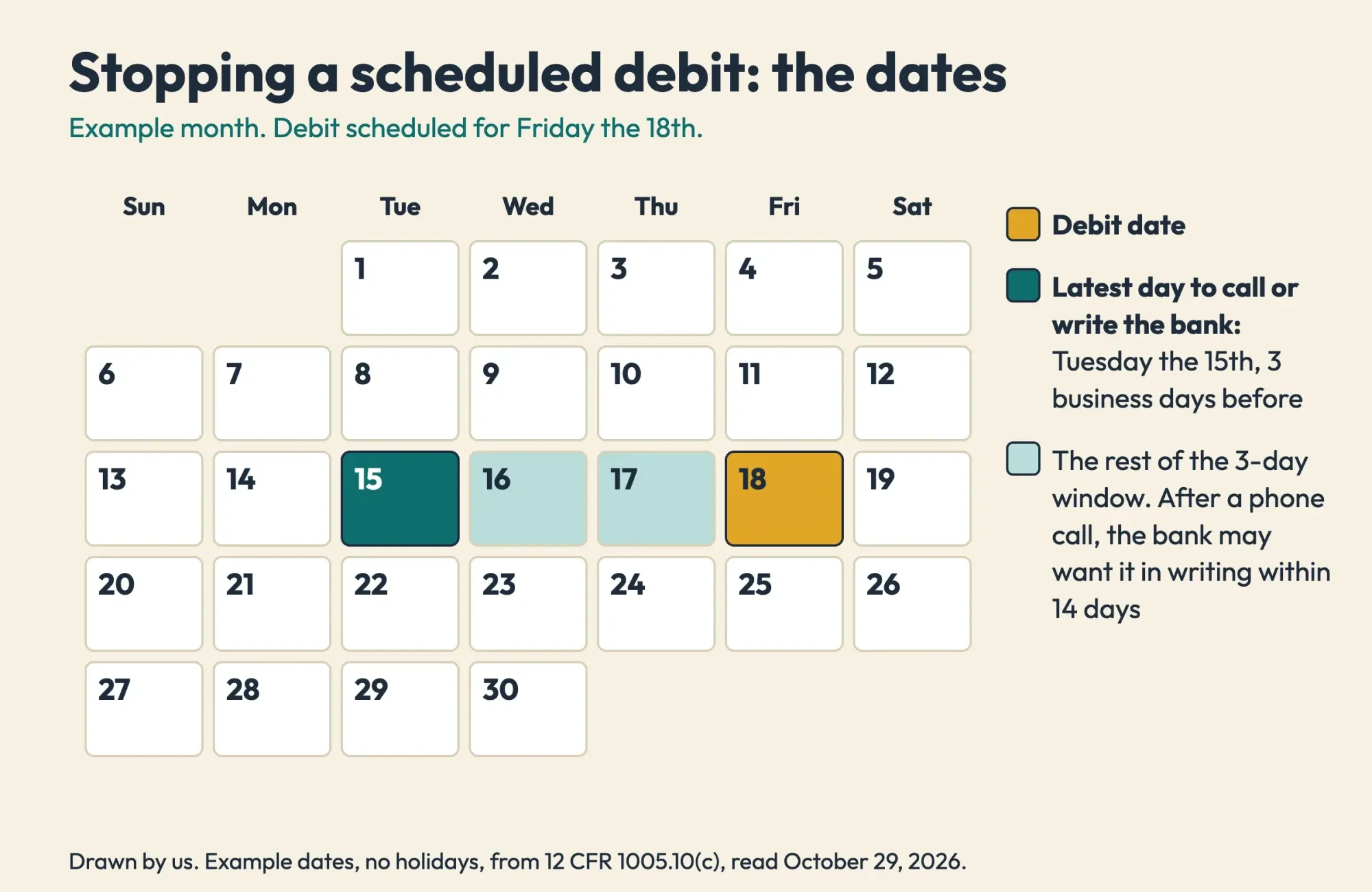 Drawn by us. Example dates with no holidays, from 12 CFR 1005.10(c), read October 29, 2026.
Two more rules sit in the federal text. The same Regulation E section says no one may "condition an extension of credit to a consumer on the consumer's repayment by preauthorized electronic fund transfers," with narrow exceptions. The payday rule adds limits on the lender's side. Under 12 CFR 1041.8, a lender "must not initiate a payment transfer" after two failed attempts in a row, unless you authorize new ones. Section 1041.9 requires a notice before the first withdrawal: by mail "no later than six business days prior," or electronically no later than three. The CFPB ratified these payment provisions in July 2020. Ask the CFPB whether they cover your loan.
The debt doesn't go away, though. The CFPB says it "does not cancel your contract," so the balance is still owed. If a debit you don't recognize posts anyway, our guide to disputing an unknown bank statement charge walks through the dispute.
Extra protection for servicemembers
For active-duty servicemembers and their dependents, a federal cap sits on top of state law. The Military Lending Act rule at 32 CFR 232.4 bars a creditor from charging a Military Annual Percentage Rate, or MAPR, above 36% on covered credit. The FTC's payday guide says that cap covers payday loans, car title loans, personal loans and credit cards. Now compare it with the fee table. The lowest fee there, $10 per $100 on 14 days, is 260.71% APR, so no fee in that range fits under 36% on a 14-day term. The CFPB's Military Lending Act rights page explains how the MAPR is figured, and it says a military legal office can help with your specific situation.
Where to complain and who to ask
When something's gone wrong, put it in writing so there's a record. The CFPB takes payday loan complaints through its complaint portal or by phone at (855) 411-2372, and it says most companies respond within 15 days of getting one. Your state regulator or attorney general handles licenses and state rules.
Dishonest lenders go to the FTC as well, at ReportFraud.ftc.gov, per its payday guide. For a lawsuit, a garnishment notice or a contract question, a legal aid or licensed attorney is the right person.
Our take: do the license lookup and the APR math before a bank number leaves your hands, and save every disclosure you're shown. The CFPB's own examples show the cost doubling at the first rollover. Still weighing where emergency money could come from? Our guide to common financial emergencies covers other routes.
Payday lender questions
Frequently asked
Can a payday lender garnish my wages without going to court?
No. The CFPB's garnishment answer says a payday lender can garnish your wages or bank account "only with a court order from a lawsuit filed against you."
What if I never send the written stop payment order?
Under 12 CFR 1005.10(c)(2), the oral order "ceases to be binding after 14 days" when the bank asked for written confirmation.
Do payday lenders check whether I can repay?
Generally not. The CFPB's payday loan explainer says they "do not generally verify your ability to repay the loan."
Does a tiny loan always show an APR?
No. Under 12 CFR 1026.18(e), the APR may be left off when the finance charge is $5 or less on $75 or less.
How we made this guide: We read 11 CFPB pages, two FTC guides, five federal rule sections, a Federal Register notice and the NMLS home page. Nothing was signed into or filled in, and our script, calculator and domain lookup ran locally. Facts checked by the DigitalTreed team on October 29, 2026.
First published April 2025 as an opinion piece about one lender. Rewritten October 29, 2026: now a step-by-step check of any online payday lender. It adds a fee to APR table, the license lookup and the federal debit and military rules.
Sources
- CFPB: What is a payday loan?
- CFPB: What are the costs and fees for a payday loan?
- CFPB: What does it mean to renew or roll over a payday loan?
- CFPB: What should I consider if I'm thinking about getting a payday loan online?
- CFPB: How can I tell if a payday lender is licensed to do business in my state?
- CFPB: How do I find my state's bank regulator?
- CFPB: How can I stop a payday lender from electronically taking money out of my account?
- CFPB: What can I do if I can't repay my payday loan?
- CFPB: Can a payday lender garnish my bank account or my wages?
- CFPB: What are my rights under the Military Lending Act?
- CFPB: Submit a complaint
- FTC: What To Know About Payday and Car Title Loans
- FTC: What To Know About Advance-Fee Loans
- eCFR: 12 CFR 1026.18, content of disclosures
- eCFR: 12 CFR 1005.10, preauthorized transfers
- eCFR: 12 CFR 1041.8, payment transfer attempts
- eCFR: 12 CFR 1041.9, payment notices
- Federal Register: Ratification of Payment Provisions, July 13, 2020
- eCFR: 32 CFR 232.4, Military Lending Act limits
- NMLS Consumer Access
Comments
No comments yet. Start the conversation below.