

Quick answer
A FunwithFeet review comes down to its own terms, in archive copies captured July 21 to October 12, 2026. A UK company runs the site, and sellers pay a membership fee to open a shop. No public page we read showed that fee in dollars, and referrers earn 20% of it. Each seller also sends ID and proof of address, so read the fee and refund rules first.
This FunwithFeet review is for anyone deciding whether a seller shop there is worth paying for. It's built only on the site's own pages and public records, each with a date. FunwithFeet is a UK-run marketplace where adults sell foot photos and videos to buyers who top up an on-site wallet. The live site wouldn't load for us, so every FunwithFeet quote here carries the date of the Internet Archive copy it came from. In those copies, no public page prices the seller fee in dollars, and the refund policy won't pay back a seller whose sales fall short.
This review isn't legal advice. For a contract or consent question, speak with a licensed attorney in your state.
Key takeaways
- Its terms charge sellers a membership fee, but no public page lists it.
- The refund policy rules out refunds when creator earnings fall short.
- Referrers earn 20% of seller memberships, so check who profits from a review.
- Every seller sends government ID and proof of address to a UK company.
- Report all sales income, even below the $20,000 Form 1099-K line.
What FunwithFeet says about itself
FunwithFeet's terms of use, in an archive copy captured July 21, 2026, name GYCO Online Limited as the operator. They give its address as Kemp House, 152-160 City Road, London. The UK government's Companies House record lists GYCO Online Limited as company number 14503687, active, and incorporated on November 24, 2022, at that same London address. The terms say they're "governed by and construed in accordance with the laws of the United Kingdom." So the terms point a fee or payout dispute to UK law, even when the seller lives in a US state.
Card payments run through Epoch, a billing company the terms name. The footer's billing support link points to Epoch's own site, not a FunwithFeet page.
The .com registry's RDAP record dates funwithfeet.com to May 24, 2021, about 18 months before GYCO Online Limited was incorporated.
On November 12, 2026, funwithfeet.com first pointed to a server whose certificate had expired, and both Python and curl stopped with the error "certificate has expired." That certificate ran from July 20 to October 18, 2026. Within the hour, the domain pointed to Cloudflare instead, with a certificate valid until January 31, 2027. After that switch, the terms page sent back a 403 code, a bot block we left alone. Later, a browser got a Cloudflare "502: Bad gateway" error there, so we couldn't read the live terms. So every quote from the site here comes from Internet Archive copies captured between July 21 and October 12, 2026. Our guide to SSL certificates explains why browsers warn when one lapses.
| Check | Result on November 12, 2026 |
|---|---|
| First verified HTTPS check | Failed: certificate has expired (valid July 20 to October 18, 2026) |
| Second check, under an hour later | Domain on Cloudflare, certificate valid to January 31, 2027, terms page 403 |
| Domain registered (RDAP) | May 24, 2021 |
| Operator on the UK company register | GYCO Online Limited, active, incorporated November 24, 2022 |
| Policy phrases found in the archive copies | 21 of 21 |
| Seller membership price in dollars on public pages | None found |
| Times the terms mention tax, 1099 or W-9 | 0 |
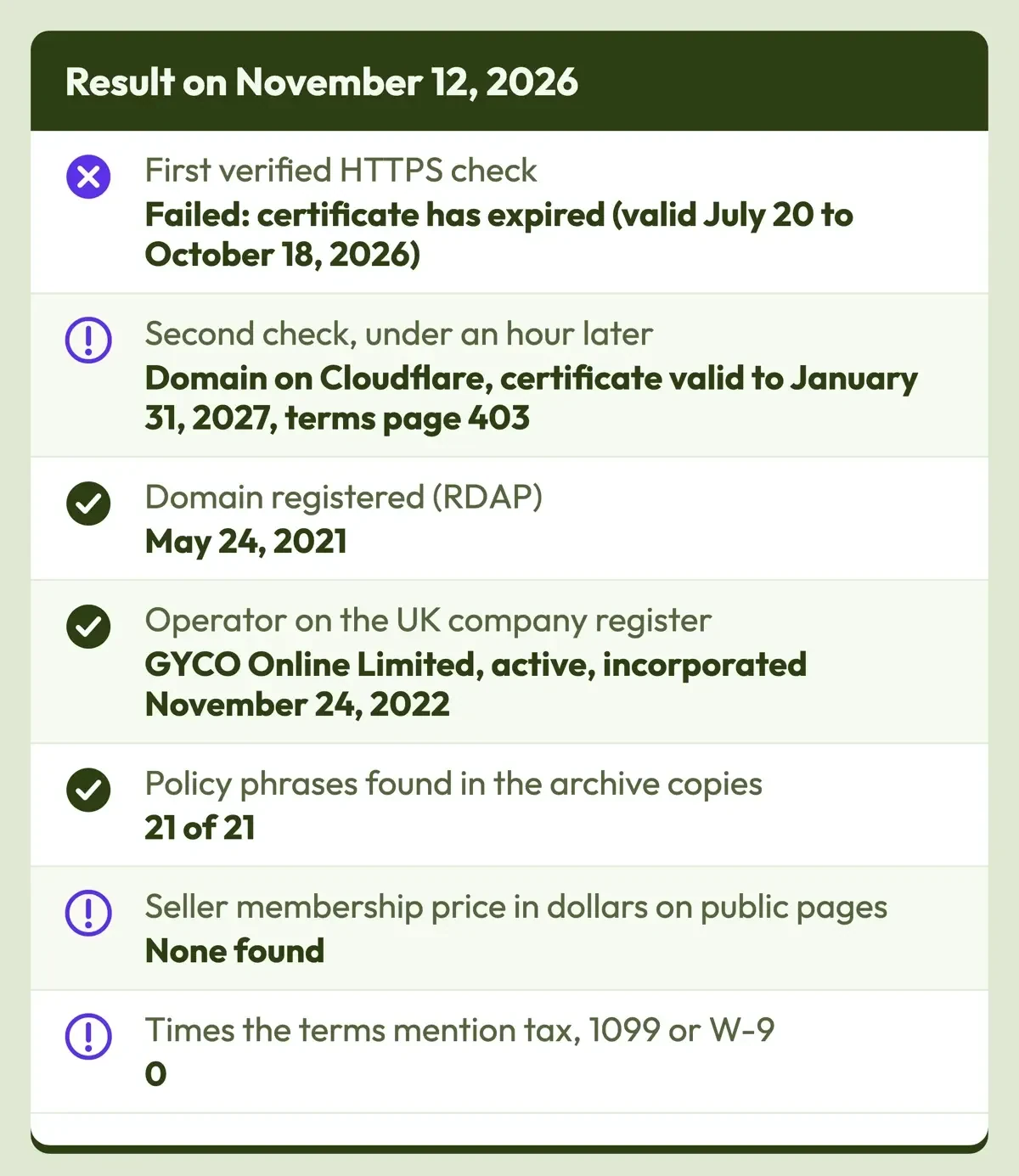 Diagram by DigitalTreed: results of our site check run on November 12, 2026 (test/site-results.json).
What we tested
We wrote a short script, test/site_check.py, and ran it on November 12, 2026 with plain GET requests and no account. It tried a verified connection twice, read the certificate dates, saved the registry and Companies House records, and searched seven archived policy pages for 21 phrases. All 21 turned up. A phrase match shows what a page said on its capture date. It doesn't show how the site treats sellers in practice. We didn't open an account, upload anything or write to support, so two things stay untested. We can't speak to payout speed or support quality.
Fees, payouts and refunds in the terms
The archived policy pages disagree on what selling costs. The monetization section of the July 21, 2026 terms capture says "We generate revenue through membership fees collected from sellers when they create a shop." The site also receives "a small commission when buyers top up their wallet," the same section says, so its cut of sales comes from the buyer side.
The seller sign-up page, captured October 10, 2026, reads differently. It says "Sign Up Free" and states that "FunWithFeet does not take any commission from seller earnings." An account can be free while a shop costs money, but none of the five public pages we searched names the shop fee in US dollars. The terms also warn that "Prices for our memberships are subject to change without notice." The 2024 text of this review quoted $9.99 for three months and $14.99 for six, but no 2026 page we read says so, so those prices are out.
That October 10 capture also carries the site's own claim of "$2.1M+ paid to sellers," and no outside record we saw backs it up.
| What a sales page says | What the terms or other pages say | Pages (capture date) |
|---|---|---|
| "Sign Up Free" | Sellers pay a membership fee when they create a shop | Sell page (October 10, 2026); terms (July 21, 2026) |
| No commission from seller earnings | A small commission is taken when buyers top up their wallet | Sell page; terms |
| Site's own claim: "100,000+ active sellers" | Home page: "hundreds of verified sellers" | Sell page; home page (October 12, 2026) |
| "Fast Payments" | Payouts are "subject to any minimum threshold or payment processing fees" | Home page; terms |
If you go ahead, email support before paying and ask for three numbers: the membership price in US dollars, the minimum payout and the processing fee per payout. Keep the dated reply. Prices can change. The terms don't promise notice.
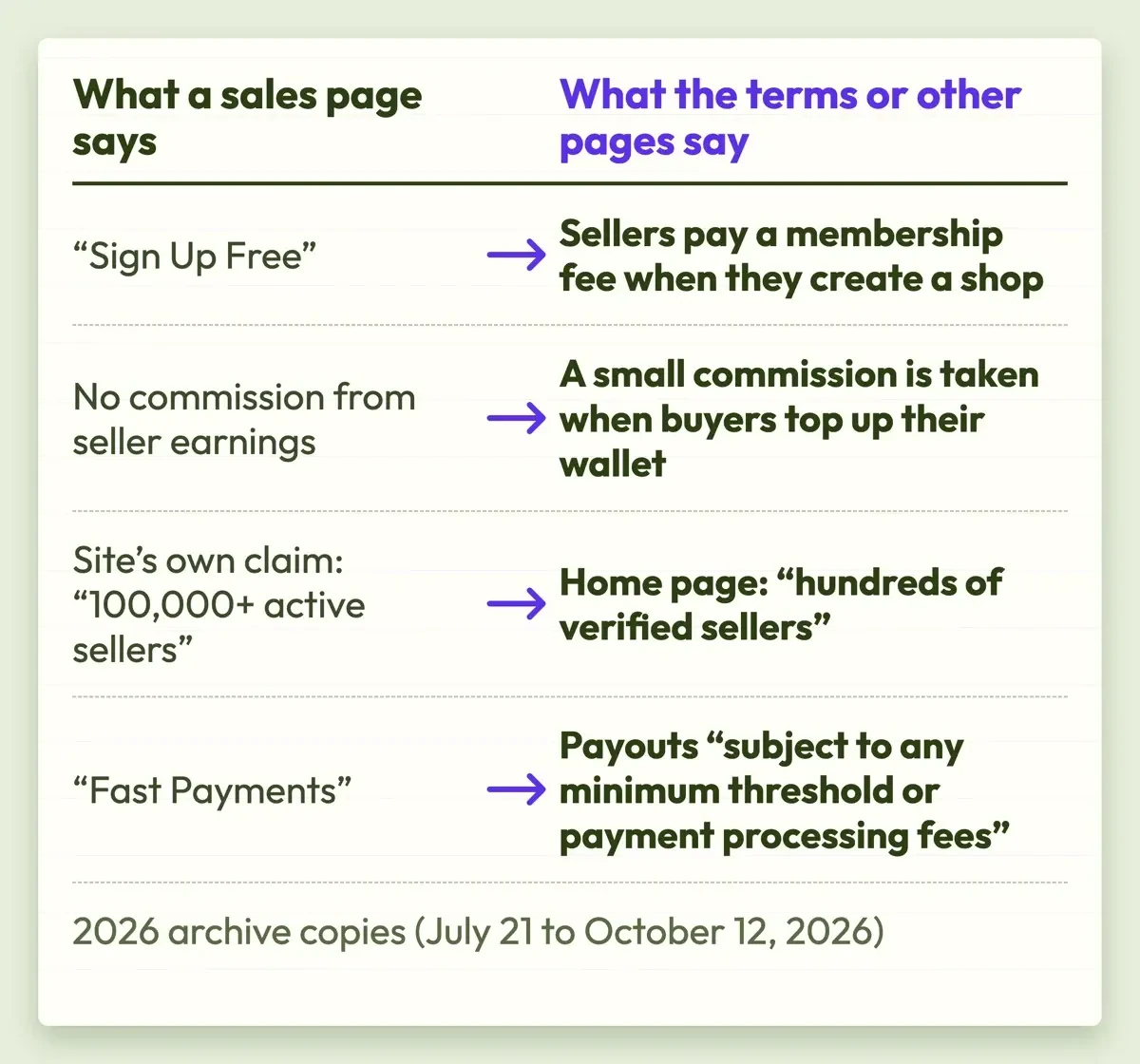 Diagram by DigitalTreed: FunwithFeet sales-page lines beside its terms, from 2026 archive copies.
Refunds aren't easy to get. A July 21, 2026 archive copy of the refund policy, effective March 5, 2026, allows them for fraudulent or unauthorized charges, duplicate payments, billing errors and a verified technical fault. It rules them out when "creator earnings are lower than anticipated" and when "the user changed their mind." Treat the membership fee as money you won't see again if sales don't come. The same policy asks users to contact FunwithFeet before starting a chargeback with their card company. It warns that a fraudulent or abusive chargeback may lead to account suspension, permanent termination or a ban from future use.
FunwithFeet's partner page, captured July 21, 2026, pays referrers "20% on any seller membership purchased within 12 months." It adds "5% on all buyer purchases forever." So a referrer earns from both sides. The 2024 text of this review pushed a rival site in the same way, and we've cut that plug along with its unsourced claims about this one. Our checklist for any online store covers the same before-you-pay checks on other sites. Partners can also hand out 10% off coupon codes. So when a referral link or code sits next to praise for a site like this, someone's likely getting paid.
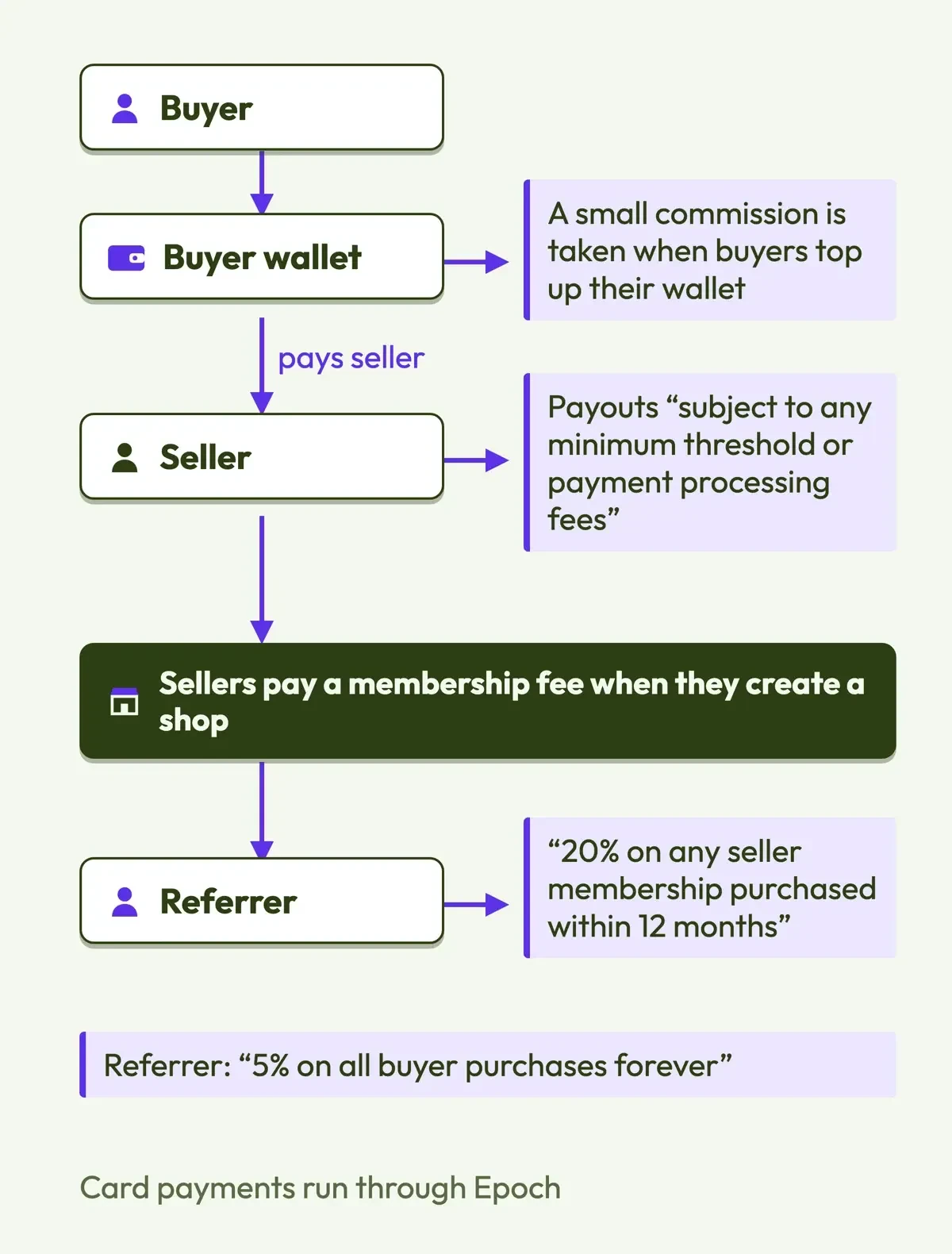 Diagram by DigitalTreed: where money moves on FunwithFeet, per its terms and partner page (2026 archive copies).
ID checks, age and consent rules
Every seller has to pass ID checks before a shop goes live. The terms, in the July 21, 2026 archive copy, call this KYC. Sellers hand over "government-issued identification, proof of address" and any other details the site asks for, and a compliance team reviews them by hand before approval. The stated goal is to confirm that sellers "are at least 18 years of age" and are who they claim to be.
The age rule doesn't stop at sellers. The terms require every user to "be at least 18 years of age" or of legal age where they live. Its anti-trafficking policy, effective March 5, 2026 and captured October 10, 2026, repeats the 18-year minimum for all users. US federal law draws the same line. The Justice Department's citizen's guide to federal law defines a minor as "someone under 18 years of age."
Under 18 U.S.C. 2257, producers of certain adult material must check each performer's ID for name and date of birth and keep records. FunwithFeet's footer links a 2257 compliance statement saying everyone shown was over 18 when the material was made. That statement, in a July 21, 2026 archive copy, is the site's own claim. No public record we found lets an outsider check the files behind it.
Consent has its own rule. Sellers must get "explicit, written consent from all individuals who are featured" in their content and keep records the site may ask to see. You keep ownership of what you upload, the terms say. But you grant the site a "non-exclusive, royalty-free, worldwide license" to display and promote it. The content complaints page, captured July 21, 2026, promises to resolve reports of illegal or non-consensual content "within seven (7) business days."
A complaint there needs your name, email address, the relevant URLs and a description of the issue, so collect the links before you write.
Federal law sets a shorter deadline than those seven days for some sites. Under 47 U.S.C. 223a, part of the TAKE IT DOWN Act, a covered platform has 48 hours to remove a nonconsensual intimate image after a valid request. The FTC enforces that rule. Whether a UK-run site like FunwithFeet counts as a covered platform needs an attorney's answer.
If an image of you was taken before you turned 18, NCMEC's free Take It Down service can help, and it works without you sending the image to anyone.
Which scams target sellers here?
The FTC's fake check scam page names overpayment as one scam type a seller can meet. A buyer sends a check for too much, then wants the extra back. The FTC warns that "It can take weeks for a bank to figure out that the check is a fake." By then, you owe the bank what you sent. FTC advice on avoiding scams gives the rule: "never deposit a check and send money back to someone." Our work-from-home scam guide shows the same check trick in fake job offers.
Gift cards are the next red flag, whether a buyer offers them or a fake verification step asks you to buy one. The FTC's gift card scam page says "No real business or government agency will ever tell you to buy a gift card to pay them." Our footography safety guide goes deeper on these scams and on threats to share photos.
Account theft is the third pattern. The FTC's payment app safety page says "Don't give your account credentials to anyone that contacts you." FunwithFeet's terms also ban users from asking other users for account names or passwords, so a buyer who asks for them is already breaking the site's own rules. If a buyer wants a login code, a password or payment off the site, stop there. Then report the account. Our walk-through for a clicked phishing link covers the case where you've already typed something in.
Report any scam that reaches you at ReportFraud.ftc.gov, the reporting site the FTC names on its scam pages.
Protect your ID and your photos
After KYC, a UK company holds a copy of your ID and a document showing your home address. Its home page, captured October 12, 2026, says "all sensitive data is encrypted and never shared with third parties." Yet the terms let the site bring in "third-party verification services" when it decides they're needed. We can't check either claim from outside, so protect the parts you control.
If someone misuses your name, ID or address anyway, the FTC sends you to IdentityTheft.gov to report it and get a recovery plan.
FTC advice on protecting personal information says to lock the account with a strong password and two-factor authentication. It calls an authenticator app or a security key the more secure kinds, compared with the one-time codes sent by text or email that most people use. CISA's password tips set the length at 16 characters or more. Its page on multifactor authentication notes that a stolen password alone won't get past the second step.
We'd also use an email address that exists only for selling, so a leak doesn't reach your bank or work accounts. Keep a note of what you uploaded for KYC and when.
Google's Photos help page on locations says a photo can hold a location when the phone's camera saves it. It adds that you can't remove a camera-added location inside Google Photos. The Library of Congress description of Exif explains where that data sits: in metadata segments inside the JPEG file. FunwithFeet's sell page, in its October 10, 2026 capture, tells sellers to leave out "identifying features such as your face, tattoos, or background details." The page says those could reveal who they are or where they live. Our footography guide tested which edits strip the location and which don't.
US taxes on feet pic income
Sales income is taxable whether or not a form shows up. The IRS hub page for gig workers says gig income goes on your return even when no Form 1099-K or other information return covers it. That holds for pay in cash, property, goods or virtual currency. As of November 2026, the IRS Form 1099-K page says a payment app or marketplace must send the form when payments "total over $20,000 in more than 200 transactions."
The IRS Form 1099-K FAQs say the One, Big, Beautiful Bill brought that threshold back retroactively, restoring the line in effect before the American Rescue Plan Act of 2021.
FunwithFeet's terms, in the July 21, 2026 archive copy, don't use the words tax, 1099 or W-9 even once. Don't count on a form from a UK operator to tell you what you earned.
Regular selling usually counts as a business. The IRS Schedule C page calls an activity a business when its primary purpose is income or profit and you're involved with continuity and regularity. The IRS hobby or business fact sheet lists the questions for close cases, such as whether you keep accurate books. A business brings self-employment tax. Net earnings of $400 or more mean filing Schedule SE. As of November 2026, the IRS self-employment tax page puts the rate at 15.3%: 12.4% for Social Security and 2.9% for Medicare.
The IRS estimated tax FAQ says you generally must pay during the year if you expect to owe at least $1,000 for the year after withholding and refundable credits.
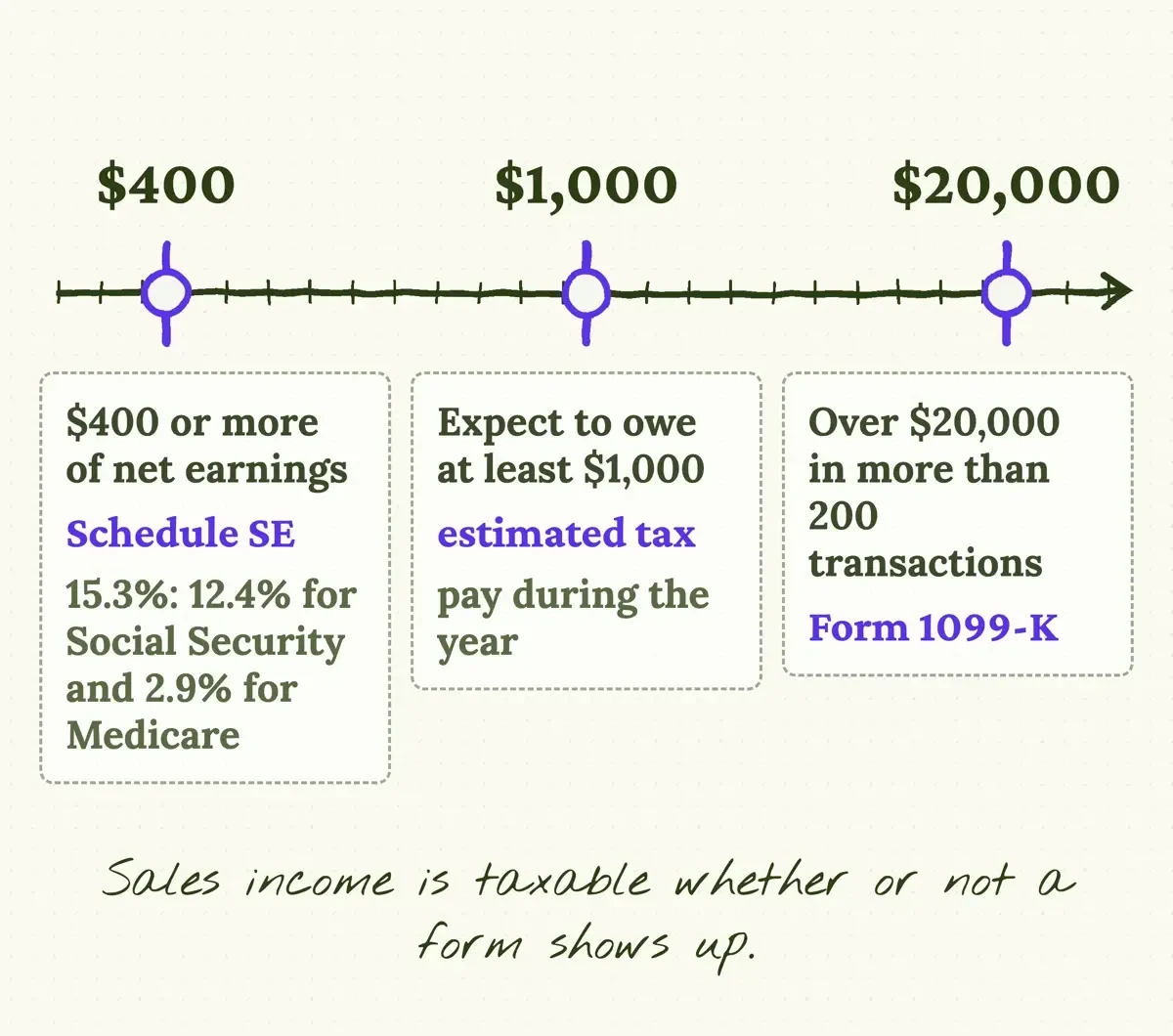 Drawn by us: three IRS lines for side income, from IRS pages read November 12, 2026.
The IRS recordkeeping page lists deposit information and invoices among the papers that back up gross receipts. They're how you'd prove where you stand on all three lines, so save every payout statement and the membership receipt. Our fees and taxes guide for flipping items shows the same rules on resale income, while our guide to selling feet pics online covers the selling side. This is how the IRS pages read in November 2026, and it isn't tax advice, so get help from a licensed tax pro before you file. The IRS guide to choosing a tax professional names CPAs, enrolled agents and attorneys among the preparers who hold credentials.
Frequently asked
Is FunwithFeet a scam?
We found no regulator or court record saying so. Companies House lists its operator as active, with its last confirmation statement dated August 17, 2026.
How much does a FunwithFeet seller membership cost?
No public page we read gave a dollar price. Its partner page, in a July 21, 2026 archive copy, says affiliates can create 10% off coupon codes to share with their audiences.
Will FunwithFeet send me a Form 1099-K?
Its terms don't say. The IRS 1099-K page adds that a platform may send one even below $20,000 and 200 transactions.
How we made this guide: The live site first failed our certificate check, then sent a 403 bot block, and later that day a browser got a Cloudflare 502 error. So FunwithFeet's terms, refund, consent, anti-trafficking, partner and sign-up pages came from Internet Archive captures. Those captures are dated July 21 to October 12, 2026. The UK company register, the domain's RDAP record and the pages in Sources were read on November 12, 2026, when test/site_check.py also ran. We didn't open an account, upload, pay or contact the site. Facts checked by the DigitalTreed team on November 12, 2026. This guide isn't legal or tax advice.
First published March 2024, when the text praised a rival site. Rewritten November 12, 2026: the plug, the unsourced prices and the unsourced scam claims are gone. The site's own terms, a dated site check, seller safety steps and IRS rules replace them.
Sources
- Companies House: GYCO ONLINE LIMITED, company 14503687
- LII: 18 U.S.C. 2257, record keeping requirements
- U.S. Department of Justice: Citizen's guide to U.S. federal law
- LII: 47 U.S.C. 223a, notice and removal of nonconsensual intimate visual depictions
- NCMEC: Take It Down
- FTC Consumer Advice: How to spot, avoid, and report fake check scams
- FTC Consumer Advice: Avoiding and reporting gift card scams
- FTC Consumer Advice: How to avoid a scam
- FTC Consumer Advice: Mobile payment apps, how to avoid a scam
- FTC Consumer Advice: Protect your personal information from hackers and scammers
- CISA: Use strong passwords
- CISA: Turn on MFA
- Google Photos Help: Understand, find and edit your photos' locations
- Library of Congress: Exif Exchangeable Image File Format, Version 2.2
- IRS: Gig economy tax center
- IRS: Understanding your Form 1099-K
- IRS: Form 1099-K FAQs
- IRS: About Schedule C (Form 1040)
- IRS: Know the difference between a hobby and a business
- IRS: About Schedule SE (Form 1040)
- IRS: Self-employment tax (Social Security and Medicare taxes)
- IRS: Estimated tax FAQs
- IRS: What kind of records should I keep
- IRS: Choosing a tax professional
- FunwithFeet terms of use, refund policy, content complaints, anti-trafficking policy, 2257 statement, partner program, sell page and home page: Internet Archive captures of July 21, October 10 and October 12, 2026 (named, not linked)


Comments
No comments yet. Start the conversation below.