
Quick answer
A chief operating officer job description needs a short summary, 6-8 duties with the essential ones marked, requirements, a reports-to line, a pay range and an EEO line. BLS puts the May 2025 median for chief executives, which include COOs, at $213,990 (read November 4, 2026). Under 100 employees, price an operations manager first; that median was $105,770.
You're a founder-CEO with 30 to 90 people, and you're about to post a chief operating officer job description. A chief operating officer is the executive who runs day-to-day operations and reports to the CEO. O*NET's Chief Executives profile files the COO title under code 11-1011.00. Under the ADA, 42 U.S.C. 12111(8), a description you write before advertising is evidence of the job's essential functions.
The template below has eight duties, seven tagged essential under the ADA, and a pay line with base, bonus and equity apart. After it come the BLS education and pay numbers and the state posting rules. Then we compare COO, CEO and president titles, give seven reasons from a 2006 HBR article and list head-count signs a small company is ready. Our view: under 100 people, hire an operations manager first.
Key takeaways
- Write the description before you advertise; the ADA treats it as evidence.
- BLS put the chief executive median at $213,990 in May 2025.
- An operations manager's May 2025 median was $105,770, about half that.
- Five states we checked require pay ranges in many job postings.
- Delaware lets one person be president and COO unless the bylaws forbid it.
A COO job description template you can copy
We wrote this template's duties from the task statements on O*NET's Chief Executives details page, which lists 31 tasks and rates 20 of them core. Swap every [bracket] for your own facts.
- Job title: Chief Operating Officer (COO)
- Summary: The chief operating officer (COO) runs [Company]'s day-to-day operations. The COO turns the plan set by the CEO and board into monthly targets, budgets and staffing, and leads the heads of [operations, finance, customer service and fulfillment].
- Reporting line: Chief Executive Officer. Direct reports: [Head of Operations, Controller, Head of Customer Service].
- Pay: $[low] to $[high] base salary per year, plus [bonus target %] and [equity, if any]. Benefits: [list or link].
- Equal opportunity: [Company] is an equal opportunity employer. All qualified applicants get equal treatment regardless of race, color, religion, sex (including pregnancy, sexual orientation and gender identity), national origin, age, disability or genetic information. To ask for an accommodation to apply or interview, email [address].
Each duty below opens with a verb and names something you can check later: a budget, a contract limit or a monthly report. The tag after each duty is our essential-or-marginal call. Delete any duty your COO won't really do, because a listed duty is one you may have to defend if a candidate or employee challenges it. Keep it to six to eight duties, so each one can carry a number or a limit you'll actually use.
- Direct daily operations across [departments and sites] and coordinate work between them. (essential)
- Prepare the yearly operating budget with the CEO and track spending against it each month. (essential)
- Appoint, coach and evaluate the department heads who report to the COO. (essential)
- Analyze operations data each month to find costs to cut and processes to improve. (essential)
- Negotiate and approve contracts with suppliers and service providers up to $[limit]. (essential)
- Write and update operating policies and procedures, and see that each department follows them. (essential)
- Prepare and present reports on results, expenses and risks to the CEO and the board [monthly]. (essential)
- Represent [Company] at industry events and speak for it with the press when the CEO asks. (marginal)
Requirements are where COO posts go vague, so tie each line to a number. BLS says top executives typically need at least a bachelor's degree and five years or more of related experience.
- Bachelor's degree in business, engineering or a field related to [industry]; an MBA is welcome but not required.
- [7+] years of management experience, including [3+] years leading other managers.
- A record of owning a budget of $[size] or more and hitting the targets set for it.
- Travel to [sites] about [20]% of the time.
Once it's filled in, hold the post up to O*NET's General and Operations Managers task list as a check on the title. That profile's 17 tasks include "Prepare staff work schedules and assign specific duties," which is hands-on scheduling work. If most of your duties read like that one, you're hiring an operations manager. Duties like D3 and D7, which manage managers and report to the board, are what make the COO title honest.
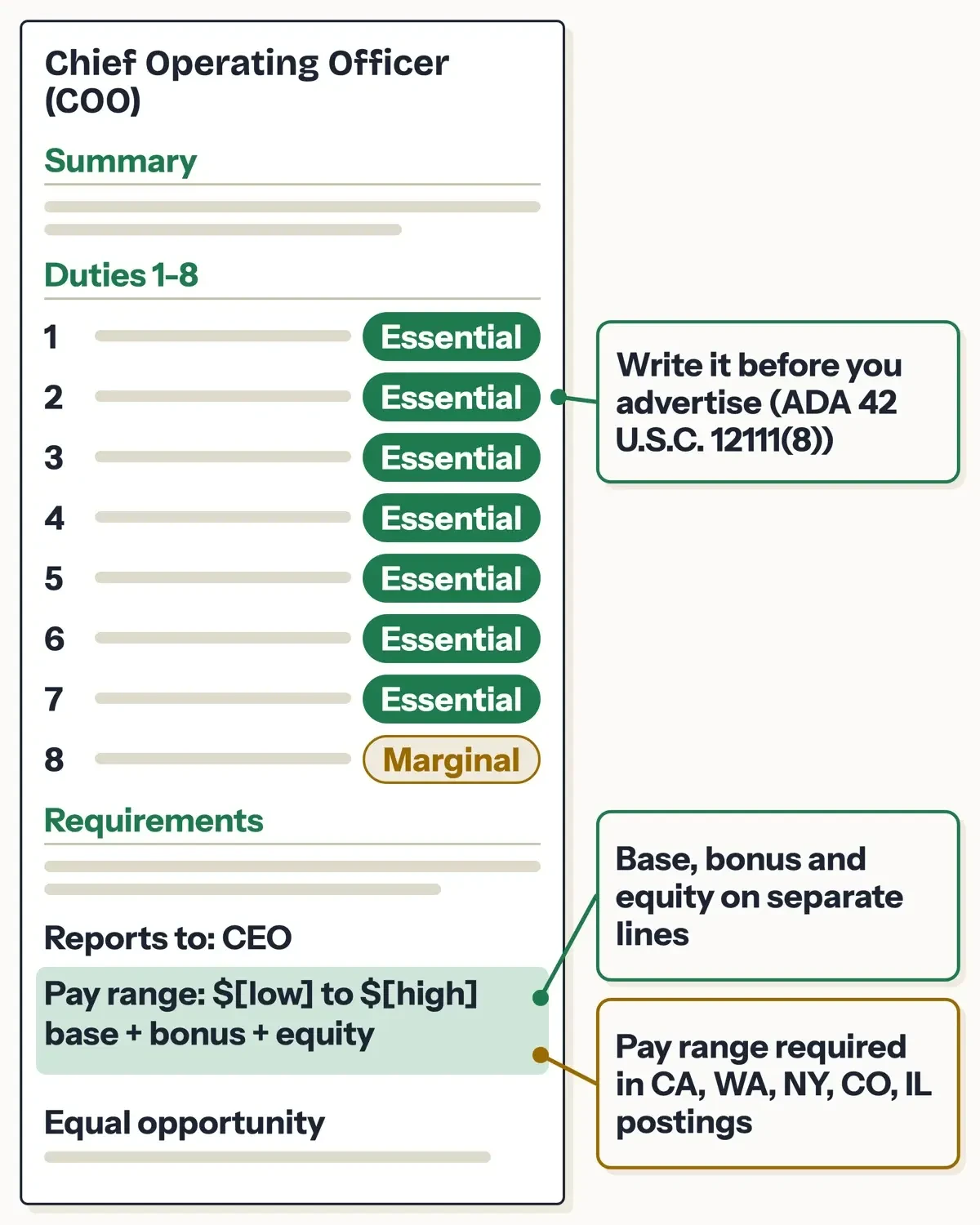 Diagram by DigitalTreed, from our COO template and O*NET 11-1011.00 task statements, November 4, 2026.
Which COO duties count as essential functions?
That essential-or-marginal tag matters under the ADA, which covers employers with 15 or more employees in 20 or more calendar weeks. The EEOC's rule at 29 CFR 1630.2(n) defines essential functions as "the fundamental job duties" and leaves out "the marginal functions of the position." Under 1630.2(m), an applicant with a disability is qualified if they meet the job's skill, experience and education requirements. They must also be able to do the essential ones, with or without a reasonable accommodation. Your written description isn't the only evidence, though. The rule also lists your judgment, "The amount of time spent on the job performing the function," and the work of past people in the job.
The EEOC's ADA guide for employers adds that a description written before you advertise or interview counts as evidence too, alongside the actual work experience of present or past employees.
So D1 to D7 are tagged essential. A COO who can't run the budget, the department heads or the contracts isn't doing the job you're paying for. D8, speaking at events and to the press, is tagged marginal because the CEO can cover it. If your COO will spend weeks a year on that work, retag it and say how much time it takes. Physical lines belong only where they're true. We ask for travel "about [20]% of the time" because BLS says travel is common for chief executives, but a lifting line copied from a warehouse post doesn't fit. When an applicant asks to change the process or the job, use the EEOC's accommodation guidance.
What we tested
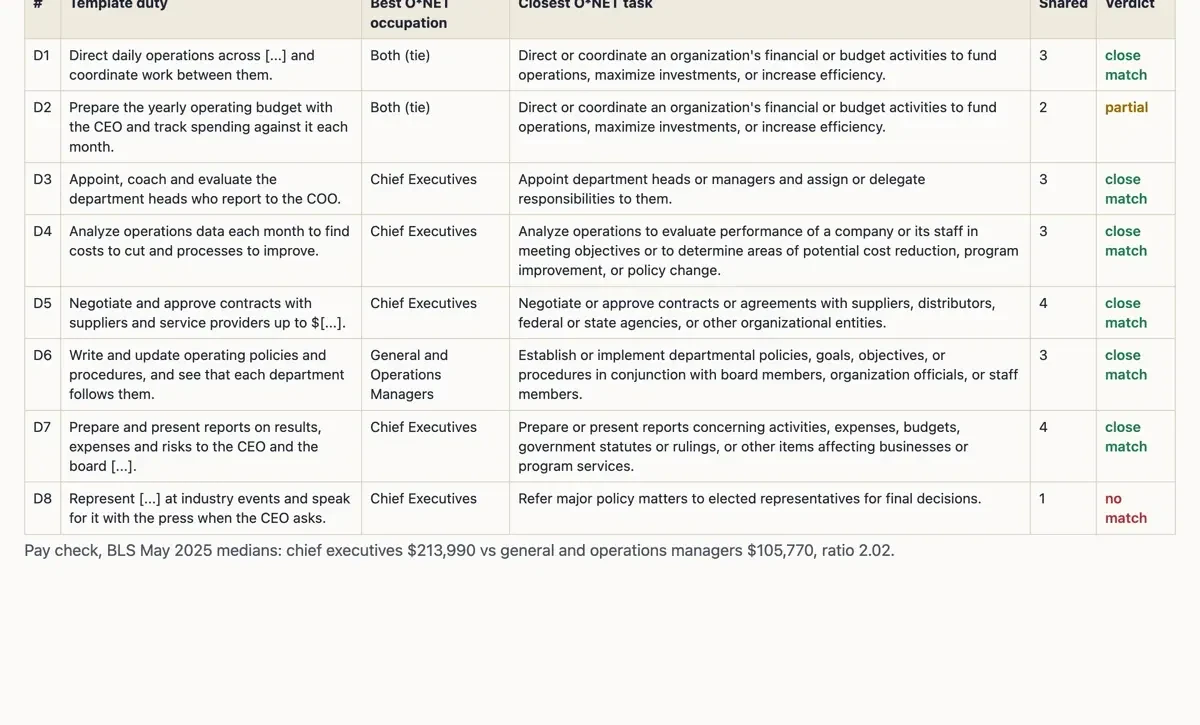
We ran our 8 template duties against the 48 O*NET task statements we saved on November 4, 2026, using a script that counts shared word stems. Our rule, set before the run: 3 or more is a close match, 2 is partial, 0-1 is none. Result: 6 close, 1 partial and 1 with no match.
The budget duty, D2, only reached partial. D6 matched the General and Operations Managers list better, and two duties tied. The D8 miss is the script's fault: a person would pair it with the O*NET task "Deliver speeches, write articles, or present information at meetings or conventions."
 Screenshot: our COO duty check page on 127.0.0.1, November 4, 2026.
Education, experience and pay: the BLS numbers for COOs
The BLS Occupational Outlook Handbook page for top executives, last updated October 29, 2026, groups chief executives with general and operations managers. Those are the two O*NET profiles whose task lists our duty check used.
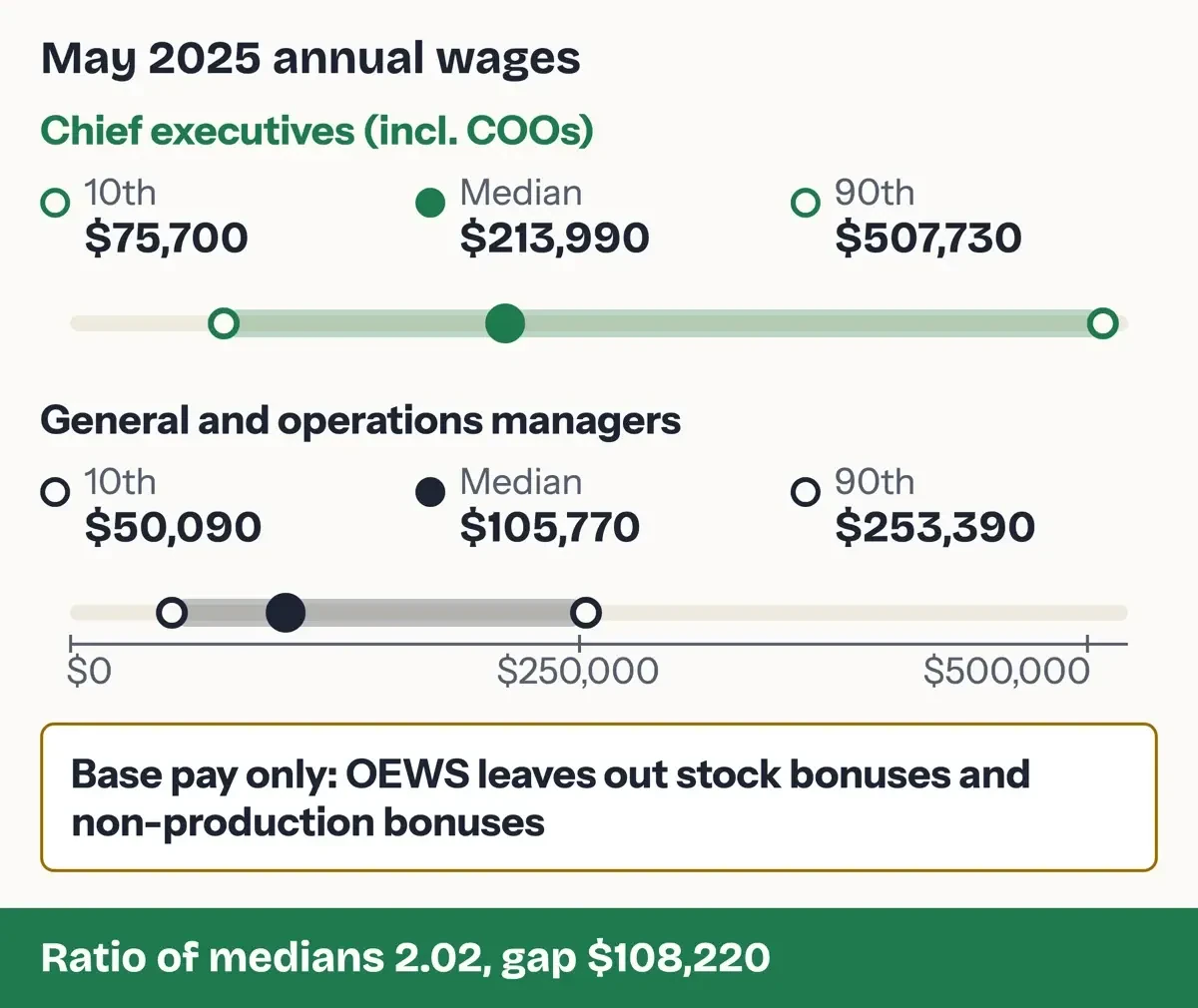
For education, BLS says top executives typically need a bachelor's or master's degree, and executives of large corporations may have an MBA. O*NET puts chief executives in Job Zone Five, where "Many require more than five years of experience." That's why our template asks for [7+] years, with [3+] spent managing managers. Pay is where the two groups split. BLS put the median annual wage for chief executives at $213,990 in May 2025, with the lowest 10% under $75,700 and the highest 10% over $507,730. General and operations managers had a $105,770 median, ranging from under $50,090 to over $253,390.
O*NET's General and Operations Managers profile shows the same $105,770 median, so the handbook and O*NET, both built on the same OEWS survey, agree.
Our script divides one median by the other: $213,990 / $105,770 = 2.02, a gap of $108,220 a year. Both figures come from the OEWS survey that BLS released on May 15, 2026. The OEWS profile for chief executives and the one for general and operations managers break them out by state, metro area and industry. Use them to price the role where you'll hire. BLS projects chief executive jobs to grow 3% from 2025 to 2035, the all-occupation average. General and operations managers get 5%.
 Source: BLS Occupational Outlook Handbook, Top Executives, May 2025 wages, read November 4, 2026. Chart drawn by us.
BLS expects about 304,100 openings a year for top executives as a whole. Chief executives held about 291,600 jobs in 2025. Of those, 27% were self-employed.
Writing the pay range line for a COO posting
Those medians cover base pay only. The OEWS survey FAQ says its wages "are straight-time, gross pay, exclusive of premium pay," and its list of excluded pay names stock bonuses, profit-sharing payments and non-production bonuses. Yet BLS also notes that executive pay often includes stock options and other performance bonuses, so the median can understate a COO's full package. Write the line in two parts: the base salary range first, then the bonus target and any equity, each stated on its own. A made-up example: "$170,000 to $220,000 base salary per year, plus a 20% bonus target and 0.5% equity vesting over four years."
Split that way, a candidate can hold the made-up $170,000 to $220,000 base against the $213,990 median, since neither counts stock or non-production bonuses.
Several states make the range a legal duty. California says an employer with 15 or more employees must include the pay scale for a position in any job posting. Washington requires a wage scale or salary range and a general description of benefits, also at 15 or more. New York's rule reaches businesses with four or more employees and, per the state's FAQ, took effect September 17, 2023. Colorado's SB23-105 added "compensation, benefits, and date that the application window is anticipated to close," effective January 1, 2024. Illinois has required pay scale and benefits in postings from employers with 15 or more since January 1, 2025.
Our competitive pay guide has the full state table. This isn't legal advice; have an employment lawyer read any posting for these states.
The EEO line has a federal reason too. The EEOC says it's illegal to publish a job advertisement that shows a preference based on race, color, religion, sex, national origin, age (40 or older), disability or genetic information. So our template asks for "[7+] years of management experience" and never asks for "recent college graduates," the EEOC's own example of wording that may discourage people over 40.
COO, CEO and president: three titles, one O*NET code
BLS says CEOs are also known by titles such as executive director, managing director, or president, and they "typically report to a board of directors." O*NET lists CEO, President, COO and Executive Vice President as sample titles for the same code, 11-1011.00. State law decides how those titles sit in your company. Delaware's corporation code, 8 Del. C. 142, gives officers "such titles and duties as shall be stated in the bylaws or in a resolution of the board of directors." It adds that "Any number of offices may be held by the same person unless the certificate of incorporation or bylaws otherwise provide."
So in a Delaware company one person can be both "President" and "COO" by default; it takes a charter or bylaw clause to forbid it.
Public companies have one more layer. The SEC's Rule 3b-7 defines an executive officer as the president, any vice president in charge of a principal business unit, division or function, or any other policy-making officer. A COO in charge of operations fits that wording. If you're heading toward an IPO, ask securities counsel how the title will be reported.
| Title | Who usually sets it | Reports to | Main job in BLS and O*NET wording |
|---|---|---|---|
| CEO | Board resolution or bylaws | Board of directors | Overall direction, policy and strategy |
| President | Bylaws; often held by the CEO | Board, or the CEO if the titles are split | Same O*NET code; duties set by your bylaws |
| COO | Board or CEO, per bylaws | CEO | Day-to-day operations across departments |
| Operations manager | CEO or COO | CEO or COO | O*NET 11-1021.00: schedules, staff, daily operations |
Treat the table as a default, since your bylaws can rename or merge any row. If you're adding finance leaders too, our finance job titles guide places the CFO and controller next to the COO.
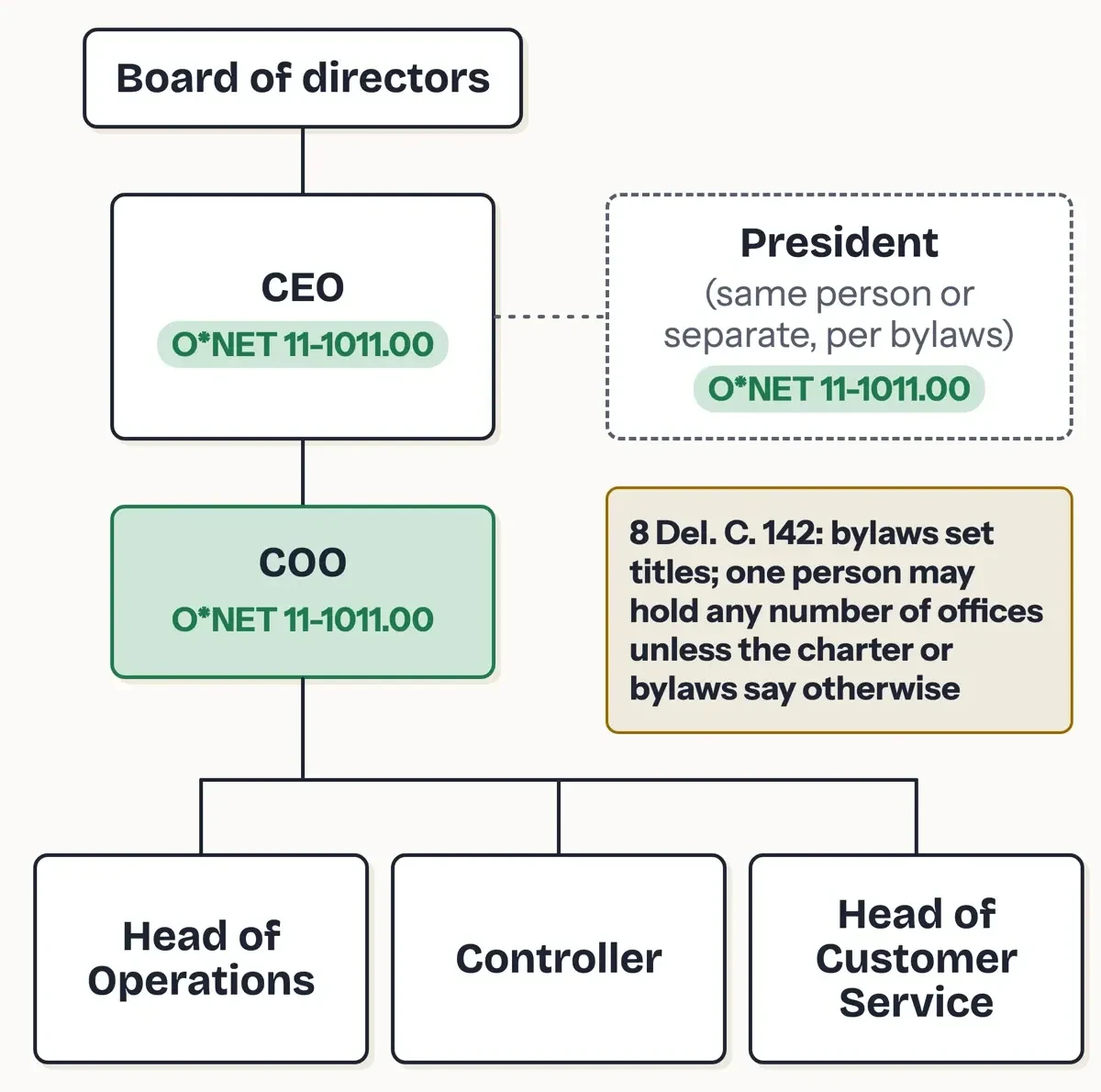 Diagram by DigitalTreed, from BLS Top Executives, O*NET 11-1011.00 and 8 Del. C. 142, November 4, 2026.
Seven reasons companies create a COO role
A title doesn't say which kind of COO you need. In Harvard Business Review's "Second in Command" (May 2006), Nate Bennett and Stephen A. Miles drew on talks with dozens of COOs and the CEOs they worked with. They write that "There are seven basic reasons why companies decide to hire a COO." They add that the seven aren't mutually exclusive. Here are their labels, with the reasons in our words:
- Executor: carry out the strategy that the CEO and the top team set.
- Change agent: lead one push, such as a turnaround or a fast expansion.
- Mentor: guide a young, inexperienced CEO.
- Other half: cover what the CEO's skills and style leave out.
- Partner: work at the top as a partner to the CEO.
- Heir apparent: test a likely successor before the CEO steps down.
- MVP: keep a valuable executive from leaving for a rival.
Each reason changes the template. An heir apparent needs a line on succession and time with the board, and a change agent's D8 slot should name the project and its end date. If your honest reason is MVP, still write the post around the work. The EEOC's ad rule applies to every applicant, not only to the person you have in mind. For a partner COO, write down which of D1 to D7 stay with the CEO.
Signs a small company is ready for a COO
One sign you can measure is head count. Federal rules switch on at 15, 20, 50 and 100 employees. Each adds a filing, a leave rule or a notice duty for someone in operations.
| Employees | What starts | Source |
|---|---|---|
| 15 | Title VII and ADA cover you | 42 U.S.C. 2000e(b) |
| 20 | Age Discrimination in Employment Act | EEOC age page |
| 50 | FMLA leave; ACA large-employer rules (full-time plus equivalents) | DOL FMLA, IRS ALE page |
| 100 | EEO-1 report each year; WARN notice 60 days before a plant closing or mass layoff | EEOC data collections, DOL WARN |
The second sign is how many department heads you'd hand over. O*NET's chief executive tasks include "Appoint department heads or managers and assign or delegate responsibilities to them." Our cutoff: with fewer than three heads, a COO has almost no one to lead. Count your direct reports first; our span of control guide gives the method. The third sign is cost. At May 2025 medians, chief executives earned $108,220 a year more in base pay than general and operations managers. O*NET lists Operations Director and General Manager among that cheaper profile's job titles. So we'd hire the operations manager first and post the COO once you're near 100 employees with three or more department heads reporting to you.
The steps after posting are in our hiring manager guide. Our job-description guides for a senior accountant, a business development director and an executive assistant use the same essential-functions rule with their own duties. For the requirements list, our post on O*NET abilities explains the ability ratings.
Frequently asked
Who does a COO report to?
In the usual setup, the CEO. BLS says CEOs "collaborate with and direct the work of other top executives," and its Top Executives page counts COOs among them.
Is a COO higher than a president?
Your bylaws decide. Delaware's section 142 lets the bylaws or a board resolution set each officer's title and duties, and one person may hold several offices.
Does a COO need an MBA?
No law requires one. BLS says executives of large corporations may have an MBA, so list it as preferred unless the work needs it.
How many hours does a COO work?
Plan for long weeks. BLS says many top executives work more than 40 hours a week, including evenings and weekends.
How we made this guide: Every quote here was matched against copies of the Sources pages that our fetch script saved on November 4, 2026. The eCFR site and the BLS data API refused the script, so we cite Cornell's copies and the BLS handbook. Facts checked by the DigitalTreed team on November 4, 2026.
The April 2025 version was a general COO overview with no sources. This November 4, 2026 rewrite turns it into a copy-ready template built on BLS, O*NET and EEOC pages.
Sources
- BLS Occupational Outlook Handbook: Top Executives
- O*NET OnLine: 11-1011.00 Chief Executives (summary)
- O*NET OnLine: 11-1011.00 Chief Executives (details, tasks)
- O*NET OnLine: 11-1021.00 General and Operations Managers (summary)
- O*NET OnLine: 11-1021.00 General and Operations Managers (details, tasks)
- BLS OEWS profile: chief executives, May 2025
- BLS OEWS profile: general and operations managers, May 2025
- BLS: Occupational Employment and Wages, May 2025 (news release)
- BLS: OEWS frequently asked questions
- 42 U.S.C. 12111, ADA definitions (Cornell LII)
- ADA.gov: Americans with Disabilities Act, text
- 29 CFR 1630.2, definitions incl. essential functions (Cornell LII)
- EEOC: The ADA, your responsibilities as an employer
- EEOC: Enforcement guidance on reasonable accommodation and undue hardship
- EEOC: Prohibited employment policies and practices
- 42 U.S.C. 2000e, Title VII definitions (Cornell LII)
- EEOC: Age discrimination
- 29 U.S.C. 630, ADEA definitions (Cornell LII)
- DOL Wage and Hour Division: Family and Medical Leave Act
- 29 CFR 825.104, FMLA covered employer (Cornell LII)
- IRS: Determining if an employer is an applicable large employer
- IRS: ACA information center for applicable large employers
- EEOC: EEO data collections
- EEOC: EEO-1 Component 1 data collection
- DOL: Plant closings and layoffs (WARN)
- 20 CFR 639.3, WARN definitions (Cornell LII)
- Delaware Code, title 8, section 142: officers
- 17 CFR 240.3b-7, definition of executive officer (Cornell LII)
- Harvard Business Review: Second in Command, Bennett and Miles, May 2006
- Colorado General Assembly: SB23-105
- California DIR: Equal Pay Act FAQ
- Washington L&I: Equal Pay and Opportunities Act
- RCW 49.58.110
- New York State DOL: Pay transparency and its Pay Transparency Act FAQ
- Illinois DOL: Equal Pay Act salary transparency


Comments
No comments yet. Start the conversation below.