
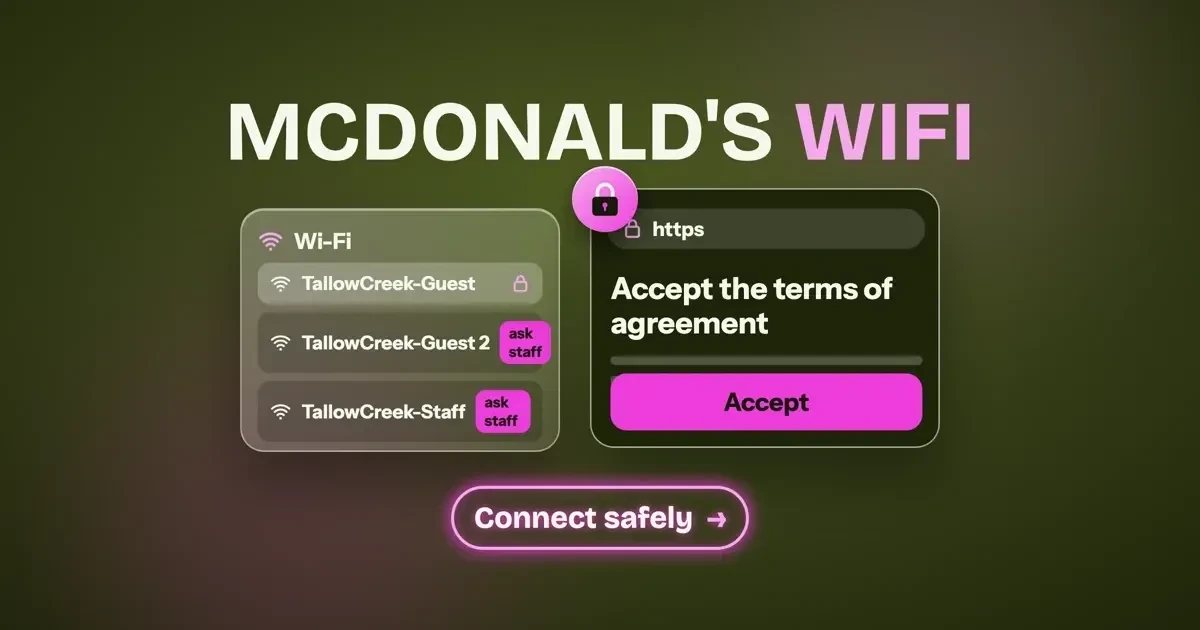
Quick answer
McDonald's WiFi needs no account or password: you pick the McDonald's network and accept the terms of agreement, per McDonald's US Wi-Fi page as of November 2026. Some owner-operators switch it off, so not every McDonald's has it. If two similar network names appear, ask staff which one is real.
McDonald's WiFi is a free public hotspot that McDonald's says runs on AT&T, open to anyone who accepts its terms page. Parked outside with a laptop that needs an update, you have two jobs: join the real network, and keep your bank app on cellular data.
McDonald's pages answer the login question. They never name the network. The phone and laptop menus come from Apple, Google and Microsoft help pages. On banking, the FTC, FCC and CISA give three different answers, and the oldest page is the strictest. We also ran 12 made-up hotspot names through a small script.
Key takeaways
- McDonald's asks for no login, only acceptance of its terms page.
- McDonald's never publishes its network name, so ask staff at the counter.
- Our checker flagged 8 of 12 made-up names; 2 showed no visible difference.
- CISA's archived 2021 advice says to bank on cellular data instead.
- Turn off Auto-Join for the McDonald's network after you leave.
What McDonald's says about its free Wi-Fi
McDonald's answers the login question in one line. Its free Wi-Fi page says: "No, you will not need a special login. Simply accept the terms of agreement in order to sign into McDonald's Wi-Fi." The Wi-Fi FAQ says the same, and so does a one-question FAQ page dated March 4, 2021, still live as of November 2026. The carrier has a name, too: the FAQ says "McDonald's restaurants use AT&T as their Wi-Fi carrier of choice." The Free Wi-Fi page agrees: "AT&T is our carrier of choice."
The two McDonald's pages give different counts. As of November 5, 2026, the Free Wi-Fi page (no page date shown) offers Wi-Fi "at more than 11,500 participating restaurants". The Wi-Fi FAQ (also undated) points to the Restaurant Locator to see "which of our 14,000 stores offer complimentary WiFi." Neither page explains the gap. We quote the lower figure and leave the store-by-store answer to the Locator, where McDonald's says to check one store's Wi-Fi policy.
Both pages carry the same two caveats. They say "some owner-operators may choose to disable the service." Each location also "may have its own terms and limitations of use." Speed isn't promised either: it "may vary from restaurant to restaurant based on bandwidth availability", and service "is capped to the lowest network prioritization." Neither page gives the network name, a time limit or the terms text. We searched the 78,228-character McDonald's Terms and Conditions for five Wi-Fi words in a browser read on November 5, 2026, and found none. The terms you accept seem to appear only on the in-restaurant pop-up, which we haven't seen.
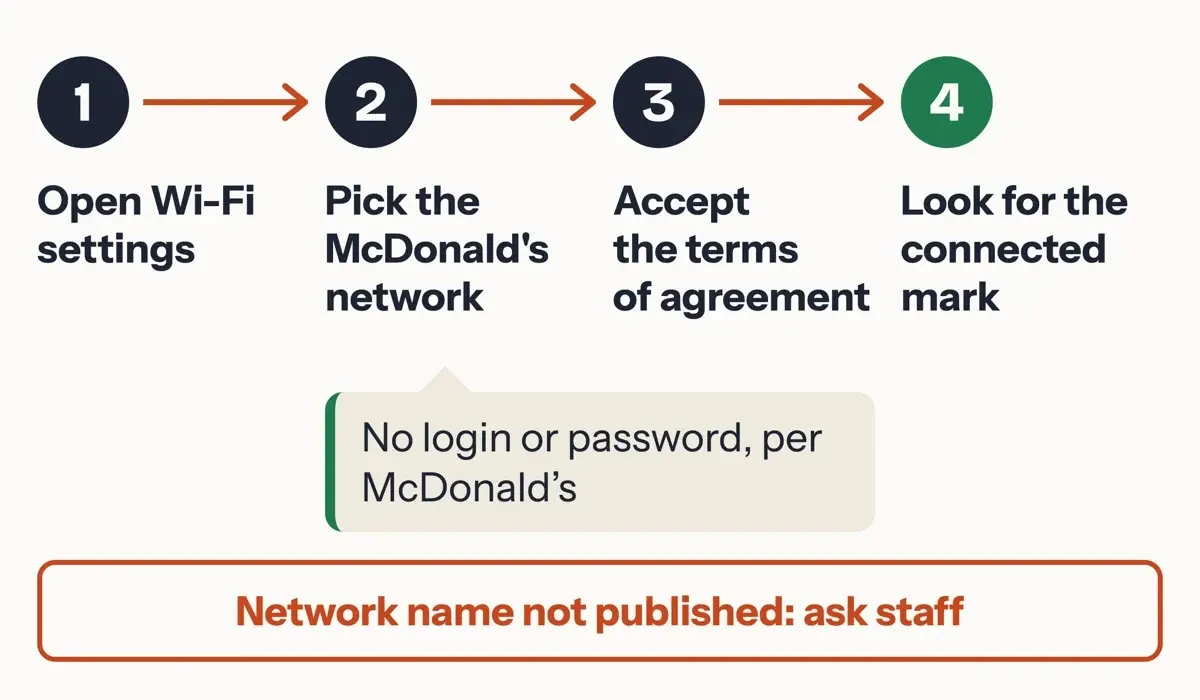 Diagram by DigitalTreed, from McDonald's free Wi-Fi page and Wi-Fi FAQ, read November 5, 2026
How do you connect to McDonald's WiFi on a phone?
McDonald's says an iPhone set to join networks automatically will show "a McDonald's Wi-Fi pop-up with terms of agreement." Otherwise you pick the network in Wi-Fi settings, and for Android McDonald's says to "Follow the standard Android procedure for connecting to Wi-Fi networks."
Apple and Google supply the menu names McDonald's leaves out:
- iPhone: open Settings, tap Wi-Fi, check that it's on, then tap the network name (Apple's Wi-Fi help page).
- Android 12 and up: open Settings, tap Network & internet, then Internet, and tap the network (Google's Android Wi-Fi help).
- Android can also show a public network as a notification with a Connect button.
- Both: read the terms pop-up and accept it. That's the only sign-in McDonald's describes.
- Both: confirm it worked. Apple says to "look for a blue checkmark" by the network.
Android then saves the network. Google says "When your device is nearby and Wi-Fi is on, your device automatically connects to this network." On your next visit, that can happen before you've checked which name is real.
Laptops: Mac menu bar and Windows quick settings
McDonald's pitches the service for "laptops or mobile devices" alike, yet its FAQ answers cover only iPhone and Android.
On a Mac, Apple's Mac User Guide says to click the Wi-Fi icon "in the menu bar, then choose the network you want to join." If it isn't listed, click Other Networks. McDonald's pages mention no password, only the terms of agreement, so a password box is a cue to recheck the network name. On Windows the list sits behind the taskbar icons instead. Microsoft's Wi-Fi connection guide says to open quick settings, select Manage Wi-Fi connections, choose the network and select Connect, then accept the terms page.
Turn on one Windows privacy switch before you go out. Microsoft says the scan "contains the unique physical hardware (MAC) address" and that "shopping malls, stores, or other public areas, might use this unique address to track your movement." The fix is Random hardware addresses, under Network & internet, then Wi-Fi.
When the terms page never shows up
McDonald's names two causes when a connection sticks, and its advice is one line: "Make sure to select the correct Wi-Fi network and to accept the terms of agreement." Its FAQ adds that you can "ask a McDonald's employee for assistance", and that person can also tell you the network name.
Still stuck on the right network? Google's Android troubleshooting page says to restart the device, then turn Wi-Fi off and mobile data on and swap back to see which side fails. If nothing changes, it says to contact "the host of the Wi-Fi network", which here means the restaurant.
Apple's Wi-Fi help page names VPN or security software as a culprit and says to uninstall it, restart, and "Test the Wi-Fi connection" before deciding what to keep.
Don't tap through security warnings to force a page open, though. Microsoft's Windows notice page says a not-secure notice means "outdated security standards like WEP or TKIP" and to switch to a network you trust.
Is McDonald's WiFi safe for banking?
The FTC's public Wi-Fi article, from February 2023, is the most relaxed of the three federal pages. It says: "Because of the widespread use of encryption, connecting through a public Wi-Fi network is usually safe." It tells you to "Look for a lock symbol or https in the address bar." The FTC adds that scammers "create fake websites and encrypt them", which means the lock vouches for the connection to a site and says nothing about who runs it.
CISA's holiday travel tips, released February 1, 2021 and now labeled archived, are the strictest. They say to "Avoid using open Wi-Fi networks to conduct personal business, bank, or shop online." The FCC's wireless security tips, last reviewed November 26, 2025, land in between, saying that "using your cellphone data plan instead of Wi-Fi may be more secure."
| Agency and page date | Banking on public Wi-Fi | What it tells you to check |
|---|---|---|
| FTC, February 2023 | "usually safe" because most sites encrypt | Lock symbol or https; fake sites can be encrypted too |
| FCC, reviewed November 26, 2025 | Data plan "may be more secure" | Imposter hotspots; https; no auto-connect |
| CISA, February 1, 2021 (archived) | Avoid banking or shopping on open Wi-Fi | Confirm the hotspot name; at least WPA2 |
Our take: let the bank app use cellular data, even for a balance check, and keep McDonald's WiFi for updates, maps and browsing.
CISA gives the same step for checking a balance while traveling: "turn off your device's Wi-Fi connection" and use cellular data. Typed a password into a page that looked off? Follow the cleanup steps after a phishing link click.
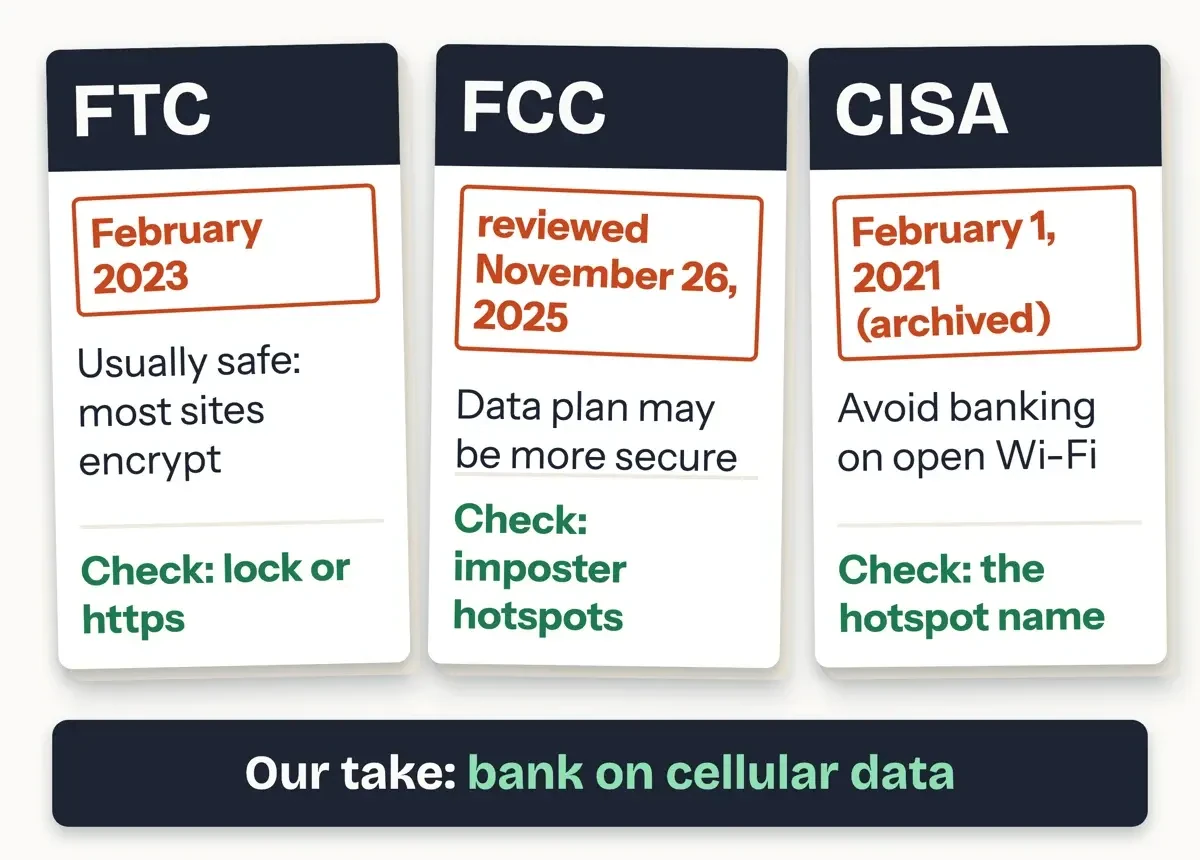 Drawn by us, from the FTC, FCC and CISA pages in Sources, read November 5, 2026
Lookalike hotspot names and auto-join
A fake network is a separate risk from a fake website, and the FCC says to "Watch out for imposter public Wi-Fi hotspots." If more than one seems to belong to the place you're in, "check with the staff to avoid connecting to an imposter hotspot." CISA's archived 2021 wireless network page calls this an evil twin attack, where an attacker copies a public access point and broadcasts a stronger signal. CISA's fix is blunt: "Always confirm the name and password of a public Wi-Fi hotspot prior to use." At McDonald's there's no password, so the name is all you've got. We ran 12 made-up names through a small checker against one made-up real one.
| Made-up name in the list | Result | Why |
|---|---|---|
| TallowCreek-Guest | exact match | |
| tallowcreek-guest | Lookalike, ask staff | same letters, different capitals |
| TallowCreek-Guest 2 | Lookalike, ask staff | real name plus extra text on the end: "2" |
| TallowCreek-Guest-FREE | Lookalike, ask staff | real name plus extra text on the end: "-FREE" |
| TaIlowCreek-Guest | Lookalike, ask staff | look-alike characters swapped (for example I for l, 3 for e) |
| TallowCr33k-Guest | Lookalike, ask staff | look-alike characters swapped (for example I for l, 3 for e) |
| TallowCreek_Guest | Lookalike, ask staff | punctuation or spacing changed |
| TallowCreek-Guest (Cyrillic a) | Lookalike, ask staff | letter from another alphabet: U+0430 CYRILLIC SMALL LETTER A |
| TallowCreek-Guest + trailing space | Lookalike, ask staff | extra space at the start or end |
| Free Public WiFi | not this venue | no resemblance to the confirmed name |
| TallowCreek-Staff | different network at the same venue: ask staff | starts like the venue name, ends differently |
| Bramble Street Coffee | not this venue | no resemblance to the confirmed name |
Eight of the 12 came back as lookalikes, one as a different network at the same venue, and two as unrelated. The two that worried us most, the Cyrillic "a" and the trailing space, show no visible difference from the real name. Our report prints the Cyrillic one as its code, U+0430. The same trick shows up in web addresses, where a swapped letter can send you to a different site, as our lookalike finance website check shows.
Auto-join is how a saved network comes back without a tap: Apple says a device "can automatically join only known Wi-Fi networks", meaning ones it has joined before. Apple's Auto-Join help page shows two choices on iPhone and Mac: turn off Auto-Join for a network, or Forget This Network. On Android, you touch and hold a saved network and tap Forget, while the FCC wants phones that skip any network "not on your short list of trusted networks."
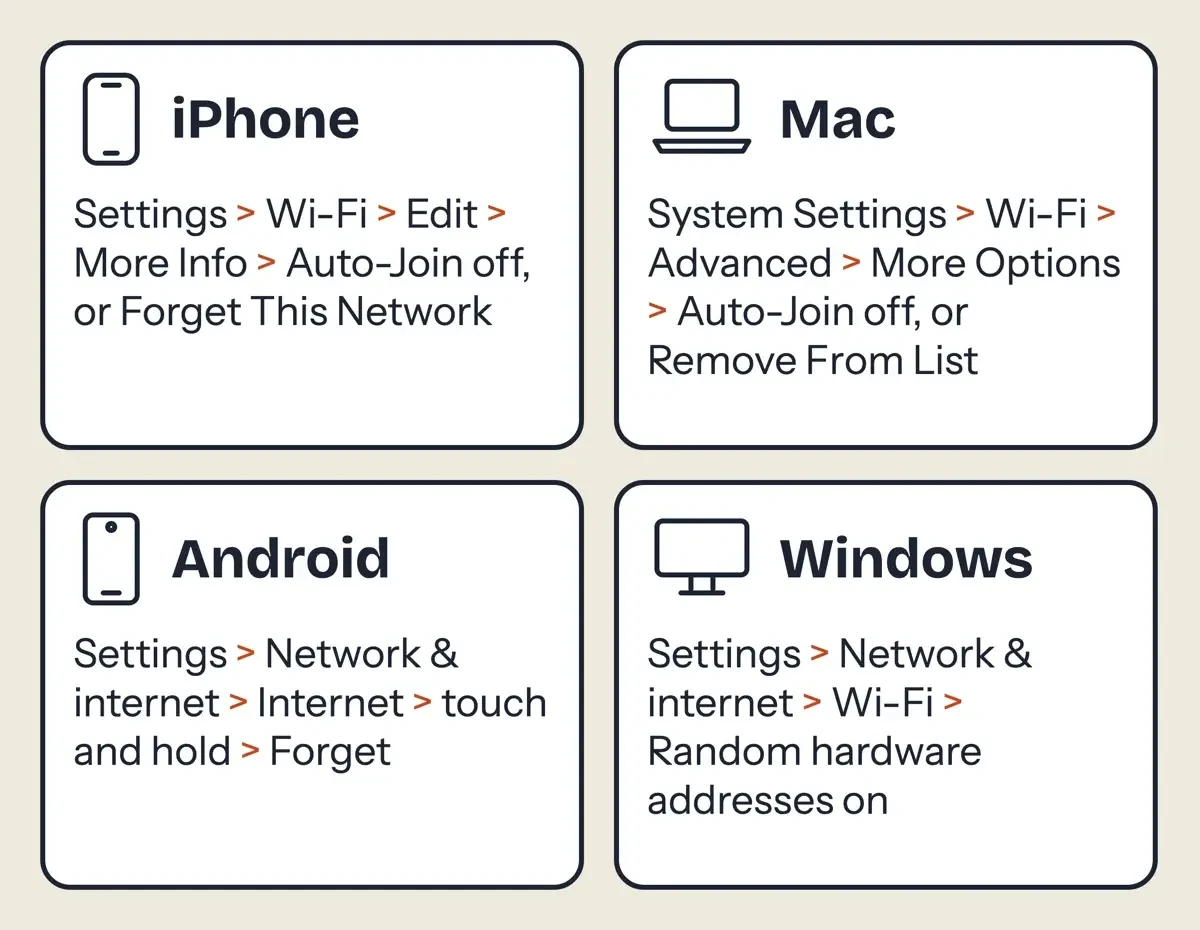 Diagram by DigitalTreed, from Apple, Google and Microsoft help pages, read November 5, 2026
CISA's archived 2021 page also says to "deny sharing files and folders" on public networks, and the FCC and CISA both say to turn Bluetooth off when idle.
On VPNs, the FCC suggests one if you use hotspots "on a regular basis." We don't name a brand; our explainer on VPN server networks covers how one works.
What we tested
On November 5, 2026 we ran a 149-line Python checker offline. It compared the 12 names above with TallowCreek-Guest, the network of a made-up diner. It also found 9 of the safety lines quoted in this guide, from the FTC, FCC, CISA and McDonald's, word for word in our saved copies.
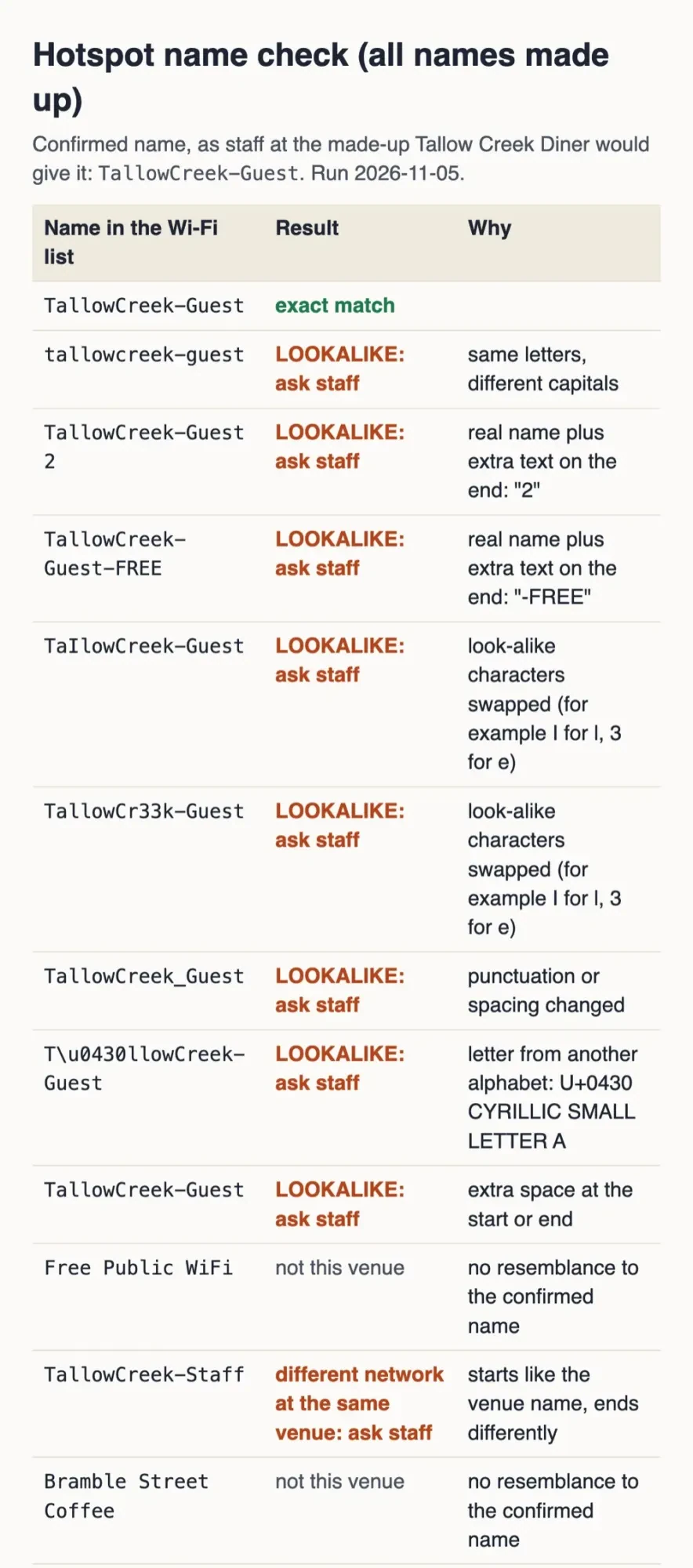 Screenshot: our hotspot name checker on 127.0.0.1, made-up names only, run November 5, 2026
Our routine for a McDonald's stop
The routine starts at the counter: ask staff for the network name, since McDonald's doesn't publish one and the FCC names staff as the check against imposter hotspots. Join only that one. Accept the terms page, then let the bank app run on cellular data. Before you drive off, turn off Auto-Join for that network so your phone joins it only when you choose to. Home Wi-Fi, with a password and router you control, gets its own steps in our Xfinity xFi Complete review and PLDT home Wi-Fi settings guide. For a fuller travel routine, see our security tips for remote workers and these simple online security steps, which add updates, passwords and two-factor sign-in.
Frequently asked
Can you use McDonald's WiFi from the parking lot?
McDonald's doesn't say. CISA's archived 2021 page puts the "typical indoor broadcast range of an access point" at "150–300 feet" and outdoors up to 1,000 feet.
Is a VPN required on McDonald's WiFi?
No. McDonald's lists no such step, and Apple notes that VPN or security software can stop an iPhone joining Wi-Fi.
Is McDonald's WiFi encrypted?
McDonald's pages don't say. CISA's archived 2021 page says to "Ensure that all the access points you connect to use at least WPA2 encryption."
Can a restaurant track your phone over Wi-Fi?
Microsoft says stores "might use" your hardware (MAC) address to track you. Google's advanced network settings page shows a per-network "Randomized MAC address" option on Android.
How we made this guide: McDonald's, the FCC and CISA block automated readers, so we read them in a normal browser and matched every quote to saved copies. Facts checked by the DigitalTreed team on November 5, 2026.
First published December 2023 with an unsourced provider claim and iPhone menu steps that no McDonald's or Apple page supports. Rewritten November 5, 2026 from McDonald's own Wi-Fi pages, the phone and laptop makers' help pages and FTC, FCC and CISA guidance.
Sources
- McDonald's: Free Wi-Fi
- McDonald's: Wi-Fi FAQs
- McDonald's: Do I Need a McDonald's Login to Sign into McDonald's Wi-Fi?
- McDonald's: Terms and Conditions
- Apple Support: If you can't connect to Wi-Fi on your iPhone or iPad
- Apple Mac User Guide: Connect your Mac to the internet using Wi-Fi
- Apple Support: Forget a Wi-Fi network or prevent your device from automatically joining it
- Android Help: Connect to Wi-Fi networks on your Android device
- Android Help: Fix internet connection problems on Android devices
- Android Help: Manage advanced network settings on your Android phone
- Microsoft Support: Connect to a Wi-Fi network in Windows
- Microsoft Support: Wi-Fi network not secure in Windows
- FTC Consumer Advice: Are Public Wi-Fi Networks Safe? What You Need To Know
- FCC: Wireless Connections and Bluetooth Security Tips
- CISA (archived): Securing Wireless Networks
- CISA (archived): Holiday Traveling with Personal Internet-Enabled Devices

Comments
No comments yet. Start the conversation below.