

Quick answer
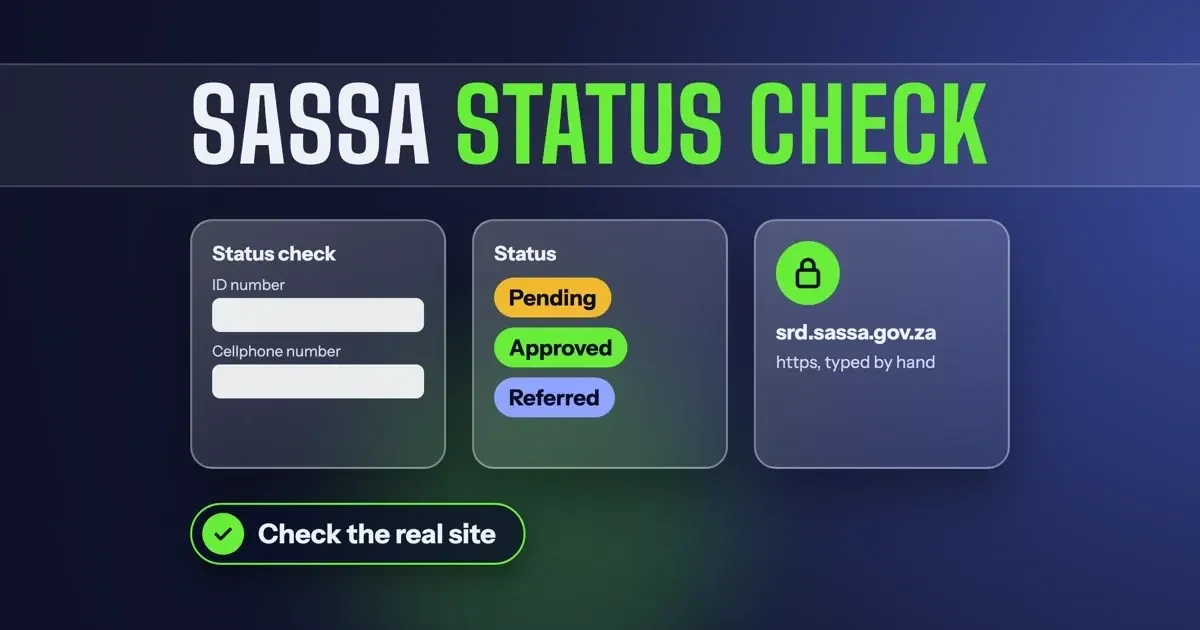
A SASSA status check runs only on srd.sassa.gov.za, by the applicant's South African ID number or registered cellphone number. The SRD grant pays R370 a month, about $22.15 at the October 30, 2026 Federal Reserve rate, through March 31, 2027. A declined month can be appealed within 90 days.
A SASSA status check shows people in South Africa where their Social Relief of Distress (SRD) grant stands. It's a South African benefit, not a US one. SASSA is the South African Social Security Agency, which pays the country's social grants. A relative's status may read referred, a word SASSA has used for two different problems.
SASSA's status page didn't load for us on November 6, 2026, so its words here come from government statements, laws and budget papers.
Key takeaways
- Check SRD status only on srd.sassa.gov.za, typed by hand.
- R370 a month (about $22.15 on October 30, 2026), paid to March 2027.
- SASSA has used "referred" for a duplicate ID and for suspected fraud.
- A declined month can go to the Independent Tribunal within 90 days.
- SASSA's status page didn't load for us on November 6, 2026.
Who runs the SRD grant, and who qualifies
South Africa has a general social relief of distress service on gov.za, which can be a food parcel, a voucher or cash, usually for up to three months. The status check isn't for that one. It's for the grant SASSA's November 2025 statement on phone numbers calls the "COVID-19 Social Relief of Distress (SRD) grant (R370)".
The March 2024 amendment regulations raised the grant from R350 to R370 per person a month. In a February 17, 2026 statement, the Department of Social Development said R370 "will be paid to successful applicants" from April 1, 2026 until March 2027. Treasury's 2026 Budget Review backs that with R36.4 billion, paid "at the current R370 per month per beneficiary" until March 31, 2027.
SAnews reported in 2026 that the extended grant will support "approximately 8 million working-age individuals".
In a January 2025 statement, SASSA's Mpumalanga office listed who can apply: citizens, refugees, asylum seekers and special permit holders aged 18 to 60. Applicants also need insufficient means. They can't be contributing to or eligible for UIF payments.
The November 2025 note splits the form the same way: South African ID holders, or asylum seekers and special permit holders.
How to run a SASSA status check
Those applicants check a status with one of two details, and in May 2026 the government newspaper Vuk'uzenzele gave the official steps in a reply to a reader. The letter says: "Applicants may track the status of their application on the SRD platform using their ID number or the registered cellphone number." The gov.za COVID-19 grants page lists the same site under "Check the status of your application".
SASSA's November 2025 statement asks applicants to use cellphone numbers registered under their own names. That number is how they "monitor, check the progress of the application and receive notifications" from SASSA.
Vuk'uzenzele adds three more parts of applying: a one-time PIN by SMS, an e-KYC face check against Home Affairs records, and a bank account in the applicant's own name.
The gov.za page dates from when the grant was R350. It lists what an application asks for: the ID number, the name as captured in the ID, gender and disability, bank details, a cellphone number and an address. It also says "SASSA does not require any applicant to scan in supporting documents such as ID, proof of address or bank statements." By applying, people let SASSA check those details against bank and government records. A payment won't verify if the bank account isn't theirs, SASSA said in 2025.
On November 6, 2026, srd.sassa.gov.za, www.sassa.gov.za and services.sassa.gov.za gave our checker no answer from outside South Africa. We couldn't test from inside the country. Your relative should run the check themselves.
What each SRD status means, in SASSA's words
SASSA hasn't published one status glossary we could read. Each meaning below comes from a dated provincial SASSA statement, April 2023 to April 2025, and the wording changed in that time.
| Status | What SASSA says it means | Statement |
|---|---|---|
| Pending | Checks with Home Affairs, UIF and the bank are not finished. | April 18, 2023 |
| Approved | All checks passed. Pay still needs bank account details, not just a bank name. | April 18, 2023 |
| Declined | Refused that month, for example details that differ from Home Affairs. | November 11, 2024 |
| Referred (2024) | ID number already registered. Phone or visit SASSA. | November 11, 2024 |
| Referred (2025) | The system suspects fraud. Contact SASSA right away. | January 20, 2025 |
| Identity verification | Suspected fraud or wrong details. Use the SMS link within 72 hours. | April 28, 2025 |
| Cancelled | Cancelled for suspected fraud. The person may reapply. | January 20, 2025 |
SASSA has used referred two ways. In November 2024 it tied the word to an ID number already registered for the grant, and told people to phone or visit SASSA. In January 2025 it said the word means "the SASSA system is suspecting fraudulent activity", and told people to contact SASSA right away.
For pending, SASSA's April 2023 statement says: "If the verification of the above mentioned requirements are not yet finalised, the status will state 'pending'." Approval doesn't always mean payment, since the same statement on gov.za says some approved people chose a bank's name but never gave an account number.
For identity verification, the April 2025 statement says "the clients will receive a link via SMS and it must be attended to within 72 hours."
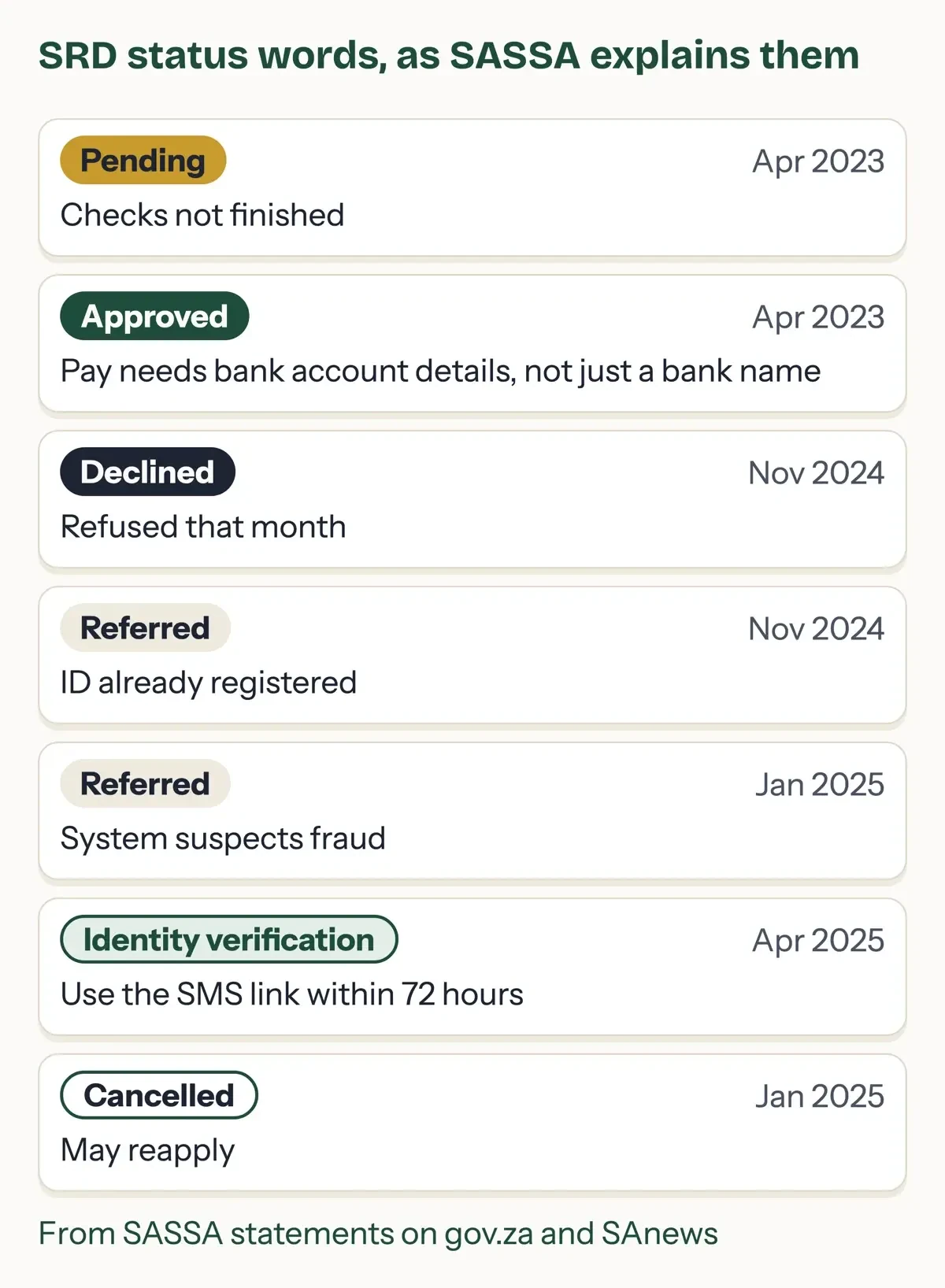 Diagram by DigitalTreed, from SASSA statements on gov.za and SAnews dated 2023 to 2025, read November 6, 2026.
R370 in rand and dollars, and when it pays
Once approved, a person gets R370 a month. The Federal Reserve's H.10 release of November 2, 2026 lists 16.7055 rand per US dollar for October 30, 2026. Example: R370 / 16.7055 = about $22.15 a month. A full year is 12 x R370 = R4,440, or about $265.78 at the October 30, 2026 rate, though the dollar figure moves as the rate does. SASSA's 2026/27 payment schedule, as SAnews reported it on March 23, 2026, gives dates for older persons, disability and children's grants. It doesn't give one for SRD. SASSA's November 2025 statement only says that once bank details are verified, "the grant will be received from next pay run."
Regulation 6A of the 2024 amendment covers approved people who weren't paid because SASSA couldn't trace them or they didn't update their details. After 90 days from being told to update, the application may be suspended. After another 90 days without an answer, it's cancelled. The State keeps the money.
How do you appeal a declined month?
SASSA's November 2024 statement tells declined applicants who believe they qualify to appeal by "logging in on the SRD website, select appeal option and click on DSD Appeals." The Department of Social Development's Social Grant Appeal page points its "COVID-19 SRD Appeals" menu at that same SRD site. Late appeals get a condonation form.
The Social Assistance Amendment Act of 2020 lets an applicant who disagrees with SASSA, "within 90 days of the decision being made, lodge a written appeal with the Independent Tribunal". Its full name is the Independent Tribunal for Social Assistance Appeals, or ITSAA, as a 2010 Parliamentary Monitoring Group record calls it. Under the 2011 appeal regulations, the Tribunal can accept a late appeal "upon good cause shown". An appeal must be finalised within 90 days of the Tribunal receiving it.
The same rules let an appeal be "delivered by hand, post, fax or electronic mail", so papers sent for a relative can go by email.
The 2020 Act says the appeal "must set out the reasons for the appeal against such a decision and why the Independent Tribunal should vary or set aside such decision". The 2011 regulations add a limit. The appellant "must not be allowed to produce any evidence or information which was not provided to the Agency" when they applied. So, in our reading, a wrong bank account can't be fixed through the appeal itself. You'd correct the details on the SRD site, then argue the decision on what SASSA already had. If the reason was income in the bank account, say what that money was and why it wasn't income.
Example: a month declined on May 4 should be appealed by about August 2, and since each status line covers only one month, check every month separately.
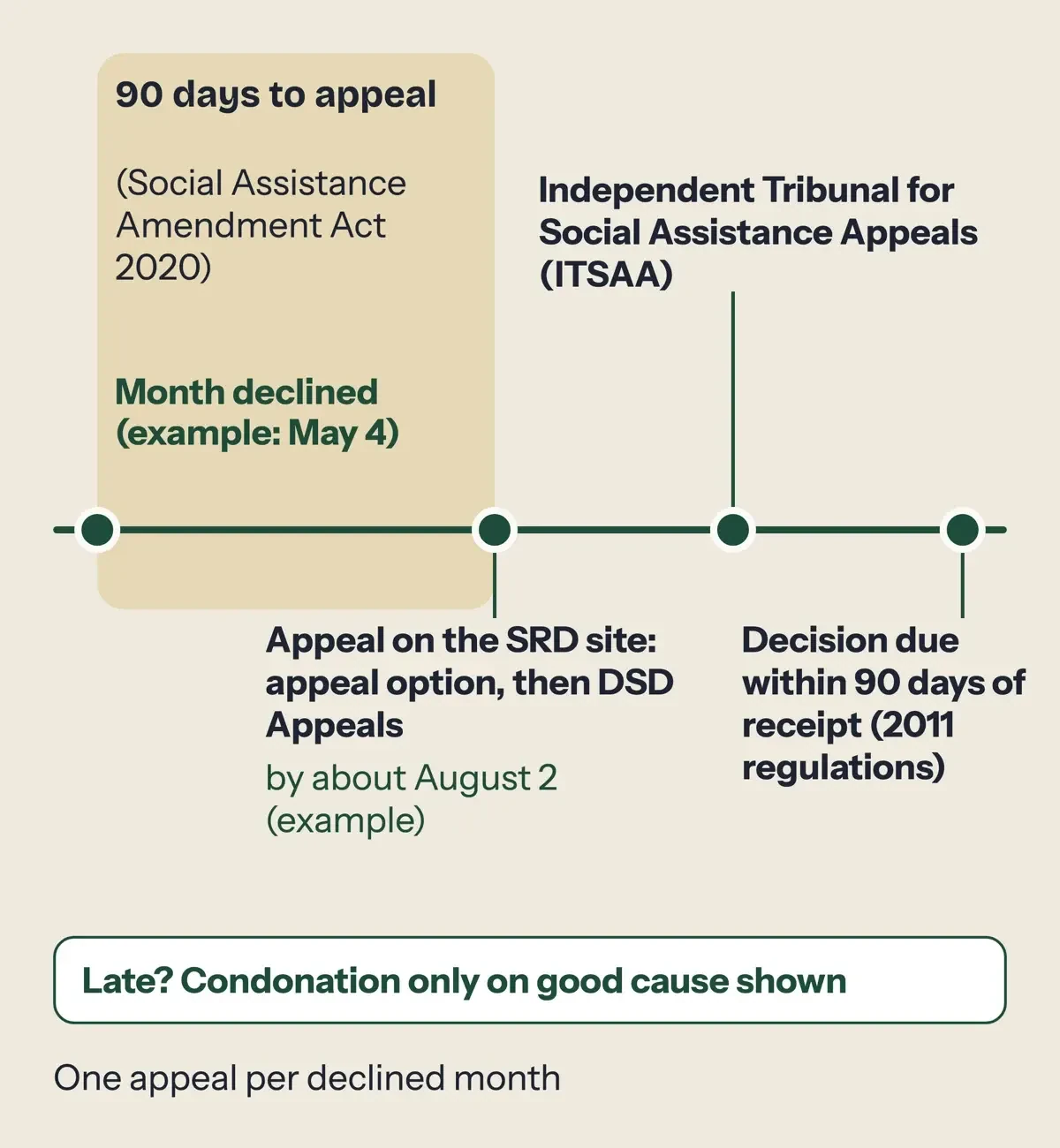 Diagram by DigitalTreed, from the Social Assistance Amendment Act 2020, the 2011 appeal regulations and SASSA's November 2024 statement.
Fake SRD status sites SASSA has named
On February 26, 2025, the Department of Social Development and SASSA warned that the real platform is SRD.sassa.gov.za. As SAnews reported, two other addresses, srd-sassa.org.za and srdsassagov.co.za, "are fake and are used to collect data from unsuspecting applicants". We don't link either one. The gov.za grants page from the R350 days says there's no charge to apply and warns people not to buy "application forms". Nobody should get a PIN or card CVV number, it adds, "not even SASSA".
In October 2022, SASSA said scammers offered help on WhatsApp, then changed applicants' contact details. Its answer: "SASSA official customer care cannot change beneficiary contacts details without their request".
In January 2026, the department called posts saying the grant would end false. "There is no such decision, announcement or directive from the department or government regarding the termination of the SRD", it said. If someone already typed details into a lookalike page, read our steps on what happens after a phishing link and our phishing prevention tips.
Two of our made-up test links show why the start of a link proves nothing: in https://[email protected], a browser ignores everything before the @ sign. In the other, a Cyrillic letter that looks like a Latin a turns srd.sassa.gov.za into srd.xn--sssa-53d.gov.za, a domain that isn't SASSA's, and our checker marked it not official.
Our lookalike domain check of two finance sites shows the pattern on a US example. Our explainer on why a site needs an SSL certificate covers what the padlock does and doesn't prove.
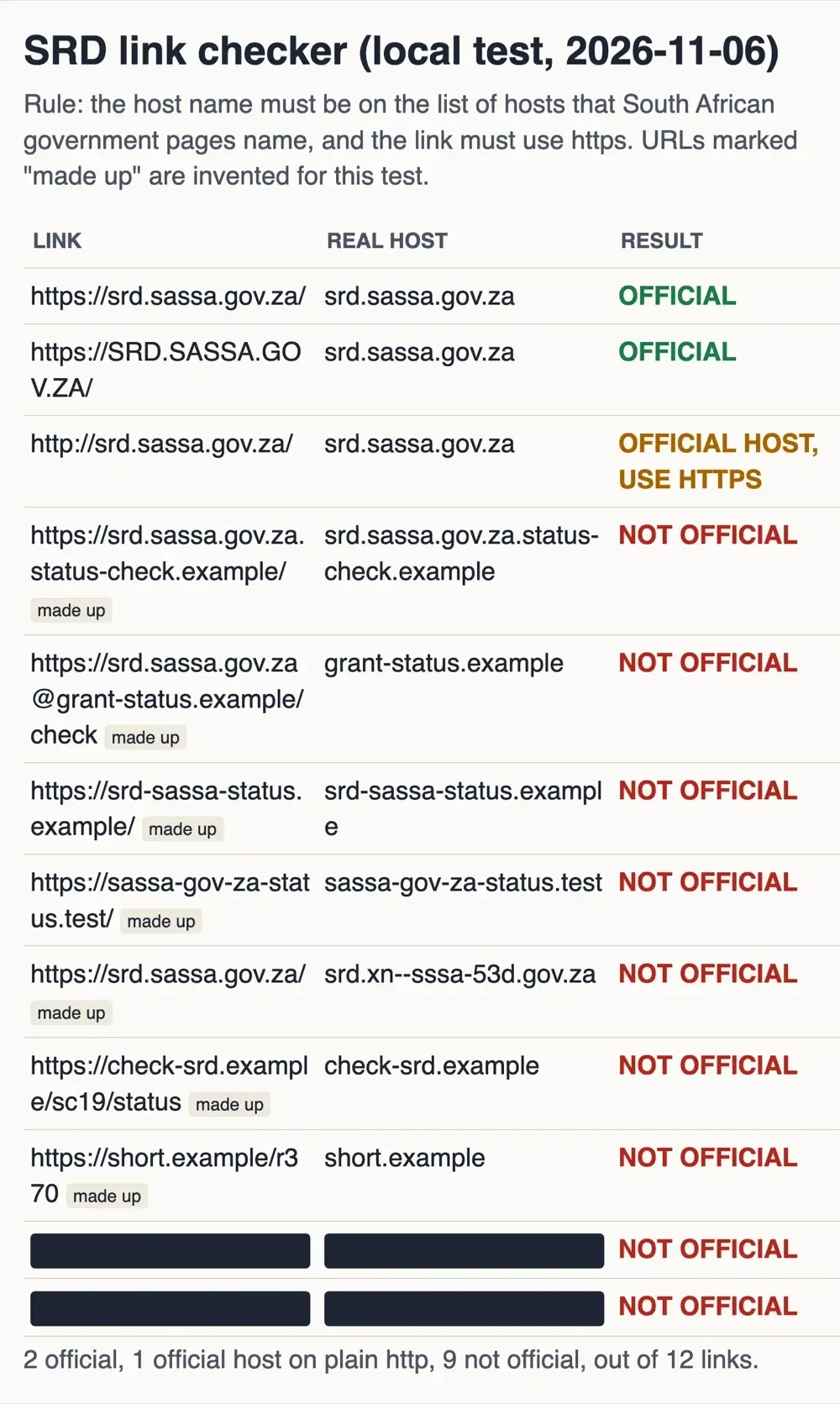 Screenshot: our SRD link checker served on 127.0.0.1, November 6, 2026. The links marked made up are invented.
What we tested
On November 6, 2026 we ran a small Python script that sorts links by real host name. A link passes only if its host is on a list South African government pages name, over https. We fed it 12 links: 7 made up, 3 real SRD addresses and the 2 named fakes, parsed but never opened. Result: 2 official, 1 official host on plain http, 9 not official.
| Link tested | Real host | Result |
|---|---|---|
| https://srd.sassa.gov.za/ | srd.sassa.gov.za | Official |
| https://SRD.SASSA.GOV.ZA/ | srd.sassa.gov.za | Official |
| http://srd.sassa.gov.za/ | srd.sassa.gov.za | Use https |
| https://srd.sassa.gov.za.status-check.example/ (made up) | srd.sassa.gov.za.status-check.example | Not official |
| https://[email protected]/check (made up) | grant-status.example | Not official |
| https://srd-sassa-status.example/ (made up) | srd-sassa-status.example | Not official |
| https://sassa-gov-za-status.test/ (made up) | sassa-gov-za-status.test | Not official |
| https://srd.sаssa.gov.za/ (made up) | srd.xn--sssa-53d.gov.za | Not official |
| https://check-srd.example/sc19/status (made up) | check-srd.example | Not official |
| https://short.example/r370 (made up) | short.example | Not official |
| https://srd-sassa.org.za | srd-sassa.org.za | Not official |
| https://srdsassagov.co.za | srdsassagov.co.za | Not official |
Next, the script checked TLS certificates in full. www.gov.za, www.sanews.gov.za and www.dsd.gov.za passed. The three SASSA hosts gave no answer within 25 seconds. srd.dsd.gov.za failed: its certificate doesn't match that name.
Supporting a relative in South Africa from abroad
The gov.za requirements list, written for the first R350 grant, included "Resident within the borders of the Republic of South Africa". SASSA's later notes still want a phone number and a bank account in the applicant's own name. A US number or account can't stand in. The face check uses their Home Affairs record. SASSA's 2022 warning told people to apply themselves or "request a person that they trust and have access to see or visit them". That points to someone nearby who can visit. From abroad, you can sit on a video call while they type the address. Read the status word against the table above, and put any appeal date in a shared calendar.
For questions, SASSA's April 2025 identity verification notice lists the toll-free line 0800 60 10 11 and WhatsApp 082 046 8553. They're South African numbers. Your relative can call them from their own phone.
SASSA status check vs a US benefit status check
The USAGov Social Security page says a free "my Social Security" account lets you "Check your Social Security benefit application status." SNAP runs through states. As the USAGov food assistance page puts it, "To apply for SNAP, contact your state or local SNAP office." Benefits.gov, the old federal site, now forwards to the USAGov Benefit Finder. On the US side, "Only verified U.S. government organizations can register and operate a .gov domain", says CISA's get.gov eligibility page. The FTC's government impersonation guide adds: "Government agencies will never call, email, text, or message you on social media to ask for money or personal information." The FTC says caller ID can be faked.
| Question | SRD grant (South Africa) | US benefits |
|---|---|---|
| Where to check | srd.sassa.gov.za, by ID or registered cellphone number | my Social Security; your state SNAP office |
| Who runs it | SASSA, under Social Development | SSA; state agencies for SNAP |
| Real site test | Hosts named by government pages | .gov, verified US government only |
| Appeal | SRD site, then the Tribunal within 90 days | Set by each program |
| Scam warnings | SASSA and DSD statements | FTC impersonation guide |
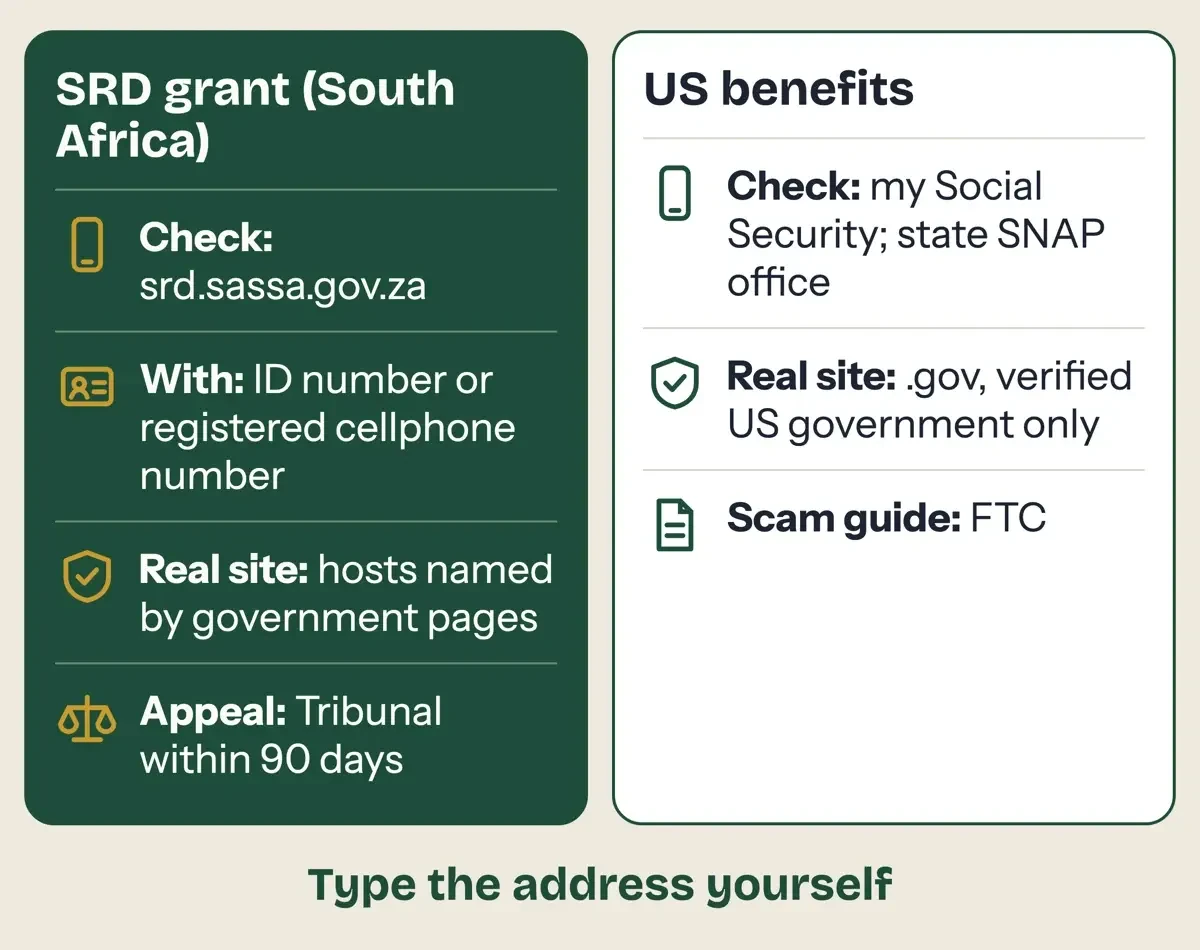 Drawn by us from SASSA statements, CISA's .gov rules, USAGov pages and the FTC guide, November 6, 2026.
If you draw Social Security while living abroad, USAGov's page on benefits outside the US says SSA sends a questionnaire every 1 to 2 years. Skip it, and payments may stop. SASSA's 90-day rule for untraced people works much the same way.
Our guides on free phones with SNAP and government money programs list US routes, and our text mail subscriber explainer covers calls that pose as agencies. Treat every SRD link that arrives by text or WhatsApp as unverified, and have your relative type the address.
SASSA status check questions
Frequently asked
Can I check SRD status with only an ID number?
Yes. Vuk'uzenzele's 2026 answer to a reader says either the ID number or the registered cellphone number works.
Is the SRD grant ending?
It's funded to March 31, 2027 in Treasury's 2026 Budget Review. The department said draft regulations for the 12-month extension went out for comment on February 11, 2026.
What if SASSA cannot reach me after approval?
The 2024 amendment regulations make keeping a current mobile number the applicant's job; SASSA "bears no liability for any communication sent to an incorrect mobile number".
Do I pay to apply for the SRD grant?
No. The gov.za service page says of social relief of distress: "The service is free."
How we made this guide: SASSA's sites didn't answer our checker. So we saved its statements on gov.za and SAnews, the laws, the Budget Review and the US pages in Sources, then matched every quote. Facts checked by the DigitalTreed team on November 6, 2026. Appeal rules summarized, not legal advice.
First published December 2023 with status meanings and steps that had no sources. Rewritten November 6, 2026 from South African government statements and laws, with a US comparison.
Sources
- South African Government: Social relief of distress
- South African Government: Social grants, Coronavirus COVID-19
- National Treasury: 2026 Budget Review, Chapter 5
- SAnews: Social grants remain central as Social Development tables R302bn budget
- SAnews: Public comment sought on special COVID-19 SRD amendments
- South African Government: Minister calls for public comments on COVID-19 SRD regulation amendments
- Government Gazette 50369: Amendment Regulations relating to COVID-19 Social Relief of Distress, 2024
- Social Assistance Amendment Act 16 of 2020 (Parliament of South Africa)
- Government Gazette 34618: Regulations on lodging and consideration of appeals, 2011
- Department of Social Development: Social Grant Appeal
- Parliamentary Monitoring Group: Independent Tribunal for Social Assistance Appeals briefing
- SAnews: SASSA explains R350 grant application approval process
- South African Government: SASSA on approving R350 grant application after bank verification
- South African Government: SASSA encourages declined SRD R370 applicants to lodge appeal
- SAnews: All fraudulent COVID-19 SRD grants automatically canceled
- South African Government: SASSA on cancellation of fraudulent COVID-19 SRD grant
- SAnews: SRD grant beneficiaries urged to verify identity to avoid delays
- SAnews: SASSA urges use of registered cellphone numbers for SRD grant
- Vuk'uzenzele: Letter to the editor on SRD applications
- SAnews: Beware of fake COVID-19 SRD application sites
- SAnews: SASSA advises beneficiaries to keep verifying contact details
- SAnews: Government dismisses claims COVID-19 SRD grant is ending
- SAnews: SASSA announces 2026/27 social grant payment dates
- Federal Reserve: H.10 Foreign Exchange Rates, November 2, 2026
- FTC: How to avoid a government impersonation scam
- CISA get.gov: Eligibility for .gov domains
- USAGov: What is Social Security
- USAGov: Food stamps (SNAP benefits)
- USAGov: Benefit Finder
- USAGov: Social Security abroad


Comments
No comments yet. Start the conversation below.