

Quick answer
SNAP qualifies you for Lifeline, a discount of up to $9.25 a month on phone or internet service, not a free iPhone (as of October 2026). On qualifying Tribal lands the discount rises to $34.25, and a voice-only plan gets $5.25. Apply through the National Verifier first (Oregon and Texas use a state site), then choose a company; any phone you get is that company's own offer.
An ad says your EBT card gets you a free iPhone today, and the sign-up box under it already wants your name and date of birth. Lifeline is a federal discount on monthly phone or internet service for low-income households, run by USAC under FCC rules. This guide explains the rules; it is not legal advice. The Lifeline Support Center at (800) 234-9473 handles your own application, and a legal aid office can help after a denial.
Below are the three monthly amounts: $9.25, $5.25 for voice only and $34.25 on Tribal lands. Then come the programs that count besides SNAP and the household test we ran on nine made-up homes. After that come the National Verifier steps, the ACP end date, five made-up ads checked against the rules, and the 30-day and yearly rules that keep the discount. Our order: apply for the discount, then pick the plan, and treat any phone as the company's own offer.
Key takeaways
- SNAP qualifies your household for Lifeline, up to $9.25 a month (October 2026).
- Lifeline pays toward service; a phone comes only if a company offers one.
- Roommates who keep separate money can each get one benefit at one address.
- On qualifying Tribal lands the discount rises to $34.25 a month (October 2026).
- ACP's $30 internet discount ended June 1, 2024; ads still promising it are outdated.
Can you get a free iPhone with food stamps?
Not from the program itself. The rule's wording settles it: under 47 CFR 54.401(a), "Lifeline means a non-transferable retail service offering." The benefit attaches to a phone or internet plan, not to a handset. USAC's Lifeline Support home page describes the program the plain way, as one that "lowers the monthly cost of phone or internet service."
So why do the ads show phones? A company may hand one out, and the FCC sets rules for when it does. The device rule in 47 CFR 54.408(f) covers a provider "which provides devices to its consumers," and every device that provider hands out has to be Wi-Fi enabled. A mobile data provider that gives out devices must also offer at least one that works as a hotspot. Nothing in the rule names a model, though, and nothing makes a company give you a phone at all, so a flagship iPhone in an ad is the company's marketing. Its own fine print sets the terms.
The word free usually describes the plan, not a phone. USAC's About page mentions Lifeline service you "don't pay out-of-pocket for," and those plans carry a use-it-or-lose-it rule covered below.
What you can count on is narrower. If your company offers devices with a data plan, at least one must work as a hotspot, per USAC's Your Rights page, and you can change companies at any time. Already own a phone? Ask the company whether it works on the Lifeline plan instead of buying a new one. If you do switch handsets, here's how to move your messages to a new iPhone.
What Lifeline gives you each month
Your company takes the discount off the monthly bill. Three federal amounts apply as of October 2026. Which one you get depends on the plan and on where you live:
| Plan or place | Monthly discount, up to | Where the number comes from |
| Home internet, a phone plan whose data meets the minimum, or a bundle | $9.25 | USAC About Lifeline; 47 CFR 54.403(a)(1) |
| Voice only, or voice with data below the minimum | $5.25 | USAC FAQ; USAC minimum service standards page |
| Qualifying Tribal lands | $34.25 ($9.25 plus up to $25) | USAC Tribal Lands Benefit; 47 CFR 54.403(a)(3) |
The middle row matters if your plan is minutes only. USAC's minimum service standards page says $5.25 "remains available to eligible consumers who subscribe to voice-only service through November 30, 2027." The reason, in the same page's words: "On July 1, 2026 the Wireline Competition Bureau (WCB), paused the phase-out of Lifeline support for voice-only services for an additional year." The full $9.25 in 47 CFR 54.403 needs a plan that meets the broadband minimum. For a cell plan, USAC's rights page puts that at 4.5 GB of data a month. Home internet has to reach 25/3 Mbps and 1,280 GB a month.
Tribal lands add more. The rule allows "up to $25 per month" on top, and USAC's Tribal Lands Benefit page shows the total as up to $34.25. Residents may also get Link Up under 47 CFR 54.413, which takes up to $100 off the set-up charge for phone service at the home address. If set-up costs more than $100, USAC says Link Up can offer a no-interest payment plan of up to $200 for one year. USAC's Tribal Lands Verification Tool shows whether an address qualifies, but USAC says the tool "does not establish your eligibility." To see which home connection types usually reach the 25/3 Mbps minimum, our broadband connection types explainer compares them.
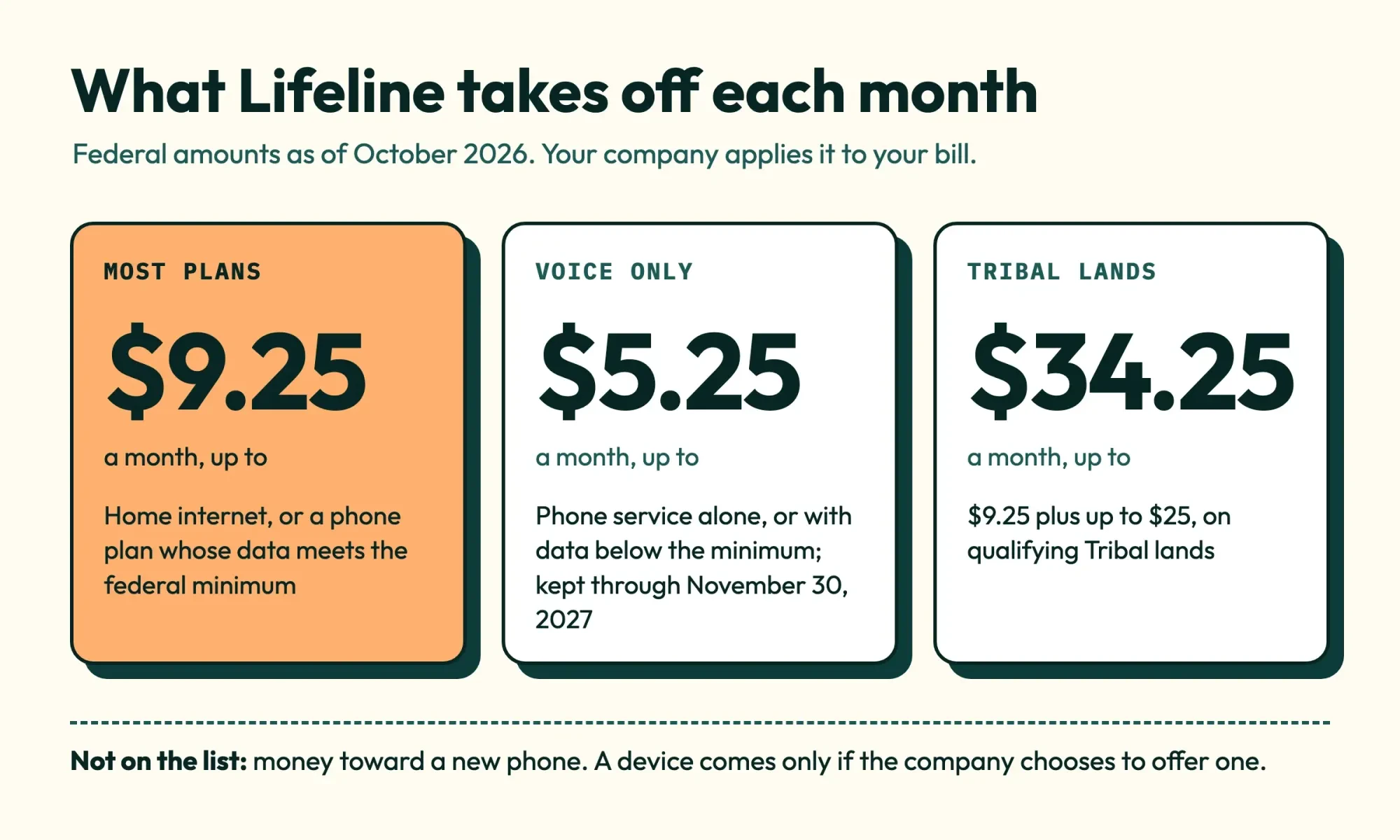 Drawn by us. Amounts as of October 2026 from USAC's Lifeline pages and 47 CFR 54.403; no company or plan is shown.
Does SNAP qualify you, and what else counts?
Yes, and you usually won't need an income check. USAC's How to Qualify page lists "Supplemental Nutrition Assistance Program (SNAP), formerly known as Food Stamps," and USA.gov's food stamps page confirms the old name. It also counts when the SNAP case belongs to your dependent or to someone in your household, the people you share income and bills with. The rule, 47 CFR 54.409(a)(2), covers "The consumer, one or more of the consumer's dependents, or the consumer's household."
The federal list is short. The rule names five programs, and four more count only on Tribal lands:
- Medicaid
- Supplemental Nutrition Assistance Program (SNAP)
- Supplemental Security Income (SSI)
- Federal Public Housing Assistance (USAC lists Section 8 vouchers, project-based rental help and public housing under it)
- Veterans and Survivors Pension Benefit
- On Tribal lands only: Bureau of Indian Affairs General Assistance, Tribal TANF, Head Start (income-qualified households only), Food Distribution Program on Indian Reservations
No listed program? Then income is the other way in. The limit is 135% of the federal poverty guidelines. For 2026, USAC's table shows $21,546 a year for one person, $29,214 for two and $44,550 for four in the 48 contiguous states, DC and the territories. Alaska and Hawaii run higher, at $55,688 and $51,233 for four.
We checked those figures against HHS's 2026 poverty guidelines. One person's guideline is $15,960, and $15,960 x 1.35 = $21,546. All seven values we tested matched.
WIC, free school lunch and a Pell Grant aren't on the main list. USAC counts them only for survivors who've asked to separate their line from a shared plan.
Proof can be simple. USAC's Supporting Documents page asks for a document showing your name or your dependent's, the program, who issued it, and a recent date. The date must fall within the last 12 months, or the document must expire in the future. A SNAP benefit letter works, and so does a screenshot of your online benefits portal. If your letter is old, ask your state or local SNAP office for a current one; USA.gov's page links to a tool to find that office. For income, USAC accepts a prior year's tax return, a Social Security benefits statement or an unemployment statement. Three months of pay stubs in a row, dated within the last 12 months, also work.
One benefit per household: who counts as your household
This is the rule that decides how many people in one home can get Lifeline. Section 54.409(c) says there "must not be anyone else in the subscriber's household subscribed to a Lifeline service." USAC's About Lifeline page is blunter: "Only one discount is allowed per household." But household is a defined word here, and it isn't the same as an address.
The definition in 47 CFR 54.400(h) is "any individual or group of individuals who are living together at the same address as one economic unit." An economic unit is the adults who share the income and the expenses. So two roommates who keep their own income and pay their own bills can be two households, while a married couple paying every bill from one account is clearly one. And an adult with "no or minimal income" who's supported by someone at the same address counts in that person's household. Children under 18 who live with a parent or guardian count in that parent's household, too, whatever their own benefits are.
Two households at one address need a form. USAC's Consumer Eligibility page says the Household Worksheet "must be completed any time more than one subscriber at a single residential address receives Lifeline-supported service."
The form you sign carries a warning. The certification in 47 CFR 54.410(d)(3) warns that false statements "can result in fines, imprisonment, de-enrollment or being barred from the program."
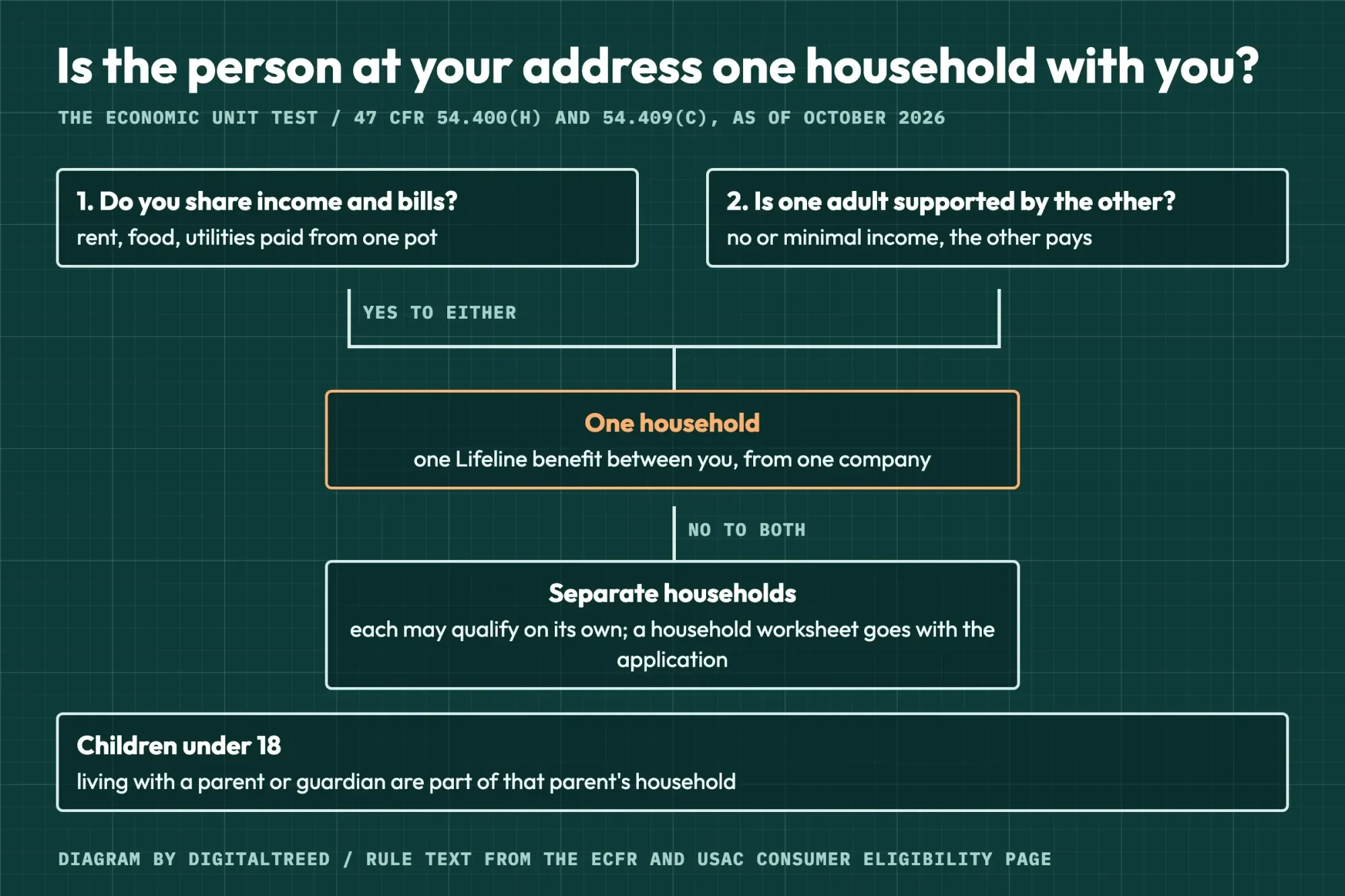 Diagram by DigitalTreed: the household test in 47 CFR 54.400(h) and 54.409(c), drawn as two questions, as of October 2026.
Our checker run below puts made-up homes through this test: one plain case, then three that turn on the household rule. Home A, a single adult on SNAP in Ohio, was the plain case and got $9.25. Roommates B1 and B2 keep separate money, so each formed its own unit and each qualified for $9.25, with the worksheet flag on. The couple in home C share bills. So only one of them could get the benefit, and that held even though just one of them is on SNAP. In home D, a 22-year-old with no income counted in the parent's household, and since the parent already had Lifeline, the answer for the child was no.
Income rows show how much the state matters. Homes E and F both earn $50,000 with four people, yet only E, in Hawaii, came in under its $51,233 limit. Home F, in Texas, went over the $44,550 limit for the 48 states. Home I, on WIC only, earned $31,000 for two and missed the $29,214 line by $1,786. Home G on Tribal lands came out at $34.25, and home H's voice-only plan at $5.25.
What we tested
Our small Python checker took nine made-up homes, A to I, through the rules on October 29, 2026. It groups adults into economic units, applies the program list, the 135% table and the amounts, and scans five made-up ad lines. Nothing went to USAC or a phone company. The full log:
Lifeline household checker, 9 made-up homes, rules as of October 2026
135% table vs HHS 2026 x 1.35: 7 of 7 match
A A1 qualifies via SNAP $9.25
B B1 qualifies via SNAP $9.25
B B2 qualifies via SNAP $9.25
B two units at one address: household worksheet
C C1+C2 qualifies, but only one of C1, C2 can get it via SNAP $9.25
D D1+D2 no: already has Lifeline (D1) via SNAP none
E E1 qualifies via income, limit $51,233 HI $9.25
F F1 no: income $50,000 above $44,550 via none none
G G1 qualifies via Tribal FDPIR $34.25
H H1 qualifies via SNAP $5.25
I I1 no: income $31,000 above $29,214 via none none
Ads: 1 device promise; 2 ACP, device promise; 3 per-person promise; 4 payment by gift card; 5 no flag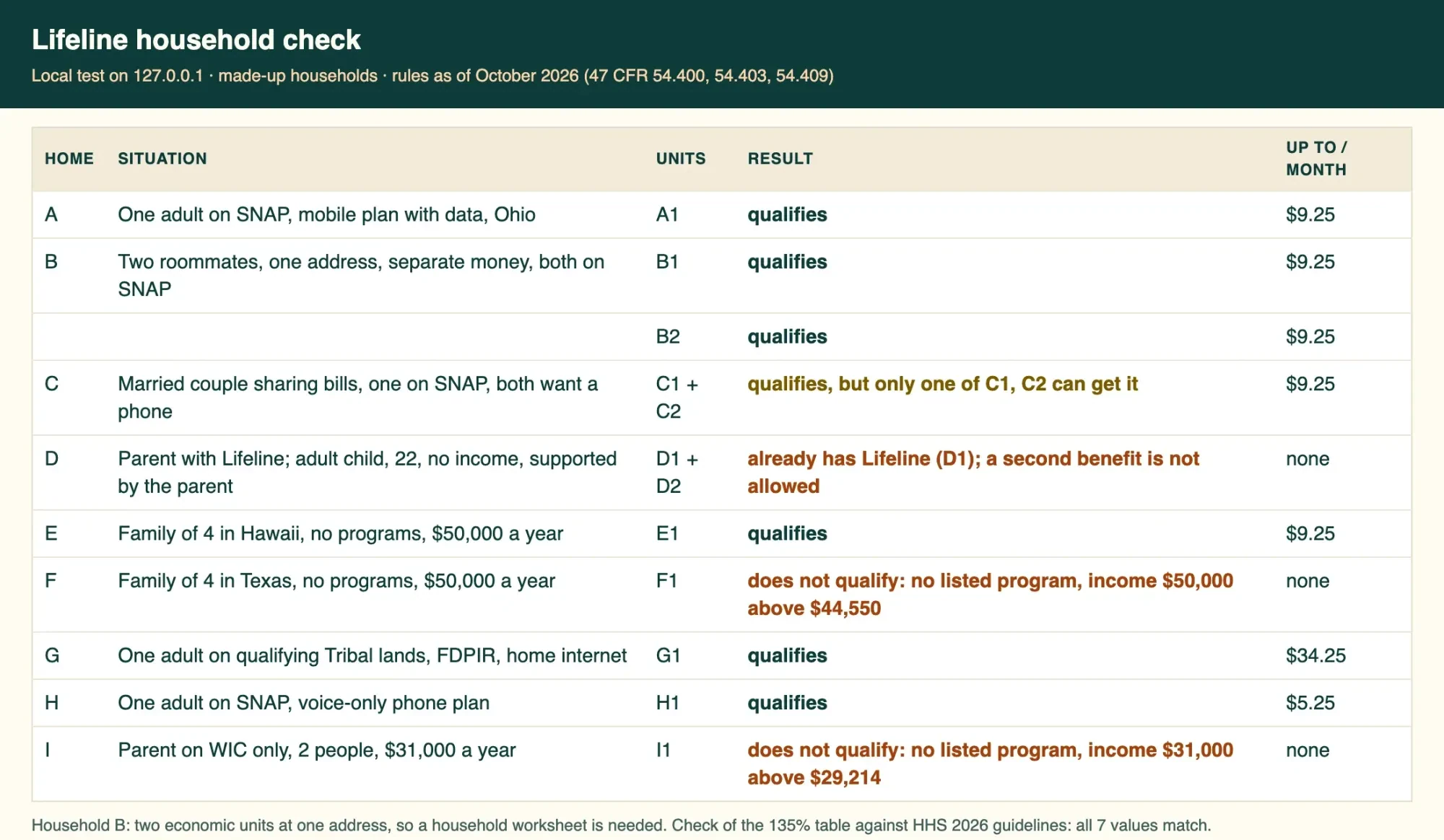 Screenshot: nine made-up homes in our checker at 127.0.0.1, October 29, 2026.
How to apply with SNAP through the National Verifier
Once your household looks eligible, the application itself is short. USAC calls the National Verifier "Lifeline's centralized application system." It checks state databases first, and it asks for documents only when it can't find you there, which is why a current SNAP letter is worth having ready. USAC's How to Apply page gives three ways in:
- Online, through the National Verifier.
- Through a phone or internet company that offers Lifeline, which uses the same system for you.
- By mail to the Lifeline Support Center, PO Box 1000, Horseheads, NY 14845, with the printed form.
Texas and Oregon are different. USAC says, "If you live in Oregon or Texas, visit your state website to apply." Everywhere else, USAC's Lifeline FAQ says you'll give your full name, date of birth and home address. You'll also give the last four digits of your Social Security number or Tribal ID. Type those only into the National Verifier, a paper form, or your state's Lifeline site in Texas or Oregon, and never into a form an ad links to. It's worth learning how lookalike sites copy real ones before you trust an address. Even the last four digits deserve care, as our page on why Social Security number lookups are not public explains.
After approval, you choose a company. USAC's Companies Near Me tool searches by ZIP code, though USAC warns that "The search results may not show every company that is near you." Ask two things before you sign: which plan the discount goes on, and whether a phone is included, sold or not offered.
Can't apply online? Call (800) 234-9473, and USAC can mail you a paper application. The same line helps people with a disability. It's the Lifeline Support Center, and USAC's FAQ says it's open seven days a week, 9:00 a.m. to 9:00 p.m. ET. Email works too, at [email protected].
The ACP ended on June 1, 2024
The 2023 text on this page pointed readers to a second program, and it's gone. The Affordable Connectivity Program gave, in USAC's words, "a discount of up to $30 per month for broadband services." It also offered a one-time device discount of up to $100. USAC's ACP page is direct: "The ACP ended on June 1, 2024, due to a lack of additional funding from Congress."
The FCC put it in writing too. An April 3, 2026 FCC notice in the Federal Register says the ACP "effectively ended June 1, 2024, because funding for the program had been exhausted."
The same notice asks about tighter checks on Lifeline sign-ups and transfers, and its comment period closed on May 4, 2026, with no final rule in the eCFR yet. The eCFR text we read, current to October 27, 2026, still shows every amount in this guide. A $30 ACP promise in an ad today is more than two years out of date.
Reading a free-phone ad against the rules
Lifeline ads themselves are normal. USAC's Advertise Lifeline page says every provider must advertise the program "in a manner reasonably designed to reach eligible households".
Each of our five made-up ad lines makes one claim the rules can test. Our checker flagged four of the five made-up lines and passed the last one, which only stated the $9.25 discount:
| Made-up ad line | What the rule says |
| Free new iPhone with food stamps. Apply today! | Support pays for monthly service (54.403); a device comes only if the company offers one (54.408(f)) |
| Get a free phone and $30 off internet every month with ACP | Same device point; and the ACP ended June 1, 2024 (USAC, FCC) |
| Sign up everyone in your home for their own Lifeline line | One benefit per household (54.409(c)); only separate economic units can each get one |
| Government phone grant: pay the $25 activation fee with a gift card | The FTC says no government agency will demand payment by gift card |
| Lifeline: up to $9.25 off phone or internet each month if you qualify | No flag; it matches the federal amount |
Ad 4 asks for a gift card. The FTC's government impersonation page says, "No government agency will demand you wire money or pay with gift cards, cryptocurrency, or a payment app."
You can report that kind of offer at ReportFraud.ftc.gov. If the offer reached you by text, these notes on texts from unknown senders show the usual patterns.
Already filled in a free-phone form you now doubt? Start with these steps after clicking a phishing link. USAC's FAQ adds a Lifeline-only step for when someone is using your information to get the benefit: call USAC at (800) 234-9473. The same FAQ says, "Please also contact the FCC's Lifeline Fraud Tip Line at (855) 455-8477."
Keeping the benefit after you sign up
After approval, the benefit isn't permanent. USAC's About page lists what keeps it, and the use rule is in 47 CFR 54.405(e)(3). On a plan with no monthly bill, "you must use it at least once every 30 days to keep your service." Miss that, and a 15-day notice comes before the service is shut off, so a phone left unused in a drawer for a month can cost you the benefit. You also tell your company within 30 days if you move or stop qualifying, or if someone else in your household gets Lifeline.
Once a year, USAC or your state checks that you still qualify. If a database can't confirm it, a letter or email arrives, and USAC says reminders may also come by mail, email or a recorded message on your phone. USAC's Recertify page says you "must do so within 60 days, or you will lose your Lifeline benefit." You can answer online, or by mail with copies of any proof the letter asks for. Calling (855) 359-4299 with the application ID from your letter works only when the letter asks for no proof. If the deadline passes and the discount ends, USAC says you can reapply if you think you still qualify.
Switching companies is allowed as well. The Change My Company page says you may transfer "at any time," and once the move is complete, the benefit ends at the old company.
A company that won't help is a separate problem. USAC's rights page says to complain to your state's public utility regulator, USAC or the FCC.
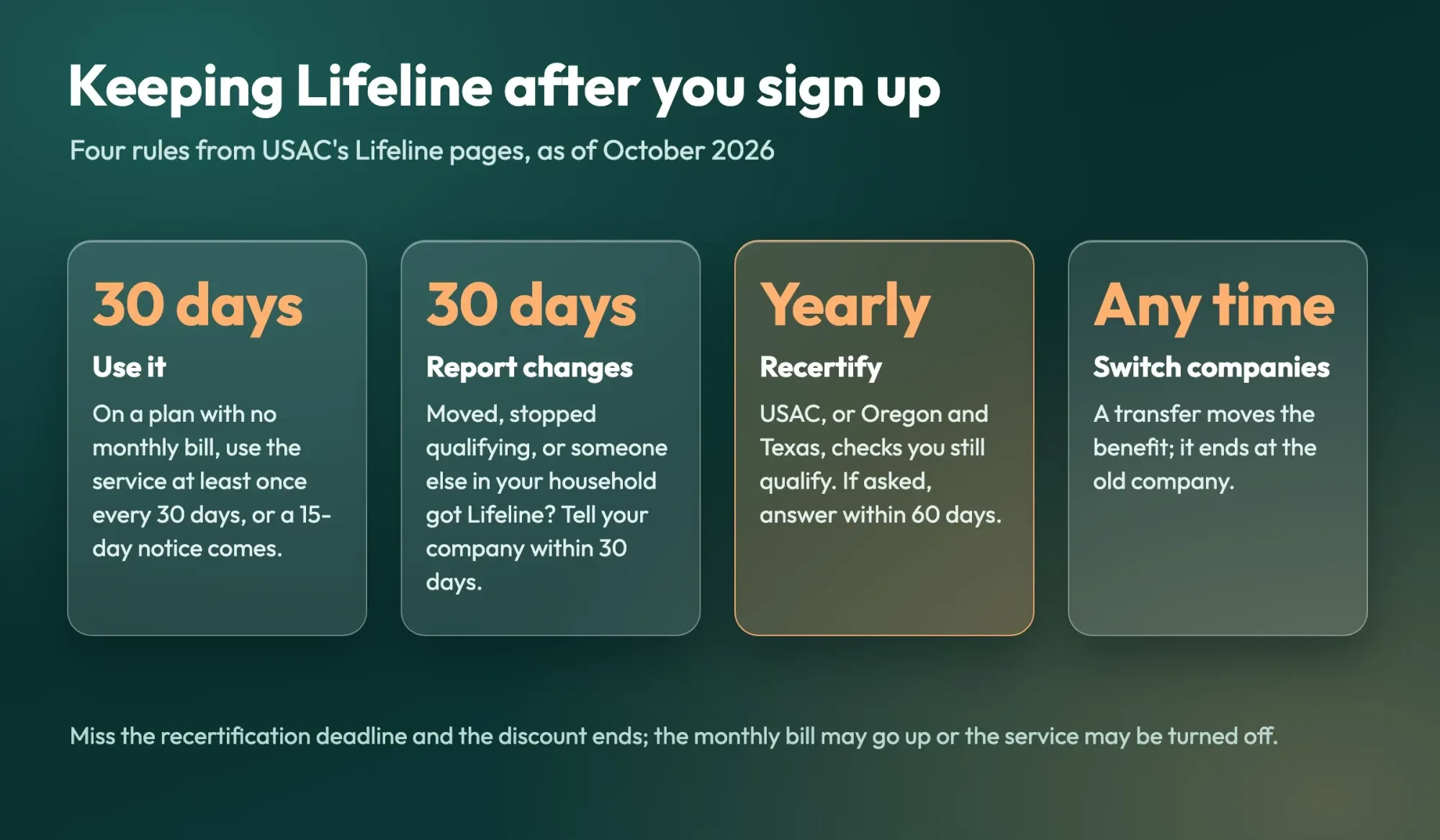 Drawn by us: four keep-it rules from USAC's About, Recertify and Change My Company pages, as of October 2026.
Lifeline trims one bill by $9.25 a month at most (October 2026). If the phone bill is one of several you're behind on, the financial emergency options hub puts other help programs in order, from calling the biller to local aid.
Before you sign with a company, write down three lines from its plan sheet. They are the monthly price after the $9.25 (or $5.25) discount, the data allowance next to the 4.5 GB minimum, and the price or terms of any phone it offers.
Free phone with SNAP questions
Frequently asked
Can I keep my own phone and still get Lifeline?
USAC doesn't promise it. Its FAQ sends "Lost or broken handsets or devices" to your phone company, so ask it whether your phone works.
What if I have no permanent address?
USAC's FAQ says you can use a temporary address, such as a shelter, family or friend, or a descriptive address.
I live in Texas or Oregon. Who checks my benefit each year?
Your state does. USAC's Recertify page says the state runs the yearly check there.
Does Lifeline cover a landline?
Yes. USAC lists voice service as mobile or fixed, with no minimum standards for fixed voice-only service.
How we made this guide: Every dollar figure here, except the made-up homes and ad lines, comes from USAC and HHS pages read October 29, 2026. Rule text comes from the eCFR as current to October 27, 2026. fcc.gov returned a 403 error to our requests, so a Federal Register notice confirmed the ACP date. Facts checked by the DigitalTreed team on October 29, 2026.
First published November 2023 as "Get Free iPhone with Food Stamps". Rewritten October 29, 2026: the free iPhone promise and ACP steps are gone. The post now covers the real Lifeline amounts, the household rule with a test, and how to read the ads.
Sources
- USAC Lifeline Support: home
- USAC Lifeline Support: About Lifeline
- USAC Lifeline Support: How to Qualify
- USAC Lifeline Support: Supporting Documents
- USAC Lifeline Support: Tribal Lands Benefit
- USAC Lifeline Support: Frequently Asked Questions
- USAC Lifeline Support: Your Rights
- USAC Lifeline Support: How to Apply
- USAC Lifeline Support: Change My Company
- USAC Lifeline Support: Recertify
- USAC Lifeline Support: Companies Near Me
- USAC: National Verifier
- USAC: Consumer Eligibility
- USAC: Minimum Service Standards
- USAC: Affordable Connectivity Program
- eCFR: 47 CFR 54.400, terms and definitions
- eCFR: 47 CFR 54.401, Lifeline defined
- eCFR: 47 CFR 54.403, Lifeline support amount
- eCFR: 47 CFR 54.405, carrier obligation to offer Lifeline
- eCFR: 47 CFR 54.408, minimum service standards
- eCFR: 47 CFR 54.409, consumer qualification
- eCFR: 47 CFR 54.410, eligibility and certification
- eCFR: 47 CFR 54.413, Link Up for Tribal lands
- Federal Register: FCC proposed rule on Lifeline, April 3, 2026
- HHS ASPE: 2026 poverty guidelines
- USA.gov: How to apply for food stamps (SNAP benefits)
- FTC: How to avoid a government impersonation scam
- FTC: ReportFraud.ftc.gov
Comments
No comments yet. Start the conversation below.