
Quick answer
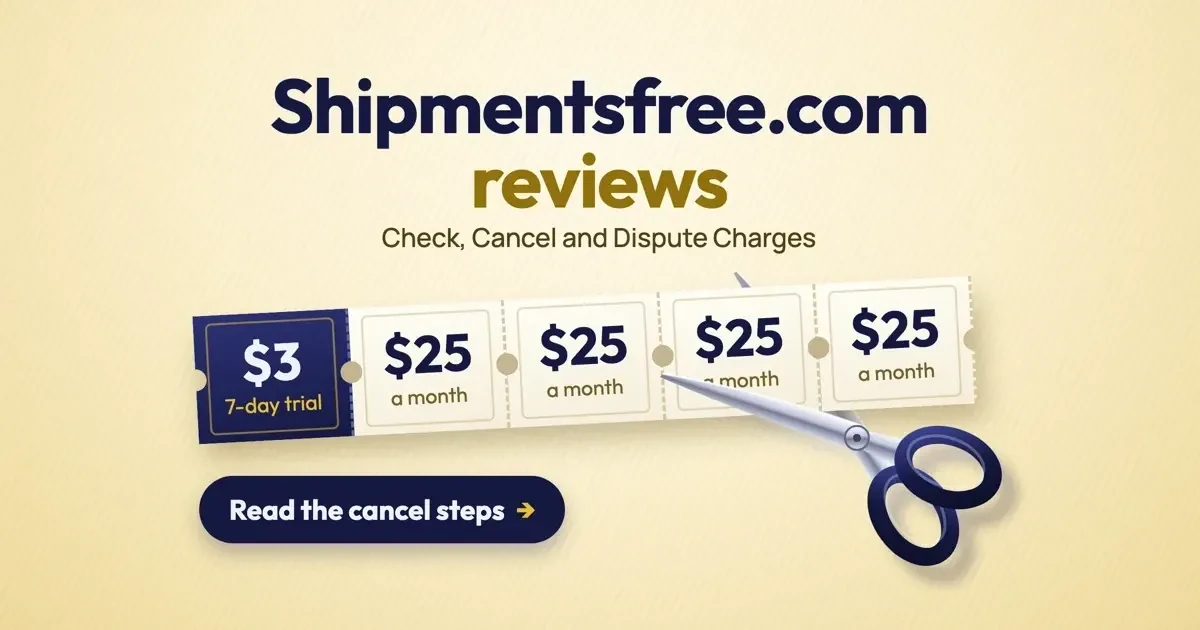
Shipmentsfree.com reviews can't lean on a regulator record, since no FTC case, BBB profile or CFPB complaint names the site. As of November 11, 2026, its home page offered a $3 trial for 7 days, then $25 a month until you cancel. Cancel in writing and keep proof; a card dispute letter must reach the issuer within 60 days of the statement.
Maybe a trial turned into a charge you didn't plan on. Or you're about to type a card number and want to know who gets it. Shipmentsfree.com is a paid subscription site whose home page sells "Shipping & Return Rebates for Your Online Purchases." Our script gets a bot check on its pages, and we read them by hand in a browser on November 11, 2026. Records and archives fill in the rest. With money on the line, talk to your card issuer or bank early, and to a licensed consumer attorney if the amount is large.
Dated record checks come first, then how the trial turns into a monthly charge and where the click-to-cancel rule stands after a 2025 court ruling. The steps: cancel with proof, dispute a card charge within 60 days, stop debits from a bank account three business days ahead, and report a subscription that keeps billing.
Key takeaways
- As of November 11, 2026, a $3 seven-day trial renews at $25 monthly.
- A court vacated the FTC click-to-cancel rule in July 2025.
- ROSCA still requires a simple way to stop online subscription charges.
- No FTC case, BBB profile or CFPB complaint names Shipmentsfree.com.
- Banks honor stop-payment orders placed three business days before a debit.
Shipmentsfree.com reviews and the public record
The Verisign registry record for shipmentsfree.com shows a registration on November 16, 2021, through GoDaddy Online Services Cayman Islands Ltd. That's almost five years before our November 2026 check. It runs to November 16, 2027 and, like most records today, doesn't name an owner. Its name servers belong to Cloudflare. Our plain request to the bare domain, sent on November 11, 2026, got a 301 redirect to the www address, the same one its archived pages use. Every page we asked for after that answered 403 with a Cloudflare challenge: the home page, the FAQ path, the terms path and the sitemap.
We don't work around bot checks, so a team member read the home page, terms and FAQ by hand, signed out.
Only robots.txt loaded, and it just blocks four paths, such as /track/ and /auth/, without a word about the service itself.
Archives fill part of the gap. The Wayback Machine holds 396 captures of the home page from March 31, 2022 to October 3, 2026, and 369 of them are from 2023 and 2024. A FAQ file it saved on February 18, 2023 says the service "provides rebates to users for shipping or return costs" on online purchases. That FAQ set a $100 monthly cap, and it said rebate checks went out by USPS once a month to members who'd sent proof of the shipping cost.
As of November 11, 2026, the live home page still listed the shipping and return rebate at up to $100 per month.
The same FAQ sent rebate claims to an account page on joinsmarty.com. The joinsmarty.com registry record shows a November 25, 2018 registration through the same registrar, on the same two Cloudflare name servers. If your statement shows a brand you don't recognize, search both names.
| What we checked | Result on November 11, 2026 |
|---|---|
| shipmentsfree.com registry record (RDAP) | Registered November 16, 2021 via GoDaddy; runs to November 16, 2027; no owner named |
| First web answer (curl -I) | Bare domain redirects to www; every page we asked for except robots.txt returned 403 with a bot check; the home page, terms and FAQ opened by hand in a browser |
| Wayback Machine, home page | 396 captures, March 31, 2022 to October 3, 2026 |
| Archived FAQ data, February 18, 2023 | Shipping and return rebates, $100 monthly cap, checks by mail, 14-day trial |
| Archived offer data, October 3, 2026 | Monthly plan with a 5-day trial at $0 |
| BBB business search | No results for shipmentsfree |
| FTC cases and proceedings | No results for shipmentsfree or joinsmarty |
| CFPB complaint database | 0 complaints with the name |
Three record searches didn't turn up anything. BBB's business search showed no results for shipmentsfree, and BBB itself notes it doesn't list every business. The FTC cases and proceedings search didn't find anything for shipmentsfree or joinsmarty. The CFPB consumer complaint database held 0 complaints with the name. It's built for banks, card issuers and other money companies, not rebate clubs, so its zero carries the least weight of the three.
The 2024 article on this URL called the site a trustworthy choice and claimed to debunk fraud claims. Neither line had a source, so both are gone. It also said the domain was registered many years ago. The registry date is November 16, 2021, about two and a half years before that post went up on May 3, 2024. No regulator or court record names Shipmentsfree.com, so this page doesn't give a verdict on the company either way. Each check above shows its date and what it found. A padlock in the address bar isn't on the list, for the reason our Jebek Shop store check gives: it shows the connection is encrypted, not who runs the site.
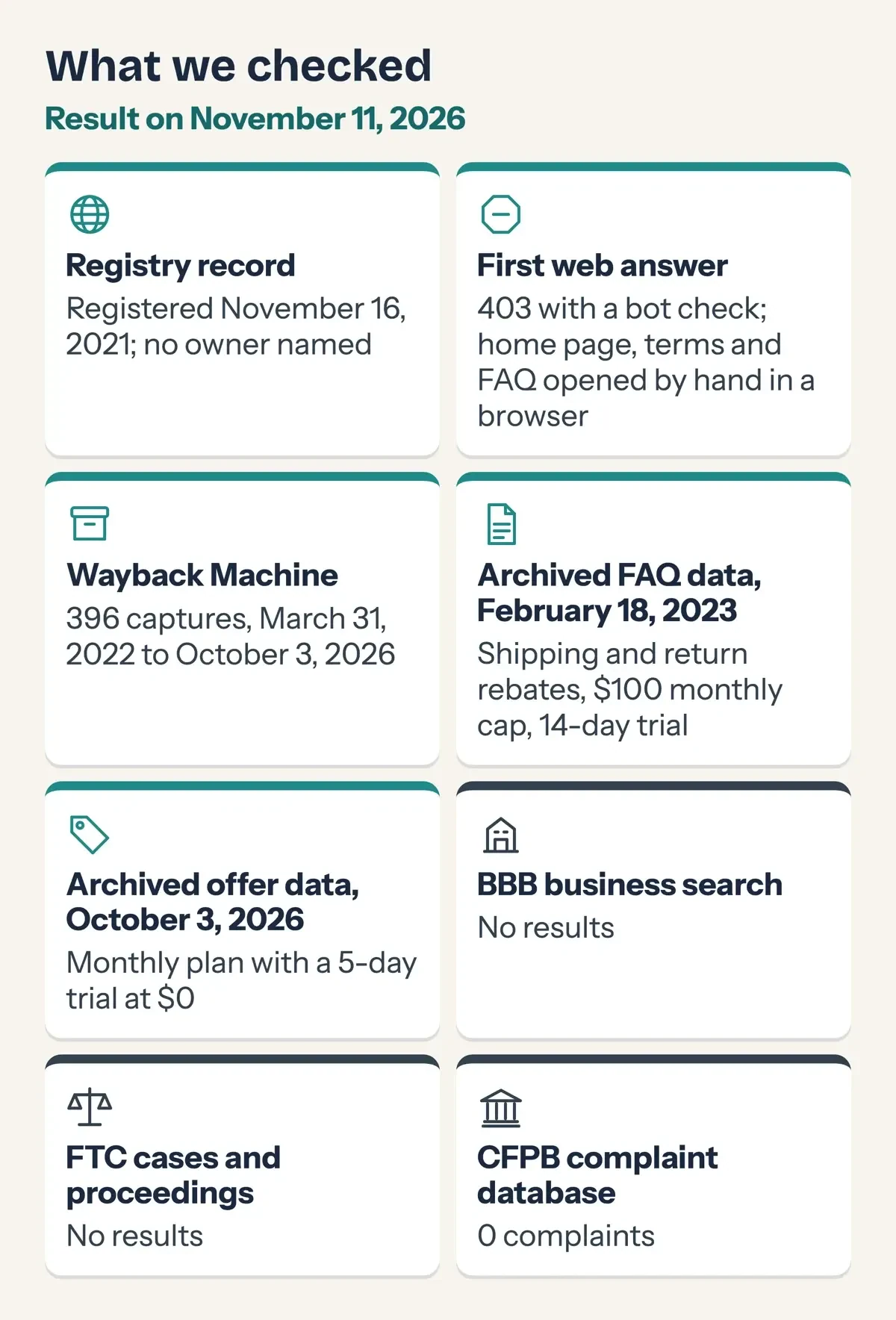 Diagram by DigitalTreed, from our registry, web, archive and record checks on November 11, 2026.
What we tested
Our site_check.py script made plain DNS, registry and web requests on November 11, 2026, with a user agent that says it's DigitalTreed. It read the archive lists and three archived data files from the site, then logged our saved BBB, FTC and CFPB searches. We didn't open an account, start a trial or type in a card number, and the browser read of the three live pages was signed out. A second script, recurring_check.py, scans a made-up five-month statement for repeat charges and works out the dispute and stop-payment dates. Its output, five made-up merchants with the pattern and deadline for each, is the table under the credit card dispute heading.
How the trial turns into a monthly charge
Shipmentsfree.com sells a subscription. The trial isn't free. As of November 11, 2026, its home page offered "a $3 USD trial for 7 days, and then only $25 USD/month thereafter." Its terms, last modified October 28, 2026, call it "a paid, auto-renewing, subscription-based service." Kept for a year, that'd cost $303 in this example ($3 + $25 x 12). Older files from the site don't match. They're kept here only as dated history. The 2023 FAQ said "You may sign up for a 14-day trial" at no cost. Offer data saved on October 3, 2026 listed a 5-day trial at $0.
Offers change, so you'll want a screenshot of the trial length, the price and the cancel steps before you type a card number.
Regulators call this setup a negative option. The FTC's March 11, 2026 press release defines it as marketing "in which the absence of affirmative consumer action constitutes consent to be charged." For this site, that means doing nothing before the 7 days run out counts as a yes to the $25 monthly charge, and it'll repeat until you cancel.
For online sales, the Restore Online Shoppers' Confidence Act (ROSCA) adds three duties. Under 15 USC 8403, a seller must disclose all material terms before it takes your billing information. It has to get your "express informed consent" before charging you. And it must offer "simple mechanisms for a consumer to stop recurring charges." The FTC's ROSCA page lists the law, 15 U.S.C. 8401 to 8405, among the statutes it enforces. ROSCA dates from December 29, 2010.
Offers that pop up right after you check out at another store face tighter rules. Section 8402 bars a post-transaction third party seller from charging you unless it says it isn't the store you bought from and states the cost. It also needs your full account number from you, plus a click or checkbox that shows you agree. The FTC's summary puts it this way: the seller "must obtain the number of the account to be charged directly from the consumer."
Those rules came after a Senate investigation, which the law's findings describe. Retailers had shared customers' card numbers with third party sellers through a process called "data pass". So if a club charges a card you never typed into its form, that's worth raising with your issuer.
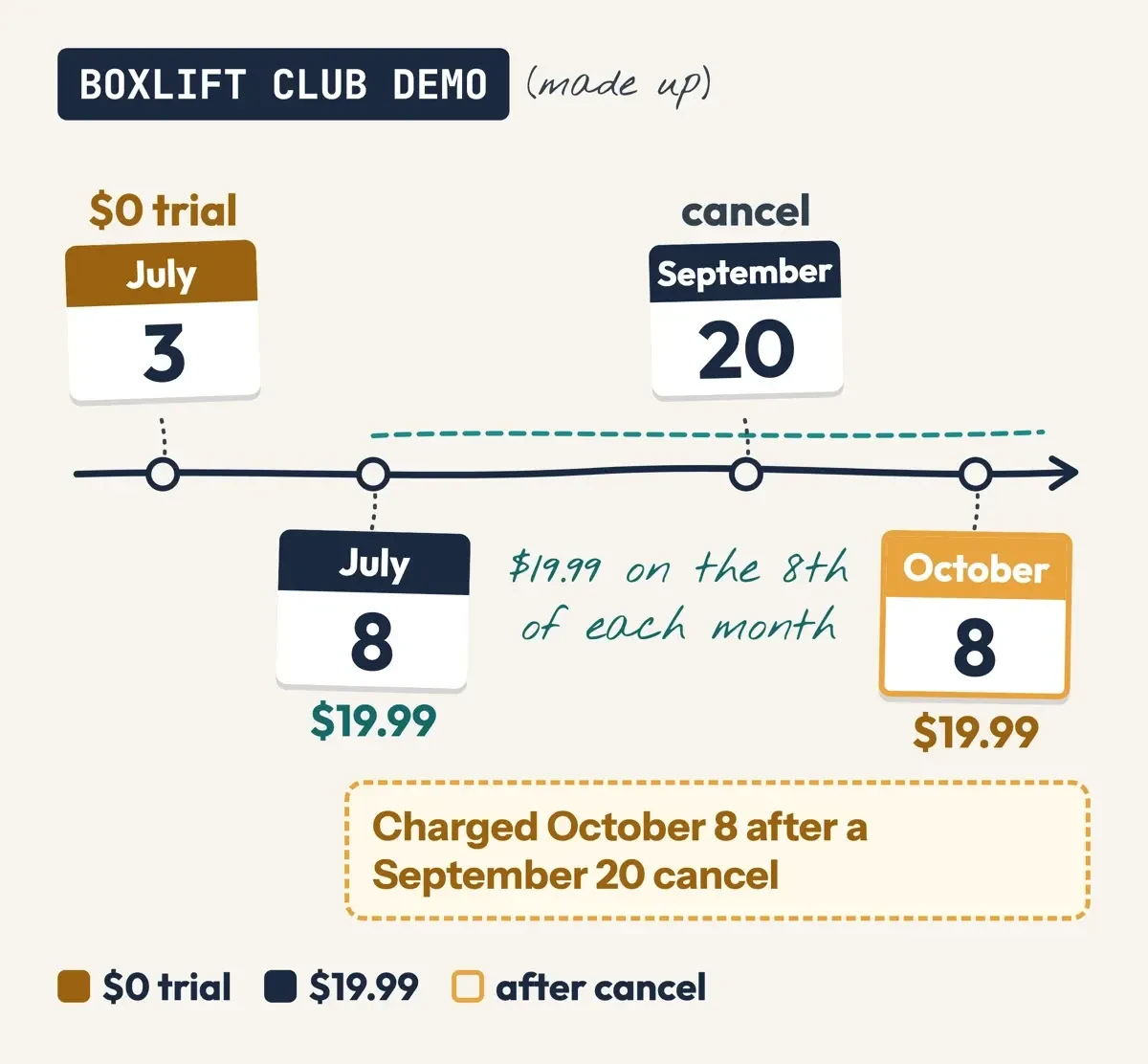 Drawn by us from the made-up statement in our recurring_check.py test.
Does the FTC click-to-cancel rule still apply?
As of November 11, 2026, there's no federal rule in force that makes canceling as easy as signing up. The FTC announced one on October 16, 2024, saying sellers would have "to make it as easy for consumers to cancel their enrollment as it was to sign up." The Commission vote was 3-2.
It never took full effect. On July 8, 2025, the Eighth Circuit in Custom Communications v. FTC wrote: "we grant the petitions for review and vacate the Rule." The FTC hadn't done a preliminary regulatory analysis that the FTC Act requires. The moved compliance dates before that ruling are in our gym cancellation letter guide.
Two 2026 notices followed. A February 12, 2026 Federal Register rule put the text back the way it read before the 2024 amendments, effective that day. Then an advance notice published March 13, 2026 asked whether to amend it again. Comments closed April 13, 2026. The FTC's release lists "adopting provisions of the vacated 2024 Rule" as one option. Its Negative Option Rule page still shows that notice as the latest step.
Nothing newer has replaced it. The latest FTC filing on the rule is an October 14, 2026 Federal Register notice. That notice describes the rule "as that rule was written before courts vacated the final rule promulgated on November 15, 2024." For a website subscription, that leaves ROSCA, the card and bank rules below, and state laws, which in some states go further than anything federal right now. California's Attorney General says its Automatic Renewal Law was amended effective July 1, 2025. Under it, businesses must give "a clear and straightforward method for cancelling unwanted subscriptions." Other states have auto-renewal rules too, so check your attorney general's site.
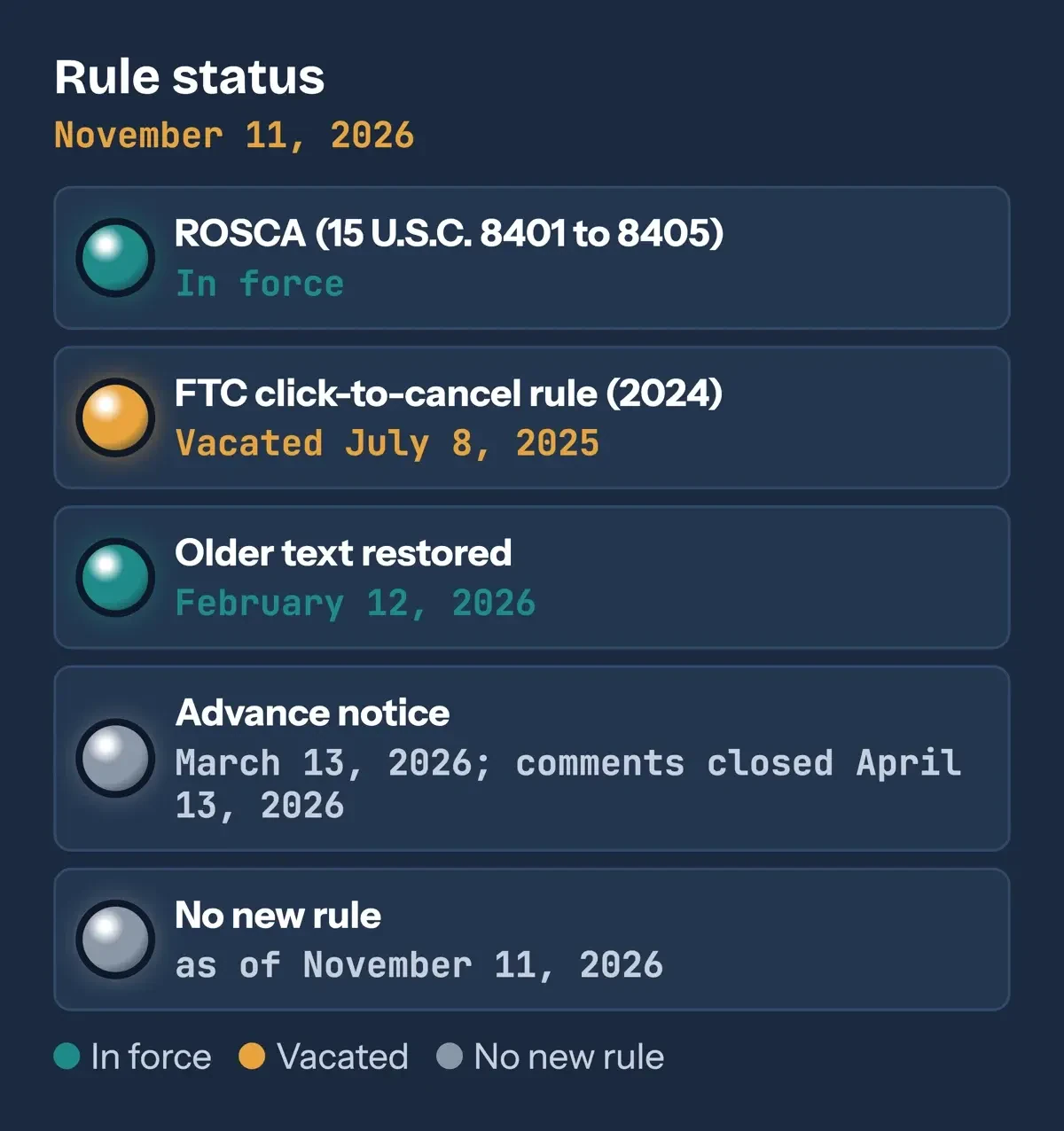 Diagram by DigitalTreed, from the court opinion, FTC pages and Federal Register notices read November 11, 2026.
Cancel the subscription and keep proof
Cancel in a way you can prove later, because the dispute and bank steps work better when you can show you asked first. As of November 11, 2026, the site's FAQ lists five ways: email [email protected], call (800) 524-2165, use website chat or the webform, or self-serve in your account. There, the FAQ's path is your name, then My Account, the Membership tab and Cancel ShipmentsFree Subscription. The 2023 FAQ named only the website and that same email address.
Without signing in, we haven't seen the button work, so send the email as well and keep the sent copy.
Note the date and time you sent it, since that's the cancel date you'll quote in any dispute letter or call to your bank later on.
The CFPB's page on stopping automatic payments says to cancel the contract "as well as telling it to stop automatic payments." One email can do both. We'd put these six lines in it:
- Subject: Cancel my membership and stop all charges
- Your full name and the email address on the account
- The last 4 digits of the card charged and the latest charge date
- Cancel effective today; do not bill this card or account again
- Please confirm the cancel date in writing
- Save the sent email and any reply as a PDF
Then watch your next statement. If a charge lands after your cancel date, you've got a dated email to show your issuer or bank. When the service bills through Apple, Google or another platform, cancel there instead, because the platform holds the billing, as our Hulu cancel guide explains step by step.
A charge name you can't place may be a payment processor's code, not the seller's. Our FDMS bank statement guide traces a merchant name back to a seller.
Dispute a credit card charge within 60 days
Once you've cancelled, a credit card gives you the strongest federal tool if the company keeps billing anyway: the Fair Credit Billing Act. The clock in 15 USC 1666 starts when the issuer sends the statement that first shows the bad charge. Your letter has to arrive within sixty days of that, or 60 calendar days in the CFPB's wording. A phone call alone isn't enough. The issuer then has 30 days to confirm in writing that it got your letter.
A renewal you didn't agree to can fit two kinds of billing error. Regulation Z section 1026.13 covers charges for services "not accepted by the consumer" or not delivered as agreed. The FTC's credit card dispute page also lists unauthorized charges, where federal law caps your share at $50. Per the same FTC page, you can hold off paying the disputed amount while the issuer looks into it, and it's got up to 90 days to finish.
Send the letter certified with a return receipt, since the FTC says that "gives you proof of what the issuer got."
Our recurring_check.py script ran over a made-up statement with 19 transactions from June to October 2026, one credit card with statements sent on the 25th, and one bank account. Every name and amount is made up:
| Merchant (made up) | Paid by | Pattern found | Yearly cost, example (amount x 12) | Date that matters |
|---|---|---|---|---|
| BOXLIFT CLUB DEMO | Credit card | $0 trial on July 3, then $19.99 on the 8th of each month | $239.88 | Charged October 8 after a September 20 cancel: letter due December 24, 2026 |
| TUNEWAVE DEMO | Credit card | $10.99 on the 15th of each month | $131.88 | Next charge expected November 15, 2026 |
| FITLOOP DEMO | Bank account | $39.00 on the 10th of each month | $468.00 | Stop-payment order by December 7, 2026 for the December 10 debit |
| NOTEVAULT DEMO | Credit card | One $59.88 charge on October 20 | Not flagged | A yearly plan shows up once, so a five-month scan misses it |
| CORNER GROCER DEMO | Credit card | Three different amounts | Not flagged | Ordinary purchases |
The October 8 charge came after the September 20 cancel and sat on the statement sent October 25, 2026. Sixty days later, December 24, 2026, is the last day the letter can arrive. The three repeat charges came to $69.98 a month, or $839.76 a year in this example ($69.98 x 12).
NOTEVAULT DEMO shows what a five-month scan can't catch. A yearly renewal appears once, so look back 13 months of statements.
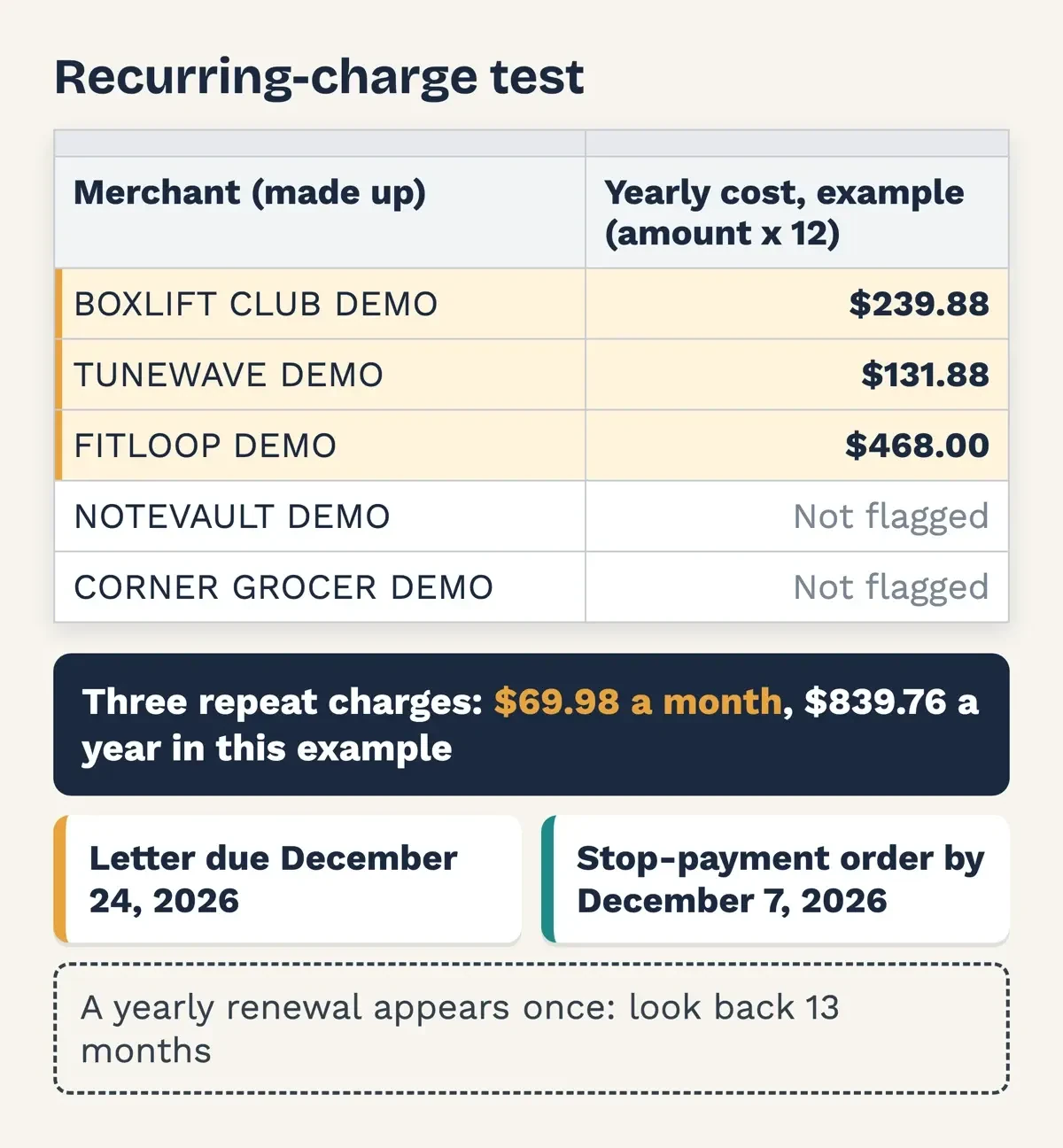 Diagram by DigitalTreed: output of recurring_check.py on a made-up statement, run November 11, 2026.
Stop debits from a bank account
Unlike card charges, bank drafts run under a different law, the Electronic Fund Transfer Act, and its rule, Regulation E. Regulation E section 1005.10 says a bank "must honor an oral stop-payment order made at least three business days before a scheduled debit." The CFPB's automatic payments answer says to call and write your bank that you've revoked the company's permission. After that, "any additional payments initiated by that company would be errors," and you can ask the bank for a refund.
If the bank asks for written confirmation and you don't send it within 14 days, it may honor later debits.
The CFPB adds that banks generally charge fees for stop payment orders, so it's worth asking what yours costs before you place one.
In our made-up statement, FITLOOP DEMO debits $39.00 on the 10th, so the next one falls on Thursday, December 10, 2026. Count back three business days, skip the weekend, and you land on Monday, December 7. We'd call the bank the day we decided to quit, not the last day allowed, and send the written confirmation that same week so the order doesn't lapse.
Report a subscription that keeps billing
A report won't refund you. The FTC does count them, though: in March 2026 it said it had received more than 100,000 complaints about negative options and related practices in five years. File yours at ReportFraud.ftc.gov. If your card issuer or bank mishandles a dispute, the CFPB complaint form is the right place, since the CFPB takes complaints about banks and card issuers. State officers can act too. Under 15 USC 8405, a state attorney general can sue in federal court for residents. A copy of your complaint to your state's office reaches someone with that power.
A first charge that followed an email link may be phishing, not a real sign-up. Our phishing link recovery guide covers what to lock down first, and our phishing email tips show what a fake bill looks like. If the site's name is one letter off from a brand you know, our lookalike website comparison shows how to tell them apart.
This summary of federal rules, as of November 11, 2026, isn't legal or financial advice. If a large charge is at stake or your dispute's been refused, start with your bank or card issuer. A licensed consumer attorney or your state consumer protection office can tell you the rules where you live.
Frequently asked
When does a Shipmentsfree.com trial start charging?
When the 7-day trial ends. Its terms, last modified October 28, 2026, say a trial "will automatically convert into a paid, month-to-month subscription" if it isn't canceled first. On November 11, 2026, the home page priced that trial at $3.
Does canceling my card stop the subscription?
Not by itself. The CFPB warns that "Cancelling an automatic payment does not cancel what you owe," so cancel with the company too.
Can my card issuer mark me late during a dispute?
No. Per the FTC, your issuer can tell credit bureaus you're challenging the bill. It can't report you as delinquent or close your account for disputing.
Who enforces the online subscription law?
The FTC. Under 15 USC 8404, a ROSCA violation counts as a violation of an FTC rule on unfair or deceptive practices, and the FTC Act's penalties apply.
How we made this guide: Our scripts checked two domains in the registry, in DNS and on the web, and read three archived data files from the site. Someone on our team read the live home page, terms and FAQ in a browser, signed out. We also saved BBB, FTC and CFPB searches, read the court opinion and the 2026 notices, and ran a deadline script on a made-up statement. Facts checked by the DigitalTreed team on November 11, 2026.
This page first went up on May 3, 2024 as a review of Shipmentsfree.com. The November 11, 2026 rewrite swapped that for record checks, the site's own trial and cancel terms, and the steps to cancel and dispute charges.
Sources
- Verisign RDAP: shipmentsfree.com registration record
- Verisign RDAP: joinsmarty.com registration record
- ShipmentsFree home page, terms (last modified October 28, 2026) and FAQ, read in a browser November 11, 2026 (403 to our checker, opens in a browser)
- Internet Archive: Wayback Machine
- BBB: business search for shipmentsfree
- FTC: Cases and Proceedings search
- CFPB: Consumer Complaint Database
- FTC: ANPRM on negative option marketing (March 11, 2026)
- 15 U.S.C. 8401: Findings; declaration of policy
- 15 U.S.C. 8402: Prohibitions against certain unfair and deceptive Internet sales practices
- 15 U.S.C. 8403: Negative option marketing on the Internet
- 15 U.S.C. 8404: Enforcement by Federal Trade Commission
- 15 U.S.C. 8405: Enforcement by State attorneys general
- FTC: Restore Online Shoppers' Confidence Act
- FTC: Final click-to-cancel rule announced (October 16, 2024)
- U.S. Court of Appeals for the Eighth Circuit: Custom Communications, Inc. v. FTC, No. 24-3137 (July 8, 2025)
- Federal Register: Revision of the Negative Option Rule to conform to court decisions (February 12, 2026)
- Federal Register: Negative Option Rule advance notice of proposed rulemaking (March 13, 2026)
- FTC: Negative Option Rule
- Federal Register: Negative Option Rule information collection notice (October 14, 2026)
- California Attorney General: Consumer alert on California's Automatic Renewal Law
- CFPB: How do I stop automatic payments from my bank account?
- FTC: Fair Credit Billing Act
- 15 U.S.C. 1666: Correction of billing errors
- CFPB: How do I dispute a charge on my credit card bill?
- CFPB: Regulation Z, 12 CFR 1026.13 Billing error resolution
- FTC: Using Credit Cards and Disputing Charges
- CFPB: Regulation E, 12 CFR 1005.10 Preauthorized transfers
- FTC: ReportFraud.ftc.gov
- CFPB: Submit a complaint
Comments
No comments yet. Start the conversation below.