
Quick answer
Span of control is the number of people who report directly to one manager. There's no single right number. FEMA's incident command doctrine calls one supervisor to five people the optimum, but only a guideline, and Gallup found the average US manager had 12.1 direct reports in 2025. The right span is whatever your manager's week can hold.
That last line is the one most guides skip.
The famous numbers come from fire scenes and big corporations, and they don't transfer to a 15-person shop. What does transfer is span of control in management terms you can check: hours. A made-up garage door company shows the exact week it needs a team lead.
Key takeaways
- Span of control counts only the people who report directly to you.
- In Gallup's data, the median US team held at five to six reports.
- Managers spend a median of 40% of their time on their own work.
- Size each span by the hours a manager has left for people.
- Add a team lead when the team needs more hours than the manager has.
Span of control means the people who report straight to you
Span of control is the count of people a manager supervises directly. If five people come to you for their schedule, their questions and their reviews, your span is five. People who report to those five don't count toward yours. They count toward their own manager's.
FEMA's National Incident Management System (October 2017) defines it as "the number of subordinates for which a supervisor is responsible." Business writers mean the same thing, just with fewer fire trucks.
Picture a Saturday lunch rush. A kitchen lead with four cooks can watch every plate, answer every question and still cook. An owner with all 15 staff reporting to her, from the dishwasher to the bookkeeper, spends the rush answering texts.
Both have a span of control. Only one of them can do the job.
The real question, then, isn't "how many?" It's "how many, for this work, with this person leading?" If you're about to hire or promote someone to lead a team, read up on what a hiring manager does first.
Narrow vs wide spans: tall and flat companies
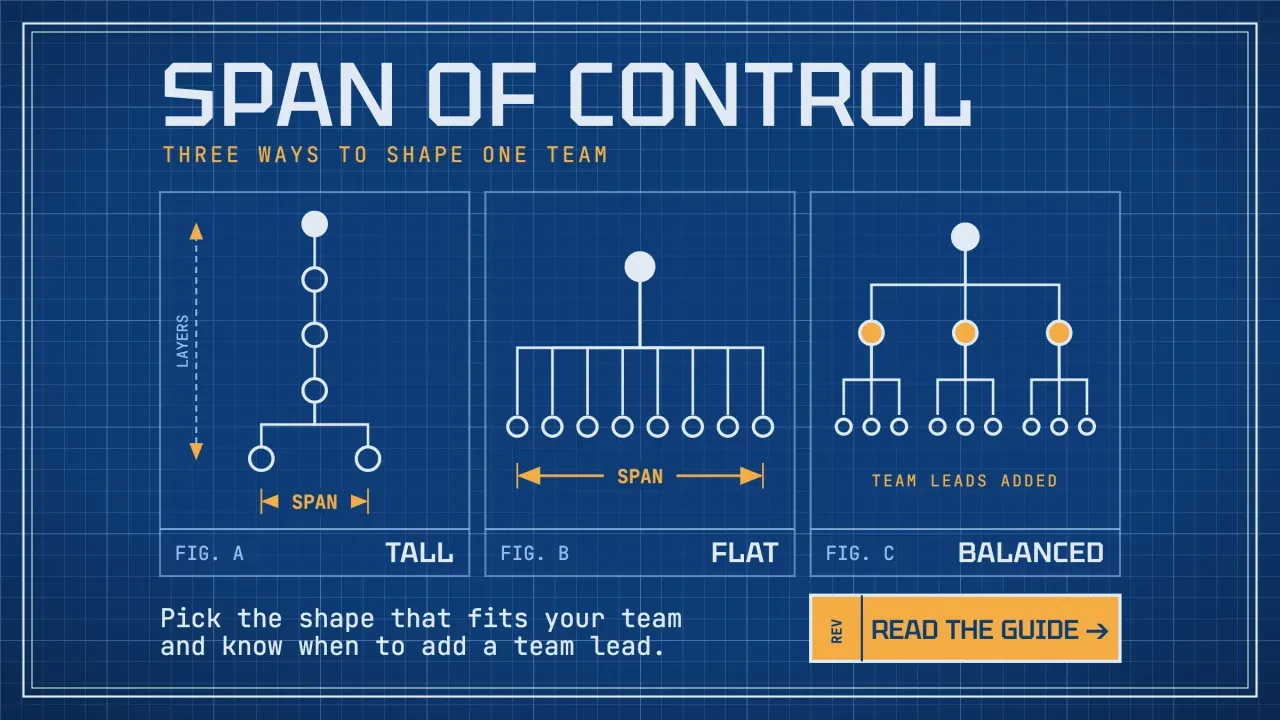
Every span you pick also sets the shape of the company. A narrow span gives each manager few reports, so you'll need more managers and more layers. That's a tall company. A wide span gives each manager many reports and fewer layers: a flat one.
| Narrow span (tall company) | Wide span (flat company) | |
|---|---|---|
| Direct reports per manager | Few | Many |
| Layers between owner and front line | More | Fewer |
| Time per person | More coaching and checking | Less; people work on their own more |
| Decisions | Pass through more hands | Fewer hands, but more land on each manager |
| Promotion steps | More rungs to climb | Fewer rungs |
| Fits best when | Work is varied, risky or new to the team | Work is similar and the team knows it well |
Neither shape wins on its own. Valerie Smeets, an economist at Aarhus University, reviewed the research for IZA World of Labor in February 2017. Wider spans let a good manager's talent reach more workers. But she notes that "higher spans of control limit the attention that managers can allocate to each worker," and fewer layers mean fewer promotion steps.
Flat isn't automatically freer, either. Julie Wulf's research on flattening, published in California Management Review in 2012, found that "flattened firms typically exhibit more control and decision making at the top."
Cutting a layer can pull decisions up to the boss.
That's the opposite of what most owners want. If you've read about big companies cutting middle managers, our roundup of workplace trends puts that shift in context.
How many direct reports should a manager have?
So what number should you aim for? There isn't a proven ideal, and the most-quoted guideline says so itself.
The Incident Command System, used by US fire and emergency crews, works to one supervisor for five people. The NIMS doctrine (page 22) calls that "the optimal span of control for incident management." Then it adds that "effective incident management frequently necessitates ratios significantly different from this. The 1:5 ratio is a guideline." Crews use "their best judgment" for the real split.
Real workplaces run much wider. Gallup's January 2026 report asked US managers how many people report directly to them. The average was 12.1 in 2025, up from 10.9 in 2024 and about 8.2 in 2013, but the median held at five to six. Gallup says 37% of managers lead fewer than five people and 66% fewer than 10, while 13% have 25 or more.
A few huge teams drag the average up.
The federal government tried a target once. In 1993 the governmentwide ratio was one supervisor to seven employees, and the National Performance Review recommended one to 15. Its own 1996 progress report admitted that many agencies thought the goal "is not appropriate for their agency."
Old theory explains why big jumps hurt. In 1933, V. A. Graicunas counted every possible relationship in a team: you with each person, people with each other, and you with each small group. His table is reprinted in Gulick and Urwick's Papers on the Science of Administration (1937). Going from four reports to five raises the count from 44 to 100, "an increase in complexity of 127 per cent in return for a 20 per cent increase in working capacity."
When we ran his formula for 1 to 12 reports through a short Python script, every one of the 12 figures matched the table printed in the 1937 book.
Not every one of those relationships is active, of course. It's a model of what you might have to track, not a law.
Big companies moved too. An NBER summary of Rajan and Wulf (October 2003) found that CEOs of over 300 large US firms went "from an average of four in 1986 to an average of seven" direct reports. Smeets also describes one Scandinavian high-tech firm where managers at the same level averaged 25 to 30 reports. The range? From "1 to 286 subordinates."
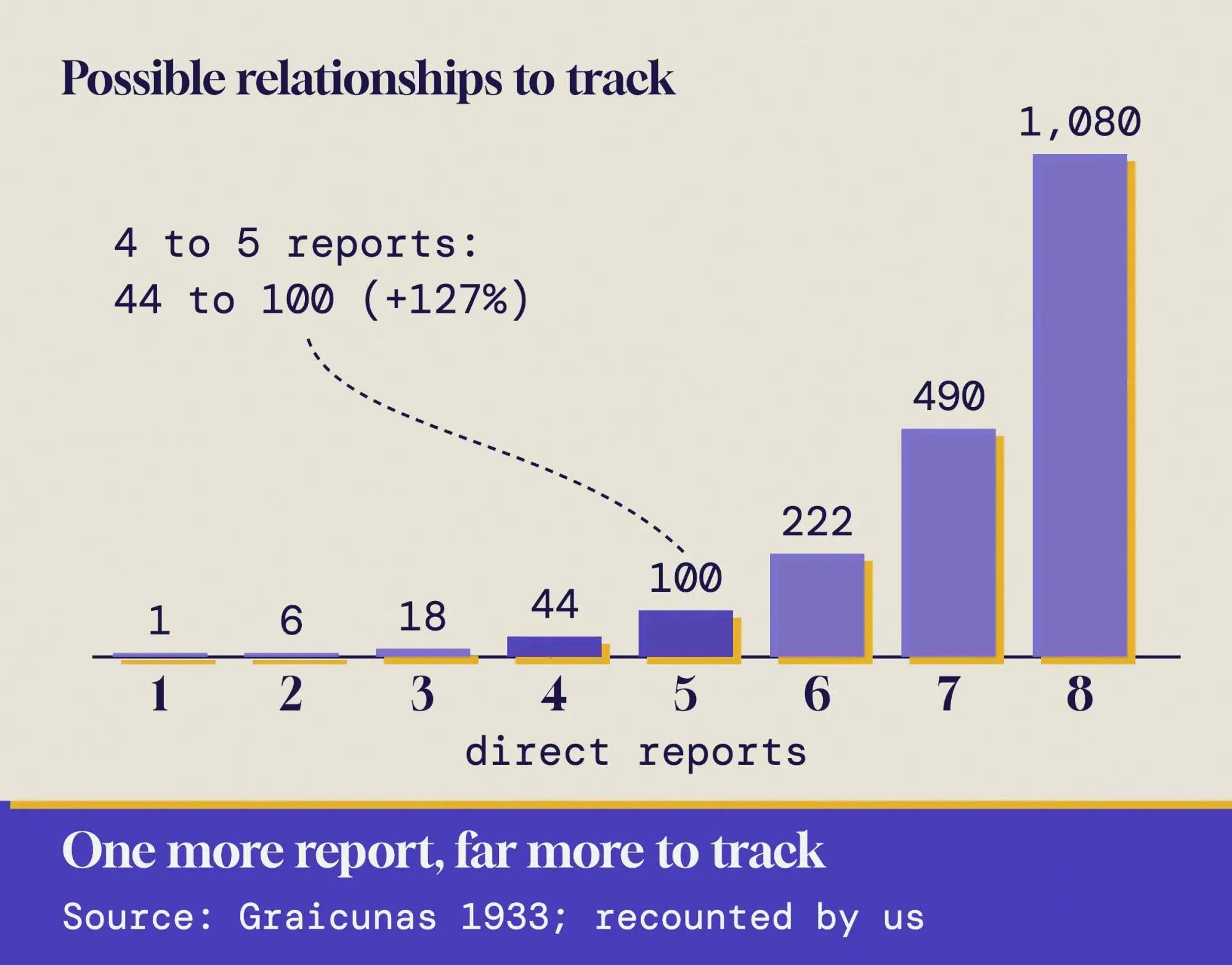 Source: V. A. Graicunas, "Relationship in Organization" (1933), reprinted in Papers on the Science of Administration, 1937; we recomputed the counts on October 25, 2026, and they matched the book.
Four things set the right span for your team
So if no number transfers, what does? The research keeps landing on the same forces. NIMS lists "the type of incident, nature of the task, hazards and safety factors, experience of the supervisor and subordinates, and communication access between the subordinates and the supervisor." Here's how those translate to a small business.
How similar the work is
Luther Gulick put it plainly in 1937. Where work is "routine, repetitive, measurable and homogeneous," one person "can perhaps direct several score workers." Where it's "diversified, qualitative, and particularly when the workers are scattered, one man can supervise only a few" (Gulick, pages 7-8).
Kenneth Meier and John Bohte tested Gulick's idea on 678 Texas school districts in a peer-reviewed 2003 study. Function, time and space did shape spans. Their effect, though, depended on the level of the hierarchy.
The manager's own workload
Most small-business managers also do hands-on work. Gallup found US managers spend a median of 40% of their time on their own individual work. Those above that line "have lower engagement, and this gets worse as the number of workers they manage increases."
An owner who still runs every estimate can't also hold a wide span. Our ways to grow your skills as an entrepreneur are a fair read when you're stretched that thin.
Remote and hybrid teams
Distance shrinks the span you're able to handle. In the same Gallup report, more direct reports hurt engagement "particularly" for managers who work from home or hybrid, while team size had a minimal effect for on-site managers. If your people are spread out, the right tools help. Our comparison of video call apps for small businesses covers the free tiers, and these virtual team building ideas help remote staff feel part of the team.
How experienced the team is
New people need more of your time. Smeets' review notes that "more knowledgeable workers can work more autonomously and therefore need less managerial time," and that better communication tools let managers supervise more people. A shared schedule is one of those tools, and our list of employee scheduling software is a fair place to start, with more picks in our roundup of business apps for small business.
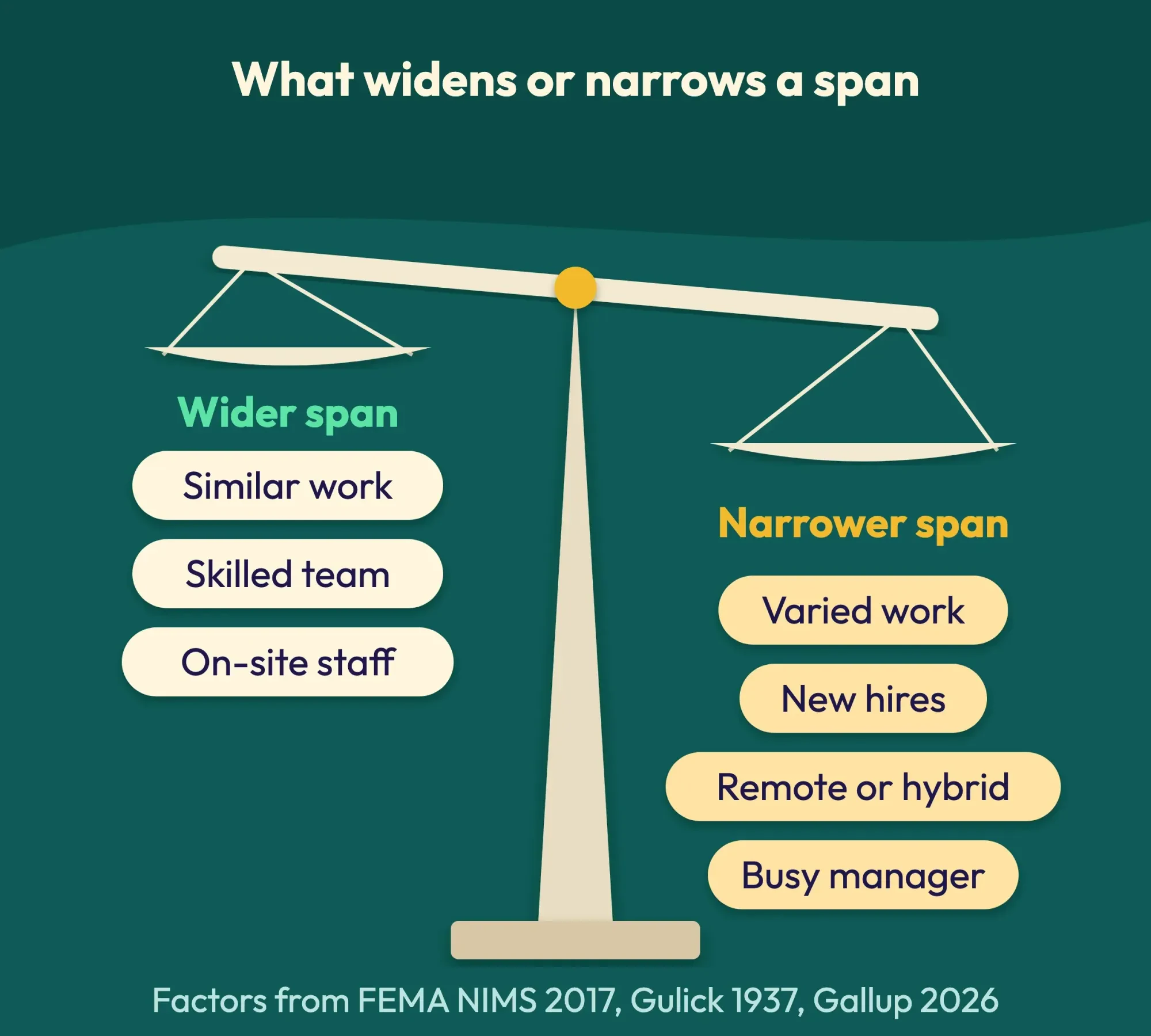 Diagram by DigitalTreed, from the factors in FEMA NIMS (2017), Gulick (1937) and Gallup (January 2026).
Work out your span of control as a time budget
Those four forces all come down to time, and time's something you can measure. So measure it, not ratios. Here's the check we'd run for any owner who feels stretched:
- Write down who reports to whom today, including the people who "just ask you things".
- Count each manager's direct reports. That's their span.
- For a rough company average, divide the people with no reports by the people with reports.
- For each manager, take their weekly hours and subtract their own hands-on work. What's left is their managing time.
- Estimate the weekly time each report needs: check-ins, approvals, training, fixing problems. Add it up and compare.
Step 3 is where most guides stop. It's also the weakest step. The US Government Accountability Office warned in a 1980 report that "the usefulness of aggregate data such as supervisor to nonsupervisor ratios is very limited."
An average of seven can hide one manager with three reports and another with 11.
National numbers have the same problem. BLS, the federal labor statistics office, counted 13.7 million management jobs out of 170.3 million in 2025. We did the division: that's 8.0% of jobs, or about 11.4 other jobs for each management job. Gallup quotes 11.5. It's a handy sanity check, but BLS counts first-line supervisors inside their own trades, so it isn't a supervisor ratio.
If your staff and job records already live in one system, steps 1 and 2 take minutes. Our guide to cloud ERP for small businesses shows which tools keep them together.
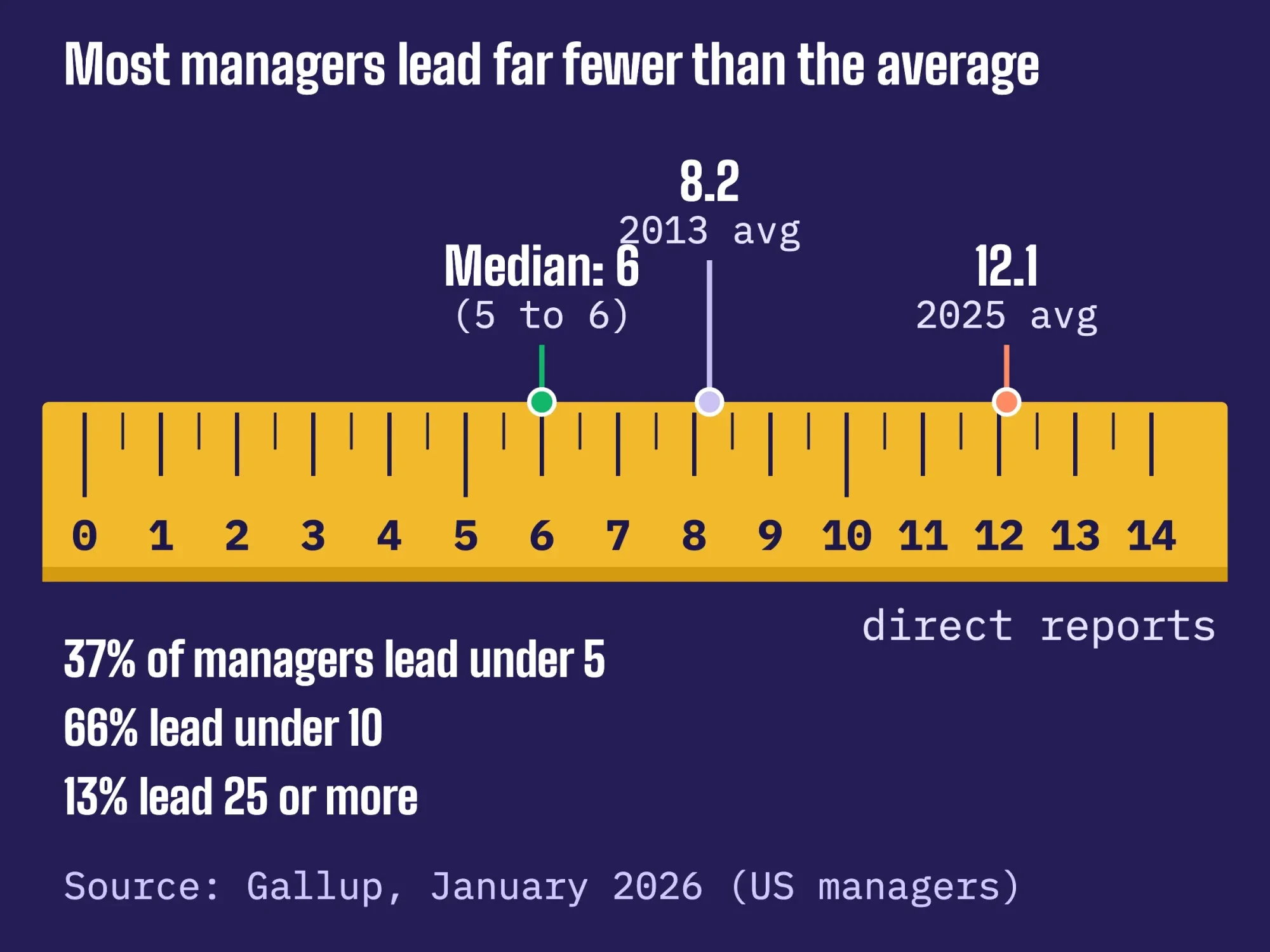 Source: Gallup, Span of Control: What’s the Optimal Team Size for Managers?, January 2026 (US managers, 2013 to 2025).
Example: Ironwood Garage Doors runs 3 hours short
Here's that time budget on a small trade business. Example: Ironwood Garage Doors is a made-up company in Cedar Rapids, Iowa. The owner has 15 people reporting to her: an office manager, two customer service reps, seven experienced technicians, three newer techs and two apprentices.
She works 50 hours a week, and 30 go to estimates, sales and the books. That leaves 20 for managing. Her own estimate of what each person needs a week is 1 hour for the office manager and 1.5 per rep. Experienced techs need 1 hour each, newer techs 2 and apprentices 3. Add it up: 1 + 3 + 7 + 6 + 6 = 23 hours.
She's 3 hours short every week, before the spring rush.
So she promotes one experienced tech to lead tech over the three newer techs and the two apprentices. That takes 12 hours a week of the lead's time. Her own span drops from 15 to 10. Her managing time drops to 12 hours: 11 for her remaining reports plus 1 for coaching the new lead, which leaves her 8 hours of slack.
The lead spends 12 of 40 hours leading, or 30%, and the rest on jobs. That's a player-coach, and Gallup found that heavy player-coaches "can stay engaged when managing a small team." The company's average span goes from 15 to 7.5, and the five people under the lead sit one layer further from the owner.
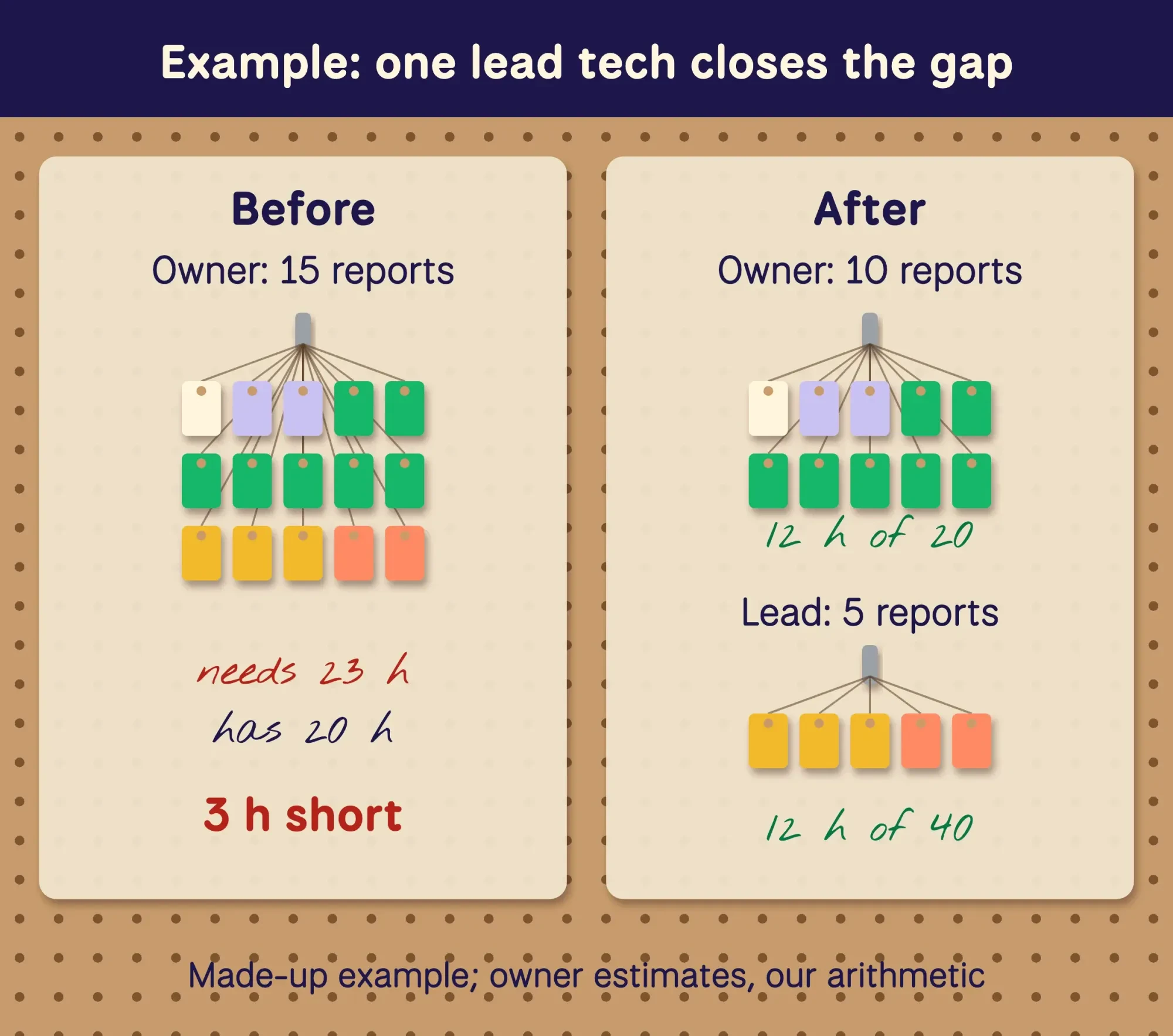 Drawn by us: the made-up Ironwood Garage Doors example; hours are the example owner’s estimates and our arithmetic (October 2026).
When to add a team lead, and who to pick
That example ran short on hours, and that's the clearest signal. These are the others we'd watch for:
- check-ins keep getting skipped or cut short
- jobs wait on your approval while you're on a job site
- you're about to hire two or more people into the same role
- the team has split by place or by shift, and you can't be in both
Incident command does the same thing. Under the NIMS doctrine (pages 87 and 88), the operations chief "assigns subordinate supervisory personnel as necessary." Divisions and groups get set up once resources exceed a manageable span. That's the same signal you're watching for.
Pick the lead for how they'll lead. Skill at the job comes second. Smeets' review warns that "the highest performers do not necessarily make the best managers." Ask your best tech if they want the job before you offer it, and cut their job load to match. Our task management skills post is a quick refresher for a new lead juggling jobs and people.
Access matters too. When the lead starts approving timesheets or seeing customer data, give them only what they need. Our security tips for remote workers apply to anyone handling logins away from the office.
Then teach the habit that matters most. Gallup asked employees whether they'd had meaningful feedback in the past week. Those who strongly agreed were highly engaged, "about seven in 10," whatever the size of their team.
Our take: size spans by the hours a manager actually has, and add a lead when the hours run out. A ratio shouldn't decide it.
A lead with five people and time to talk to each of them every week beats a flat chart nobody can manage.
Flatter isn't always faster, and the average hides overload
Two beliefs make spans worse, and both sound sensible until you've tried them.
The first is that cutting a layer speeds things up. Sometimes it does. But Wulf's research found flattened firms often ended up with more decisions made at the top. If the owner takes back every call the old supervisor used to make, nothing gets faster.
The second is that the average tells you who's overloaded. It doesn't. Gallup's 2025 average of 12.1 sits next to a median of five to six. And the GAO said back in 1980 that broad ratios mainly show where to look closer.
Check each manager's week, person by person.
Frequently asked
Does promoting someone to team lead make them exempt from overtime?
Not by itself. Under federal rules, an exempt executive must earn a salary of at least $684 a week and regularly direct two or more other employees, as of October 2026. Management must be the main duty, with a say in hiring or firing. The test is in 29 CFR 541.100, and state rules can be stricter.
How long should a weekly check-in with each report take?
Not long. Gallup says meaningful feedback conversations of 15 to 30 minutes, done consistently, are enough. Only 16% of nearly 15,000 employees in one Gallup study called their last talk with their manager extremely meaningful (Gallup).
What traits should I look for in a new team lead?
Gallup names five traits linked to more engaged teams: motivation, workstyle, initiation, collaboration and thought process. In its data, managers with high talent stayed more engaged even with 25 or more reports and heavy hands-on work (Gallup).
Start with one week of calendars
You don't need software or a consultant for this. For one week, ask everyone who manages anyone to note two things: time on their own work and time on their people. Then run the five steps above. If the notes turn into a to-do list, our project management basics help you sort out who owns what.
If someone's short on hours, you've found your next lead.
How we made this guide: the 2025 post quoted studies without sources. On October 25, 2026, we traced each of its numbers, kept the ones we could confirm and dropped the rest. We read the FEMA NIMS doctrine (October 2017), Gallup's January 2026 report, BLS Table 1.1, a 1980 GAO report, the 1996 National Performance Review appendix, the 1937 Gulick and Urwick papers and four research papers, each linked where it's used. We ran a short Python script (Python 3.9.6, macOS 27.0.1) to recompute Graicunas' table, the BLS manager share and the Ironwood arithmetic. Ironwood Garage Doors is made up. Eram N. reviews and approves the final text.
First published April 2025. Rewritten October 25, 2026: the old post quoted studies with no sources and some wrong dates. It now uses the real wording of the FEMA guideline, Gallup's 2025 team-size data, the federal 1:15 target, the studies behind the old claims, a time-based way to size your own span and a worked example of when to add a team lead.
Sources
- US Department of Homeland Security and FEMA: National Incident Management System, Third Edition (October 2017), PDF
- Gallup: Span of Control: What’s the Optimal Team Size for Managers? (Jim Harter, January 13, 2026)
- US Bureau of Labor Statistics: Employment by major occupational group, 2025 and projected 2035 (Table 1.1)
- US GAO: Supervisor to Nonsupervisor Ratios in the Federal Government and the Private Sector (FPCD-80-65, September 30, 1980)
- National Performance Review, 1996 report, Appendix H: Progress in Streamlining Management Control Positions
- Gulick and Urwick (eds.): Papers on the Science of Administration (1937), Internet Archive
- Meier and Bohte: Span of Control and Public Organizations, Public Administration Review 63(1), 2003
- NBER Digest: The Flattening of Corporate Management (October 2003)
- Rajan and Wulf: The Flattening Firm, Review of Economics and Statistics 88(4), 2006
- Wulf: The Flattened Firm: Not as Advertised, California Management Review 55(1), 2012
- Smeets: Can firms oversee more workers with fewer managers?, IZA World of Labor 333 (February 2017)


Comments
No comments yet. Start the conversation below.