

Quick answer
Enterprise fax solutions are still needed where the other side accepts only fax or mail. ONC data show 40% of US hospitals often sent care summaries by mail or fax in 2025. Part D controlled-substance prescriptions are the exception: CMS doesn't count a faxed one as electronic, and prescribers need a 70% electronic rate. List your fax flows before you pick cloud or on-prem.
Say you run IT for a medical practice that wants its fax machines gone. Enterprise fax solutions are the servers and cloud services that send, receive and log faxes for a whole organization. First list what the law or the other side still expects by fax: hospital records, prior authorization, IRS forms, Schedule II prescriptions and court service.
We cover where fax is still the expected channel, what HIPAA says about faxing patient records and where federal rules move health care off fax. Then come the junk fax law, cloud or on-prem setups with a checklist, a made-up fax log checked against the rules and what its flags say about fax habits.
Key takeaways
- A faxed Part D controlled-substance prescription doesn't count as electronic for CMS.
- HIPAA lets providers fax records for treatment with reasonable safeguards.
- A cloud fax service handling patient data needs a business associate agreement.
- An unsolicited fax ad can cost $500 per violation under the TCPA.
- Our check flagged 6 of 12 faxes in a made-up log.
Where fax is still the expected channel
Fax survives because the people on the other end haven't stopped accepting it, and hospitals are the clearest case. ONC's quick stat on hospital exchange methods shows 40% of US hospitals often sent summary of care records by mail or fax in 2025, up from 30% in 2023. On the receiving side, 35% often got records that way in both years, while 60% often sent records through a state, regional or local health information exchange. So 74% of hospitals still sent records by mail or fax at least sometimes in 2025 (40% often plus 34% sometimes), next to network exchange. Those figures come from the American Hospital Association's IT survey, which 2,351 hospitals answered in 2025.
Prior authorization still runs partly on fax. CMS's Interoperability and Prior Authorization final rule, CMS-0057-F, finalized January 17, 2024, says payer decisions may go out by portal, fax, email, mail or phone. Its prior authorization FAQ adds that the 72-hour expedited and seven-day standard deadlines apply whether a request arrives by API, portal, fax or phone. Those deadlines cover Medicare Advantage, Medicaid and CHIP. Qualified Health Plan issuers on the federal exchanges are out, the FAQ says, since the rule didn't change their timelines. From 2026, every payer under the rule must also give a specific reason for a denial, regardless of the method used to send the request.
Outside health care, a few federal forms still name fax. The IRS instructions for Form 2848 say: "If you check the box on line 4, mail or fax Form 2848 to the IRS office handling the specific matter." Without line 4, you're free to file online, by fax or by mail. An e-signed form can't go by fax; it has to go online. The Form SS-4 instructions still list fax for an EIN, though the IRS recommends applying electronically. In the December 2025 revision, the fax numbers moved into their own "Apply by fax" section.
The DEA's 21 CFR 1306.11 lets a practitioner fax a Schedule II paper prescription to a pharmacy, but the pharmacist has to see the original manually signed one before dispensing. In federal court, Rule 5(b)(2)(E) allows service by other electronic means only if the person consented in writing. Rule 5(b)(2)(F) sets the same condition for any other means, so a fax needs that consent on file.
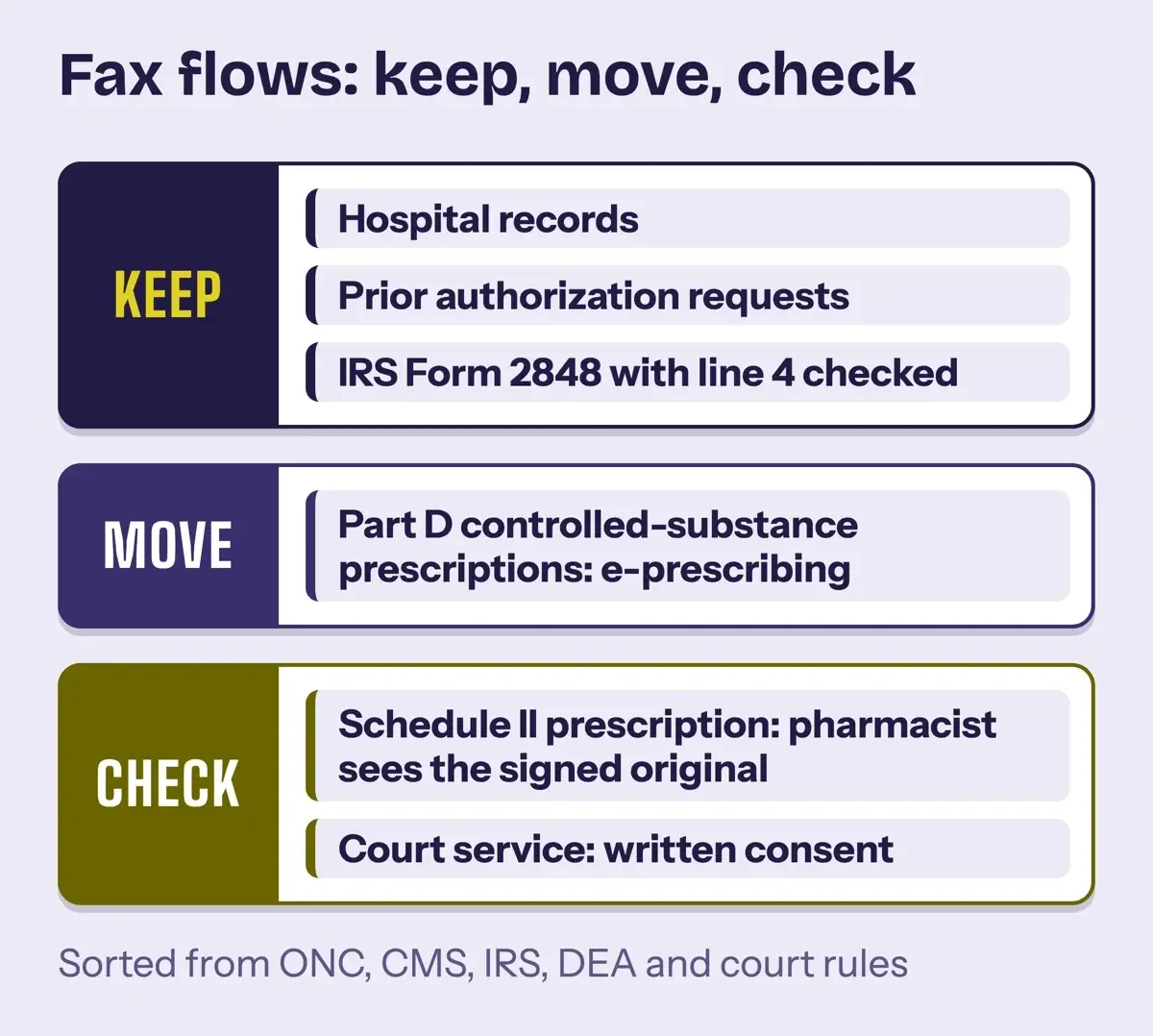 Diagram by DigitalTreed: fax flows sorted into keep, move and check, from the ONC, CMS, IRS, DEA and court rule pages cited in this section.
What HIPAA says about faxing patient records
Once you know which flows stay, check that you're allowed to fax the records at all. What follows is background from official pages, not legal advice. HHS says yes in its HIPAA FAQ on sharing patient information for treatment by fax, as long as there are reasonable safeguards. Its examples are confirming a number with the recipient and pre-programming numbers you use often. The rule behind that is 45 CFR 164.530(c). It says a covered entity "must reasonably safeguard protected health information from any intentional or unintentional use or disclosure" that breaks the rules. Its next line covers incidental disclosures that ride along with a permitted one, and those must be limited too.
Treatment faxes get one break. Under 45 CFR 164.502(b)(2), the minimum necessary standard doesn't apply to disclosures to a provider for treatment. So a specialist gets the full chart. A payer getting the same chart for billing falls under the minimum necessary standard.
The machine you use changes which HIPAA rules apply. The definitions in 45 CFR 160.103 say a paper fax isn't a transmission via electronic media if the data wasn't electronic just before it was sent. A fax server or cloud inbox that stores page images is different. Those files are electronic protected health information, so the Security Rule at 45 CFR 164.312 applies. It asks for audit controls that record activity, and for transmission security on data sent over a network. Encryption is marked addressable. Under 45 CFR 164.306(d)(3), you use it if it's reasonable and appropriate; if it isn't, you document why and use an equivalent measure if one is.
Faxed records arrive as images you can't search. An OCR tool for PDFs and images cuts the retyping, but PHI shouldn't go into a tool that hasn't signed a business associate agreement.
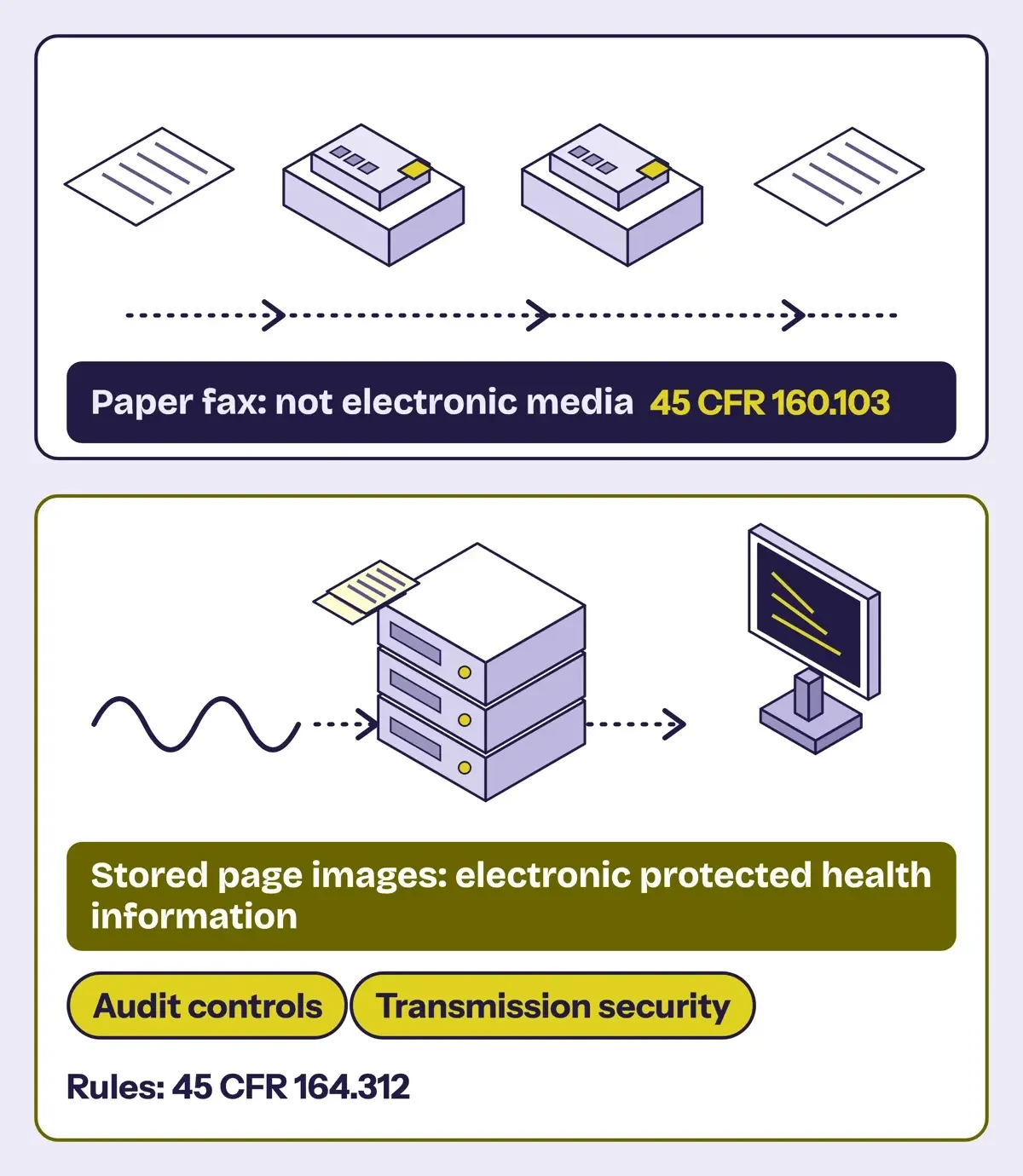 Diagram by DigitalTreed: paper fax vs fax server under HIPAA, from 45 CFR 160.103 and 164.312.
Where federal rules move health care off fax
Medicare's Part D drug rules are stricter than HIPAA. Under 42 CFR 423.160, Part D prescriptions must use the NCPDP SCRIPT standard. The only fax allowance reads: "computer-generated facsimile is only permitted in instances of temporary/transient transmission failure". CMS's e-prescribing standards page says that exemption shrank to network failures as of January 1, 2012.
Controlled substances add a target. CMS's EPCS program page counts a prescriber as compliant when 70% or more of their Part D Schedule II-V prescriptions are electronic. The EPCS FAQ, version 8.0 from June 2026, says a prescription made in an EHR and sent by fax isn't electronic, so each EHR fax lowers the clinic's rate. CMS posts each prescriber's yearly status in its EPCS Prescriber Portal, and data for a measurement year shows up in mid-September of the next year. EHR faxes sent in 2026 wouldn't show there until September 2027.
Prescribers with 100 or fewer qualifying Part D controlled-substance prescriptions don't need to hit 70%; the same CMS page gives them an automatic exception.
Prior authorization is moving too. CMS-0057-F gives payers API compliance dates that generally start January 1, 2027. Drugs aren't covered. ONC's Data Brief 71 on hospital interoperability asks hospitals whether they receive a summary of care record "electronically (not eFax)", so an eFax doesn't count in ONC's measures. Our guide to digital technology in health care covers the EHR and telehealth side.
How does the junk fax law apply to business faxes?
Fax ads to prospects and customers fall under the junk fax law. Under 47 U.S.C. 227(b)(1)(C), an unsolicited ad to a fax machine is unlawful unless three things are true. You'll need an established business relationship, a number the recipient gave you or published, and an opt-out notice. An ad isn't unsolicited if the person gave "prior express invitation or permission, in writing or otherwise".
The notice has fixed parts. The FCC rule at 47 CFR 64.1200(a)(4) wants it "clear and conspicuous and on the first page of the advertisement". It must give a domestic phone and fax number for opt-outs. If neither is toll-free, you'll add a cost-free route such as a website or email address. Opt-outs have to be honored within the shortest reasonable time, and never later than 30 days. The statute lets a recipient sue for actual loss or $500 per violation, whichever is greater. Willful or knowing violations may draw up to three times that.
If each fax counts as one violation, a 200-number blast without the notice could mean $100,000 (example: 200 x $500).
Hiring a fax broadcaster won't move the risk, because the rule defines the sender as the business on whose behalf the ad is sent or whose goods it promotes. The FCC's Akin Gump ruling of September 21, 2020 makes the broadcaster solely liable when it deceives or defrauds the advertiser. An advertiser on notice of violations that doesn't act can still be liable.
Online fax inboxes are a gray area. The FCC's Consumer and Governmental Affairs Bureau adopted the Amerifactors declaratory ruling on December 9, 2019. It said an online fax service isn't a telephone facsimile machine under the TCPA, and it limited that finding to the online fax services described in its record. The Bureau's Ryerson ruling of September 3, 2020 noted that an application for review of Amerifactors was pending. Since you can't tell who reads faxes in an email inbox, we'd treat every number on an ad list as a fax machine. For AI tools in email, chat and phone, see our piece on AI for business communication.
Cloud or on-prem enterprise fax solutions
The build choice comes down to who holds the pages and the logs. A cloud fax service that handles patient data for you is a business associate. The HIPAA definitions include anyone who provides data transmission services for PHI and needs routine access to it. HHS's guidance on HIPAA and cloud computing applies that to cloud services that create, receive, maintain or transmit electronic PHI. Under 45 CFR 164.308(b)(1), you'll need those satisfactory written assurances, the BAA, before any PHI goes on the service.
An on-prem fax server keeps the pages on your network, but it still has to reach the phone network. Over IP, the ITU standard for that is ITU-T Recommendation T.38, which covers real-time Group 3 fax over IP networks; its in-force version dates from November 2015. Ask your carrier in writing whether its SIP trunks support T.38 before you buy a fax server. The page images and logs stay on your servers, and both are electronic PHI, so access control and backups are your job, not the carrier's. Our pieces on role-based access control and cloud backup for businesses cover both. The table sets the two side by side on five points; it doesn't rate any product.
| Point | Cloud fax service | On-prem fax server |
|---|---|---|
| Who stores the page images | The provider, under your BAA | You, on your servers |
| HIPAA paperwork | BAA before any PHI, plus your own risk analysis | Your own Security Rule risk analysis |
| Phone line | Provider's network | Analog lines or SIP trunks that support T.38 |
| Audit logs (164.312(b)) | Ask the provider for exports | Kept and reviewed by your team |
| Ad faxes (TCPA) | You're still the sender | You're still the sender |
Keep the answers you get from the checklist below. HIPAA's documentation rule has covered entities keep required records for six years from creation or the date last in effect, whichever is later.
- Name every fax flow, its sender, its recipient and whether it carries PHI.
- Mark each flow keep, move to an electronic route, or stop.
- Get a signed business associate agreement before any PHI touches a cloud service.
- Ask where page images and logs are stored and for how long.
- Ask for audit logs that show who sent, viewed and deleted each fax.
- Confirm encryption in transit and at rest, or document why not.
- Pre-program and verify the fax numbers you use most.
- Turn off EHR fax routing for Part D controlled-substance prescriptions.
- Put the first-page opt-out notice on every fax ad, or stop sending them.
- Keep written consent before serving court papers by fax.
State privacy laws such as California's can add terms; our data protection compliance guide covers the CCPA next to HIPAA. For the network the fax server sits on, start with our cybersecurity tips for businesses.
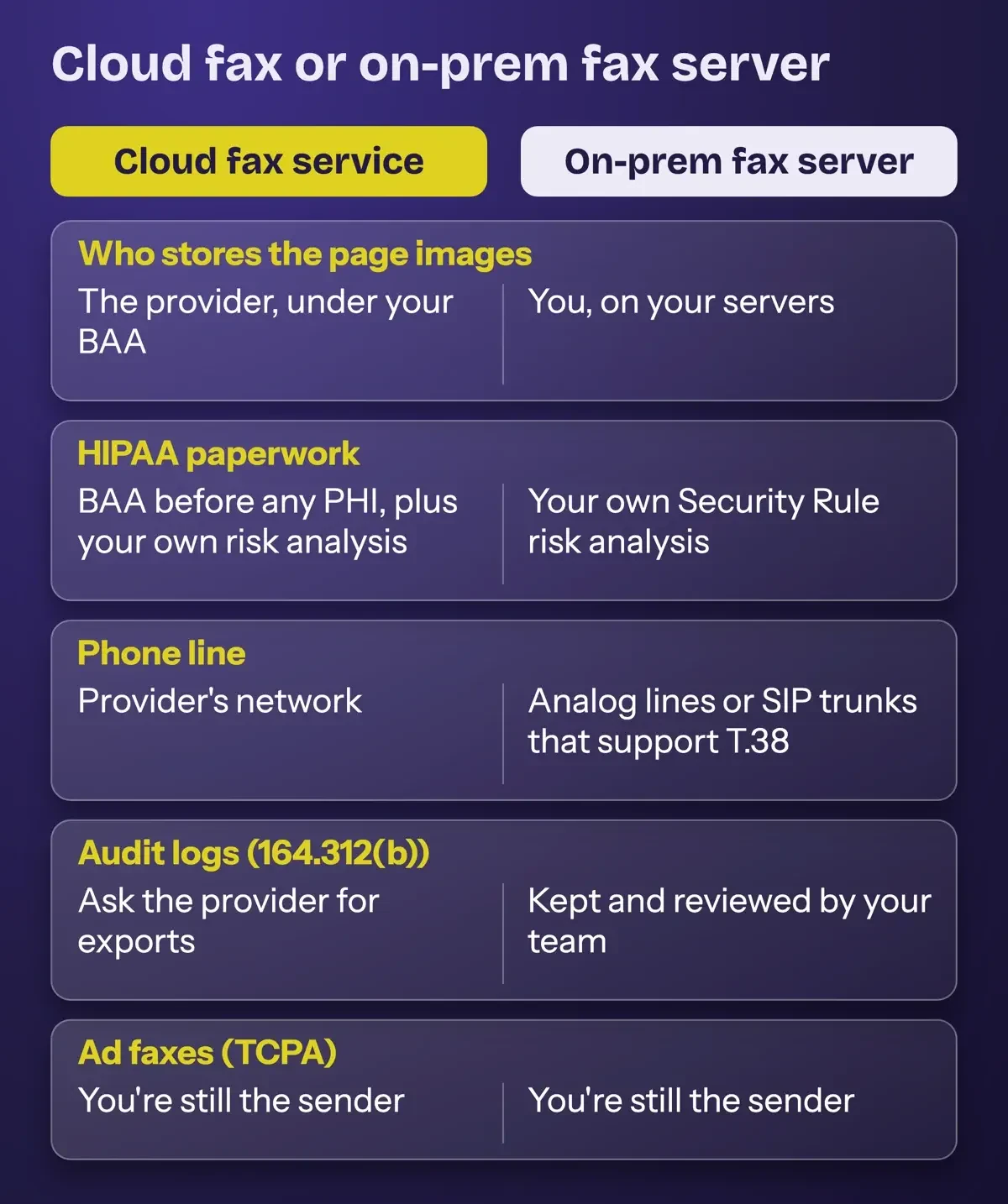 Diagram by DigitalTreed: cloud fax vs on-prem fax server, from 45 CFR 160.103, 164.308, 164.312 and ITU-T T.38.
Check your fax log against the rules
We turned the rules above into a script that reads a fax log, one outbound fax per row with the facts each rule needs, like a BAA on file.
What we tested
On November 7, 2026, we ran test/fax_route_check.py on a made-up 12-row log for Quillfen Family Clinic, a made-up practice. All nine rules matched a phrase in their saved source pages. It flagged 6 rows, each under a different rule, and passed 6.
| Row (made up) | Fax | Result | Rule |
|---|---|---|---|
| 2 | Records to a specialist, cloud fax | Flag: number not verified | 45 CFR 164.530(c) |
| 3 | Lab result, cloud fax | Flag: no BAA on file | 45 CFR 160.103 |
| 6 | Part D controlled Rx from the EHR | Flag: fax with no network failure | CMS EPCS FAQ |
| 8 | Fax ad to past customers | Flag: no first-page opt-out notice | 47 CFR 64.1200 |
| 11 | Court papers to opposing counsel | Flag: no written consent | FRCP 5(b)(2)(E) |
| 12 | IRS Form 2848, e-signed | Flag: e-signed form must go online | IRS Form 2848 instructions |
Rows 1, 9 and 10 passed cleanly.
What the six flags say about fax habits
None of the six flags came from the fax hardware. Each is a missing step: an unchecked number, a missing BAA, an EHR fax with no outage, no opt-out line, no written consent and an e-signed Form 2848. The clean passes show the fix: row 1's number was checked, row 9's ad met all three conditions and row 10's recipient invited it.
Row 12 is the odd one, because under the IRS instructions Form 2848 is fine to fax with a handwritten signature; only the electronic signature forces it online.
Two prior authorization requests, rows 4 and 5, passed with a note that the payer's clock runs the same as for an API request. Row 7 is a controlled-substance prescription faxed during a network outage, which 42 CFR 423.160 allows, though CMS still won't count it as electronic. If outages like that happen every week, the EPCS rate will show it.
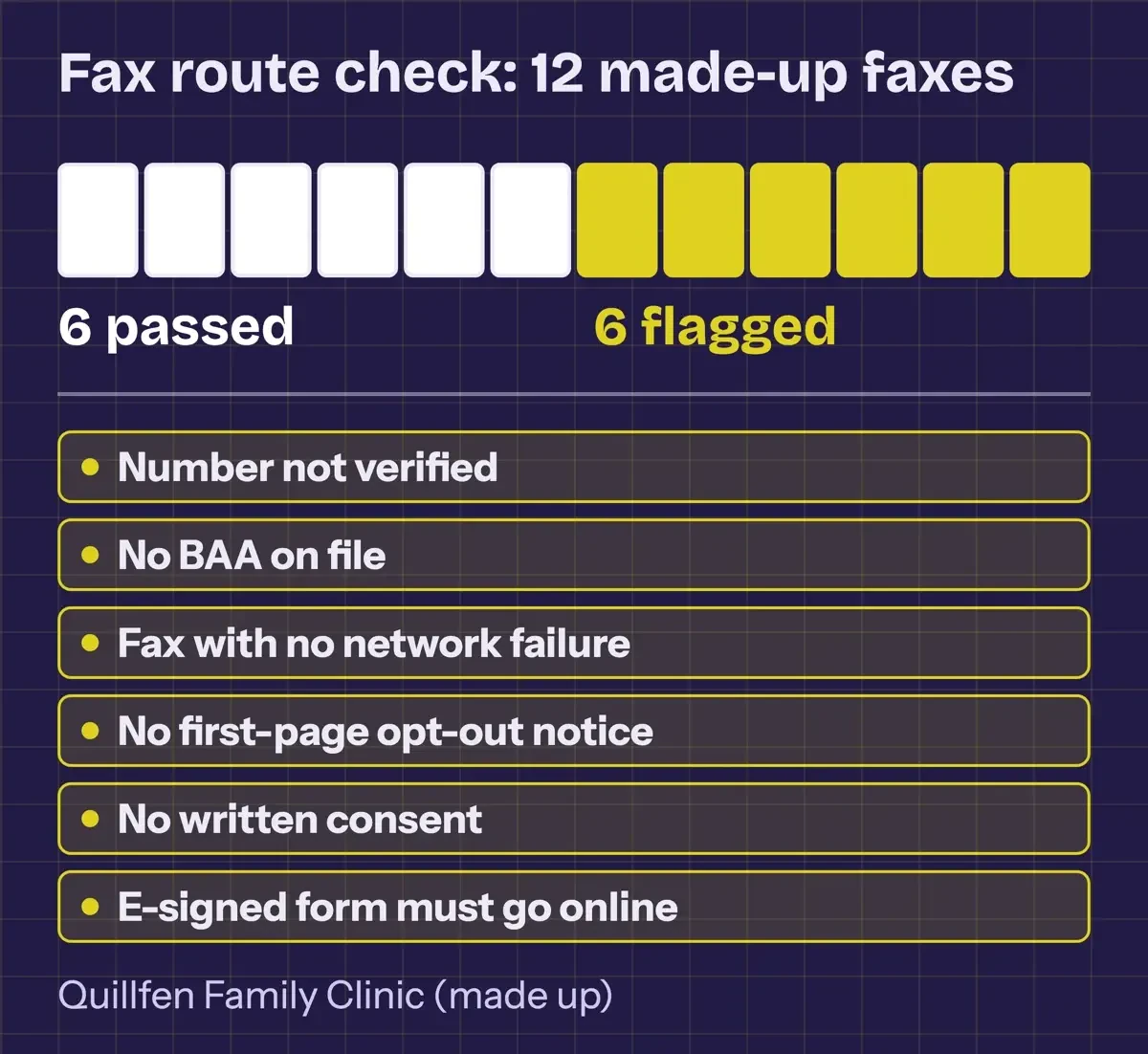 Drawn by us: results of our fax route check on a made-up 12-row log, from test/results.json.
Our take: fix the missing steps before you shop. We'd export 30 days of fax logs, fix the EHR routing and collect missing BAAs, then compare cloud and on-prem.
Frequently asked
Can a pharmacy accept a faxed Schedule II prescription?
Yes, in general. 21 CFR 1306.11 allows it if the pharmacist sees the signed original before dispensing.
Can I fax Form 2848 to the IRS?
Yes, with a handwritten signature. The Form 2848 instructions list fax numbers; e-signed forms go online.
Is fax more secure than email under HIPAA?
Neither is exempt. A paper fax isn't electronic media, but 45 CFR 164.530(c) safeguards still apply.
Do prior authorization deadlines change for a faxed request?
No. CMS's prior authorization FAQ says the same deadlines apply whatever the channel.
How we made this guide: We saved the source pages on November 7, 2026. HHS's site returned a 403 on two, so we paraphrase those and lean on the CFR text. Facts checked by the DigitalTreed team on November 7, 2026. Nothing here is legal advice; have a health care attorney review your fax policies.
First published July 2025 as a general essay on the benefits of enterprise fax that promoted one fax service. Rewritten November 7, 2026: where fax is still expected, HIPAA, Part D e-prescribing, the junk fax law, cloud vs on-prem and a tested log check. The vendor mentions and unsourced compliance claims were cut.
Sources
- ONC: Methods used by hospitals to engage in interoperable exchange (2018-2025)
- ONC Data Brief 71: Interoperable exchange among U.S. hospitals, 2023 (May 2024)
- CMS: Interoperability and Prior Authorization final rule, CMS-0057-F (January 17, 2024)
- CMS: Improving prior authorization processes FAQ
- CMS: Electronic Prescribing for Controlled Substances program
- CMS: EPCS frequently asked questions, v8.0 (June 2026)
- CMS: E-prescribing standards and requirements
- 42 CFR 423.160: Part D electronic prescription standards (Cornell LII)
- 21 CFR 1306.11: Schedule II prescription requirements (Cornell LII)
- IRS: Instructions for Form 2848
- IRS: Instructions for Form SS-4 (12/2025)
- Federal Rules of Civil Procedure, Rule 5 (Cornell LII)
- HHS: HIPAA FAQ on sharing patient information for treatment by fax
- HHS: Guidance on HIPAA and cloud computing
- 45 CFR 160.103: HIPAA definitions (Cornell LII)
- 45 CFR 164.502: Uses and disclosures, minimum necessary (Cornell LII)
- 45 CFR 164.530: Administrative requirements (Cornell LII)
- 45 CFR 164.308: Administrative safeguards (Cornell LII)
- 45 CFR 164.312: Technical safeguards (Cornell LII); 45 CFR 164.306: Security standards, general rules (Cornell LII)
- 47 U.S.C. 227: Telephone Consumer Protection Act (Cornell LII)
- 47 CFR 64.1200: Delivery restrictions (Cornell LII)
- FCC DA 19-1247: Amerifactors declaratory ruling (December 9, 2019)
- FCC DA 20-1038: Ryerson declaratory ruling (September 3, 2020)
- FCC DA 20-1116: Akin Gump declaratory ruling (September 21, 2020)
- ITU-T Recommendation T.38: Group 3 fax over IP networks


Comments
No comments yet. Start the conversation below.