
Quick answer
101Desires.com cloud storage showed no sign-up page, price list or upload screen in our November 12, 2026 checks. The domain answered our 20 requests with blank Loading pages, rate-limit errors or nothing, and Google's Workspace Marketplace returned no match for the name. Need storage for client files? Read a provider's own encryption page and its renewal price first.
Our December 16, 2023 post called 101Desires.com cloud storage an affordable service that had "newly collaborated with Google". It cited no source for either claim. Today 101Desires.com is a .com domain that serves a blank redirect page.
A storage company leaves a trail: a sign-up page, a price list, a listing with the partner it names. We looked for all three on November 12, 2026, in the domain's own answers, its registry record, the Wayback Machine and Google's Workspace Marketplace. None turned up. One check, Google's Cloud partner directory, is still open.
Key takeaways
- Google's Workspace Marketplace returned no match for 101Desires.com on November 12, 2026.
- The current 101desires.com registration began November 3, 2024, after our 2023 post.
- Archived copies show a general blog, then an Account Suspended page from September 2023.
- Only end-to-end encryption keeps the provider itself from reading your files.
- Proton Drive Plus renews at $47.88 a year, as of November 2026.
What 101Desires.com shows on November 12, 2026
Our script looked up the domain first, on November 12, 2026. Both 101desires.com and www.101desires.com resolved in DNS. But 101desires.net and 101desires.org returned NXDOMAIN, the no-such-domain answer explained in our NXDOMAIN error guide, so those look-alike names don't exist. Then we asked for the home page 20 times, 3 seconds apart, without following any redirect. Five answers were a page of about 480 bytes titled Loading, holding nothing but a script that sends the browser on to another address we didn't follow. Ten were 429 Too Many Requests. Five got no answer at all.
None of the 20 answers had even 20 words of visible text. In earlier manual checks, two header-only requests were sent on to an unrelated domain, and we stopped there.
The Verisign registry record for 101desires.com says the current registration began on November 3, 2024 and runs to November 3, 2027, with TurnCommerce, Inc. DBA NameBright.com as the registrar. No registrant is named, and a whois query gave the same creation date. Our old post went up on December 16, 2023, about 11 months earlier, so this record can't tell us who ran the site when we wrote about it.
| Where we looked | How | Result (November 12, 2026) |
|---|---|---|
| 101desires.com and www | DNS lookup | Both names resolve |
| 101desires.net and .org | DNS lookup | NXDOMAIN: the names do not exist |
| Home page, 20 requests | Plain request, no redirect followed | 5 blank Loading pages, 10 Too Many Requests, 5 no answer |
| Registry record (RDAP) | Public lookup | Registered November 3, 2024; owner not shown |
| Wayback Machine | Archived copies | 2022-2023 general blog; Account Suspended from September 2023 |
| Google Workspace Marketplace | Its own search page | No matching results |
| Google Cloud partner directory | Needs a browser | Not checked yet |
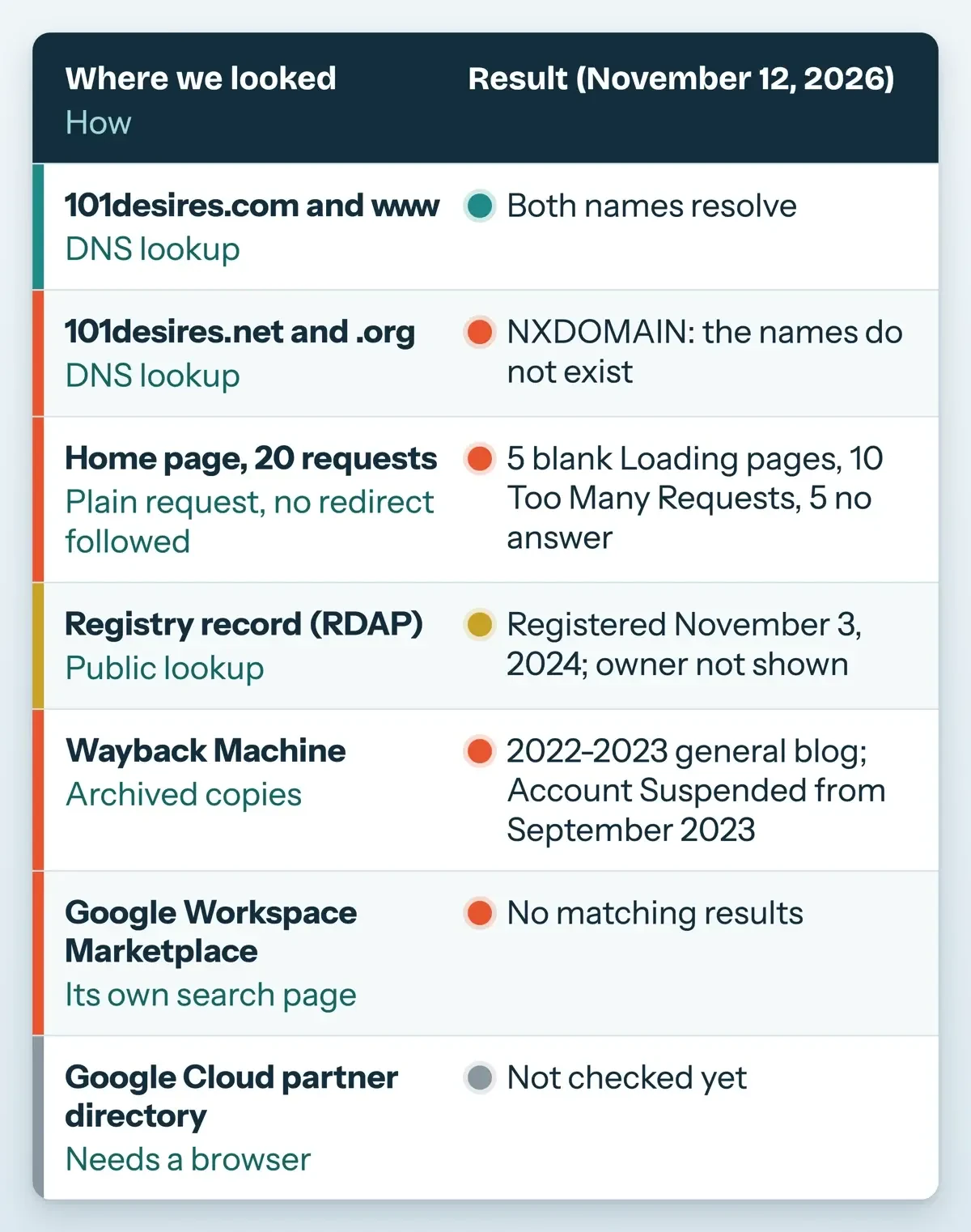 Diagram by DigitalTreed, from our DNS, web, registry and Marketplace checks on November 12, 2026.
What we tested
Those checks came from three small scripts with plain requests, no sign-in and no forms. One did the checks in the table. One matched 9 claims from our old post, from Google ties to two-factor login, against 7 saved site pages and 2 Google pages, and none was backed. One confirmed that all 18 encryption and price lines quoted below appear word for word on 12 saved provider pages, then did the cost math.
Did Google ever partner with 101Desires.com?
The old post's Google claims came with an instruction: search the Google Workspace Marketplace for the name and click Install. So we read Google's own Marketplace search page for 101desires, plus a second search for 101Desires.com. Both said "No matching results". A control search for dropbox listed the Dropbox for Gmail add-on, so plain requests do get real results there. Google also lists its cloud partners in the Google Cloud partner directory, but that directory is a script app our plain request couldn't read, so one check is still open. No Google page we saved names 101Desires.
The Wayback Machine's September 25, 2022 capture shows a blog titled "Latest Information Related to G-Suit and Google World". Its posts, signed admin, covered thyroid health, the Polygon Matic coin and Google Meet versus Zoom, which reads like a general news blog rather than a company selling storage. The site's Cloud Storage Services category page from August 3, 2023 lists articles such as "Top 10 Benefits of Cloud Storage and Disadvantages". No capture we read had a sign-up page, a price list or an upload screen. Of the 52 archived page addresses, not one names a partner, a collaboration or an About page.
From September 17, 2023, the archive's copies show the host saying "This Account has been suspended" in a suspended-account capture. Copies of that page run to December 20, 2023, four days after our post went up calling the site a cloud storage provider with Google behind it.
False claims of a tie to a business fall under federal law. The FTC's Impersonation of Government and Businesses Rule covers them. Under 16 CFR 461.3, it's unlawful to "materially misrepresent, directly or by implication, affiliation with, including endorsement or sponsorship by, a business". This summary isn't legal advice. We make no finding about any site. If a false partnership claim cost you money, ask a licensed attorney about your options.
Encryption in transit, at rest and end-to-end
Unlike 101Desires.com, each of the five providers we compared publishes its own security page, and for client files that's what we read next. Three terms carry most of the meaning. In transit covers files moving between your device and the provider. At rest covers files sitting on its disks, and end-to-end means only your devices hold the keys.
Google and Dropbox both name AES, the cipher NIST standardized in FIPS 197. That standard specifies three key sizes, "AES-128, AES-192, and AES-256". 256-bit AES is the largest. But the cipher alone doesn't say who holds the key, and the key holder is who can read your files. Google's Drive privacy and security page says "Data is encrypted in-transit and at-rest." Its default encryption documentation adds: "All data that is stored by Google is encrypted at the storage layer using the Advanced Encryption Standard (AES) algorithm, AES-256." Extra client-side encryption is listed for four editions only, per Google's client-side encryption help page. They are "Frontline Plus; Enterprise Plus; Education Standard and Education Plus".
Dropbox's security overview says "Dropbox files at rest are encrypted using 256-bit Advanced Encryption Standard (AES)". It uses SSL/TLS "to protect data in transit between Dropbox apps and our servers". It says "Dropbox doesn't offer client-side encryption," then "However, Dropbox offers end-to-end encryption" in the next line, without naming a plan. Its advanced encryption article says "Only a team admin or a security admin can activate advanced encryption", so it's a setting for team accounts rather than one person. Microsoft's OneDrive encryption page says "Communication to OneDrive across the Internet uses SSL/TLS connections." At rest, it lists "BitLocker disk-level encryption and per-file encryption of customer content", but it names no end-to-end option.
Apple's iCloud data security overview says "Your iCloud data is encrypted in transit and stored in an encrypted format at rest," but by default "only certain data is end-to-end encrypted". With the optional Advanced Data Protection setting, "your trusted devices retain sole access to the encryption keys for the majority of your iCloud data".
Proton's Drive security page says "no one, not even Proton, can access your files and folders or see their names without your permission."
| Provider | In transit | At rest | End-to-end for personal files |
|---|---|---|---|
| Google Drive | Yes | Yes, AES-256 | Client-side encryption on 4 Workspace editions only |
| Dropbox | Yes, SSL/TLS | Yes, 256-bit AES | No client-side encryption; end-to-end plan not named |
| Microsoft OneDrive | Yes, SSL/TLS | Yes, BitLocker plus per-file keys | No end-to-end option named |
| Apple iCloud | Yes | Yes | Some data by default; most with Advanced Data Protection |
| Proton Drive | Not listed separately | Not listed separately | Yes, for all files |
Read the last column first. Of the five pages, only Proton's promises "End-to-end encryption for all your files". Apple's covers most iCloud data only after Advanced Data Protection is turned on.
Apple's Advanced Data Protection page warns that with it on, "Apple doesn't have the encryption keys needed to help you recover your end-to-end encrypted data." We'd set up a recovery contact or recovery key before turning it on, and keep that key somewhere outside the account it protects, such as a printed copy.
For a signed contract or a tax file, we'd want end-to-end. For shared marketing images, we'd accept at-rest encryption.
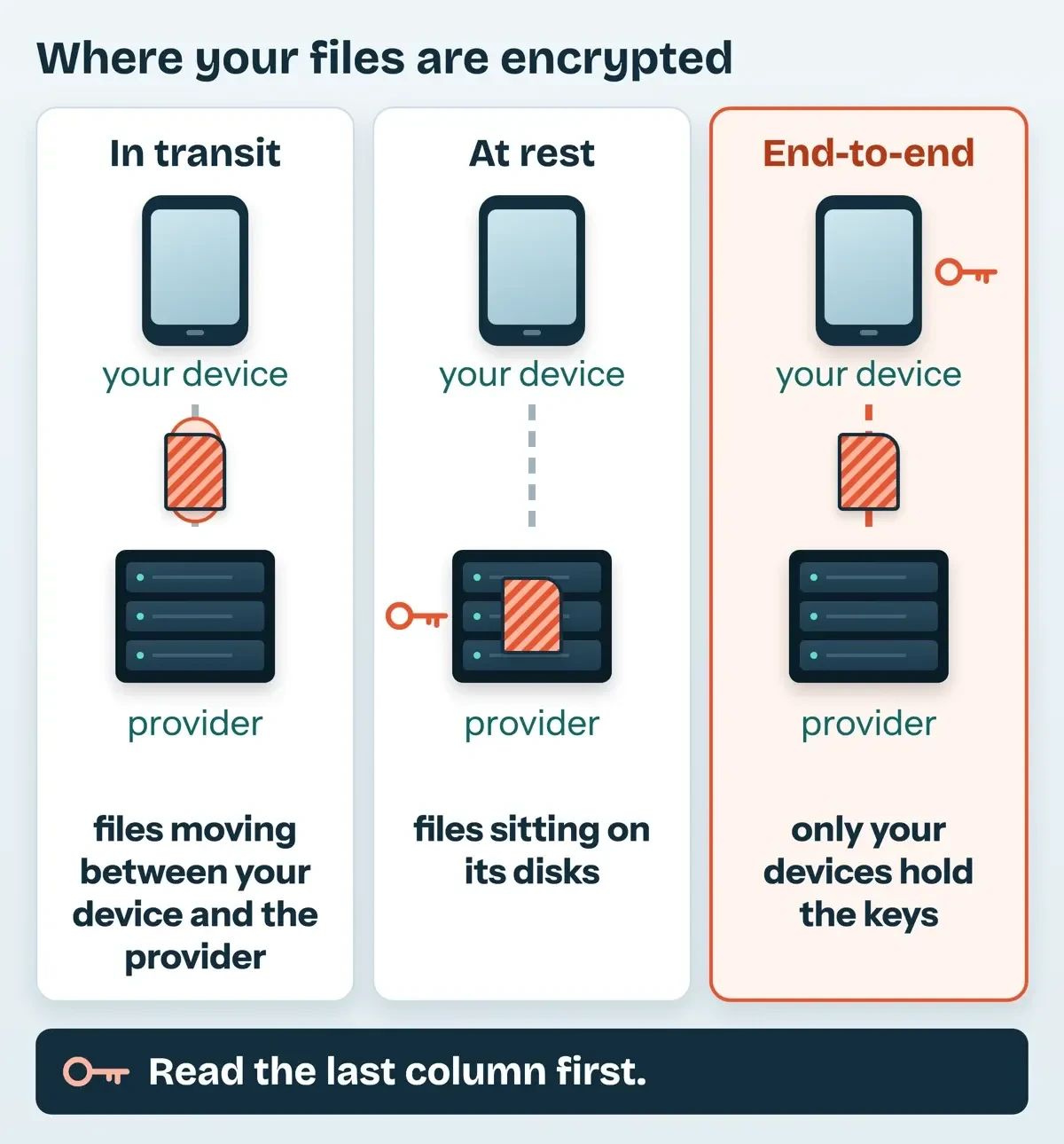 Diagram by DigitalTreed, from Google, Dropbox, Microsoft, Apple, Proton and NIST pages read November 12, 2026.
Cloud storage prices from US pricing pages
Apple's iCloud+ bills monthly and Proton's Drive Plus by the 12 months, so we put every plan on a yearly basis. We use two example formulas: annual cost = monthly price x 12, or the stated 12-month price. Cost per TB-year = annual cost / TB of storage. Apple's and Proton's pages each list a 5 GB free tier, so the table covers paid plans only.
Apple's iCloud+ plans and pricing page gives a United States row, as of November 2026. It lists $0.99 for 50 GB, $2.99 for 200 GB and $9.99 for 2 TB. The 6 TB plan is $29.99 and 12 TB is $59.99. Apple says "After you upgrade, you're billed monthly", and a footnote says some US states add tax. Dropbox's plans page showed Plus, 2 TB for one person, at $9.99 a month as of November 2026. The Billed yearly option was selected, which makes $119.88 a year (example: $9.99 x 12). Proton's Drive pricing page lists Drive Plus with 200 GB, as of November 2026: "Billed at $29.88 for the first 12 months, then renews at $47.88 every 12 months."
| Plan (example) | How billed | Per year | Per TB-year |
|---|---|---|---|
| Apple iCloud+ 200 GB | Monthly, $2.99 | $35.88 | $179.40 |
| Apple iCloud+ 2 TB | Monthly, $9.99 | $119.88 | $59.94 |
| Dropbox Plus 2 TB | Yearly, shown as $9.99 a month | $119.88 | $59.94 |
| Proton Drive Plus 200 GB, first year | 12 months, $29.88 | $29.88 | $149.40 |
| Proton Drive Plus 200 GB, renewal | 12 months, $47.88 | $47.88 | $239.40 |
So in this example, 2 TB from Apple or Dropbox works out to $59.94 per TB-year. Proton's renewal is $239.40 per TB-year, about 4 times as much ($239.40 / $59.94), but Proton's security page promises "End-to-end encryption for all your files".
Need under 200 GB? Then compare the yearly bill instead: $35.88 at Apple versus $47.88 at Proton after year one, as of November 2026.
Microsoft's US OneDrive page didn't answer our request, and Google's plans page served us rupee prices, so neither is in the table. Team plans from Google, Microsoft and Dropbox are compared per user in our cloud storage for small business comparison.
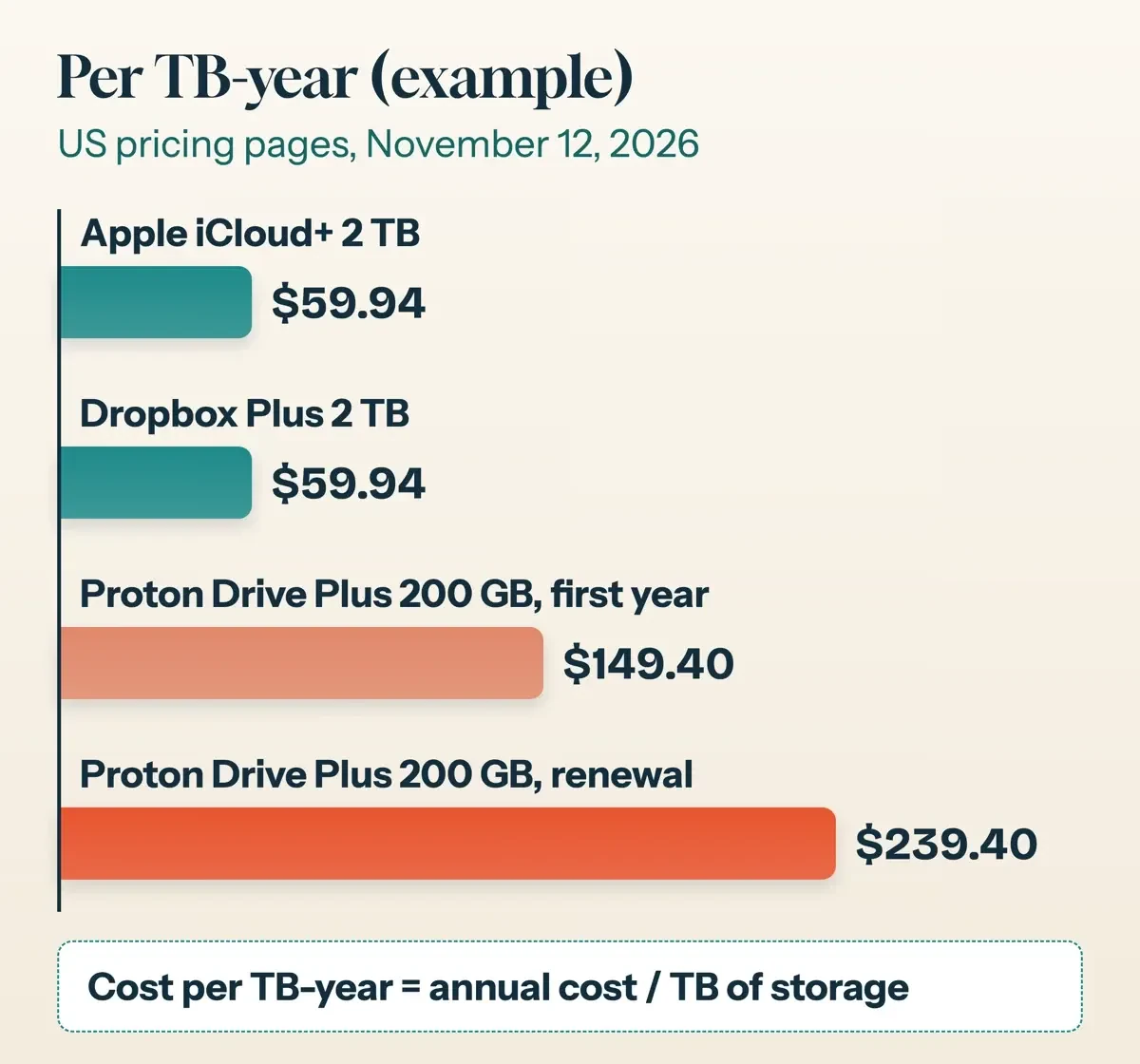 Drawn by us from Apple, Dropbox and Proton US pricing pages read November 12, 2026 (example math).
Five checks before you upload client files
These five checks use public pages only, and three came from this case. They caught the 2024 registration date, the empty Marketplace search and Proton's renewal price, $18 a year above year one ($47.88 - $29.88, as of November 2026).
- Look up the domain on ICANN Lookup and compare its creation date with the claims.
- Confirm any partnership in the partner's own directory or marketplace.
- Read the provider's encryption page for in transit, at rest and end-to-end.
- Write down the renewal price and billing term, not only the first-year price.
- Turn on multifactor login and keep one backup outside the storage account.
The first check works on any name through ICANN Lookup. For the last two, the FTC's small business cybersecurity basics say to "Save your backups in the cloud or on an external hard drive." It also names "cloud storage solutions" among the devices and media a business should encrypt when they hold sensitive personal information, next to laptops and backup tapes. Our cloud backup guide explains why a synced folder isn't a backup on its own.
For logins, an FTC consumer article on protecting personal information says to use a strong password "and turn on two-factor authentication." CISA's More than a Password page, now in its archive, says "Users who enable MFA are significantly less likely to get hacked." Our online security steps cover those settings. Our SSL certificate explainer shows what HTTPS protects in transit.
Brand claims get one more test: compare the site's address with the brand's own, as in our GoMyFinance .com vs .org lookalike check. For the vocabulary on these pages, start with what cloud computing is.
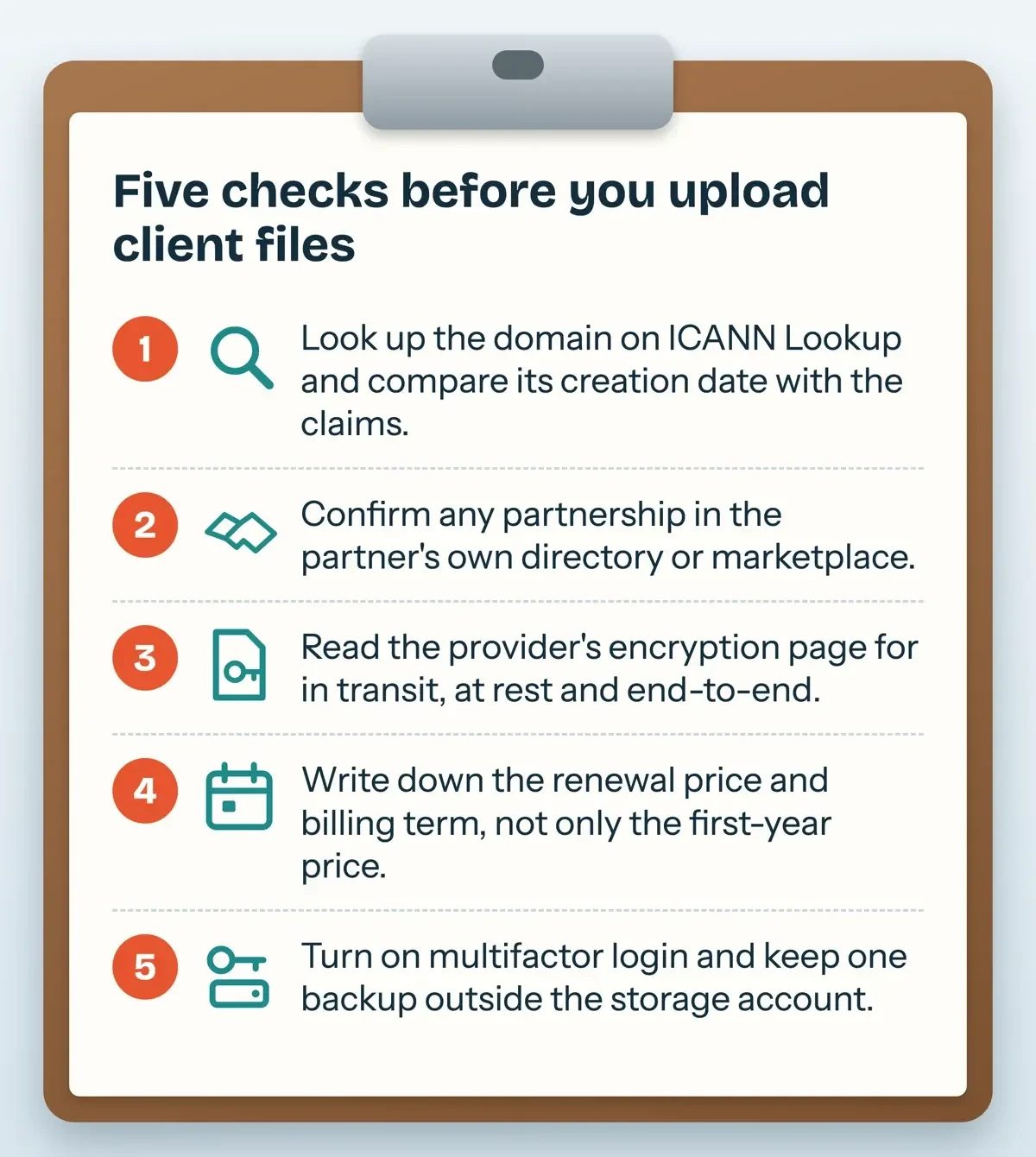 Drawn by us: five checks before uploading files to a new storage service.
Frequently asked
Is 101desires.net the same site as 101desires.com?
No. On November 12, 2026, 101desires.net returned NXDOMAIN, so it doesn't exist. The registry record covers only the .com.
What if I lose access with end-to-end encryption on?
Per Apple, you'd recover with "your device passcode or password, your recovery contact, or recovery key".
Can I get my money back on a storage plan?
Read each provider's terms. Proton's pricing page shows a "30-day money-back guarantee" next to Drive Plus.
What does NIST count as cloud computing?
Per NIST SP 800-145, the model "is composed of five essential characteristics, three service models, and four deployment models."
How we made this guide: We sent 20 plain requests to 101desires.com and read its registry record, 52 archived addresses and Google's Marketplace. We saved 19 provider and government pages as text. Facts checked by the DigitalTreed team on November 12, 2026.
First published December 16, 2023 as a profile of 101Desires.com. Rewritten November 12, 2026 as a dated check plus a provider-neutral cloud storage guide.
Sources
- Verisign RDAP: 101desires.com registration record
- ICANN Lookup
- Google Workspace Marketplace: search for 101desires
- Google Cloud: Find a partner
- Wayback Machine: 101desires.com, September 25, 2022
- Wayback Machine: Cloud Storage Services category, August 3, 2023
- Wayback Machine: suspended-account page, September 17, 2023
- FTC: Impersonation of Government and Businesses Rule
- Cornell LII: 16 CFR 461.3, Impersonation of businesses prohibited
- NIST FIPS 197: Advanced Encryption Standard (AES)
- NIST SP 800-145: The NIST Definition of Cloud Computing
- Google Drive Help: How Google Drive protects your privacy and security
- Google Cloud: Default encryption at rest
- Google Workspace Admin Help: About client-side encryption
- Dropbox Help: How Dropbox security works
- Dropbox Help: Dropbox advanced encryption
- Dropbox: Plans
- Microsoft Learn: Data encryption in OneDrive and SharePoint
- Apple Support: iCloud data security overview
- Apple Support: How to turn on Advanced Data Protection for iCloud
- Apple Support: iCloud+ plans and pricing
- Proton: Proton Drive security
- Proton: Proton Drive pricing
- FTC: Cybersecurity for Small Business
- FTC: How To Protect Your Personal Information From Hackers and Scammers
- CISA: More than a Password
Comments
No comments yet. Start the conversation below.