
Quick answer
To work with social media influencers in India, pick creators whose audience data shows India and require an ASCI label like "Ad" in each paid caption's first line. ASCI processed 1,609 influencer ads from April 2025 to March 2026, and 97.3% needed changes. If US buyers can see the post, FTC rules apply too, so use one label that meets both.
This guide covers social media influencers in India and India's rules on their paid posts, for a US brand or diaspora business selling there. A social media influencer is a person who, in ASCI's guidelines, has "access to an audience and the power to affect their audiences' purchasing decisions or opinions".
The creator market comes first, then which rules apply when a creator in India posts for you and how ASCI, DoCA and FTC disclosure rules compare on labels. After that: finding creators whose audience is in India, cost per engagement in rupees and dollars for three made-up creators, and the contract and payment steps on each side.
Key takeaways
- Open paid captions with "Ad" or "Sponsored" to meet ASCI and FTC wording.
- ASCI processed 1,609 influencer ads in FY 2025-26; 97.3% needed changes.
- Ask for audience-country data before you compare creator fees.
- In our made-up example, the cheapest creator cost most per India engagement.
- IRS rules source a creator's fee where the creator does the work.
How the creator market in India works for a US brand
India's influencer rules come from ASCI, an industry self-regulator, more than from a statute. ASCI's influencer resource page says "In May 2021, ASCI introduced a set of guidelines for influencer advertising". Its February 22, 2021 press release on the draft cited an AdLift figure: "India's influencer market is estimated at $75-$150 million a year".
ASCI's annual complaints report for April 2025 to March 2026 now quotes larger numbers. It says "Estimates place the market anywhere between ₹3,000–4,000 crore by 2026 (EY 2024) and nearly ₹10,000 crore (KlugKlug, 2025)". At the Federal Reserve H.10 rate of 94.94 rupees per dollar for October 30, 2026, that's about $316 million to $1.05 billion. One crore is 10 million rupees, and dollars are rupees ÷ 94.94. EY and KlugKlug made the two estimates, so read them as a range, not as growth from one year to the next.
The report says a "significant share of spends" moves "directly between brands and influencers". With no agency in that deal, the label and claim rules below go in your own brief.
Instagram's creator marketplace page offers Bengali, Gujarati, Hindi, Kannada, Tamil and Telugu next to English. Our checker runs in India, and on November 6, 2026 it got the Hindi page by default. That Hindi page carried the same Paid Partnership rules we quote below, so a creator can read them in their own language before signing. A creator in Chennai may caption in Tamil for a Tamil-speaking audience, so the label rules in the table below have to work in Tamil as well as English. Our beginner guide to influencer marketing covers how paid creator deals work in general.
We removed this page's old ranking of five named accounts, written in July 2020 with follower counts that carried no dates and no sources for any claim. None of those counts showed where the followers lived or whether their paid posts carried a label.
Which rules apply when an Indian creator posts for you?
Both countries' rules follow a post made abroad. ASCI's guide for social media influencers says "When posting from abroad, Indian laws apply if the post is intended for and will affect Indian consumers. Foreign laws might also apply". The FTC's influencer disclosure guide reads almost the same: "If posting from abroad, U.S. law applies if it's reasonably foreseeable that the post will affect U.S. consumers." The FTC's FAQ tells a London video blogger the same: US law applies if US consumers will foreseeably see and be affected by the videos. India's test is intent; the FTC's is foreseeability. A Mumbai creator promoting a snack brand sold in Pune and Philadelphia answers to both.
ASCI's guidelines for influencer advertising in digital media place disclosure duties on the advertiser "and also upon the influencer." The advertiser "shall, where needed, call upon the influencer to delete or edit an advertisement". The FTC also looks at the brand first. Its answers to common endorsement questions say its focus "usually will be on advertisers or their ad agencies and public relations firms."
Fines come from the government, not from ASCI. ASCI's guide says "ASCI, as a matter of principle, does not impose penalties and fines", though "ASCI may also escalate non-compliant cases to the government and sector regulators".
The Department of Consumer Affairs (DoCA), PIB and India Code sites returned 403 errors to our checker, so we read India's penalty rules through ASCI's AdLaw Compendium (March 2026). According to the compendium, penalties come from the Central Consumer Protection Authority (CCPA), set up under the Consumer Protection Act, 2019.
The compendium says the CCPA can "impose penalties of up to INR 10 lakhs for a first offence and up to INR 50 lakhs for subsequent offences" for misleading ads. At the same 94.94 rate, that's about $10,533 and $52,665 (rupees ÷ 94.94). The compendium also says the CCPA can bar the endorser of a misleading ad from endorsing "for a period which may extend to 1 year." The Department of Consumer Affairs, the compendium adds, "issued the Endorsements Know-Hows expressly addressed to celebrities, influencers and virtual influencers using social media platforms."
ASCI, DoCA and FTC disclosure rules compared
ASCI, the FTC and DoCA's Know-hows, as the AdLaw Compendium summarizes them, agree on the trigger: a material connection must be disclosed. The compendium's summary of the Know-hows counts "free products including unsolicited discounts / gifts, trips or hotel stays, barters". In the US, 16 CFR 255.5 says such a connection "must be disclosed clearly and conspicuously." So a free box of spices sent to a Bengaluru creator, with no fee and no request to post, still needs a label if it shows up in a Reel. The rules part ways on how to do it:
| Rule | ASCI (India) | FTC (US) |
|---|---|---|
| Labels | Advertisement, Ad, Sponsored, Collaboration, Partnership, Employee, Free gift, Affiliate | Ad, advertisement or sponsored; not sp, spon or collab |
| Platform tag | Counts as a label (Paid Partnership on Instagram, Includes Paid Promotion on YouTube) | Consider using it in addition to your own label |
| Placement | Not only in a bio, at the end, behind MORE or among hashtags | Hard to miss; in the video, not only the description |
| Video length | 3 seconds for videos up to 15 seconds; 1/3 of length up to 2 minutes; the whole brand section after that | In the video itself; audio plus on-screen text is more likely to be noticed |
| Live streams | At the beginning and the end | Repeated periodically during the stream |
| Language | English or the language of the ad | The language of the endorsement |
| Virtual influencers | Must say they are not human (the AdLaw Compendium's summary of the Know-hows says the same) | Not addressed on the FTC pages we read |
| Who answers | The advertiser and the influencer | Focus usually on advertisers and agencies |
Two rows trip up cross-border campaigns. ASCI's 2025 guidelines PDF counts Instagram's Paid Partnership tag as a label by itself. The FTC is more cautious. Its page says "Don't assume that a platform's disclosure tool is good enough". ASCI also accepts Collaboration, while Disclosures 101 warns against "vague or confusing terms like" sp, spon or collab. An example caption reading "Collaboration with @brand" passes ASCI's list, yet collaboration isn't among the plain terms the FTC page offers, such as advertisement, ad and sponsored.
So we'd open with "Ad" or "Sponsored" in the caption's language and switch on the platform tag too. Both words are on both lists.
Video timing is where ASCI is stricter. On an example 45-second Reel, that's 15 seconds (45 ÷ 3) of label on screen, a third of the length. Disclosures 101 sets no seconds count.
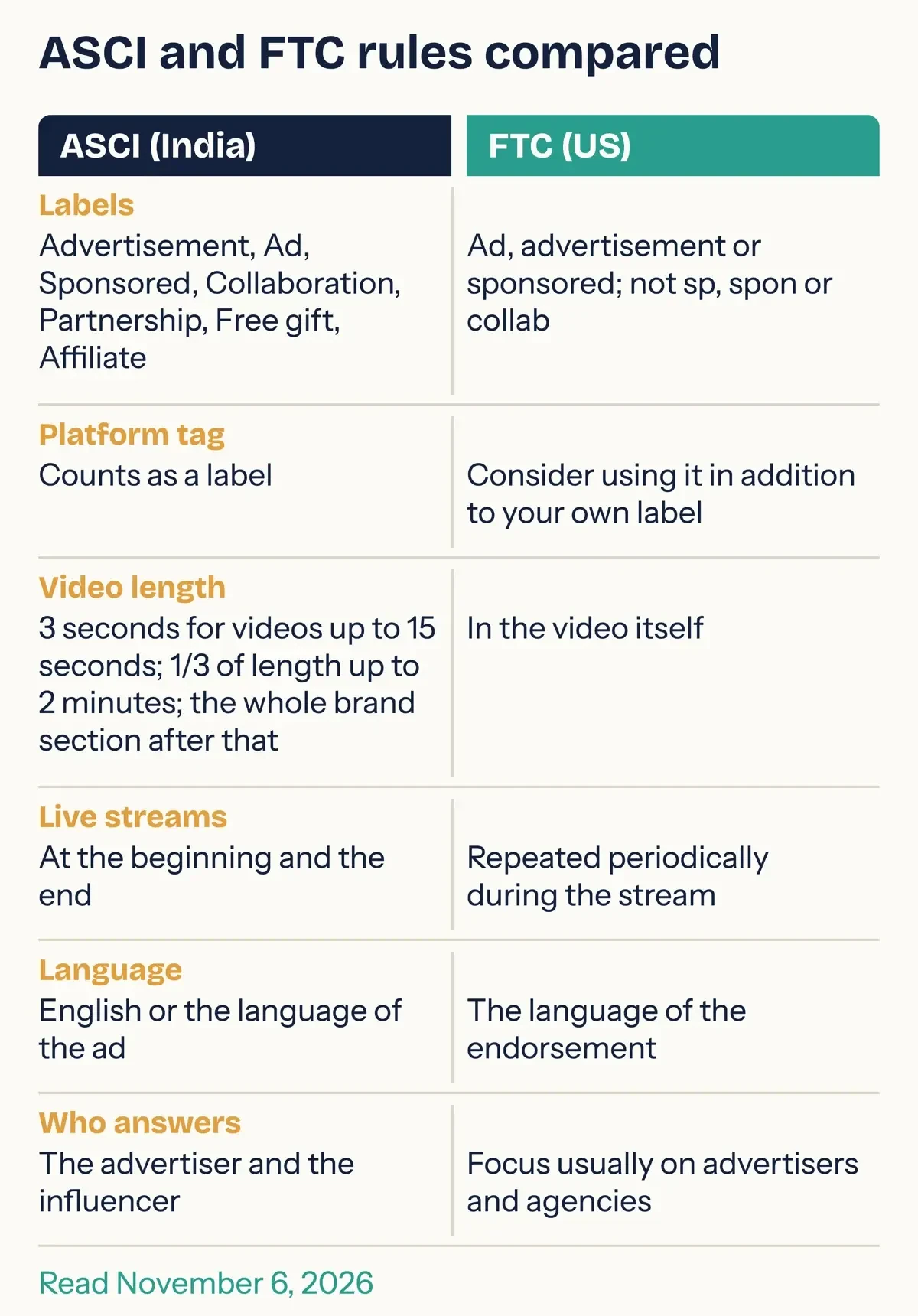 Diagram by DigitalTreed, from ASCI influencer guidelines, ASCI AdLaw Compendium and FTC Disclosures 101, read November 6, 2026.
Finding creators whose audience is in India
Before any label matters, check where a creator's followers live, because an account based in Delhi can still draw much of its audience from Dubai, London or New Jersey. Meta's Instagram insights API reference lists follower_demographics with country and city breakdowns. That data is "Not returned if the IG User has less than 100 followers." YouTube's Analytics help page says "The Audience tab shows you who is watching your videos", though geography data "may be limited". Ask each creator for a 90-day top-countries screenshot with their media kit.
In the made-up table below, only 23% of Creator West's followers are in India. Most of that fee buys reach outside India.
Next, read their past paid posts. Instagram's creator page says "If you're getting paid in any form for your content, you'll need to add a Paid Partnership label". Gifted products count, too. On YouTube, the paid promotion label "appears at the beginning of your video," according to the branded content help page.
That YouTube page also lets a creator "limit who gets to find your branded content based on their age or location". It helps if your product ships to India, not Canada.
Then search ASCI's list of non-compliant influencers and brands. On November 6, 2026 our script counted the rows in each year tab of a saved copy of that page. It found 664 entries from June 2021 to September 2026, with status "as of October 5, 2026". The peak year was 2023, with 211 entries, and 2026 had 22 through September.
Checking the Forbes India Top 100 Digital Stars (2024) list, ASCI's report found "76% in contravention in 2025 compared to 69% in 2024."
Scroll the feed for categories India restricts. Of the 1,609 influencer ads ASCI processed, the report says "54% promoted categories where advertising is disallowed by law, eg. betting, alcohol." It counted 869 influencers promoting ads prohibited by law, including offshore betting, so a betting promo in a creator's feed is a warning sign. Personal care is another hot spot, where "45% of the cases processed involved influencer-led advertising". If you sell supplements or a finance app, ASCI also wants the creator's qualifications stated upfront. Our guide to finding and vetting social media influencers covers tiers, engagement formulas and fake-follower checks for US campaigns.
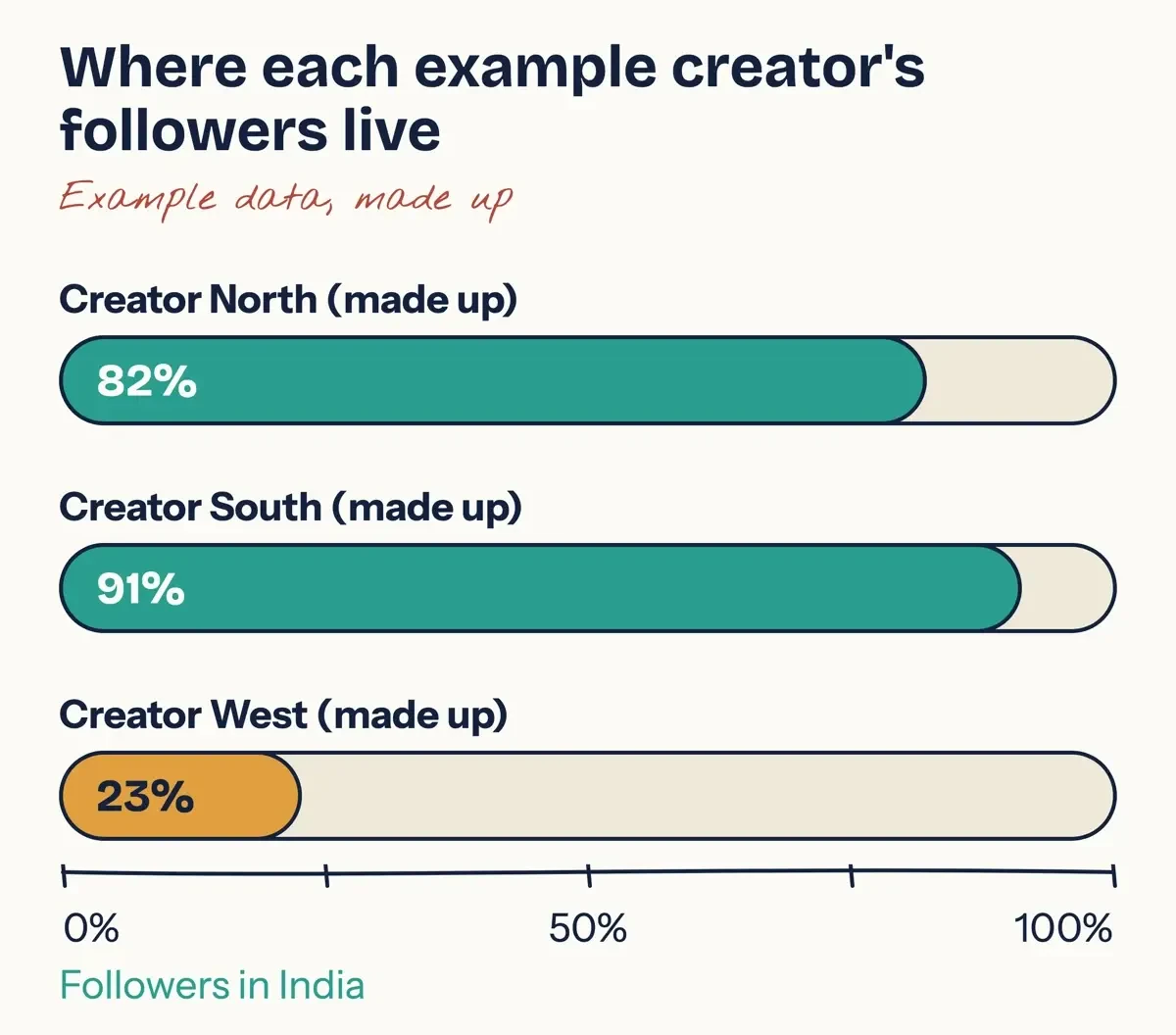 Drawn by us from our example script on November 6, 2026. The three creators are made up.
Cost per engagement in rupees and dollars
Once a shortlist passes those checks, compare cost per engagement: the fee divided by average likes, comments, saves and shares per post. For an India campaign we add a step. Multiply engagements by the share of followers in India and divide the fee by that, which assumes engagement splits the way followers do (no platform publishes that split).
The creators below are made up, so the result ranks example inputs only. Dollars use the Federal Reserve H.10 rate of 94.94 rupees per dollar for October 30, 2026.
| Creator (made up) | Followers | Fee per Reel (example) | Engagement by followers | Cost per engagement | Followers in India | Cost per India engagement |
|---|---|---|---|---|---|---|
| Creator North (made up) | 48,000 | ₹30,000 (about $315.99) | 3.19% | ₹19.61 (about $0.21) | 82% | ₹23.91 (about $0.25) |
| Creator South (made up) | 120,000 | ₹75,000 (about $789.97) | 1.75% | ₹35.77 (about $0.38) | 91% | ₹39.31 (about $0.41) |
| Creator West (made up) | 65,000 | ₹40,000 (about $421.32) | 4.1% | ₹15 (about $0.16) | 23% | ₹65.22 (about $0.69) |
In this example, Creator West looks cheapest at ₹15 per engagement (about $0.16 at the October 30, 2026 rate), but only 23% of that audience is in India. Each India engagement costs ₹65.22 (about $0.69), the most of the three. Creator North wins at ₹23.91 (about $0.25). Creator South lands between them at ₹39.31. The fees are example inputs, not market rates; US rates are covered under how much influencers charge.
Give each creator a separate tagged link from our UTM builder, so each Reel's sales show up as their own line in your analytics.
What we tested
On November 6, 2026 our Python script ran the three made-up creators and built a calculator page, which we served on 127.0.0.1. The table above is its output, and the 94.94 rate matched both the saved H.10 release and the FRED DEXINUS series. Six captions went through a word check. All six are made up. Four carried an ASCI-listed label in the first line. The two using only "#collab" or "#sp" had none and hit the FTC's vague-term list. The "Collaboration" caption passed ASCI's list and missed the vague terms, though collaboration isn't one of the FTC's plain terms. The script also computed engagement by reach (7.29%, 5.52% and 8.89%) from made-up reach figures, which the table leaves out.
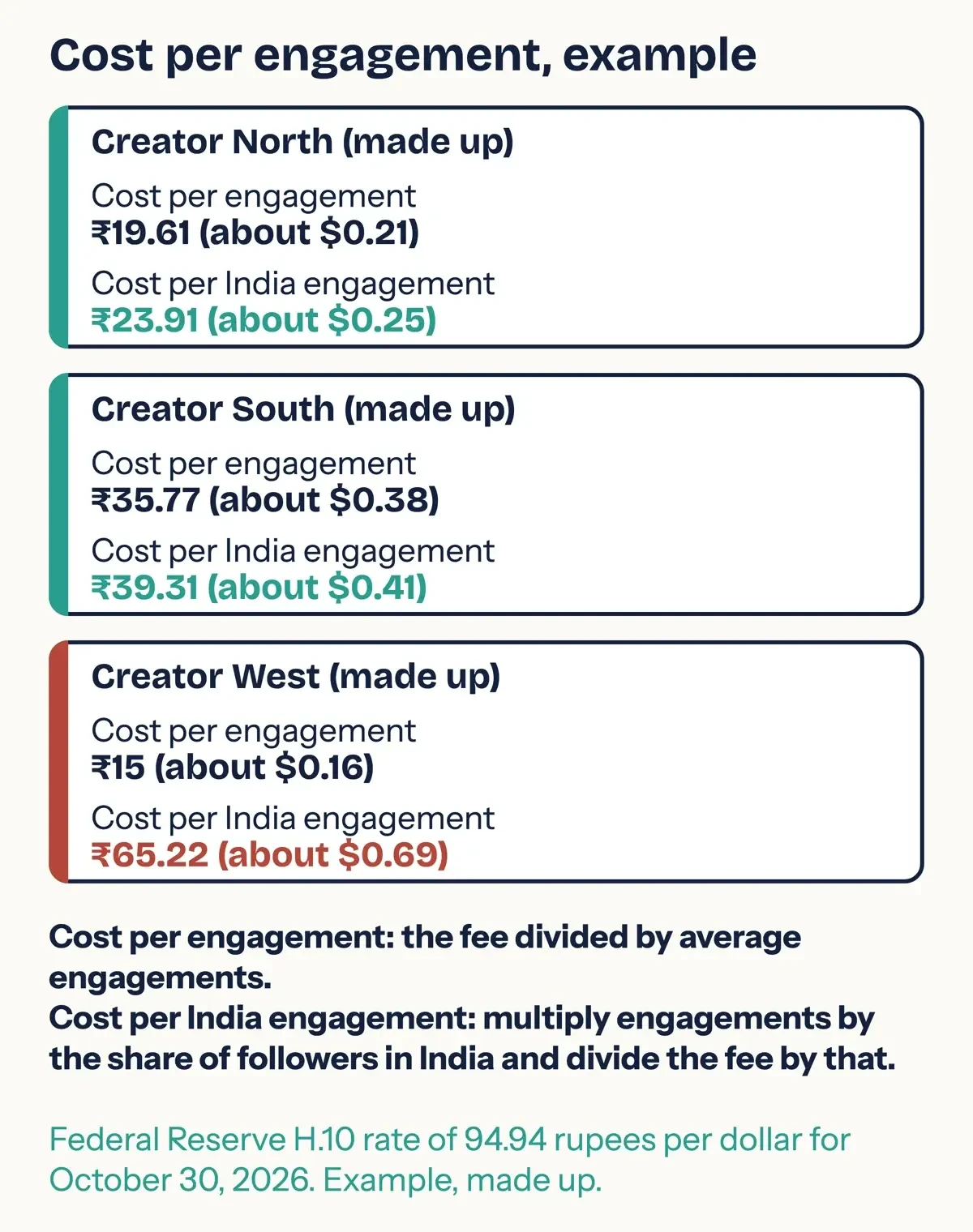 Drawn by us from our example calculator results on November 6, 2026. The creators are made up.
Contracts and payment when the creator is in India
Once you pick a creator, two rulebooks meet: India's contract law on the creator's side and US tax rules on yours. Essentials of a Contract, an article on ASCI's creator site, says "The law governing contracts in India is Indian Contract Act, 1872." ASCI's negotiation tips for content creators list what creators bargain over: products, money, timeline, exclusivity and number of deliverables. Deal types include "fixed fee, CPM, CPI", so settle the type before the rate. Exclusivity matters most for a diaspora brand, since a creator who also promotes a rival snack brand that month splits the audience you paid for.
Claims need proof before the post. ASCI's guidelines say influencers should "review and satisfy themselves that the advertiser is in a position to substantiate the claims made in the advertisement." Under the Know-hows, the compendium adds, "The endorser is also recommended to have personally used the product / service." Ship product early enough for the creator to use it on camera and off, and keep the claim file you send them with the signed brief.
On the US side, IRS Publication 515 ties a fee's source to where the work happens. It says "The place where the services are performed determines the source of the income", whoever pays and wherever the contract was signed. A Reel filmed in Jaipur is work done outside the US. Usage rights are different. The same publication sources copyright royalties "where the property is used", so a fee for running the Reel in US ads may count differently. The Form W-8 BEN page says a foreign person submits it "when requested by the withholding agent or payer".
Ask a CPA how to split one fee between the Reel and its US usage rights. These are steps, not tax advice.
Our foreign payment fee calculator shows what the creator's payment from abroad loses to fees before it reaches a bank in India. Our SEO career guide covers getting paid from abroad, GST, LUT and FIRA. We'd put these lines in every brief, one requirement each, before the contract goes out:
- Start every paid caption with Ad or Sponsored, in the first line.
- Also turn on the platform tag: Paid Partnership on Instagram, paid promotion on YouTube.
- Write the label in the same language as the post.
- Videos up to 15 seconds: keep the label on screen for at least 3 seconds.
- Videos from 15 seconds to 2 minutes: keep the label on screen for a third of the length.
- Live streams: say it is paid at the start and the end, and repeat it during the stream.
- Gifted products count: label those posts too.
- No health or money claims unless you hold the qualification and state it upfront.
- Send us every product claim before posting; we will send the proof.
- Share a 90-day top-countries screenshot from Insights or YouTube Analytics before signing.
The live-stream line asks for a label at the start, the end and during the stream. That covers ASCI's start-and-end rule and the FTC's call to repeat the disclosure. Keep the signed brief with the audience screenshots, because ASCI expects the advertiser to get a faulty post fixed.
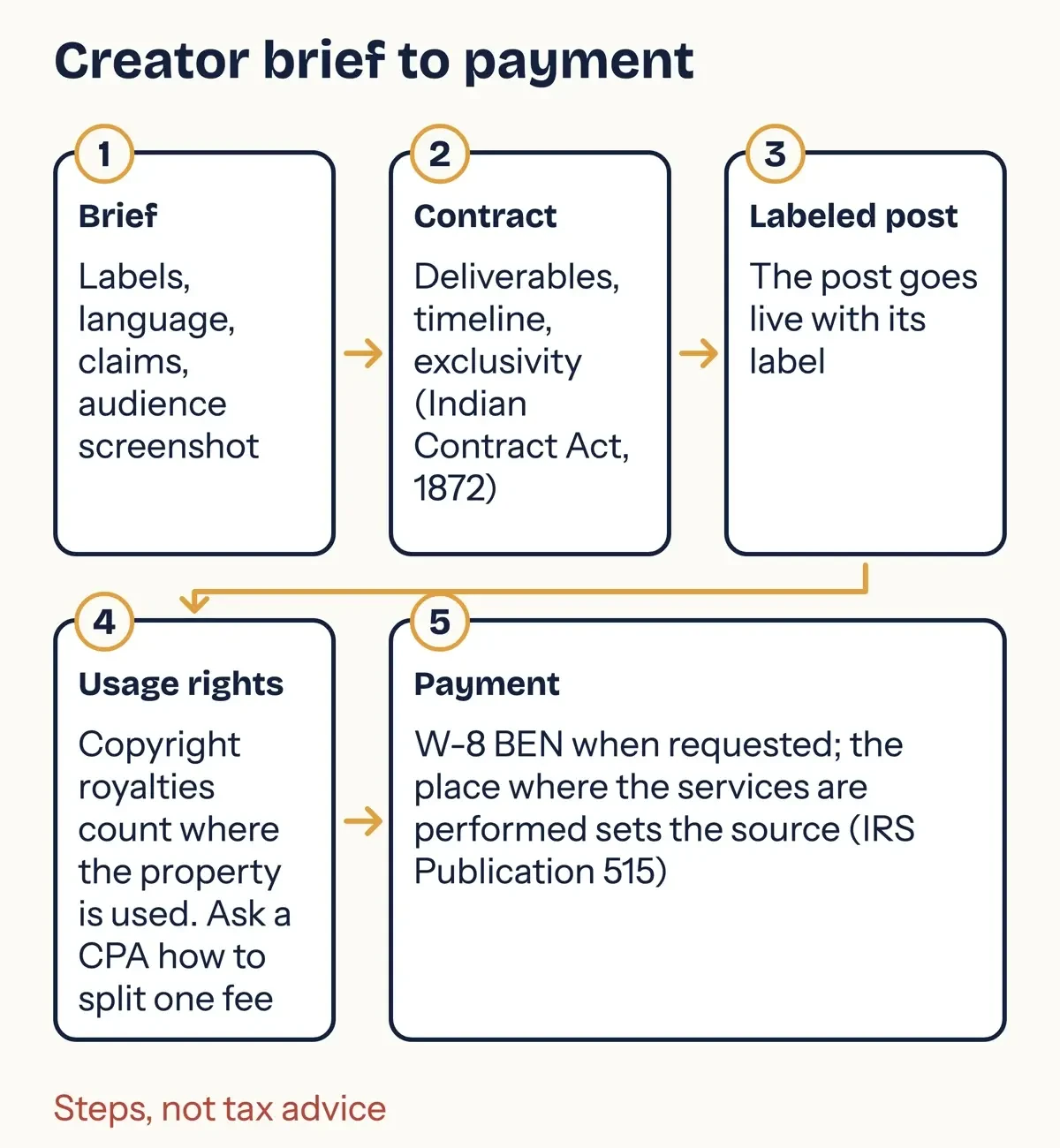 Diagram by DigitalTreed, from ASCI creator articles, IRS Publication 515 and the IRS Form W-8 BEN page, November 6, 2026.
If you'd like the shortlist and briefs handled for you, the DigitalTreed social media marketing page lists what the team does.
Social media influencers in India: questions
Frequently asked
Can an influencer in India promote supplements or investment products?
Only with stated qualifications. ASCI's influencer guidelines say investment influencers "should be registered with SEBI and their SEBI registration number should be stated". Others may share generic information, like a chef promoting a meal service.
When does an Indian creator count as a celebrity?
One test in ASCI's 2017 celebrity guidelines, per the AdLaw Compendium, is a "social media following of 5 lakhs or more" on one handle. That's 500,000 followers.
Can you sign a contract with a creator under 18 in India?
Not directly. The ASCI-hosted contract article says "A contract entered by a minor is void ab initio". A lawyer in India can explain working through a parent or guardian.
Can a creator have an ad checked before it posts?
Yes. ASCI's Endorser Due Diligence service reviews an ad's claims; its advice "will be issued in the name of the endorser".
How we made this guide: Three Indian government sites sent our checker 403 errors, so their rules come via ASCI's AdLaw Compendium. Every quote was checked against copies of the 22 pages in Sources. Facts checked by the DigitalTreed team on November 6, 2026.
First published July 2020 with five Instagram accounts, follower counts and no sources. Rewritten November 6, 2026 for US brands working with creators in India, from ASCI, FTC, IRS and platform pages.
Sources
- ASCI: Guidelines for influencer advertising in digital media (with Addendum II)
- ASCI: Influencer guidelines PDF (2025)
- ASCI: Guide for social media influencers
- ASCI: Influencer resource
- ASCI: Annual complaints report, April 2025 to March 2026
- ASCI: The AdLaw Compendium (March 2026)
- ASCI Social: Non-compliant influencers and brands
- ASCI: Endorser Due Diligence
- ASCI Social: Essentials of a Contract
- ASCI Social: Negotiation tips for content creators
- ASCI press release, February 22, 2021: draft influencer guidelines
- FTC: Disclosures 101 for Social Media Influencers
- FTC: FTC's Endorsement Guides: What People Are Asking
- 16 CFR 255.5, Disclosure of material connections (Cornell LII)
- YouTube Help: Add branded content restrictions and disclosure labels
- YouTube Help: Get started with YouTube Analytics
- Instagram for Creators: Creator marketplace
- Meta for Developers: Instagram account insights
- IRS Publication 515, Withholding of Tax on Nonresident Aliens and Foreign Entities
- IRS: About Form W-8 BEN
- Federal Reserve H.10, release of November 2, 2026
- FRED: Indian rupees to US dollar spot rate (DEXINUS)


Comments
No comments yet. Start the conversation below.