
Quick answer
Influencers paid through one creator marketplace got median fees of about $130 to $520 per sponsored post or video, unless they had a million followers. That was across 1,527 paid deliverables from January 2025 to June 2026; creators with 1M+ followers had a median of $2,727. Published rate cards quote far more, so treat them as an opening ask.
So how much do influencers charge in practice? We put two 2026 sources side by side on October 26, 2026: OpenSponsorship’s analysis of 1,527 paid deliverables and Influencer Marketing Hub’s rate card. They don't agree, and the gap tells you how to negotiate.
We wrote it for a US business paying a creator for the first time.
You'll get the numbers, what pushes them up, and the two federal rules that come with the deal.
What influencers actually get paid, by follower count
Start with what brands actually paid.
OpenSponsorship, a creator marketplace, took the completed, paid deliverables on its platform from January 2025 to June 2026. It kept those with over 100 tracked views and a fee of at least $50, then reported the median cash fee per deliverable. Its write-up is blunt about the method: "Not a survey. Not self-reported rate cards." That matters, because most rate tables you'll find online are someone's estimate, and few say where the numbers came from or how many deals sit behind them.
| Tier (followers) | Paid deliverables | Median fee per deliverable | Median cost per view |
|---|---|---|---|
| Nano (under 10K) | 146 | $134 | $0.13 |
| Micro (10K to 50K) | 349 | $150 | $0.14 |
| Mid (50K to 250K) | 513 | $417 | $0.19 |
| Macro (250K to 1M) | 441 | $517 | $0.10 |
| Mega (1M+) | 53 | $2,727 | $0.07 |
Source for the table: OpenSponsorship, July 15, 2026, cash fees only, as of the July 2026 data pull. inBeat's 2026 benchmark report reports the same medians.
So how much do micro influencers charge? In this data, about $150 as of the July 2026 pull. That's barely more than a nano creator.
Read the small print before you quote these numbers to a creator, though.
The fees "exclude the value of gifted product," so a deal that also shipped free product cost more. Tiers use today's follower counts, not the count when the creator posted. The data leans toward "sports, wellness, food, and lifestyle." And the page doesn't say which countries the creators were in.
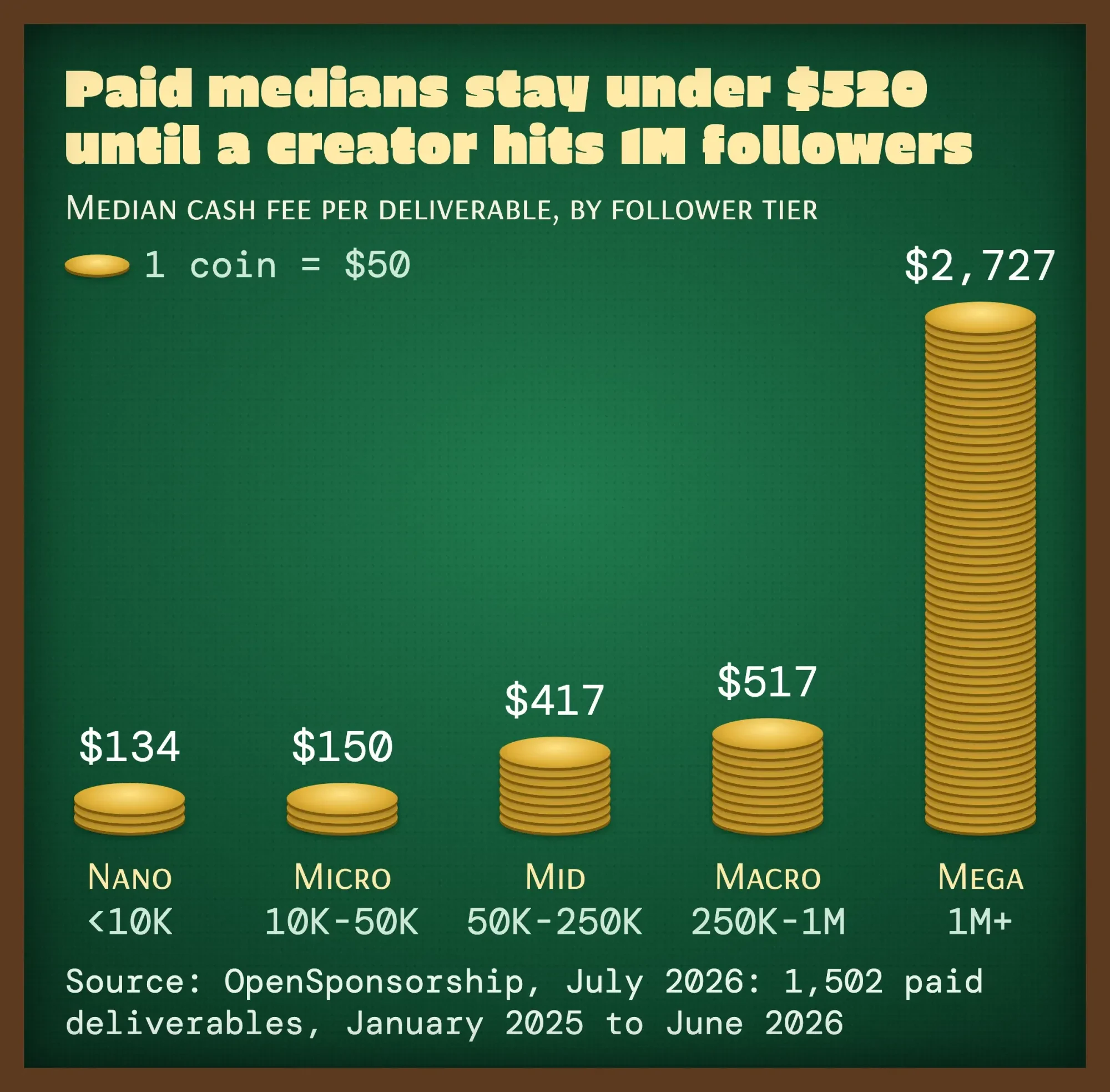 Source: OpenSponsorship, July 2026, median cash fee per deliverable from 1,502 paid deliverables (January 2025 to June 2026). Chart drawn by DigitalTreed.
How much do influencers charge per post on Instagram, TikTok and YouTube?
Those medians mix every platform together.
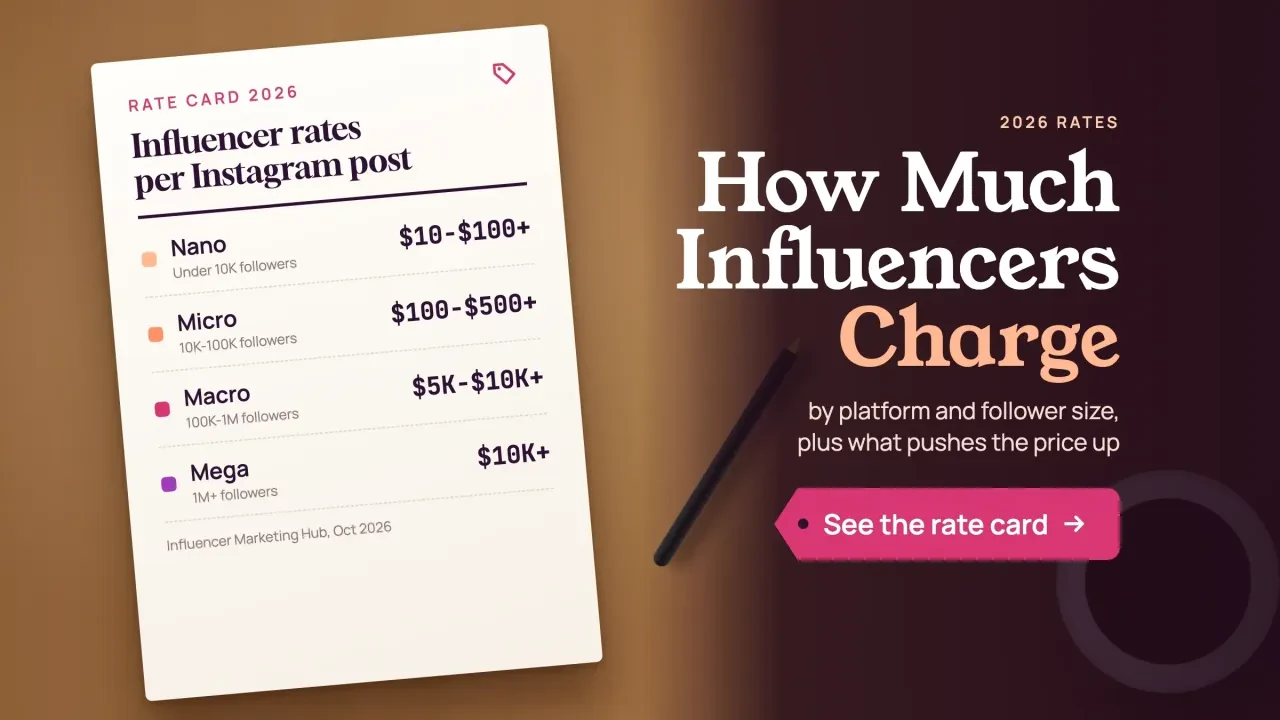
For each platform, the most quoted 2026 ranges come from Influencer Marketing Hub, whose rate page, last updated October 6, 2026, gives Instagram micro creators $100 to $500+ per post. TikTok micro creators get $200 to $800 per video, and YouTube micro creators $200 to $1,000+ per sponsored video.
Those figures come with a warning from the publisher itself: "These are planning benchmarks, not fixed rate cards." It doesn't publish how it built them.
| As of October 2026 | Instagram (per post) | TikTok (per video) | YouTube (per sponsored video) |
|---|---|---|---|
| Nano (under 10K) | $10 to $100+ | $50 to $200 | $20 to $200+ |
| Micro (10K to 100K) | $100 to $500+ | $200 to $800 | $200 to $1,000+ |
| Macro (100K to 1M) | $5,000 to $10,000+ | $800 to $5,000 | $10,000 to $20,000+ |
| Mega (1M+) | $10,000+ | $5,000 to $50,000+ | $20,000 to $50,000+ |
Source for the table: Influencer Marketing Hub's 2026 rate cheat sheet, linked above, whose follower bands differ from OpenSponsorship's, so the two tables don't line up row for row.
As of that October 2026 update, YouTube tops every tier from macro up. Format matters too: the same page puts a nano creator's static Instagram post at $10 to $50 and a Reel at $20 to $100. It also says "micro-influencers may charge as high as $1,250 per Facebook post," while nano creators on X "may charge as low as $2 per post."
Bigger YouTube channels have another income to weigh against your offer. The YouTube Partner Program shares ad revenue once a channel has 1,000 subscribers and 4,000 watch hours in a year. If you're curious how creators see the money side, our post on how creators make money on TikTok covers it.
Rate cards ask about 4 to 10 times what big creators settled for
Now put the two sources next to each other, and something odd jumps out.
Here's what we found when we lined them up tier by tier on October 26, 2026.
For small creators, the October 2026 card and the July 2026 data mostly agree. OpenSponsorship's micro median of $150 sits inside the $100 to $500+ Instagram range. Its mid-tier median of $417 sits just under the $500 floor that Influencer Marketing Hub gives mid-tier Instagram creators.
Then the gap opens. Fast.
The paid macro median was $517, while the rate card's macro floor is $5,000, so the median fee came in at about 10% of the lowest listed price. For mega creators, a tier of only 53 deliverables, the paid median of $2,727 is about 27% of the $10,000 floor. In other words, the rate card asked roughly 10 times more at macro level and 4 times more at mega level.
It isn't a perfect match, and we'd be misleading you if we said it was. The follower bands differ, one source counts Instagram only, and the paid data skews toward a few niches.
But the direction is hard to argue with.
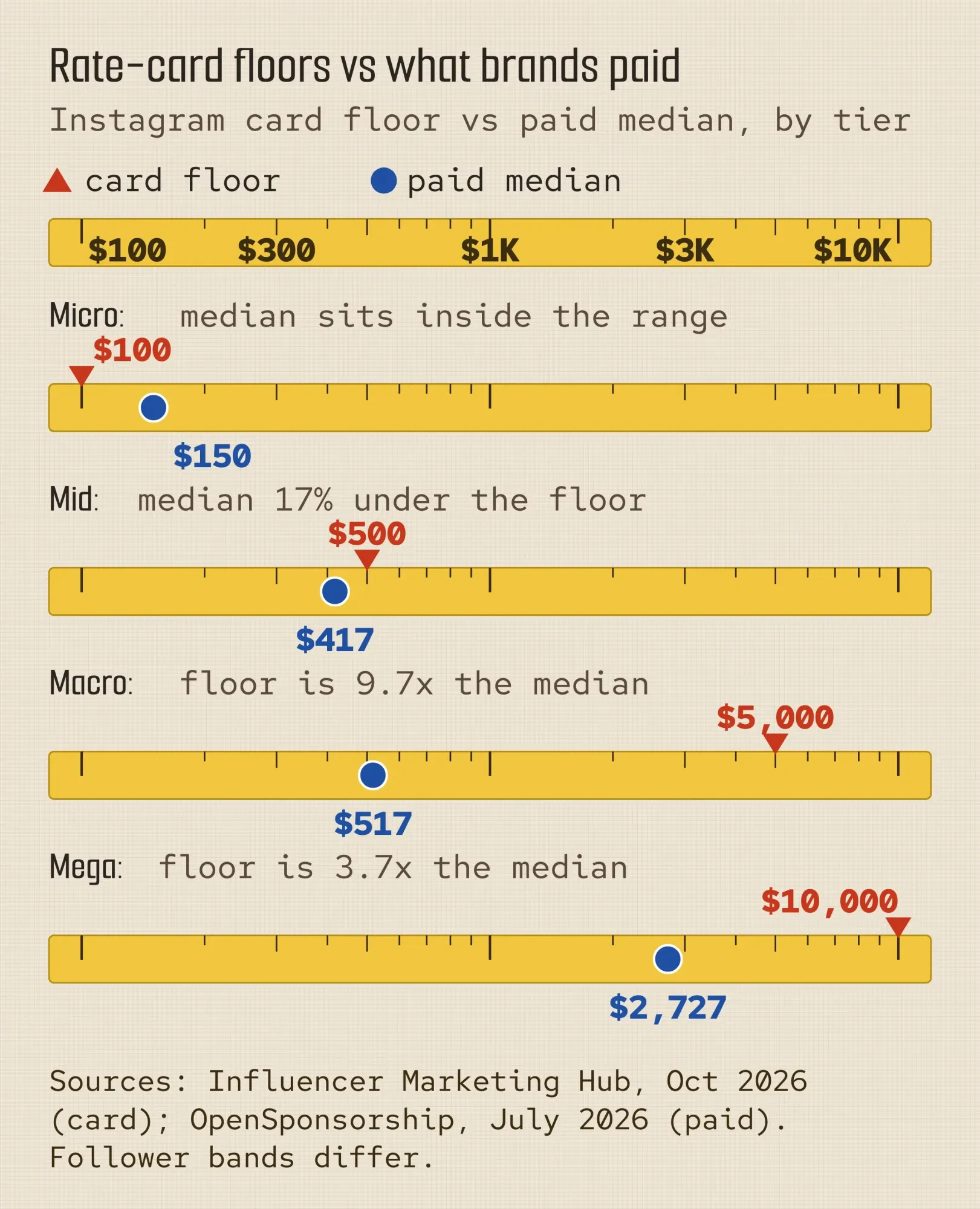 Diagram by DigitalTreed, October 2026. Rate-card floors from Influencer Marketing Hub (updated October 6, 2026); paid medians from OpenSponsorship (July 2026). Follower bands differ between the two sources.
There's a second surprise in the same data: mega creators delivered views at a median of 7 cents each, against 13 cents for nano creators. OpenSponsorship's summary: "If you are buying reach, big creators are cheaper." Nano creators may still win on trust in a small town, but not on price per view.
Our take: use a rate card to learn the creator's opening number, then price the deal on views. Ask for the median views of their last 10 sponsored posts and work out what you'd pay per view. If that's well above the medians in the first table, you have room to negotiate.
Usage rights, boosting and exclusivity add to the fee
Beyond the gap, there's the question of what the fee covers.
A posting fee usually buys one thing: the post on the creator's account. Usage rights cost extra. As of October 2026, a guide for creators from impact.com puts a number on it. It says: "Most influencers charge an additional 20 to 50 percent of their base rate for usage rights."
That's vendor guidance, not a study, so treat it as a rough guide.
Usage rights are what let you run the post in your own ads or on your website.
If you plan to put ad money behind the creator's post, read how Facebook partnership ads run a creator’s post as your ad. The same impact.com page says creators "typically charge five to 20 percent of the brand's total paid ad spend" for that kind of boosting.
Exclusivity costs more again: "Most creators charge between 20 and 100 percent of their base rate" to stay away from your competitors for a set time. Ask for it only if a rival brand is a real worry.
Price also climbs with video over photo, a busy niche, and tight turnaround; none of those are fixed percentages, so ask the creator to price each one separately.
Free product still counts as pay to the FTC
Those extras are all cash. But paying in product doesn't make the deal free in the eyes of the law.
Federal guidance is clear on this. Disclosures 101, the FTC's guide for influencers, puts it this way: "Financial relationships aren’t limited to money. Disclose the relationship if you got anything of value to mention a product."
Meta draws the same line. Its branded content help page defines branded content as content "for which the creator has been compensated by a brand or business partner. This may include when products and services are gifted for free."
So whether you send a check or a box of soap, the creator has to disclose.
The FTC wants that disclosure to be easy to see. Disclosures 101 asks creators to "Place it so it’s hard to miss" and to "Use simple and clear language." On video, it wants the disclosure said out loud and shown on screen.
This isn't only the creator's problem. In its FAQ on the Endorsement Guides, the FTC tells brands: "Your company is ultimately responsible for what others do on your behalf."
It also says: "Advertisers need to have reasonable programs in place to train and monitor members of their network."
Since October 21, 2024, the FTC's reviews and testimonials rule has also let courts fine knowing violations, such as an influencer lying about using a product. Put the disclosure wording in your brief. Our guide to sponsored blog post disclosure shows wording that works on a blog, too.
This is a plain summary of federal guidance as we read it in October 2026. It isn't legal advice, so ask a lawyer about health, money or results claims.
Pay a creator $2,000 or more and you'll likely file a 1099-NEC
Once the disclosure is in the brief, the tax side is next. It's simpler than it sounds, and it changed this year.
Under the IRS Instructions for Forms 1099-MISC and 1099-NEC, a business generally reports a payment as nonemployee compensation when four conditions are met. All four have to apply.
- You paid someone who isn't your employee.
- You paid for services in the course of your trade or business.
- You paid an individual, partnership, estate or, in some cases, a corporation.
- You paid that person at least $2,000 during the year.
That $2,000 figure is new. The instructions say that "For tax years beginning after 2025," the threshold "increased to $2,000 and may be adjusted for inflation beginning in calendar year 2027."
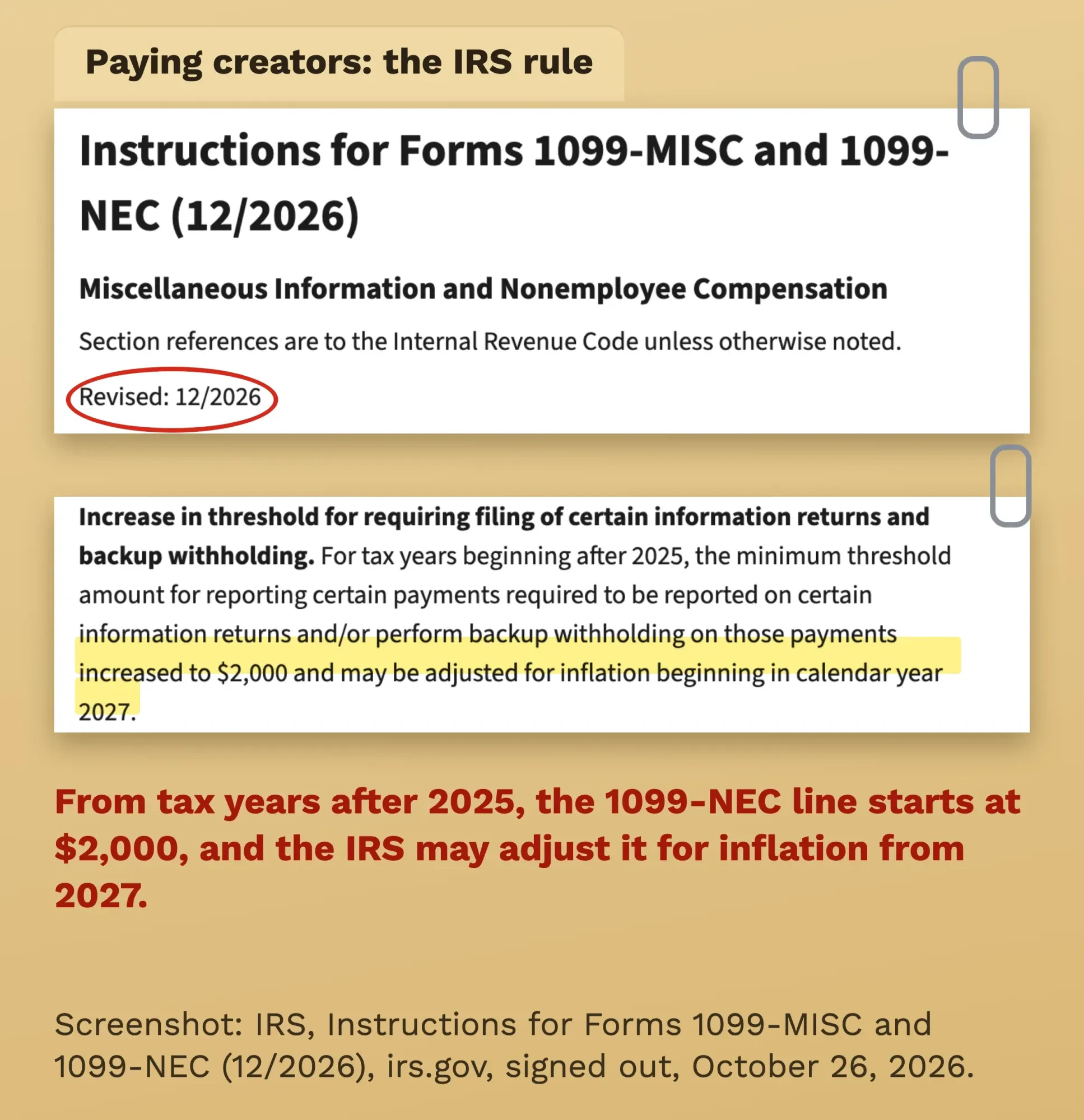 Screenshot: IRS, Instructions for Forms 1099-MISC and 1099-NEC (12/2026), irs.gov, taken signed out on October 26, 2026, cropped to the title and the threshold paragraph. Highlights by DigitalTreed.
Two exceptions matter for creator deals.
If you pay by credit card or through a payment app, the instructions say those payments "must be reported on Form 1099-K by the payment settlement entity." They're not your 1099-NEC to file. Payments to a creator's corporation, including an LLC taxed as a C or S corporation, generally aren't reported either.
The form is due to the IRS and the creator by January 31, which falls on a Sunday in 2027, so 2026 forms are due February 1, 2027. Before you pay anyone, ask for a Form W-9, which the IRS says is how a payee gives you "your correct Taxpayer Identification Number (TIN)."
Rules can change before you file, so check the IRS Form 1099-NEC page in January. Treat this as a starting point for a talk with your accountant, not as tax advice.
Example: what $3,000 buys Sweetfern Soap Works
Now put those numbers to work on one shop.
Example: Sweetfern Soap Works, a soap maker we made up, is two people in Laramie, Wyoming. It has $3,000 in cash for a spring launch, as of October 2026, and two plans on the table.
Plan A pays six micro creators at OpenSponsorship's $150 median, which is $900. Each also gets 30 days of ad usage at impact.com's 20 to 50% uplift, or $30 to $75 per creator. That's $180 to $450 more, so fees total $1,080 to $1,350, and the other $1,650 to $1,920 goes into ads behind the two best posts.
Plan B books one mega creator at the $2,727 median. Add the same usage uplift, $545.40 to $1,363.50, and the deal costs $3,272.40 to $4,090.50. It's over budget before a cent goes into ads.
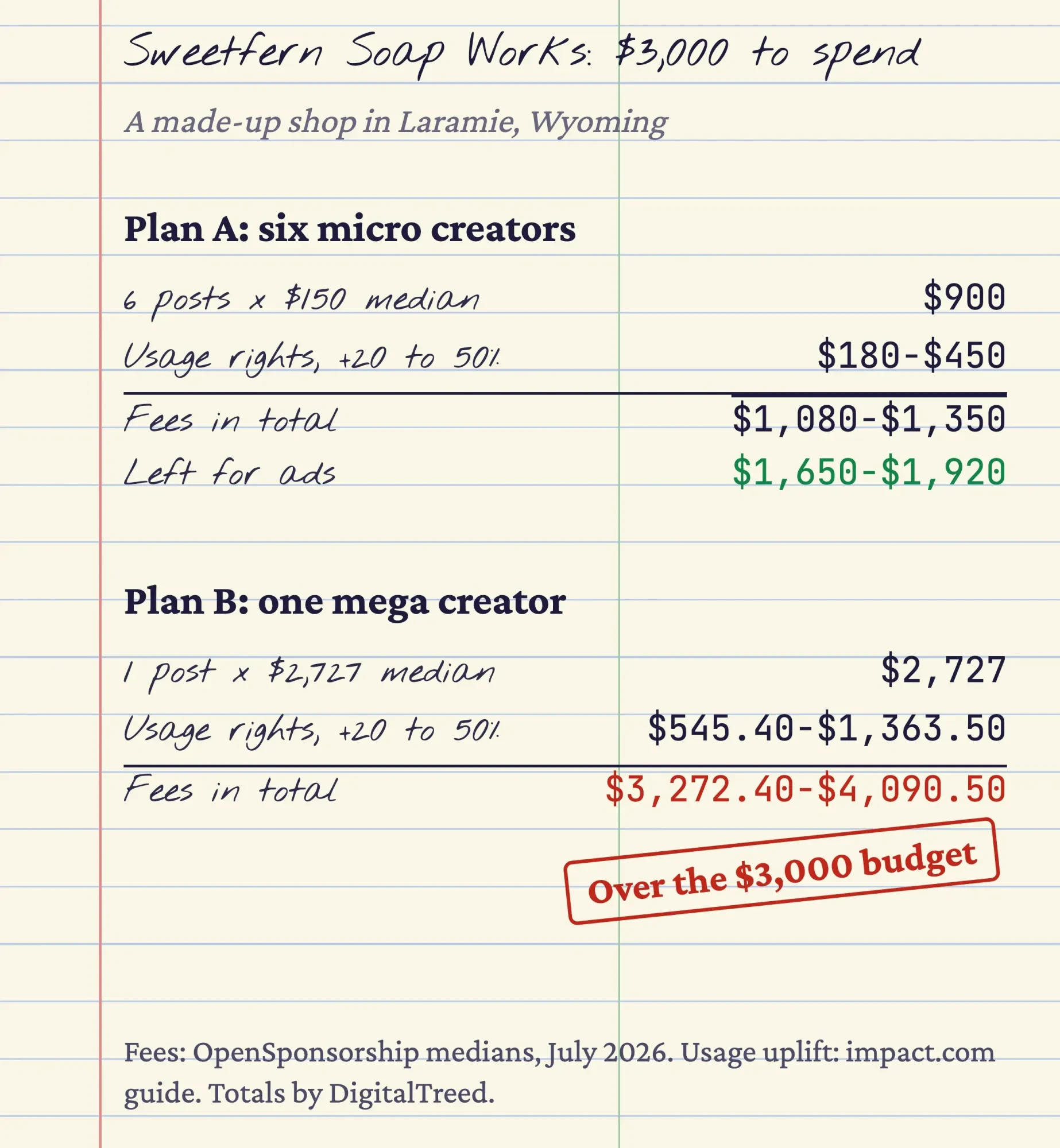 Diagram by DigitalTreed, October 2026. A made-up example; fees from OpenSponsorship medians (July 2026) and usage uplifts from impact.com's guide.
Reach tells a different story. At the median cost per view, $900 on micro creators buys about 6,400 views, and $2,727 on a mega creator about 39,000. Medians aren't promises, but Plan B isn't a bad deal on reach. It's just too big for this budget.
Sweetfern picks Plan A.
Six smaller posts also give the owner six chances to learn which creator's audience actually buys handmade soap. That lesson is worth more next spring than one big spike of views from people who may never order.
Taxes stay simple: no micro creator gets near $2,000, so no 1099-NEC is needed for them this year. Each creator gets a link tagged in our UTM builder, so Google Analytics 4 shows which one sold soap.
How much to pay an influencer: a fair offer in five steps
That math works for most small shops.
Here's the order we'd follow before you send a number to any creator.
- Ask for a media kit with real numbers: followers, median views on recent sponsored posts, and audience location. A creator who won't share views is a red flag.
- Start your offer near the paid median for their tier, then adjust for views, format and niche.
- Price usage rights, ad boosting and exclusivity as separate lines, each with an end date.
- Write the disclosure into the brief, and pay in a way you can document after collecting a W-9.
- Give every creator their own tagged link, and compare cost per sale after 30 days.
Affiliate commission can replace part of the fee for creators who sell well, so offer it as a bonus on top of a small flat fee, not the whole deal.
Creators are one channel, so fit them into your wider social media plan. Thinking of paying an agency to run it all? Check what a digital marketing agency costs first.
Frequently asked
Which social media platform has the highest influencer rates?
YouTube, in Influencer Marketing Hub's October 2026 table. Its mega YouTube creators run $20,000 to $50,000+ per sponsored video, against $10,000+ per Instagram post, per its rate page.
Does an influencer who only got free product need to disclose it?
Yes. The FTC's influencer guide says to disclose free or discounted products "even if you weren’t asked to mention that product."
Do I need to send a 1099 to an influencer I paid through PayPal?
Usually not a 1099-NEC. The IRS 1099 instructions say card payments and third-party network transactions go on Form 1099-K, filed by the payment company, per the instructions revised 12/2026.
Want help finding creators, briefing them and tracking sales? We do that work as a paid social media service. Hiring us pays us, so weigh our quote against others; you can get a quote from us in a few minutes.
How we made this guide: on October 26, 2026, we read OpenSponsorship's July 2026 analysis of 1,527 paid deliverables and Influencer Marketing Hub's rate page. Then we compared them tier by tier and did the gap math ourselves. We read the FTC's influencer guide, its Endorsement Guides FAQ and its reviews rule Q&A, and the IRS 1099 instructions. The IRS screenshot is from the public page, signed out. Each number in the post carries a link to the page we took it from.
Two sources we wanted, Collabstr's 2026 report and IZEA's earnings data, were behind a bot check or blocked, so we left their numbers out. Meta's branded content page wouldn't load for our second check that day, so its quote comes from the writer's first read and isn't re-verified. Before this version goes live, Eram N. reads it and signs off as the author.
First published July 2020. Rewritten October 26, 2026: the old post explained what influencers are, with a 2019 user count. This version answers what they charge: paid medians by tier, rate cards by platform, what adds to the fee, FTC disclosure, the 1099-NEC rule and a worked budget.
Sources
- OpenSponsorship: Nano vs Micro vs Mega Influencers: What 1,527 Creator Campaigns Reveal About Cost and ROI (July 15, 2026)
- Influencer Marketing Hub: Influencer Rates: How Much Do Influencers Really Cost in 2026? (updated October 6, 2026)
- inBeat: 2026 Influencer Marketing Benchmark Report (October 9, 2026)
- impact.com: How much to charge for usage rights as an influencer
- YouTube Help: YouTube Partner Program overview and eligibility
- FTC: Disclosures 101 for Social Media Influencers (November 2019)
- FTC: FTC's Endorsement Guides: What People Are Asking
- FTC: Consumer Reviews and Testimonials Rule: Questions and Answers (November 2024)
- Meta Business Help Center: About branded content on Facebook, Instagram and Threads
- IRS: Instructions for Forms 1099-MISC and 1099-NEC (12/2026)
- IRS: About Form 1099-NEC
- IRS: About Form W-9


Comments
No comments yet. Start the conversation below.