
Quick answer
To find and vet social media influencers, start with creators who already tag your brand, then divide each post's engagements by followers. Under 1% falls below the 1% to 5% range where Hootsuite says a good rate typically falls, as of November 2026. Then read their old sponsored captions, because the FTC can hold your brand liable for a missing disclosure.
Social media influencers come with two things a small US brand can't take at face value. Follower counts can be bought. And the FTC won't treat an old sponsored post as only the creator's problem. Here, a social media influencer is a creator a brand pays, gifts or lends products to in return for posts, the deals Meta's branded content rules cover.
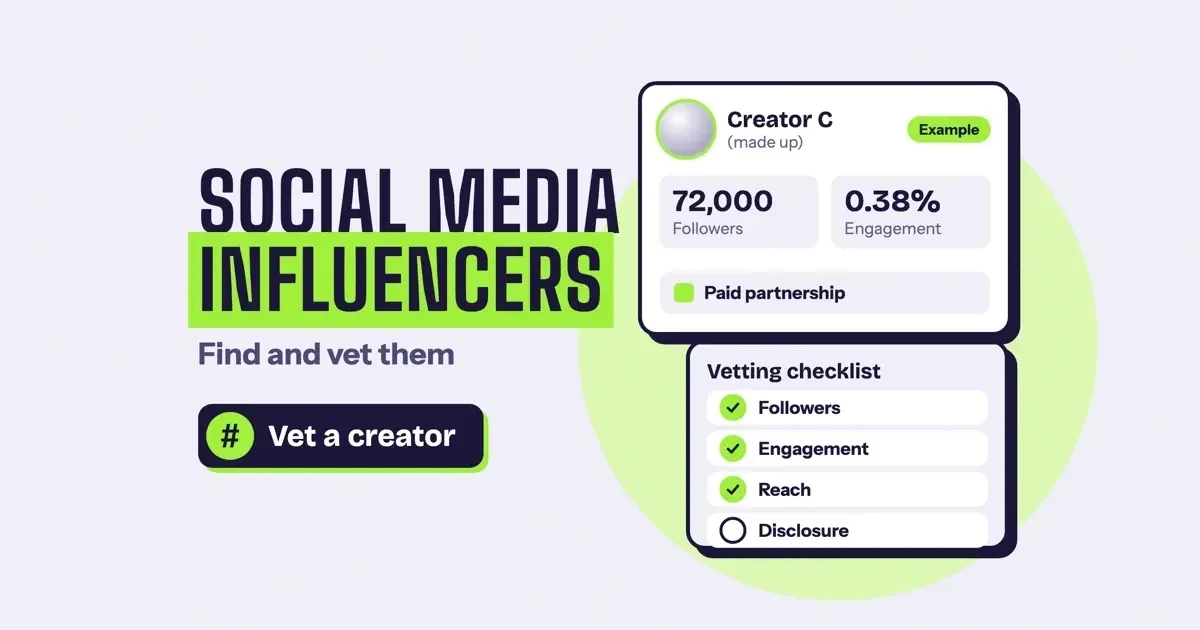
Take our made-up Creator C, with 72,000 followers. Their engagement is 4.39% of reach but 0.38% of followers, and both sponsored captions use words the FTC calls vague. The 11-point vetting list we ran on five made-up creators is below, ready to copy.
Key takeaways
- Divide engagements by followers, not reach, to spot a weak follower base.
- Sprout calls 72,000 followers micro, while OpenSponsorship calls the same count mid-tier.
- Your brand can be liable for an influencer's missing disclosure.
- The FTC says spon, collab or a stand-alone thanks don't disclose clearly.
- Owning or exclusively licensing a creator's post needs a signed writing.
What is a social media influencer?
In everyday use, an influencer is anyone whose recommendations change what an audience buys or tries, at 2,000 followers or 2 million. The legal meaning is narrower, and it's the one a brand pays for. FTC staff's Disclosures 101 for Social Media Influencers brochure says a "material connection" includes "a personal, family, or employment relationship or a financial relationship". Gifts and discounts count as financial. Once that connection exists, the post is an endorsement, with duties on both sides.
We dropped this page's 2020 five-account ranking, with 2021 follower counts, because it couldn't help a US brand pick, check or contract a creator it can afford. If you're still deciding whether creators fit your plan at all, start with a step-by-step social media plan.
Influencer tiers: where the follower lines fall
Sprout Social's guide to influencer types (August 12, 2025) runs from "Nano influencers (1K–10K followers)" to "Mega influencers (over 1M followers)". OpenSponsorship's July 15, 2026 pricing study adds a mid tier from 50K to 250K and starts macro at 250K.
They're both marketing firms. The FTC and Meta pages we read don't sort creators by follower count, so the lines move from one source to the next.
| Tier | Sprout Social (Aug 12, 2025) | OpenSponsorship (July 15, 2026) |
|---|---|---|
| Nano | 1K to 10K | Under 10K |
| Micro | 10K to 100K | 10K to 50K |
| Mid | No mid tier | 50K to 250K |
| Macro | 100K to 1M | 250K to 1M |
| Mega | Over 1M | 1M and up |
Read the raw follower count, not the tier label in a pitch. Our made-up Creator C has 72,000 followers. That's micro on Sprout's scale and mid on OpenSponsorship's, so a rate card priced for one tier can look cheap or steep under the other. OpenSponsorship also says its "Follower tiers use current follower counts", not the count at posting time. So in that study, a creator who grew fast after a post sits in a higher tier than when the post ran. Ask each creator for the exact follower count and the date it was read, then compare it with how much influencers charge, tier by tier.
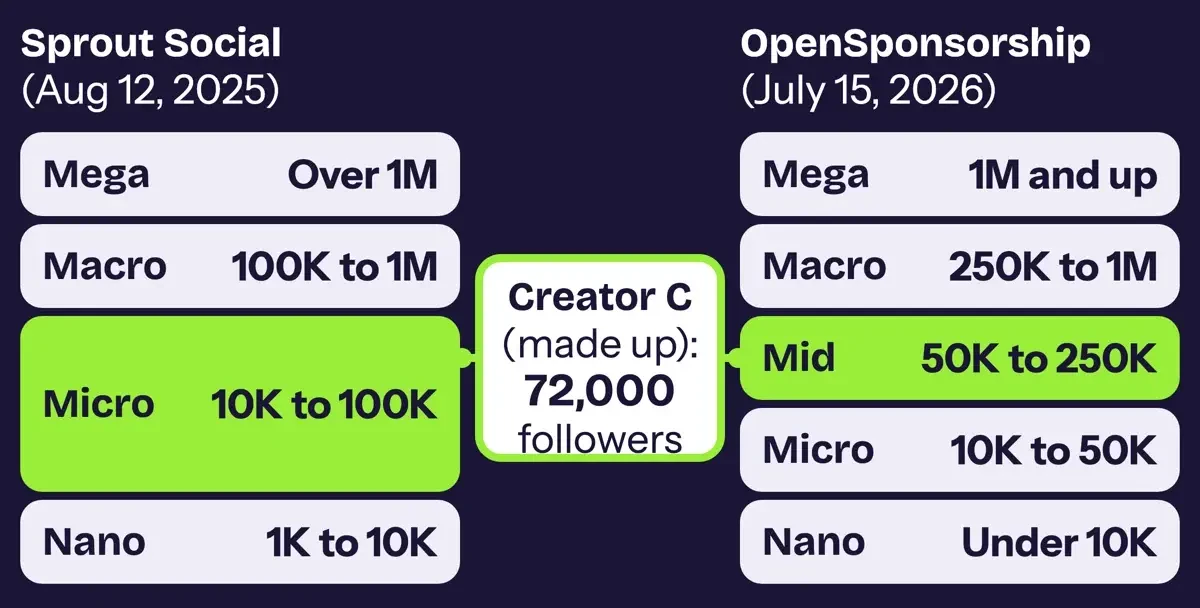 Diagram by DigitalTreed, from Sprout Social (August 12, 2025) and OpenSponsorship (July 15, 2026), read November 5, 2026.
Where to find Instagram influencers who fit
Start with people who already post about your brand. Open your brand's tagged posts and the comments under your own Reels, and note who mentions you unasked. They already use the product, and under 16 CFR 255.1(c) a creator shown as a user "must have been a bona fide user" when endorsing. Instagram also runs a matching tool. Its Creator Marketplace page calls it "the easiest way for creators like you to get discovered by brands and earn money." Meta's help page on tagging a business partner adds that creators may share insights from a linked Instagram account there.
No public page we found lists which brands or countries get access, so you'll want to check access from your own business account before you plan around it.
Whichever route you use, ask for numbers from the creator's own Insights. Instagram's creator page says it's a good idea to give brands data like "number of followers, average number likes, views, comments and shares". Instagram Insights covers up to the past 90 days for public accounts, and a good creator media kit names each metric and its date range.
Engagement rate: two formulas, two different answers
Instagram's insights page counts interactions as "likes, comments, saves and shares", so add those four per post. Hootsuite's engagement rate guide (October 6, 2026) gives two versions. Engagement rate by reach is engagements divided by reach, times 100, and engagement rate by post swaps reach for followers. For made-up Creator C, six posts averaged 270.5 engagements on 72,000 followers, so the example math by followers is 270.5 / 72,000 x 100 = 0.38%. By reach, the same posts averaged 4.39%, which looks healthy. But the average post reached only 8.54% of followers. Inactive or fake followers could produce that pattern, so ask the creator to explain it before you pay.
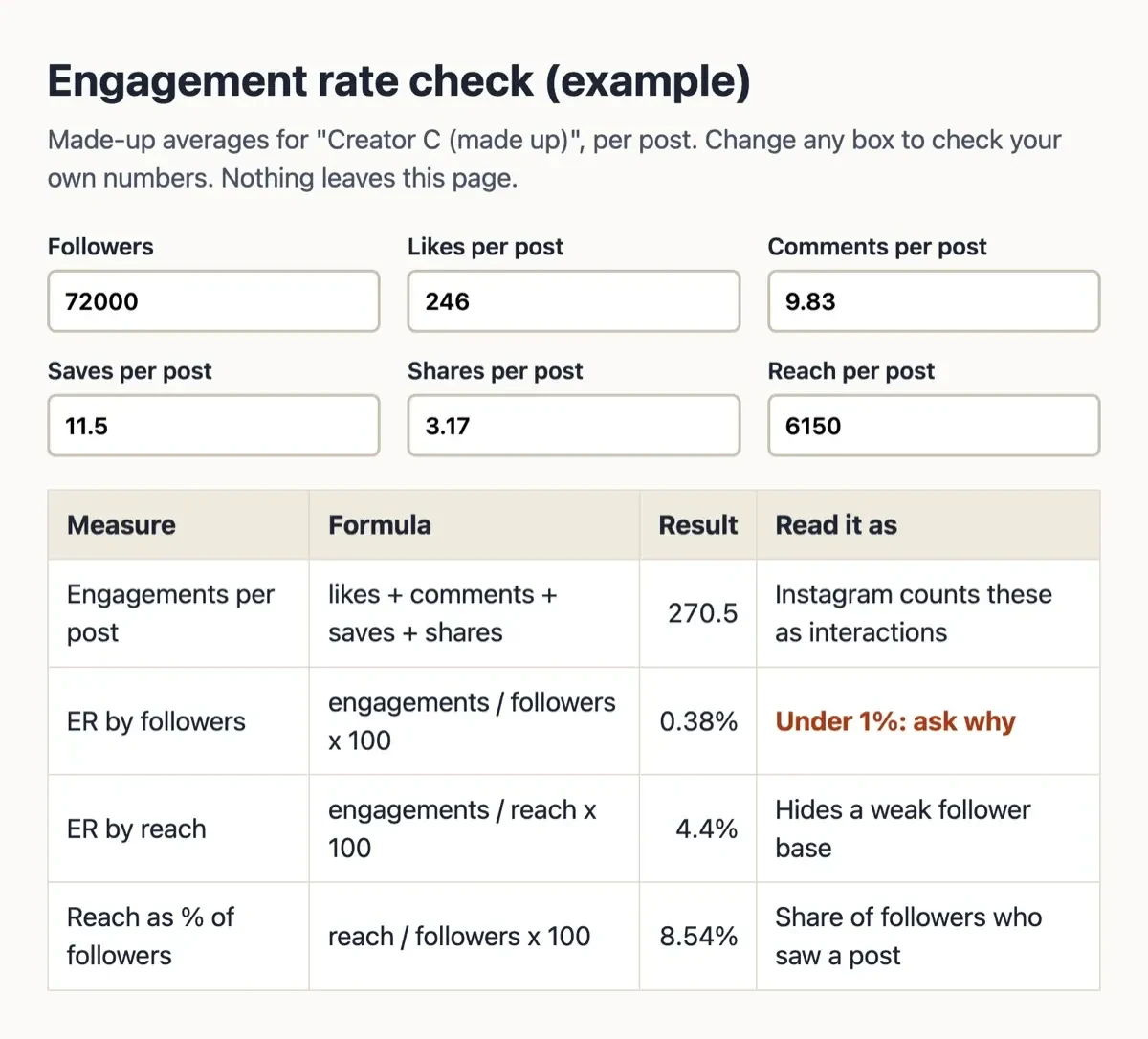 Screenshot: our engagement rate calculator served on 127.0.0.1, November 5, 2026, filled with made-up Creator C averages.
Our calculator shows 4.4% by reach rather than 4.39% because it divides average engagements by average reach, while the script averages six separate per-post rates.
Hootsuite says a good rate "typically falls between 1% and 5%". Under 1% by followers, we'd ask questions. Cost per engagement shows the same gap, since Hootsuite defines it as the total you spend on a creator divided by the engagements their posts earn. At an example $600 fee per post in our November 2026 test, made-up Creator B costs $600 / 1,199 average engagements = $0.50 per engagement. Creator C costs $600 / 270.5 = $2.22, despite more followers.
Vetting a creator before you pay
Since October 21, 2024, 16 CFR 465.8 has banned buying fake followers to look bigger for business. It covers anyone who would "Purchase or procure fake indicators of social media influence" known to be fake, and it counts likes, views, saves and comments as indicators too. The FTC's Q&A on that rule says followers a creator sends you "are real people who chose to follow the business account." So hiring a real creator isn't buying fakes. The risk to you is paying for a padded count, and our breakdown of what buying Instagram followers costs shows what sellers offer. Each of the 11 checks below needs only the creator's Insights and public posts.
- Get the follower count, plus 90 days of reach and interactions from Instagram Insights.
- Divide each post's likes, comments, saves and shares by followers, then average.
- Ask why if the average is under 1% of followers.
- Compare average reach with followers, and ask about a small share.
- Look at six months of follower counts for one-month jumps over 10%.
- Read comments on recent posts for real replies, not only emoji or one-word praise.
- Open the last five sponsored posts and check for "ad", "sponsored" or a plain thank-you for a free product.
- Flag "sp", "spon", "collab", a stand-alone "thanks" or "ambassador".
- Check that the disclosure sits near the top, not inside a run of hashtags.
- Note any health, money or results claims you'd have to prove yourself.
- Ask whether the audience skews under 18, since kids read disclosures differently.
The 10% follower-jump line and the 1% engagement line are our own screening rules. They aren't FTC or Meta standards.
Over six months, our made-up Creator C went from 50,800 followers to 51,500, 52,100, then 70,900, 71,600 and 72,000. Ask about it. One viral Reel could explain a spike like that. The wording lines come from Disclosures 101, which lists "sp," "spon," and "collab" as terms to avoid.
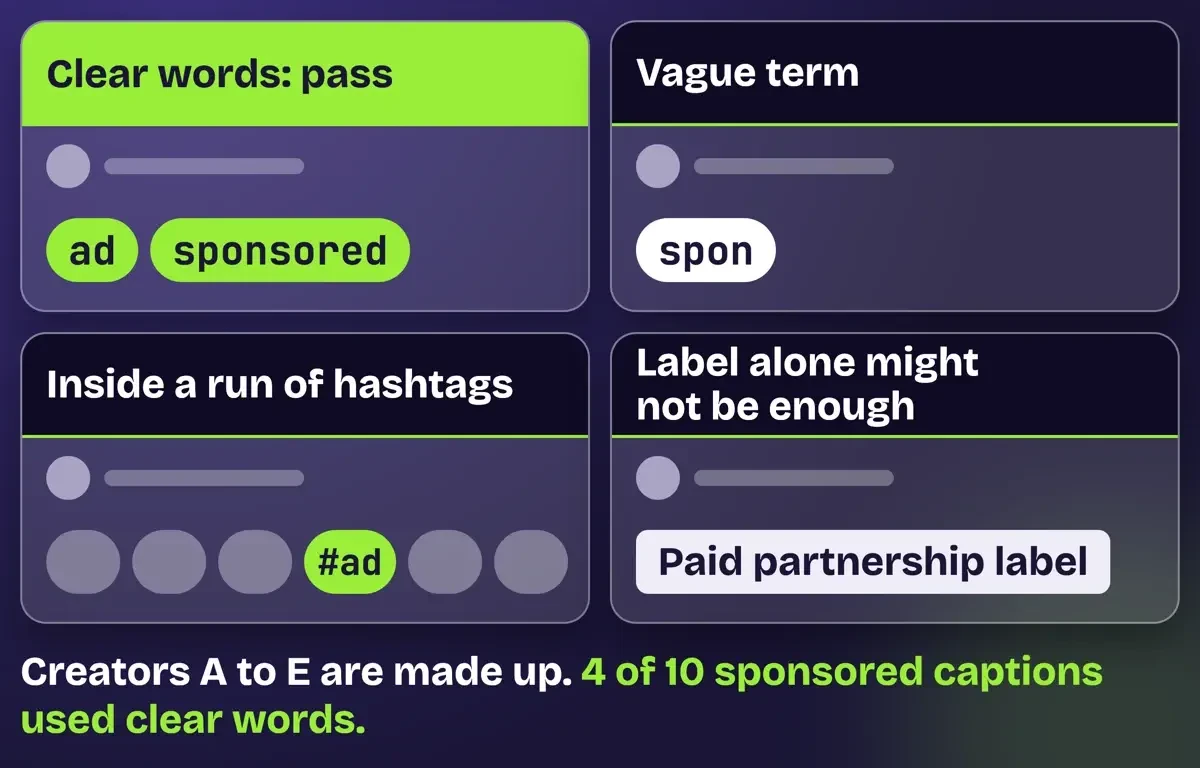 Drawn by us from our vet.py results on made-up captions and the FTC's Disclosures 101, November 5, 2026.
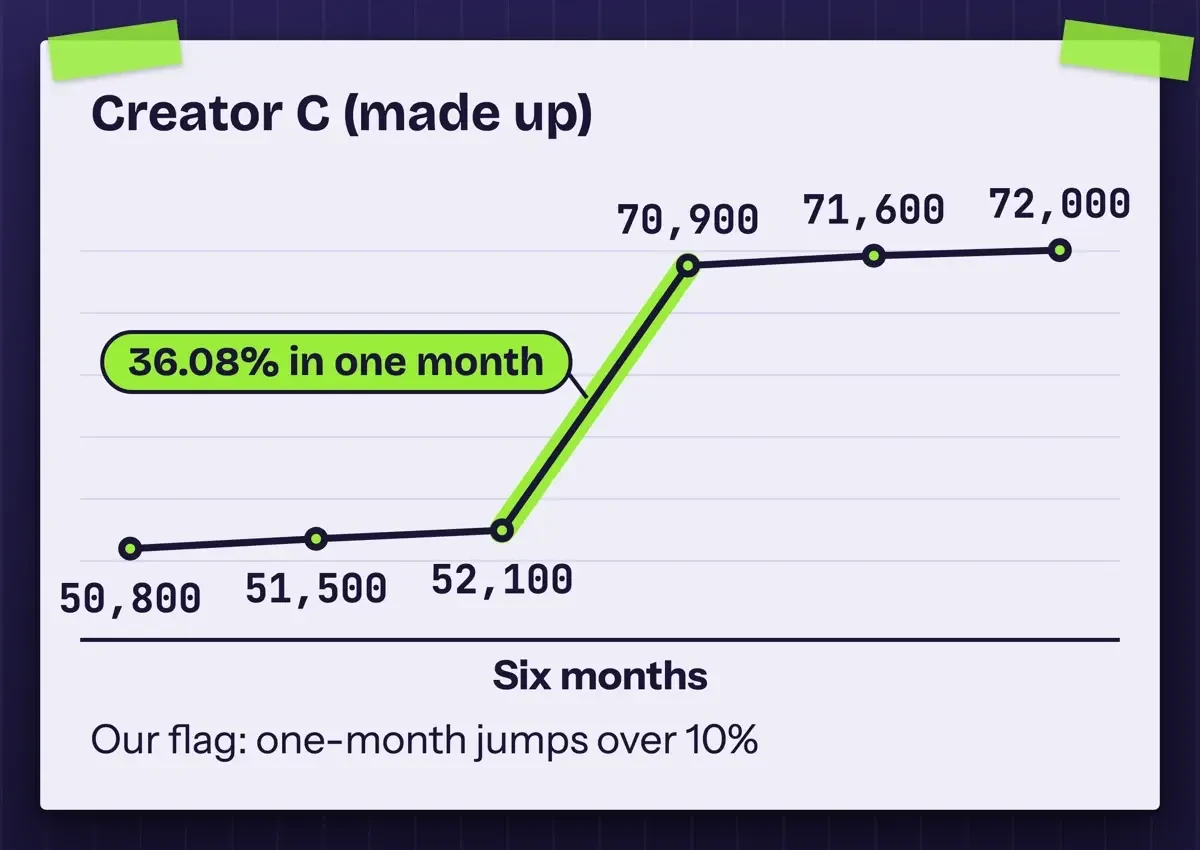 Drawn by us from made-up data in our vetting test, November 5, 2026. Not real accounts.
What we tested
We ran that list as a script on five made-up creators, Creator A to Creator E, with invented numbers and captions. Only Creator A cleared every check. Just 4 of 10 sponsored captions used clear words. Creator C failed three ways: 0.38% by followers, a 36.08% one-month follower jump and two vague captions. Creator D tucked "#ad" fourth in six hashtags. Creator E used the Paid partnership label alone once, and "Partner:" with no brand name once. Disclosures 101 names "AcmePartner", with the brand name, as an option on space-limited platforms like Twitter.
What FTC endorsement rules ask of a brand
The FTC staff FAQ on endorsements says enforcement focus "usually will be on advertisers or their ad agencies and public relations firms." On June 29, 2023, the FTC announced updated Endorsement Guides, the first revision since 2009. The update defined clear and conspicuous and warned that a platform's built-in disclosure tool might not be enough. Under 16 CFR 255.1(d), "Advertisers are subject to liability for misleading or unsubstantiated statements made through endorsements", and for hidden connections too. It tells brands to guide endorsers, to "Monitor their endorsers' compliance" and to fix problems. Creators carry their own share, including when one "falsely represents that they personally used a product."
Asked whether a creator can rely on a platform's disclosure tool, the same FAQ answers "Not necessarily." Meta's branded content page still requires its paid partnership label, so we'd ask for the label plus "ad" in the caption.
Stories vanish fast, so the FAQ says "you should require that paid posts aren't made without you approving them in advance."
Disclosures 101 also covers placement. It says a disclosure shown only on a profile page, tacked onto a post's last line or behind a MORE link is likely to be missed. On Stories, it tells creators to put the disclosure over the picture and leave enough time to read it. Video endorsements need the disclosure inside the video, since a note in the description alone isn't enough, and a live stream should repeat it now and then for late viewers. It should also match the language of the endorsement, so a Spanish-language Reel needs a Spanish disclosure.
A gift with no contract still needs a disclosure, and the FAQ calls training material alone "important, but insufficient" for free-product creators. Kid audiences raise the bar. The FAQ says "research suggests that disclosures will not work for younger children." FTC staff reviewed Instagram posts and, in April 2017, sent more than 90 letters to influencers and marketers.
Brands that also sell into India answer to ASCI's rules there, and they're the subject of our guide to social media influencers in India.
A basic influencer contract checklist
The FTC staff FAQ still expects disclosure and monitoring for a free product with no money paid, so we'd put these nine terms in writing even then.
- Deliverables: format, number of posts, dates and how long each stays up.
- Disclosure: the exact words, placed near the top, plus Meta's Paid partnership label.
- Pre-approval of every paid post and Story, with your turnaround time.
- Claims the creator may and may not make, with your proof for each.
- Content rights: who owns the posts, where you can reuse them and for how long.
- Partnership ads permission, its length and any extra fee for paid reach.
- Payment terms, a W-9 before the first payment and the 1099-NEC line.
- Your monitoring window during the deal and for a few months after.
- How either side ends the deal, and what happens to live posts then.
Under 17 U.S.C. 204, a copyright transfer "is not valid unless" it's in writing and signed. Section 101 counts an exclusive license as a transfer, "but not including a nonexclusive license." The Copyright Office's FAQ adds that "all or part of the rights in a work may be transferred". If you want to own a Reel outright, or stop the creator from licensing it to another brand later, you'll need that transfer in writing and signed.
Instagram's partnership ads page tells creators they can "advocate for higher pay given the extended usage rights", so price it into the first deal. Instagram adds there that "Content that includes licensed music cannot be run as a partnership ad", so a Reel you plan to boost needs royalty-free audio. Our partnership ads walkthrough covers setup, and a tagged link from the free DigitalTreed UTM link builder lets you see each creator's sales in your analytics.
For a first test, we'd sign one or two creators whose old captions already pass, with pre-approval in the contract. If you want a team on the wider social plan, DigitalTreed's social media marketing help is there.
Frequently asked
Does a loaned product need a disclosure?
Yes on Meta's apps. Meta's branded content guide covers the case where "A company loans you a free product" and says to use the paid partnership label.
How long should a brand monitor an influencer after a deal?
For creators under contract, the FTC staff FAQ suggests watching "for a reasonable time, such as a few months, after the contract expires."
Do FTC rules apply to a creator posting from abroad?
Often, yes. Disclosures 101 says "U.S. law applies if it's reasonably foreseeable that the post will affect U.S. consumers".
Does an influencer need a 1099 from you?
For tax years starting after 2025, the IRS Form 1099-NEC instructions require a 1099-NEC when you pay a non-employee at least $2,000 for services in the year. Get a Form W-9 first.
How we made this guide: Each quote was matched on November 5, 2026 to a saved copy of its page, and our test used only made-up creators. Facts checked by the DigitalTreed team on November 5, 2026.
First published August 2020 as a ranking of five Instagram accounts, later retitled for 2021. Rewritten November 5, 2026 as a US guide to finding, checking and contracting creators under FTC rules.
Sources
- FTC: Disclosures 101 for Social Media Influencers (November 2019)
- FTC: FTC's Endorsement Guides: What People Are Asking
- 16 CFR Part 255: Guides Concerning the Use of Endorsements and Testimonials in Advertising (eCFR)
- 16 CFR Part 465: Use of Consumer Reviews and Testimonials (eCFR)
- FTC press release, June 29, 2023: updated Endorsement Guides
- FTC press release, April 19, 2017: letters to influencers and marketers
- FTC: Consumer Reviews and Testimonials Rule, Questions and Answers
- Meta Business Help Center: What is considered branded content
- Meta Business Help Center: About tagging a business partner in a branded content post
- Instagram for Creators: Creator Marketplace
- Instagram for Creators: Partnership Ads
- Instagram Help Center: About Instagram insights
- Sprout Social: Types of influencers (August 12, 2025)
- OpenSponsorship: Nano vs Micro vs Mega Influencers (July 15, 2026)
- Hootsuite: How to calculate engagement rate (October 6, 2026)
- 17 U.S.C. 101, Definitions (Cornell Legal Information Institute)
- 17 U.S.C. 204, Execution of transfers of copyright ownership (Cornell LII)
- U.S. Copyright Office FAQ: Assignment and transfer of copyright ownership
- IRS: Instructions for Forms 1099-MISC and 1099-NEC
- IRS: About Form W-9

Comments
No comments yet. Start the conversation below.