

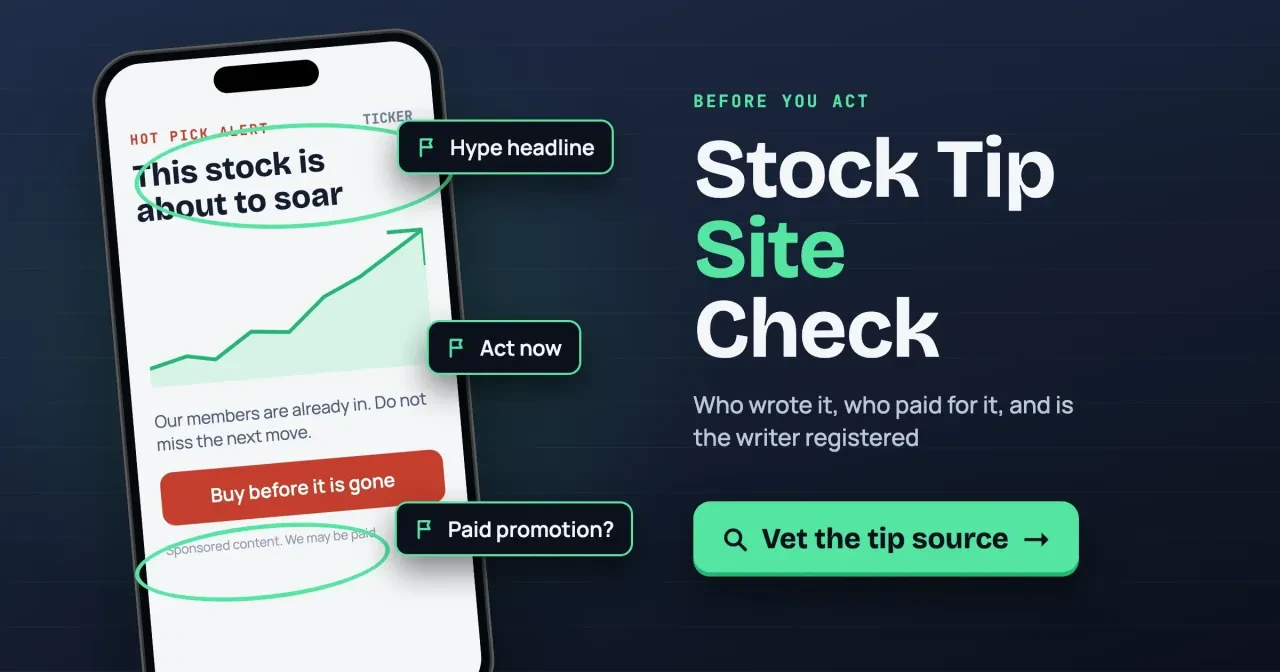
Quick answer
To check a stock tip website, run 6 checks, starting with two free lookups, IAPD and FINRA BrokerCheck, for the people behind it (as of October 2026). A newsletter that sends the same picks to every reader on a regular schedule may fall outside adviser registration, and then the payment disclosure carries more weight.
You typed 5StarsStocks into a search bar, or a stranger dropped a "hot pick" and a chat link into your feed. Now you want to check the stock tip website before any money moves. A stock tip website is a site, newsletter or social account that names specific stocks for readers to buy or sell. This guide explains the rules; it isn't investment or legal advice. For your own account or a loss, ask the SEC's Office of Investor Education and Assistance, FINRA, your state securities regulator or a securities attorney.
We'll start with who's behind the tip and whether they're registered, then the SEC's action records and whether the writer was paid. Then pump and dump signs, the company's filings and trading status, 5StarsStocks' own pages and where to report.
Key takeaways
- Look up the person and firm in IAPD and BrokerCheck first.
- Section 17(b) makes paid promoters disclose the payment and its amount.
- A payment line without payer, amount and form is vague.
- Our word checker caught 7 signs on a made-up hype page.
- A quiet made-up pitch passed every word check, so lookups come first.
Who is behind the tip, and are they registered?
We put the people checks first because a promoter can reword a pitch in minutes but can't edit a BrokerCheck report or an SEC order.
Look for an author, a firm, an address and a phone number on the page itself. If the tip arrived in a chat, scroll back to the first message and copy the name, the handle and any firm mentioned before the thread disappears. A page that lists a city but no street, or a phone number that only takes texts, gives you less to check than it seems. Investor.gov puts the reason plainly on its page on checking an investment professional: "Unlicensed, unregistered persons commit much of the investment fraud in the United States." A search there shows whether a person or firm is licensed with the SEC, a state or FINRA, plus any disciplinary history.
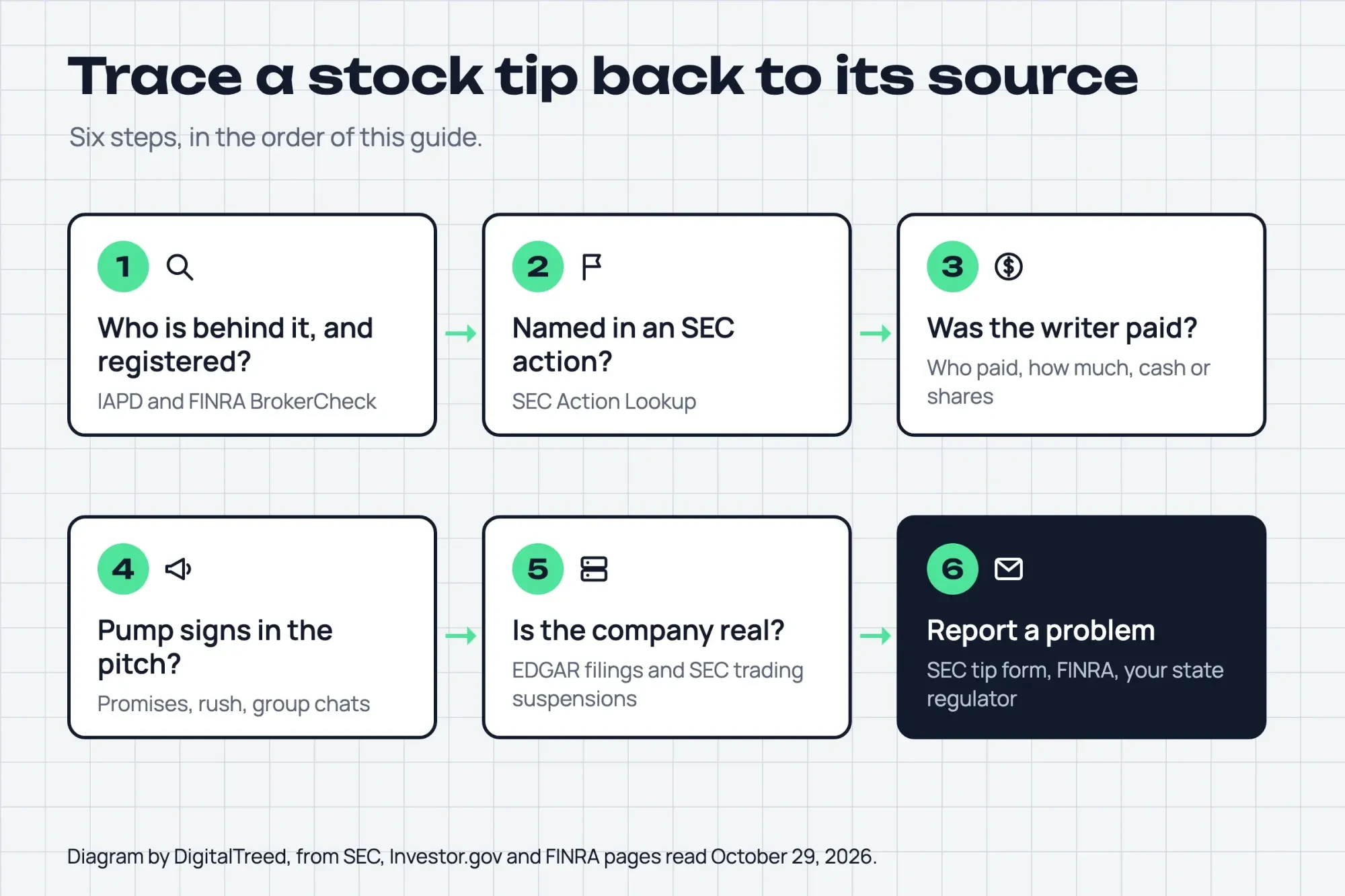 Diagram by DigitalTreed: the six checks in this guide, from SEC, Investor.gov and FINRA pages read October 29, 2026.
If the page names no author or firm, that's your first finding, and it's worth writing down. Check the About and Contact pages, the footer and any terms page for a business name and a street address. A chat handle or a first name gives you nothing to search. The SEC's 2026 alert asks whether someone "claiming they are a famous investment professional" reached you through social media, and that's exactly the case where a name alone means little. Ask for the full name and the firm, then search both. A refusal is an answer too.
Two free databases do the lookup. The SEC's Investment Adviser Public Disclosure site covers advisers, and FINRA's BrokerCheck covers brokers and their firms. Type the name exactly as the page spells it, then try the firm name too, since a search on a nickname or a chat handle will usually come back empty. FINRA's BrokerCheck overview says a report lists registrations, employment history and a disclosure section on customer disputes and disciplinary events. FINRA's guide to investing ideas from social media points to the same two tools for anyone who touts registration or credentials.
A matching name isn't proof you're talking to that person, though. The SEC's February 6, 2026 alert on social media stock tips warns that "fraudsters may impersonate registered brokers or investment advisers on social media." Its fix is simple. Reach the professional through the phone number or website in the firm's Client Relationship Summary, called Form CRS, which you open from the firm's search result on Investor.gov. FINRA's guide flags the same trick of posing as registered representatives.
Now the catch for pick sites. The Investment Advisers Act, at 15 U.S.C. 80b-2(a)(11), leaves out "the publisher of any bona fide newspaper, news magazine or business or financial publication of general and regular circulation." So a site that writes the same picks for everyone may not be in IAPD at all. The SEC's alert on investment newsletters explains what a "not a registered investment adviser" line means: the publisher "is disclaiming these responsibilities and obligations."
An empty IAPD search for a pick site is therefore normal, not a finding. The exclusion covers the publication, not the person: if the site's author also manages money for clients, look up that adviser or firm under its own name.
Search the SEC's action records
Once you have names, see whether the SEC has already gone after any of them. Investor.gov's SEC Action Lookup lets you look up individuals "named as defendants in SEC federal court actions or respondents in SEC administrative proceedings." It leaves out cases still pending at trial and people "against whom no judgement or order has been issued," in the page's words. The page also says not to rely on this one tool alone. So a clean result is only a partial answer. The SEC newsletter alert tells readers to "Search SEC.gov and contact your state securities regulator" for actions against the newsletter or anyone tied to it. Note the date of each search.
Was the writer paid to push the stock?
Next comes money. A paid write-up can look exactly like independent research. Section 17(b) of the Securities Act, 15 U.S.C. 77q(b), covers anyone who describes a security for pay from an issuer, underwriter or dealer. They can't do it "without fully disclosing the receipt, whether past or prospective, of such consideration and the amount thereof." The rule is about disclosure. The SEC calls the breach touting: "promoting a stock without properly disclosing compensation received for promoting the stock."
The newsletter alert then shows what a weak disclosure looks like. It names three problems:
- No disclosure: the alert says to be suspicious when a newsletter "does not disclose having received any compensation."
- Vague disclosure: it doesn't say "who paid them, the amount, and the type of payment."
- Buried disclosure: the line is "difficult to find" or in "tiny, hard-to-read print."
So read the fine print at the bottom of any pick page. You're looking for a payer by name, a dollar amount and a form such as cash or shares. One of the SEC's own vague examples reads "From time to time, the Newsletter may receive compensation from companies we write about." That sentence doesn't name any of the three. Even a complete disclosure isn't a pass, though. The alert warns that "fraudsters may include such disclosures to create the false appearance that the newsletter is legitimate." A specific line tells you who wants the stock to rise, and nothing more.
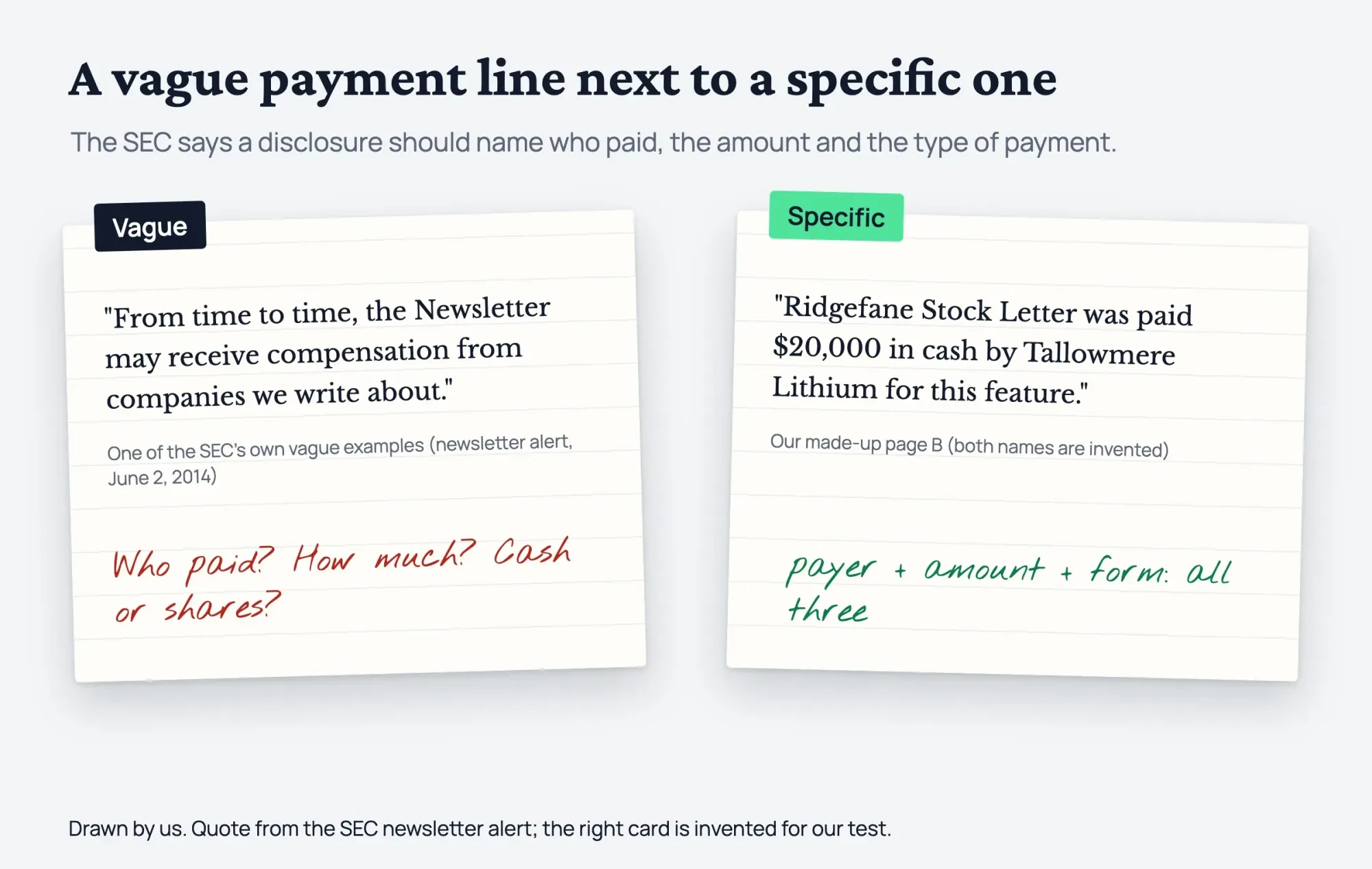 Drawn by us. The left line is quoted from the SEC newsletter alert; the right card comes from our made-up test page B.
Our made-up page B, used in the test below, shows that limit. It names the payer, a made-up $20,000 and cash, then says the invented company's mine opens next year on $4 million in cash and no revenue. The disclosure tells you who paid; only the company's filings can show whether that plan holds up.
Pump and dump signs in the pitch
Now read the pitch itself, with the people and the money already checked. Investor.gov's pump and dump page says these schemes "have two parts": promoters lift the price with false or misleading statements, then sell their own shares. After that, it says, "the price typically falls, and investors lose their money."
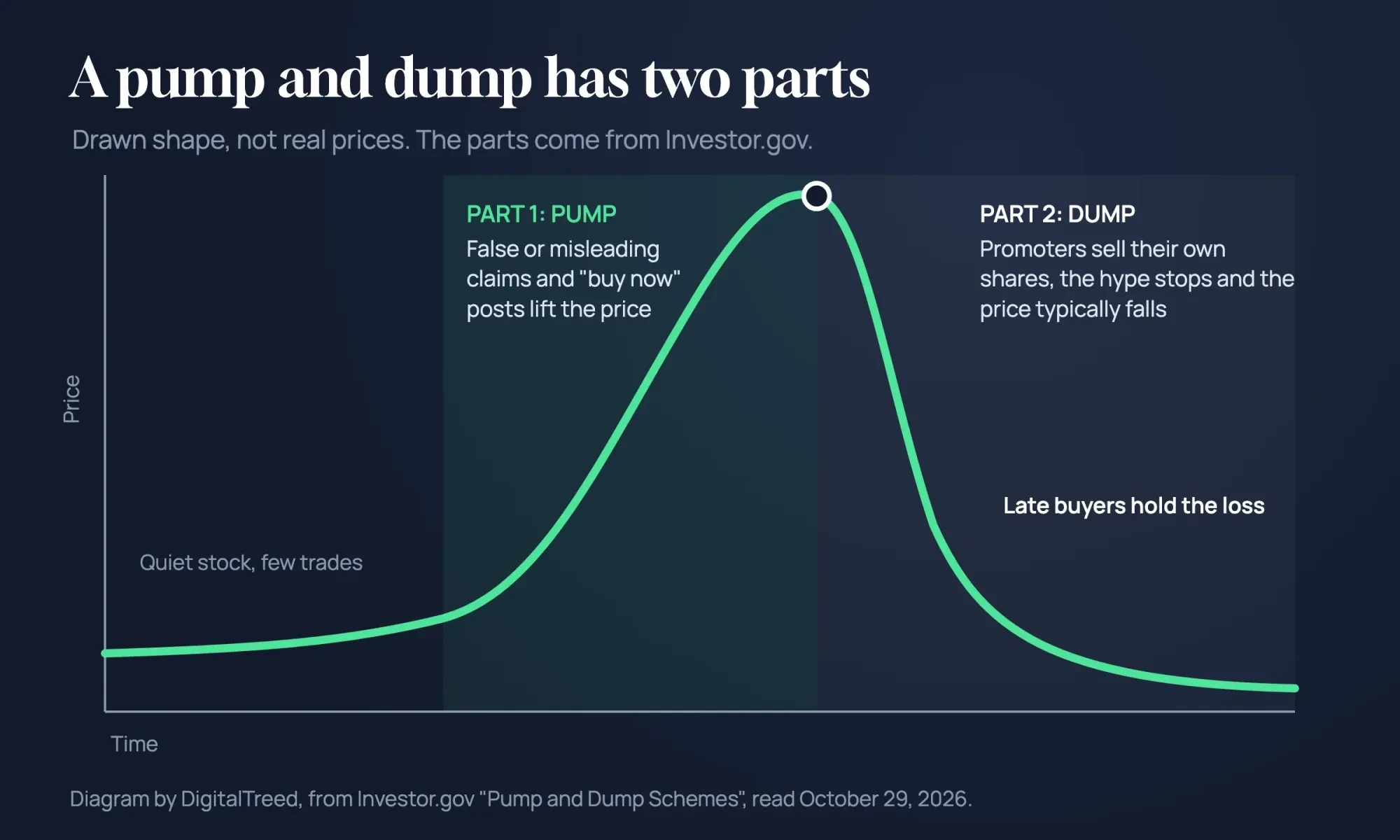 Diagram by DigitalTreed. A drawn shape, not price data; the two parts come from Investor.gov, read October 29, 2026.
The SEC alerts and FINRA's guide name the same handful, and a pitch that carries several of them deserves a slow read:
- A promise of big returns with little or no risk. The SEC calls that "a classic sign of investment fraud."
- Pressure to buy right now, before a deadline that the promoter sets.
- A claim of "inside" or confidential information.
- A request to keep it quiet, which FINRA lists as "demands for secrecy."
- An ad that drops you into a group chat run by someone calling themselves an adviser.
- Requests for screenshots of your trades, or for how many shares you bought.
Our made-up page A, 92 words long, packs in every sign on that list. Our checker scores the no-risk promise and the big-return claim as two separate checks, so page A's count below is 7, not 6.
Group chats deserve a closer look. The SEC's 2026 alert says that once trust builds, you may be steered to "relatively smaller companies (including companies listed on major U.S. stock exchanges)." You may also be asked to send the adviser screenshots of your purchases.
If an ad link passes through short links before the chat opens, paste it into our redirect checker. It prints every address in the chain, ending with the page that actually loads. Judge that page, not the ad.
We wanted to know how far a word check gets you, so we built one. It reads a page and runs 7 checks, each tied to the SEC, Investor.gov and FINRA lists above. It also reads the payment line for a payer, an amount, a form, vague wording and small print. Then we ran it on four pages we made up ourselves, all about an invented company we called Tallowmere Lithium. Nothing real was scored.
What we tested
Page A, the hype page, tripped all 7 checks, with a vague payment line in 9-pixel print. Page B named the payer, a made-up $20,000 and cash, and pages C and D had no flags or payment line.
A: 7 of 7 flags, vague, small print
B: 0 flags, payer + amount + form
C: 0 flags, no payment line
D: 0 flags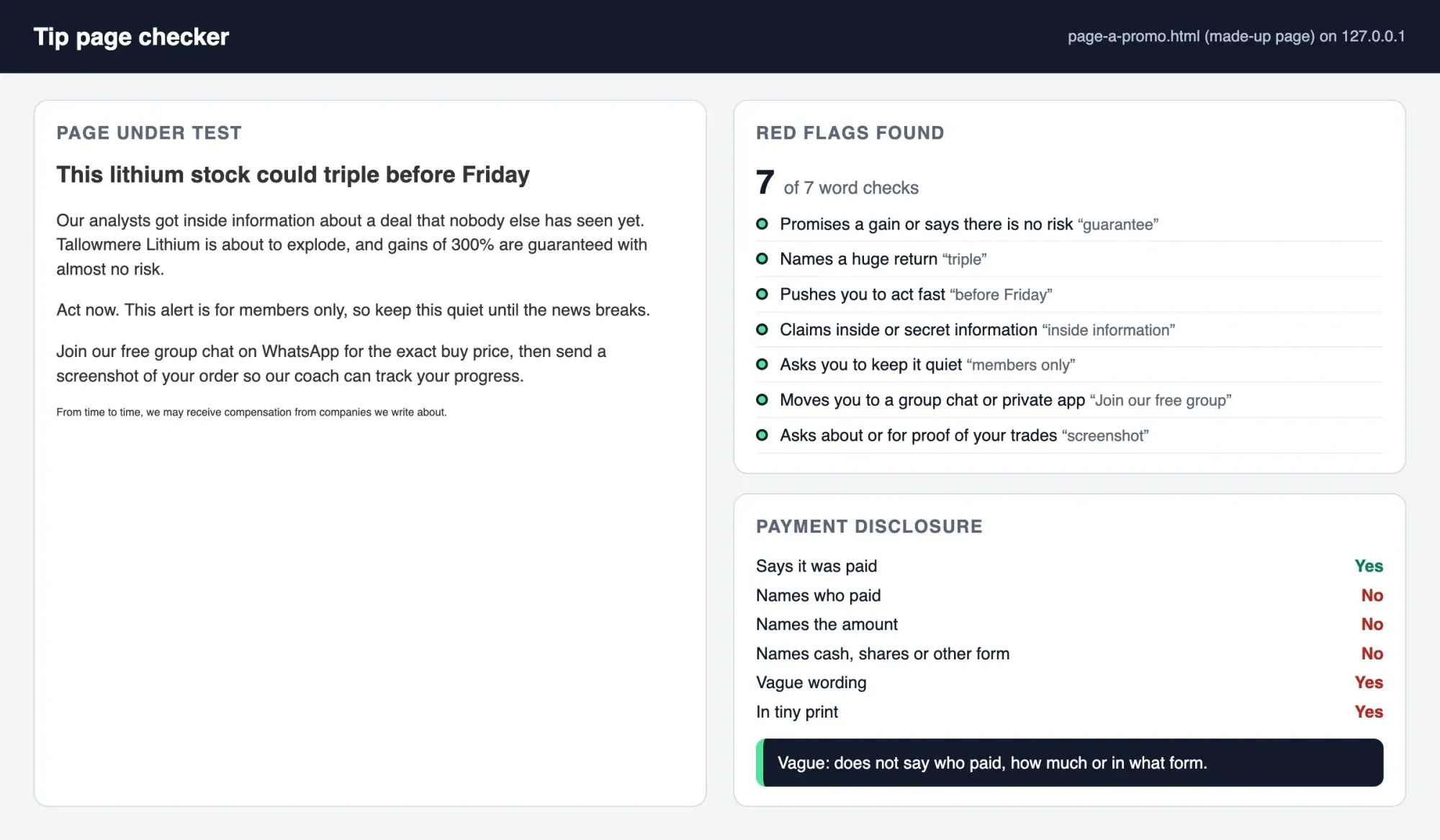 Screenshot: our checker on 127.0.0.1 reading made-up page A, October 29, 2026.
Page D is the result to remember. It calls Tallowmere "the one lithium name I would own this year" and says readers who bought "are glad they did." None of its 46 words is a trigger word, and the checker found nothing. It sailed through.
Check the company and its trading status
Word checks catch a loud page in seconds, but anyone can write around them, so the lookups above still come first.
A tip is only as real as the company behind it, so look the company up. Public companies file their reports on EDGAR, the SEC filing search, where, in the SEC's words, any investor can get them "for free from the SEC's website." The SEC's rules at 17 CFR 249.308a, 249.310 and 249.308 name the three forms you'll use most. Those are Form 10-Q for quarterly reports, Form 10-K for annual reports and Form 8-K for current reports. Start with the latest 10-K. The SEC's guide to microcap stock warns that "Many microcap companies do not file financial reports with the SEC," which makes the facts hard to get.
If EDGAR finds nothing under the company's name or its ticker, note the date you searched. Without filed reports there are no audited numbers to hold the pitch's claims against, which is the problem the microcap guide describes.
Then see whether the SEC has paused trading in the stock, using its list of trading suspensions. Read the newest entries first, and note the date you checked.
The SEC's February 2026 alert says it suspended trading in 13 small-cap companies whose investors got social media tips "from unknown persons." The power comes from 15 U.S.C. 78l(k), which lets the SEC suspend trading when the public interest and the protection of investors require it.
What 5StarsStocks' own pages say
So what do the pages of the site in this post's title show? Here's what we could see on October 29, 2026, and nothing more. The site 5starsstocks.com loaded. Its disclaimer page calls it "a research and educational platform, not a licensed financial advisory firm, brokerage, or accounting service." It describes its content as "for informational and educational purposes only" and tells readers to consult a licensed advisor.
We also searched the text of its home page and disclaimer for words about payment from the companies it covers. We didn't find any on those two pages. That doesn't mean anyone was or wasn't paid; it means the payment question is one you'd put to the site directly, as you would to any pick site. A registry lookup on our machine showed the domain was created on January 18, 2024. Our DNS lookup tool pulls a domain's records, and copied finance domains get their own walkthrough in our post on lookalike finance sites. If you'd like to judge a stock on its own numbers, our walkthrough on researching a stock before investing starts with the filings.
The same first check works here: copy any author or company name from the site's About, Contact and terms pages into IAPD and BrokerCheck. Save the disclaimer as it reads today, since a page can change after you act.
Where to report a tip that looks wrong
Once a tip looks like a pump, a paid promotion with no disclosure or an imposter, report it. Do that even if you didn't buy. The SEC asks the public to use its tips, complaints and referrals system, which lists "Manipulation of a security's price or volume" among the problems it takes. For a broker or brokerage firm, FINRA's help page has an online form for suspicious activity. The SEC newsletter alert also says to "contact your state securities regulator."
Before you file, save dated screenshots of the page, the chat and the payment line, plus the dates and results of your IAPD, BrokerCheck and SEC Action Lookup searches. An empty result is still a record of what you checked.
If the pitch promised a fast double, our piece on getting rich quick, realistically runs the math. Job-style pitches that promise income from home are a separate scam, covered in our post on spotting work-from-home scams. Trades by members of Congress are covered in reading congressional stock trade data, and for borrowing, our online payday lender check uses the same license-first logic.
Stock tip website questions
Frequently asked
How long can the SEC suspend trading in a stock?
Its trading suspensions page says "up to 10 trading days" when the public interest calls for it.
Does BrokerCheck show brokers who left the industry?
Yes. FINRA's BrokerCheck overview says it keeps their records "for 10 years after their registration" ended.
Can a tip site profit if I trade through my own broker?
Yes. The SEC newsletter alert says "the newsletter publisher may profit from your trading activity."
Is a big-exchange stock safe from a pump and dump?
No. The SEC's social media alert says "pump and dump schemes are not limited to microcap stocks."
How we made this guide: Sources: 14 SEC, Investor.gov and FINRA pages, three U.S. Code sections, two 5StarsStocks pages and one registry lookup. The checker ran on 127.0.0.1 against four made-up pages. Facts checked by the DigitalTreed team on October 29, 2026.
First published March 2025 as a review of one stock-pick site. Rewritten October 29, 2026 as a check of any stock tip source, with a tested word checker.
Sources
- Investor.gov: Check Out Your Investment Professional
- Investor.gov: SEC Action Lookup, Individuals
- SEC investor alert: Investment Newsletters Used as Tools for Fraud
- SEC investor alert: Social Media and Stock Tip Scams
- Investor.gov: Pump and Dump Schemes
- SEC: Trading Suspensions
- SEC: Report Suspected Securities Fraud or Wrongdoing
- SEC: Microcap Stock, A Guide for Investors
- SEC: EDGAR company search
- SEC: Investment Adviser Public Disclosure
- FINRA BrokerCheck
- FINRA: About BrokerCheck
- FINRA: Following the Crowd, Investing and Social Media
- FINRA: Need Help
- U.S. Code: 15 U.S.C. 77q, Securities Act Section 17
- U.S. Code: 15 U.S.C. 78l, Exchange Act Section 12
- U.S. Code: 15 U.S.C. 80b-2, Investment Advisers Act definitions
- 5StarsStocks.com: Disclaimer page (read October 29, 2026)


Comments
No comments yet. Start the conversation below.