
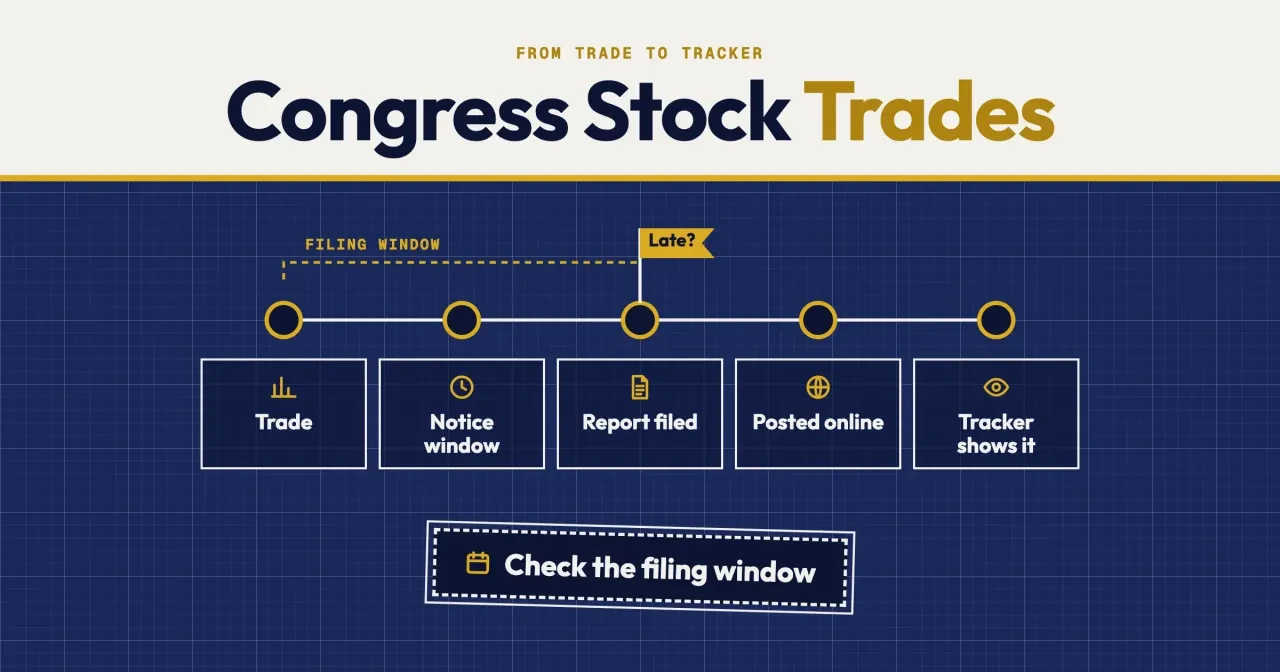
Quick answer
Congress stock trading data comes from reports filed within 30 days of a member learning of a trade, never later than 45 days after it (as of October 2026). When a member learns of a trade more than 15 days late, the 45-day date comes first. Each trade shows a value range, such as $1,001 to $15,000, and the original filing sits on the House Clerk or Senate eFD site.
You saw a feed post listing trades by members of Congress, credited to Unusual Whales, and you'd like to know what it rests on before you share it. A periodic transaction report (PTR) is the form a member files to disclose securities trades over $1,000. This guide covers how the filings work and gives no investment or legal advice. Filing questions go to the House or Senate ethics committee, and money questions to a licensed financial professional.
We follow one filing: what a periodic transaction report covers, the filing window and where House and Senate filings are posted. Then come the amount column's ranges, what Unusual Whales adds, and checking a tracker row against the original filing. We read a row's filed date first. It's what shows how old a trade was once the public could see it.
Key takeaways
- As of October 2026, PTRs are due 30 days after notice, 45 at most.
- Notice after day 15 means the 45-day date sets the deadline (October 2026).
- A lawful filing can reach the public 75 days after the trade (October 2026).
- Summed ranges blur totals: six made-up trades gave $168,006 to $445,000.
- On October 30, 2026, Unusual Whales rows linked back to Clerk or eFD filings.
What is a periodic transaction report?
The report comes from the Stop Trading on Congressional Knowledge Act, the STOCK Act, Public Law 112-105, signed April 4, 2012. The law's section 6, headed "Prompt Reporting of Financial Transactions," added the report to the Ethics in Government Act.
That rule now sits in title 5 of the U.S. Code, and the notes to 5 U.S.C. 13105 trace it to the same law and date.
What goes on a PTR is set by 5 U.S.C. 13104(a)(5). It's "a brief description, the date, and category of value" of any purchase, sale or exchange that "exceeds $1,000." The assets covered are "stocks, bonds, commodities futures, and other forms of securities," while trades "solely by and between the reporting individual, the individual's spouse, or dependent children" aren't reported. Section 13105(l) lists who files, and paragraph (9) reads "A Member of Congress, as defined under section 13101 of this title." The House Committee on Ethics financial disclosure page puts its side plainly, saying Members, officers and certain employees must "disclose transactions over $1,000 for certain securities."
Section 13104(a)(5) asks for no share count, no price and no exact dollar figure, only the "category of value." A row may also be a spouse's trade rather than the member's own.
The filing window, in the statute's words
The deadline is one sentence in section 13105(l), quoted here as it reads in October 2026. The first half: "Not later than 30 days after receiving notification of any transaction required to be reported." The second half: "but in no case later than 45 days after such transaction."
The House Ethics page turns that into two dates and says the report is due "by the earlier of these two dates."
So the order flips at day 15. If a member hears of a trade the day it happens, it's the 30-day date that comes first. Notice can come later, say when it's someone else in the household who placed the trade.
Once it arrives more than 15 days after the trade, the 45-day date wins, because 15 + 30 = 45.
There's no asking for more time. The House Ethics financial disclosure FAQ says, word for word, "Extensions for PTRs are not permitted under the STOCK Act."
Take a made-up trade on March 2, 2026 that the member hears about on March 20. It's due April 16. That's the 45-day date, since notice plus 30 days lands on April 19, and had the notice come on March 5, the due date would've been April 4 instead. Under 5 U.S.C. 13106(d), as of October 2026, a report filed "more than 30 days after" its due date carries a fee. The filer must "pay a filing fee of $200," under the ethics office's rules. The committee's financial disclosure forms page lists a Late Fee Waiver Request Form, so a fee can be waived.
We ran the rule on a made-up six-row report, filed September 10, 2026. Three rows were on time and three late, with row 1 missing its September 2 date by 8 days and row 5 running 57 days past its due date. That's past the 30-day line where the $200 fee starts.
Row 4 is the odd one. The filer learned of a July 1 sale on August 28. That's day 58. The trade's 45-day date had passed on August 15, so the report was late before the filer knew of the trade. In the reader's output, it's the only row whose 45-day date fell before its notice date. The statute still says "in no case later than 45 days after such transaction," and that's the line our reader applied. How the House committee handles a notice that late is a question for its disclosure office (202-225-7103). Here's the reader's full output:
PTR reader run, October 30, 2026, python3 on local files. Input: sample-ptr.txt (made up). Report filed 2026-09-10.
row owner  type     trade      notified   day due        rule                late status  fee line range                         mid
  1 self   Purchase 2026-08-03 2026-08-03   0 2026-09-02 30 days from notice    8 late    -        $1,001 - $15,000  $8,000.50
  2 self   Purchase 2026-08-20 2026-08-21   1 2026-09-20 30 days from notice    0 on time -        $15,001 - $50,000  $32,500.50
  3 spouse Purchase 2026-07-30 2026-08-25  26 2026-09-13 45-day cap             0 on time -        $1,001 - $15,000  $8,000.50
  4 spouse Sale     2026-07-01 2026-08-28  58 2026-08-15 45-day cap            26 late    -        $50,001 - $100,000  $75,000.50
  5 joint  Sale     2026-06-15 2026-06-15   0 2026-07-15 30 days from notice   57 late    past     $1,001 - $15,000  $8,000.50
  6 self   Sale     2026-08-28 2026-08-29   1 2026-09-28 30 days from notice    0 on time -        $100,001 - $250,000  $175,000.50
Totals: low $168,006  high $445,000  midpoints $306,503.00  high/low 2.65x
On time 3, late 3, past the 30-day fee line 1, due date set by the 45-day cap 2, 45-day date already passed on the notice day 1.
Open to the public by 2026-10-10 (filed + 30 days).
What we tested
Our Python reader splits each line on the pipe character and trims every field, a step covered in trimming whitespace in Python. It counts calendar days and doesn't shift weekends or holidays, our simplification; the committee has its own PTR due date calculator. A JavaScript copy on 127.0.0.1 matched it on 21 of 21 values.
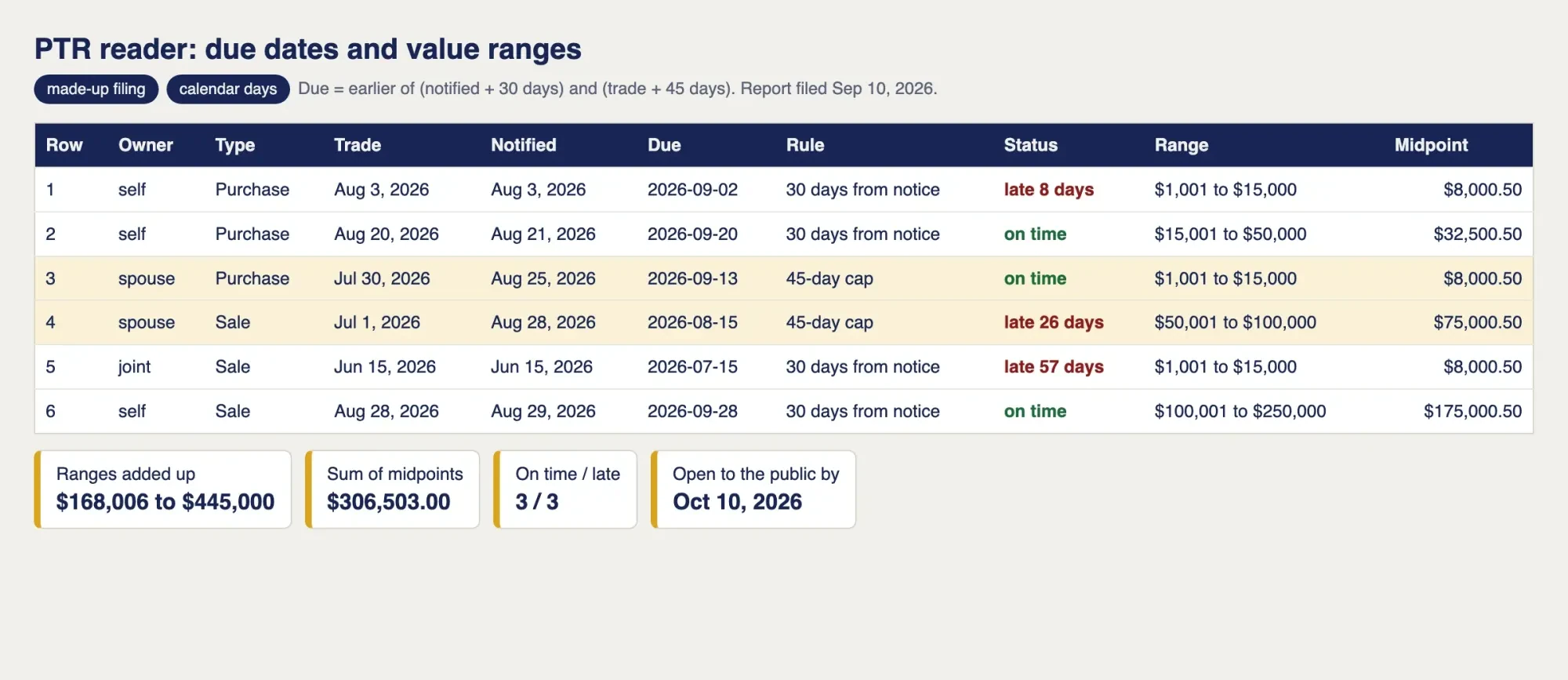 Screenshot: PTR reader running at 127.0.0.1:8752 on October 30, 2026; the two shaded rows took the 45-day cap. Made-up filing.
Where House and Senate filings are posted
Once a report is filed, it goes to one of two offices, and House PTRs "must be filed with the Clerk of the House, not the Committee," per House Ethics.
Filers use the electronic system at fd.house.gov or hand in paper at the Legislative Resource Center. If you open the public side, the Clerk's financial disclosure reports page, you'll find one tab to search reports and another to download them, as of October 30, 2026.
Senate filers report to the Secretary of the Senate, and 5 U.S.C. 13107(a) names the Clerk and the Secretary as the offices that "shall make available to the public" each report.
The Senate's public search is Senate eFD, at efdsearch.senate.gov. It returned a 403 error to our plain request on October 30, 2026, and that's why we've described it from the law and from the links trackers point to.
Both systems go back to the STOCK Act's section 8(b), printed in the notes to section 13107. It called for databases "maintained on the official websites of the House of Representatives and the Senate."
How fast does a filing go public? It's within a month. Section 13107(b)(1) gives the Clerk and the Secretary "within 30 days after any report is received." The STOCK Act's section 8(b)(3) adds that web posting "shall be deemed to have met" that duty. Our example report, filed September 10, 2026, had to be public by October 10. Add the 45-day cap, and a trade can lawfully reach the public 75 days after it happened (45 + 30).
Filings don't come down for years. Section 13107(d) keeps a member's reports public "until a date that is 6 years from the date the individual ceases to be a Member of Congress." Then they're destroyed unless needed in an ongoing investigation. House PTRs open as PDFs, and every House link in the tracker data we saved points to a ptr-pdfs folder on the Clerk's site. If a PDF won't let you select its text, the steps for converting a scanned PDF to editable text still apply.
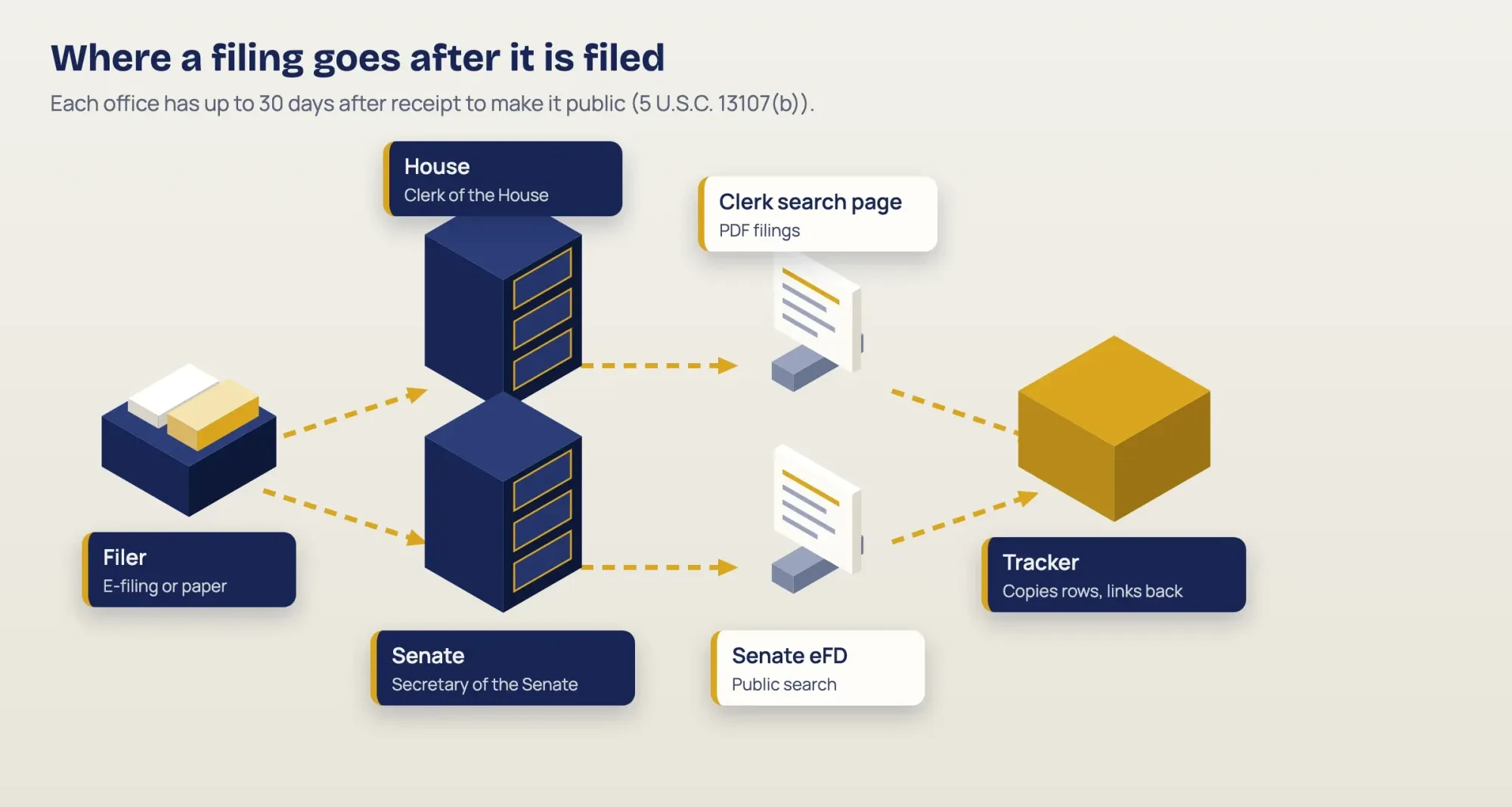 Drawn by us from 5 U.S.C. 13105 and 13107, the STOCK Act section 8(b) note and the House Ethics filing page, read October 30, 2026.
Reading the amount column: ranges, not prices
A PTR won't give you a single dollar figure. Section 13104(d)(1) sets categories instead, and as of October 2026 there are ten. Here's the list, in the dollar bands that filers and trackers use:
- (A) not more than $15,000, which in practice starts at $1,001, since smaller trades aren't reported
- (B) $15,001 to $50,000 and (C) $50,001 to $100,000
- (D) $100,001 to $250,000 and (E) $250,001 to $500,000
- (F) $500,001 to $1,000,000 and (G) $1,000,001 to $5,000,000
- (H) $5,000,001 to $25,000,000, (I) $25,000,001 to $50,000,000 and (J) greater than $50,000,000
The tracker data we saved wrote the same bands as text, from "$1,001 - $15,000" up to "$5,000,001 - $25,000,000." They're the filed categories, copied across. A row can't be more exact than the filing behind it.
Ranges get wide once they're added up. Our six made-up rows came to somewhere between $168,006 and $445,000, so the high end is 2.65 times the low end ($445,000 ÷ $168,006). Each row's midpoint is (low + high) ÷ 2, and the six midpoints add up to $306,503. That number isn't anywhere in the filing. For one $1,001 to $15,000 row, the $8,000.50 midpoint can be off by up to $6,999.50 either way. Midpoints are fine for sorting or charting trades, and the tracker page we saved stores one for each range. Any dollar total built from PTRs, though, isn't more than an estimate with a wide error band.
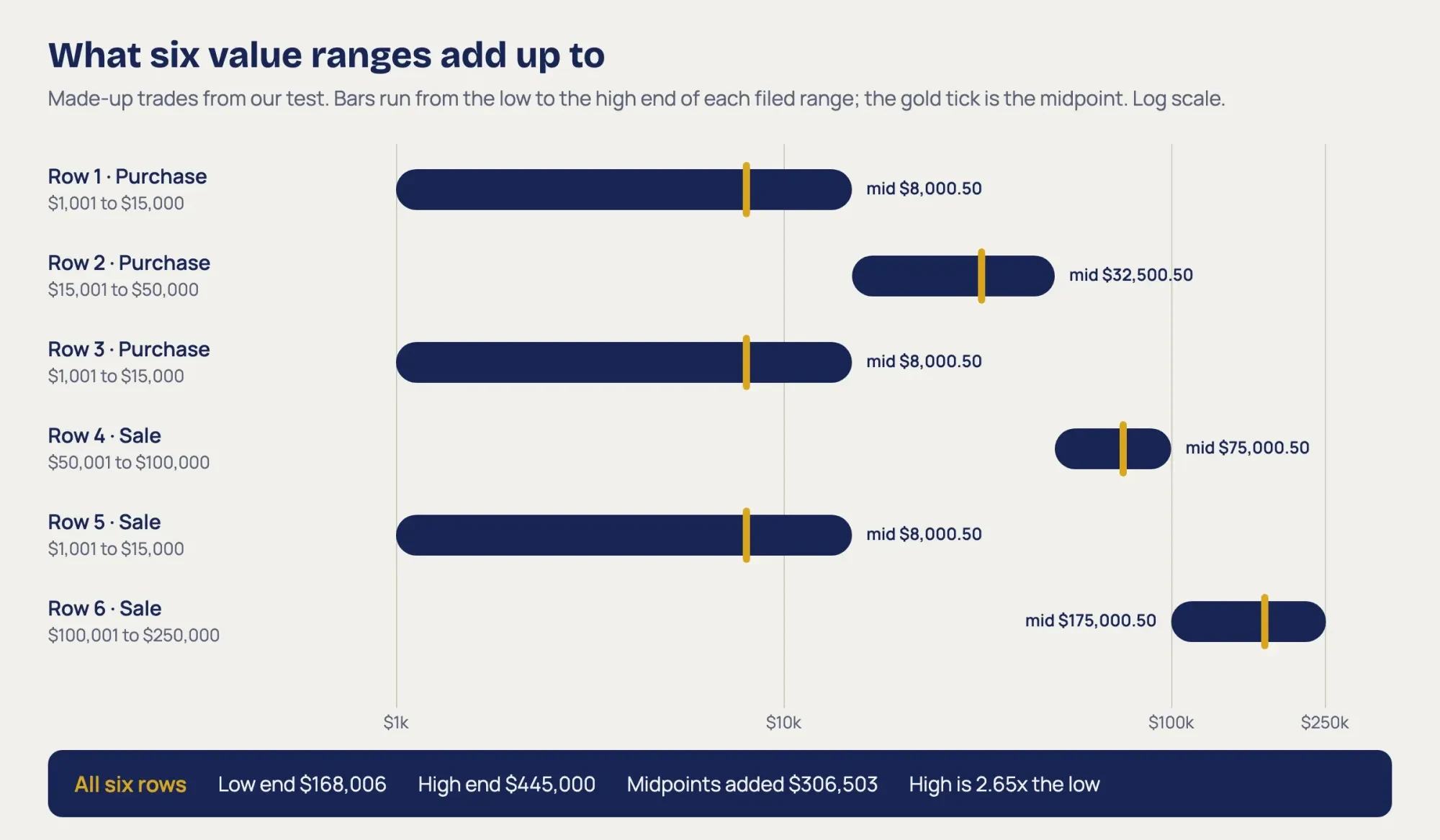 Diagram by DigitalTreed: the six made-up trades from our October 30, 2026 test, on the value categories in 5 U.S.C. 13104(d).
What Unusual Whales adds to the filings
A tracker such as Unusual Whales sits downstream of the Clerk and eFD sites, since members file their reports with the Clerk or the Secretary. To see what it layers on top, we saved three of its public pages on October 30, 2026: the politics page, the home page and the pricing page.
Its politics page is titled "US Politics: Track Congressional & Senate Stock Trades," and its description offers to "Track unusual house, senate, SCOTUS investing, and corporate lobbying for free."
The home page lists Congressional Trading, to "Track portfolios and trading activities of influential political figures and market makers." The pricing page puts "Politician Trade Information Download" among its paid plan features, and for the free tier it says users "See the whole platform delayed 2 trading days." The free tier list also says "Full dashboard, screeners, and charts, delayed," and doesn't name politics data on its own.
The data inside the politics page shows what a tracker has layered on. Our saved copy held 100 filing rows. Each carried a transaction date, a filed date, the amount range as filed and a link back to the source. All 82 House links went to disclosures-clerk.house.gov, and all 18 Senate links went to efdsearch.senate.gov. An affiliation field read joint, spouse or undisclosed. Next to those fields were low, mid and high values for each range. A daily total of $1,001 to $15,000 showed a midpoint of 8000.5, the same (1,001 + 15,000) ÷ 2 our reader used. Benchmark and percent-change fields sat beside them, and those are the tracker's own calculations rather than numbers any member filed.
Checking a tracker row against the original filing
A tracker row is a copy, so the check is to open what it copied. You'll need a few minutes a row, using the fields above:
- Open the row's link and confirm the name, chamber and filed date on the filing itself.
- Compare the trade date and, where the filing shows one, the notification date.
- Work out the due date: the earlier of notice + 30 days and trade + 45 days.
- Read the amount as the filed range, and treat any midpoint or portfolio value as the tracker's estimate.
- Note whose trade it was: the member, a spouse, a joint account or a dependent child.
If the tracker and the filing disagree on a date or range, go by the filing, since 5 U.S.C. 13107(a) makes the Clerk and the Secretary its public keepers. A late filing also tells you less than you'd think: it shows the missed date, not why it was missed or whether the $200 fee was waived.
Those five checks stop at what the member reported; under 13104(a)(5), a PTR has no field for why a trade was made. Whether the company is worth owning is a separate job, and researching and reviewing a stock covers it. When a post turns a row into a buy signal, the next question is who posted it, and vetting the source of a stock pick walks through that.
If an unfamiliar site offers a congress tracker for your email, confirming a finance site is the one it claims to be comes before you type anything in. Copy-trading promises have to survive the 75-day lag above, and promises like that are what our article on what the math says about quick-money claims puts to the test.
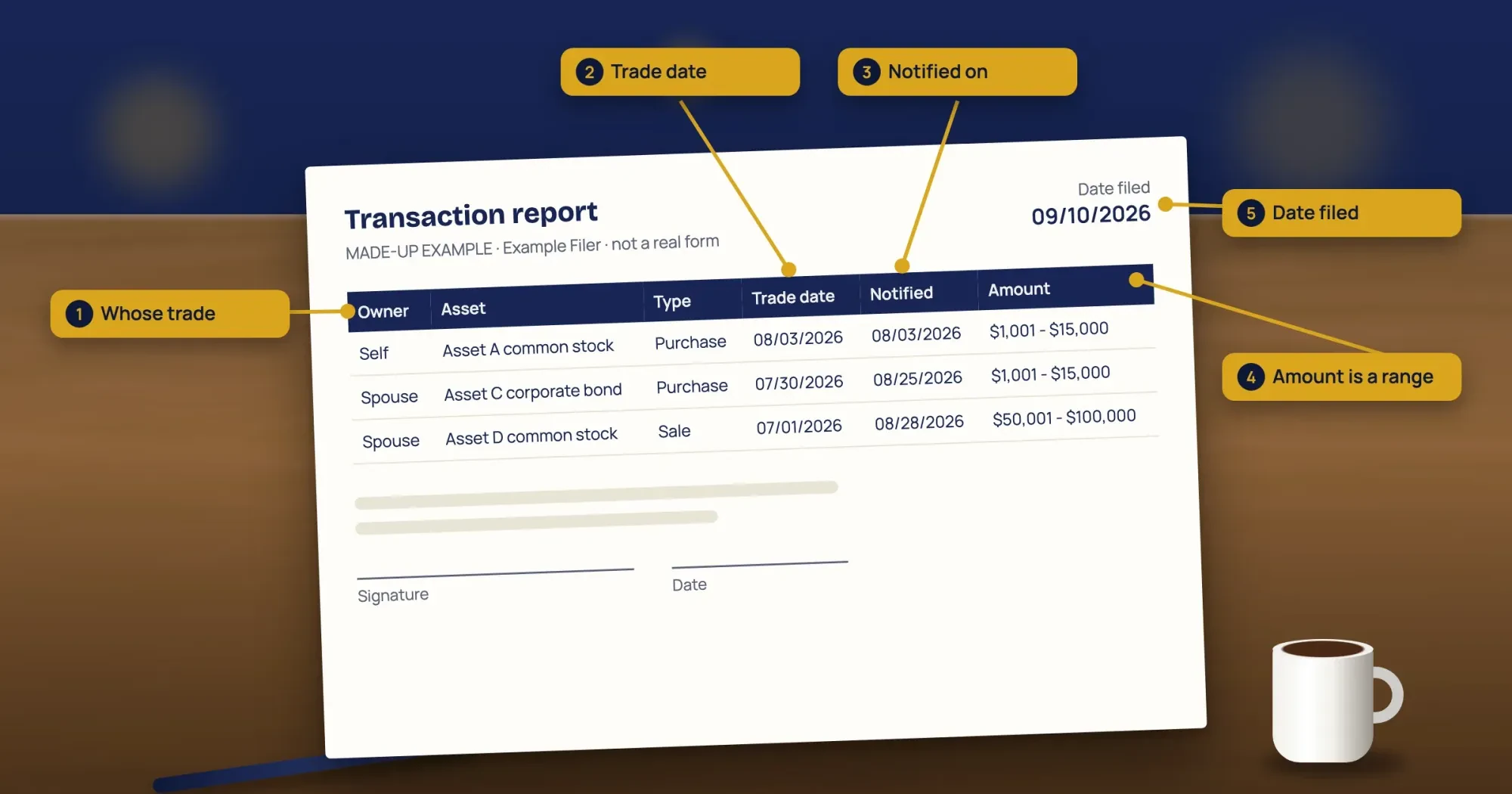 Drawn by us: a made-up report with the five fields to compare against a tracker row. It is not a copy of the House or Senate form.
Our made-up row 4 shows how old a late row can get. The sale was July 1, the report was filed September 10, and posting was due by October 10, 101 days after the trade. On any tracker row, we read the gap between the trade date and the filed date first.
Then comes the range: our row 4 midpoint of $75,000.50 stands for a filed band of $50,001 to $100,000.
Questions about congressional trade filings
Frequently asked
Do executive branch officials file these reports too?
Yes. Section 13105(l) lists the President and Vice President first, then senior executive branch employees and uniformed officers at pay grade O-7 and above.
Can I reuse filing data in my own app or newsletter?
Section 13107(c) bars using a report "for any commercial purpose, other than by news and communications media for dissemination to the general public." As of October 2026, the penalty can reach $10,000, so an attorney is the person to ask before you reuse the data.
Is a PTR the only report a member files?
No. Members also file a yearly report, and section 13107(b) mentions reports "required to be filed by May 15 of any year."
How we made this guide: Statute text is from the 2023 U.S. Code on govinfo.gov, matched against Cornell's LII copy, and House rules from four Committee on Ethics pages. Senate pages didn't load for our checker (403 errors), so Senate rules come from the statute. Facts checked by the DigitalTreed team on October 30, 2026.
Originally a 2023 review of Unusual Whales' options tools. This October 30, 2026 rewrite drops the review and explains the public filings behind congressional trade data, with a tested deadline reader.
Sources
- GovInfo: STOCK Act, Public Law 112-105 (April 4, 2012)
- GovInfo: 5 U.S.C. 13104, contents of reports (2023 edition)
- GovInfo: 5 U.S.C. 13105, including (l) periodic transaction reports
- GovInfo: 5 U.S.C. 13106, late fees
- GovInfo: 5 U.S.C. 13107, public access, with the STOCK Act section 8(b) note
- Cornell LII: 5 U.S.C. 13105
- Cornell LII: 5 U.S.C. 13107
- House Committee on Ethics: Financial Disclosure
- House Committee on Ethics: Periodic Transaction Report Calculator
- House Committee on Ethics: FAQs About Financial Disclosure
- House Committee on Ethics: Financial Disclosure Forms
- Office of the Clerk, U.S. House: Financial Disclosure Reports
- U.S. Senate: eFD search (403 to our checker on October 30, 2026)
- Unusual Whales: US Politics page (read October 30, 2026)
- Unusual Whales: home page (read October 30, 2026)
- Unusual Whales: pricing page (read October 30, 2026)


Comments
No comments yet. Start the conversation below.