
Quick answer
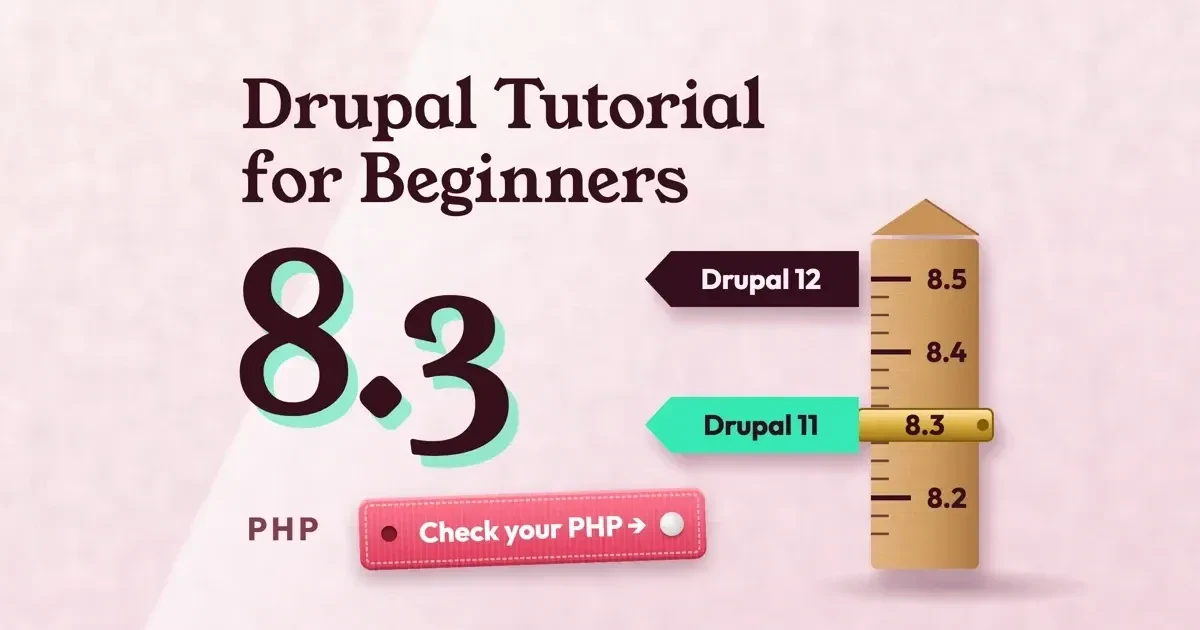
As of November 20, 2026, start on Drupal 11, now at 11.4.13, installed as Drupal CMS on a host running PHP 8.3 or newer. Drupal 10's end of life is December 9, 2026, the day Drupal 12 is scheduled, and Drupal 12 needs PHP 8.5. Then learn content types, fields, taxonomy, views, blocks and roles, in that order.
This Drupal tutorial for beginners starts from zero: you've been handed a Drupal site, or a board member's idea for one, and you've never logged in. Drupal is a free, open source content management system written in PHP. It's built for structured content that many editors share.
Inherited a site? Check its version first. Drupal 7 support ended January 5, 2025, and Drupal 10 loses security fixes on December 9, 2026.
Key takeaways
- Check your host for PHP 8.3 before you pick Drupal 11.
- Drupal 10 loses security support on December 9, 2026.
- Drupal CMS is Drupal 11 core plus ready-made marketing tools.
- Our XAMPP stack, PHP 8.2.4 with MariaDB 10.4.28, cannot run Drupal 11.
- Core security windows usually fall on the third Wednesday of each month.
What is Drupal used for?
Drupal's own about page puts it in one line: "Drupal is content management software." In practice, it's the software behind sites where several people add pages, news, events or staff profiles, and where it matters who's allowed to edit what. The page names US government agencies, the BBC, NBC, Amnesty International and the University of Oxford among the organizations that use it. Under the hood, it's a PHP application that keeps your content in a database. The Drupal User Guide calls it "a flexible CMS based on the LAMP stack", meaning Linux, Apache, MySQL and PHP. Features come from modules you install. A theme sets the look.
According to Wikipedia, Drupal's first release came out on January 15, 2001, and Dries Buytaert was its original author.
Even the User Guide's sample project, a farmers market site, plans separate roles for vendors, content editors and user managers.
Drupal core or Drupal CMS?
Drupal.org offers two downloads, and it's easy to grab the wrong one. The Drupal CMS project page calls Drupal CMS "a ready-to-use platform for marketing teams, content creators and site builders built on Drupal 11 core." It comes with media management, SEO tools, consent management, analytics, search and automatic updates already set up. The newest Drupal CMS release listed there was 2.2.10, dated November 19, 2026. Drupal core is the bare framework. On the Drupal CMS landing page, drupal.org labels Drupal CMS "Recommended for most websites" and Drupal core "For advanced users and developers". With core, you'll pick and configure every module yourself, which teaches you more but takes longer.
The project page also says "Drupal CMS itself is not something you update." It's a starting point, so after install you'll update Drupal core, modules and themes the way you would on any Drupal site.
For a first site, we'd take Drupal CMS and keep its Drupal CMS User Guide open, since its chapters run from installing with DDEV through content modeling, SEO and updates.
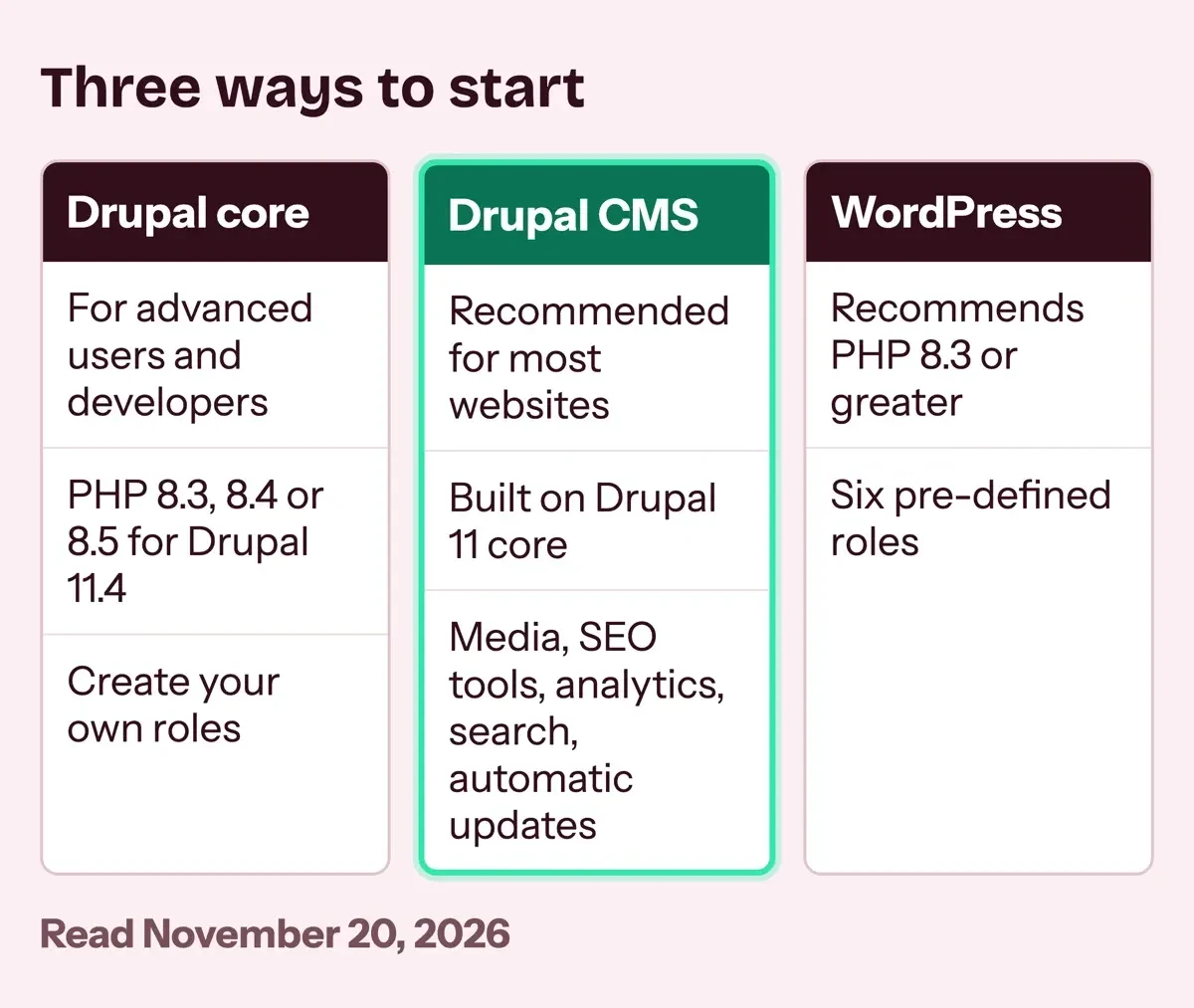 Diagram by DigitalTreed: facts from drupal.org and wordpress.org pages, read November 20, 2026.
Which Drupal version to start on
The updates that guide covers follow Drupal's core release schedule, which, as last updated on November 11, 2026, gives each major version 4 to 4.5 years of support. Drupal 10.6.x is the last minor version of Drupal 10, and that line ends December 9, 2026.
The Drupal core project page listed three supported lines on November 20, 2026, all released November 18; the table adds dates from the schedule.
| Release line | Latest release | Status | Security support ends |
|---|---|---|---|
| Drupal 11.4 | 11.4.13 (November 18, 2026) | Active: new features every six months | April 21, 2027 for 11.4.x; Drupal 11 to early December 2028 |
| Drupal 11.3 | 11.3.22 (November 18, 2026) | Security fixes only | December 2026, when 11.5.0 ships |
| Drupal 10.6 | 10.6.22 (November 18, 2026) | Last minor version of Drupal 10 | December 9, 2026 |
| Drupal 12.0 | 12.0.0-beta2 (October 14, 2026) | Stable release planned for December 9, 2026 | Early December 2030 |
| Drupal 7 | None | Ended | January 5, 2025 |
Drupal 11.4 is the line the project page recommends "for the best compatibility with future releases." Drupal 11 came out August 2, 2024, and the schedule supports it until early December 2028, about four years and four months. Drupal 12.0.0 and 11.5.0 are both scheduled for the week of December 7, 2026. We'd still start a beginner site on Drupal 11 and move up once the modules you rely on support 12. Drupal 7 shows what happens if you wait too long: the project page says its bugfix and security support ended January 5, 2025.
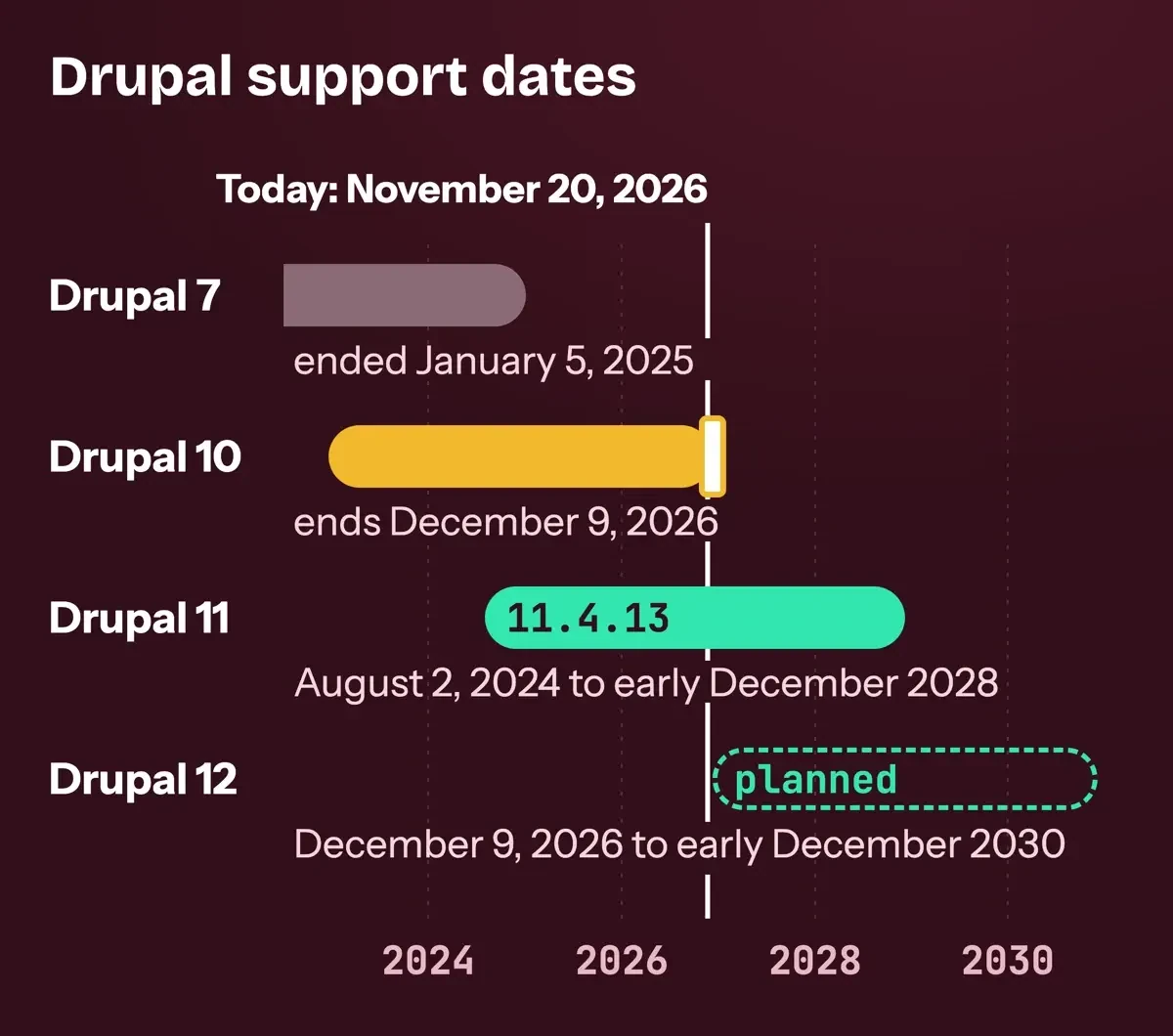 Diagram by DigitalTreed: dates from the drupal.org core release schedule, read November 20, 2026.
System requirements: PHP, extensions and database
Drupal's PHP requirements page lists PHP 8.3, 8.4 and 8.5 for Drupal 11.4. Drupal 12.0 accepts only PHP 8.5, while PHP 8.1 and 8.2 work only with Drupal 10. From Drupal 12.0, the page adds, PHP should be compiled with argon2 support for password hashing. PHP has its own end dates, too. Per the PHP supported versions page, 8.2 gets security fixes until December 31, 2026, 8.3 until December 31, 2027 and 8.5 until December 31, 2029. Your host's default PHP may be older than Drupal needs, which is why Drupal's web server requirements page says to check the version in your host's control panel.
The Drupal 11.4 core composer.json file also requires 14 PHP extensions: date, dom, filter, gd, hash, json, pcre, PDO, session, SimpleXML, SPL, tokenizer, xml and zlib. Drupal's PHP page says XML is on by default in a standard PHP install. Others, such as GD, may mean installing a package, which on shared hosting is your host's job.
For the database, the database requirements page says Drupal 11 needs MariaDB 10.6+, MySQL 8.0+, PostgreSQL 16+ or SQLite 3.45+. Drupal 12 raises MariaDB to 10.11+ and PostgreSQL to 18+. The system requirements overview recommends Linux hosting and supports Windows only for development. If you're choosing between shared hosting and your own server, our reseller vs VPS hosting comparison covers that trade.
What we tested
On November 20, 2026 we ran test/requirements_check.py against the saved drupal.org tables and both PHP installs on our Mac. Each had all 14 required extensions:
| PHP install | Drupal 10.6 | Drupal 11.4 | Drupal 12.0 |
|---|---|---|---|
| Homebrew PHP 8.3.35 | Ready | Ready on PHP; XAMPP MariaDB 10.4.28 too old | Not ready: PHP 8.5 needed; XAMPP MariaDB 10.4.28 too old |
| XAMPP PHP 8.2.4 | Ready | Not ready: PHP 8.2; SQLite and MariaDB too old | Not ready: PHP 8.5, argon2, SQLite, MariaDB |
Homebrew's PHP 8.3.35 passed for Drupal 11.4, and its SQLite library, 3.53.4, clears the 3.45 floor. XAMPP's bundle failed three ways: PHP 8.2.4 isn't on the Drupal 11 list, SQLite 3.38.5 is below 3.45, and MariaDB 10.4.28 is below 10.6. Neither install can run Drupal 12, which accepts only PHP 8.5.
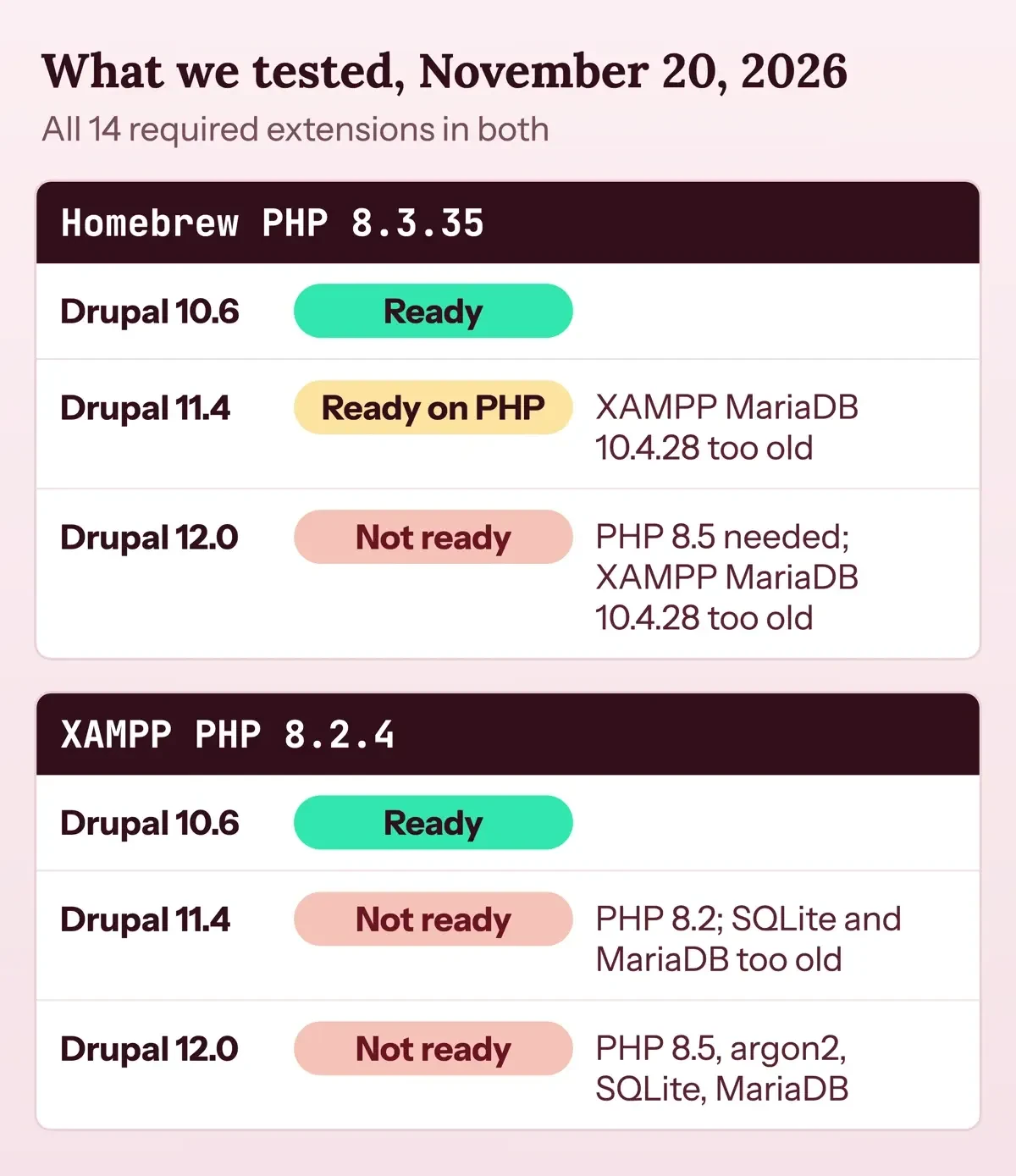 Diagram by DigitalTreed: results of test/requirements_check.py on November 20, 2026, from test/results.json.
Drupal basics in the order you meet them
Drupal's admin screens use their own names for things. Start with the User Guide chapter on content entities. A content item, often called a node, belongs to a content type, and in the guide's farmers market example those are basic pages, vendor pages and recipe pages. Fields are what make each type yours, so a staff profile type might carry a name, a photo, a phone number, a department and an office location. The User Guide's content type walkthrough builds a Vendor type, starting at Structure > Content types.
Taxonomy sorts that content. Drupal's taxonomy is a hierarchical system that, in Wikipedia's words, "lets developers categorize content or tag with keywords for easier access." The taxonomy concept page calls each tag a term and each set of terms a vocabulary. A vocabulary can be flat, like blog tags, or nested, like tomatoes under vegetables. Terms can carry fields too.
Views turn stored content into lists. The User Guide page on views says a view can output a sortable table, a grid, an RSS feed, JSON or a calendar. That's how you'd build a staff directory without hand-editing a list every time someone joins.
Blocks place things on the page. They sit in your theme's regions, and per the blocks concept page, "the main page content is also a block." Roles decide who does what: the users and roles page groups permissions into roles, so a Vendor role can edit only its own listing.
Each path below appears on a Drupal User Guide task page, read November 20, 2026. Keep them open during your first session:
- Content types: Structure > Content types (admin/structure/types)
- Taxonomy: Structure > Taxonomy (admin/structure/taxonomy)
- New view: Structure > Views > Add view (admin/structure/views/add)
- Blocks: Block layout (admin/structure/block)
- Roles: People > Roles (admin/people/roles)
- Modules: Extend (admin/modules)
- Themes: Appearance (admin/appearance)
- Updates: Reports > Available updates (admin/reports/updates)
On a test copy, we'd build one content type, two fields, a vocabulary, a view and a block, in that order. That run uses the first four paths in the list above.
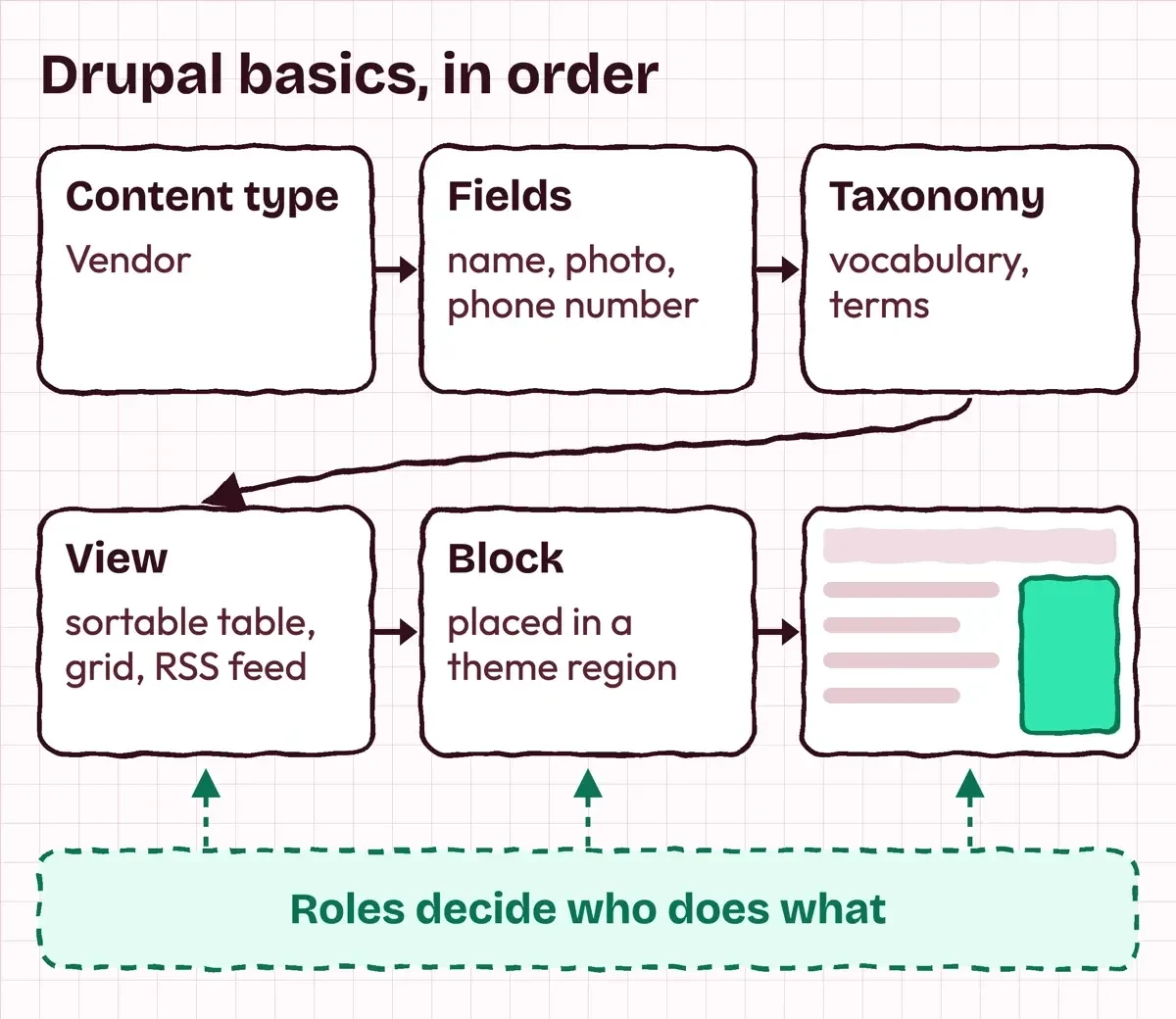 Drawn by us: Drupal concepts from the Drupal User Guide on drupal.org, read November 20, 2026.
Modules, themes and security updates
The modules concept page defines a module as "a set of PHP, JavaScript, and/or CSS files that extends site features and adds functionality." Each installed module adds to the time it takes to build pages, the guide warns, so uninstall the ones you don't use. Themes handle the look. The themes concept page says the theme decides the HTML markup and CSS that wrap your content. Core's default front-end theme is Olivero, and the User Guide's theme settings page shows how to change its colors and add a logo under Appearance.
Each module you add is also code you'll have to keep patched, and the security updates page says critical updates show up in your site's admin pages. You'll need to apply them yourself. Drupal's schedule says core security releases begin at noon New York time, usually on the third Wednesday of the month, though not every window brings one.
On November 18, 2026, the security advisories page posted SA-CORE-2026-017, a critical remote code execution risk through Drupal's install.php file. Two days earlier, public service announcement PSA-2026-11-16 warned that "exploits might be developed within hours or days." The fixed releases, 11.4.13, 11.3.22 and 10.6.22, came out the same day.
If a site can't reach its database after an update, our write-up on fixing a database connection error targets WordPress, but its credential and server checks carry over.
When Drupal fits better than WordPress
Server needs no longer split Drupal and WordPress. WordPress's requirements page recommends PHP 8.3 or greater and MariaDB 10.11 or MySQL 8.4, which is close to Drupal 11's list.
Where they part ways is how content and people are modeled. WordPress has six pre-defined roles, from Super Admin to Subscriber, each with set capabilities. Drupal lets you create your own roles and grant each permission one by one. Languages follow the same pattern. A non-English or multilingual Drupal site runs on the core Language and Interface Translation modules, per the multilingual concept page. Add core's content types, vocabularies and views, and Drupal suits a site where structure is the hard part, like a course catalog or a city's service directory.
For a one-person blog or a small business brochure site, we'd still pick WordPress. We've written up how to make a WordPress website for that build, and Blogger vs WordPress looks at the cheaper end. Our older post on WordPress as a CMS for SEO makes the SEO case for it.
If your team writes PHP, our PHP vs Node.js comparison helps you weigh hiring before you commit. Hiring a Drupal agency instead? Our checklist for choosing a web development company still applies, and it's worth asking any agency which Drupal major they'd build on.
Checked on drupal.org: what held up and what didn't
These versions, dates and minimums were all read on drupal.org on November 20, 2026, without signing in. Three of the six rows below are confirmed, and the other three are gaps you should know about:
| Claim | Where we checked | Result |
|---|---|---|
| Current releases and their dates | Drupal core project page | Confirmed |
| End-of-life dates for Drupal 10, 11 and 12 | Core release schedule, updated November 11, 2026 | Confirmed |
| PHP, database and extension minimums | PHP and database requirement pages, core composer.json | Confirmed |
| PHP 8.6 support | PHP requirements page links an open issue | Not published yet |
| Drupal CMS speed and usage figures | Drupal CMS page, marketing copy | Not tested by us |
| Whether your host meets the minimums | Your hosting control panel | Check yourself |
Drupal's PHP page has a row for PHP 8.6, which PHP released on November 19, 2026, but its support cells point to an open issue instead. The Drupal CMS landing page also says, as of November 2026, "400k+ websites using Drupal today"; that is drupal.org's own figure, and no second source we read repeats it. Before signing up with a host, open its PHP version picker and database details and compare them with the requirement pages linked above. They change with each minor release, so recheck them before every upgrade.
Frequently asked
Is Drupal free to use?
Yes. It's released under the GNU General Public License, and the about page adds, "Drupal will always be free." Hosting still costs money.
Is Drupal 7 still supported?
No. Its end of life was first set for November 2021 and pushed back twice, per Wikipedia, before support ended January 5, 2025.
Can I run Drupal on Windows?
Only for development. Drupal's system requirements recommend Linux and say running Drupal directly on Windows in production isn't supported.
How much memory does Drupal need?
At least 64MB of PHP memory, but the PHP requirements page says production sites typically use 128 MB or 256 MB.
How we made this guide: We saved drupal.org, php.net, wordpress.org and Wikipedia pages on November 20, 2026. Then we compared two PHP installs on our Mac against Drupal's published requirements, without downloading or installing Drupal. Facts checked by the DigitalTreed team on November 20, 2026.
First published May 2, 2020 as a general Drupal overview. Rewritten November 20, 2026 with current versions and end-of-life dates, drupal.org requirements, a local requirements check and the core concepts in User Guide order. Claims in the old text that had no source were cut.
Sources
- Drupal.org: About Drupal
- Drupal.org: Drupal core project page and releases
- Drupal.org: Drupal core release schedule (updated November 11, 2026)
- Drupal.org: PHP requirements
- Drupal.org: Database server requirements
- Drupal.org: Web server requirements
- Drupal.org: System requirements
- Drupal core 11.4.x composer.json (git.drupalcode.org)
- Drupal.org: Drupal CMS
- Drupal.org: Drupal CMS project page
- Drupal CMS User Guide
- Drupal User Guide: Drupal as a Content Management System
- Drupal User Guide: Content Entities and Fields
- Drupal User Guide: Adding a Content Type
- Drupal User Guide: Taxonomy
- Drupal User Guide: Uses of Views
- Drupal User Guide: Blocks
- Drupal User Guide: Users, Roles, and Permissions
- Drupal User Guide: Modules
- Drupal User Guide: Themes
- Drupal User Guide: Configuring the Theme
- Drupal User Guide: User Interface, Configuration, and Content translation
- Drupal User Guide: Security and Regular Updates
- Drupal.org: Security advisories
- PHP.net: Supported versions
- WordPress.org: Requirements
- WordPress.org: Roles and Capabilities
- Wikipedia: Drupal

Comments
No comments yet. Start the conversation below.