
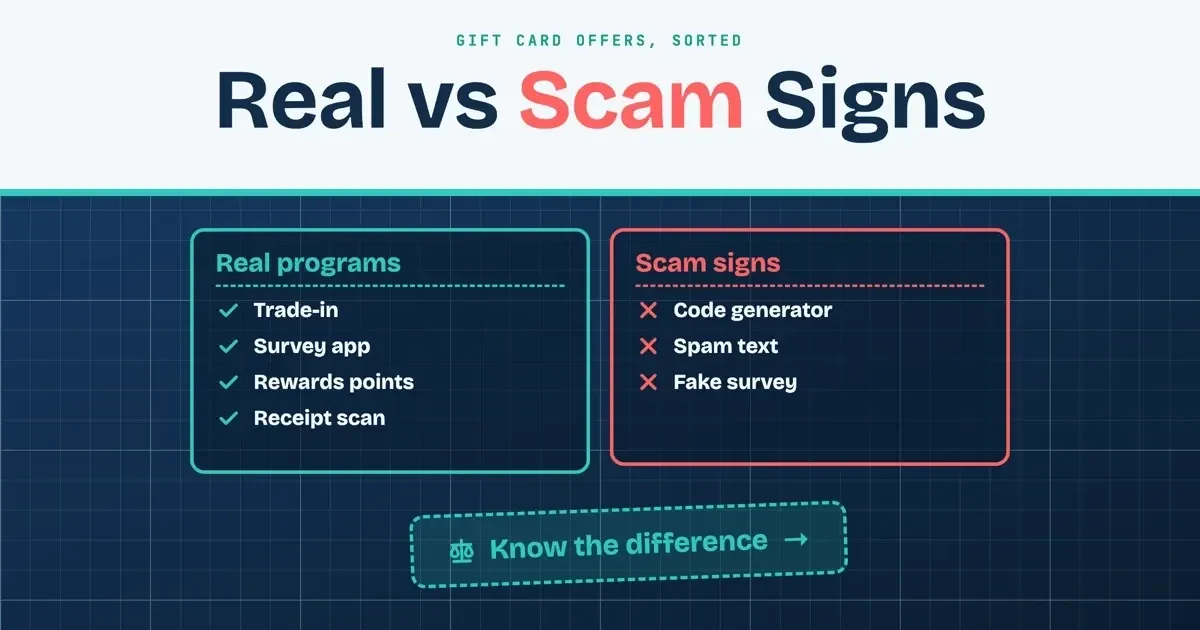
Quick answer
As of October 31, 2026, the real routes to free Amazon gift cards are Amazon Trade-In, the invite-only Shopper Panel and points apps like Microsoft Rewards, Swagbucks and Fetch. At Swagbucks' published 100 SB per $1, a $5 card takes 500 SB in our example. Any generator, prize text or survey that wants a fee, a login or a card number is a scam sign.
Maybe you want a few Amazon cards for school supplies or a birthday, and you'd rather not pay for them. Or a text just said you've won a $500 Amazon gift card. A free Amazon gift card is a card, or Amazon Balance, that you earn without paying money. You get one by trading in a device, sharing receipts or collecting points. Real ones exist. They're small, though, and each one follows its program's own terms.
We start with which programs pay in Amazon cards, then Amazon's own routes, Trade-In and the Shopper Panel. Next come the points apps and the points a $5 card takes, with the math shown. Last: the scam signs, what to do if you've paid with a gift card, and the route we'd pick.
Key takeaways
- No real business or government agency asks for payment in gift cards.
- Amazon Trade-In pays an Amazon gift card based on model and condition.
- As of October 2026, a $5 Amazon card costs 6,500 Microsoft points.
- The Shopper Panel pays up to $10 a month, by invitation only.
- Paid a scammer with a card? Call the card issuer the same day.
Which programs actually pay in Amazon gift cards?
We sorted six programs into four kinds: a trade-in, survey apps, rewards points and receipt scanning. Each row comes from the program's own page or App Store listing, read October 31, 2026. Only Trade-In always pays an Amazon gift card.
| Kind | Program | What it pays in | Who can join (own page) |
| Trade-in | Amazon Trade-In | Amazon gift card | Amazon customers with an eligible device |
| Receipt scan | Amazon Shopper Panel | Amazon Balance or a donation | By invitation, 18+, US and six other countries |
| Rewards points | Microsoft Rewards | Gift cards incl. Amazon, sweepstakes, donations | Microsoft account holders in a listed region |
| Survey app | Swagbucks | PayPal cash or gift cards incl. Amazon | Not stated on pages we could read |
| Survey app | Survey Junkie | PayPal cash or e-gift cards | 18 or older, US (App Store listing only) |
| Receipt scan | Fetch | Gift cards incl. Amazon, Visa cash cards | US shoppers |
Read the third column before you pick, because the Shopper Panel pays into Amazon Balance or a donation rather than handing you a gift card code. Survey Junkie's listing says e-gift cards without naming Amazon, so check its catalog in the app. Pawns.app runs on a different model again, and our Pawns.app gift card guide walks through it.
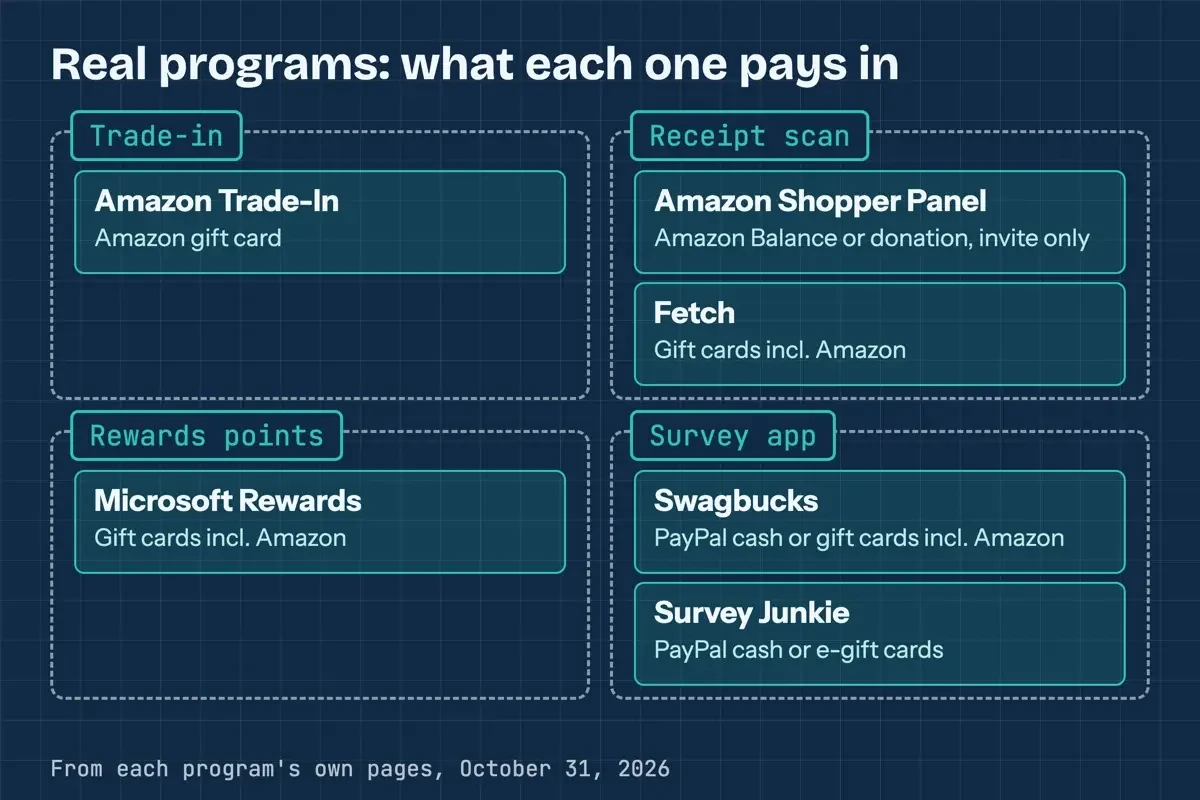 Diagram by DigitalTreed, from each program's own pages read October 31, 2026.
Amazon's own routes: Trade-In and the Shopper Panel
So if an old Kindle, phone or game console sits in a drawer, start with Amazon's own program. Amazon's Trade-In explainer says, "Finally, you'll receive your Trade-in value in the form of an Amazon gift card." It adds that "The Trade-in value depends on the model, make, and condition of your device." Shipping is free. You drop the device at a participating location or "ship it back for free within 45 days." A second Amazon story, on what happens to traded-in devices, is plainer still: "The better the condition of the trade-in device, the higher the gift card value." So charge it and find the cable first.
Amazon's explainer also says to deregister the device, or remove its screen lock, before you ship it with the free label from the confirmation email.
The Shopper Panel runs on receipts instead of gadgets, and you can't just sign up. Amazon's Shopper Panel page calls it "an opt-in, invitation-only program." Panelists earn "up to $10 per month towards either an Amazon Balance or a charitable donation," the page says. You photograph paper receipts from other stores with the app, or forward email receipts to [email protected], and the panel also pays for short surveys about brands and products. No invite yet? Amazon says people without one "can download the app to join the waitlist." The panel's App Store listing says it's open to "a limited number of Amazon customers who are 18 years of age or over and in the US."
Panelists can stop sharing receipts or answering surveys at any time, and Amazon's page says they can delete receipts they uploaded earlier.
Points apps that offer Amazon cards
The other four run on points. You swap them for cards in each app's rewards catalog, and only Microsoft's US catalog showed us Amazon card prices; Swagbucks' prize pages and Survey Junkie's site wouldn't load.
Microsoft Rewards is one many people already belong to, since Microsoft's terms say account holders in participating regions are "automatically enrolled." Its Rewards About page calls it "a free loyalty program where you earn points just by using Microsoft products and services." The page lists "gift cards from favs including Amazon, Roblox, and more." On the US version, "Each qualifying search earns 5 points." Search caps depend on your level: "Gold members can earn points for up to 20 searches per day," Silver members 10 and regular members 5. Its US redeem catalog prices the $5 Amazon.com Gift Card at 6,500 points and the $10 card at 13,000, as of October 2026.
Microsoft's own Rewards support article uses older wording, with Level 1 at 10 searches and Level 2 at 30. It also tells members to check "your Region for current redemption and earning rate," so treat any per-search figure or points price as a snapshot.
The Microsoft Services Agreement draws a firm line on automation. The program "is solely for your personal and noncommercial use," it says. A search doesn't include "a query entered by a bot, macro, or other automated or fraudulent means." Bots don't count. That rules out the auto-search tools that promise faster points. The same agreement says points "cannot be transferred to any other person or entity." So a seller offering Microsoft points or a shared account is selling something the terms don't allow.
Swagbucks publishes a plain exchange rate, so it's the easiest one to price. A Swagbucks article on whether Swagbucks is real money says "100 SB is equal to $1.00." Its App Store listing backs that up with "a 1000 SB bonus, which is equivalent to $10 in value." The listing names Amazon among its gift cards. A footnote says "free" cards "require no money or purchase, instead they are redeemed for rewards points earned by members' participation in Swagbucks activities."
Survey Junkie's website gave our checker a 403 bot-block, though it opens in a browser. So we could confirm these facts only on its App Store listing, which says "Members must be 18 or older and reside in the United States." You can redeem after "a minimum of 1,000 points," as PayPal cash, e-gift cards or a direct bank transfer, though the listing doesn't name Amazon among those cards.
We didn't find a dollar value per Survey Junkie point on any page we could read, so this guide doesn't guess one.
Fetch turns grocery and store receipts into points. It's US only. Its FAQ says "A minimum of 3,000 points are needed to redeem most rewards." Only $10, $25 or $50 rewards are open for your first redemption. The $3 and $5 rewards come after that, so a $5 Amazon card can't be your first Fetch reward. You can snap up to 35 receipts in a rolling 7 days, and paper receipts must go in within 14 days. Fetch's App Store listing names Amazon among its gift cards. In a reply to a review there, Fetch wrote "While any receipt will earn at least 25 points."
Once you redeem, Fetch's FAQ says "At most, a reward can take up to 72 hours to process," for account security.
Points needed for a $5 Amazon card
The table lines up each program's published numbers as an example dated October 31, 2026, with the formula shown. Microsoft's row is the one with a real catalog price; where a program showed no dollar value, the cell says so.
| Program (kind) | Published value used | Formula | Example result |
| Swagbucks (survey app) | 100 SB per $1 (Swagbucks article) | $5 x 100 SB | 500 SB at face value |
| Microsoft Rewards (rewards points) | 6,500 points for a $5 card; 5 points a search, 20 searches a day at Gold (US pages) | 6,500 / (5 x 20) | 1,300 searches, 65 days at the Gold cap |
| Fetch (receipt scan) | At least 25 points a receipt, 3,000 to redeem, 35 receipts a week | 3,000 / 25; 120 / 5 a day | 120 receipts in 24 days at the earliest; no dollar value shown, and $5 rewards open only after a first $10, $25 or $50 one |
| Amazon Shopper Panel (receipt scan) | Up to $10 a month in Amazon Balance | $10 x 12 | Up to $120 a year, invite only |
| Survey Junkie (survey app) | 1,000-point minimum | none | Dollar value per point not shown to us |
| Amazon Trade-In (trade-in) | Quote per device | none | Depends on model, make and condition |
The Swagbucks row is face value only. Its own SB value article says gift card discounts "can make 100 SB worth more than $1." The Fetch row assumes the minimum 25 points on every receipt and 5 receipts a day, which is the 35-a-week cap spread evenly across a week of shopping trips. In-app bonus offers move both.
These are small sums. In our example, at the Gold cap of 20 searches a day, one $5 Amazon card from Microsoft takes 65 days of Bing searches. Gold isn't automatic either. The About page sets it at "Gold: earn more than 750 points and complete 2 Level-Up activities."
Why do brands fund this at all? Fetch's FAQ is open about it: "Our partner brands pay to be featured in this list," the way they'd run a coupon. Shop owners curious about the other side can read our loyalty program ideas for small businesses, which explain points programs from the seller's side.
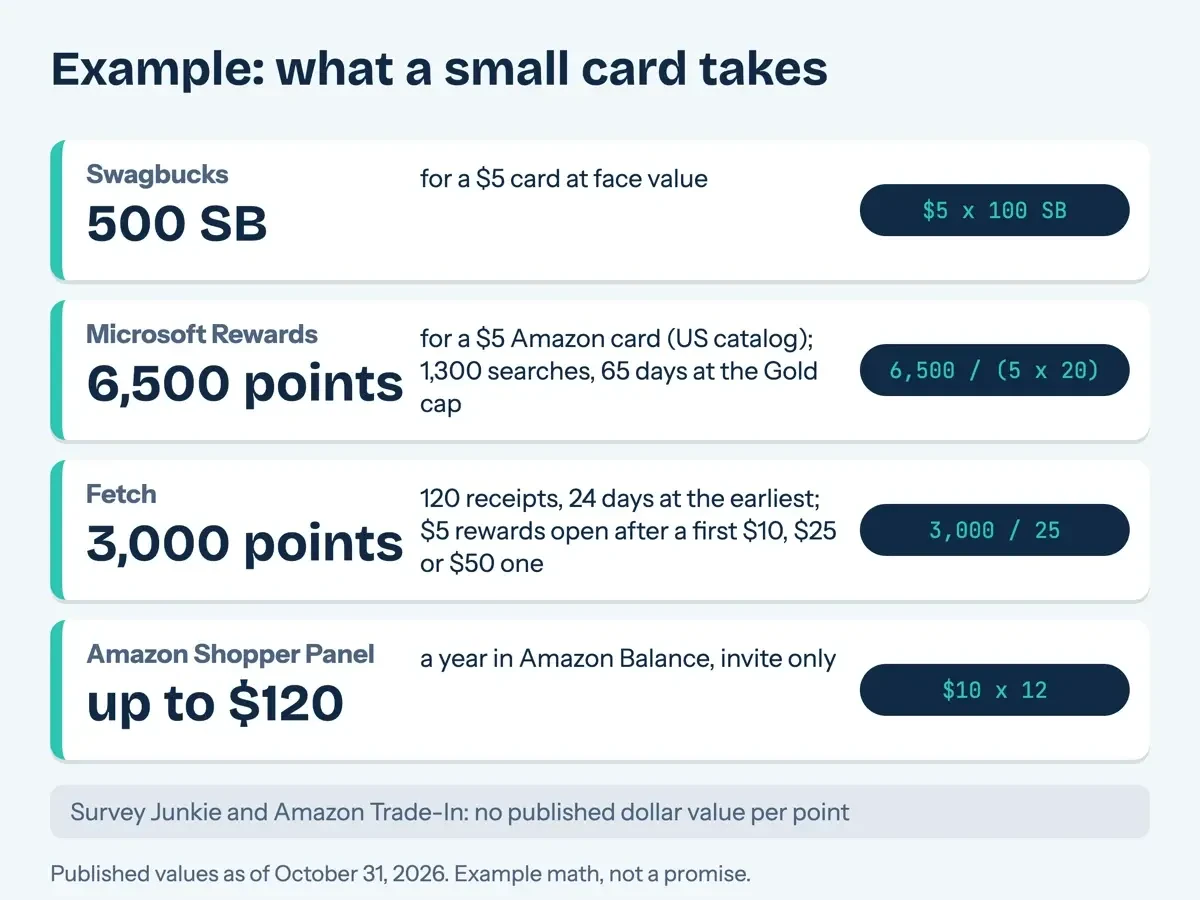 Diagram by DigitalTreed. Example math from each program's published values, October 31, 2026.
Scam signs: code generators, spam texts and fake surveys
Fake offers copy the words real programs use, like points, surveys and rewards, so the tell is what they ask you to hand over. The FTC's gift card scams page is blunt: "No real business or government agency will ever tell you to buy a gift card to pay them."
The FTC printed that sentence again in an October 2024 alert titled "Only scammers tell you to buy a gift card to pay them."
Amazon's scam tips say the same: "We will never ask you to purchase a gift card, and no legitimate sale or transaction will require you to pay with gift cards." Here are the signs we pulled from both, with our cover image's labels in brackets:
- A text or email that promises a free gift card or a prize you never entered for (spam text).
- A survey that ends with a shipping fee or a request for your card details (fake survey).
- A page that "generates" unused Amazon codes (code generator).
- Anyone who wants you to buy gift cards to pay a bill, a fine or a fee, or to read them the card number and PIN.
- Rush: pay right now, or something bad happens.
Each of those signs has a paper trail. The FTC's 2022 text alert says not to answer unexpected texts, "including ones asking you to fill out surveys to get free items." Its 2021 survey alert adds, "No legitimate surveys ask for your credit card or bank account number to pay for a "free" reward." Behind some free gift card texts sits a funnel, and the FTC once took one to court. In a 2013 case, it charged senders of spam texts that steered people to "deceptive websites falsely promising "free" gift cards." Those sites gathered personal details first. "In some cases, consumers were obligated to sign up for as many as 13 of the offers."
Phishing email gets the same warning: the FTC's December 2023 alert says scammers send phishing emails "promising free gift cards in exchange for your personal or financial information."
We found no FTC or Amazon page that uses the word "generator." Our reading: a code generator makes the same free card promise that the FTC's spam text page calls not real. Gamers get the same bait in another form, covered in our post on Free Fire diamond generator pages.
When a free offer asks for your login, the same move is laid out in how free follower sites get an Instagram login. Before you type anything, check the address against the real one, as our lookalike website check explains.
Amazon tracks one more twist. Its scam trends page warns about payment requests "including gift cards (or "verification cards," as some scammers call them)." Gift card demands turn up in fake job offers too, which our legit work-from-home jobs guide covers.
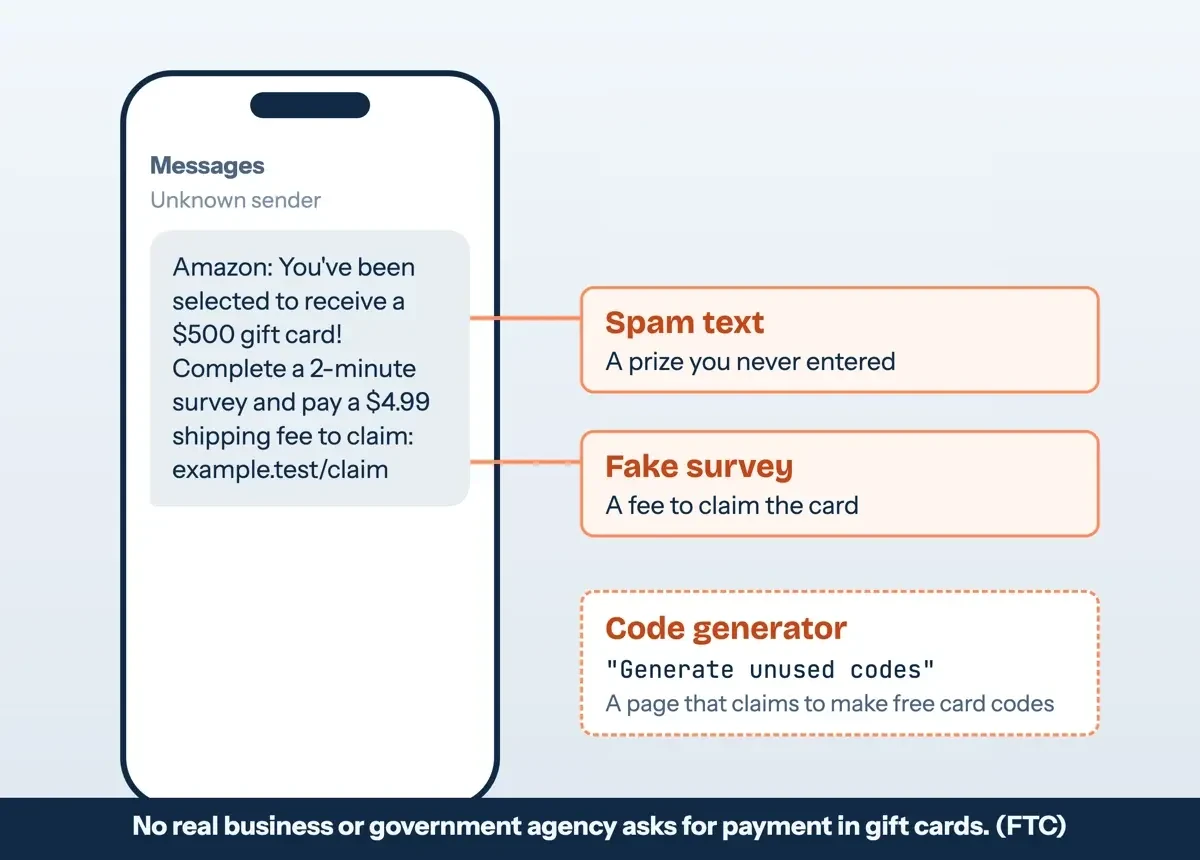 Drawn by us from FTC and Amazon warning signs, October 2026. Not a real message or app screen.
What we tested
On October 31, 2026, a local script checked 8 messages we made up against those signs, using simple word rules. It flagged 5, the prize text, court fine call, generator page, boss request and winner link, while the normal notices from Amazon, Fetch and Microsoft matched none. It also matched all 75 quotes in this guide word for word against the saved pages, and built the points table. Word rules miss new tricks, so a clean result from our script still means opening the real app or site yourself before you act on anything.
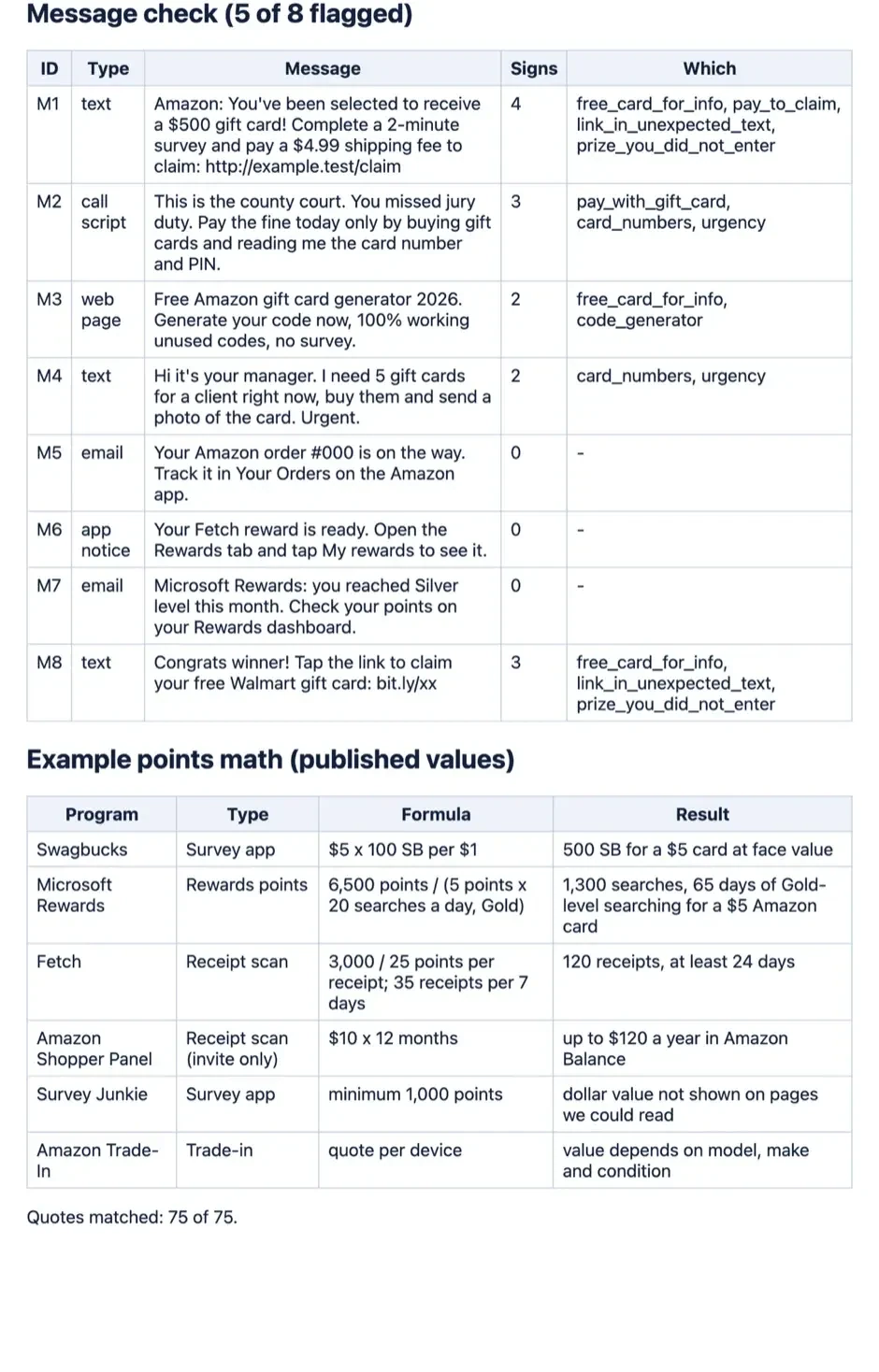 Screenshot: our gift card offer checker on 127.0.0.1, October 31, 2026. Sample messages made up by us.
If you paid with a gift card: what to do today
Once a card number has left your hands, speed matters more than anything else. Act the same day. The FTC's what-to-do page says "Contact the gift card issuer immediately. Use the number on the back of the card." Tell them a scammer got the number and PIN, and ask for a refund. For Amazon cards, the FTC gift card page gives the number: "Call 1 (888) 280-4331 and follow Amazon's instructions." It also says to report the scam "right away," however long ago it happened. Then work through the rest in order:
- Keep the card and the store receipt. The FTC says you may need them to follow up on your claim.
- Report it to the FTC at ReportFraud.ftc.gov.
- Report the message to Amazon through its self-service tool, or email [email protected] if you're not a customer.
- Forward a scam text to 7726 (SPAM), which the FTC phishing page also lists.
The FTC's gift card page says "Every report makes a difference," so file one even if the card is already drained.
Amazon's own gift card scam page, which the FTC links to, has more detail. To our checker it returned only a page frame without the article text, so read it in a browser. If you tapped a link and typed anything, see what to do after clicking a phishing link for the phone and computer steps. When the message posed as a payment app or a star's own wallet, the Prince Narula Digital PayPal explainer covers that kind of impersonation.
The route we'd pick
So here's our take: begin with what you already own. An old device through Amazon Trade-In becomes an Amazon card in one step, with its condition setting the value. Receipts you already get can go to Fetch, or to the Shopper Panel if an invite arrives. After that, pick one points app, not four, and read its redeem page before you put in hours. We'd also forward any text that promises a free card to 7726, since a real program never asks you to pay before it pays you.
Free Amazon gift card questions
Frequently asked
Does Amazon ever ask you to pay with gift cards?
No. Amazon's scam trends page says "Amazon will never ask you to provide payment information, including gift cards" for products or services.
Do Microsoft Rewards points expire?
Yes. The Services Agreement says unredeemed points expire "if you do not earn or redeem any Points in your Rewards Account for 12 consecutive months."
What does the Shopper Panel do with my receipts?
It reads products and stores from them. Amazon's panel page says "Amazon deletes any sensitive information, such as prescription information from drug store receipts."
Do Fetch points expire?
Yes, after 90 days with no activity. The Fetch terms also say points "have no cash value except as expressly redeemable through the Fetch platform."
How we made this guide: We read the FTC, Amazon and each program's own pages with a plain checker, saved them, and matched every quote with a local script. We signed up for nothing and redeemed nothing. Facts checked by the DigitalTreed team on October 31, 2026.
First published April 2024 with 11 earning apps and unsourced figures. Rewritten October 31, 2026: six programs from their own pages, example points math, FTC and Amazon scam signs and reporting steps.
Sources
- FTC: Avoiding and Reporting Gift Card Scams
- FTC: Only scammers tell you to buy a gift card to pay them
- FTC: What To Do if You Were Scammed
- FTC: How To Recognize and Report Spam Text Messages
- FTC: Don't click on that random text
- FTC: Keep your money safe from gift card scammers this holiday season
- FTC: Ignore bogus COVID vaccine survey
- FTC: How To Recognize and Avoid Phishing Scams
- FTC press release: spam texts promoting "free" gift cards (2013)
- Amazon: 6 tips to help you spot and avoid scams impersonating Amazon
- Amazon: The latest scam trends from Amazon US
- Amazon: How to trade in your old electronics and earn an Amazon gift card
- Amazon: What happens to your old devices after Amazon Trade-in
- Amazon Shopper Panel
- Microsoft Rewards: About (US)
- Microsoft Rewards: Amazon.com Gift Card (US redeem catalog)
- Microsoft Services Agreement
- Swagbucks: Is Swagbucks Real Money?
- Survey Junkie on the App Store
- Fetch FAQs
- Fetch Terms of Service

Comments
No comments yet. Start the conversation below.