
Quick answer
No. As of October 31, 2026, we found no PayPal product, app or partnership called Prince Narula Digital PayPal in PayPal's newsroom or Apple's US App Store. The real thing is the PayPal app from PayPal, Inc. and the site you reach by typing paypal.com. Check a link's domain before you pay, and never share a login code.
You probably met this phrase on a blog or video that made it sound like a new way to send money, with a famous face beside a payment button. Prince Narula Digital PayPal is a trend keyword, copied from site to site, that pairs an Indian reality TV star's name with PayPal's. Our view: treat any link, app or agent using it as unofficial until PayPal's own site says otherwise.
First, what the phrase is and why websites describe it so differently, then the real PayPal app and site, fake messages, login codes and Purchase Protection. Last, fake celebrity payment apps, our link test, and the steps to take if money already went out.
Key takeaways
- PayPal's newsroom search for Prince Narula returned no results on October 31, 2026.
- We found no PayPal app, product or partnership by this name.
- PayPal never asks for your login code by phone, email or text.
- Friends and family payments and gift cards fall outside Purchase Protection.
- Forward fake PayPal messages to [email protected], then delete them.
What "Prince Narula Digital PayPal" actually is
Start with the person, since that name is the only part of the phrase with a real source behind it. Prince Narula is an Indian reality TV personality; Gulf News reported the Bigg Boss 9 win, after earlier wins on MTV Roadies X2 and MTV Splitsvilla 8.
That's all we'll say about the person, since nothing we found ties the name to a PayPal product. On October 31, 2026, we used the search box in PayPal's own newsroom. "Prince Narula" returned no results, while "Narula" returned 2, and both of those pointed to one February 8, 2022 announcement about a crypto advisory council. It named Dr. Neha Narula, an MIT director, to that council. That's a different person. The same box found 495 results for "Venmo," which tells us the search itself was working. Apple's US App Store search for "prince narula" listed 12 apps that day, mostly games and coloring books, and none of the 12 sat in the Finance category.
None of the 13 PayPal US help, security, Purchase Protection and newsroom pages we saved mentions Narula. On Google Play we only confirmed PayPal's real listing.
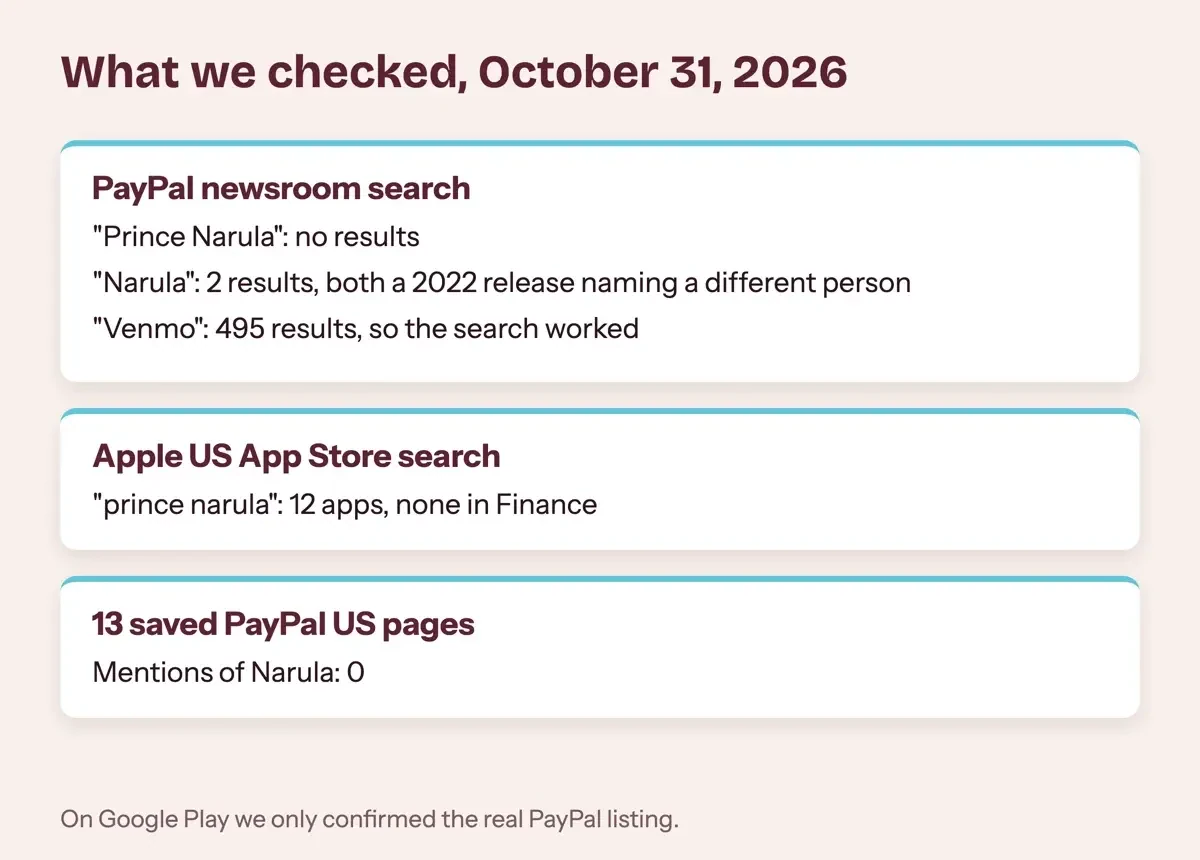 Diagram by DigitalTreed, from our searches of the PayPal newsroom and Apple US App Store and 13 saved PayPal pages, October 31, 2026.
Our earlier article at this address, first published in April 2025, told readers they could set up an account with Prince Narula Digital PayPal. We've removed that claim.
Why do websites describe it so differently?
If no product exists, why do so many pages explain it? We read three of the pages that rank for the phrase on October 31, 2026, and they don't agree. One says the star partnered with PayPal and gives no source at all. Another calls it an innovative digital payment solution, while a third says it's only a search phrase linking his fame to online payments.
None of the three cited a PayPal press release, a PayPal help page or a statement from Narula's side. We won't name or link them here.
The FTC has warned about this kind of borrowed fame. Its 2024 alert on fake celebrity endorsements says "Scammers are using fake celebrity and influencer testimonials and endorsements" to generate buzz and profits. Its advice: "Resist pressure to commit quickly." Before you buy, it suggests searching the person's name and the product with words like "scam" or "fake." A separate FTC alert on free money posts warns that "Scammers are impersonating lottery winners on social media, often using the names of real winners." In both alerts the famous name is the bait, not proof of who runs the link.
Getting the real PayPal app and website
The safe route starts with PayPal's own app. The consumer app is PayPal - Pay, Send, Save. On Apple's App Store the seller is PayPal, Inc., and on Google Play the developer is PayPal Mobile. Search for it inside the store app on your phone. Don't install from a link someone sends you. For the website, PayPal's own account security page has a plain rule for any email about your password. Don't click; instead "open a browser window, type paypal.com and log into PayPal." PayPal's fake email help adds, "We'll only ask you to enter your password on our login page."
If you accept PayPal on a store you run, buyers should land on the real PayPal domain at checkout. Our guide to payment gateway integration and what it costs covers how processors like PayPal connect to a store.
Fake PayPal emails and texts, and where to report them
When the impersonation rule took effect, the FTC noted that "Reports of text messages and email are trending up as phone calls decline." PayPal lists the signs of a fake itself. Its fake email help page says "Our emails will always address you by your first and last names or by your business name." A greeting such as Dear user is the first thing to check. Urgency is the second sign, and PayPal's examples include "Your account is about to be suspended," a line built to rush you to a spoofed login page.
The FTC's phishing guide adds a third sign: legitimate companies won't email or text with a link to update your payment information. The drawing below puts the generic greeting, the deadline and the link on one made-up email.
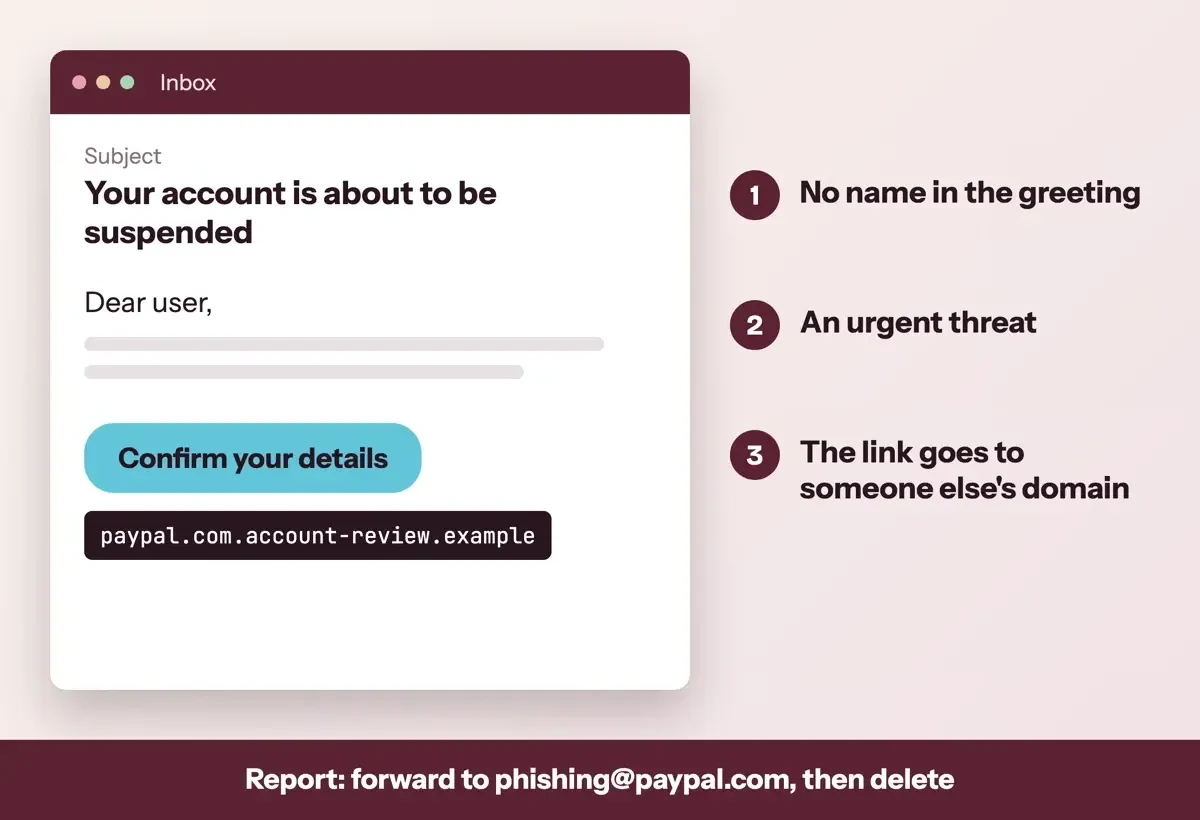 Drawn by us from PayPal help on fake emails, October 2026. Not a real email; the address is made up.
PayPal's report page says don't click on any links, call any listed phone numbers, or download attachments. Forward the entire email to [email protected] and then delete it. For a text message, forward a copy to that same address and block the sender. Phone calls get their own warning on PayPal's common scams page: "We will never call you from 1-888-221-1161 to ask you for your personal or account information."
The FTC's phone scams page says "Scammers can make any name or number show up on your caller ID." PayPal's own guide to phishing and spoofing also warns that caller IDs are easily masked. So even PayPal's real number on screen proves nothing. Our tips to avoid phishing cover more warning signs beyond PayPal.
One-time codes and passwords stay with you
Even a convincing fake usually needs one more thing from you to get in: the code PayPal sends when you log in. PayPal's security page is direct about it. "PayPal will never ask you for this code over the phone, email or text. Never share it with anyone." Its fraud awareness page says the same about passwords, PINs and one-time verification codes. The FTC goes further. Its verification code alert says "Anyone who asks you for your account verification code is a scammer." So say a fan page, a support chat or a so-called wallet agent asks you to read a code back. Stop there. Hang up, block the number and report it, as the FTC advises.
While you're in the app anyway, turn on two-step login if it's off, so a stolen password alone no longer gets someone into your account. PayPal's page says to click the Settings icon and then select Security, then get codes from an authenticator app or by text.
Social accounts need the same lock: our Snapchat account security guide covers two-factor login for Snapchat business profiles.
What PayPal Purchase Protection covers
If you buy through real PayPal, learn its buyer program before you pay, because the way you pay decides whether it applies. PayPal's Purchase Protection page promises help getting reimbursed for eligible items when your order doesn't arrive or shows up different than described. Those are its two claim types: Item Not Received and Significantly Not as Described. PayPal says "Eligible items include physical items like clothing, household electronics and housewares as well as certain intangible items like event tickets and hotel reservations." Timing is strict. A dispute of either type must be opened within 180 days of the date you sent the payment to the seller.
After that, the Purchase Protection terms give you 20 days after opening a dispute to escalate it to a claim. PayPal's coverage help page confirms that "A dispute will automatically close after 20 days unless it's been escalated." Write both dates down the day you open one.
The terms also list payments that aren't covered as of October 31, 2026, and these four matter most when a stranger sends you a link to pay:
- Personal payments, including money sent with PayPal's friends and family option.
- Gift cards, prepaid cards and other payments the terms treat as equivalent to cash.
- Payments you didn't send from your own PayPal account.
- Donations, including payments on crowdfunding platforms.
So someone who asks for a friends and family payment, or for gift cards, is asking you to give up the one protection PayPal offers. Gift card requests have their own tricks, and we cover them in free Amazon gift cards, legit programs versus scams. When you can, follow the FTC's advice on how scammers ask you to pay: "Pay by credit card whenever possible."
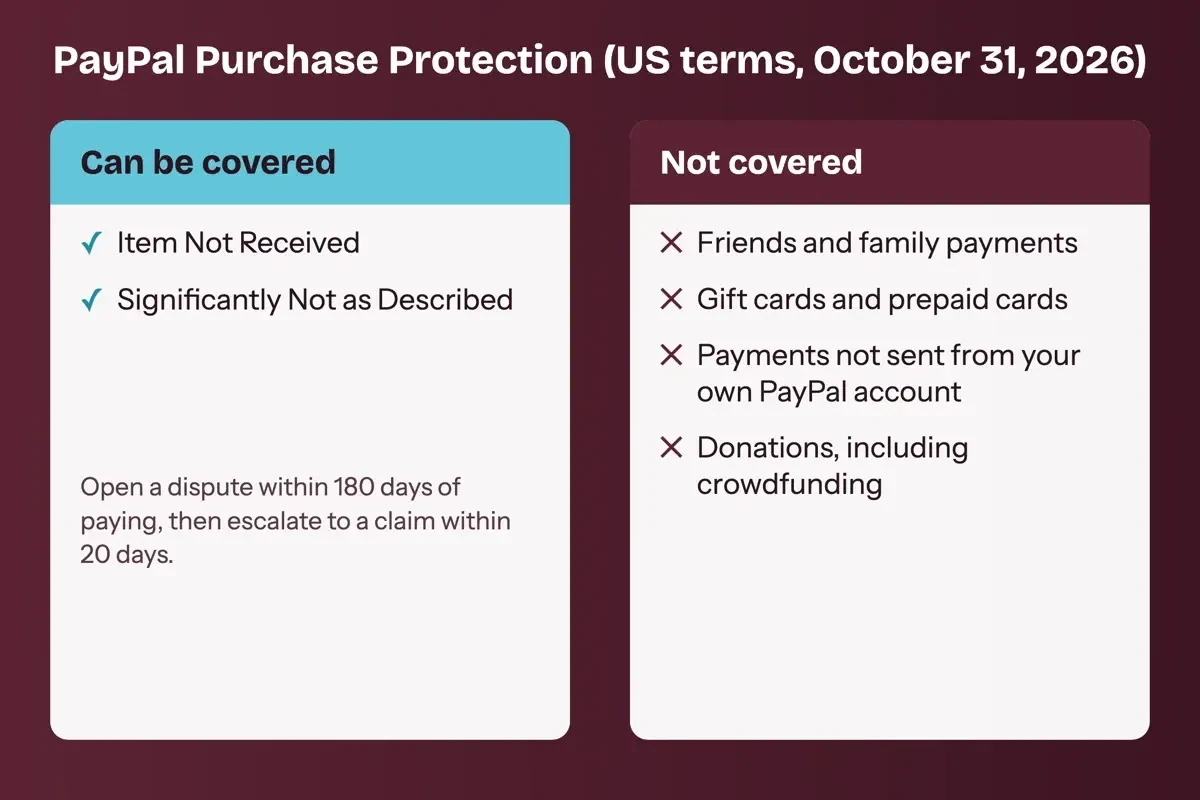 Diagram by DigitalTreed, from the PayPal Purchase Protection page and terms, October 31, 2026.
Fake celebrity payment apps and lookalike links
US law has a rule for fakes that trade on a company's name: the FTC's Impersonation Rule, which took effect on April 1, 2024, per the agency's announcement. Section 461.3 of 16 CFR part 461 makes it a violation to "materially misrepresent, directly or by implication, affiliation with, including endorsement or sponsorship by, a business or officer thereof." The rule's current text covers impersonating governments and businesses. Individuals aren't in that text. Pretending to be a person, such as a celebrity, is a separate proposed amendment, and the FTC's rule page lists a hearing on it announced in December 2024.
The FTC's business blog on the rule names "lookalike email addresses or URLs that rely on misspellings of a company's name" among the tricks it targets. If you're weighing a complaint or a case of your own, talk to a lawyer.
The FTC's mobile payment app guide has two lines that fit these schemes. One is "Don't send a payment to claim a prize or collect sweepstakes winnings." The other is "Don't give your account credentials to anyone that contacts you." In the FTC's free money example, a reply to a public post leads to a text that asks for gift cards to cover fees. Our Instagram scams guide covers that reply-then-message pattern on Instagram.
Links, at least, are something you can check yourself. This is how our checker, described just below, sorted 12 sample links:
| Sample link | Real or made up | Verdict | Why |
| https://www.paypal.com/us/security/report-suspicious-messages | Real | Official | On the allowlist |
| https://apps.apple.com/us/app/paypal-pay-send-save/id283646709 | Real | Official | On the allowlist |
| https://play.google.com/store/apps/details?id=com.paypal.android.p2pmobile | Real | Official | On the allowlist |
| https://newsroom.paypal-corp.com/news | Real | Official | On the allowlist |
| http://www.paypal.com/us/home | Made up | Real host, flagged | not https |
| https://paypal.com.account-review.example/login | Made up | Not official | PayPal name on someone else's domain |
| https://paypa1-secure.example/verify | Made up | Not official | lookalike spelling of paypal |
| https://[email protected]/claim | Made up | Not official | text before @ hides the real host |
| https://xn--pypal-4ve.example/send | Made up | Not official | punycode name (letters that only look Latin); lookalike spelling of paypal |
| https://prince-narula-digital-paypal.example/setup | Made up | Not official | PayPal name on someone else's domain; celebrity name in a payment link |
| https://narula-pay.example/wallet | Made up | Not official | celebrity name in a payment link |
| https://apps.apple.com/us/app/star-pay-wallet/id0000000001 | Made up | Not official | app store page, but not the PayPal app listing |
All 8 made-up links were flagged, and the 4 real PayPal addresses passed. The plain-http PayPal address got a flag for skipping https, even though its host is real. Look at the store row too. An App Store address isn't proof on its own, because the store holds apps from many sellers. Apple's US store showed three apps sold by PayPal, Inc. on October 31, 2026, and our checker accepts only the consumer app's listing. Our GoMyFinance .com vs .org check walks through comparing two similar domains.
What we tested
On October 31, 2026, we ran a Python checker we wrote on this computer. It compares each link's real host with an allowlist: paypal.com, PayPal's newsroom domain and PayPal's own App Store and Google Play listings. The 8 made-up links use reserved .example names, and the script made no network requests.
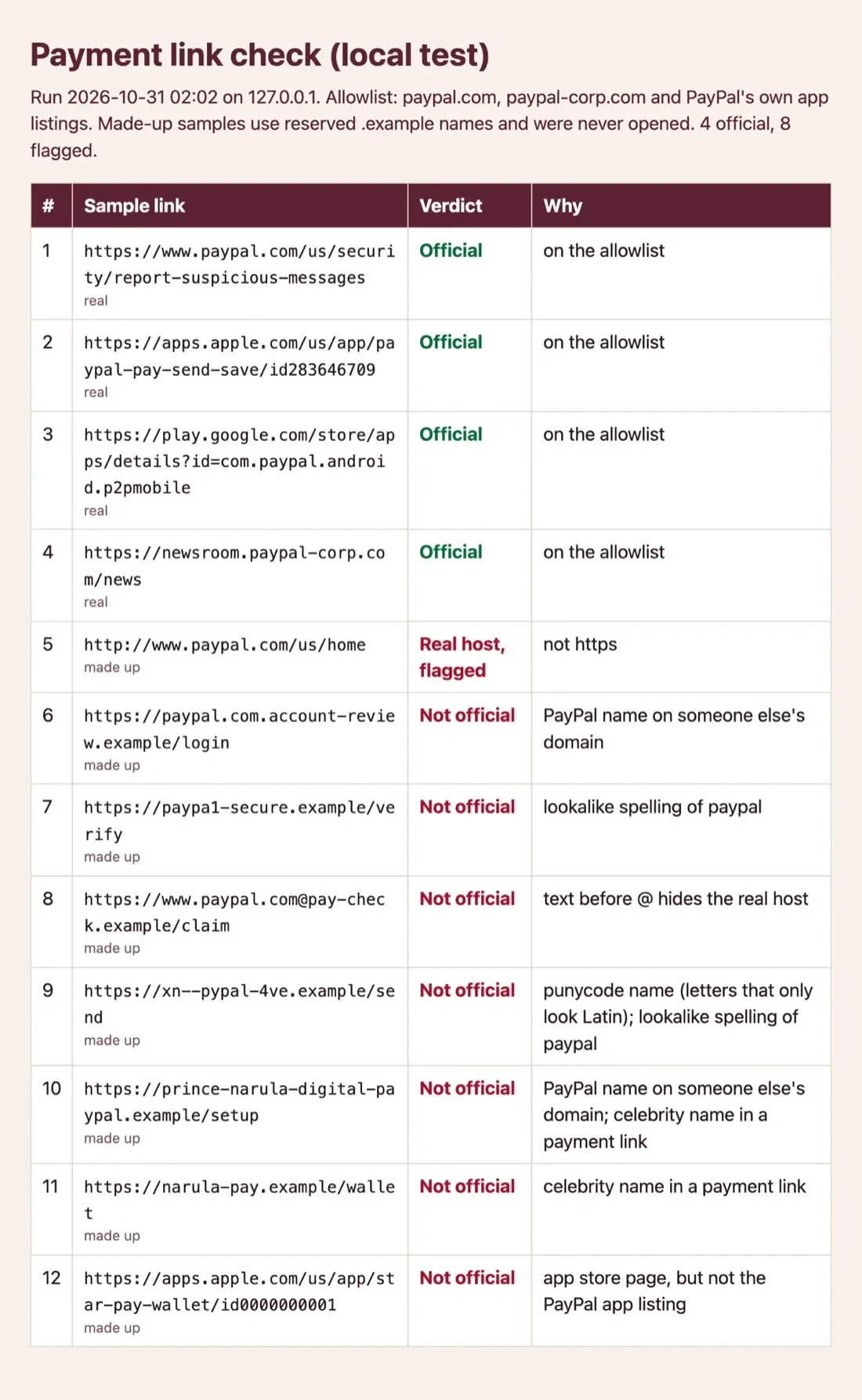 Screenshot: our payment link checker on 127.0.0.1, October 31, 2026. Eight sample links are made up.
Already paid a fake link or shared a code?
Once money or a code has gone, speed matters most. The FTC's payment advice says "Don't delay if you paid a scammer." It tells you to contact the company you used right away and ask whether it can stop or reverse the payment. Start with PayPal itself. These are the steps we'd take, in this order:
- Report the payment in PayPal's Resolution Center, or call 1 (888) 221-1161, the PayPal number the FTC lists.
- If you typed a password or code anywhere, open a new browser window, type paypal.com and change your password.
- If a card or bank account is linked, call that issuer on the number printed on your card or statement.
- Forward the message that started it to [email protected].
- File a report with the FTC at ReportFraud.ftc.gov.
That PayPal phone number comes from the FTC's payment app guide, and you file the FTC report itself at ReportFraud.ftc.gov.
The bank tip is from the FTC's code alert: "Use a number you trust, like the one on your statement or in your app." Clicked the link but didn't pay? Read the steps after a phishing click.
Our take: our October 31, 2026 checks found nothing called Prince Narula Digital PayPal, so there is no account to set up and no app to install.
Use the PayPal app from the store listing, type paypal.com into the browser yourself, and keep every password and one-time code to yourself, whoever asks for them. Check before you pay, every time a famous name sits next to a payment button.
Prince Narula Digital PayPal questions
Frequently asked
Is Prince Narula Digital PayPal an official PayPal app?
We found no app by that name. Apple's listing for PayPal's consumer app names PayPal, Inc. as the seller, and a US App Store search for the star's name showed no finance app.
Does Purchase Protection pay for return shipping?
No. The Purchase Protection terms say the program "does not entitle you to coverage for the return shipping costs" when you send an item back.
Where do I forward a fake PayPal text message?
Send it to [email protected], per PayPal's report page. The FTC's phishing guide also says to forward phishing texts to SPAM (7726).
How we made this guide: We saved PayPal's US help, security and Purchase Protection pages, FTC pages and two news reports with a plain checker. A local script matched every quote. We searched PayPal's newsroom and Apple's US App Store, signed in nowhere and opened no made-up link. Facts checked by the DigitalTreed team on October 31, 2026.
First published April 2025 as a guide to Prince Narula Digital PayPal with account setup claims. Rewritten October 31, 2026: what the phrase is and isn't, with the setup claim removed, plus PayPal's own safety steps and FTC impersonation advice.
Sources
- PayPal Newsroom: search results for Narula
- PayPal Help: How do I spot a fake, fraudulent, or phishing PayPal email or website?
- PayPal: How to report suspicious emails and messages
- PayPal Help: What are common scams and how do I spot them?
- PayPal: Account security
- PayPal: Fraud awareness
- PayPal: Purchase Protection
- PayPal: PayPal's Purchase Protection Program (terms)
- PayPal Help: Does PayPal cover my purchase if there's a problem?
- App Store: PayPal - Pay, Send, Save
- Google Play: PayPal - Pay, Send, Save
- FTC: Mobile payment apps, how to avoid a scam when you use one
- FTC: What's a verification code and why would someone ask me for it?
- FTC: Did a celebrity really endorse THAT? Maybe not
- FTC: Free money on social media? Nah. It's a scam
- FTC: A way to spot scams: how someone asks you to pay
- FTC: How to recognize and avoid phishing scams
- FTC: Phone scams
- PayPal: What is phishing or spoofing?
- FTC: Impersonation Rule goes into effect (April 1, 2024)
- FTC: Impersonation of Government and Businesses Rule
- FTC Business Blog: New Impersonator Rule
- eCFR: 16 CFR part 461
- Gulf News: Prince Narula wins reality show Bigg Boss 9
Comments
No comments yet. Start the conversation below.