
Quick answer
The 12 loyalty program ideas below start with a $27.99 box of 500 punch cards. At the top end, points and VIP tiers on Square Plus cost $49 a month per location, as of October 2026. Each one comes with what it costs to run. The software is the cheap part; the reward you give back costs more.
So decide how much you'll give back first, and only then pick the program.
A loyalty program is a standing deal that rewards people for coming back. Think a stamp per visit, points per dollar, a better tier for regulars, or a monthly fee for perks.
Example: Mesquite Mile Car Wash is a two-bay car wash in Wichita Falls, Texas, with a $15 basic wash. It doesn't exist. We made it up so every idea gets priced for the same business.
You'll want your customers in one list before any of this. If they aren't yet, start with setting up a CRM in your first 30 days.
Key takeaways
- Set the give-back rate from your margin before you pick a program.
- A buy 9, get the 10th free card gives back 10% of retail.
- A Gold tier at 3x points turns a 5% plan into 15% back.
- Google bans any reward for a review, including points and stamps.
- Money on a gift card you sell must last at least five years.
Pick the give-back rate before you pick a program
Every loyalty program hands back a share of what customers spend, and that share is the real price tag.
Here's how the usual offers work out. A "buy 9, get the 10th free" punch card gives back 10% of retail to anyone who finishes it. A points plan where $1 earns 1 point and 100 points buy $5 off gives back 5%. Square's loyalty page shows example VIP tiers at 1.5x, 2x and 3x points, and those turn the same 5% into 7.5%, 10% and 15%.
That last number's the one that surprised us.
We priced every idea in this post on October 26, 2026, from the vendors' own pages, and did the sums in a short script. The software bills came out small: $588 a year for Square Plus at one location, and $0 for Smile.io's free plan on a small Shopify store. Then we ran Mesquite Mile's Gold tier. At 15% back, a member who washes once a week on a $15 wash earns $117 of free washes a year. That's more than two months of Square Plus.
Our take: set the give-back rate from your margin, not from what a competitor offers.
If a wash costs you far less than $15, 10% is easy. If your margin's thin, start at 5% and add tiers later.
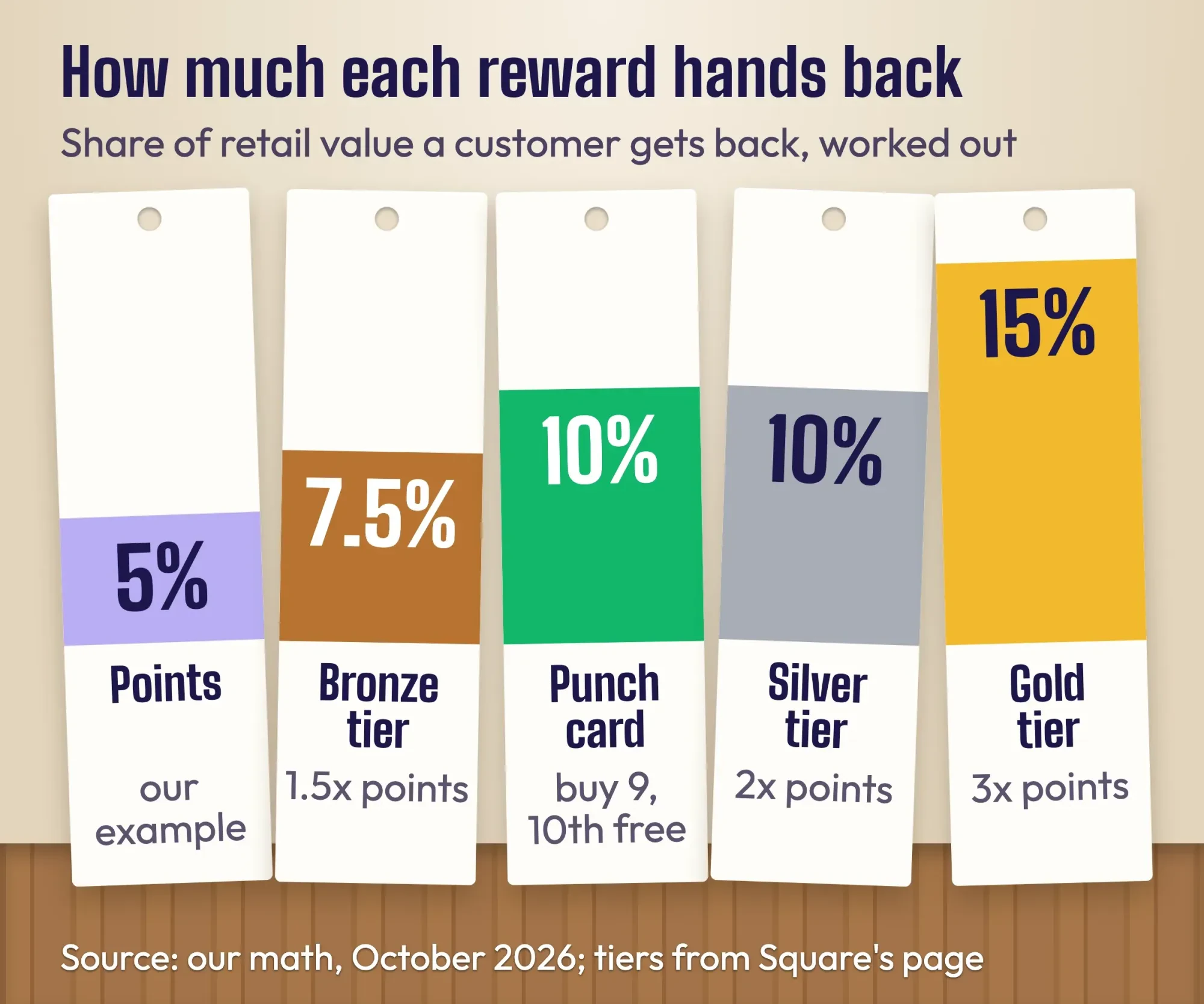 Diagram by DigitalTreed: give-back rates from our math. Tier multipliers are Square's examples; the 5% points plan is our example.
Three ideas that cost under $50 to start
Not ready for tiers or margin math? These three cost almost nothing to start.
1. A paper punch card
The oldest program still works: one stamp per visit, a free one at the end.
Vistaprint listed 500 loyalty cards for $27.99, plus $5.99 standard delivery, as of October 2026. No struck-through price sat next to it. But the page showed "Up to 40% off select options" and a sitewide sale ending October 29, 2026, so treat $27.99 as a possible sale price. Either way it's about 7 cents a card.
Here's the catch: Vistaprint says its cards "don't have mag strip or scanning technology," so you can't see who's close to a free wash.
Mesquite Mile would print "Buy 9 washes, get the 10th free" and stamp the back.
If your card shows a dollar value or an end date, read the expiry rules further down before you print 500 of them.
2. Surprise rewards
Some of the best rewards aren't announced at all.
A free tire shine on a rainy Tuesday. A free upgrade for the customer who's been in eight times this month. It costs only the reward, and you don't need software. Keep one quiet rule, such as one surprise per regular per quarter, so it stays a surprise and doesn't turn into a discount people expect.
3. A birthday perk
Ask for a birth month and day at sign-up, then send a free wash that month.
Square Marketing can run automated campaigns "to wish customers a happy birthday." Its page says Square Plus includes 500 texts a month, then 3 cents a text, as of October 2026. So even 1,000 birthday texts in one month would add $15. Email sends are unlimited on that plan.
Get consent before you text anyone. Our CRM automation examples lay out a birthday workflow with its timing and the text rules, and our email marketing examples show what to write.
Points and tiers need a register that keeps count
But a birthday list and a paper card can't tell you who's close to a reward, so points, tiers and promotions need software that counts.
4. Points for every dollar or visit
Points are what most people picture: earn on every purchase, trade them in later.
Square Loyalty lets customers earn points by visits, amount spent, or items or categories purchased, and they earn "even when they use cash". It comes with Square Plus, which cost $49 a month per location as of October 2026, with a 30-day free trial. Square Free, at $0, doesn't include it.
Here's a detail the vendor pages leave you to work out.
Square Plus also cuts the tap, dip or swipe rate from 2.6% + 15 cents to 2.5% + 15 cents, on the same pricing page as of October 2026. That 0.1-point cut pays the $49 fee once about $49,000 a month runs through your card readers. Below that, the gap is what the program really costs you.
Selling on Shopify instead? Smile.io's free plan covers points and referrals for up to 200 orders a month. Its page said "Reviewed as of September 25, 2026" when we read it.
Mesquite Mile would go with visit points: 1 point per wash, and a free wash after 9 paid ones.
It's the same 10% as the paper card. The register just remembers.
5. VIP tiers for your regulars
Tiers give your best customers more. That's the whole idea.
Square marks its VIP tiers "New" on the Square Loyalty page, with example tiers of Bronze at 1.5x points, Silver at 2x and Gold at 3x. You can rename them. On Shopify, Smile.io keeps its VIP program on the Growth plan: $199 a month for up to 2,500 orders, at its September 2026 price review.
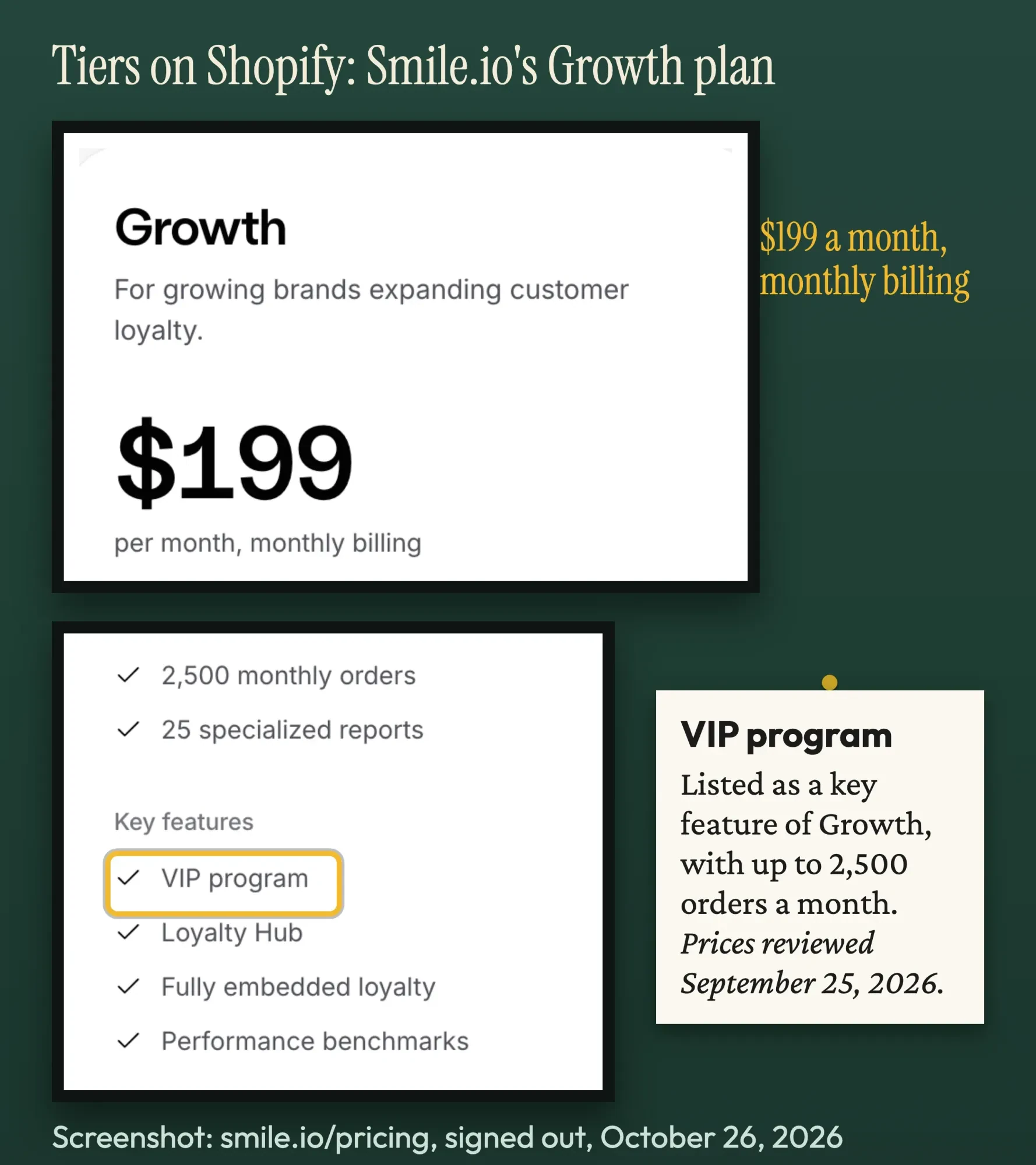 Screenshot: Smile.io's public pricing page, signed out, October 26, 2026 ("Prices in USD. Reviewed as of September 25, 2026.").
Keep it to two or three tiers.
If Mesquite Mile made Gold anyone with 4 washes a month, that's the 15% group from the math above. It should stay small.
6. Double-points days
A short promotion gives a slow day a reason to fill up.
Square Plus lets you run one-time or recurring promotions with bonus points, and Smile.io lists "2x points weekends" on its Standard plan at $79 a month, as of October 2026. For Mesquite Mile, double points on gray weekdays fits.
Nobody washes a car before a storm unless you give them a reason.
Charge a membership fee when customers already come weekly
Points pay customers back after they visit.
A membership charges them before they do.
7. A paid membership
A paid membership is a monthly fee for perks, such as unlimited washes, free delivery or member prices.
It works when the perk's something people use often. Example: Mesquite Mile's club is $25 a month for unlimited basic washes, so a member's ahead by the second wash.
The running cost is mostly card fees, and they're easy to work out. Square's pricing page, as of October 2026, lists 2.9% + 30 cents for online and invoice payments on Square Plus (3.3% + 30 cents on Square Free). A card on file costs 3.5% + 15 cents. On a $25 charge, both Plus rates come to about $1.03, or 4.1%. Billing through Stripe instead adds its 0.7% Billing fee on top of card processing.
We break those fees down in what it costs to take card payments.
Make cancelling as easy as joining. A member who feels trapped won't send you friends.
8. Prepaid wash books and bonus gift cards
Sell 10 washes for the price of 8, and you're paid now while they're back later.
Square's gift card page says you pay "the standard processing fee when a customer buys a gift card," as of October 2026. On top of that comes "up to a 2.5% load fee each time funds are added." So a $50 card can cost up to $1.25 to load, on top of card fees. Redeeming it costs nothing, and Square's FAQ says its gift cards "do not expire."
A "buy $50, get a $10 bonus card" offer sells well in December. But the card you sell and the free bonus card follow different expiry rules, and we'll get to those below.
Let regulars bring in the next customer
Once members are happy, the cheapest new customer is the one they'll send you.
9. Referral rewards
A referral program rewards a customer when someone they've sent buys.
For an online store, ReferralCandy charged $39 a month plus a 10.5% success fee on its Basic plan, and $79 plus 3.5% on Grow, as of October 2026. We worked out where they cross: at $571.43 of referred sales a month the two cost the same, and above that Grow's cheaper. Smile.io's free plan includes referrals too.
A local shop doesn't need software for this. Mesquite Mile hands each member two "first wash free" cards with the member's name on the back, and gives the member a free wash for each card that comes back.
Online, give each customer a tagged link, and you'll know which referrals turn into sales. Build one in a minute with our UTM link builder.
One rule to pass on.
If customers share your referral link on social media to earn the reward (shares, never reviews), read the FTC's endorsement Q&A. It says that when someone's "being compensated – for example, getting a discount on a future purchase or being entered into a sweepstakes for a significant prize – a disclosure is appropriate."
So ask sharers to say they get a reward. Planning a prize draw instead? Our Facebook giveaway rules cover that.
10. Perks with the shop next door
Team up with a nearby business that shares your customers but doesn't compete: a coffee shop, a detailer, a tire store. Members of one get a perk at the other, and each of you pays only for the perk you give. Our hyperlocal marketing playbook has more ways to work with neighbors.
11. A members-only group
Some regulars don't want cheaper; they want to be first.
A private group with early news of new services costs nothing but time; here's how to start a Facebook group for your business.
12. A welcome reward for joining
Give something small the day someone signs up, like a free tire shine, so the first stamp happens while they're standing at your counter.
Never pay points for a review
Rewards for joining are fine.
Rewards for reviews are where they'll get you in trouble.
Google's Business Profile help is blunt: "Offering incentives, like free or discounted goods or services, in exchange for customers to post reviews, change reviews, or remove negative reviews is considered fake & misleading content and is strictly prohibited". That's points, stamps and free washes included.
The FTC's rule is narrower. Its Q&A on the review rule notes that the rule itself took effect on October 21, 2024. The Q&A says "The rule does not prohibit giving incentives for reviews, as long as there isn't an express or implied requirement that the reviews have to express a particular sentiment."
Paying for 5-star reviews is out even with a disclosure, and the FTC answers that "That conduct would violate Section 465.4". Its own example of an implied demand is a line that's easy to write by accident: "Tell us how much you loved your visit to John's Steakhouse and get a $5 coupon."
So the FTC rule stops short of a full ban, but Google bans any reward for a Google review, and we don't recommend rewarding reviews anywhere.
Most of your reviews are on Google. That's why reviews stay out of the program.
Ask anyway, just without a reward. A free link maker for Google reviews gives you the link to send. Timing and wording are in how to automate review requests without losing authenticity.
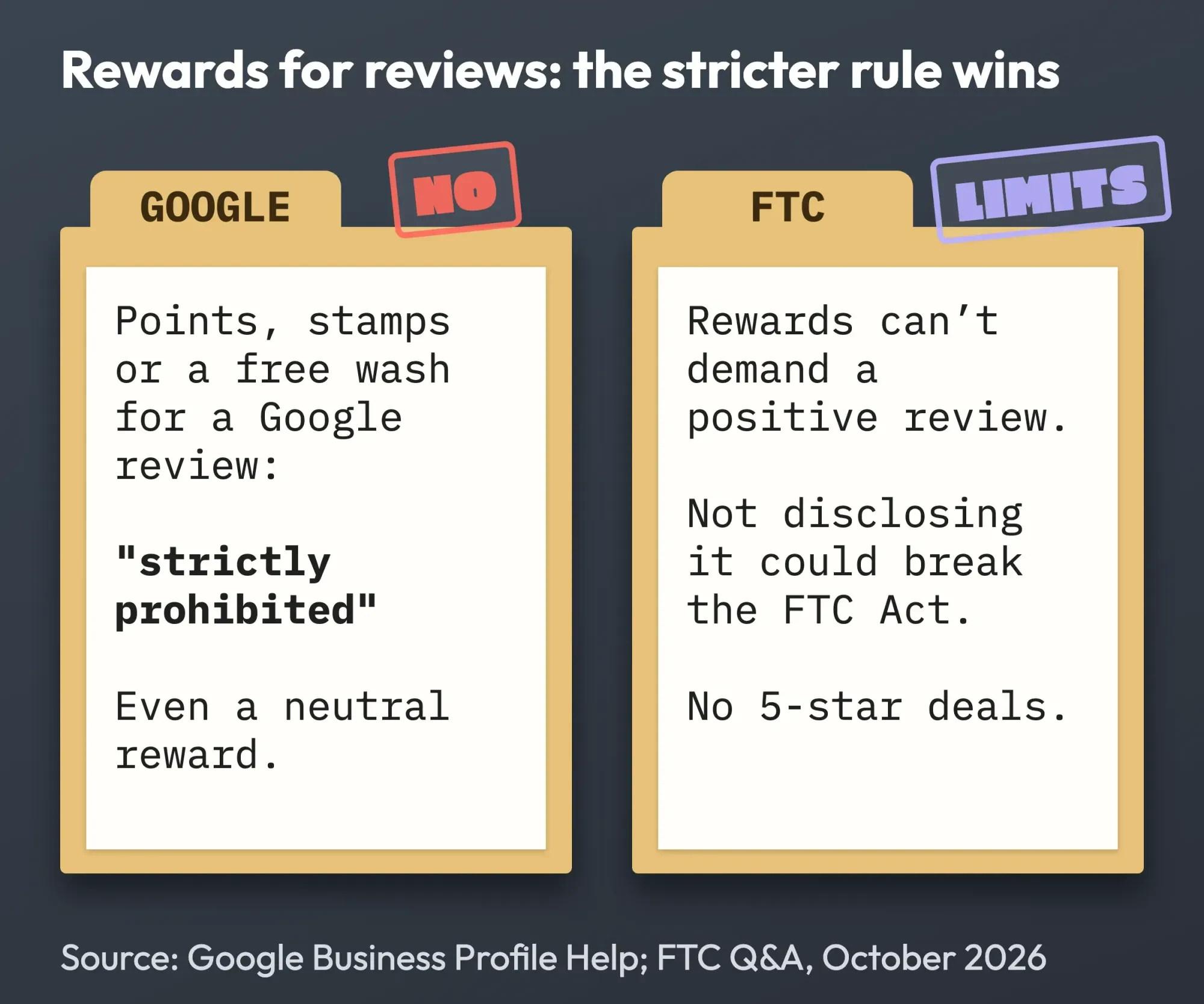 Source: Google Business Profile Help and the FTC review rule Q&A, October 2026. Drawn by us.
Can loyalty rewards expire?
Under the federal rule, a free reward card can carry an end date if its front says so. A gift card that customers pay for is held to a five-year floor.
The federal gift card rule, Regulation E at 12 CFR 1005.20, covers gift cards you sell and sets several conditions. One is that funds must last at least "Five years after the date the gift certificate was initially issued, or the date on which funds were last loaded to a store gift card or general-use prepaid card." If the card's own expiration date is later, that date applies.
Reward cards are carved out. The rule's exclusions list a "Loyalty, award, or promotional gift card" given out by a loyalty program, as long as it carries certain disclosures.
Two of those must be printed "on the front": a statement that it's "issued for loyalty, award, or promotional purposes," and "The expiration date for the underlying funds."
California's stricter about what you sell. Civil Code section 1749.5 makes it "unlawful for any person or entity to sell a gift certificate to a purchaser that contains any of the following: (1) An expiration date". A free loyalty reward is exempt only "if the expiration date appears in capital letters in at least 10-point font on the front."
Mesquite Mile is in Texas, and the federal rule applies in every state. Under it, the money on the $50 card it sells couldn't be set to expire in under five years. The free $10 bonus card could end sooner if its front says it's a promotional card and shows the date. California's exemption, for comparison, asks for that date in capital letters in at least 10-point font on the front.
States can add their own gift card laws on top of the federal rule, and we read only California's.
None of this is legal advice. It's our reading of the federal and California text, meant for planning. If you sell gift cards in more than one state, have a business lawyer check your card wording first.
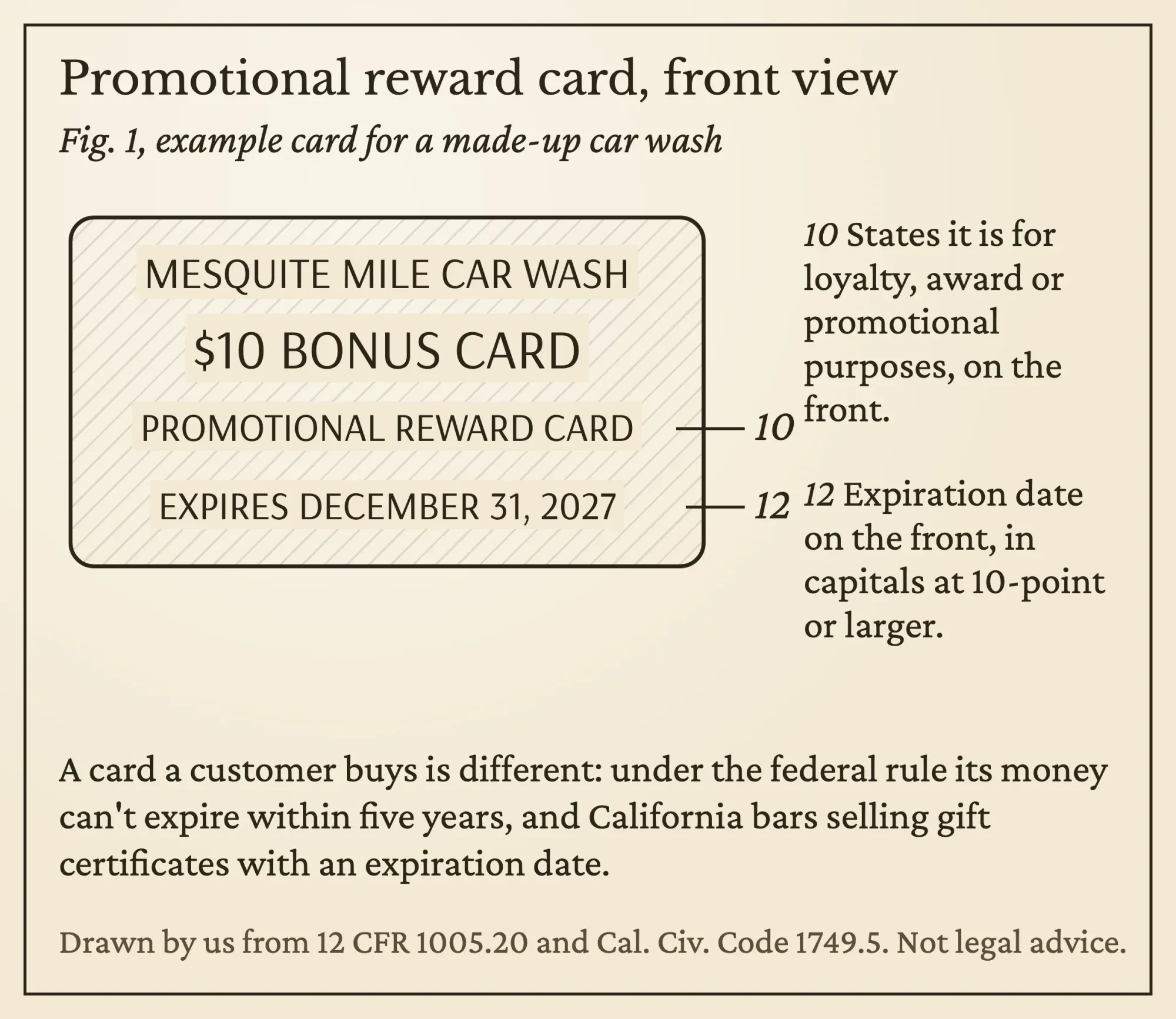 Drawn by us from 12 CFR 1005.20 and California Civil Code 1749.5, read October 26, 2026. Not legal advice.
The 12 ideas side by side
That's every idea. Here they are in one place, with what each costs to run as of October 2026 and how much it hands back.
| 1. Punch card | $27.99 for 500 cards, possibly a sale price, plus $5.99 delivery (Vistaprint) | 10% (buy 9, 10th free) | Any counter business |
| 2. Surprise rewards | The reward only | You decide | Shops with regulars |
| 3. Birthday perk | Square Plus $49 a month per location; 500 texts, then 3 cents each | One reward a year | Anyone with a customer list |
| 4. Points | Square Plus $49 a month per location; Smile.io Free up to 200 orders | 5% in our example | Frequent small sales |
| 5. VIP tiers | Square Plus $49 a month; Smile.io Growth $199 a month | 7.5% to 15% in our example | A clear group of top customers |
| 6. Double-points days | Square Plus; Smile.io Standard $79 a month | Twice the base rate that day | Filling slow days |
| 7. Paid membership | About $1.03 in card fees per $25 charge (Square Plus) | Set by your perks | Weekly-visit services |
| 8. Prepaid books, bonus gift cards | Up to 2.5% load fee plus card fees (Square) | Your bonus value | Holiday sales |
| 9. Referral rewards | ReferralCandy $39 + 10.5%, or $79 + 3.5%, a month | One reward per new customer | Online stores, trades |
| 10. Partner perks | The perk only | You decide | Neighboring shops |
| 11. Members-only group | Your time | Early access | Fans who want to be first |
| 12. Welcome reward | The reward only | One reward | Any program's first step |
Prices change, so you'll want to open the vendor page before you buy. If you're still choosing a CRM to hold the member list, our CRM software comparison is a good place to start.
Frequently asked
What consent do I need before calling or texting members with offers?
Get it in writing. The FCC rule at 47 CFR 64.1200 requires prior express written consent for marketing calls to cell phones made with an autodialer, as of October 2026. Telephone solicitations also can't reach homes before 8 a.m. or after 9 p.m. local time.
How fast must I stop loyalty emails after someone unsubscribes?
Within 10 business days. The CAN-SPAM Act at 15 U.S.C. 7704 makes it unlawful to keep sending commercial email past that point, as of October 2026. The same section requires a working way to opt out in every message.
Can customers keep a loyalty card on their phone instead of in a wallet?
Yes. Google's Wallet loyalty card guide lets a business issue cards that customers save in Google Wallet. You can send the card as a link on a website, in an email or by text. The customer then opens the Wallet app to show it at the counter.
Launch one program in a weekend
Pick one idea from that table. You don't need three.
- Set the give-back rate from your margin; 5% to 10% is a safe start.
- Write the rules on one card or screen: how to earn, what you get, when it ends.
- Set it up in your register or app, or print the cards, and test it on your staff.
- Tell people: a counter sign, the receipt, your Business Profile on Google and your social accounts.
- After 90 days, compare how often members come back with everyone else.
Step 4's the one owners skip, and a program nobody hears about gives back nothing. Promoting launches like this is part of the social media marketing we do for clients. That's paid work for us, so read step 4 knowing that.
Want help picking the right program? Request a quote and tell us what you sell and how often people come back.
How we made this guide: we took every price from the vendors' own US pages on October 26, 2026, and rechecked them on October 27. We copied the FTC, CFPB and California text from the official pages the same day. We did the cost math in a short script, using those prices plus example prices for a made-up car wash. We took the Smile.io screenshot from its public page while signed out. We didn't sign up for any loyalty app, so the screens inside may look different. Every link sits next to the claim it supports.
First published August 2020. Rewritten October 27, 2026: the old post defined customer relationship marketing in general terms. This version gives 12 loyalty program ideas, each priced from the vendor's own page or labelled as an example. It adds the give-back rate of each reward and the review and expiry rules quoted from Google, the FTC, the CFPB and California law.
Sources
- Square: Pricing (US), plans, processing fees and gift card load fees
- Square: Square Loyalty
- Square: Square Marketing
- Square: Gift cards (fees FAQ)
- Smile.io: Pricing and plans (reviewed September 25, 2026)
- ReferralCandy: Pricing
- Vistaprint: Loyalty Business Cards
- Stripe: Billing pricing
- Google Business Profile Help: Tips to get more reviews
- Federal Trade Commission: The Consumer Reviews and Testimonials Rule: Questions and Answers
- Federal Trade Commission: FTC's Endorsement Guides: What People Are Asking
- Consumer Financial Protection Bureau: 12 CFR 1005.20, Requirements for gift cards and gift certificates
- California Legislative Information: Civil Code section 1749.5
Comments
No comments yet. Start the conversation below.