
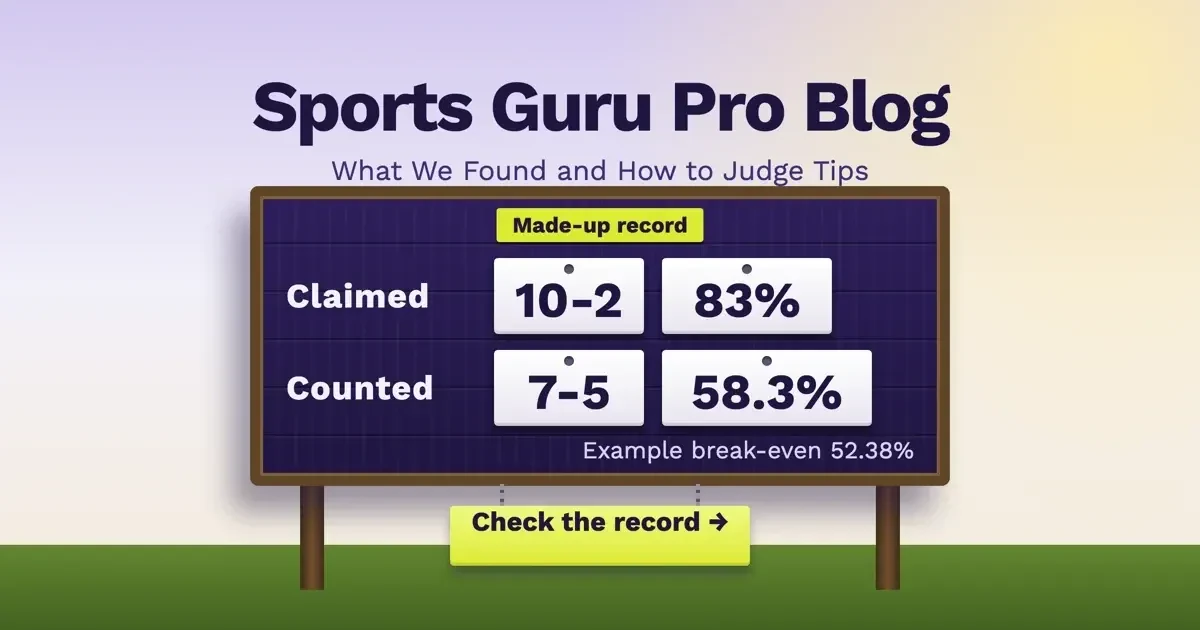
Quick answer
The Sports Guru Pro blog is part of sportsgurupro.com, a fantasy cricket tips and news site built for India's fantasy apps. On November 12, 2026, its newest news dated from September 5, 2025, its /blog/ address returned 403, and its home page hid 87 links. Before acting on any tip, check a timestamped record and your state's gaming regulator.
If a friend dropped a Sports Guru Pro blog link in your group chat, know first that it isn't a US betting blog. Sports Guru Pro is a fantasy cricket prediction and news site at sportsgurupro.com. Its own footer calls it "a free Fantacy Prediction and Cricket News site." No page we read names an owner, a company or a street address, so we can describe what the site shows but can't vouch for it.
Its /blog/ address turned our plain request away with a 403. Its one success figure, a claim above 80% on its app listing, comes with no published pick log. If betting already strains your money or sleep, call the National Problem Gambling Helpline at 1-800-MY-RESET. You'll reach trained professionals who specialize in gambling problems.
Key takeaways
- Trust a tips record only when each pick is timestamped before the game.
- Sports Guru Pro's /blog/ address returned 403 Forbidden on November 12, 2026.
- At example odds of -110, break-even is 52.38% of picks (110 / 210).
- The FTC says small-print disclaimers don't excuse a misleading results claim.
- Sports betting is legal only where state law allows it, so check your regulator.
The Sports Guru Pro blog on November 12, 2026: our checks
Our first version never gave the blog's address, so we started with the name. It matches sportsgurupro.com, whose page title reads Sports Guru Pro and whose menu has a Blog item. Its search description offers Dream11 cricket predictions for each day's match. The site's Google Play app calls itself "India's Top Fantacy apps Prediction App." With a menu of cricket, football and kabaddi and no US sports in sight, it's written for Indian fantasy players rather than for US bettors.
Verisign's registry entry for sportsgurupro.com shows a registration on August 5, 2020, through OwnRegistrar, Inc., running to August 5, 2027. It doesn't name the owner. Neither did any page we read, since /about-us returned 404 and the privacy policy names no company, street address or date. The .net name, registered in 2023, showed only a registrar notice that its registration had expired, with no link back to the .com site and no mention of the blog. The .org, .blog, .co and .in names don't exist in DNS.
The home page loads, yet every item in its latest-news strip was dated September 5, 2025. Its cricket previews ran from May 8 to May 31, 2025, and the Blog menu item opens an /article page whose four posts date from 2023. The /blog/ address itself returned 403 Forbidden to our plain request. So did the Task Offers page. That 403 didn't hide everything, because the site's own sitemap still lists the blog. It names 37 post addresses under six categories: free-redeem-code, giveway, google-redeem-code, paytm, paytm-cashback and unlimited-earning. Slugs like earn-unlimited-big-loot and rs5000-free-paytm-cash point to rupee cashback and giveaway posts, not sports analysis. We couldn't read their text.
Near the bottom of the home page, a block styled display:none holds 87 links to 72 other web addresses, so visitors never see them. Its link text repeats betting terms such as toto and slot 77 times, mostly inside two site names. The same hidden block sits on the Blog page. The site's robots.txt points search engines to a second list, atom.xml, with 34,938 addresses ending in ?id=. All of them carry the date November 11, 2026, the day before our check, and 13,813 of them, or 39.5%, contain words like slot, togel or casino. The one we opened returned the home page.
Google's spam policies describe this kind of pattern in general terms. They say "Hacked content is any content placed on a site without permission." Intruders, they add, may insert "hidden links or hidden text to a page by using CSS or HTML," and the block we found is hidden with CSS in that way. We can't tell from outside who added the links, so we report them as facts about the pages rather than a verdict on anyone. We don't link to the site at all. Our explainer on Google ranking systems walks through each system Google lists, spam systems included.
| Where we looked | How | Result (November 12, 2026) |
|---|---|---|
| sportsgurupro.com home page | Plain request | Live; newest news dated September 5, 2025 |
| /blog/ and Task Offers | Plain request | 403 Forbidden |
| About page | Plain request | 404; no owner named on any page |
| Registry record (RDAP) | Public lookup | Registered August 5, 2020; owner not shown |
| Site sitemap | Parsed | 37 blog posts in giveaway, cashback and earning categories |
| Hidden block on home page | Parsed | 87 links to 72 other sites |
| atom.xml list in robots.txt | Parsed | 34,938 ?id= addresses; 39.5% with gambling words |
| .org, .blog, .co, .in names | DNS lookup | Do not exist (NXDOMAIN) |
The privacy policy linked from the site's Play listing says "You may be asked for, as appropriate, name, email address, mailing address, phone number, and social security number." That page doesn't say why a free tips app would need a Social Security number, and we wouldn't hand one over to any tips site. The listing showed 1M+ downloads, a 3.7 rating and an update on August 11, 2026, almost a year after the newest news item on the website. It also claims expert head-to-head teams with a success rate above 80%. We found no published record behind that number.
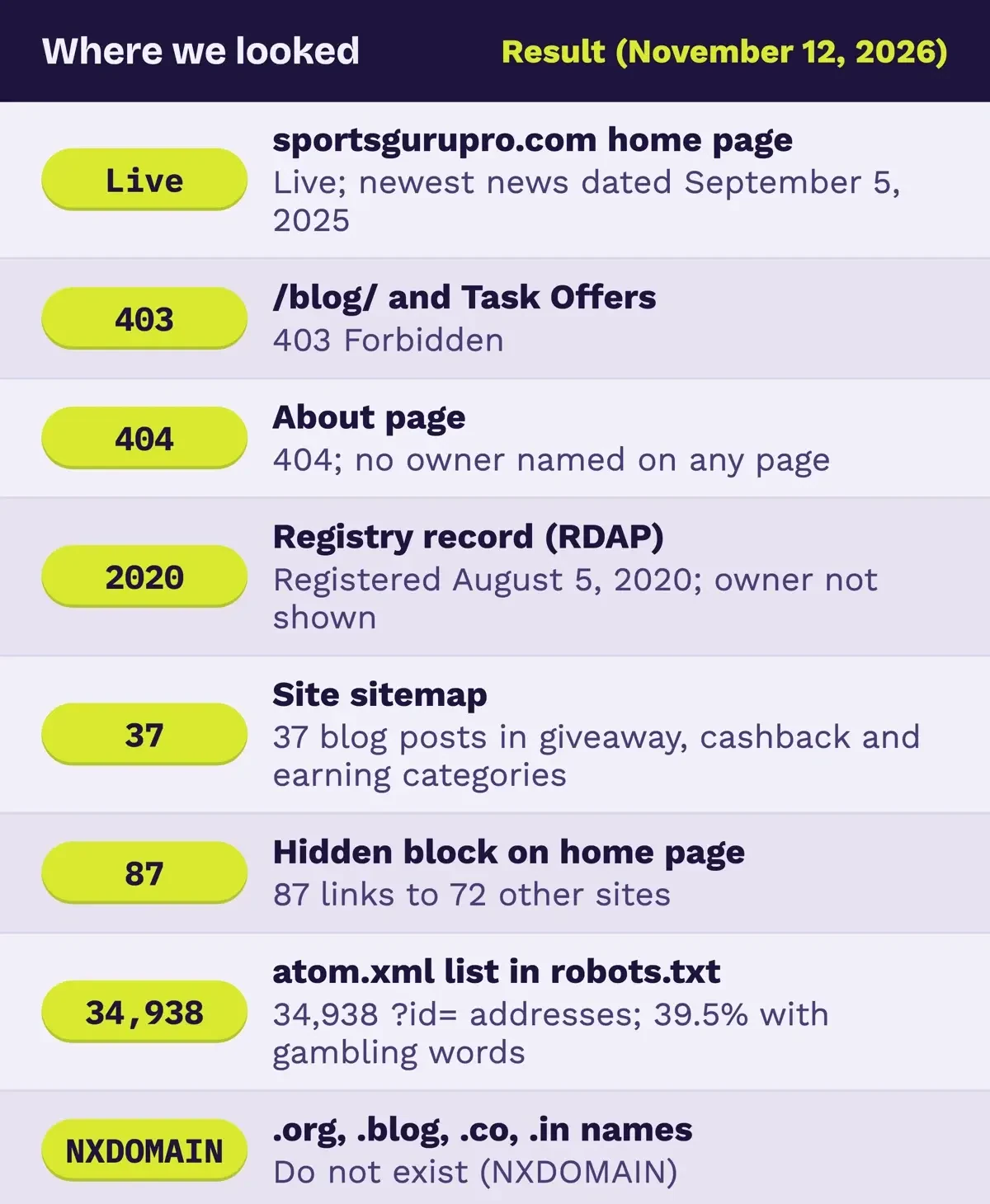 Diagram by DigitalTreed, from our DNS, registry and page checks on November 12, 2026.
What we tested
We ran two scripts on November 12, 2026. The first sent plain requests whose user agent named DigitalTreed, covering DNS, the registry, 12 of the site's own addresses, its two sitemaps and the app listing. It never touched the contact form or followed a link off the site.
The second runs offline on a made-up log of 12 picks from an invented tips page and scores it on the six checks described in the track record section. Its report opened at 127.0.0.1.
Six claims from our first version, set against the site
Before this rewrite, our January 2024 version described the blog without a single source. So we checked each claim against the visible text of four saved pages: home, Blog, latest news and cricket.
| Claim in our first version | What the site showed (November 12, 2026) |
|---|---|
| Player rankings for cricket and basketball | Cricket previews, May 2025; basketball: 0 mentions |
| Founded by a group of sports lovers | No founder named; About page 404 |
| Forums and comments for members | Not found in the visible text |
| Fitness and nutrition guides for athletes | 0 mentions |
| Updated several times a week | Newest dated item: September 5, 2025 |
| Free to use | Backed: the site calls itself free |
Only the free claim holds in full. The rankings claim is half right, since cricket previews exist but serve Indian fantasy contests. Basketball doesn't appear anywhere we read. The other four claims had nothing behind them on the site's pages, so they're gone.
How can you verify a tipster's track record?
Even a published record is easy to dress up, so we built a checker to show how. We fed it an invented tips page rather than any real tipster's picks, so nobody's actual record is judged here.
A record you can check has four parts. There's a public timestamp before each game, a number on every pick so deletions show, the odds taken, and a graded result. Our made-up page claimed a 10-2 record, 83% winners. It showed 12 picks, numbered from 1 to 14. The checker found picks #3 and #9 posted after their games had already started, both marked as wins, so the page had added two results that were already known. Picks #6 and #11 are missing. As displayed, the log read 9-3. That already misses the claim. Dropping the two late posts left 7-3. Counting the missing two as losses left 7-5, a 58.3% win rate.
| Made-up record | W-L | Win rate | Units | ROI |
|---|---|---|---|---|
| As the page showed it | 9-3 | 75.0% | +5.7 | 43.2% |
| Late posts (#3, #9) dropped | 7-3 | 70.0% | +3.7 | 33.6% |
| Missing #6 and #11 counted as losses | 7-5 | 58.3% | +1.5 | 11.4% |
A win rate also leaves out the odds taken on each pick. In this example, at -110 odds you risk $110 to win $100. So the example break-even rate is 110 / (110 + 100) = 52.38%. In units, a win counts as +1 and a loss as -1.1, and ROI is the units won divided by the units risked across every pick. Our corrected 58.3% clears the line. Still, 12 picks is a tiny sample. Three of our 6 checks failed, too.
New Jersey's responsible gaming page lists one belief about past wins as a common myth: "Tracking previous results can help a player forecast the coming results."
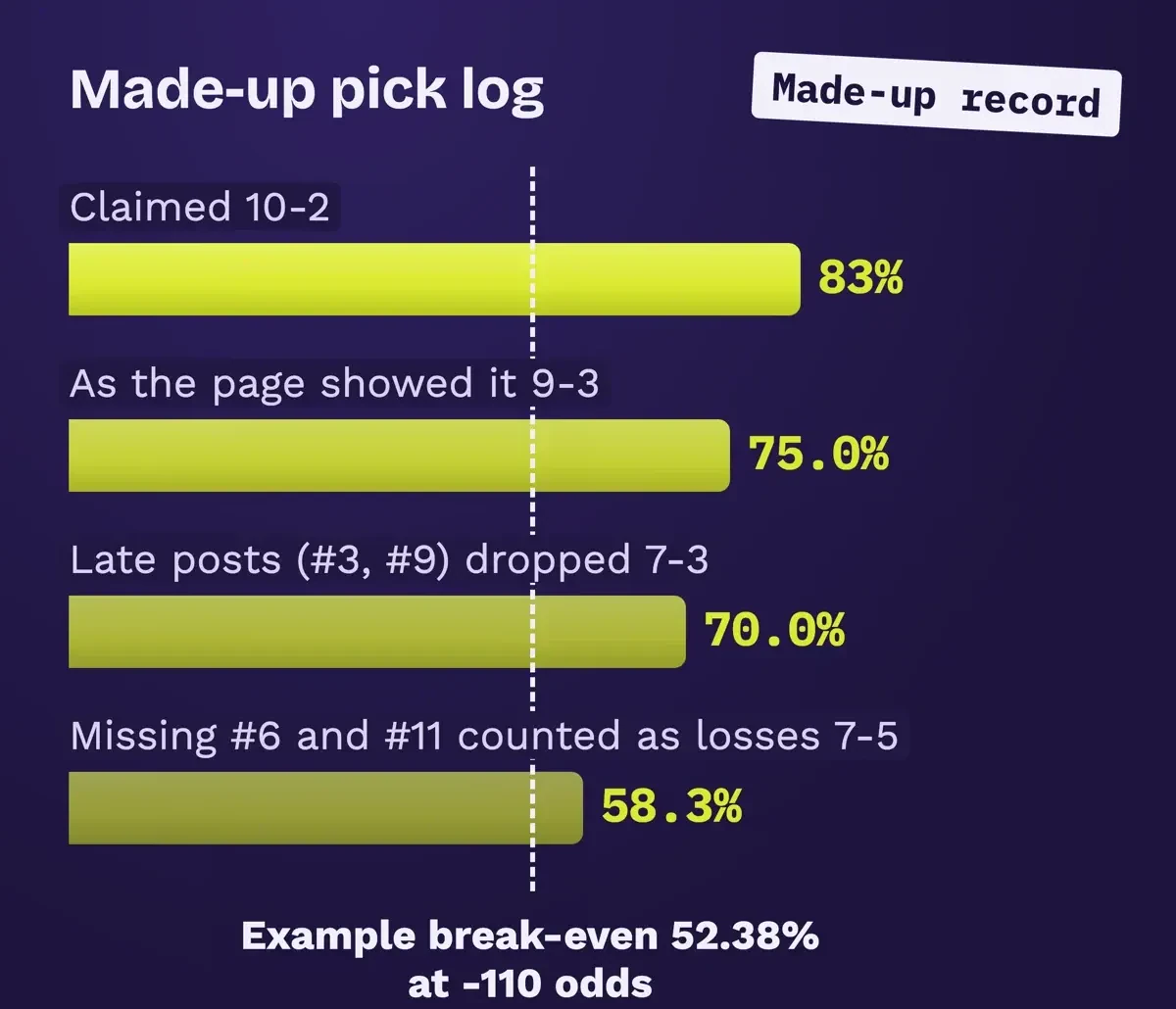 Drawn by us from our pick_check.py run on a made-up log, November 12, 2026.
Sports Guru Pro's app listing claim of more than 80% can't be run through these checks. We didn't see a timestamped log behind it on any page we could open.
Paid picks, affiliate links and FTC rules
Beyond the record, three FTC texts limit what a US-facing tips site can claim and what it must say about who pays it. They're the Endorsement Guides, the consumer reviews rule that took effect in 2024, and a 2021 notice on money-making claims.
The FTC FAQ on its Endorsement Guides says a testimonial showing specific results is read as what others can expect. It adds that a line like "Individual results may vary" won't change that reading.
The guides themselves, at 16 CFR 255.2, say the advertiser must "possess and rely on adequate substantiation" for the results it implies.
If a tips page earns a commission on the sportsbook accounts you open through its links, the FTC's FAQ calls for a clear and conspicuous disclosure. It offers sample wording: "I get commissions for purchases made through links in this post." The influencer guide Disclosures 101 from the FTC says a material connection includes "the brand paying you." Our pages on labeling affiliate links and sponsored post disclosure show where that line belongs.
Glowing member reviews fall under a newer rule. The FTC's consumer reviews rule Q&A says the rule took effect on October 21, 2024, and courts can impose civil penalties for knowing violations. The FTC's August 14, 2024 announcement says it covers fake testimonials, including AI-generated ones, and paying for reviews with a set sentiment. It also reaches insider reviews that don't disclose the writer's ties to the business. We cover the business side in automating customer reviews under FTC and Google rules.
Sports Guru Pro's own sitemap shows blog categories named unlimited-earning, paytm-cashback and free-redeem-code, which is the language of money-making offers rather than of sports analysis. For offers aimed at US readers, the FTC issued a Notice of Penalty Offenses on money-making opportunities in 2021. It found that "certain acts or practices used to attract participants to money-making opportunities are unfair or deceptive." For the site's giveaway posts, the FTC's prize scam page sets one simple test: "If you have to pay to get your prize, it's a scam." Our US giveaway rules and free Steam games guide show what real offers look like.
We'd put these six questions to any tips site in writing and keep its replies.
- Where is the full pick log, with a timestamp before each game?
- Are picks numbered, so deleted losses would show as gaps?
- What odds were taken, and what is the win rate against break-even?
- Does the site earn money when I open a sportsbook account through its links?
- Who runs the site, and where is the company based?
- Which state regulator licenses the sportsbooks it mentions?
Of these six, Sports Guru Pro's open pages didn't answer questions 1, 2, 3 or 5. If a tips channel then asks for a login or payment, our GoMyFinance lookalike site check and phishing prevention tips cover what to do next.
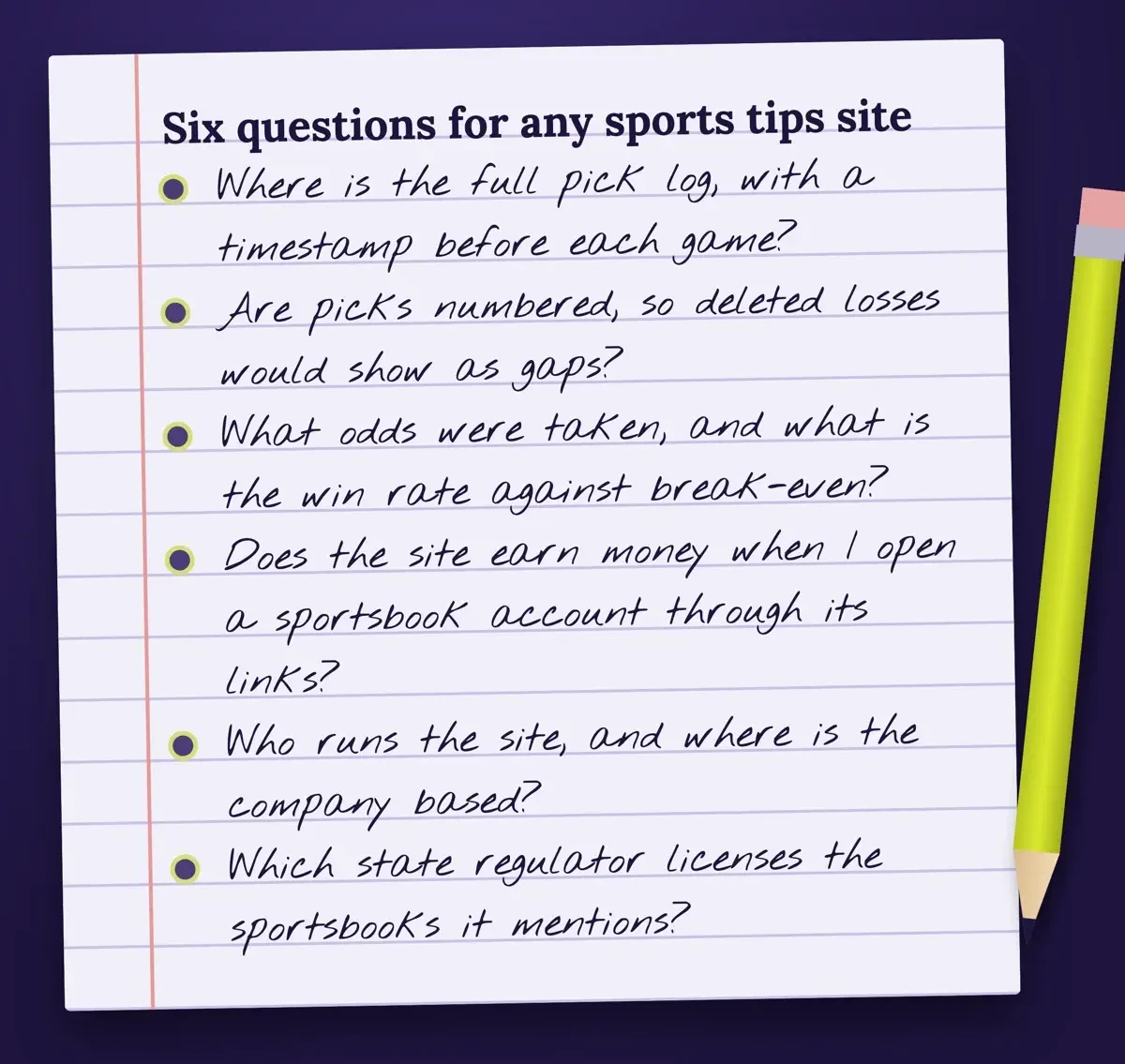 Drawn by us: our six-question checklist for any sports tips site.
Where sports betting is legal: ask your state's regulator
Once a tips site passes those six questions, the next check is your state's law. Sports betting is legal in some states and not in others. Since the Supreme Court decided Murphy v. NCAA on May 14, 2018, each state chooses whether to allow it.
The Murphy v. NCAA opinion put it plainly: "Congress can regulate sports gambling directly, but if it elects not to do so, each State is free to act on its own."
That makes your own state's gaming regulator the source to trust, not a national list of legal states posted on a tips site or in a group chat. We read the pages of four state regulators on November 12, 2026, and each one answers the legal question for its own state only.
New Jersey's Division of Gaming Enforcement keeps a sports wagering page listing each licensed online sports pool and the casino or racetrack behind it. New York's Gaming Commission page says state law authorizes mobile wagers made "from a location within New York." So the bettor's location at that moment counts. The commission also lists the operators it has licensed, and it decides which wagers they may offer, down to which player prop bets are allowed. Pennsylvania's Gaming Control Board, on its online sports wagering operators page, says, "Before you bet, use the links below to verify that a site is PGCB regulated."
The Illinois Gaming Board has posted cease-and-desist letters to 13 online operators it believes offered unlicensed sports wagering, dated from February 3, 2025 to January 27, 2026. Its sports wagering FAQ adds that licensed sportsbooks must publish house rules, including how wagers can be cancelled or voided.
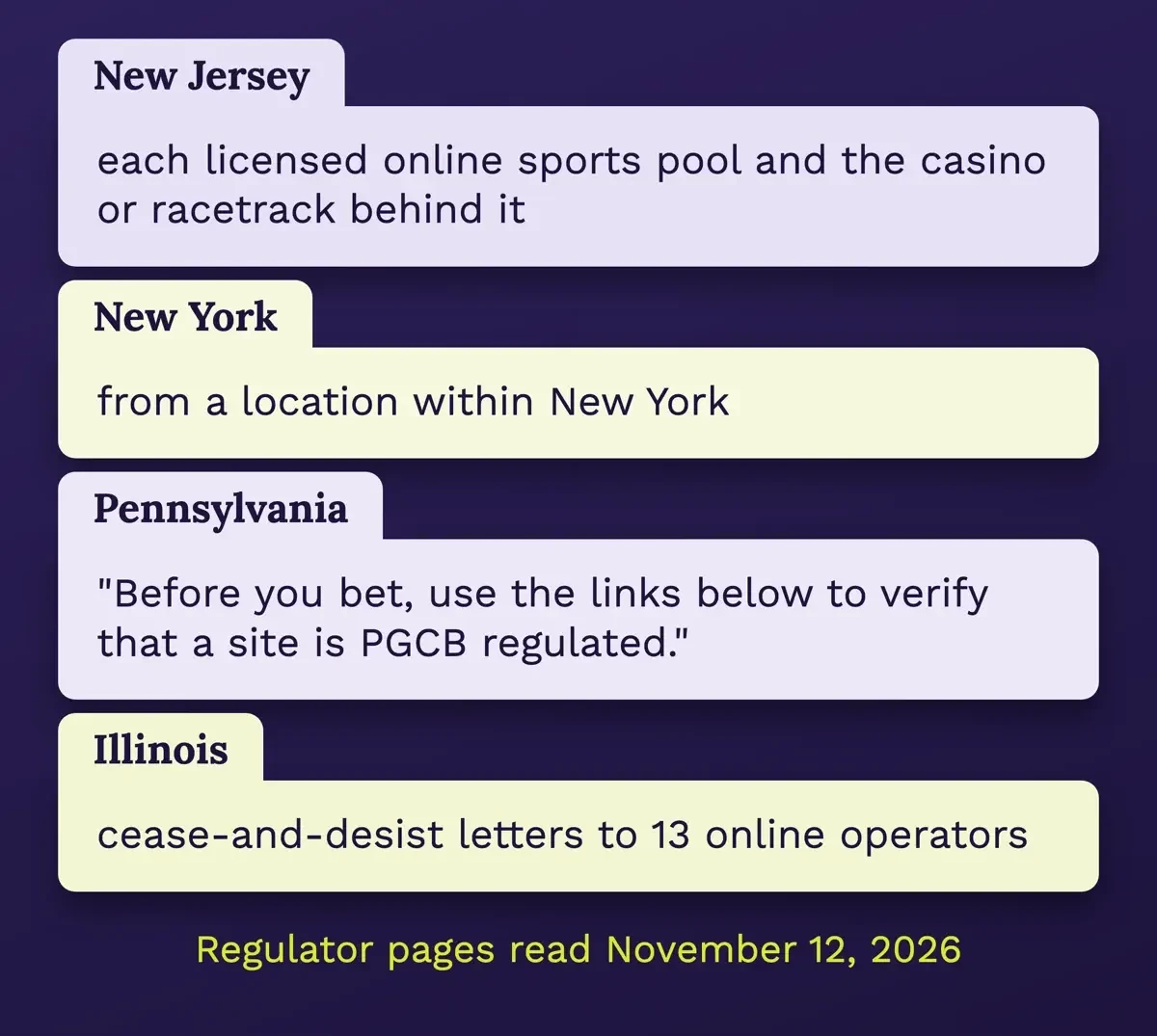 Diagram by DigitalTreed, from New Jersey, New York, Pennsylvania and Illinois regulator pages read November 12, 2026.
This section summarizes regulator pages and isn't legal advice. Rules change, so recheck your state's page before each season. If a question turns on the law, ask a licensed attorney in your state.
Help when betting stops being fun
NCPG's problem gambling FAQ lists chasing losses, betting again to win back the last one, among the warning signs. Others on its list include needing to bet more money more often, feeling restless when you try to cut back, and gambling despite the harm it causes.
NCPG runs the National Problem Gambling Helpline at 1-800-MY-RESET. You can call, text or chat 24/7/365. Its helpline page says the line "is not a crisis hotline designed for emergency services." Anyone in crisis should call 911 or 988, it says.
State pages add local options. New Jersey's responsible gaming page and the Illinois Gaming Board's site both list 1-800-GAMBLER. Both states run self-exclusion programs that let you bar yourself from licensed betting there, and in Illinois that single list covers casinos and sports wagering together. Pennsylvania runs its program through its Responsible Play site. When gambling mixes with drinking or drug use, USA.gov's substance abuse help page points to SAMHSA's National Helpline, 1-800-662-HELP (4357). It's for treatment and mental health referrals, and USA.gov says SAMHSA offers "free, confidential help." NCPG calls gambling disorder "a recognized mental health diagnosis." That's why a licensed counselor or doctor is the right person to talk to, not a tips channel.
Frequently asked
Is the Sports Guru Pro app the same as the website?
They're linked: the app's Google Play listing points to a privacy policy on sportsgurupro.com. The listing says the app contains ads and "is not affiliated" with the fantasy companies it covers.
How old do you have to be to bet on sports in New Jersey?
Twenty-one. New Jersey's 2018 sports wagering law says "A person placing a wager on a sports event shall be at least 21 years of age."
Does it cost anything to contact 1-800-MY-RESET?
No. NCPG says "No payment or insurance information is required to receive resources." Carrier data rates may still apply to texts.
How can I see who owns a tips website?
Look up the domain on ICANN Lookup, which shows the registration record. For sportsgurupro.com, the record named the registrar but not the owner.
How we made this guide: Our checks of sportsgurupro.com were plain requests to its own pages, sitemaps and registry record. The pick checker ran offline on made-up data. Facts checked by the DigitalTreed team on November 12, 2026.
First published January 5, 2024 as a profile of the Sports Guru Pro blog. Rewritten November 12, 2026 with dated checks and a guide to judging sports tips sites.
Sources
- Verisign RDAP: sportsgurupro.com registration record
- ICANN Lookup
- Google Search Central: Spam policies for Google web search
- Cornell LII: Murphy v. National Collegiate Athletic Assn. (2018)
- New Jersey: Sports Wagering Law, P.L. 2018, c. 33
- New Jersey Division of Gaming Enforcement: Sports Wagering
- New Jersey Division of Gaming Enforcement: Responsible Gaming
- New York State Gaming Commission: Sports Wagering
- Pennsylvania Gaming Control Board: Online Sports Wagering Operators
- Pennsylvania Gaming Control Board: Responsible Play
- Illinois Gaming Board: Sports Wagering Cease and Desist Letters
- Illinois Gaming Board: Sports Wagering FAQ
- NCPG: About the National Problem Gambling Helpline
- NCPG: FAQs, What is Problem Gambling?
- USA.gov: Find help for substance abuse
- FTC: FTC's Endorsement Guides, What People Are Asking
- Cornell LII: 16 CFR 255.2, Consumer endorsements
- FTC: Disclosures 101 for Social Media Influencers
- FTC: Consumer Reviews and Testimonials Rule, Questions and Answers
- FTC: Final Rule Banning Fake Reviews and Testimonials (August 14, 2024)
- FTC: Penalty Offenses Concerning Money-Making Opportunities
- FTC: Fake Prize, Sweepstakes, and Lottery Scams


Comments
No comments yet. Start the conversation below.