
Quick answer
Facebook giveaway rules come from Meta's Pages policy and US law. Post official rules, have entrants release Meta and confirm Meta doesn't sponsor it, and never require shares or tags to enter. Keep entry free for any random draw. Prizes over $5,000 can need state filings, and in tax year 2026, prizes of $2,000 or more need a 1099-MISC.
Facebook giveaway rules are short, but they are strict. Meta's Pages, Groups and Events Policies say your promotion must not require or reward sharing, reposting or tagging. US law then decides whether your giveaway is a legal sweepstakes or an illegal lottery.
A Facebook giveaway is a promotion on a Facebook Page, group or Event that gives a prize to people who enter. This guide covers both sets of rules for a US small business running a giveaway on its Facebook Page. If giveaways are one part of a bigger plan, start with our social media marketing strategy guide.
This is general information, not legal advice; check with an attorney. Prize and promotion laws differ by state, and we checked only federal rules, Florida and New York.
Key takeaways
- Never require or reward shares, reposts or tags. Meta's policy bans both.
- Every giveaway needs official rules, a release of Meta, and a line saying Meta doesn't sponsor it.
- A random draw that needs a purchase to enter is a lottery pattern. Keep entry free.
- Florida and New York want a filing when a random-draw giveaway's prizes total more than $5,000.
- For tax year 2026, a prize worth $2,000 or more needs a Form 1099-MISC. Smaller prizes are still income to the winner.
What are Facebook's giveaway rules?
Facebook's giveaway rules are 5 sentences in Meta's Pages policy. They make you follow the law, require 2 lines in every giveaway, and ban share or tag to enter.
Meta keeps its giveaway rules in section 7, "Promotions," of the Pages, Groups and Events Policies. Here is section 7 as Meta shows it in US English, read on October 22, 2026, with what each sentence means for you.
| Meta's exact words | What it means for you |
|---|---|
| "If you use your Page, group, or Event to announce or administer a promotion (a contest, giveaway, or sweepstakes) you must ensure that your promotion complies with applicable legal and regulatory requirements (ex: providing entrants a copy of the promotion’s official rules, disclosing offer terms and eligibility requirements, and registering your promotion with the relevant authorities)." | You must follow the law yourself. Write official rules, state who can enter, and register when a state asks. |
| "You must also require participants to (a) fully release and hold Meta harmless from liability, and (b) acknowledge that the promotion is in no way sponsored, endorsed, administered by," or otherwise linked to, Meta. (We put the last few words in our own words.) | Put both lines in your rules and in the post. |
| "Your promotion must not require or incentivize participants to share, repost, tag others, or in any other way publicize your promotion." | No "share to enter," no "tag 3 friends," and no bonus entries for doing either. |
| "Note that Meta will not assist you in administering a promotion. Should you use our services to administer your promotion, you do so at your own risk." | If something goes wrong, Meta won't help you sort it out. |
One more trap: a Meta help page called the Monetization Promotion Guidelines often ranks first for this topic. It covers promotions run on Facebook monetization products, and it says you can't give away physical goods there. Our reading: a shop's normal Page post follows section 7 above instead.
Do Facebook contest rules differ from giveaway rules?
No. Section 7 sets one rule set for "a contest, giveaway, or sweepstakes." What changes is US law. A skill contest is judged, a sweepstakes is a random draw, and each needs slightly different official rules, as shown below.
Can you run a giveaway in a Facebook group or Event?
Yes. Section 7 opens with "If you use your Page, group, or Event," so the same rules cover all three. Some giveaway guides say you can't run one inside a group, but Meta's policy doesn't say that.
A group giveaway still needs official rules, the 2 Meta lines and no share or tag to enter. A personal profile is different, as the FAQ below explains.
Facebook giveaway key facts
- Every Facebook giveaway needs 2 lines: entrants release Meta, and Meta doesn't sponsor it, per Meta Pages policy section 7 (read October 23, 2026).
- New York requires a filing at least 30 days ahead, with a $100 fee, when chance prizes total over $5,000, per General Business Law 369-e.
- Florida requires a filing at least 7 days ahead, with a $100 fee, when chance prizes total over $5,000, per section 849.094.
- For tax years beginning after 2025, prizes of $2,000 or more go on Form 1099-MISC, box 3, per the IRS instructions for Form 1099-MISC.
- After a filed giveaway, Florida wants a list of winners of prizes over $25 within 60 days, and New York within 90 days.
Can you ask people to share, tag or like to enter?
No to shares and tags. Section 7 bans requiring them and bans rewarding them, so "1 extra entry for every share" breaks the rule too.
Section 7 doesn't name likes, so like-to-enter doesn't break section 7 itself. But Meta's Community Standards on spam ban giveaways "of cash or cash equivalents in exchange for engagement" outright. Meta's own example is "Anyone that likes my page will be entered to win $500".
The FTC adds another reason. Its Endorsement Guides FAQ says advertisers "shouldn't encourage endorsements using features that don't allow for clear and conspicuous disclosures," and names the like button. Our take: skip like-to-enter. For post lines that ask for an action without bait, see our bait-safe Facebook call to action examples.
Section 7 doesn't ban comment-to-enter, but it may cost you reach. Meta's engagement bait guideline shows fewer people posts that "explicitly request engagement" such as comments and tags. An entry form on your website avoids that.
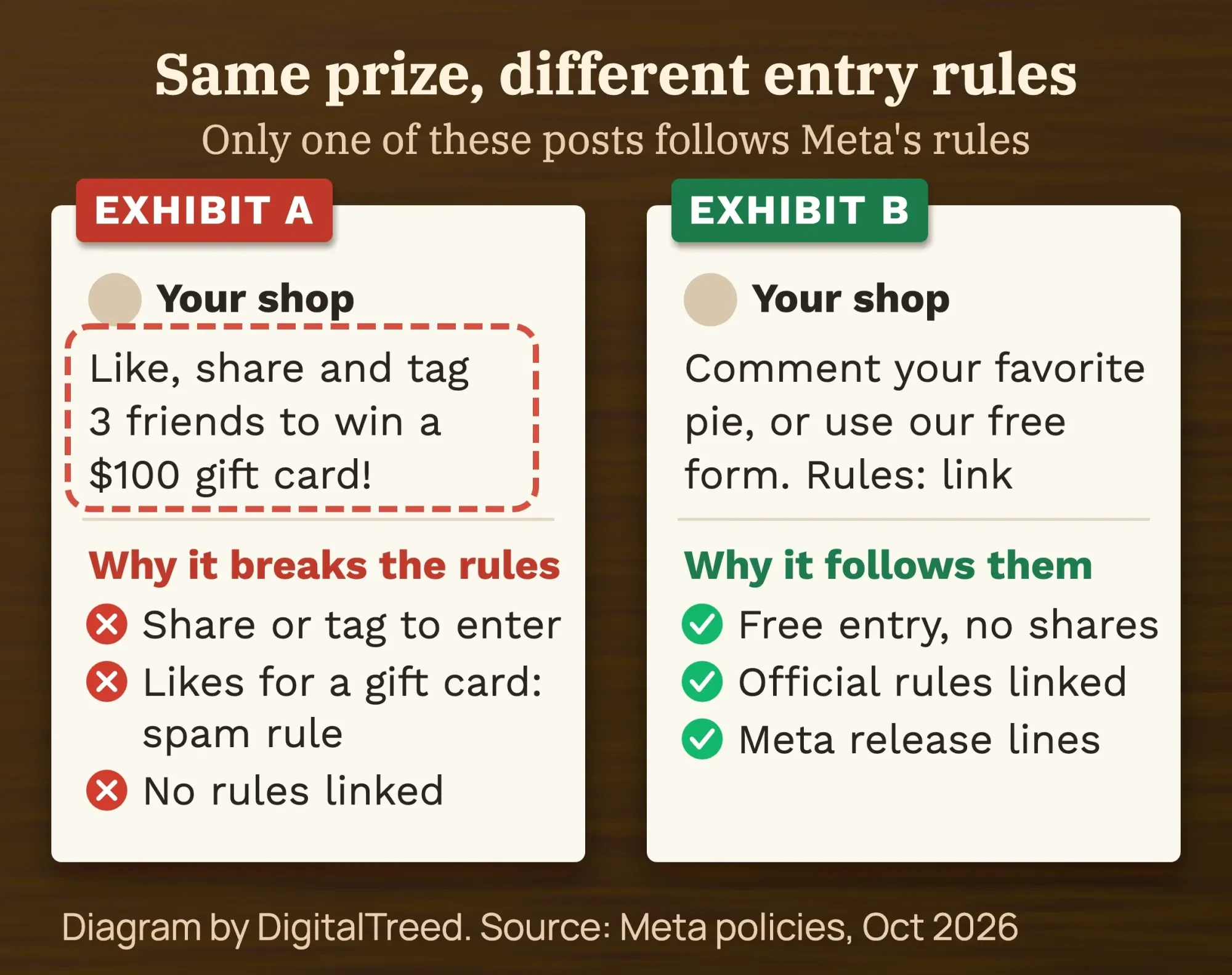 Diagram by DigitalTreed, based on Meta's Pages policy section 7 and spam standard, read October 22, 2026. Not a real Facebook screen.
A correction. An earlier version of this page promised giveaways that "drive likes, shares." Meta's rules ban share-to-enter, so we rewrote it.
Do the same rules apply on Instagram?
Mostly, but the wording differs. Instagram's Promotion Guidelines ask for official rules, eligibility terms and a complete release of Instagram. They also want a line saying Instagram doesn't sponsor, endorse or run the promotion.
They don't repeat Facebook's share and tag ban. They ban inaccurate tags instead, such as asking people to tag themselves in a photo they aren't in. We suggest that if one giveaway runs on both apps, follow Facebook's stricter rule on both, and name both Meta and Instagram in the release.
Sweepstakes vs contest vs lottery: which one are you running?
A sweepstakes is a random draw with free entry. A contest is judged on skill. A lottery is a random draw people pay to enter, and it's the pattern to avoid.
Federal law separates them. Under 39 U.S.C. 3001(k), "a game of chance for which no consideration is required to enter" is a sweepstakes. In a skill contest, "the outcome depends predominately on the skill of the contestant" instead of luck.
A lottery has 3 parts: a prize, chance, and a payment or purchase to take part. The FCC's rule in 47 CFR 73.1211 uses that test for broadcasters. Without the purchase it's a sweepstakes, and without the chance it's a skill contest.
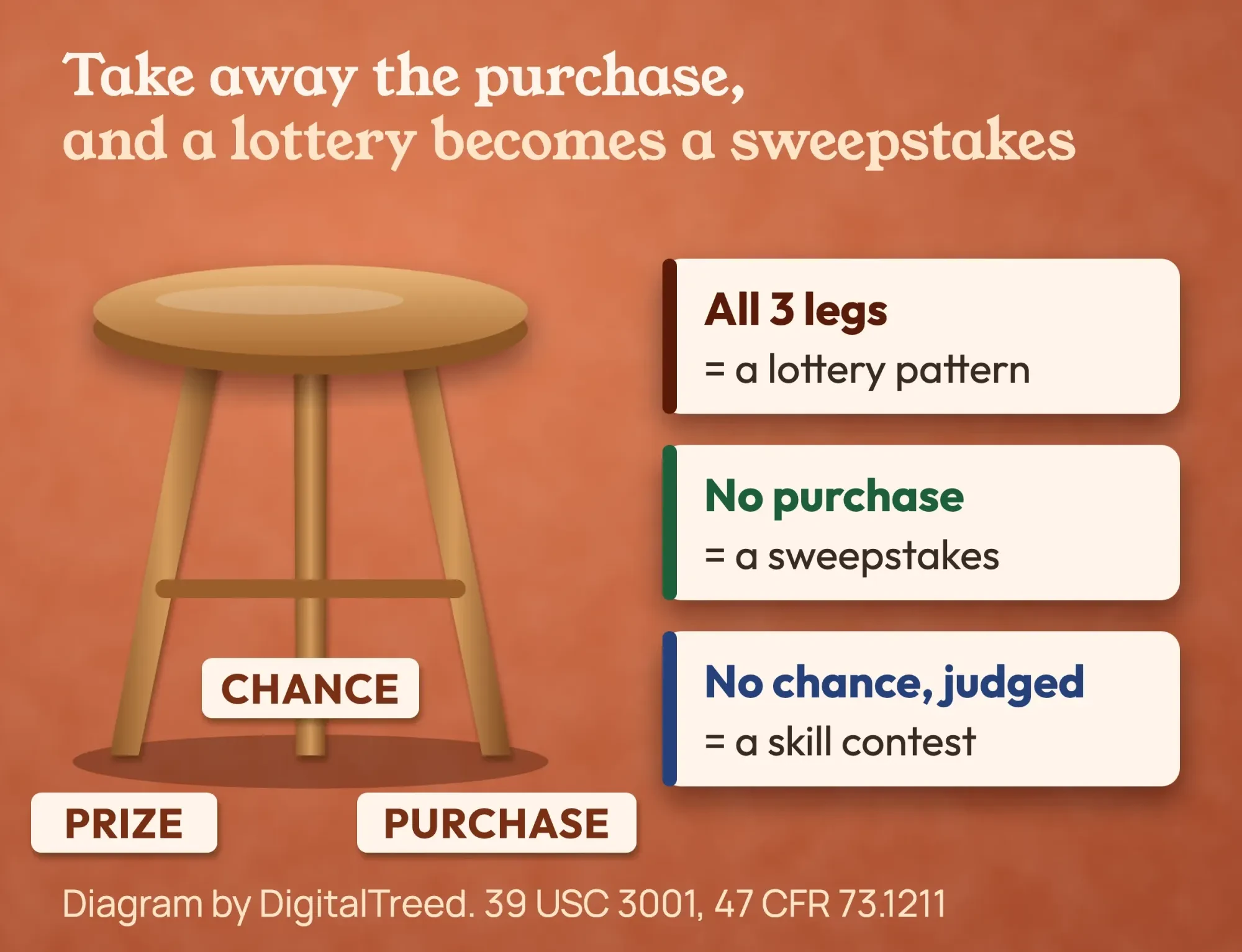 Diagram by DigitalTreed, based on 39 U.S.C. 3001(k) and 47 CFR 73.1211, read October 22, 2026.
Our old post made another mistake: it called "buy one item, get a second free" a giveaway that needs a purchase. A buy-one-get-one deal is a sale, which is fine, but a random draw that needs a purchase is not. The FTC tells consumers "It's illegal to ask you to pay or buy something to enter".
Why every random draw needs "no purchase necessary"
"No purchase necessary" tells people they can enter free, which keeps a random draw a sweepstakes. Florida's section 849.094 also bans requiring "an entry fee, payment, or proof of purchase as a condition of entering."
Want shop customers in the draw too? Offer the same free entry form to everyone. A counter sign with a QR code from our free QR code generator sends people to the form, and nobody has to buy.
What must your giveaway official rules say?
Meta's section 7 asks for official rules but doesn't list what goes in them. The federal mail rule in 39 U.S.C. 3001(k) is a good model. It asks mailed sweepstakes to state the odds and "the quantity, estimated retail value, and nature of each prize." Cover these points:
- Who runs it: your business name and address.
- "No purchase necessary. A purchase will not improve your chances of winning."
- Who can enter: age, the states or country, and "void where prohibited." Many sponsors also exclude staff and their families.
- Start and end date and time, with the time zone.
- How to enter, and how many entries each person gets.
- The prize, how many, and the estimated retail value in USD.
- The odds, such as "odds depend on the number of eligible entries."
- How and when you pick the winner, how you contact them, and what happens if they don't answer.
- Taxes are the winner's job, and you send a 1099-MISC for prizes of $2,000 or more.
- The Meta release and the "not sponsored" line from section 7.
- For a skill contest: the judges, the judging criteria, and your right to use entries.
If you collect emails or phone numbers, say so in the rules. Section 8 of the Meta Pages policy says people "must explicitly consent to your use of their data" first. You must also "clearly explain that you (and not Meta) are collecting this data" on the form or in the rules.
Free Facebook giveaway rules template (copy and paste)
Copy this template to a page on your website, fill in every part in [brackets], and delete the lines you don't need. It follows the checklist above, Meta's sections 7 and 8, and the IRS 1099-MISC line. If prizes total over $5,000, read the state filings below first. Have an attorney read your final version.
Note
OFFICIAL RULES: [Giveaway name]
NO PURCHASE NECESSARY TO ENTER OR WIN. A PURCHASE WILL NOT IMPROVE YOUR CHANCES OF WINNING.
1. Sponsor: [Business name, street address, city, state].
2. Who can enter: Legal residents of [the 50 US states and DC] who are [18] or older. Employees of the sponsor and their families can't enter. Void where prohibited.
3. Dates: The giveaway starts [date, time, time zone] and ends [date, time, time zone].
4. How to enter: [Comment on the giveaway post on our Facebook Page / Fill in the free form at URL]. Limit [one] entry per person. Shares, tags and likes don't earn entries.
5. Prize: [Number] prize(s) of [description]. Estimated retail value: $[amount] each, $[total] in all.
6. Odds: The odds of winning depend on the number of eligible entries.
7. Picking the winner: On [date], the sponsor will draw [number] winner(s) at random from all eligible entries. [For a contest: judges score entries on [criteria].]
8. Contacting the winner: We'll message the winner only from our Facebook Page, [Page name], by [date]. If the winner doesn't reply within [number] days, we'll pick another winner.
9. Taxes: The winner pays any taxes on the prize. For a prize worth $2,000 or more, the sponsor files Form 1099-MISC.
10. Your data: The sponsor, not Meta, collects entrant information. We use it only to run this giveaway [and, if you agree, to send our emails].
11. Meta: This giveaway is in no way sponsored, endorsed or administered by Meta, or linked to Meta. Entrants fully release and hold Meta harmless from all liability.
For entries on Instagram too, add the same release and line naming Instagram. This is general information, not legal advice; check with an attorney.
How to do a giveaway on Facebook, step by step
To do a giveaway on Facebook, pick a sweepstakes or a contest and write official rules. Then choose a free entry method with no shares or tags, post it on your Page, and pick the winner the way your rules say. The 8 steps below take about an hour of setup.
Run a Facebook Page giveaway that follows the rules
- Pick the type A sweepstakes is a random draw with free entry. A contest is judged on skill, such as the best pie photo against stated criteria.
- Pick the prize Choose a product, service or experience, and write down its retail value. Keeping the total at $5,000 or less avoids the Florida and New York filings.
- Write and publish the official rules Put them on a page of your own website, so the post can link to them. Use the checklist above.
- Pick a safe entry method A comment on the Page post or a free form on your site. No shares, reposts, tags or extra entries for them.
- Tag the rules link Add UTM tags so Google Analytics shows how many visits the giveaway sent. Our free UTM builder does it in a minute.
- Write the post Include the prize, dates and time zone, how to enter, "No purchase necessary," the Meta lines and the rules link.
- Pick the winner Draw at random from eligible entries, or judge by the stated criteria. Record the draw on screen and keep the record.
- Contact, deliver and announce Message the winner only from your Page, as your rules say. Announce the name only with their permission.
For step 5, we ran our free UTM builder on October 22, 2026, for a made-up bakery rules page. We used source facebook, medium social and campaign pie-giveaway-nov. The tool showed that Google Analytics files those visits under Organic Social.
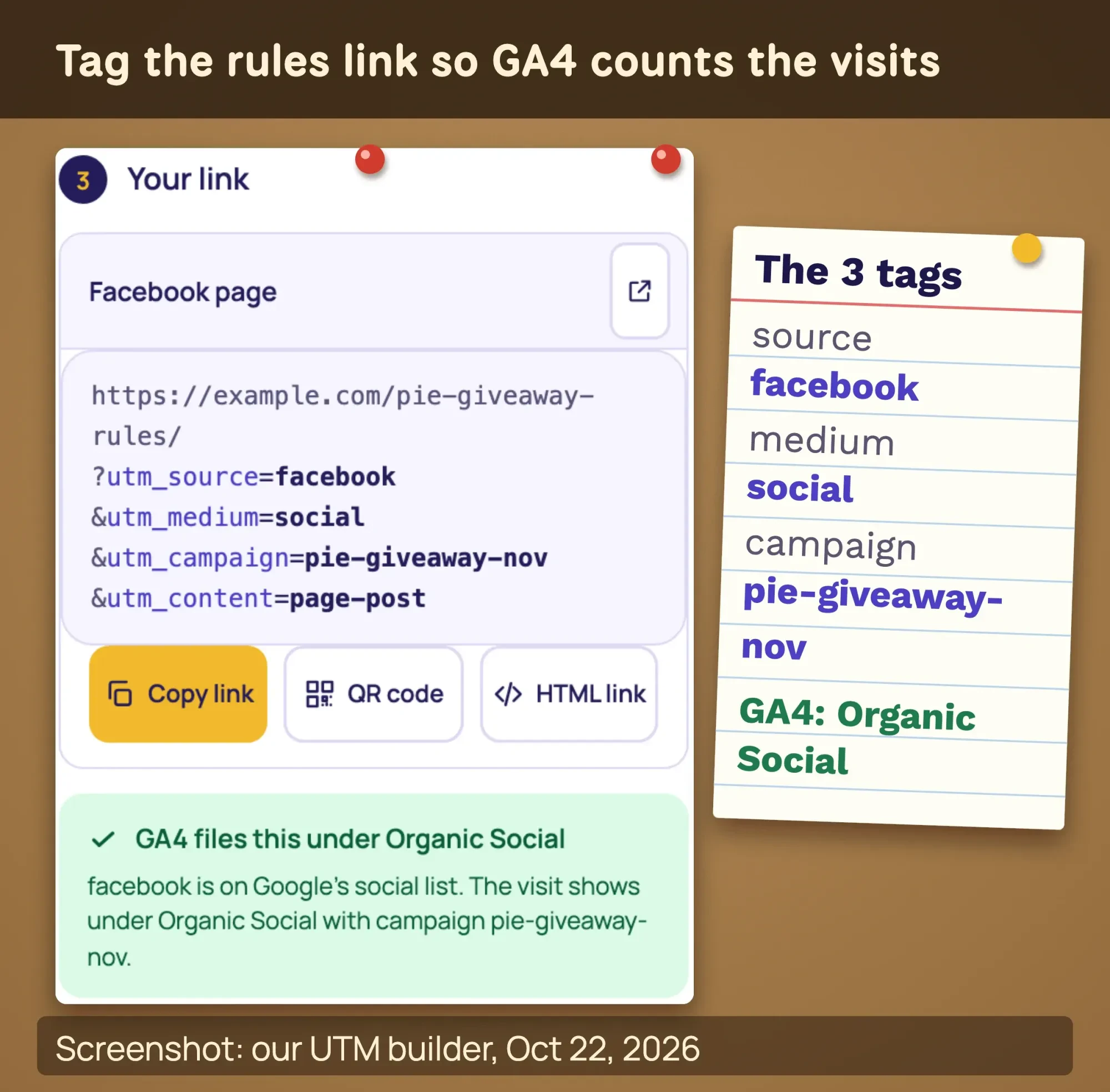 Screenshot: DigitalTreed's free UTM builder, October 22, 2026, with a made-up example.com link.
Steps 3 and 4 are where giveaways usually go wrong. If you'd rather not do it alone, our social media marketing service can run the giveaway with the rules in place. (DigitalTreed sells this service.)
How do you pick a Facebook giveaway winner fairly?
Pick the winner exactly the way your official rules say, from a clean list of eligible entries. For a random draw, we suggest these steps:
- Copy every comment and form entry into a spreadsheet after the giveaway closes.
- Remove duplicates, late entries and anyone your rules exclude, and note why.
- Number the rows, then draw one number with a random number generator.
- Record your screen while you draw, and keep the list and the video.
Comment-picker apps do the same job faster. Pick one that shows which entries it left out and why, so you can answer anyone who asks.
Do you need to register your giveaway?
Only in some states. Florida and New York require a filing when a random-draw giveaway's prizes total more than $5,000. New York's General Business Law section 369-e covers chance promotions with prizes "in excess of five thousand dollars" in total. You file with the Secretary of State at least 30 days before the start and pay a $100 fee, as of October 2026. You also need a trust account or a bond for the prizes.
Florida's section 849.094 sets a similar $5,000 line. It asks for a filing at least 7 days ahead, a $100 fee and a trust account or surety bond. We covered Florida in more detail in our Instagram Story ideas for business guide.
The paperwork doesn't end at the draw. New York's General Business Law section 369-e wants a list of winners of prizes over $25 within 90 days after the giveaway ends.
Florida's section 849.094 asks for a similar certified list within 60 days after the winners are picked. Both rules apply only to giveaways that had to file.
Facebook posts reach every state. If your prizes total more than $5,000, either limit entry to states you have checked, or have an attorney handle the filings. This is general information, not legal advice; check with an attorney.
Do winners pay tax on giveaway prizes?
Yes. IRS Publication 525 says a prize from a drawing or contest must be included in income. Prizes "in goods or services" count "at their FMV," which means fair market value.
Your side is the paperwork: per the IRS instructions for Form 1099-MISC, the threshold for prizes "increased to $2,000" for "tax years beginning after 2025." So for tax year 2026, you file a 1099-MISC, box 3, for a prize worth $2,000 or more. Some giveaway guides still quote the old, lower figure.
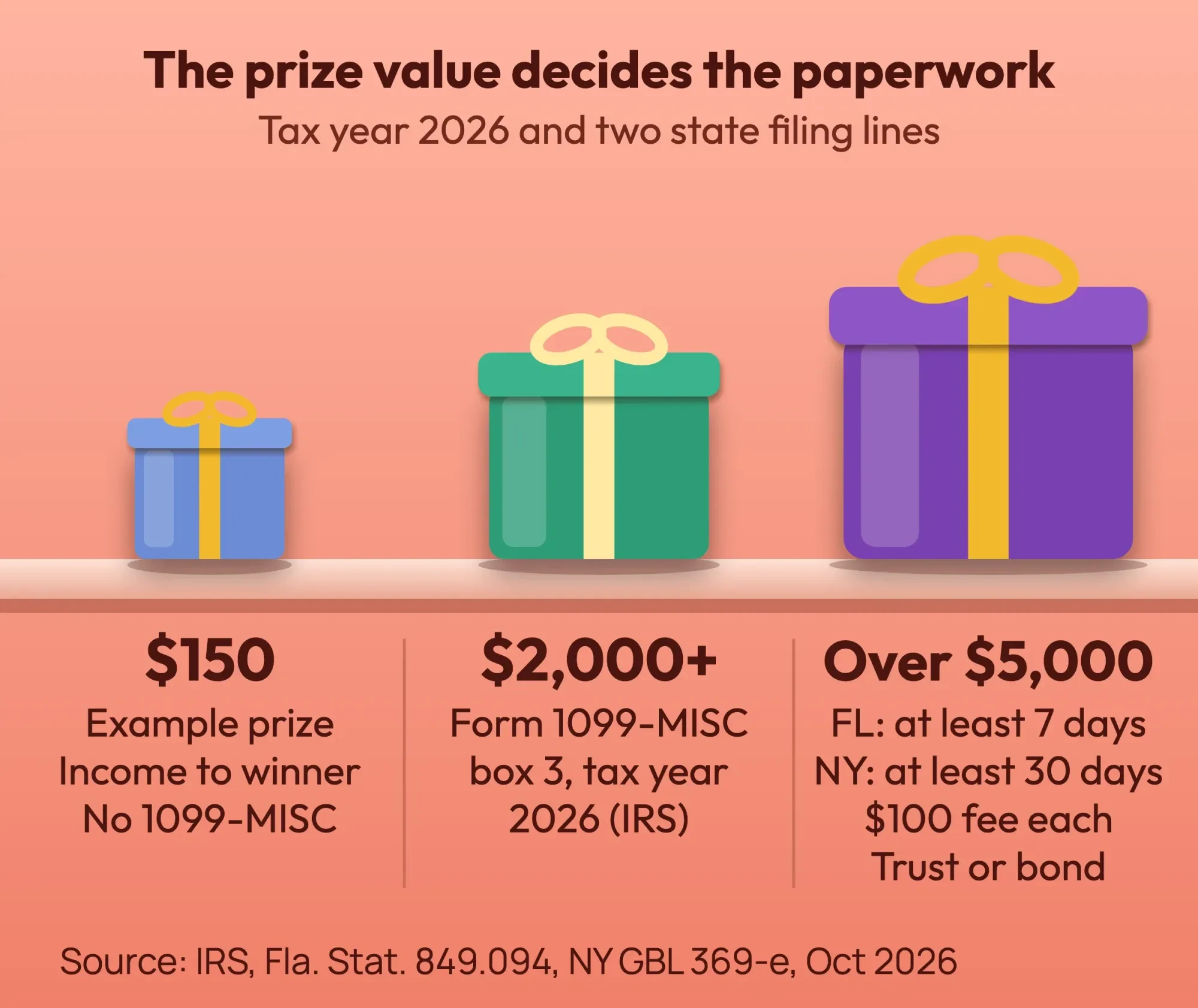 Source: IRS 1099-MISC instructions, Fla. Stat. 849.094 and N.Y. Gen. Bus. Law 369-e, read October 22, 2026.
The IRS says the $2,000 figure may be adjusted for inflation from 2027, so check it again next year. Our reading is that the threshold counts everything you paid one winner in the year. This is general information, not tax advice; check with a CPA.
Do entrants need #contest in their posts?
Only when the entry is a post about you, such as a pie photo on the entrant's own profile with your hashtag. For those posts, the FTC Endorsement Guides FAQ says #XYZ_Contest or #XYZ_Sweepstakes "should be enough" as a disclosure. Giving away tokens or crypto prizes adds securities and ad-platform rules, which our guide to crypto marketing within US rules covers. It also says "the word ‘sweeps’ probably isn't" clear enough.
Tell entrants to put the hashtag at the start of the post. The rules behind this sit in 16 CFR Part 255. In our view, a plain comment on your own Page post is not a separate endorsement.
Hosting with a local creator? The FTC's Disclosures 101 for social media influencers says to "disclose when you have any financial, employment, personal, or family relationship with a brand." If a brand pays you to run a giveaway on your blog, our guide to labeling sponsored blog posts explains the FTC disclosure.
How do you keep your giveaway from looking like a scam?
Fake giveaways copy real ones, so make yours easy to check. The FTC prize scam page warns consumers that "If you have to pay to get your prize, it's a scam." It adds that there is "absolutely no reason" to give a bank account or card number to claim a prize.
- Never ask a winner for a fee, a shipping charge or bank details.
- Say in the rules that you'll message winners only from your Page, and when.
- Warn entrants in the post about copycat accounts.
- Use a rules page on your own website, with your business name and address.
Before you post, run the rules link through our social preview checker. It shows the title and image people will see, so a blank or broken card doesn't make a real giveaway look fake.
Example: a pie giveaway for a bakery in Columbus
Example: Maple & Rye is a made-up bakery in Columbus, Ohio. It wants more email signups before Thanksgiving pie orders open.
- Prize: one pie a month for 3 months at $30 each ($90), plus a $60 apron and mug set. Total retail value $150, as of October 2026.
- Entry: comment your favorite fall pie on the Page post, or use the free form on the website. No shares, no tags, one entry each.
- Dates: November 2 to 9, 2026, ending at 11:59 p.m. ET. The winner is drawn at random on November 10.
- Paperwork: $150 is under the $2,000 1099-MISC line and the $5,000 filing lines. It is still income to the winner.
The post goes up at a time the bakery's fans are online. Our guide to the best time to post on Facebook shows how to find it. This is the post text, with the rules link tagged as in step 5:
Note
Pie giveaway! Win a pie a month for 3 months plus our apron and mug set (value $150). To enter, comment your favorite fall pie below, or use the free form on our site. One entry per person. Open to US residents 18+. Ends Nov 9, 2026, 11:59 p.m. ET. No purchase necessary. We'll message the winner only from this Page on Nov 10. This giveaway is in no way sponsored, endorsed or administered by Meta, or linked to Meta. Entrants fully release and hold Meta harmless from all liability. Rules: example.com/pie-giveaway-rules
We didn't check Ohio's own rules for this example. A real Ohio bakery should.
Frequently asked
Is it legal to run a giveaway on Facebook?
Yes, if it follows Meta's section 7 and US law. Meta says you are responsible for following the law, and it won't help run your promotion.
Can I ask people to share the post to enter?
No. Meta bans requiring or rewarding shares, reposts and tags. Ask for a comment or a form entry instead.
Can I run a giveaway from my personal profile?
Use your business Page. Section 7 covers Pages, groups and Events, and the Monetization Promotion Guidelines say personal Timelines must not be used to run promotions.
Do I need "No purchase necessary" on a giveaway?
For a random draw, yes in practice. A required purchase turns it into a lottery pattern, and Florida bans proof of purchase as a condition of entry. Check with an attorney.
Can I give away cash on Facebook?
Yes, with free entry that isn't tied to engagement. Meta's Community Standards on spam ban cash giveaways "in exchange for engagement," such as likes. A cash prize of $2,000 or more also needs a 1099-MISC.
Can I give away a gift card?
Yes, with free, rule-following entry. Don't tie it to likes or follows. Meta bans cash or cash-equivalent giveaways for engagement, and doesn't say whether a gift card counts.
Your next step
Write your official rules first, on your own website. Then build the post around them: free entry, no shares or tags, and the 2 Meta lines.
If you want help planning the giveaway, the post and the follow-up, our social media marketing service can run it with you.
How we made this guide: it's built from Meta's policies and Community Standards, FTC guidance and the eCFR. We also used the U.S. Code on govinfo.gov, the Florida Statutes, the New York General Business Law and IRS instructions. On October 22, 2026, we re-read Meta's section 7 and the IRS $2,000 threshold and built the rules link in our UTM builder. Every source is linked where we use it, and we checked every number against it the same day. Updated October 23, 2026: added group, Event and Instagram rules and a copy-and-paste official rules template. We also added how to pick a winner fairly, the Florida and New York winner lists, key facts and a cash prize FAQ.
First published July 2023. Rewritten October 2026: Meta's section 7 line by line, no share-to-enter, sweepstakes vs lottery law, a rules checklist, state filings and the $2,000 tax line.
Sources
- Meta: Facebook Pages, Groups and Events Policies, sections 7 and 8
- Meta Transparency Center: Community Standards, Spam
- Meta Transparency Center: Content distribution guidelines, Engagement bait
- Meta Business Help: Monetization Promotion Guidelines
- 39 U.S.C. 3001, nonmailable matter (govinfo.gov, 2023 edition)
- 47 CFR 73.1211, broadcast of lottery information (eCFR)
- FTC: Fake prize, sweepstakes and lottery scams
- FTC: Endorsement Guides, what people are asking
- FTC: Disclosures 101 for social media influencers
- 16 CFR Part 255, Guides concerning endorsements (eCFR)
- The Florida Statutes: section 849.094, game promotions
- New York General Business Law section 369-E
- IRS: Instructions for Forms 1099-MISC and 1099-NEC
- IRS Publication 525, Taxable and nontaxable income
- Instagram Help Center: Promotion Guidelines
Comments
No comments yet. Start the conversation below.