
Quick answer
Sponsored blog posts are legal in the US, but two sets of rules apply. The FTC wants the paid relationship labeled where readers can't miss it, and the start of the post is the safe spot. Google wants every paid link marked rel="sponsored" or nofollow. Skip the label and the brand and the blogger can both be on the hook.
A sponsored blog post is a post that a brand pays for, in money, free products or other perks, and that runs on someone else's blog. The blogger may write it, or the brand may supply the draft. Either way, readers see an article rather than a banner, and that's exactly why the label matters.
This guide covers both sides of that deal in the US: the business buying a post and the blogger selling one. We read the FTC's rules and Google's link policies line by line, then tested where a label actually lands on a phone screen.
Key takeaways
- Disclose any brand connection a reader wouldn't expect, including free products.
- Put "Sponsored by [brand name]" as the first line under the title.
- Google wants every paid link marked rel="sponsored".
- The rel attribute tells Google about the link but tells readers nothing.
- The brand, the blogger and the agency can all be liable.
The brand, the blogger and the agency all carry the duty
That label isn't only the blogger's job. The FTC's Endorsement Guides, revised in July 2023, say advertisers are subject to liability for "failing to disclose unexpected material connections" with the people who endorse them. The same section tells brands to guide their endorsers, monitor them and fix problems they find.
The blogger is on the hook as well. "Endorsers may be liable for statements made in the course of their endorsements," the section says, and agencies, PR firms and review brokers can be liable for their part in a post that hides a paid tie.
In practice, the FTC says its focus usually will be on advertisers or their ad agencies and PR firms. That's a reason for the brand to be the careful party. It isn't a reason for a blogger to skip the label.
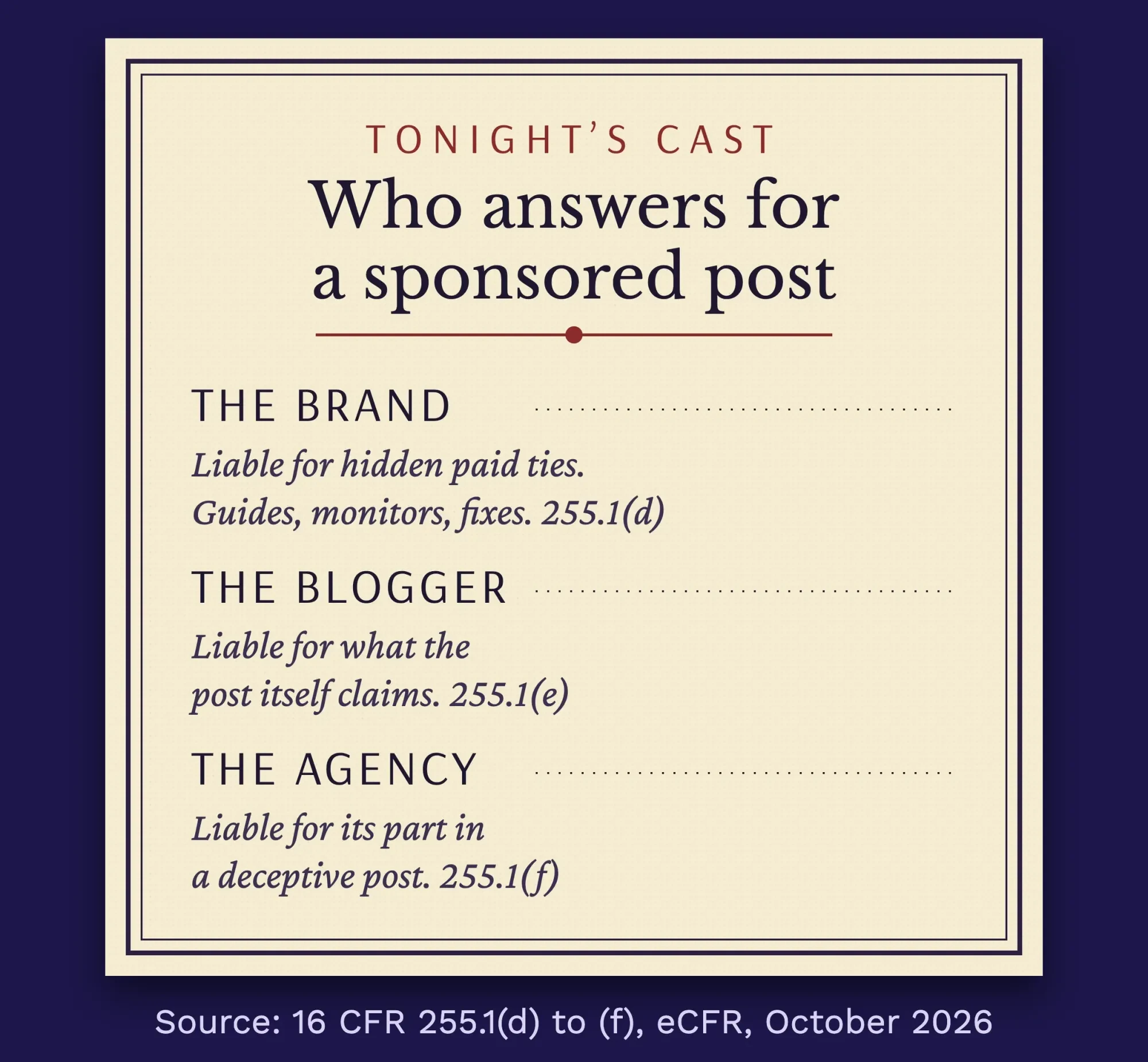 Diagram by DigitalTreed, from 16 CFR 255.1(d) to (f), October 2026.
A real case shows how this plays out. In 2016 the FTC settled with Lord & Taylor, which had placed a paid article it edited in Nylon and paid 50 fashion influencers $1,000 to $4,000 each to post photos of one dress. None of the posts said they were paid. The order barred the retailer from presenting paid ads as coming from "an independent or objective source." That release names no fine, but the company was now under an FTC order.
Sponsored post disclosure: the FTC rules in plain words
Those duties come down to one rule. If you got money, free products or any other perk from a brand, and your readers wouldn't expect that, you have to tell them clearly. For a blog post, the Guides and the FTC's own answers break it into six parts:
- Disclose any connection a reader wouldn't expect. Section 255.5 names money and "free or discounted products," and says they count "regardless of whether the advertiser requires an endorsement in return."
- Make it clear and conspicuous. The Guides define that as difficult to miss and easily understandable, and online the disclosure "should be unavoidable."
- Put it before the pitch, inside the post. The FTC's FAQ doesn't fix one spot, but it says a label "in the middle or at the end of a post is easier to miss," that a label up in the page header, outside the blog, can be overlooked too, and that one disclosure on your home page won’t be sufficient.
- Use plain words. "Advertisement," "ad" and "sponsored" are fine under Disclosures 101; "sp," "spon" and "collab" are not.
- Label affiliate links too. The Guides' own coffee blog example says commission links need a clear disclosure, and the FAQ accepts "Paid link" right next to the link.
- Don't sell rankings. If a brand pays for a higher spot in a "best of" list, the Guides call those rankings deceptive, and a disclosure won't fix it.
The FTC's native advertising guide adds one detail for posts that look like articles: put the label in front of or above the headline. It also warns against vague words such as "Promoted."
Our take: make "Sponsored by [brand name]" the first line under the title. It's short, it names who paid, and the FTC's FAQ calls "Sponsored by XYZ" clearer than a bare "Sponsored."
Where the label lands on a phone: our test
That top-of-post advice can sound fussy until you scroll a real page. So we built three copies of the same made-up 1,507-word sponsored post and measured them in Google Chrome 155, at a 390-pixel phone width and at 1,280 pixels on desktop. The test ran October 24, 2026.
Only the label changed. One copy had it at the top of the post body, one at the end, and one had none, just a footer link to an "About and disclosure policy" page.
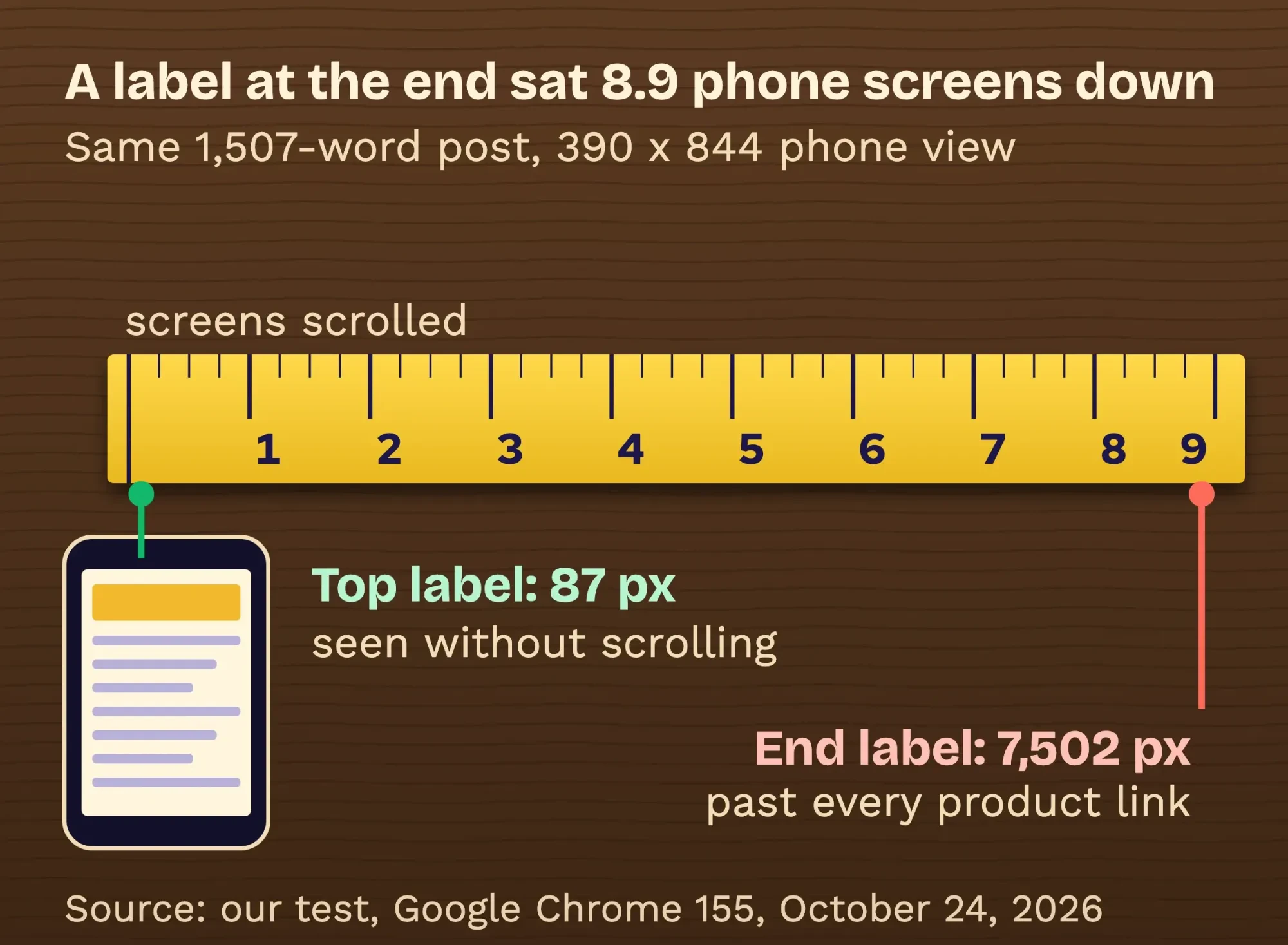 Diagram by DigitalTreed: our phone test on three made-up pages, Google Chrome 155 at 390 x 844, October 24, 2026.
The top label started 87 pixels down and showed on the first screen at both widths. The end label started 7,502 pixels down on the phone, so a reader had to scroll about 8.9 screens to reach it, past every product link. On desktop it took about 6 screens. The footer-only copy never showed a label inside the post at all, which is the setup Disclosures 101 warns about when a disclosure sits only on an About page.
The second result mattered more.
The link marked rel="sponsored" looked exactly like a plain link: same blue, same underline, same weight and size.
Readers can't see rel.
It tells Google about the link and tells people nothing, so it can't stand in for the label, and the label can't stand in for it.
Example: Riffle & Rye Fly Shop, a made-up shop in Bozeman, Montana, pays Big Sky Riffles, a made-up fly-fishing blog, to cover its spring gear. The version that passes opens with "Sponsored by Riffle & Rye Fly Shop. We got the waders free." The shop's links carry rel="sponsored", and the blogger's verdict on the waders stays the blogger's.
Google wants every paid link marked rel="sponsored"
That invisible attribute is the whole of Google's rule, and it's separate from the FTC's.
rel="sponsored" is a link attribute that tells Google a link was paid for. Google's page on outbound links says to mark links that are advertisements or paid placements with it. Nofollow "is still an acceptable way to flag them, though sponsored is preferred."
The rule behind that is Google's link spam policy. Its examples include "Exchanging money for links, or posts that contain links" and "Sending someone a product in exchange for them writing about it and including a link." It names paid advertorials whose links pass ranking credit, too. Yet the same policy says paid links are fine "as long as they are qualified" with nofollow or sponsored.
That's the part the old version of this post got wrong.
Buying a sponsored post to boost your backlink profile is exactly what Google calls spam. Links that help rankings have to be earned backlinks, and our off-page SEO checklist marks which link tactics to do and which to skip.
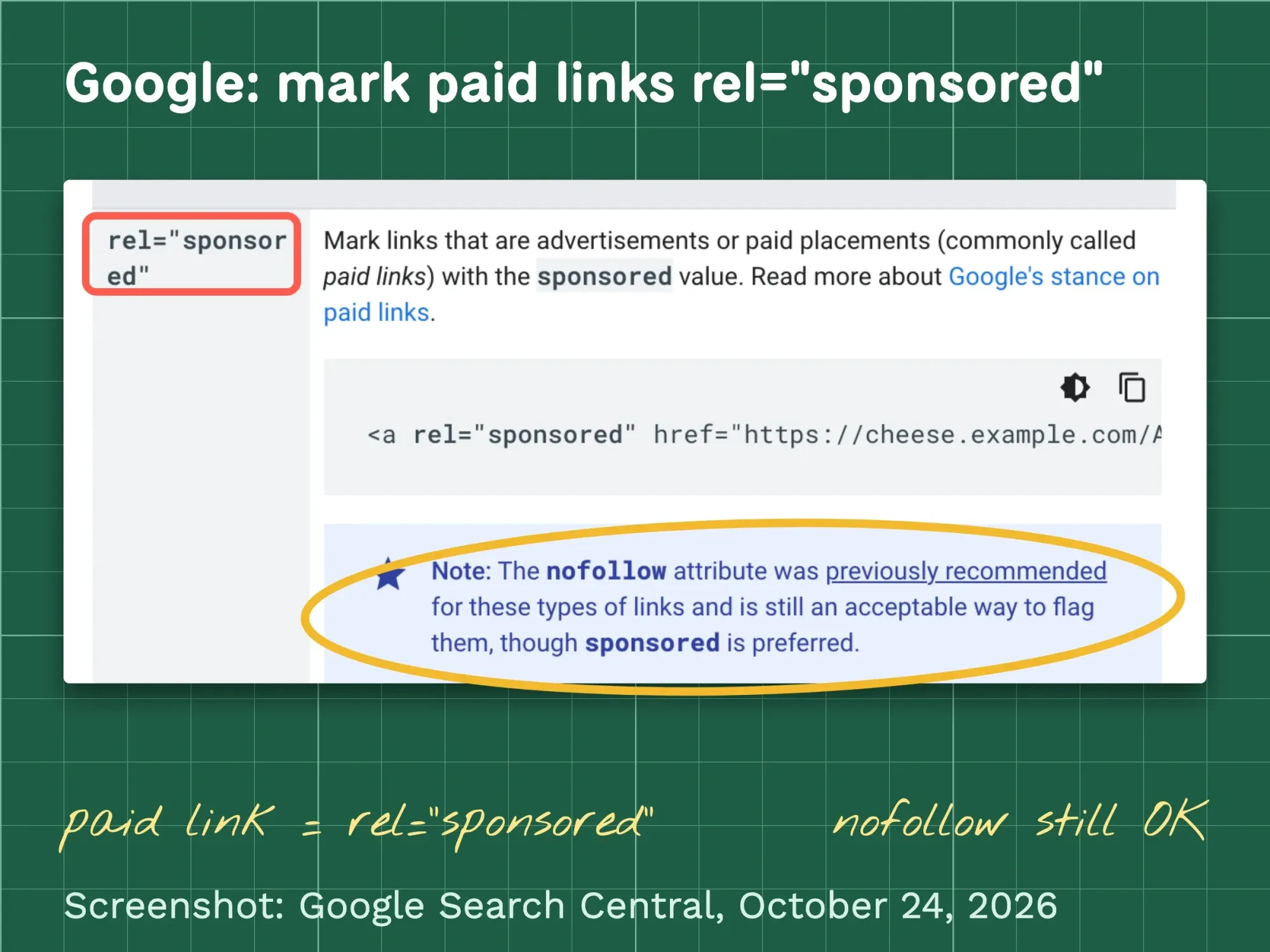 Screenshot: Google Search Central, Qualify your outbound links, taken October 24, 2026; notes by DigitalTreed.
Ignoring it can cost search visibility. Google's help page on the Unnatural links from your site manual action tells site owners to find links "that were paid for" and remove them or add nofollow or a more specific attribute. Its spam team also warned in 2017 that publishing articles with spammy links could affect its ranking.
Hand-typing the attribute in a CMS is easy to get wrong. Our free hyperlink generator builds the tag with rel="sponsored" ticked and shows a preview, so you can paste a clean link into the post. You can stack values, too: Google's 2019 announcement says rel="ugc sponsored" is valid.
One more Google rule matters if you sell posts in bulk. Its site reputation policy allows advertorials meant for your readers, but not third-party pages hosted mainly to borrow your site’s ranking signals.
Paid reviews and fake testimonials fall under a stricter rule
Beyond links, a sponsored post can also run into the FTC's newer rule on fake reviews. That rule, codified at 16 CFR 465, took effect October 21, 2024. Unlike the Guides, it's a rule, so the FTC can seek civil penalties against knowing violators.
It's narrower than many blog posts suggest. Its "consumer review" means a review on a site built to collect reviews, and a blog post isn't one. Still, four parts of the rule reach sponsored content directly:
- Fake testimonials: no business may write, create or sell a testimonial from someone who doesn't exist or never used the product (section 465.2).
- Paying for a mood: no paying for consumer reviews that express "a particular sentiment, whether positive or negative" (section 465.4).
- Fake independence: a review site a business controls can't pose as independent (section 465.6).
- Fake influence: knowingly buying or selling fake followers or views to fake influence for business use is banned (section 465.8).
So a brand can pay a blogger to review its product.
What it can't do is pay only for a glowing review, or hand the blogger made-up customer quotes to paste in.
What happens if a sponsored post isn't labeled?
So what does a missing label cost? The money risk depends on which rule you break. The Endorsement Guides aren't a penalty rule by themselves; they're the FTC's reading of section 5 of the FTC Act, usually enforced through orders like Lord & Taylor's. The reviews rule works differently. A knowing violation there can bring a civil penalty as high as $53,088 for each violation, the cap the eCFR lists as current in October 2026.
Per violation, not per campaign.
The FTC's FAQ adds that companies that received its Notice of Penalty Offenses on endorsements and then broke those rules could face substantial civil penalties.
On the Google side, the cost is traffic. A manual action stays on the site until the paid links are fixed and you request a review in Search Console. Until then, Google says affected pages are usually ranked lower or omitted from results.
A fair sponsored post deal, clause by clause
That's why the deal matters most: these problems usually start there, not in the post. Put these clauses in writing before anyone drafts a word. Each one points to the rule it protects you from, so either side can check it.
| Clause | What it says | Rule behind it |
|---|---|---|
| Label | "Sponsored by [brand]" is the first line of the post body | FTC Guides 255.5; FTC FAQ on placement |
| Paid links | Every link the brand asked for carries rel="sponsored" | Google link spam policy |
| Free products | Gifts, trips and discounts are disclosed too | FTC Guides 255.5(a) |
| Honest verdict | The opinion is the blogger’s; pay is not tied to a positive tone | FTC Guides 255.1; Part 465 for review sites |
| Claims check | The brand confirms every product claim it supplies is true | FTC Guides 255.1(d) |
| No paid rank | Money never buys a higher spot in a "best of" list | FTC Guides 255.4 |
| Monitoring | The brand checks the live post and asks for fixes | FTC Guides 255.1(d) |
| Tracking | The brand link carries UTM tags, with no ranking promise | Our advice |
| Term | How long the post stays live and who may edit it | Our advice |
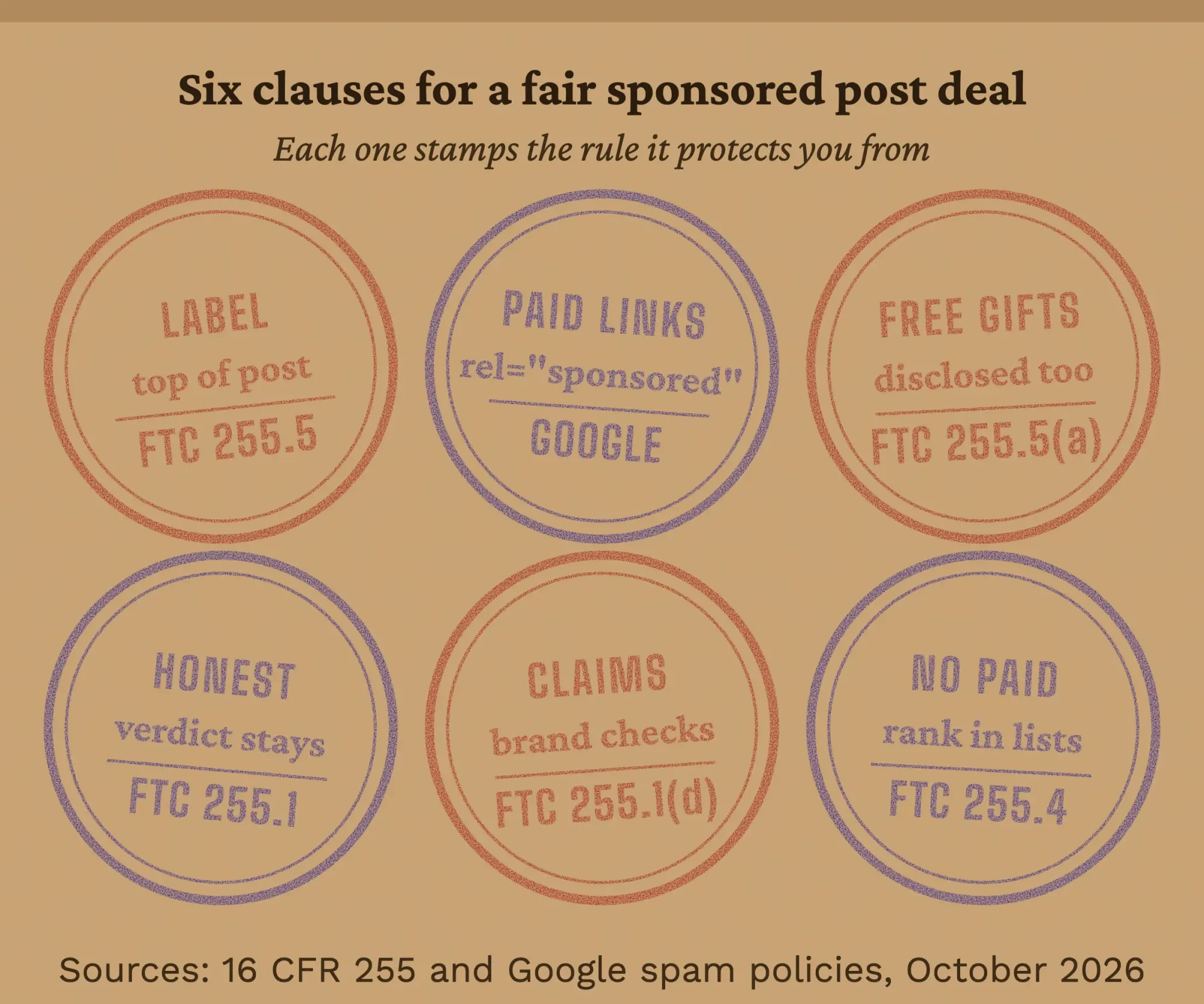 Diagram by DigitalTreed: the deal clauses and the rule behind each, October 2026.
The last two rows are our advice, not law.
Tag the brand's link with our UTM builder so the brand can see visits from the post in its analytics, and agree on how long the post stays up. Neither rule mentions either one, but both save an awkward email later.
What about price? We couldn't find any primary-source data on US blog rates, and the ranking guides give only unsourced ranges. The price follows the blog's real audience, how much writing the blogger does and how long the post stays live. Before you agree to a number, ask for the blog's media kit with traffic proof.
Before you publish or pay: a short check
Once the deal is signed, run this check on the draft and again on the live post.
- Read the deal for a "dofollow" or "no label" clause, and refuse it.
- Put the label under the title, naming the brand.
- Open the page source and confirm rel="sponsored" on each paid link.
- Load the post on a phone: the label should show before you scroll.
- Check each product claim against what the brand can prove.
- Save the deal, the draft and the brand's notes.
Running a giveaway inside the post? That adds contest rules, which our guide to Facebook giveaway rules covers, along with the FTC's contest disclosure. For video and social posts the same FTC idea applies, and our beginner’s guide to influencer marketing explains how those deals usually work.
Once the post is live, promote it like any other article. Our plan for promoting a business blog post works the same way, as long as every reshare keeps the label. For where paid links sit in a wider link plan, see the links chapter of our intermediate SEO guide.
If you sell sponsored posts, write your rule down once and send it with every quote: the label goes at the top of the post, and every link to the sponsor carries rel="sponsored". A sponsor who won't accept that rule is asking you to carry their risk.
And if you'd rather build rankings without paid posts, our SEO team plans link work for US small businesses. That's a paid service of ours, which is worth knowing as you weigh this suggestion.
Frequently asked
Do I have to disclose a sponsored post if I only got a free product?
Yes, if your readers wouldn't expect it. Section 255.5 lists "free or discounted products" as a material connection, and its woodworking example says a creator who got a free lathe should say so.
Is "#sp" or "collab" enough as a label?
No. Disclosures 101 calls "sp," "spon" and "collab" vague and tells creators not to use them. "Ad" and "Sponsored" work, and "Sponsored by" plus the brand name is clearer still.
Do sponsored links still help SEO?
Not as ranking credit you paid for. Since 2019 Google treats sponsored, ugc and nofollow as hints it may use or ignore, and paid links that pass ranking credit are link spam. A sponsored post can still send visitors.
Does the label need to be in Spanish if the post is?
Yes. The FTC's Endorsement Guides FAQ says to disclose "in whatever language or languages the endorsement is made."
This guide explains the federal rules as they stood October 24, 2026, and it isn't legal advice for your deal. If a contract or a large campaign depends on it, ask a US advertising lawyer to read it first.
How we made this guide: our team read the Endorsement Guides and the reviews rule in the eCFR, the FTC's FAQ, Disclosures 101 and its native advertising guide, and Google's link pages, checking each quote against its page by October 24, 2026. The phone test ran that day on local, made-up pages in Google Chrome 155; no live site or account was touched. Big Sky Riffles and Riffle & Rye Fly Shop are made up. Each fact links to its source where it appears. Eram N. reads and approves this rewrite before it goes live.
First published August 2021. Rewritten October 24, 2026: new sections on FTC disclosure, Google's rel="sponsored" rule, the 2024 reviews rule and penalties, plus our phone test and a deal checklist. The unsourced blog statistics and the advice to buy posts for backlinks are gone.
Sources
- eCFR: 16 CFR Part 255, Guides Concerning Use of Endorsements and Testimonials in Advertising
- Federal Register: Guides Concerning the Use of Endorsements and Testimonials in Advertising (July 26, 2023)
- FTC: FTC’s Endorsement Guides: What People Are Asking
- FTC: Disclosures 101 for Social Media Influencers (November 2019)
- FTC: Native Advertising: A Guide for Businesses (December 2015)
- FTC: Lord & Taylor settles FTC charges (March 15, 2016)
- eCFR: 16 CFR Part 465, Rule on the Use of Consumer Reviews and Testimonials
- Federal Register: Trade Regulation Rule on the Use of Consumer Reviews and Testimonials (August 22, 2024)
- FTC: Final rule banning fake reviews and testimonials (August 14, 2024)
- eCFR: 16 CFR 1.98, Adjustment of civil monetary penalty amounts
- Google Search Central: Qualify your outbound links to Google
- Google Search Central: Spam policies for Google web search
- Google Search Central blog: Evolving nofollow (September 10, 2019)
- Google Search Central blog: A reminder about links in large-scale article campaigns (May 25, 2017)
- Search Console Help: Manual actions report

Comments
No comments yet. Start the conversation below.