

Quick answer
LED signs for business promotion need a local sign permit, a listing label to UL 48 and settings that meet your city's brightness and hold-time rules. An example 500-watt sign run 18 hours a day would cost about $475 a year at the U.S. average commercial price for August 2026, or $758 at New York's price. Call your city's sign or planning office before you sign a quote.
A sign shop has quoted you a programmable LED panel, and you're weighing LED signs for business promotion against more ads. An electronic message center is a sign whose LED panel changes its words or pictures by software. We'd settle the permit and the dimming setup before the price, because Albuquerque, for one, wants the photocell plan on its permit form.
We read sign rules from three cities, the UL 48 scope page and EIA power prices, then scored a made-up sign program and priced an example sign's power and payback.
Key takeaways
- Example settings passed 4 of 4 Bismarck checks and 1 of 3 in Albuquerque.
- Albuquerque requires 8 seconds per message; Bismarck requires 1 second.
- NEC 600.3 requires electric signs to be listed, so check the label.
- An example 500-watt sign run 18 hours daily uses 3,285 kWh yearly.
- With example inputs, a 36-month payback needs about 38 extra sales a month.
What permits does an LED business sign need?
Start with your city, because no federal agency issues a storefront sign permit. The SBA's launch your business guide says it directly: "Zoning laws are typically controlled at the local level, so check with your department of city planning" or a similar office. Ask the clerk whether your sign needs one permit or two: a sign or zoning permit for size and placement, and an electrical permit for the wiring. If it's two, ask whether one fee covers both. Laguna Hills, for one, asks for the electrical details on its sign permit form. Bring the sign's spec sheet, since Albuquerque's form also asks for the software used and how the photocell will operate.
The Laguna Hills, California sign permit form wants scaled plans, landlord approval, the sign's voltage and amperage, and the disconnect switch location. Every sign there goes through plan check. If you rent, get that landlord sign-off first.
Some cities treat a digital sign as a yearly permit, and Albuquerque's electronic sign permit application is one. It's valid for one year. On November 6, 2026 the form said: "The renewal permit fee has not been established as of this date."
Federal highway law covers signs along the Interstate and primary highway systems. There, 23 USC 131 allows on-premise signs "advertising activities conducted on the property on which they are located," electronic ones included. A sign for a business located somewhere else isn't on that on-premise list.
The Supreme Court limits what cities can regulate. In the Reed ruling on the Town of Gilbert's sign code, decided June 18, 2015, the Court held that rules based on a sign's message face strict scrutiny. Seven years later, the City of Austin ruling, decided April 21, 2022, held that an on-premises versus off-premises rule is "facially content neutral." Expect your city's rules to cover size, brightness and timing, not your wording. If you haven't picked a spot yet, our guide to choosing a business location covers checking zoning before you lease.
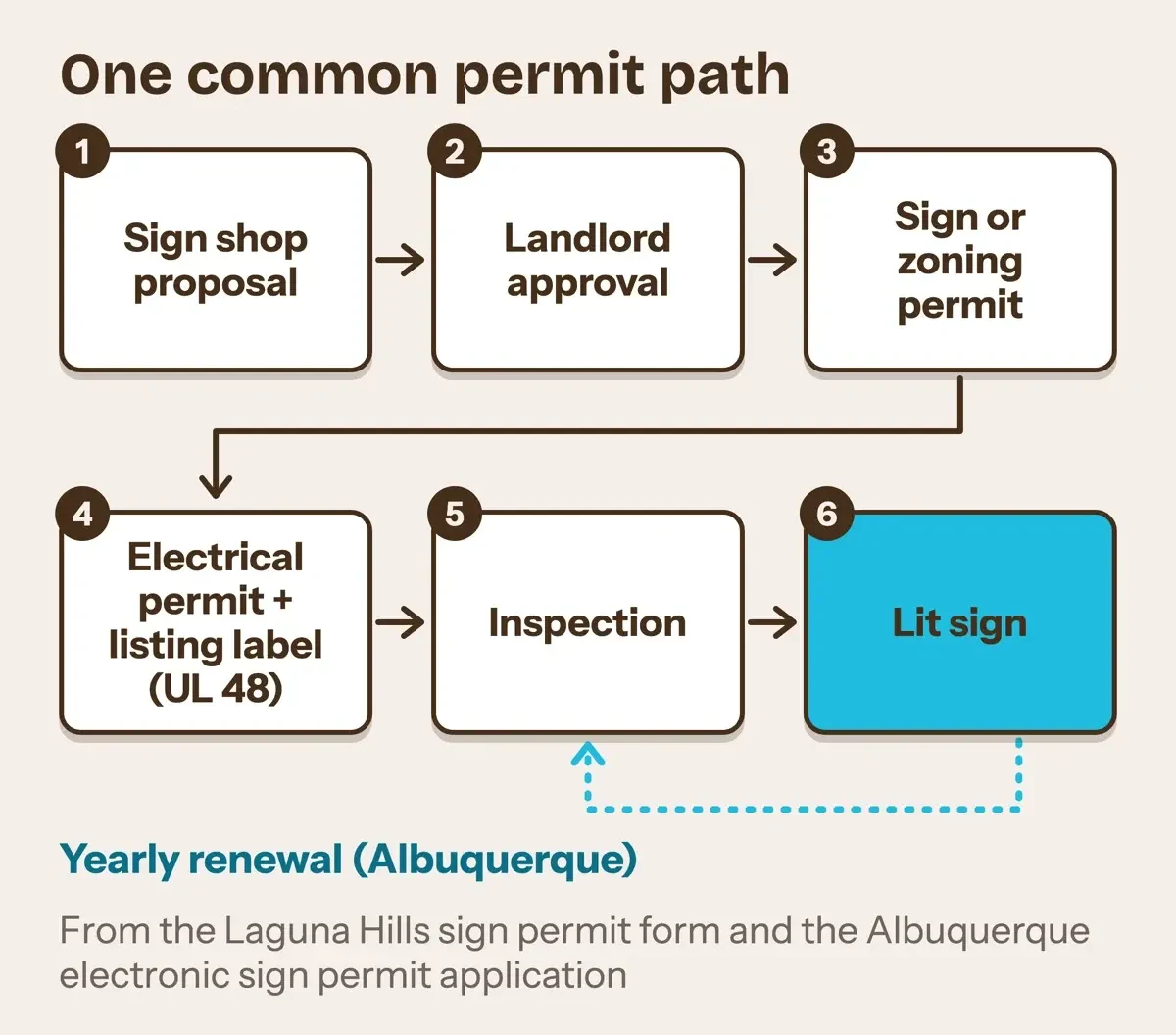 Diagram by DigitalTreed: one common permit path for an on-premise LED sign, drawn from the Laguna Hills and Albuquerque forms.
Check the UL 48 listing before you sign
Zoning rules cover a sign's size and placement; the electrical inspector checks for a listing label. UL 48 is the safety standard for electric signs. Its scope page covers "all electric signs, art forms and outline lighting" used under the National Electrical Code, and it names LED and changing message signs. As of November 2026, Edition 15 is active, and its last revision and ANSI approval are dated May 14, 2025. The code rule behind the label is NEC section 600.3, which the electrical inspectors' association quotes: signs "shall be listed and installed in conformance with that listing." Without a label, the article says, the inspector may inspect the whole product, require a field evaluation or reject the installation.
States and cities write the same rule into their own codes. Washington's WAC 296-46B-600 says all electrical signs "must be listed or field evaluated by a testing laboratory accredited by the department." The Laguna Hills form is blunter: "All signs must be listed by Underwriters Laboratories (U.L.)" and installed per Article 600 of the NEC. OSHA's rules define listed in 29 CFR 1910.399: equipment in a list "published by a nationally recognized laboratory that makes periodic inspection" of its production. Washington's rule wants a disconnecting means per NEC Article 600 on awning signs, and Laguna Hills asks for the switch location on the plans. Make sure it's in the electrician's price.
Email these seven questions to the sign shop and keep the written replies with the contract.
- Which lab lists this sign to UL 48, and where will the label sit on the cabinet?
- Who pulls the electrical permit, and who pulls the sign or zoning permit?
- What are the sign's maximum watts, and its average watts with night dimming on?
- What is its maximum brightness in nits, and can it be set to our city's limit?
- Does it have a photocell, and what does the display do if the photocell fails?
- Can the hold time and transitions be locked to our city's minimums?
- Is a disconnect switch included, and where will it be mounted?
Question five comes from Bismarck's rules, which require a photocell plus a default that freezes the sign if it malfunctions.
Brightness, hold time and dimming rules
Two city documents show how far apart local brightness and timing limits can be: Albuquerque's electronic sign permit form and Bismarck's operational narrative for commercial zones, revised September 25, 2023.
| Rule | Albuquerque, NM (nonresidential) | Bismarck, ND (commercial) |
|---|---|---|
| Brightness | 0.3 foot-candles above ambient light | 0.3 foot-candles above ambient light |
| Minimum time per message | 8 seconds | 1 second |
| Transitions | 1 second or less, no visual effects | Entrance effects that read in order; right-to-left scroll allowed |
| Motion | No apparent motion or animation from light changes (twinkling excepted) | Full-motion video prohibited |
| Dimming | Owner states how the photocell will operate | Photocell required; sign freezes if it malfunctions |
| Night cap | 320 footlamberts at night | Not stated |
Both cities use the same brightness test: no more than 0.3 foot-candles above the light already there. Neither document gives the measuring distance, so ask your city how its inspector takes the reading; Albuquerque also caps night luminance at 320 footlamberts in nonresidential zones. If a spec sheet lists brightness in nits, that's candelas per square meter, and NIST's conversion table puts one footlambert at 3.426259 of them. So 320 footlamberts is about 1,096 nits. The 200-footlambert cap near homes is about 685. Hold the shop's maximum-nits answer from the email list against those two numbers.
Bismarck's form shows how detailed effect rules get. It bans left-to-right and top-to-bottom entrance scrolls and effects like slot machine and spin, and it says: "The use of full-motion video is prohibited."
Albuquerque's form says a transition "shall not include any visual effects." Before the installer leaves, have them set the hold time, transition and photocell to your city's numbers. Then photograph the settings screen.
Albuquerque applies the stricter of two rule sets to any sign within 40 feet of a residential zone. Its night cap there is 200 footlamberts, and only one sign per premises may be lit from 10:00 p.m. to 7:00 a.m., apart from general lighting. Outside that 40-foot band, a sign may change brightness only if it isn't within 200 feet of a residential zone and visible from it. Bismarck's form asks the owner to list the sign's operating hours and pass the rules to any tenant who runs it. If your lot backs onto houses, read this part of your own code before you pick a spot for the sign.
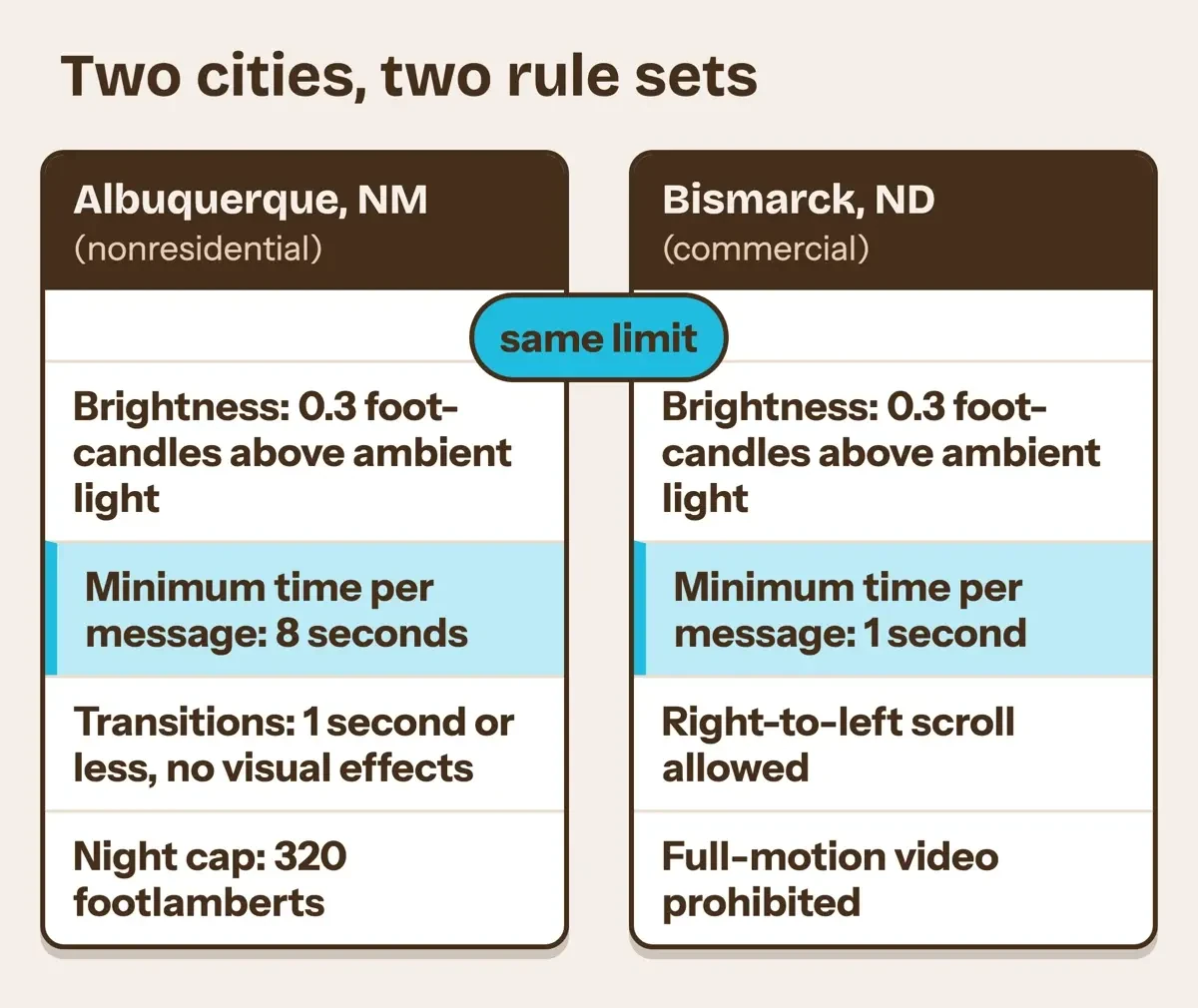 Diagram by DigitalTreed: electronic sign rules from the Albuquerque permit form and the Bismarck operational narrative, read November 6, 2026.
What we tested
On November 6, 2026 we scored one sign program against both cities' rules with test/sign_check.py. Fenwold Bakery, a made-up shop, got 4-second messages, a 0.5-second dissolve, right-to-left scrolling and a photocell. Bismarck: 4 of 4 checks passed. Albuquerque: 1 of 3. The 1-second transition passed, but the 8-second hold and no-effects rule failed. Brightness needs a meter after dark, so we didn't score it.
What an LED sign costs to run
Unlike brightness, which needs a meter after dark, power use is plain arithmetic. The EIA's measuring electricity page says watts times hours, divided by 1,000, gives kilowatthours, and its own check is a 40-watt bulb run five hours, which uses 0.2 kWh.
For an example sign drawing 500 watts on average for 18 hours a day, that's 500 x 18 x 365 / 1,000 = 3,285 kWh a year. A spec sheet may list only maximum watts, so ask for the average draw with night dimming on. It's the number your bill follows. Then multiply by the commercial rate in the EIA's Electric Power Monthly Table 5.6.A, which reports August 2026 prices in cents per kWh. If your sign shop's numbers don't fit that formula, ask them to show their math.
| Area (August 2026 commercial price) | Cents per kWh | Yearly cost, example 3,285 kWh |
|---|---|---|
| U.S. average | 14.47 | $475.34 |
| New York | 23.06 | $757.52 |
| New Mexico | 12.14 | $398.80 |
| Texas | 8.96 | $294.34 |
| North Dakota | 8.07 | $265.10 |
At August 2026 prices from the EIA table, the same example sign costs $757.52 a year in New York and $265.10 in North Dakota. Use the per-kWh rate on your own bill instead of any average. Cutting display hours from 18 to 12 a day would lower the example U.S. figure by a third, to about $317.
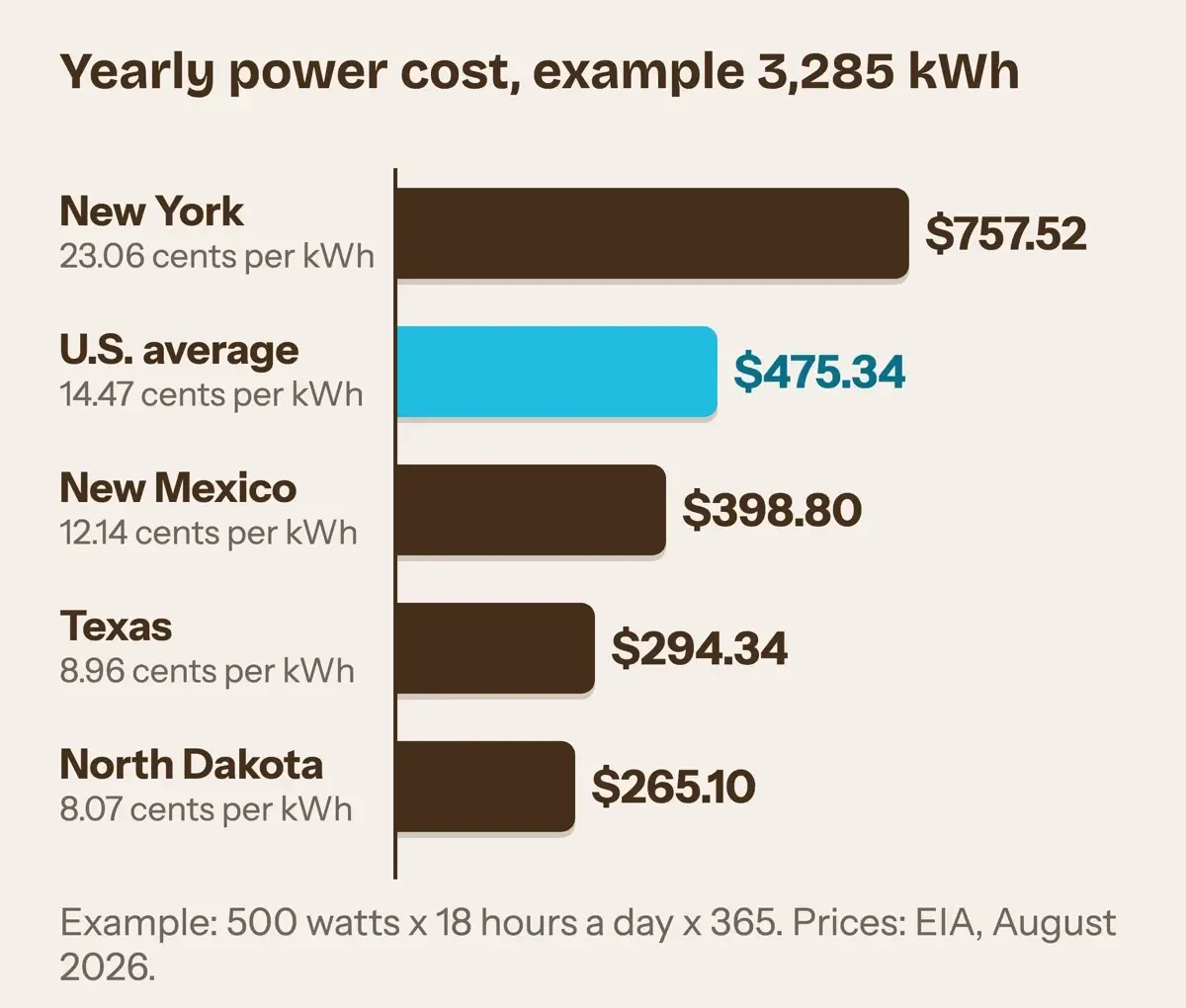 Diagram by DigitalTreed: yearly power cost of an example sign, from EIA Table 5.6.A commercial prices for August 2026.
Break-even math for your own quote
Even New York's example $757.52 a year is small next to an example $15,000 upfront, so the question is how many extra sales the sign has to bring in. We couldn't find an official source that measures sales lift from a sign for small shops, so we don't promise one. The formula is upfront cost divided by payback months, plus monthly running cost, all divided by gross profit per extra sale.
Our example inputs, as of November 2026, are $15,000 installed, which isn't a quote, and $12 gross profit per extra sale. That's a $30 ticket at 40% margin. Running cost is $39.61 a month at the U.S. power price in the EIA table.
| Payback target (example) | Gross profit needed per month | Extra sales per month | Extra sales per day (30-day month) |
|---|---|---|---|
| 24 months | $664.61 | 55.4 | 1.85 |
| 36 months | $456.28 | 38.0 | 1.27 |
| 60 months | $289.61 | 24.1 | 0.8 |
At a 36-month target, the example sign needs about 38 extra sales a month, or 1.27 a day. Count passersby for a week and ask whether one or two more of them walking in each day is believable. Add any yearly permit renewal, as in Albuquerque, to the running cost.
The SBA lists "Purchasing and installation of machinery and equipment" among 7(a) loan uses, with a cap of $5 million as of November 2026. If you borrow, add the interest to the upfront figure.
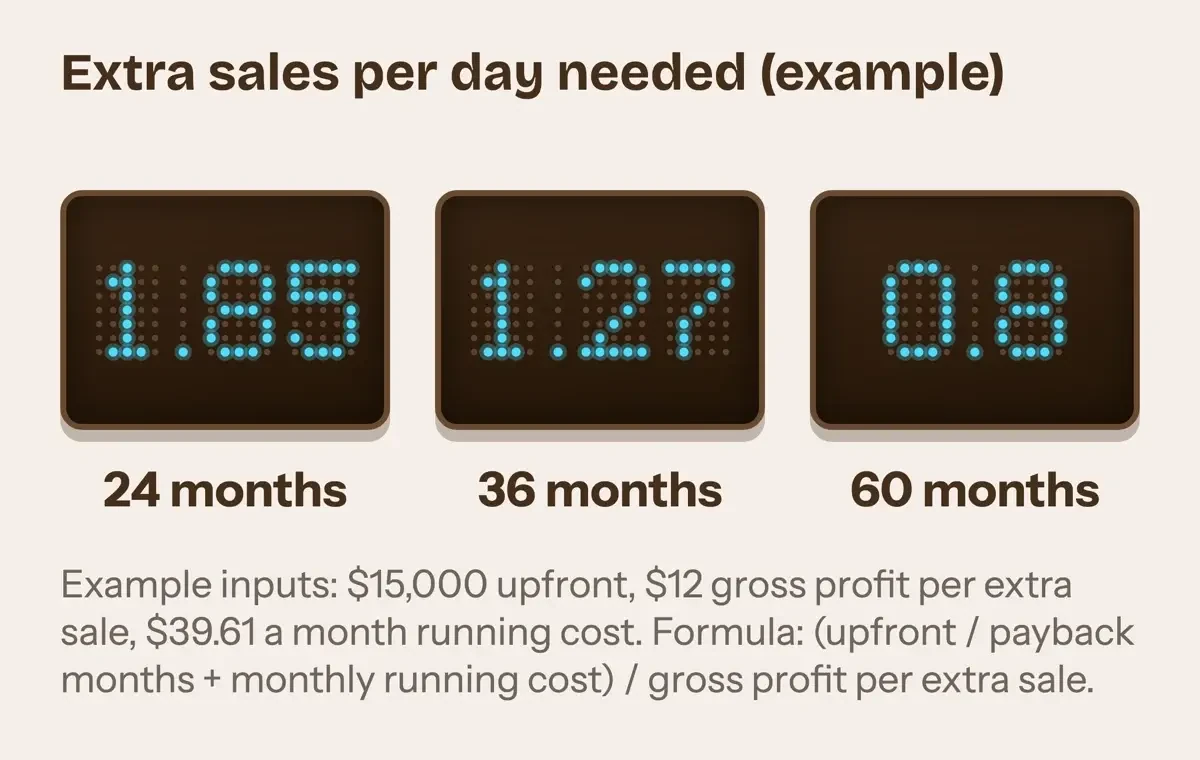 Diagram by DigitalTreed: break-even for an example sign, from our test script with example inputs.
If your break-even needs more than two extra sales a day, we'd spend part of that budget online first. A sign only reaches people who already pass your door. People searching nearby find you through local search results and a well-kept business profile on Google Maps. The places in our free advertising list for small businesses cost nothing to try. The SEO ROI Calculator runs online spend against gross profit, the same test our table runs on a sign, and our retargeting ads setup covers Google and Meta ads.
Frequently asked
Can my city control what my LED sign says?
Not easily. Under the 2015 Reed ruling, rules based on a sign's message face strict scrutiny, but brightness and timing rules still apply.
Can I convert my old neon or fluorescent sign to LED myself?
Check your state first. In Washington, WAC 296-46B-600 lets a licensed electrical or sign contractor retrofit a listed sign to LED with a listed kit.
How bright is 0.3 foot-candles?
About 3.23 lux, using the NIST factor of 10.76391 lux per foot-candle. Both cities above allow that much over the light already there.
Is a disconnect switch part of the permit?
Often. The Laguna Hills sign permit form asks for the disconnect switch location on your plans.
How we made this guide: We saved the 15 pages in Sources on November 6, 2026, checked each quote against those copies and ran our script. Facts checked by the DigitalTreed team on November 6, 2026. Sign rules are local and they change, so confirm yours with your city; it's not legal advice.
First published August 2023 as a general piece on LED signs. Rewritten November 6, 2026 with permit, listing and brightness rules from official pages, EIA power prices and break-even math. The old footfall figure and case studies had no source and were cut.
Sources
- U.S. Small Business Administration: Launch your business (local zoning)
- City of Laguna Hills, CA: Sign permit submittal requirements
- City of Albuquerque, NM: Application for electronic sign permit
- City of Bismarck, ND: Electronic message center operational narrative, commercial (revised September 25, 2023)
- LII: 23 U.S.C. 131, Control of outdoor advertising
- LII: Reed v. Town of Gilbert, 576 U.S. 155 (June 18, 2015)
- LII: City of Austin v. Reagan National Advertising of Austin (April 21, 2022)
- UL Standards and Engagement: UL 48, Electric Signs
- IAEI Magazine: Do you inspect and approve electric signs?
- Washington State Legislature: WAC 296-46B-600, Electric signs and outline lighting
- LII: 29 CFR 1910.399, Definitions (OSHA electrical)
- NIST: Guide to the SI, Appendix B.9 conversion factors
- U.S. Energy Information Administration: Measuring electricity
- U.S. Energy Information Administration: Electric Power Monthly, Table 5.6.A (August 2026)
- U.S. Small Business Administration: 7(a) loans


Comments
No comments yet. Start the conversation below.