
Quick answer
What is local SEO? Local SEO is the work that gets a business found by people searching nearby. It covers Google's map results, Google Maps, the regular results, AI answers and Apple Maps. Google ranks local results on relevance, distance and prominence. You can't pay Google for a better map spot.
Key takeaways
- Google weighs three things: how well you match the search, how close you are, and how well known you are.
- The map and the regular results reward different work. Surveyed experts put Business Profile signals at 32% of map ranking but 7% of regular local results.
- Reviews are a legal topic in the US now. Federal Trade Commission (FTC) penalties reach $53,088 per violation in 2026, and Google bans any reward for a review.
- Apple Maps is catching up: 27% of US consumers used it to read local reviews in 2026, up from 14% in 2025, per BrightLocal.
- Most of the work is free. A tracking tool for one location costs about $16 to $65 a month, if you want one.
Picture a dental office in Austin, a plumber in Columbus and a bakery in Cincinnati. Their customers don't search for "dentist". They type "dentist near me" or "emergency plumber Westerville" and call one of the first few names Google shows.
Local SEO for small business is how you become one of those names. Most of it costs nothing but a few hours a month. The part owners most often get wrong is reviews: offer a discount for one and you break Google's rules, and possibly federal law.
What is local SEO, in plain words?
SEO (search engine optimization) is the work of getting found in search. Local SEO is the part aimed at people in one area. What you're after is calls, direction requests and walk-ins from people close enough to buy.
Search for a plumber and Google usually shows a map with a short list of businesses. People call this the local pack, the map pack or the 3-pack. The usual blue links below it are the local organic results. Local SEO works on both, and on a few newer places:
- Map results and Google Maps. Mostly driven by your Google Business Profile, the free listing with your hours, photos and reviews.
- Regular results. Mostly driven by your website pages and the links pointing to them.
- AI answers. Google's AI Overviews and AI Mode (AI-written answers in Search), Ask Maps, and chat tools like ChatGPT now recommend local businesses.
- Other maps and review sites. Apple Maps, Bing, Yelp, the Better Business Bureau (BBB) and industry directories.
You don't even have to type a city. Search "hair salon" and Google will usually show salons near you, because it reads the search as local. And a business can appear in the map with only a Business Profile, no website at all. That's why local SEO is often the cheapest marketing a small business can do.
Google's help page is blunt: "There's no way to request or pay for a better local ranking on Google." Ads are a separate, labeled product. So a "guaranteed #1 on Google Maps" offer is a red flag.
Is local SEO for small business worth it?
Yes, for any business that serves people in one area. Local SEO reaches people who are already searching for what you sell and are close enough to buy. Most of the work costs time, not ad money. It also builds the reviews and listings people check before they call.
Google gives one more reason. Its help page for Business Profile owners says businesses with complete and accurate info are "more likely to show up in local search results". So finishing your profile is the cheapest first step.
Local SEO vs regular SEO: what's the difference?
Regular SEO is for anyone searching a topic. Local SEO is for people in one area, and it adds the map results. A strong website helps both.
| Regular SEO | Local SEO | |
|---|---|---|
| Who you want | Anyone searching the topic, anywhere | People near you, or in the area you serve |
| Typical search | "how to fix a leaking faucet" | "plumber near me", "plumber Columbus OH" |
| Where you show up | Regular results and AI answers | Map results, Google Maps, regular results, AI answers, Apple Maps |
| Main levers | Content, links, technical health | Business Profile, reviews, service pages, listings, links |
| Success looks like | Visits, sign-ups, online sales | Calls, direction requests, bookings, walk-ins |
Sell only online and ship nationwide? Regular SEO is your game. If customers come to you, or you go to them, you need local SEO too. Our SEO for beginners guide covers the website basics underneath it.
Local SEO ranking factors: how Google picks nearby businesses
Google explains this on its help page for Business Profile owners. Its summary line reads: "Local results are mainly based on relevance, distance, and popularity." Its subheadings still use the older word, prominence, so you'll see both. These three are the core local SEO ranking factors:
- Relevance is "how well a Business Profile matches what someone is searching for." Your categories, services and description do this job.
- Distance is "how far each business is from the customer who's searching." It's measured from wherever the searcher is, so your rank changes from street to street. If the searcher hides their location, Google estimates it, for example from the general area of their IP address. It's also the one factor you can't work on.
- Prominence is "how well-known a business is." Links to your business and your reviews count here. Google adds: "More reviews and positive ratings can help your business's local ranking."
Google doesn't publish weights. The closest thing is Whitespark's Local Search Ranking Factors survey, published November 6, 2025. In it, 47 local search experts scored 187 factors. It's expert opinion, and Whitespark says "None of the experts have special access" to Google's algorithm.
Whitespark's survey shows the most useful idea in local SEO: the map results and the regular results reward different work.
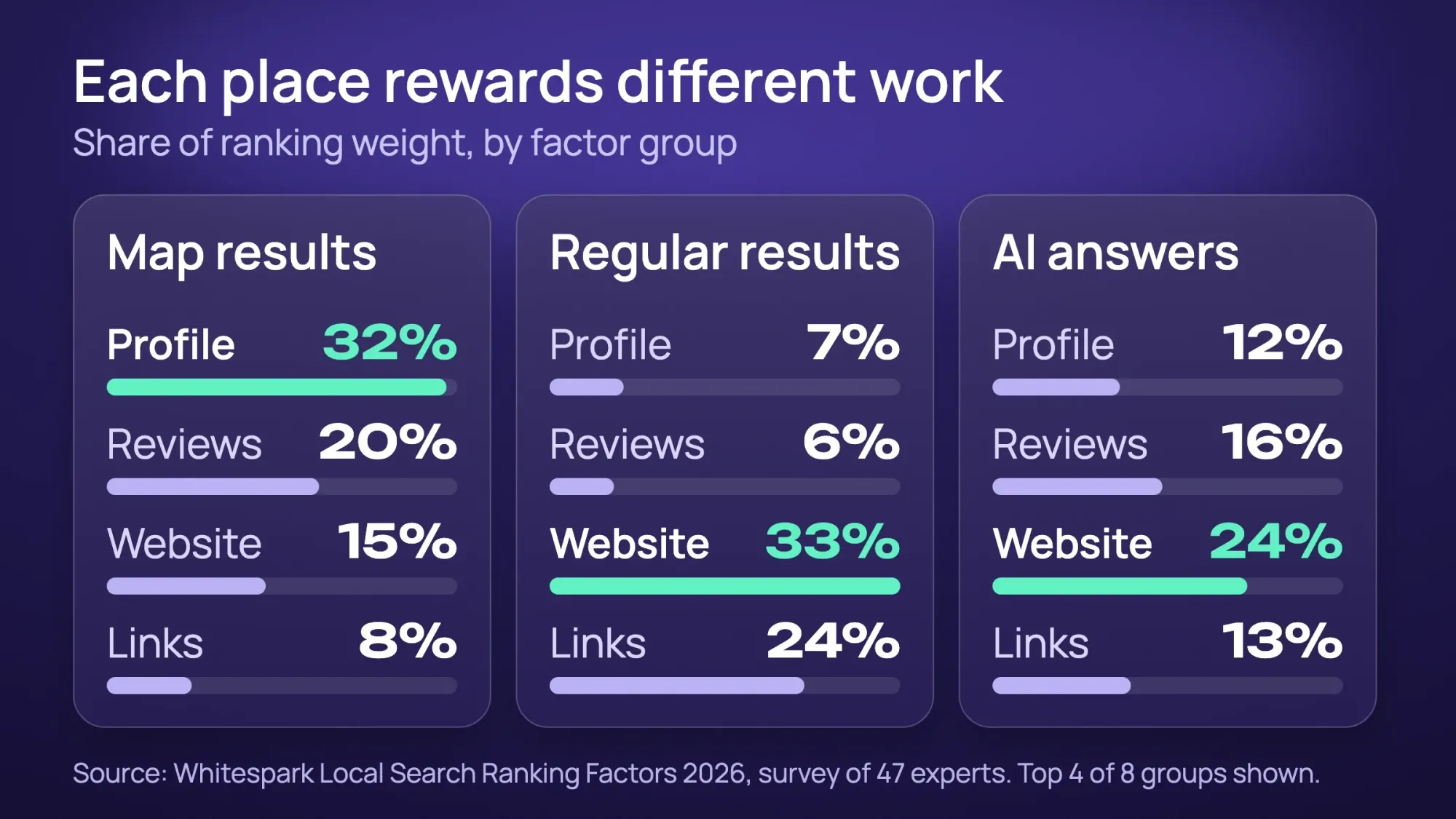 Source: Whitespark Local Search Ranking Factors 2026 (survey of 47 local search experts, published November 6, 2025). Expert opinion, not Google data. Group weights from Whitespark's chart.
For the map, your Business Profile (32%) and reviews (20%) carry the most weight. For the regular results below it, your website pages (33%) and links (24%) matter more. AI search spreads the weight around. There, the experts' top factor was being named on curated "best of" lists, like a local paper's "Best plumbers in Columbus".
What changed in local search in 2025 and 2026?
The biggest changes are AI answers in Google Maps, tougher review enforcement and new free listings on Apple and Bing. If an older guide tells you to fill in your profile's Q&A, skip it: Google removed it. These are the changes that matter for a small business, oldest first:
| When | What changed | What it means for you |
|---|---|---|
| Late 2025 | Google removed questions and answers (Q&A) from Business Profiles; Maps now answers some questions with AI | Skip advice to "seed your Q&A". Put common answers on your profile and website. |
| Oct 3, 2025 | New Bing Places for Business, with easier import from Google | You can import your Google listing instead of starting from scratch. |
| Oct 20, 2025 | Local Services Ads (Google's pay-per-lead ads) moved to one Google Verified badge; the Google Guarantee money-back program ended | If you run these pay-per-lead ads, the badge is now "Google Verified". |
| Dec 22, 2025 | First Federal Trade Commission (FTC) warning letters under its consumer reviews rule (FTC press release; law firm Benesch calls them the rule's first public use) | Review rules are being enforced. |
| Jan 2026 | AI summaries showing 1 or 2 businesses instead of 3 on some local searches (seen by SEO practitioners, not confirmed by Google) | Being an obvious top choice matters more. |
| Mar 12, 2026 | Google launched Ask Maps, a chat-style way to ask Maps questions, in the US | Complete profiles and good reviews feed its answers. |
| Apr 14, 2026 | Apple Business replaced Apple Business Connect, free in the US | Claim or check your Apple Maps place card. |
| Apr 16, 2026 | Google now pauses new reviews and shows a notice during fake-review attacks, and emails owners about suggested edits | Watch your inbox for edit alerts. |
| Late Aug 2026 | Ads on Apple Maps went live in the US (reported by MacRumors); home services aren't allowed | A new paid option for shops and restaurants, not plumbers. |
Key local SEO facts for 2026
- Google's local results rest on 3 factors: relevance, distance and popularity, per Google's Business Profile help page (checked October 23, 2026).
- In Whitespark's 2026 ranking factors report, published November 6, 2025, 47 local search experts scored 187 factors.
- In BrightLocal's 2026 review survey (vendor data), 97% of consumers read reviews for local businesses. Apple Maps use for reviews rose from 14% in 2025 to 27%.
- In 2025, Google blocked or removed over 292 million policy-violating reviews and removed over 13 million fake Business Profiles.
- Google's LocalBusiness structured data has only 2 required properties, name and address, per its documentation last updated September 8, 2026.
How to do local SEO, step by step
Work through these in order. The first four steps are free. Most of the typing fits into a weekend, but Google's verification can take several days. Steps 5 to 9 become a monthly routine.
- Get your name, address and phone number straight.
- Find the searches your customers use.
- Set up your Google Business Profile.
- Claim your listings beyond Google.
- Build pages for each service and real service areas.
- Add LocalBusiness structured data.
- Get reviews the legal way.
- Earn local links and mentions. Then check that each linking page is open to Google with our 5 backlink indexing checks.
- Track calls and bookings.
1. Get your name, address and phone number straight
NAP means name, address and phone number. Pick one version of each and use it everywhere: your website, your Business Profile, Apple Maps, Yelp, Facebook and every directory.
Use your real business name, the way it reads on your sign. Our one-page branding strategy shows how to keep that name the same on your site, signs and social bios. Google's rule is that your name should "reflect your business's real-world name", with nothing added. So "Joe's Plumbing" is fine. "Joe's Plumbing - Best Emergency Plumber Columbus" can get the profile suspended.
Use a local number you control. Google asks for "a local phone number instead of a central call center helpline number whenever possible." Did you move or change numbers lately? Search for the old address and number, and fix every listing that still shows them.
2. Find the searches your customers actually use
You can't match a search you never thought about, so this step comes before any page or profile work. Local searches usually follow three patterns:
- Service + city: "water heater repair Columbus".
- Service + near me: "emergency dentist near me".
- Service + neighborhood or landmark: "bakery Hyde Park Cincinnati".
Start with your own records. Write down the services people call about most and the words they use. Then type each one into Google and note the suggestions that drop down. Once your profile is live, its Performance report shows the actual searches that found you.
For rough search counts, Google's Keyword Planner shows estimated monthly searches for each phrase. It sits inside Google Ads, and Google asks you to finish account setup, including billing details, before you can use its basic features. Our Google Keyword Planner guide walks through it.
While you're there, look at who already ranks. Search your main service from your shop's location. Note the top three businesses, their categories, how many reviews they have and how recent those are. That's your bar to clear.
3. Set up your Google Business Profile properly
Your Google Business Profile is the biggest lever for the map results. Claim or create it, verify it, set hours, add photos and list your services. Then keep it alive: new photos and a short update every couple of weeks.
Choose the most specific primary category that fits your core work. In the Whitespark survey, the primary category was the top map factor of all 187. "Cosmetic dentist" beats a vague one if that's what you mostly do.
Our Google Business Profile guide covers every setting, verification method and suspension rule. Here are the three rules beginners break most:
- No virtual offices or mailboxes. Google says a virtual office "isn't eligible for a Business Profile" and rejects "P.O. boxes or mailboxes located at remote locations".
- If you travel to customers, hide your address. Plumbers, cleaners and mobile groomers are service-area businesses, and Google wants their address kept off the public profile.
- Keep the service area realistic. Google says it "shouldn't extend farther than about 2 hours of driving time" from your base. You get one profile for that base, not one per town.
4. Claim your listings beyond Google
Google is still where most people read local reviews. But its share fell from 83% to 71% in a year, according to BrightLocal's 2026 consumer survey. AI tools jumped from 6% to 45%, and Apple Maps from 14% to 27%.
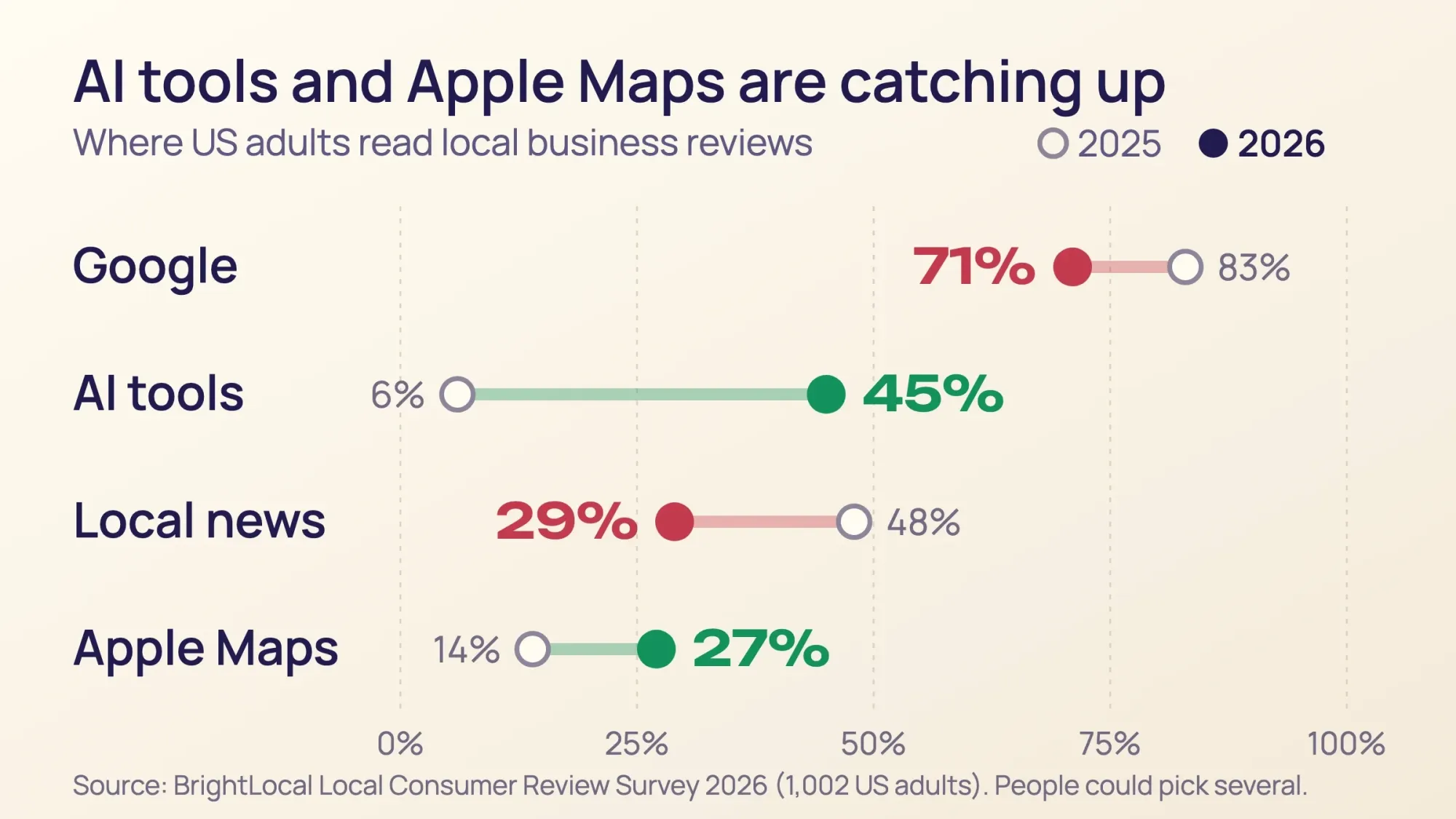 Source: BrightLocal Local Consumer Review Survey 2026 (1,002 US adults, published February 11, 2026). Vendor survey; people could pick more than one platform.
So, after Google, claim these free listings:
- Apple Business at business.apple.com. It controls your place card on Apple Maps, Safari and Siri, and it's been free in the US since April 14, 2026.
- Bing Places for Business at bing.com/forbusiness. You can import your Google listing.
- Yelp, Facebook, Nextdoor and the BBB. A BBB profile doesn't need paid accreditation. Accreditation fees vary by local BBB, so ask yours.
- Your industry's directories: Healthgrades and Zocdoc for dental, Angi and Thumbtack for trades, Tripadvisor for restaurants.
Each mention of your name, address and phone is called a citation. For the map, citations are a small factor today: 6% in the Whitespark survey. For AI answers they count more, at 13%. Whitespark's summary: "In AI SEO, mentions (citations) are the new link."
5. Build pages for what you do and where you do it
For the regular results, the top factor in the Whitespark survey was a "Dedicated Page for Each Service". A dentist needs separate pages for implants, Invisalign and emergency visits. One "Services" page with a bullet list won't compete.
Give each page the service and your city in its title tag. Answer what customers ask, show prices or ranges if you can, and make it easy to call or book. Your contact page needs your phone, hours, a map and your address, unless you're a service-area business.
Location pages are where businesses get into trouble. Google calls it doorway abuse when sites make "pages targeted at specific regions or cities that funnel users to one page". Agents writing neighborhood pages also face Fair Housing wording rules, covered in our local SEO for real estate guide. Twenty town pages with the same text and a new city name can hurt you.
Do not
- Copy a page and swap the city name
- Create pages for towns you never visit
- Hide area pages so only Google finds them
- Stuff 40 suburbs into your footer
Do
- Make a page for an area only if you really work there
- Show proof from that area: jobs, photos, reviews, local permits
- Link it from a clear "Areas we serve" section
- Start with one strong "Areas we serve" page if you're small
Here's a simple test. If you could change the city name and nothing else on the page would need to change, don't publish it.
Run more than one staffed location? Give each its own Business Profile and its own page on your site, and link each profile to that page.
Local content helps too. Write about real jobs in named neighborhoods, a city permit you handle often, or an event you sponsor. Pages like these show searchers that you really work in the area.
Plenty of your customers will be searching on a phone while out, so check your pages there too. Our website speed test shows what slows them down.
6. Add LocalBusiness structured data
Structured data, or schema, is a small block of code that spells out your business details for search engines. Google's documentation, updated September 8, 2026, requires only two properties for LocalBusiness: name and address.
Google's documentation recommends adding your phone, website, hours and map coordinates. It also says to "Use the most specific LocalBusiness sub-type possible", such as Dentist, Plumber or Bakery. Law firms use LegalService; our SEO guide for law firms shows a sample block. Here's a bakery example you can adapt:
<script type="application/ld+json">
{
  "@context": "https://schema.org",
  "@type": "Bakery",
  "name": "Hyde Park Bread Co.",
  "address": {
    "@type": "PostalAddress",
    "streetAddress": "123 Example Ave",
    "addressLocality": "Cincinnati",
    "addressRegion": "OH",
    "postalCode": "45208",
    "addressCountry": "US"
  },
  "telephone": "+1-513-555-0142",
  "url": "https://www.example.com",
  "openingHoursSpecification": [{
    "@type": "OpeningHoursSpecification",
    "dayOfWeek": ["Tuesday", "Wednesday", "Thursday", "Friday", "Saturday"],
    "opens": "07:00",
    "closes": "15:00"
  }]
}
</script>
Don't mark up your own testimonials as star ratings. Google says review markup is "only recommended for sites that capture reviews about other local businesses", so your own stars won't show.
And if you hide your address on Google, think twice before publishing it in your code. When you're done, test the page with the schema markup validator below.
7. Get reviews the legal way
Reviews feed prominence, and people read them before they call. In BrightLocal's 2026 survey, 97% of consumers read reviews for local businesses. And 47% won't use a business with fewer than 20 reviews.
Before you ask anyone, know the rules. Google, the FTC and Yelp each set their own, and they don't agree.
Google bans every kind of reward. Businesses may not "Offer incentives – such as payment, discounts, free goods and/or services" for reviews. They also may not "selectively solicit positive reviews from customers". That second practice is called review gating.
The FTC bans buying positive reviews. Its consumer reviews rule (16 CFR Part 465) took effect October 21, 2024. It bans rewards tied to reviews "expressing a particular sentiment" and undisclosed reviews by owners and managers. It also bans "an unfounded or groundless legal threat" used to get a review removed.
How much? On September 15, 2026, the FTC confirmed 2026 penalties stay at the 2025 level: up to $53,088 per violation.
Yelp goes further. Its support page says "Don't ask anyone to review your business". It warns that prompted reviews may not be recommended by its software.
The routine that keeps you inside all three sets of rules: ask every customer the same way, at the same moment. Send your Google review link by text after the job, or put a QR code on the receipt. Google allows this: "you can ask customers to visit a Google link or scan a QR code."
Offer nothing in return, don't screen for happy customers first, and skip staff quotas. For Yelp, show a "Find us on Yelp" badge and let reviews come on their own. To send requests automatically without breaking these rules, see our guide to automating review requests.
Then reply to every review, good or bad, in your own words. BrightLocal found 89% of consumers expect a reply. For a bad one, keep it short: thank them, say what you'll fix, and offer a phone number to sort it out offline. Don't argue in public.
Medical and dental offices need extra care. In 2019, a Dallas dental practice paid $10,000 to settle a case under HIPAA, the federal health privacy law. Its replies to Yelp reviews had disclosed patients' health details, according to HIPAA Journal's report on the HHS settlement. Never confirm that a reviewer is a patient.
Tip
A reply that works for any office, including a dental one: "Thank you for the feedback. We take every comment seriously and would like to make this right. Please call our office manager at (512) 555-0123 so we can talk it through." It doesn't confirm the person was a patient, and it moves the conversation offline.
Google blocked or removed 292 million policy-violating reviews in 2025, up from 170 million in 2023.
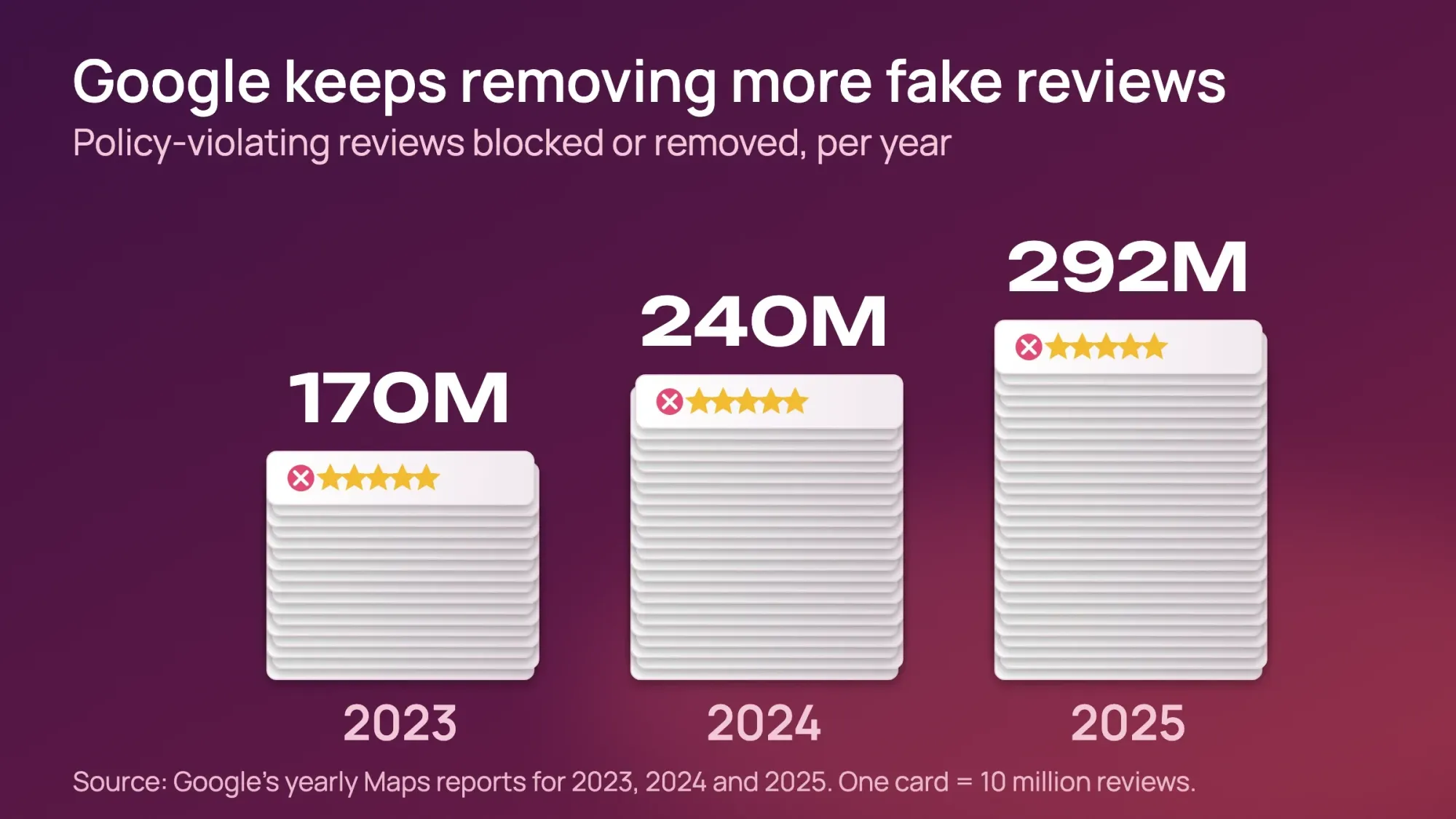 Source: Google blog posts for 2023 (February 13, 2024), 2024 (April 7, 2025) and 2025 (April 16, 2026).
Warning
If someone threatens fake one-star reviews unless you pay, don't pay. Google named this exact scam in April 2026. Report the reviews from your Business Profile and keep screenshots of the messages.
8. Earn local links and mentions
Links from other websites still count, especially for the regular results: 24% in the Whitespark survey. For a local business, the best ones come from real relationships. You probably have several already:
- Your chamber of commerce member directory.
- Sponsorships: a Little League team, a school fundraiser, a charity 5K. Most list sponsors with a link.
- Suppliers with a "find a dealer" or "find an installer" page.
- Local news: a new location, a community project, or a quote as the local expert.
- "Best of [your city]" lists from local publications. These help with AI answers too.
- Businesses you already trade with, like the coffee shop that sells your pastries.
To see which links help and which ones to avoid, read our guide on what a backlink is and how to earn good ones.
9. Track calls and bookings, not just rankings
Ranking reports are useful. But calls, bookings and visits pay the bills. Check these once a month:
- Your Business Profile Performance report: searches that found you, calls, direction requests and website clicks.
- Google Search Console, Google's free report on your website: the searches that bring people to your website. It doesn't cover your map listing, so you need both.
- Visits from your profile. Add a UTM tag (a label that tells your analytics where a visit came from) to the website link on your profile, like
?utm_source=google&utm_medium=organic&utm_campaign=gbp. A free UTM builder writes it for you. - Calls. A common setup is a local tracking number as the profile's main number, and keep the usual one as an extra. Google's rules don't mention tracking numbers by name, but the number must be "under the direct control of the business".
Also know why your "rank" isn't one number. Distance is a core factor, so you might be first two blocks away and missing five miles out. A geo-grid tool runs the same search from many points around you and maps your position at each.
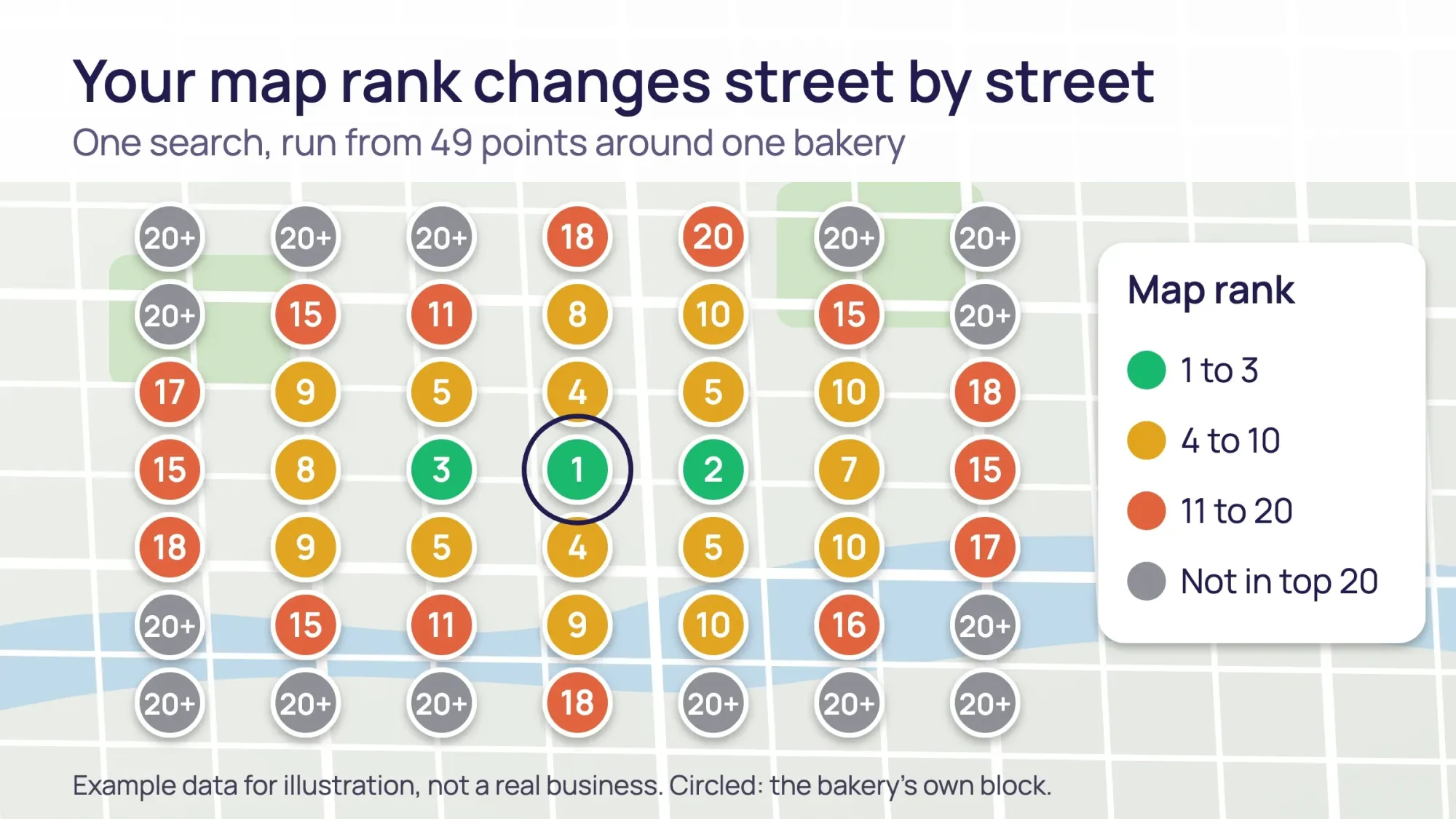 How a geo-grid scan works: the same search from 49 points around one business. Example data for illustration, not a real business.
BrightLocal, Whitespark (grids from $10 a month) and Moz Local all offer grid scans. You don't need one on day one. Run a scan before and after a big change, like adding service pages.
Three examples: a dentist, a plumber and a bakery
The same rules play out differently by business type. These three are made up, but every rule they follow is real.
| Dental office, Austin, TX | Plumber, Columbus, OH | Bakery, Cincinnati, OH | |
|---|---|---|---|
| Type | Storefront with several dentists | Service-area business run from home | Walk-in storefront |
| Business Profile | One for the practice, plus one per public-facing dentist, under Google's practitioner rules | One profile, address hidden, service area covering Columbus, Westerville, Dublin, Grove City and Hilliard | One profile, "Bakery" category, holiday hours kept current |
| Website | A page each for implants, Invisalign and emergency visits; insurance info; Dentist schema | Pages for water heaters, drains and sewer lines; one solid "Areas we serve" page | Menu and custom cake pages; Bakery schema with opening hours |
| Listings | Healthgrades, Zocdoc, Apple Business, Yelp (no asking) | Angi, Nextdoor, BBB, Bing | Apple Business with an order button, Yelp, Tripadvisor |
| Reviews | Text a link after each visit; replies never confirm someone is a patient | Text a link when the job is done | QR code at the register; no "free cookie for a review" |
| Paid options | Local Services Ads, if the dental category is offered in their area | Local Services Ads; Apple Maps ads don't allow home services | Apple Maps ads, since food isn't on Apple's banned list |
Free local SEO checklist for small businesses
This free checklist is yours to copy, print or share. Work down it in order, then run through it again every 3 months as a quick local SEO audit. Every line comes from Google's rules and the sources in this guide.
| Area | Task | Done? |
|---|---|---|
| NAP | One business name, address and local phone number, written the same everywhere | |
| Keywords | A list of your main services with the city and "near me" searches people use | |
| Business Profile | Verified, specific primary category, hours, services, photos; address hidden if you visit customers | |
| Other maps | Apple Business, Bing Places, Yelp, Facebook, BBB, two to four industry directories | |
| Website | A page per main service; service and city in title tags; contact page with phone, hours and map | |
| Area pages | Only for places you serve, each with real local proof; no city-swap copies | |
| Schema | LocalBusiness with the most specific type; name and address at least; no self-review stars | |
| Reviews | Ask every customer by link or QR code; no rewards, no screening, no quotas; reply to all | |
| Links | Chamber, sponsorships, suppliers, local news, best-of lists | |
| Tracking | Profile Performance, Search Console, UTM tag on the profile link, call tracking you control |
Want a quick read on your site first? Our free website audit checks local SEO alongside speed, security and AI visibility.
A 90-day local SEO plan for beginners
Your first 90 days of local SEO
- Days 1-30: foundations Fix your NAP and list your main searches. Claim and verify your Business Profile, then set the category, hours and services. Claim Apple Business, Bing Places, Yelp, Facebook and the BBB profile. Add service pages, a contact page with a map, and LocalBusiness schema. Set up Search Console and tag your profile link with our UTM builder.
- Days 31-60: reviews and content Ask every customer for a Google review by link or QR code. Reply to every review within a few days. Fix any listing that still shows an old address or number. Add one or two genuine area pages if you serve several towns. Post updates and new photos on your profile twice a month.
- Days 61-90: links and review Join the chamber, list your sponsorships, ask suppliers for a dealer listing and pitch one local news story. Our off-page SEO checklist marks each of these as do or skip, with the rule behind it. Compare calls, direction requests and website clicks with day one. Keep what worked, then decide whether paid options like Local Services Ads make sense.
How long until results? Honestly, nobody can promise a date. A new profile in a quiet category can show up within weeks. A dentist in a crowded city may need months of reviews and pages. Judge progress by calls and bookings, not one ranking on one day.
How much does local SEO cost?
Doing it yourself costs $0 plus a few hours a month. A tool adds about $16 to $65 a month. Hiring help averaged $1,150 to $1,819 a month in one industry poll. Here's what it costs, from vendors' 2026 pricing pages and one older industry poll:
| Option | Cost (USD) | What you get |
|---|---|---|
| Do it yourself | $0 plus your time | Business Profile, Apple Business, Bing Places, Yelp and BBB listings are free |
| DIY with a tool | About $16 to $65 a month | One location on BrightLocal ($31 to $65 a month by plan and billing) or Moz Local ($20 to $40 a month, less billed yearly): rank tracking, listings, grids |
| Citation building service | About $2 to $3.20 per listing | Someone submits your NAP to directories for you (BrightLocal pay-as-you-go prices) |
| Freelancer | About $1,000 to $1,500 a month | Our rough range: freelancers averaged $1,150 a month in an Ahrefs poll of 439 SEO providers |
| Agency | About $1,500 to $2,500 a month | In the same poll, local SEO averaged $1,557 a month, and agencies charged $1,819 |
The Ahrefs post dates from December 2023 and doesn't say when the poll ran, so treat those numbers as a rough guide. Whoever you hire, ask three things. What will you do each month? How will you report calls and bookings? Do you follow the review rules above?
If you'd rather hand it off, local SEO is part of our SEO service.
What are the most common local SEO mistakes?
The most common local SEO mistakes are keywords in the business name, virtual or mailbox addresses, paid or filtered reviews and copied city pages. Each one breaks a Google rule.
Do not
- Add keywords or a city to your business name
- Use a virtual office, UPS box or co-working desk you don't staff
- Offer discounts, raffles or gifts for reviews
- Ask for Yelp reviews or set staff review quotas
- Mark up your own testimonials as star ratings
- Follow old advice about Business Profile Q&A, which Google removed
Do
- Use your real business name, exactly as on your sign
- Hide your address if customers never visit you
- Ask every customer for a review, the same way
- Reply to reviews without sharing private details
- Keep your phone number local and under your control
And skip any package sold as a "guaranteed #1 map ranking". If Google won't sell that spot, nobody else can promise it.
Is local SEO still worth it with AI answers?
Yes. Whitespark's experts wrote that local search "has remained somewhat insulated from this AI upheaval". And Google says there are "no additional requirements to appear in AI Overviews or AI Mode" beyond normal SEO.
AI tools read the same profiles, reviews, lists and pages you build for local SEO. What's changed is that some AI answers name only one or two businesses. When only one or two names show, being the third-best plumber in town gets you nothing.
To go further on AI answers, our GEO guide (generative engine optimization) explains how they pick sources and how to measure your visibility.
Frequently asked questions
Frequently asked
What is local SEO in simple words?
It's the work that helps people near you find your business on Google, Maps, AI tools and Apple Maps. It covers your Business Profile, reviews, website pages and listings on other sites.
What's the difference between local SEO and regular SEO?
Regular SEO aims at anyone searching a topic. Local SEO aims at people in your area and adds the map results, which lean on your Business Profile and reviews. A good website helps both.
How much does local SEO cost per month?
It can cost nothing but your time. A tracking tool runs about $16 to $65 a month for one location. In one industry poll, freelancers averaged about $1,150 a month and agencies about $1,800.
Can I do local SEO without a storefront?
Yes. Service-area businesses like plumbers can have a Business Profile with the address hidden. The service area can reach about two hours' drive. Virtual offices and mailbox addresses aren't allowed.
What are the most important local SEO ranking factors?
Google names relevance, distance and prominence. In Whitespark's 2026 expert survey, the top map factors were the primary Business Profile category, closeness to the searcher, and keywords in the business name. Google's rules forbid adding those, so don't copy that one. For regular results, it was a page for each service.
How long does local SEO take to work?
There's no reliable timeline. Quiet categories can move in weeks, and crowded ones can take months. Follow the 90-day plan above and judge it by calls and bookings.
Can I give customers a discount for leaving a review?
No. Google bans any reward for reviews. The FTC's rule bans rewards tied to positive reviews, with penalties up to $53,088 per violation in 2026. Ask every customer the same way and offer nothing back.
Is local SEO better than Google Ads?
They do different jobs. Ads, including pay-per-lead Local Services Ads, bring calls right away and stop when you stop paying. Local SEO is slower but keeps working. Many local businesses use both. Our PPC guide explains how ads are priced.
Can you do local SEO without a website?
Partly. A Google Business Profile can put you in the map results with no website at all. But the regular results rank web pages. In Whitespark's 2026 survey, website signals were the top group for local organic results, so a simple site with a page per service helps.
Is local SEO dead?
No. Whitespark's 2026 report says local search "has remained somewhat insulated from this AI upheaval". AI Overviews, Ask Maps and chat tools draw on the same profiles, reviews and listings that local SEO builds.
How do you do a local SEO audit?
Go through the free local SEO checklist in this guide line by line and note every gap. Then search your main service from your location and compare your profile with the top 3 results. Our guide to your first SEO audit covers the website side.
What do local SEO services include?
A local SEO service should cover the work in this guide's checklist. That means your Business Profile, listings, service pages, review requests, local links and a monthly report. Ask for calls and bookings in that report, not just rankings.
How we made this guide: we built it from Google's help pages, the FTC rule text and the 2026 BrightLocal and Whitespark studies. We checked every number against the source named next to it on October 21, 2026. Where we only had press reports, we say so. Updated October 23, 2026: we added a section on whether local SEO pays off for small businesses and a key facts list. We also added Keyword Planner and local content tips, how Google estimates a searcher's location, and four FAQs. Some headings now ask the question they answer, and a few tool links moved to the step that uses them.
Sources
- Google Business Profile Help: Tips to improve your local ranking on Google
- Google Business Profile Help: Guidelines for representing your business on Google
- Google Search Central: Spam policies (doorway abuse)
- Google Search Central: Local business structured data (updated September 8, 2026)
- Google Search Central: AI features and your website
- Google: Maps user-generated content policy (fake engagement) and Business Profile Help: Get reviews from customers
- Google: New ways we're protecting businesses on Maps (April 16, 2026)
- Google: How machine learning keeps contributed content helpful (February 13, 2024) and Google: New ways AI helps keep business information trustworthy (April 7, 2025)
- Google: How we're reimagining Maps with Gemini (Ask Maps) (March 12, 2026)
- Google: Getting started with Local Services Ads, United States
- 16 CFR Part 465: Rule on the Use of Consumer Reviews and Testimonials
- FTC notice on 2026 civil penalty amounts (September 15, 2026)
- Yelp Support: Don't Ask for Reviews
- Apple Newsroom: Introducing Apple Business (March 24, 2026)
- Bing: Introducing the new Bing Places for Business (October 3, 2025)
- Whitespark: Local Search Ranking Factors 2026 (expert survey, November 6, 2025)
- BrightLocal: Local Consumer Review Survey 2026 (February 11, 2026)
- Search Engine Roundtable: AI Overviews replacing local packs (January 16, 2026)
- Search Engine Roundtable: Google Verified badge for Local Services Ads
- Ahrefs: SEO pricing poll of 439 providers
- BrightLocal pricing, Moz Local pricing and Whitespark pricing (checked October 21, 2026)
- HIPAA Journal: Dental practice fined $10,000 for PHI disclosures on Yelp (October 2019)
- Google Ads Help: Use Keyword Planner (checked October 23, 2026)
- Google Privacy & Terms: How Google uses location information (checked October 23, 2026)
- Benesch: FTC turns up enforcement under the consumer review rule
- MacRumors: Apple Maps ads go live (August 25, 2026)
- Search Engine Roundtable: Google Maps spam fighting by year (April 17, 2026)


Comments
No comments yet. Start the conversation below.