

Quick answer
An online MBA cost a median $47,000 a year in tuition and fees, against $35,000 for a full-time two-year MBA, in GMAC's October 2026 survey, a global sample. In our example, two years of lost pay at a made-up $70,000 salary flips that gap, since online students can keep working. Check accreditation first, then run our cost formula.
An online MBA offer is open next to a campus brochure, and you've got a job you'd rather keep. The online degree is a Master of Business Administration taught over the internet, sometimes with short campus residencies.
The degree name doesn't change, so cost, loans and employer views decide it. We'd pick online for most working adults who can keep their paycheck, once the school's accreditation checks out.
Key takeaways
- Half-time students now get half the $20,500 yearly federal loan cap.
- Accreditors judge online programs by the same standards as campus ones.
- GMAC's 2026 global sample put median online MBA tuition at $47,000 a year.
- In GMAC's 2026 survey, 61% of employers valued both formats equally.
- Our checker flagged two of five made-up ads as likely diploma mills.
Online MBA or campus MBA: what actually differs?
GMAC, the group behind the GMAT exam, defines an online program as one where students "take all classes virtually, excluding residencies." That definition sits on page 19 of its Application Trends Survey 2026 report, where a full-time, in-person program means classroom classes on a full-time schedule. A hybrid program mixes the two.
NCES Fast Facts on distance learning counts 33% of postbaccalaureate students taking only distance courses in fall 2019. The share hit 52% in fall 2020 and settled at 40% in fall 2021, and Digest table 311.15 puts fall 2022 at 1,232,625 of 3,182,544 students, or 38.7%.
Business is the biggest master's field of all. It produced 205,751 of 880,249 master's degrees in 2021-22, per Digest table 323.10, so you'll compete with plenty of MBA holders either way.
The six rows below set GMAC's 2026 medians, the federal loan cap and a made-up $70,000 salary side by side:
| Online MBA | Classic full-time MBA | |
|---|---|---|
| How classes run (GMAC) | All virtual, residencies possible | In classrooms, full-time |
| Median tuition and fees per year, residents (GMAC 2026, global sample) | $47,000 | $35,000 (two-year programs) |
| Accreditation rules (20 U.S.C. 1099b) | Same standards | Same standards |
| Federal loan cap per year from July 1, 2026 | $20,500, cut in proportion if part-time | $20,500 |
| Example lost pay over two years ($70,000 salary, example) | $0 if you keep working | $140,000 |
| Employers who value both equally (GMAC 2026) | 61% | 61% |
The campus program charges $12,000 a year less in median tuition ($47,000 - $35,000). The $140,000 of example lost pay sits only on its side: more than 11 years of that gap ($140,000 / $12,000).
Accreditation: one rulebook for online and campus
Accreditation is the first filter, since it decides whether credits transfer, whether federal aid applies and whether an employer counts the degree at all. Federal law lets the Education Department recognize an accreditor only as a "reliable authority as to the quality of education," under 20 U.S.C. 1099b. Distance learning is covered by the same section. An accreditor that reviews online programs must show its standards address their quality. Yet it "shall not be required to have separate standards, procedures, or policies for the evaluation of distance education."
First, the school needs an institutional accreditor that the Education Department recognizes. The FTC's college degree scams page says to look the school up in College Navigator. Then find its accreditor in the department's DAPIP accreditation database, since some accreditors don't do thorough reviews and other schools may not recognize them, the FTC warns. Second, the business school may hold a business accreditation, such as AACSB's. Its accredited school search listed 1,101 schools on November 6, 2026, including 558 US schools and 553 under its fully online delivery filter. AACSB's accreditation page says only 6% of institutions offering business degrees worldwide hold its seal. A school can lack that seal, but not a recognized institutional accreditor.
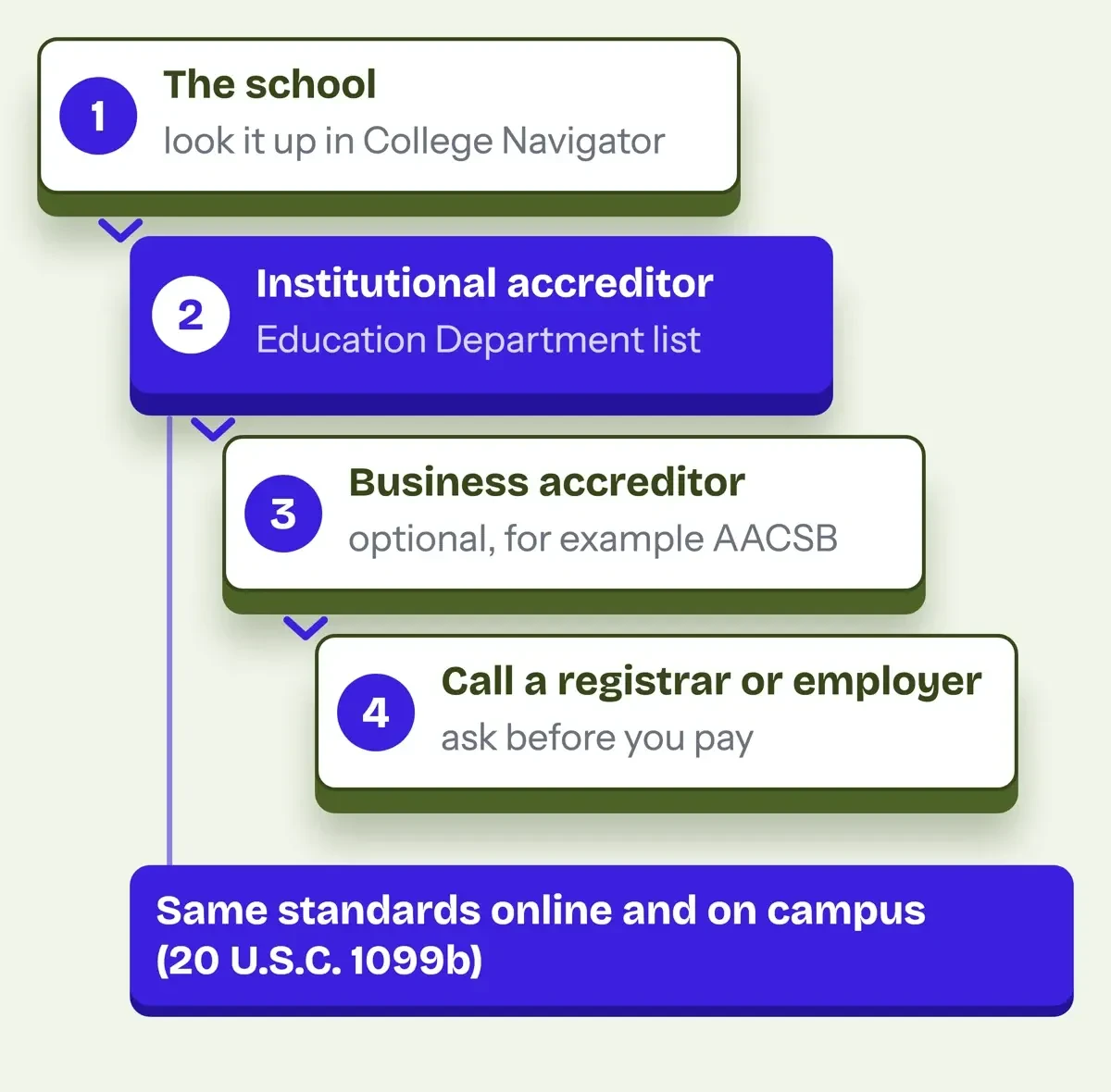 Diagram by DigitalTreed: accreditation checks for any MBA, from 20 U.S.C. 1099b and the FTC.
Cost per year and in total
On tuition alone, the online MBA costs more. GMAC's global 2026 survey covered 1,162 programs at 314 schools in 39 countries, and in Figure 25 of the report the median online MBA charged residents $47,000 a year. The median full-time two-year MBA charged $35,000, part-time $49,000 and executive $60,000. Those medians mix US and non-US schools, so your school's own tuition page sets your real number. Our example uses GMAC's medians as of November 2026, two years for both paths and a made-up $70,000 salary. The formula is tuition per year x years, minus employer aid, plus salary x months out of work / 12.
| Example (made-up inputs) | Tuition, 2 years | Employer aid | Lost pay | Total |
|---|---|---|---|---|
| A: online MBA, keep working, $5,250 a year employer aid | $94,000 | $10,500 | $0 | $83,500 |
| B: full-time two-year MBA, 24 months out of work | $70,000 | $0 | $140,000 | $210,000 |
In this example the online path costs $126,500 less. Almost all of that is the paycheck you keep. Swap in your salary and your school's published tuition, and with no employer aid, add $10,500 back to Example A. Example B also ignores summer internship pay, which would narrow the gap. For a fair salary input, use the method in Competitive pay: how to check a salary with BLS data.
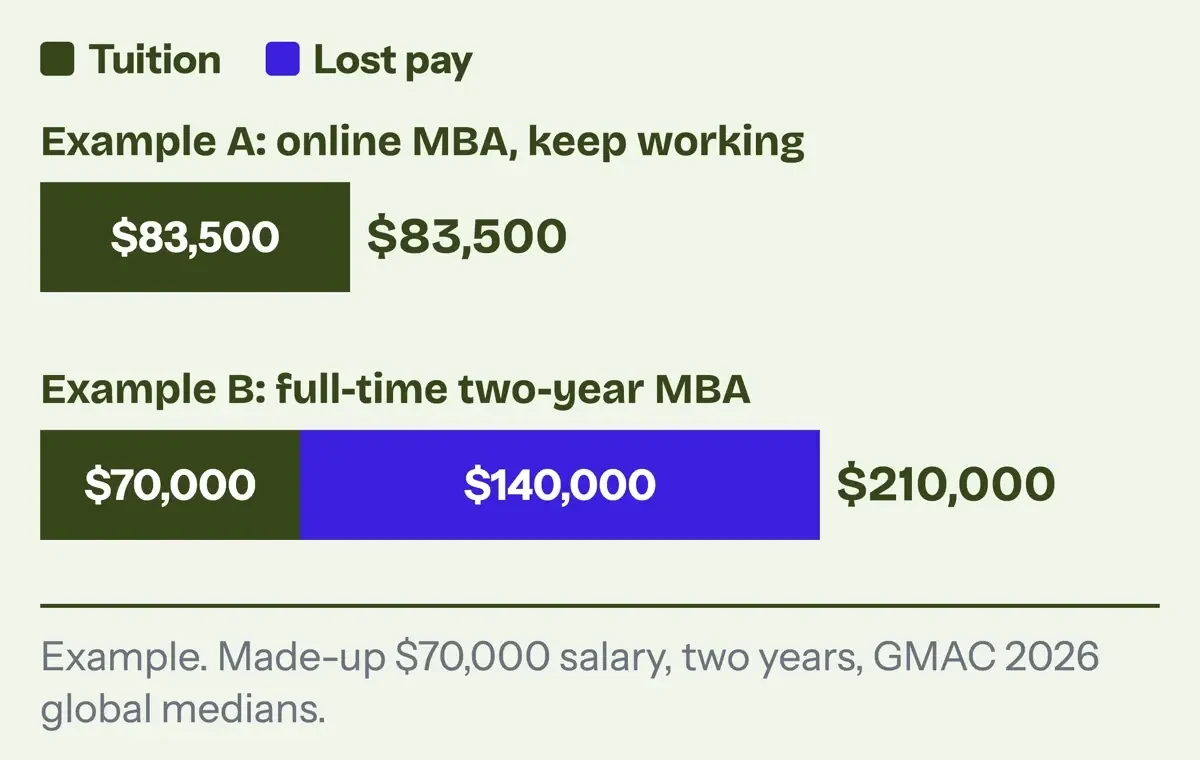 Diagram by DigitalTreed: example two-year cost, made-up inputs and GMAC 2026 global median tuition.
Paying for it after the July 2026 loan changes
Example A still leaves $83,500 of tuition to pay from savings or loans, and federal loan rules changed on July 1, 2026, hitting part-time online students hardest. The rule sits in 20 U.S.C. 1087e, as amended by Public Law 119-21. From that date, a graduate student "shall not be eligible to receive a Federal Direct PLUS Loan" for new periods of study. That leaves the Direct Unsubsidized loan, now capped at $20,500 a year and $100,000 in total for graduate study, on top of undergraduate borrowing. The law also cuts the yearly amount in direct proportion when you're enrolled less than full time. For example, a half-time student could borrow about $10,250 a year ($20,500 x 50%).
Current students get a grace period. If you were enrolled and borrowing for a program on June 30, 2026, the law's interim exception keeps the old limits for up to three academic years.
Ask the school's financial aid office which rules apply to you. This section explains the law; it isn't financial or legal advice.
MBA debt was high even before the change. The NCES graduate student loan debt indicator found 51% of MBA completers in 2015-16 had loans, and those borrowers averaged $66,300 in combined undergraduate and graduate debt (constant 2016-17 dollars).
Employer aid can be tax-free up to a limit. The IRS educational assistance FAQ (April 2026) says "the first $5,250 of those benefits per calendar year for 2025 and 2026" is tax-free. It can cover graduate courses that aren't work-related, and Publication 970 sets the same $5,250 limit. Don't double-dip, though. Costs your employer paid can't also count toward the lifetime learning credit. The same IRS publication lists that credit at up to $2,000 per return for 2025, and single filers lose it above $90,000 of modified adjusted gross income.
What employers and applicants say in 2026
In GMAC's Corporate Recruiters Survey 2026 deans summary, 61% of employers valued online and in-person programs equally. Two years earlier it was 55%. Consulting employers were still the least likely to agree, and the summary page says the shift held across most industries.
Applications didn't follow. GMAC's 2026 application trends counted a 10% drop in applications worldwide, and inside the report US programs fell 25%, while US online MBA programs reported the smallest drop: 12%.
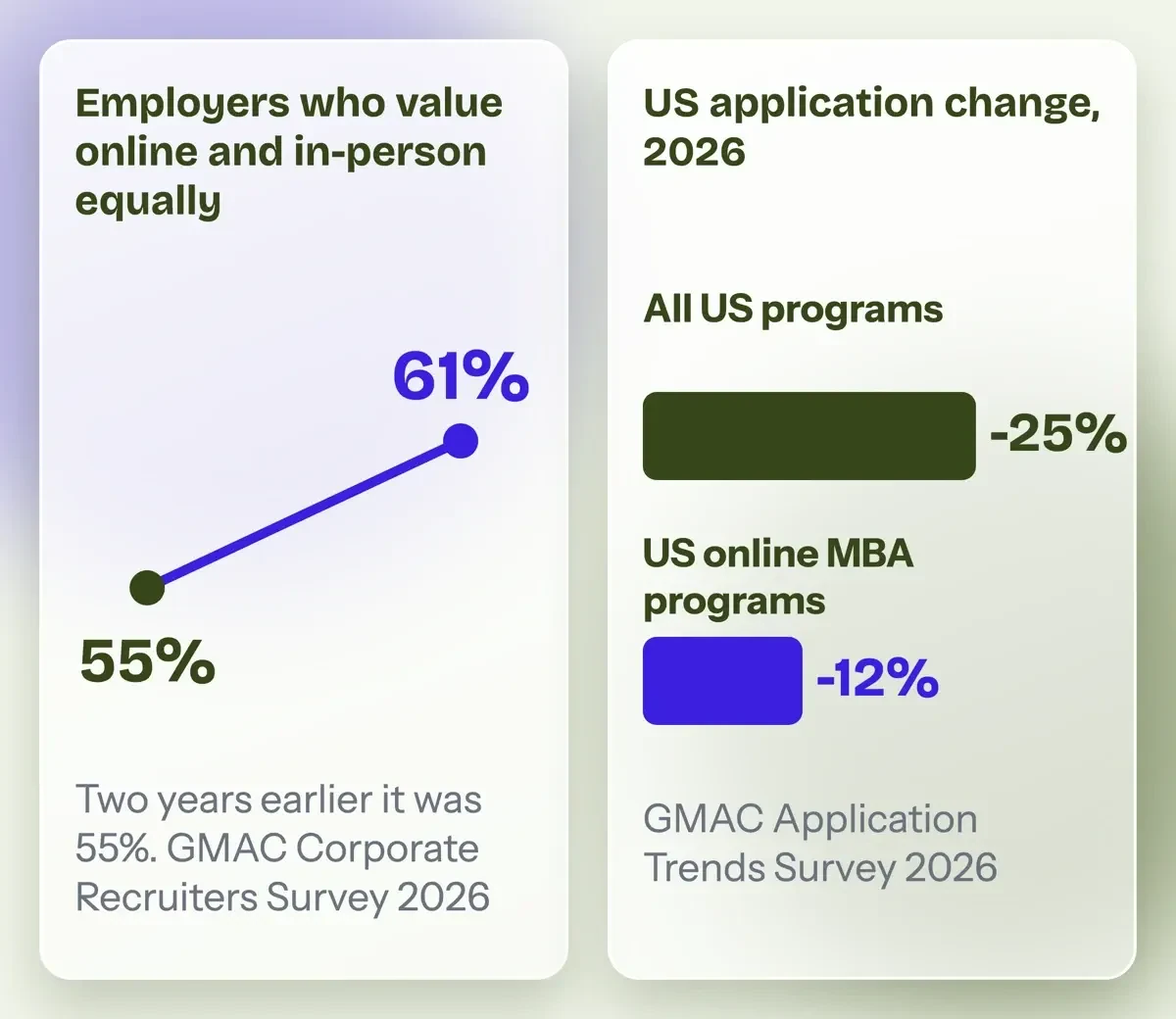 Diagram by DigitalTreed: employer and applicant figures from GMAC 2026 survey reports.
For management jobs, the degree is rarely a hard requirement. Of the 26 jobs on the BLS management occupations page, 19 list a bachelor's degree as the typical entry education, and just 2 list a master's. That group's median pay was $126,520 in May 2025, against $50,980 for all occupations. GMAC's United States profile adds that almost two-thirds of US employers agree business school graduates outearn other employees.
Before you pay, read the education line in real job posts for the role you want. Our chief operating officer job description, business development director job description and finance job titles by pay show where an MBA tends to appear. For technical roles, compare the degree with the in-demand tech skills ranked with BLS data, and for a federal job read how GS pay tables work first.
How to spot a diploma mill before you pay
A diploma mill sells a degree without the education, and an online MBA is easy cover for one. The FTC's college degree scams page lists the signs: no studying, exams or contact with professors, and a degree in days, weeks or months. It adds that "nobody legit will give you an entire degree based on your experience." Fake schools also invent accreditors and borrow names close to well-known colleges.
A .edu web address doesn't prove a school is real, the FTC warns. Before paying, run these checks from the same page:
- Look up the school in College Navigator and note its accreditor.
- Find that accreditor on the Education Department's DAPIP database.
- Call a state university registrar and ask if it would accept the credits.
- Ask an employer you want to work for if it would recognize the degree.
- Ask the attorney general in the school's state if the school operates legally.
- Search the program name with the words review, scam and complaint.
We turned those signs into nine checks and scored five made-up ads; the table is the script's output. One check is our own rule, not the FTC's: flag any program under 12 months, since the FTC only says "a few days, weeks, or even months."
| Made-up program | Checks passed | Result | Flags |
|---|---|---|---|
| P1 Harlow Pike University (made up) | 9/9 | No red flags | None |
| P2 Olvendale Graduate School (made up) | 1/9 | Stop | 8: no coursework, exams or faculty; degree for experience; 1 month; pushy ads; accreditor and school not listed |
| P3 Brisa Coast College (made up) | 9/9 | No red flags | None (12-month accelerated program) |
| P4 Varrow Hill University (made up) | 2/9 | Stop | 7: no exams or faculty; 6 months; pushy ads; accreditor and school not listed; sound-alike name |
| P5 Marsh Ternley Institute (made up) | 8/9 | Ask questions | 1: not listed in College Navigator |
P3, a 12-month accelerated program, passed because it had graded work and faculty contact. P2 and P4 ran 1 and 6 months with no exams or faculty.
If a real school fails either of the first two checks, stop there and report it to the FTC at ReportFraud.ftc.gov and your state attorney general. The same habits work on other fast-money offers, as in our list of legit work-from-home jobs and their scam signs.
What we tested
That table came from our script, which ran offline on the five made-up ads and also printed the cost example. A header request on November 6, 2026 got a 200 from College Navigator, College Scorecard, DAPIP, AACSB's search and the FTC page. CHEA's site answered 403, blocking our script, and studentaid.gov gave no answer in 30 seconds.
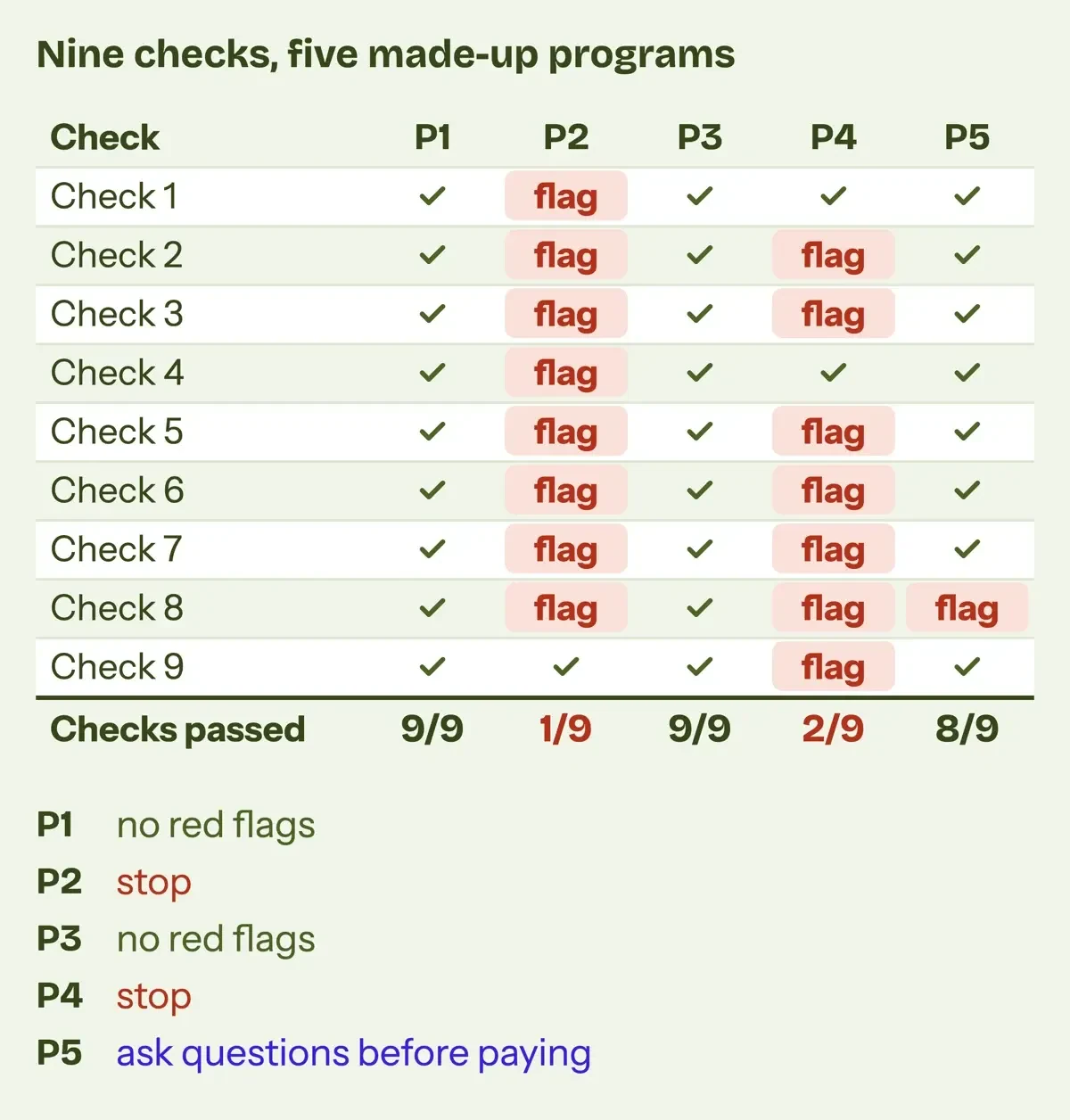 Diagram by DigitalTreed: results from our local red-flag checker at 127.0.0.1, made-up data.
Our take for a working adult
If your employer pays even part of the bill and your target jobs don't demand a campus network, we'd take the online route. In our example, keeping a made-up $70,000 paycheck outweighs the $12,000-a-year tuition gap in GMAC's global medians. Accreditors hold both formats to the same standards.
We'd pick the campus program only for a career switch where recruiting happens on campus, such as consulting, where GMAC found employers least likely to rate the formats equally.
Whichever you choose, run both lookups before you apply, and ask the aid office how part-time study cuts the $20,500 cap.
Frequently asked
Is an online MBA worth the money?
Run the cost example first. AACSB's accreditation page cites a 2022 GMAC survey: 83% of its alumni said the degree raised their earning power.
Can I take an online MBA from a school in another state?
Yes. NCES Fast Facts found 48% of graduate students taking only distance courses in fall 2021 chose a school in another state.
Can my employer help repay MBA loans?
Yes, under a section 127 plan. The IRS April 2026 FAQ counts loan principal or interest payments inside the same $5,250 yearly limit.
Do online MBA programs give scholarships?
Many do, so ask. GMAC's 2026 application trends found the share of incoming students with merit-based scholarships rose in 2026.
How we made this guide: We saved three GMAC 2026 survey reports, the loan law, NCES tables, IRS, BLS and FTC pages on November 6, 2026. A script matched every quote against them. Facts checked by the DigitalTreed team on November 6, 2026. This isn't financial, tax or legal advice.
First published August 2021 as a short opinion piece citing 2018 surveys without links. Rewritten November 6, 2026 with GMAC 2026 data, the new federal loan limits, tax rules and accreditation checks. The old statistics were cut because no current primary page carries them.
Sources
- GMAC: Application Trends Survey 2026 Report (PDF, October 2026)
- GMAC: Application Trends Survey 2026 Report page
- GMAC: Corporate Recruiters Survey 2026 Deans Summary (PDF, June 2026)
- GMAC: Corporate Recruiters Survey 2026 Deans Summary page
- GMAC: Corporate Recruiters Survey 2026, United States regional profile (PDF)
- NCES Fast Facts: Distance learning
- NCES Digest of Education Statistics, table 311.15
- NCES Digest of Education Statistics, table 323.10
- NCES Condition of Education: Trends in Student Loan Debt for Graduate School Completers
- LII: 20 U.S.C. 1099b, Recognition of accrediting agency or association
- LII: 20 U.S.C. 1087e, Terms and conditions of loans
- govinfo.gov: Public Law 119-21
- IRS: FS-2026-10, Updates to frequently asked questions about educational assistance programs
- IRS: Publication 970, Tax Benefits for Education
- BLS Occupational Outlook Handbook: Management occupations
- FTC Consumer Advice: College Degree Scams
- AACSB: The value of accreditation
- AACSB: Search accredited schools
- NCES: College Navigator
- U.S. Department of Education: DAPIP accreditation database
- U.S. Department of Education: College Scorecard


Comments
No comments yet. Start the conversation below.