
Quick answer
The in-demand tech skills for 2026 are data science, AI engineering, cybersecurity and software development. BLS now projects data scientist jobs to grow 34.6% by 2035 and information security analyst jobs 21%. But growth isn't everything: IT support is shrinking, yet it still has about 48,700 openings a year.
Most lists of in-demand tech skills say the same four words: AI, cloud, cyber, data.
Fair enough, but there's a problem with the numbers under them. The federal jobs agency, BLS, put out new 2025-35 projections on August 27, 2026, and the ranking pages we checked haven't switched.
So we built our own list.
We spent October 25, 2026 reading 10 Occupational Outlook Handbook pages and 3 BLS projection tables, then copied the pay, growth and yearly openings into one table. The BLS site wouldn't answer our download script, so we opened every page in a browser, one by one. It took an afternoon. It was worth it, because two things jumped out that the ranking pages don't mention.
A shrinking field can still hire more people than a booming one.
And inside a single field, one job can grow while the job next to it stands still. Both change what's worth learning first.
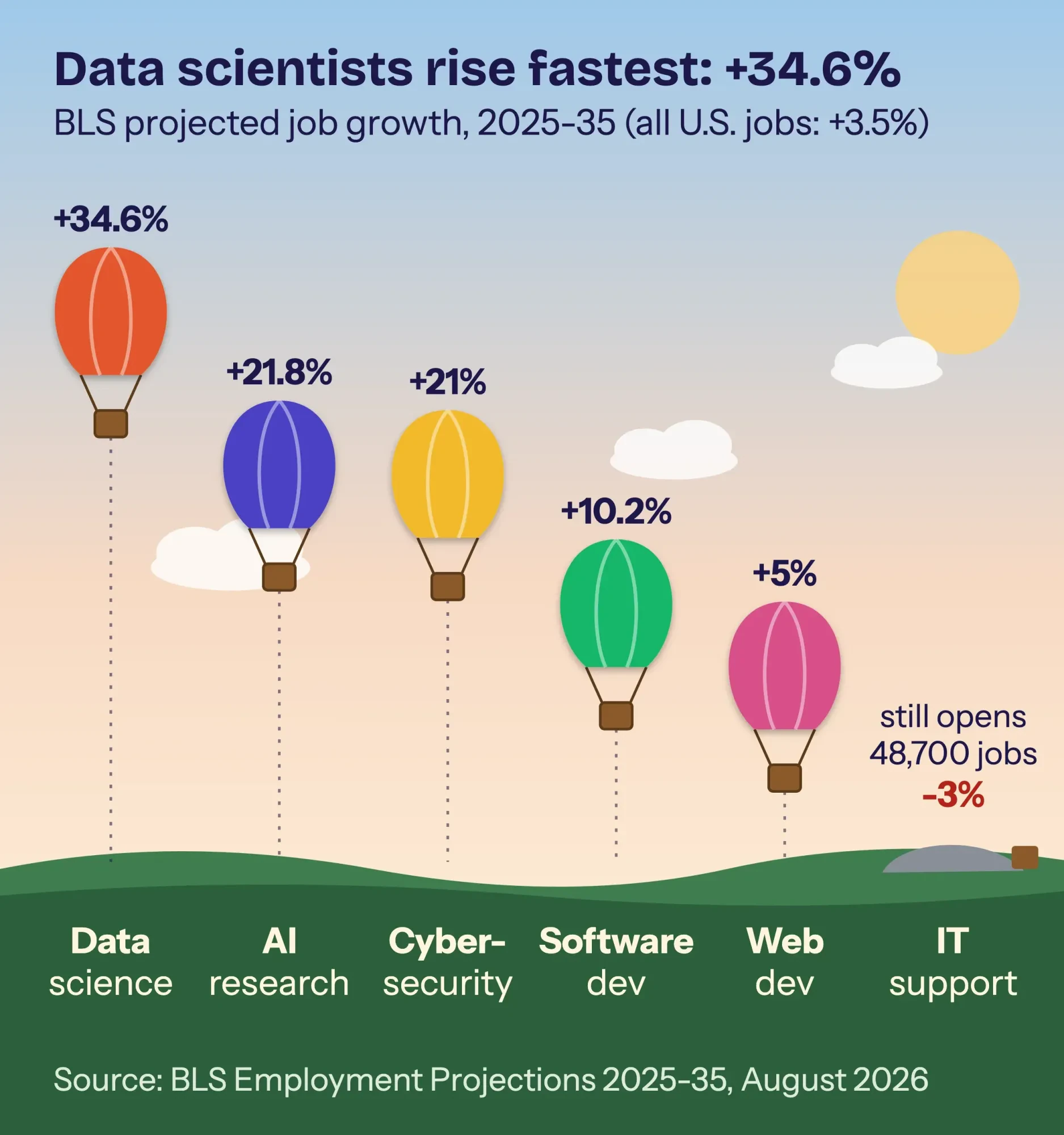 Source: BLS Employment Projections 2025-35 and Occupational Outlook Handbook, August 2026. Chart by DigitalTreed.
Key takeaways
- Data scientists are projected to grow +34.6% from 2025 to 2035.
- Software development opens about 95,300 jobs a year, the most of any tech role.
- IT support is shrinking 3% but still has about 48,700 openings a year.
- If you need a job within a year, chase openings, not growth rates.
- Older pages still quote 2024-34 figures, so check the years on any list.
Eleven tech roles on the new BLS numbers
Here's the whole picture in one table. Pay is the May 2025 median from each Handbook page, and growth is rounded as the Handbook shows it where a row combines jobs. Openings come from BLS Table 1.2, where openings count new jobs plus the people who retire or switch careers.
| Skill area | BLS job title | Median pay, May 2025 | Growth, 2025-35 | Openings a year |
|---|---|---|---|---|
| Data science and analysis | Data scientists | $120,230 | +34.6% | 24,800 |
| AI research and engineering | Computer and information research scientists | $140,300 | +21.8% | 2,900 |
| Cybersecurity | Information security analysts | $129,180 | +21% | 14,100 |
| Software development | Software developers | $135,980 | +10.2% | 95,300 |
| Systems and business analysis | Computer systems analysts | $105,850 | +8% | 32,900 |
| Cloud and network design | Computer network architects | $134,050 | +8% | 9,600 |
| Testing and QA | Software QA analysts and testers | $104,300 | +5.7% | 10,700 |
| Web development and design | Web developers and digital designers | $99,520 | +5% | 13,600 |
| Databases | Database administrators and architects | $126,760 | +4% | 7,300 |
| IT support | Computer support specialists | $62,890 | -3% | 48,700 |
| Networks and servers | Network and computer systems administrators | $99,130 | -4% | 13,400 |
For scale, all U.S. jobs are projected to grow 3.5%, and the median pay for all workers was $50,980 in May 2025, per BLS Table 1.3.
One gap: BLS has no "cloud engineer" or "DevOps engineer" title.
That work sits inside the titles above, so we've used the closest ones and said so.
Fastest growth: data and AI skills
That table's top rows are all data and AI. In its 2025-35 summary, BLS says growth in computer and math jobs "is expected to largely stem from the continued proliferation of digital tools and AI solutions."
Data science and data analysis
So start with the fastest riser. Data scientists are the third-fastest-growing job in the whole country, behind nurse practitioners and solar installers.
BLS projects +34.6% and about 24,800 openings a year, at a $120,230 median in May 2025, per Table 1.2.
The day-to-day work isn't as glamorous as the title.
You'll clean messy spreadsheets, write SQL, build charts and explain what changed.
Data analysts show up in vendor numbers too: CompTIA, which sells IT certifications, ranked them fourth among the most-posted tech jobs in September 2026.
Blockchain didn't make our list. BLS doesn't track it as a job, and we couldn't find 2026 government data to back it.
AI and machine learning engineering
Next up is the job people picture when they hear "AI." Computer and information research scientists are the closest BLS group, growing +21.8% at a $140,300 median.
Here's the catch.
BLS lists a master's degree as the usual entry point, and there'll be only about 2,900 openings a year.
Job ads tell a bigger story, and it's mostly about AI skills inside other jobs. CompTIA counted 349,821 active postings asking for AI-related skills in September 2026, plus 13,636 for dedicated AI and machine learning titles. That's vendor data built on job postings, so read it as a trend, not a headcount.
AI fluency for the job you already have
Even if you never build a model, this one's the easiest win on the list. CompTIA's State of the Tech Workforce 2026 (vendor data) found more than 275,000 postings in January 2026 asking for "some level of AI skills," from dedicated AI jobs to everyday roles.
In plain terms: can you use AI tools well and check their work?
If you can, you're worth more to an employer this year.
And no, high AI exposure doesn't mean your job's about to vanish. BLS now sorts nearly every job into four levels of AI exposure, and it warns that exposure "does not imply job loss."
Start with the tools your job already uses, and check every answer before it goes out.
Cybersecurity is the steadiest high-paying bet
But if you want growth and pay with a clearer way in, look at security. Information security analysts grow +21% by 2035, with a $129,180 median in May 2025 and about 14,100 openings a year.
You'll usually still need a bachelor's degree.
BLS also notes that "employers may prefer to hire analysts who have professional certification," and it lists under 5 years of related work experience as typical. So a year or two in IT support or networking is one realistic way in.
Security analysis and the NICE framework
That word "cybersecurity" covers dozens of jobs, so use the government's map. The NICE Framework from NIST is "a common language that describes cybersecurity work," and its current version is 2.2.0, dated April 28, 2025.
Pick one work role from it. Then learn only what that role lists. It's far cheaper than a vague "cyber" course.
You've got two free federal starting points. CISA Learning offers "no cost online cybersecurity training" on topics like cloud security and ethical hacking, and the NICCS catalog lists "thousands" of courses mapped to the framework, each priced by its own provider.
Then practice on something real: run your own site through the free DigitalTreed SSL checker and look up what each line means.
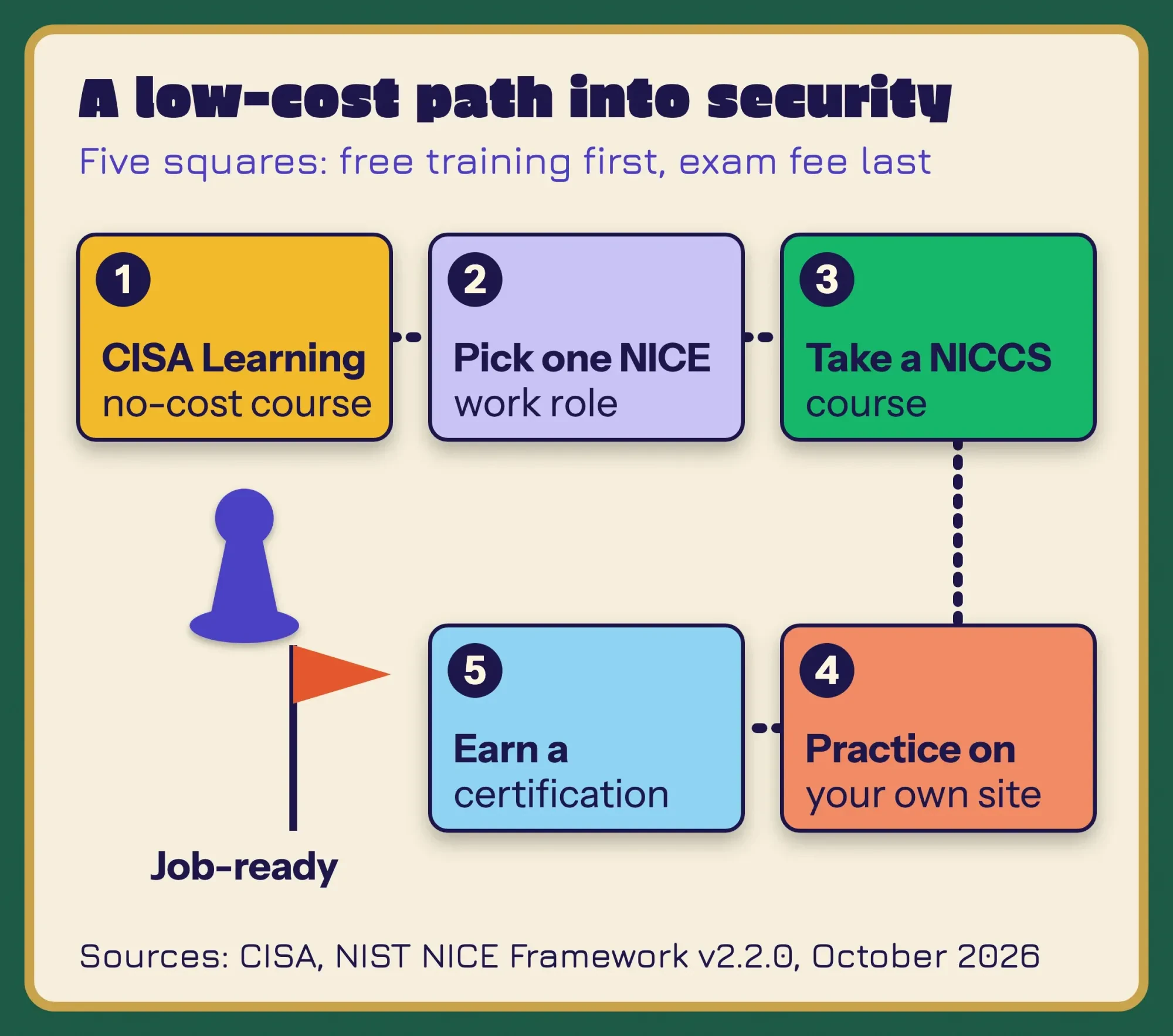 Diagram by DigitalTreed, based on NIST NICE Framework v2.2.0 and CISA training pages, October 2026.
Builders: software, testing and the web
Now for the biggest hiring pool of all, and it isn't close. Software developers earn a $135,980 median and grow +10.2%, adding 174,700 jobs by 2035.
That's the sixth-largest gain of any occupation in BLS Table 1.4, and BLS expects about 95,300 openings a year.
Software development
Employers weren't shy about posting for it this fall. CompTIA (vendor data) counted 47,598 new software developer and engineer openings in September 2026, up 8.3% from August and the most of any tech job.
The skill isn't only code.
Teams want people who'll split work into small releases, review each other's changes and ship often, the habits behind agile software development.
Which language to learn is a separate question, and we answered it goal by goal in programming languages to learn in 2026.
Quality assurance and testing
Testers find what's broken before customers do. Software QA analysts and testers earned a $104,300 median in May 2025, per the same BLS page, and BLS Table 1.2 projects +5.7%.
It's a quieter way into software, and a good one if you like finding faults.
Web development and digital design
Web work doesn't grow as fast: +5% for web developers and digital designers, with a $99,520 median in May 2025 and about 13,600 openings a year.
Designers out-earn developers here, $104,000 to $92,650 in May 2025.
It's also the most freelance-friendly job on the list, since 17.5% of web developers are self-employed, per BLS Table 1.2.
Start with a first JavaScript page or a WordPress site for a real client. Then check it with the DigitalTreed website speed test, because a slow site is the first thing a client notices.
Keeping systems running: cloud, DevOps, support and data
Still, someone has to keep all of it online, and here the BLS numbers get mixed.
Some of these jobs grow, some shrink, and two have no BLS title at all.
Cloud computing
Cloud skills don't get their own BLS title; they hide inside others. The closest BLS match, computer network architects, grows +8% with a $134,050 median, but BLS lists "5 years or more" of related work as typical.
The cheapest proof of basic cloud skills is a foundational exam: the AWS Certified Cloud Practitioner costs $100 as of October 2026, with 65 questions in 90 minutes.
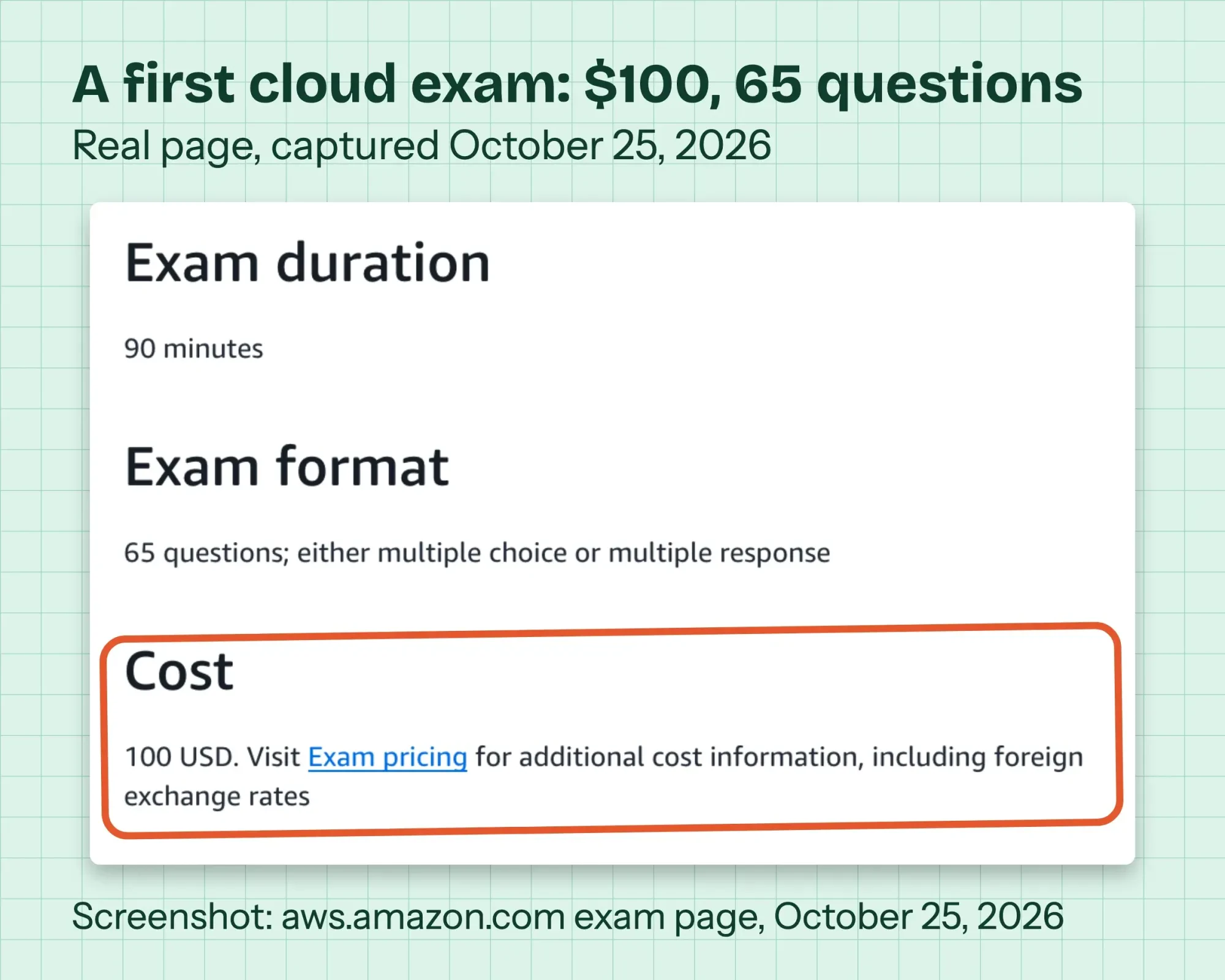 Screenshot: AWS Certified Cloud Practitioner exam page, aws.amazon.com, October 25, 2026.
AWS Skill Builder offers "1,000+ free learning resources."
Microsoft says "Microsoft Learn training is free," though hands-on labs now need an Azure subscription or a free 30-day trial. Its Azure Fundamentals exam price depends on your country.
If the words are new, the DigitalTreed cloud computing architecture tutorial explains the layers first.
DevOps and site reliability
This is where BLS goes quiet: there's no line for DevOps. CompTIA (vendor data) put DevOps engineers fifth among the most-posted tech jobs in September 2026.
The core skills? Automating releases and watching systems so problems don't pile up, which is what application monitoring looks like day to day.
IT support
Then comes the surprise. Computer support specialists are projected to shrink 3%, but BLS still expects "about 48,700 openings" a year as people move up or retire.
That's more yearly openings than data science.
You won't need as much schooling, either. BLS Table 1.2 lists "some college, no degree" for user support and an associate's degree for network support, and while the $62,890 median is the lowest here, the job builds habits every other role needs.
Want a feel for the work? Paste a few links into the free DigitalTreed HTTP status checker and learn what a 301, 404 or 500 means.
Databases and networks
Databases show the split better than anything else we've seen. In BLS Table 1.2, database architects grow +9.4% at a $139,500 median, while database administrators sit flat at -0.1% and $104,620.
Designing data systems is gaining. Babysitting them isn't.
Networks follow the same pattern: network and computer systems administrators drop 4%, yet still have about 13,400 openings a year. So if networks interest you, aim at design work, not upkeep.
Growth rate and openings tell different stories
That split is the whole point of this guide. Growth tells you where a field is heading; openings tell you how many people actually get hired each year.
We've put both on one chart, and the two lists barely match.
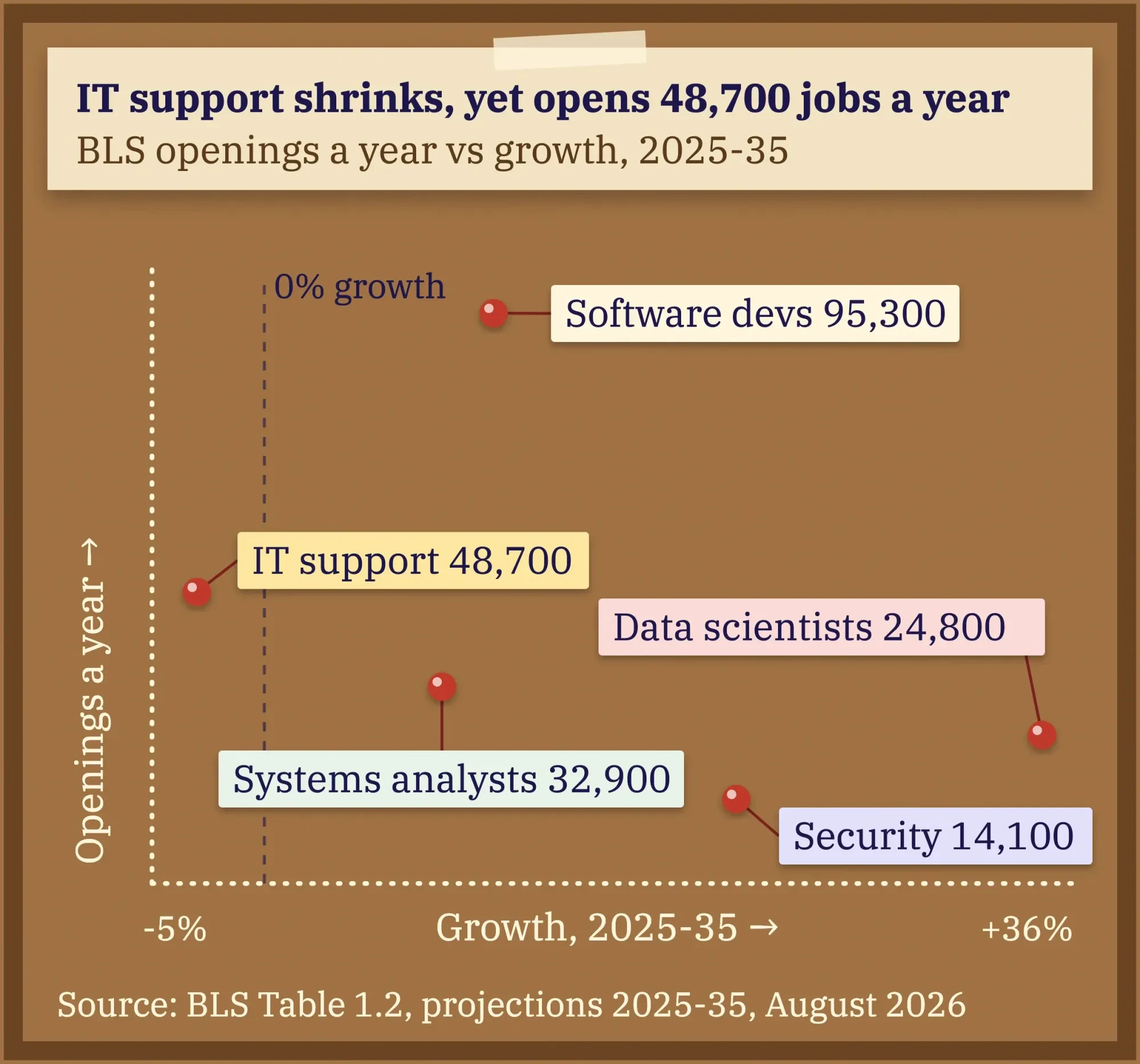 Source: BLS Table 1.2, Occupational projections 2025-35, August 2026. Chart by DigitalTreed.
IT support shrinks, yet it hires about twice as many people a year as data science, 48,700 against 24,800, per Table 1.2.
Software development grows at a middling 10.2%, but it's opening 95,300 jobs a year, more than any other tech role.
AI research grows fast, but from a base of only 38,600 workers in 2025.
If another list shows bigger growth numbers, check the years: the new BLS figures run 2025-35, and older pages still quote 2024-34.
Our take: if you need a job within a year, chase openings, not growth rates, which points you to software development and IT support. If you can study for two years or more, data science and security pay off best.
A useful skill for small-business owners
Not every reader wants a new career, and that's fine.
Some just want one skill that pays off in their own shop.
Example: Ridgeback Flooring is a fictional 9-person flooring store in Lowell, Massachusetts, and its office manager has five hours a week to learn something new. Data science won't help the store this year. Website care, basic security and reading the analytics will, because almost every lead starts on the site.
If that work turns into a career, it has its own BLS line: market research analysts and marketing specialists add 66,300 jobs by 2035, +7.0%, per Table 1.4.
Our SEO career guide maps the marketing jobs and skills, and the Google Analytics 4 walkthrough covers the reports.
Some work isn't worth doing yourself. A rebuild or a security cleanup can eat a month of evenings, and that's the kind of job DigitalTreed web development takes on; we're a paid option, so weigh it against doing it yourself.
Free and low-cost ways to learn
Once you've picked a skill, you can start most of them without paying a cent. We checked each of these official sources by hand on October 25, 2026:
- CISA Learning: no-cost cybersecurity training from the federal government.
- NICCS Education and Training Catalog: courses mapped to the NICE Framework; prices vary by provider.
- Microsoft Learn: free modules and learning paths; labs need an Azure subscription or trial.
- AWS Skill Builder: 1,000+ free resources; the Cloud Practitioner exam is $100 as of October 2026.
- Google Career Certificates: IT support, data analytics and more on Coursera, a paid monthly subscription that Google says needs no prior experience.
Google's page didn't show us a U.S. price, so we've left it out. Check Coursera before you sign up.
Which tech skill should you learn first?
So which one first? Don't pick by the hottest headline; pick by your timeline.
If you need work within a year and don't have a degree, IT support is the shortest route, and security or cloud can follow from there.
If you already code a little, push into software development, the role with the most openings. If you like numbers and can study longer, data science pays well and grows fastest.
And if you run a business, you'll get more from AI tools and your own website first. When a project outgrows your evenings, ask DigitalTreed for a quote.
One last thing: every role above needs you to explain your work in plain words, to a boss or a customer, so practice that alongside the tech.
Frequently asked
Do you need a degree for a tech job?
For most roles above, BLS lists a bachelor's degree as the usual entry point. The exceptions are computer user support ("some college, no degree") and network support (an associate's degree), per BLS Table 1.2.
Will AI replace software developers?
BLS doesn't project that. Software developers still grow 10.2% by 2035, the sixth-largest job gain of any occupation in Table 1.4. BLS does say AI productivity "may dampen employment demand for others," naming office and administrative support among them.
How we made this guide: Eram N. and the DigitalTreed team checked every figure against its source, finishing October 25, 2026. We read 10 BLS Occupational Outlook Handbook pages and BLS Employment Projections Tables 1.2, 1.3 and 1.4 in a browser, since the site blocks scripts. We copied the May 2025 pay, 2025-35 growth and yearly openings into the table above. We took the AWS exam screenshot from the public page that same day. CompTIA figures are labelled as vendor data, and every source sits next to the claim it supports.
First published July 2023. Rewritten October 25, 2026: the old post listed nine skills with no data. New: the BLS 2025-35 projections and May 2025 pay for 11 roles, yearly openings, vendor data labelled, free official training, and a small-business section.
Sources
- BLS: Employment Projections 2025-2035 Summary (USDL-26-1422), August 27, 2026
- BLS: Table 1.3, Fastest growing occupations, 2025 and projected 2035
- BLS: Table 1.4, Occupations with the most job growth, 2025 and projected 2035
- BLS: Table 1.2, Occupational projections, 2025-35, and worker characteristics, 2025
- BLS: Artificial Intelligence (AI) exposure categories
- BLS Occupational Outlook Handbook: Computer and Information Technology Occupations
- BLS OOH: Data Scientists
- BLS OOH: Computer and Information Research Scientists
- BLS OOH: Information Security Analysts
- BLS OOH: Software Developers, Quality Assurance Analysts, and Testers
- BLS OOH: Computer Systems Analysts
- BLS OOH: Computer Network Architects
- BLS OOH: Web Developers and Digital Designers
- BLS OOH: Database Administrators and Architects
- BLS OOH: Computer Support Specialists
- BLS OOH: Network and Computer Systems Administrators
- CompTIA (vendor data): State of the Tech Workforce 2026 press release
- CompTIA (vendor data): Employer demand for tech talent reaches three-year high, October 2026
- NIST: NICE Framework Resource Center
- NIST: NICE Framework current versions
- CISA: Cybersecurity Training and Exercises
- CISA NICCS: Education and Training Catalog
- AWS: Certified Cloud Practitioner exam
- AWS: Skill Builder digital training
- Microsoft Learn: Training FAQ
- Microsoft Learn: Azure Fundamentals certification
- Grow with Google: Google Career Certificates
Comments
No comments yet. Start the conversation below.