
Quick answer
Call the biller first: on our $500 example bill, a payment plan added $0, and a credit union PAL at the 28% cap added $61.62 (rules as of October 2026). With a nonprofit hospital bill, check it and ask for financial assistance before paying, since the hospital must wait at least 120 days before credit reporting. Free help through 211 comes next.
If a bill is due this week and the money isn't there, it's usually a car repair, a hospital statement, a utility notice or rent after a lost paycheck. A financial emergency is a bill you can't cover on time that does real harm if it waits. This guide lists your financial emergency options in the order we'd check them.
It starts with which bill can wait and the order to try, priced on one example bill. Then come calling the biller, medical bills and the 120-day rule, and free help from 211, energy aid and unemployment benefits. After that you'll find the credit union PAL rules, retirement money, payday loans and credit repair offers, and who to ask.
Key takeaways
- Call the biller first and get any payment plan in writing.
- Nonprofit hospitals wait at least 120 days after the first bill to report you.
- PAL caps as of October 2026: a $20 fee and a 28% rate.
- The $1,000 emergency 401(k) withdrawal skips the 10% additional tax.
- Our six-route table puts payday renewals last, at $300 on a $500 example.
Which bill can wait, and which cannot?
Before you call anyone, line the bills up by what happens if each one sits for two weeks. A utility shutoff, an eviction filing or losing the car you drive to work costs far more, and so does skipped medical care. So the bill that stops your income or your housing goes first, even if it isn't the biggest one. Draw three columns on paper: the amount, the due date, and the worst thing that happens if it's late. Fill in the third column from the notice itself, since a utility or landlord letter usually names the next step, the date it happens and who to call.
That third column, not the dollar amount, sets the order you'll work in.
This guide explains the rules; it is not financial advice. For your own numbers, ask the Consumer Financial Protection Bureau (CFPB) or a nonprofit credit counselor. The last section lists who handles state payday rules and the tax side.
The order to try, and what each step cost in our example
Once the bills are sorted, we put free help ahead of any credit, then priced every route on one example bill. The bill is $500 because the CFPB describes a payday loan as "generally for $500 or less." Each number below comes from a federal rule or a regulator's own example, and every input is labeled. The table shows the extra cost above the $500, with the formula in the middle:
| Option (example $500 bill) | Formula | Extra cost |
| Payment plan with the biller | Plan fee, example $0 | $0.00 |
| Credit union PAL at the 28% cap, 6 months | 6 x $90.27 - $500 + $20 fee | $61.62 |
| 401(k) emergency expense withdrawal | $500 / (1 - 0.12) - $500 | $68.18 |
| 401(k) hardship withdrawal, under 59 1/2 | $500 / (1 - 0.12 - 0.10) - $500 | $141.03 |
| Payday loan, one two-week term | $500 / 100 x $15 | $75.00 |
| Payday loan, renewed to four terms | 4 x $75 | $300.00 |
Read it with its limits in mind, because the 12% income tax rate is only an example and state income tax isn't counted anywhere in our numbers. Neither is the growth a 401(k) loses once money leaves it. Some billers charge a fee for a plan, so ask. One row breaks the cost order on purpose. A single payday term ($75.00) costs less than the hardship withdrawal, but the whole amount is due at once. Renewed three times, for four terms in all, the same loan reaches $300.00 in fees, so we list it last.
Free help like 211 or energy aid isn't in the table, since it costs nothing if you qualify, and that's why it comes right after the call to the biller.
What we tested
On October 29 we wrote the six formulas twice: in a Python script, and in a small calculator page served on 127.0.0.1. A check script loaded the page in headless Chrome and compared every number. All six cost rows matched to the cent, and so did the hospital date.
python3 check.py
Payment plan with the biller python $ 0.00 page $ 0.00 match
Credit union PAL at the 28% cap python $ 61.62 page $ 61.62 match
401(k) emergency expense withdrawal python $ 68.18 page $ 68.18 match
401(k) hardship withdrawal python $ 141.03 page $ 141.03 match
Payday loan, one two-week term python $ 75.00 page $ 75.00 match
Payday loan, renewed to four terms python $ 300.00 page $ 300.00 match
501(r) date: first bill 2026-03-03 + 120 days: python 2026-07-01, page 2026-07-01 match
Result: 6/6 cost rows match, date matches.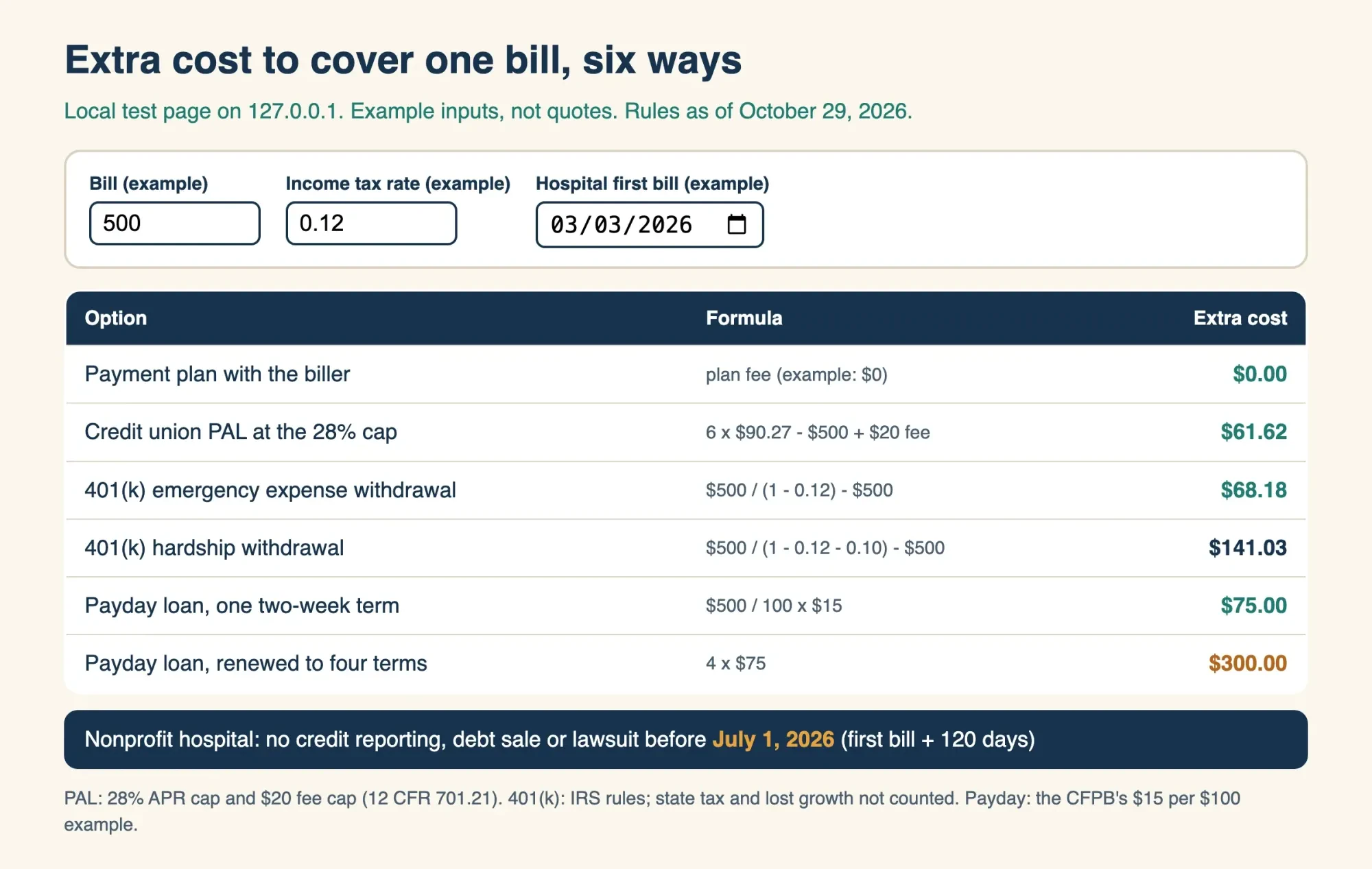 Screenshot: the six-route calculator we served on 127.0.0.1, taken October 29, 2026, with example inputs and no lender data.
Call the biller before the due date
That table's cheapest row costs a phone call, and the call works best before the bill is late. Ask three things.
Is there a payment plan or a hardship program you'd qualify for? Does it carry a fee? What happens to the late fees once you sign up?
Then ask them to send the terms by email or letter, and keep that confirmation somewhere you'll find it again if a late fee shows up anyway. Write down who you talked to, the date and what they'd agreed to.
Mortgages have a formal version of this, called forbearance. The CFPB's mortgage forbearance explainer says your servicer may let you "temporarily pause mortgage payments or make smaller payments." It also warns, "You still owe the full amount." The CFPB lists three ways it comes back. You may "pay the whole amount back at once." Or it's repaid "by adding more payments at the end of your mortgage loan," or you pay it back "by increasing your monthly payment." Ask which one first.
Timing counts here too. The CFPB adds that at some servicers, hardship help "must be requested within a specified amount of time after a disaster or other qualifying event."
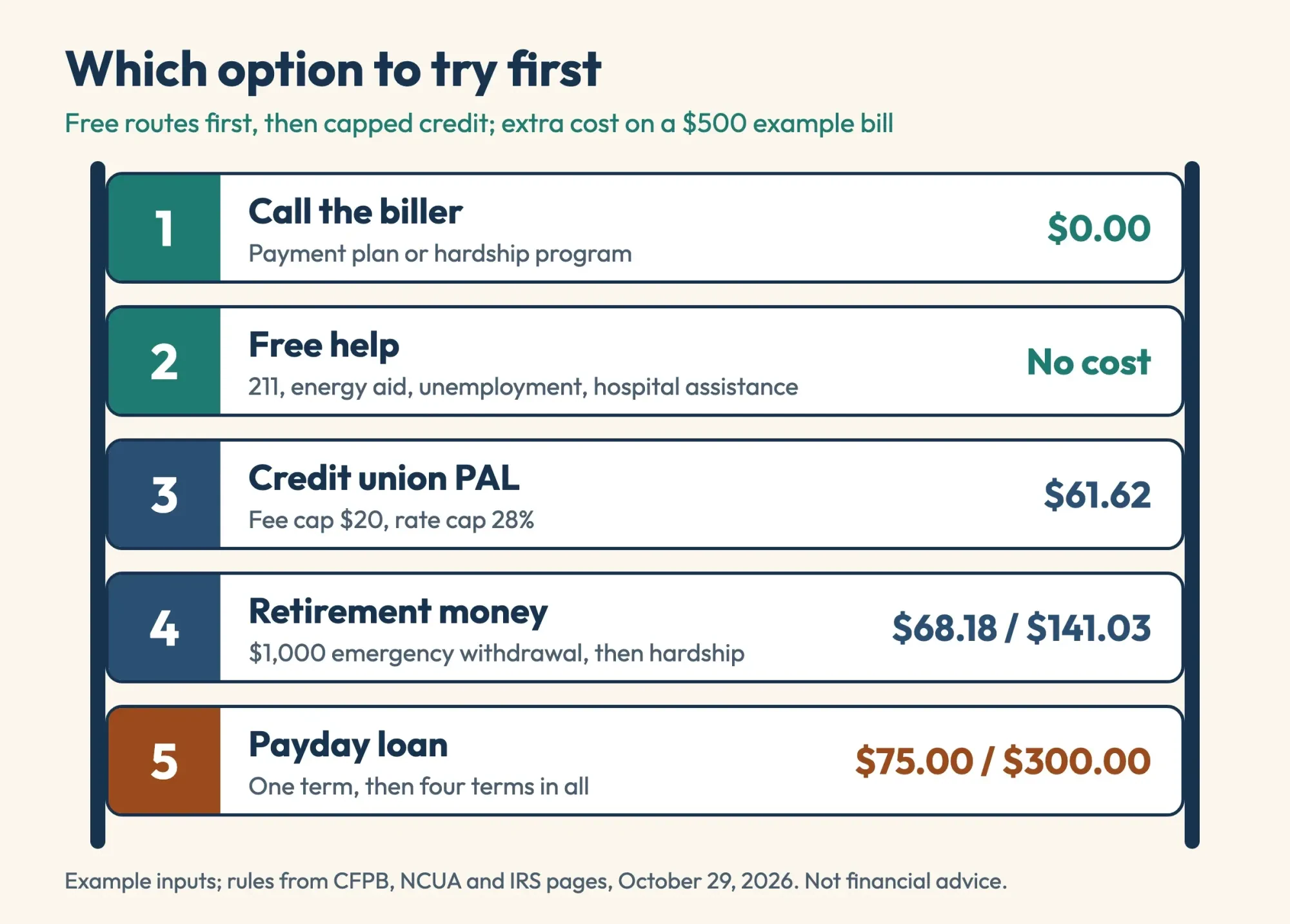 Diagram by DigitalTreed. Costs from our October 29, 2026 example; rules from the CFPB, NCUA and IRS pages linked in this guide.
Medical bills: check, ask for financial assistance, and know the 120-day rule
Next, if the bill is medical, don't pay it before you check it. The CFPB's guide to a medical bill you can't pay lists the order. Confirm you owe it, ask for an itemized list of charges, and look for errors like the same service billed twice, then appeal to your health insurer if needed. Only after those checks does the CFPB turn to payment plans, so you aren't setting up monthly payments on a charge that shouldn't be there in the first place.
Next comes financial assistance, sometimes called charity care. Nonprofit hospitals must keep a written financial assistance policy under section 501(r) of the tax code, as the IRS page on financial assistance policies explains. The CFPB's medical bill help answer says the policy "must be provided free of charge and must tell you how to apply for help." You'll apply with income papers, such as last year's tax forms or a recent pay stub, plus a list of your monthly expenses like rent and utilities. Even a for-profit hospital may have a financial assistance policy, the CFPB notes, so it's worth asking either way.
Then there's timing. The IRS billing and collections rule bars extraordinary collection actions for "at least 120 days" after the first post-discharge bill. The federal regulation, 26 CFR 1.501(r)-6, says what counts, and selling the debt, reporting to credit bureaus and steps that need a court are all on that list. The hospital also has to tell you about its financial assistance policy before any of them. Here's the date math in an example: a first bill dated March 3, 2026, plus 120 days, lands on July 1, 2026. Mark it on a calendar.
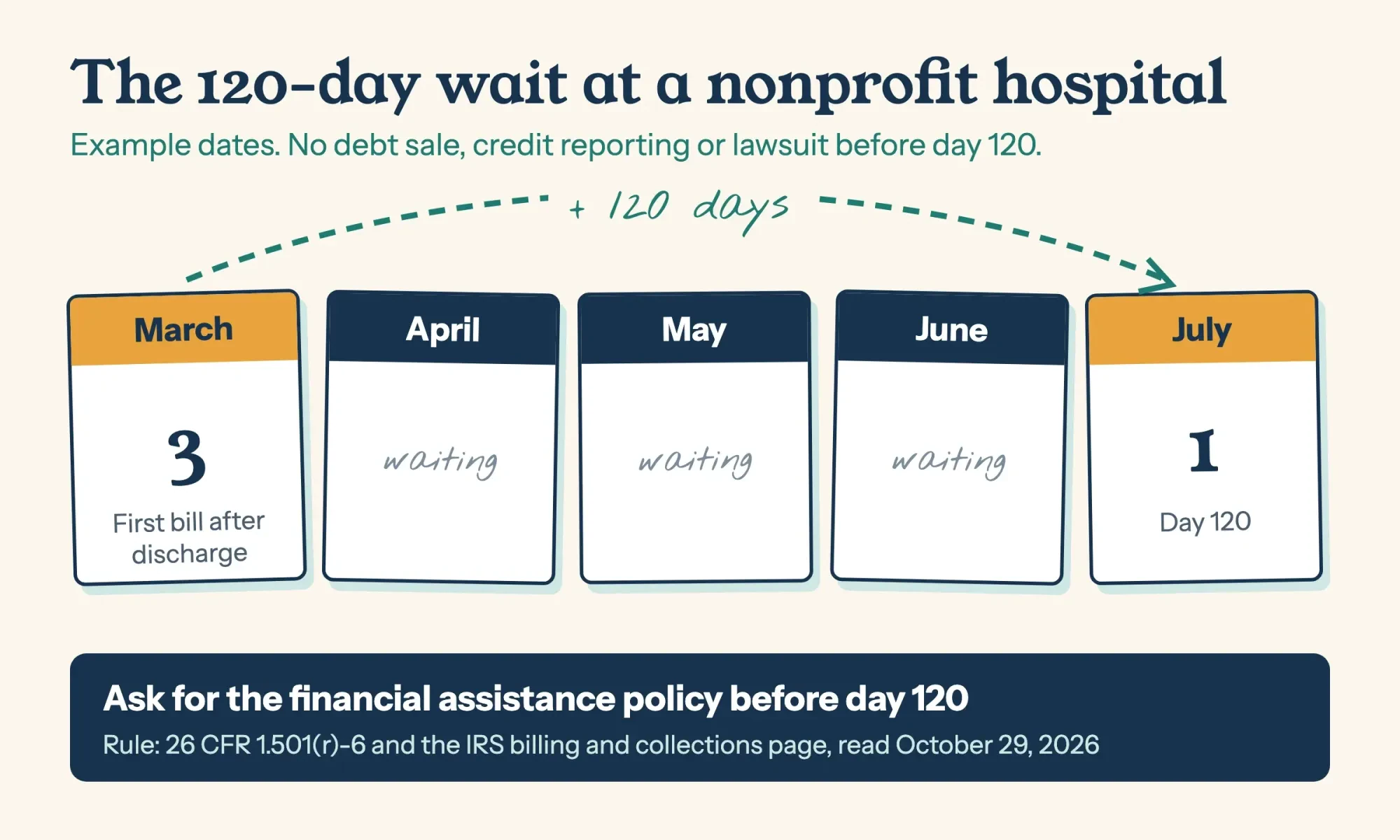 Drawn by us. Example dates; the 120-day rule from 26 CFR 1.501(r)-6 and the IRS, read October 29, 2026.
If you were uninsured or paid yourself, the CMS medical bill rights page adds one more check. Providers usually must give you a good faith estimate first. And "You may be able to dispute your bill if it's at least $400 more than the estimate."
Free help: 211, energy aid and unemployment benefits
After the biller and any medical checks, free help ranks high because it doesn't add anything to what you owe. The quickest door is 211, a phone, chat and text line run by local agencies. The 211 network says it has more than 200 agencies across the country, and calls can be anonymous. Most of its requests, the network adds, come from people looking for help with basic needs like housing, food, transportation and health care. You'll give the specialist the bill type and your ZIP code. Then ask which local programs pay that kind of bill and what papers they'll want, so you can bring the notice and proof of income the first time.
Heating and cooling bills have a federal program behind them. USA.gov's guide to help with energy bills says the Low Income Home Energy Assistance Program (LIHEAP) can help pay heating or cooling bills. It can also cover emergency services in an energy crisis, and eligibility is based on income, with every state and territory setting its own requirements for who qualifies. The program comes from 42 U.S.C. 8621, which funds states to help low-income households with "their immediate home energy needs." Shutoff policies differ by state too, so look up your state's rule from that same USA.gov page well before the shutoff date printed on your notice.
A lost job changes the math for every bill on the list. The Labor Department's unemployment insurance page says to file in the state where you worked. It adds: "It generally takes two to three weeks after you file your claim to receive your first benefit check." There's no federal program, as USA.gov on unemployment benefits puts it, because each state runs its own. If you worked remotely or in another state, your home state's unemployment office can help you file the claim with the right state.
File the week the job ends, since those two or three weeks of waiting are part of the gap you're covering.
Two smaller bills have their own help. If it's the phone bill, our guide to a free phone through Lifeline with SNAP covers the federal phone discount. For food, our grocery budget guide with unit prices and a weekly cap shows how to stretch what's left.
If you borrow: what a credit union PAL may charge
Once free help is used up and borrowing is on the table, a payday alternative loan (PAL) from a federal credit union has a federal price cap. The rule sits in 12 CFR 701.21, and the NCUA's 2019 final rule added a second version, PALs II, for larger amounts and people who just joined. Here's how the two compare, in the rule's own terms where it matters:
| Rule | PALs I | PALs II |
| Amount | Not less than $200 or more than $1,000 | Not more than $2,000 |
| Term | 1 to 6 months | 1 to 12 months |
| Membership before the loan | At least one month | No minimum time |
| Application fee | In no case exceeds $20 | In no case exceeds $20 |
| Rollovers | Not allowed | Not allowed |
| Loans per borrower | One open, three per rolling six months | One open, three per rolling six months |
The rate cap takes two steps to read. The rule lets a credit union charge 1000 basis points, or 10 percentage points, above the NCUA Board's ceiling. In its February 2026 rate ceiling letter, the NCUA says the Board kept that ceiling at a temporary 18% through September 10, 2027. So the PAL cap is 18% + 10% = 28% (as of October 2026), and it holds for as long as that 18% ceiling lasts. That's the rate our example used. Over six months, the payment came to $90.27 a month, and the extra cost reached $61.62 with the fee.
The rule says a federal credit union "may" charge the higher rate if it follows these terms. It doesn't make them offer PALs, so ask yours whether it does and at what rate.
Retirement money: the $1,000 emergency withdrawal and hardship rules
Beyond a PAL, a 401(k) can release cash in an emergency in two ways, and they're taxed very differently. Your plan decides whether either one exists for you, so the plan summary or your HR office has the final word before you count on this money.
Either way, the money counts as taxable income unless it's Roth money, and that's why the tax rate sits in both formulas.
The newer route is the emergency personal expense distribution. IRS Notice 2024-55 allows one per calendar year, "in an amount up to a maximum of $1,000." It's meant for "unforeseeable or immediate financial needs relating to necessary personal or family emergency expenses." The IRS's early distribution exceptions page confirms it avoids the 10% additional tax. Under the notice, plans can rely on your written self-certification. Plans don't have to offer it. If yours does, you can repay it within 3 years, and the notice says the $1,000 isn't indexed for inflation.
The older route is the hardship distribution. The IRS hardship distributions page requires an "immediate and heavy financial need." Its safe-harbor list includes medical care, payments to prevent eviction or foreclosure, funeral costs and certain home repairs. A purchase like a boat or a TV generally doesn't qualify. The regulation at 26 CFR 1.401(k)-1 adds that the plan judges the need by its own written standards. Hardship money may also carry the 10% additional tax. And you can't repay it to the plan or roll it over.
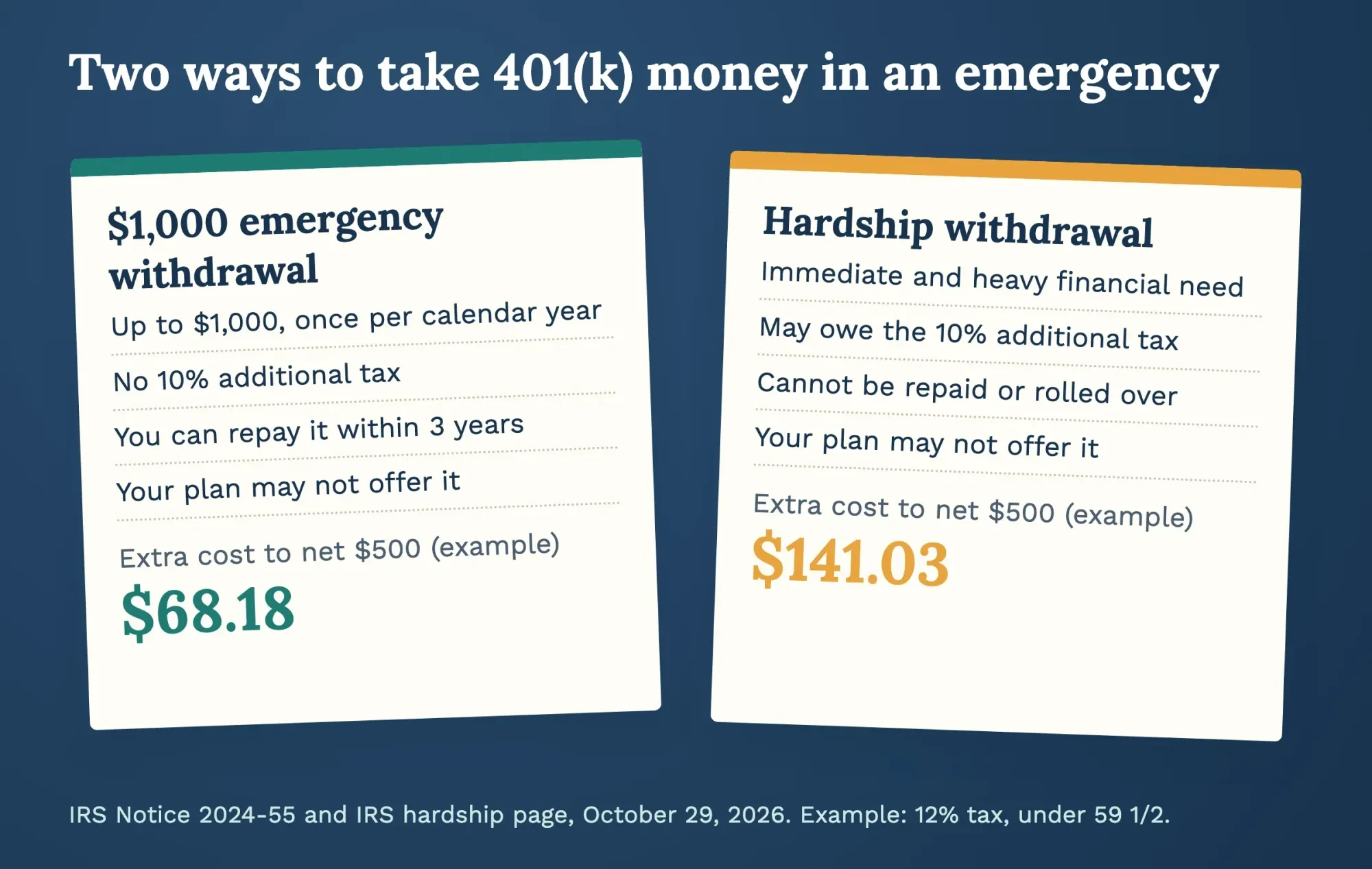 Drawn by us: our comparison of the two withdrawal routes, built from IRS Notice 2024-55 and the IRS hardship page as of October 29, 2026.
In our example, the emergency route cost $68.18 and the hardship route $141.03 to net the same $500. A CPA can run your own bracket and state tax through those formulas, since our 12% rate is only an example.
Payday loans and credit repair offers
Then there are payday loans, which the CFPB's payday loan explainer calls short-term and high-cost. Many state laws cap fees "ranging from $10 to $30 for every $100 borrowed," it says. At $15 per $100, a two-week loan works out to an APR of almost 400%, in the CFPB's own example. The whole amount is usually due at once, and the CFPB says "The due date is typically two to four weeks from the date the loan was made."
Renewals are where the cost climbs. According to the CFPB, "Some state laws permit lenders to 'rollover' or 'renew' a loan when it becomes due so that you pay only the fees." That's how our example reached $300 in fees over four two-week terms (the first plus three renewals) on $500, and the $500 itself was still owed at the end. Our payday lender checklist runs one more renewal, five terms in all, to $375. Weighing an online lender anyway? Our checklist for online payday lenders like Eloanwarehouse walks through the license lookup and the APR math. Putting the bill on a credit card has its own interest cost, worked through in our credit card financing interest math.
Credit repair pitches are the other offer to know. Under 15 U.S.C. 1679b(b), no credit repair organization may charge "before such service is fully performed." The CFPB's guide to spotting credit repair scams repeats that upfront-fee warning. It adds that disputing errors on your credit report is a free legal right. Before you type account details into an offer page from an ad or text, our guide to spotting a lookalike finance website shows how to check who runs it.
Before you pick a credit counselor, the CFPB says to "check them out with your State Attorney General's office, and local consumer protection agency."
Who to ask, and what to set up after
Once the urgent bill is handled, several people can check the rest of your plan for free or at low cost. The CFPB takes complaints about lenders, servicers and debt collectors, while a nonprofit credit counselor can go through a full budget with you line by line. Your state regulator or attorney general's office has the state payday rules, as the CFPB points out. A CPA can run the tax numbers on a 401(k) withdrawal, and a licensed attorney is who you'd call if a lawsuit or eviction notice arrives.
After that, the goal is a small cushion so the next bill doesn't restart the cycle. Our slow-money math guide shows how small monthly amounts grow over time. If a move or a loss at home started all this, our renters insurance coverage guide explains what a policy pays for. Our take: sort the bills by harm, call the biller, ask the hospital for its policy, and use 211 and state programs before any loan. If a loan offer does come up, the PAL caps above are the federal yardstick for any offer you get.
Financial emergency questions
Frequently asked
Can I get a PAL if I just joined a credit union?
Possibly a PALs II loan. The NCUA's 2019 rule dropped the minimum membership time for PALs II; PALs I still needs one month.
Can I take the $1,000 emergency 401(k) withdrawal every year?
Not always. Under IRS Notice 2024-55, no new one counts for 3 calendar years unless you repay the first or contribute that much again.
Can I pause hospital collections while I apply for help?
You can ask. The CFPB's medical bill help answer says to tell debt collectors you're seeking financial assistance and ask them to pause.
Do payday loan limits differ for military families?
Yes. The CFPB's payday loan explainer says the Military Lending Act caps the Military APR at 36% for active-duty members and dependents.
How we made this guide: Our sources are 22 public pages from government agencies, regulators and the 211 network, all read without signing in. Each money rule has two sources. Facts checked by the DigitalTreed team on October 29, 2026.
First published December 2023 as a list of emergencies. Rewritten October 29, 2026: an ordered set of options, each with its federal rule and example cost.
Sources
- eCFR: 12 CFR 701.21, Loans to members and lines of credit to members
- Federal Register: NCUA final rule, Payday Alternative Loans (October 1, 2019)
- NCUA: Permissible Loan Interest Rate Ceiling Extended (February 2026)
- IRS: Notice 2024-55, emergency personal expense distributions
- IRS: Retirement topics, Exceptions to tax on early distributions
- IRS: Retirement topics, Hardship distributions
- eCFR: 26 CFR 1.401(k)-1
- IRS: Financial assistance policy and emergency medical care policy, Section 501(r)(4)
- IRS: Billing and collections, Section 501(r)(6)
- eCFR: 26 CFR 1.501(r)-6
- CFPB: What should I do if I can't pay a medical bill?
- CFPB: Is there financial help for my medical bills?
- CMS: Medical bill rights
- CFPB: What is mortgage forbearance?
- USA.gov: Get help with energy bills
- govinfo: 42 U.S.C. 8621
- U.S. Department of Labor: Unemployment insurance
- USA.gov: Unemployment benefits
- 211: About us
- CFPB: What is a payday loan?
- govinfo: 15 U.S.C. 1679b
- CFPB: How can I tell a credit repair scam from a reputable credit counselor?
Comments
No comments yet. Start the conversation below.