

Quick answer
Playman.tech is offline as of November 15, 2026. DNS says the name doesn't exist, and the .tech registry shows it expired on September 25, 2026 and sits on server hold, pending delete. Archived 2021-2022 copies show a blog about loans, cards and Android games, not a game-key store. Before you pay any site like it, read its registry record.
If an old review sent you to Playman.tech (often typed playman tech) for gaming keys, the address doesn't lead anywhere now. Playman.tech is a lapsed .tech web address that answered nothing on November 15, 2026. Our own 2023 review of it cited no source, so we rechecked it from public records without signing up or buying anything.
We read the .tech registry record, 20 archive captures and three official record searches. What you can reuse on any key shop or earning app: the FTC's payment warnings and our 8-check record test. If you already paid a site that went offline, a card dispute has a 60-day window.
Key takeaways
- Playman.tech returned no DNS answer in any of our 7 lookups.
- The .tech registry lists the name on server hold and pending delete.
- Archived 2022 pages show 39 blog posts and zero game keys.
- Once purged, the name can be registered again by anyone.
- The FTC says gift cards are for gifts, not for payments.
Is Playman.tech online right now?
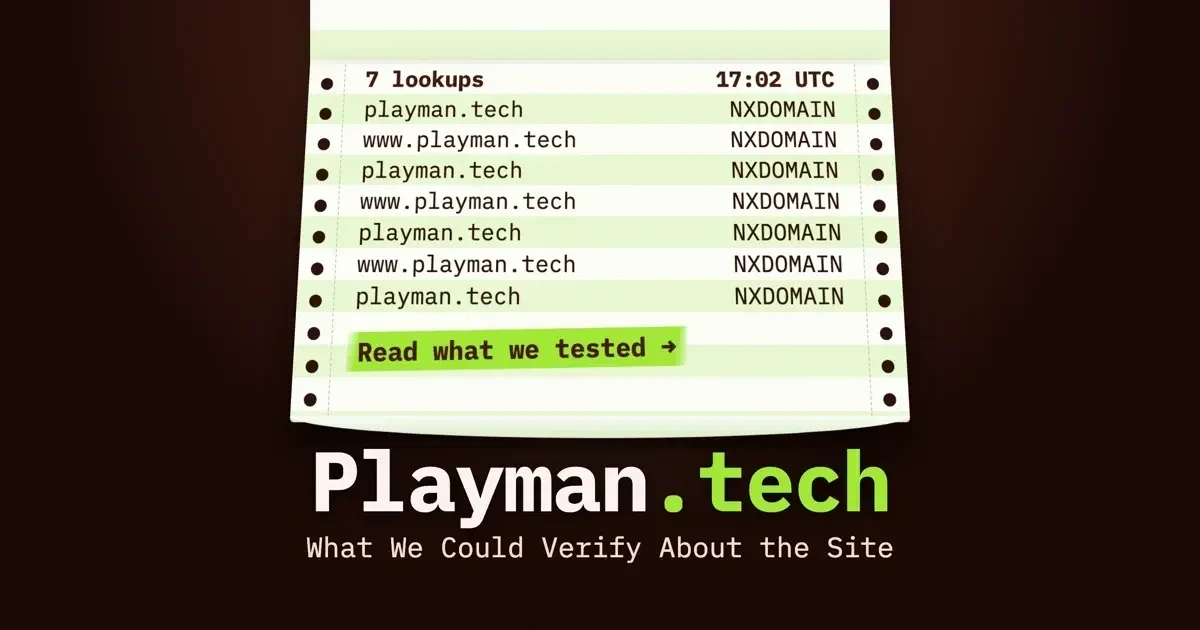
No. At 17:02 UTC on November 15, 2026, all 7 of our DNS lookups for playman.tech and www.playman.tech came back NXDOMAIN, the no-such-name answer in our NXDOMAIN error guide.
Our web requests had no server to reach, and the registry record shows why. RDAP is the public record a registry keeps for each name, and ICANN's RDAP page says it "was created as the replacement for the WHOIS protocol." The .tech registry's RDAP server says the current registration began September 25, 2025 and expired September 25, 2026. It was last changed November 1, 2026. Of its six status codes, three explain the outage, and ICANN's status code guide defines each one.
| Code on playman.tech | Set by | What ICANN says |
|---|---|---|
| server hold | Registry operator | "Your domain is not activated in the DNS." |
| redemption period | Registry, after the registrar asks to delete | Held for 30 days |
| pending delete | Registry | Purged, then open to anyone |
Nobody renewed the name. ICANN's guide says that five calendar days after the redemption period ends, a name "is purged from the registry database and becomes available for registration." A future site at this address could belong to someone with no tie to the old blog. The registrant contact is redacted, so the record doesn't say who held the name in 2025 or who will hold it next.
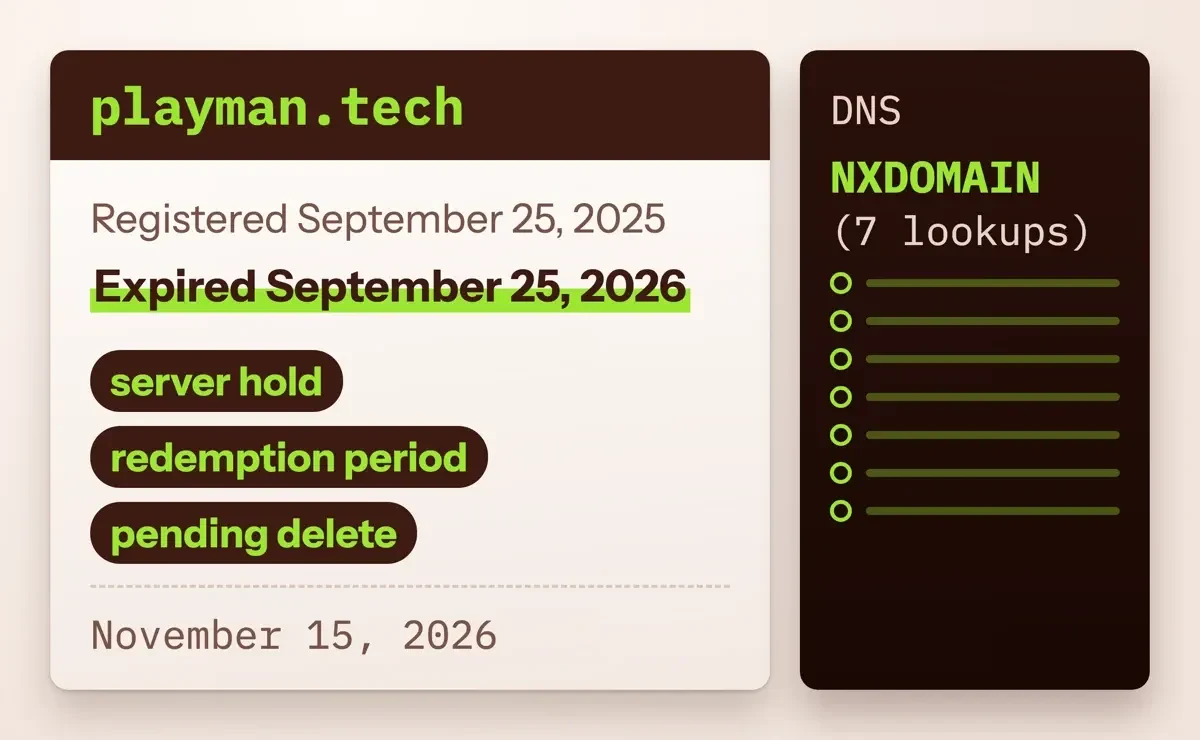 Diagram by DigitalTreed, from the .tech RDAP record and our DNS lookups on November 15, 2026.
What we tested
We saved every response on November 15, 2026, then ran an offline script, site_check.py, that scores any site on 8 record checks without making a single network call. Playman.tech got 1 pass, 4 fail, 1 partial and 2 unknown.
What the archived Playman.tech pages show
Beyond the registry, the Wayback Machine is the only public view of what the site used to be. It holds 20 captures of the home page between December 18, 2021 and August 5, 2025. There's 1 from 2021, 9 from 2022, 2 from 2024 and 8 from 2025, and none between August 2022 and September 2024. Our old review came out December 16, 2023, inside that gap, so we can't see what the site showed when it was written. The March 12, 2022 capture is a WordPress blog titled "Playman.tech | We Deliver Value." Its home page lists 39 posts from September 20, 2021 to March 11, 2022.
Of those 39, 18 cover loans, credit cards, debit cards or credit lines from banks and loan apps in India. Three titles mention rupees. Another 16 are about games, mostly mobile versions of PC games, Minecraft updates and top-5 lists. The words Steam, key and game key don't appear once. We found no store or checkout.
The 2024 and 2025 captures show something else: each page holds only the site name and a hidden enter link, with no text about games or keys. Its code loads a browser fingerprinting library, then reloads the address with a tracking ID. Nothing on it names a game, a product, a company or a person.
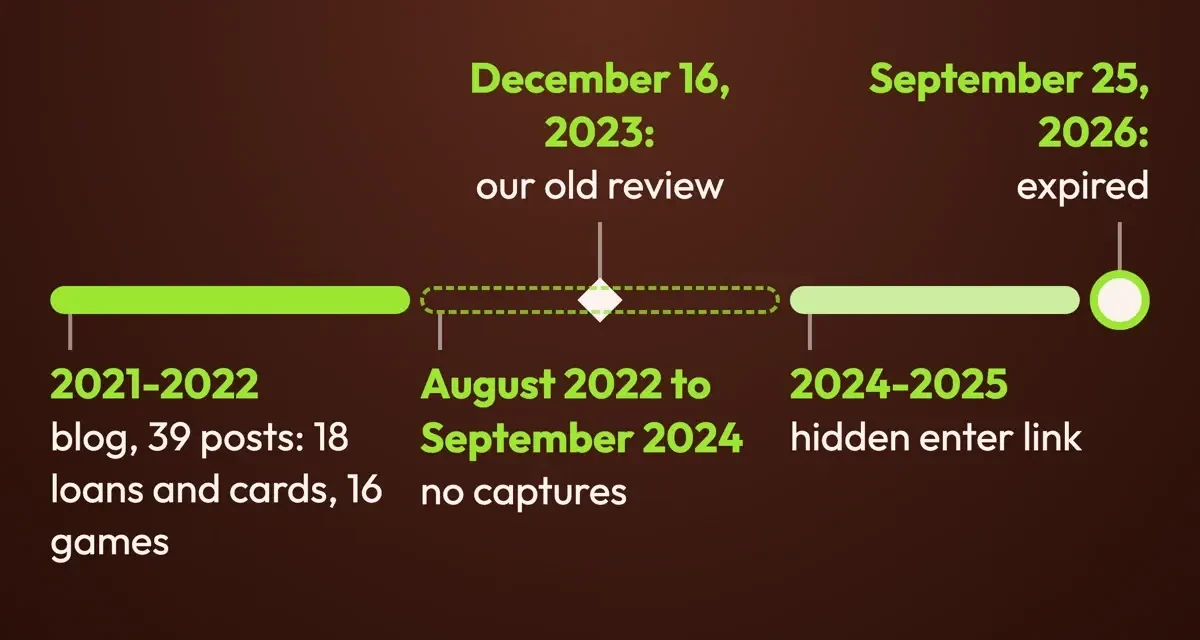 Drawn by us from Wayback Machine captures and the .tech RDAP record, read November 15, 2026.
Our 2023 review made five claims, none sourced. The captures back one, and only in part.
| What our 2023 review said | What the records show |
|---|---|
| A go-to platform for gaming keys | Not found |
| Reviews, gaming news and buying guides | Partly: game posts, no buying guides |
| A community and a marketplace | Not found: no store or checkout |
| A named founder | Not checked: registrant hidden |
| Domain scores such as DA 5 | Not checked: no source given |
The game-key claim has no support in any capture we read, so we've dropped it. The founder story went too, because the registrant is hidden. So did the DA 5 score. If you saw a game-key offer under this name somewhere else, it's a separate seller, and the record check below applies to it.
Records we confirmed, and the ones we could not reach
After the archive, we searched three official indexes by name. The SEC EDGAR full-text search covers "the full text of electronic filings since 2001." It returned 0 filings that mention playman.tech. Two more needed a browser. On November 15, 2026, the FTC's case search for playman showed "No results found for these filters," while a test search for amazon listed 26 cases. CourtListener's case-law search for playman.tech returned 0 results, but it covers published court opinions only, not dockets. An empty search shows only what those indexes held that day. There's no national search for state attorney general actions, so we didn't run one. Our tally as of November 15, 2026:
- Confirmed: no DNS answer, and the registry's expiry and hold codes.
- Confirmed: a 39-post blog in 2022, then a hidden-link page.
- Searched, 0 results: SEC filings, FTC cases and CourtListener opinions.
- Not confirmed: the registrant, the 2023 site, court dockets and state records.
- Check yourself: the FTC case search and the attorney general's office in your state.
No regulator or court record we found names the site. That's why we haven't put a scam or safe label on it. Our 101Desires.com record check uses the same method on a cloud storage name.
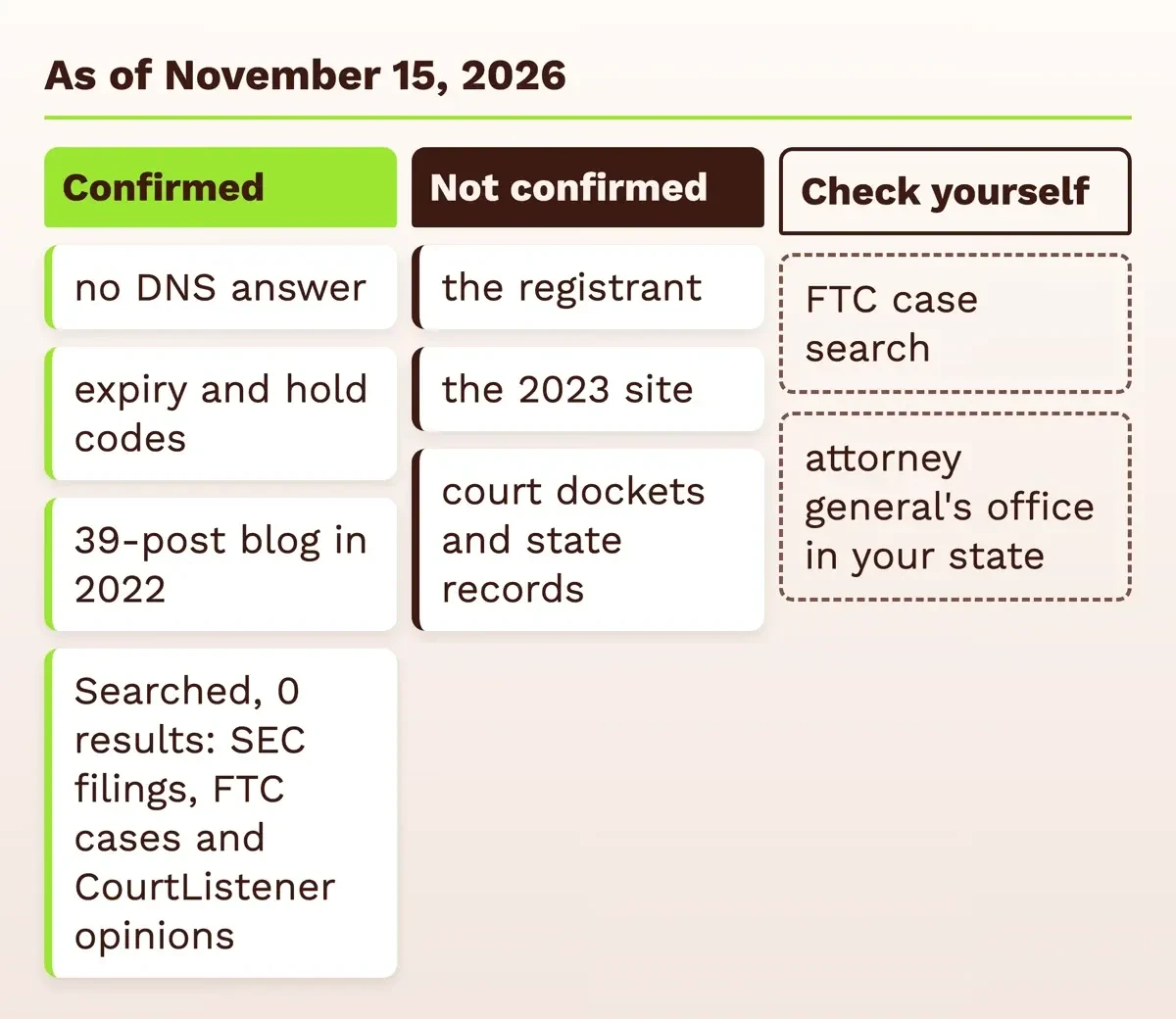 Diagram by DigitalTreed, from our record searches on November 15, 2026.
FTC warning signs for gaming and earning offers
The FTC's How To Avoid a Scam page lists four signs, and the fourth is "Scammers tell you to PAY in a specific way." That means crypto, a wire through MoneyGram or Western Union, a payment app, or gift card numbers read out to the seller. The page is just as plain about pressure: "Anyone who pressures you to pay or give them your personal information is a scammer."
The FTC's gift card guide puts it in three short lines: "Gift cards are for gifts. Only gifts. Not for payments."
Earning sites add a second set of flags. The FTC's business offer scams page says that if an offer "promises guaranteed income, large returns, or a 'proven system,' it's likely a scam." The Business Opportunity Rule "requires business opportunity sellers to give prospective buyers specific information" before they buy. That's meant to let buyers "assess the risks of buying a work-at-home program or any other business opportunity" before any money changes hands. A play-to-earn kit or a key-reselling starter pack that wants money up front fits that frame, because you're paying for a way to earn rather than for a product.
The FTC's 2024 fraud data release, its newest full-year count as of November 2026, reported more than $12.5 billion in consumer fraud losses for 2024. Business and job opportunities took $750.6 million of that, "up nearly $250 million from 2023." A later FTC Data Spotlight on social media scams says $2.1 billion in 2025 losses started on social media. Shopping scams were the most reported kind there. A key deal or earning pitch sent by ad or DM arrives through that same channel. Our guides to real gift card programs versus scams and earning money at home without job scams go deeper on both.
A record check before you pay any gaming or earning site
Our 8 record checks don't need the site online. Playman.tech's results on November 15, 2026:
| Check | Playman.tech |
|---|---|
| The address loads over HTTPS | fail |
| A registry (RDAP) record exists | pass |
| The current registration is over a year old and not expired | fail |
| No hold or delete status codes | fail |
| Archive history matches what the site is said to be | fail |
| No FTC, SEC or court record under the name | partial |
| A named business and contact on the site | unknown |
| Payment by credit card with dispute rights | unknown |
Four of the eight failed. That's a fact about the record on one date, and it doesn't tell you who ran the site. On another key shop or earning app, run these steps in order and quit when one fails:
- Look up the domain on ICANN Lookup: note creation date, expiry and status codes.
- Stop at hold, redemption or delete codes, or a name created weeks ago.
- Compare the site's old archive captures with what it claims today.
- Match the spelling to the brand's real address, letter by letter.
- Read reviews on several sites, not only the seller's pages.
- Pay by credit card, and save the receipt and order page.
- Walk away from gift card, crypto, wire or payment app requests.
ICANN Lookup reads the same RDAP record we used, with no account needed. Lookalike spellings are a trap of their own, and our GoMyFinance .com vs .org comparison shows one with a real pair of domains. For reviews, the FTC's online shopping advice says to "Check several sources" instead of trusting the seller's own page. For games, we'd buy keys only from a store the publisher links to directly. Our Jebek Shop review covers the rest of checking an online store.
Step 6 rests on the Fair Credit Billing Act. The FTC's credit card disputes page says your letter must reach the issuer "within 60 days after the first bill with the error was sent to you." Federal law also caps what you owe for unauthorized charges at $50, the page says.
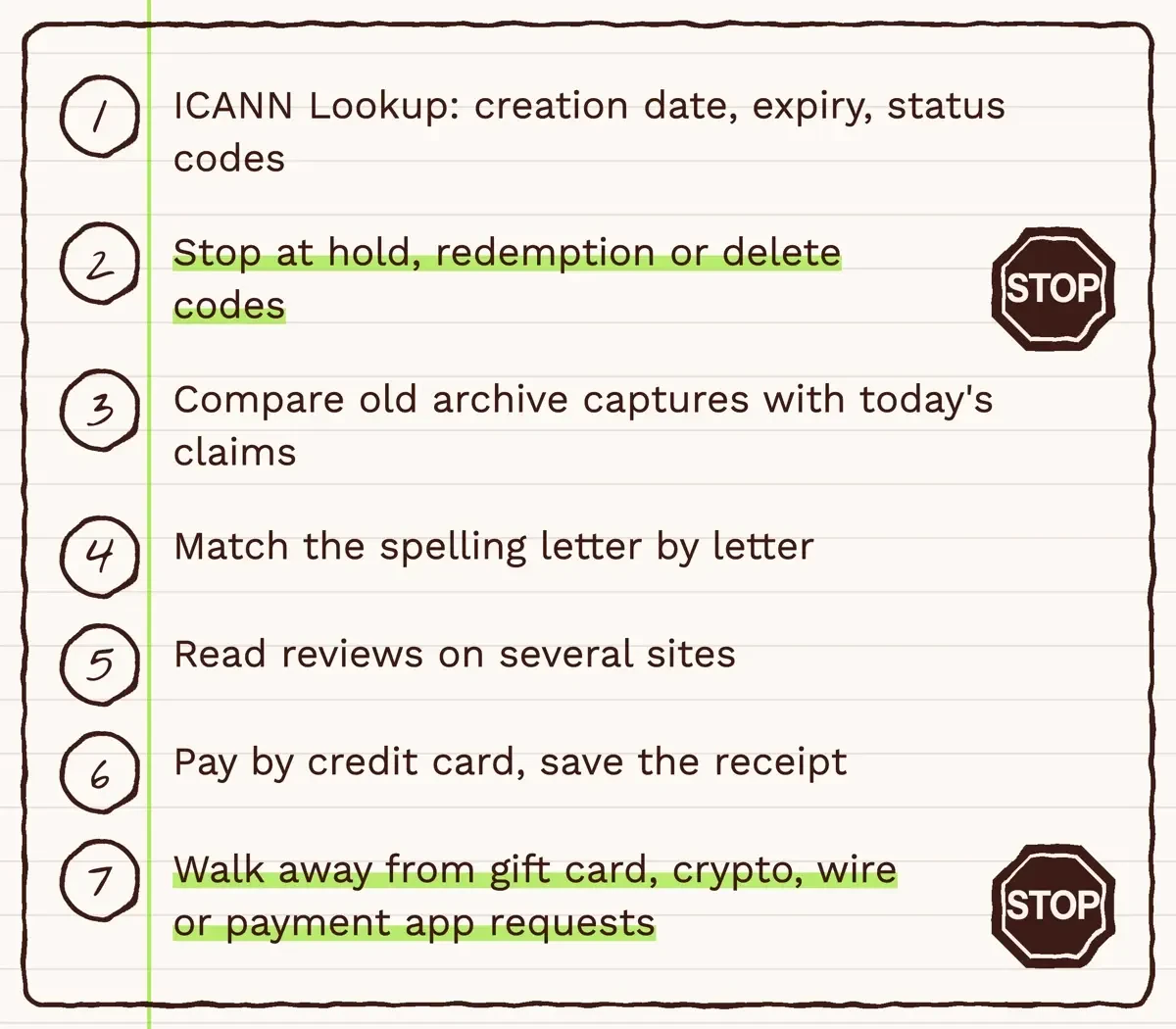 Drawn by us: the seven-step record check from this guide.
If you already paid a site that went offline
With a credit card, mail the billing-error letter inside that 60-day window. The FTC's dispute page says to send it to the billing-inquiries address with your name, address, account number and a description of the mistake.
With a gift card, the FTC's guide says to report the scam to the gift card company right away: "No matter how long ago the scam happened, report it." The guide's next step is asking for your money back, since some companies might refund it.
Then report it at ReportFraud.ftc.gov, and file at the FBI's IC3 complaint site as well if the payment went through a website or an app. Your state's consumer office is the third stop, and USA.gov's state list says those offices help with "complaints against businesses, investigating scams and fraud, and more." Typed a password into the site too? Our guide to a clicked phishing link covers changing it.
Frequently asked
Is Playman.tech a scam?
We can't say. Our FTC, SEC and CourtListener searches found no record naming it, and an empty search proves nothing either way. The FTC offers a test for any seller: "Honest businesses will give you time to make a decision."
Who owns Playman.tech?
The record doesn't say, because the registrant contact is redacted. Anyone can read the same record on ICANN Lookup.
Can someone else register playman.tech?
Yes, after deletion. ICANN says "the domain is available for re-registration in accordance with the registry's policies."
Can I get a gift card payment back?
Possibly. The FTC says "Some companies are helping stop gift card scams and might give your money back."
How we made this guide: We saved the DNS, web and RDAP answers, the archive captures and the record searches, all by plain request. Facts checked by the DigitalTreed team on November 15, 2026.
First published December 16, 2023 as a review of Playman.tech. Rewritten November 15, 2026 as a dated record check.
Sources
- ICANN: Registration Data Access Protocol (RDAP)
- ICANN: EPP Status Codes, What Do They Mean
- ICANN Lookup
- Internet Archive: Wayback Machine
- SEC: EDGAR Full Text Search
- FTC: Cases and Proceedings
- FTC: How To Avoid a Scam
- FTC: Avoiding and Reporting Gift Card Scams
- FTC: When a Business Offer or Coaching Program Is a Scam
- FTC: Business Opportunity Rule
- FTC: Online Shopping
- FTC: New FTC Data Show a Big Jump in Reported Losses to Fraud to $12.5 Billion in 2024
- FTC Data Spotlight: Reported losses to scams on social media eight times higher than in 2020
- FTC: Using Credit Cards and Disputing Charges
- FTC: ReportFraud.ftc.gov
- FBI: Internet Crime Complaint Center (IC3)
- USA.gov: State consumer protection offices

Comments
No comments yet. Start the conversation below.