
Quick answer
You can't stop copying with code, but US law gives you real tools once it happens. Your text and photos are copyrighted the moment you publish them. Register the pages that matter within 3 months of publishing ($45 to $65 in Copyright Office fees as of October 2026) to keep statutory damages of up to $150,000 per work possible.
Copying is quick to do and slow to undo.
Someone can lift a page you spent a week on in two seconds, and today the readers include AI crawlers as well as people.
This guide covers how to protect website content from copying under US law: what's protected, the deadlines that decide what you can collect, how to send a takedown, and what robots.txt can and can't do about AI bots. We also tested the usual copy-blocking tricks on a page of our own.
One thing first. We're a web and SEO agency, not a law firm, so treat this as a plain-English map of the rules and talk to a licensed attorney before you threaten anyone with a lawsuit.
Key takeaways
- Copyright covers your words, photos and code, not your layout or look.
- One GRTX filing registers up to 50 blog posts by one author for $65.
- A DMCA takedown needs six items, not a registration certificate.
- In our test, View Source and curl still showed text behind copy blockers.
- Robots.txt is only a request; a GPTBot request still got a 200 status.
Who this applies to, and what copyright covers on a website
These rules apply to anyone who publishes original work on a US website: a store writing product descriptions, a blogger, a photographer, a local firm with a services page. The Copyright Office puts it plainly: your work is protected "the moment it is created and fixed in a tangible form." Publishing a page counts.
You don't have to file anything, pay anything or add a symbol to get that protection.
But copyright covers less of a website than most owners think. 17 U.S.C. 102(b) rules out any "idea, procedure, process, system, method of operation" from protection. The Copyright Office's Circular 66 names domain names, functional design elements, and "the layout, format, or 'look and feel' of a web page" as things it won't protect. So if a competitor rebuilt your homepage layout with their own words and photos, copyright probably won't help you.
What it does cover is the expression. That means your sentences, photos, videos, illustrations and code, and the protection lasts a long time: for a work by one person, 17 U.S.C. 302(a) sets the term at the author's life plus 70 years.
Two ownership traps catch small businesses. A freelancer who writes your blog posts usually owns them unless you've got a signed agreement, because the Copyright Office's Circular 30 counts commissioned work as "made for hire" only in certain categories and in writing.
So get the assignment signed before the work starts, not after you find a copy.
And text a tool produced on its own may not be protected at all. The Office's January 2025 report on AI says AI output is protected "only where a human author has determined sufficient expressive elements," and not for "the mere provision of prompts."
Seven rules of US copyright that decide your options
Those limits shape everything that follows. Here are the rules in plain words, each linked to the statute or the Copyright Office page it comes from.
- Protection is automatic. Copyright exists once the work is fixed, and registration is voluntary, per the Copyright Office FAQ.
- Ideas, layouts and look and feel aren't protected. Only your expression is, under 17 U.S.C. 102 and Circular 66.
- A copyright notice is optional, but it helps. Under 17 U.S.C. 401(d), a proper notice blocks the "innocent infringement" defense. The form is ©, the year of first publication and the owner's name.
- You must register before you sue. 17 U.S.C. 411(a) bars an infringement lawsuit over a US work until the claim is registered, or until the Office refuses it.
- Timing decides the money. 17 U.S.C. 412 allows statutory damages and attorney's fees only if you registered before the copying began or within three months of first publishing.
- A takedown notice needs ownership and six items. 17 U.S.C. 512(c)(3) lists them, and none of them is a registration or a Terms of Use page.
- False notices cost money. Under 512(f) of the same law, anyone who knowingly and materially misrepresents that material is infringing is liable for damages, "including costs and attorneys' fees."
Rule 6 corrects a common myth, one an earlier version of this very post repeated. A Terms of Use page can tell visitors how they may reuse your work, and it's worth having. It isn't what gives you the right to send a takedown.
Owning the copyright is.
Rule 5 is the one with a deadline.
Penalties, fees and deadlines in dollars
That three-month window matters because of what's at stake. Statutory damages let a court award a set sum per work without you proving lost sales. Under 17 U.S.C. 504(c), the range is $750 to $30,000 per work, up to $150,000 if the copying was willful, and as low as $200 if the copier was truly innocent.
| Item (as of October 23, 2026) | Amount | Source |
|---|---|---|
| Statutory damages, per work | $750 to $30,000 | 17 U.S.C. 504(c) |
| Willful infringement, per work | Up to $150,000 | 17 U.S.C. 504(c) |
| Register one work, one author, online | $45 | Copyright Office fees |
| Standard online application | $65 | Copyright Office fees |
| Up to 50 blog posts by one author (GRTX) | $65 | Copyright Office fees |
| A group of photos | $55 | Copyright Office fees |
| Copyright Claims Board claim | $40 + $60 | CCB fee table |
| DMCA notice to a host or Google | $0 | Free forms |
The fees come from the Copyright Office's fee schedule, as of October 23, 2026. Registration isn't instant. For claims closed between April 1 and September 30, 2026, online claims with no back-and-forth took 3.4 months on average, and all claims averaged 4.1 months, per the Office's processing-time FAQ.
So file early. It's too late to start on the day you need it.
For bloggers, the cheapest route is the group option for short online works. The GRTX application covers 2 to 50 works of 50 to 17,500 words each, all first published within three consecutive calendar months by the same author. There's a catch for companies: works made for hire can't use it, so a blog written by your staff doesn't qualify.
Example (fictional): Larkspur Table is a made-up one-person recipe blog in Spokane, Washington. Its owner publishes 12 posts between March 2 and May 20, 2026, and files one GRTX application for $65 on May 28. Every post is still inside its three-month window. If a copycat started on April 20, statutory damages and fees would remain possible for all 12.
Now move the filing to July 15. The posts published before April 15 have missed their window, and copying that began on April 20 came before the registration. For those posts she'd be left with actual damages and the copier's profits, both of which she'd have to prove.
The only thing that changed was 48 days of waiting.
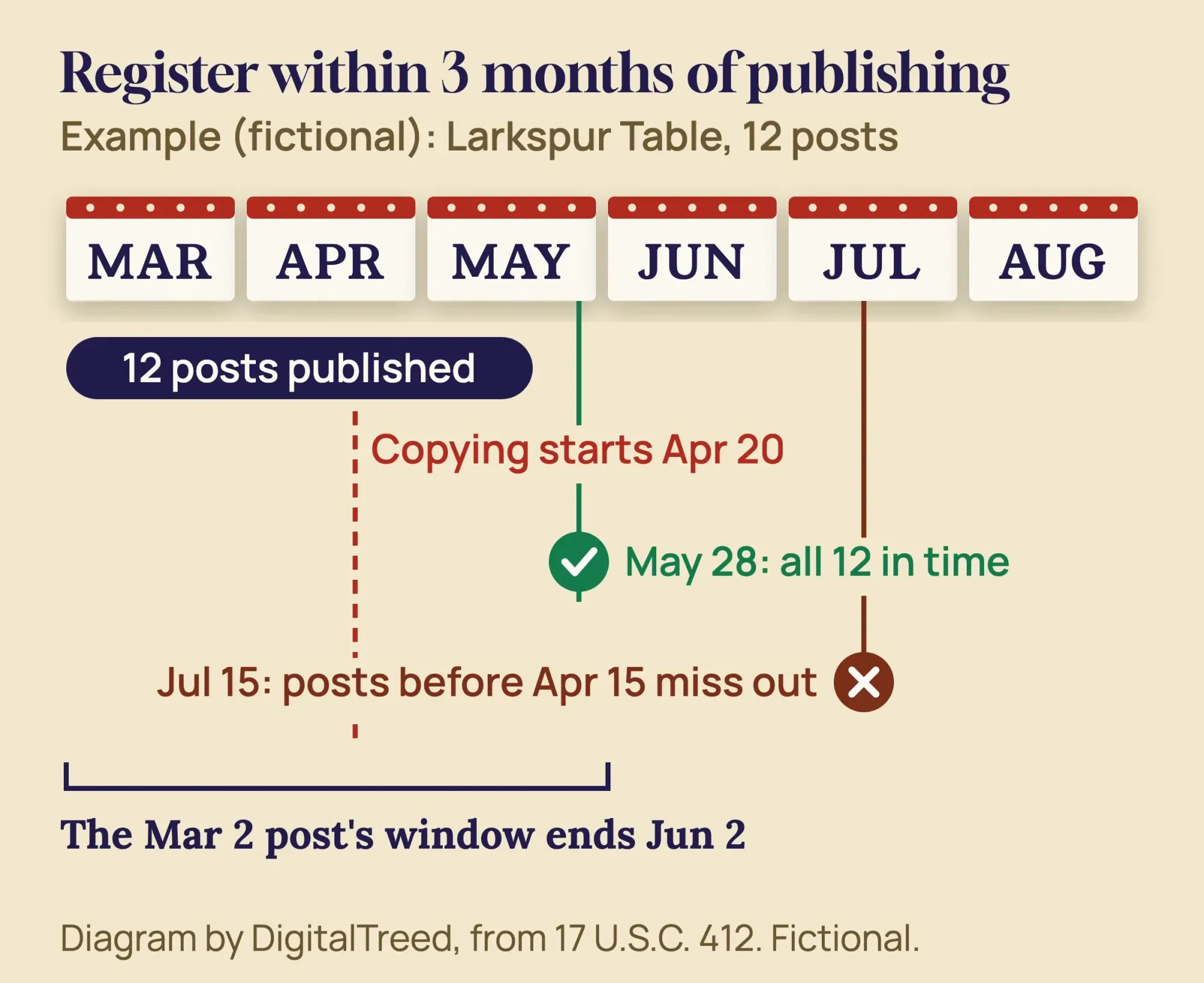 Diagram by DigitalTreed, based on 17 U.S.C. 412. Larkspur Table is a fictional example.
If a lawsuit sounds like too much, the Copyright Claims Board is the small-claims option Congress created in the CASE Act of 2020. It handles disputes "up to $30,000 total," and you can file once you've applied to register, so you won't need the certificate in hand. Filing costs $100 in two payments of $40 and $60, per the CCB fee table (checked October 23, 2026). Statutory damages there are capped at $15,000 per work. The catch: taking part is voluntary for both sides. If the other side opts out, federal court is the only place left to seek damages.
Someone copied your website: the takedown route
Once you've found a copy and checked it against those rules, work through these steps in order. Some cases end at the polite email or the host notice, without a lawyer.
A short word before you send anything: this describes how US copyright generally works, and a lawyer who has seen your facts can tell you things a web page can't.
- Check that it's yours to claim. It should be your expression, not an idea or a layout, and not something you licensed out or that may be fair use.
- Save evidence. Record the exact URL, the date and a full-page screenshot, and save a copy in the Wayback Machine.
- Email the site owner. Ask them to remove the page by a set date. Keep it short and polite.
- Find the host. Run the domain through ICANN Lookup. If it shows Cloudflare, use Cloudflare's abuse process, which forwards your complaint to the site operator and the hosting provider.
- Send a DMCA notice to the host's designated agent. Look the company up in the Copyright Office's DMCA Designated Agent Directory.
- Ask Google to remove the copied URL from search results.
- Report copies on platforms that run their own forms, such as YouTube and Pinterest.
- Escalate only if you must: the Copyright Claims Board or an attorney, after you register.
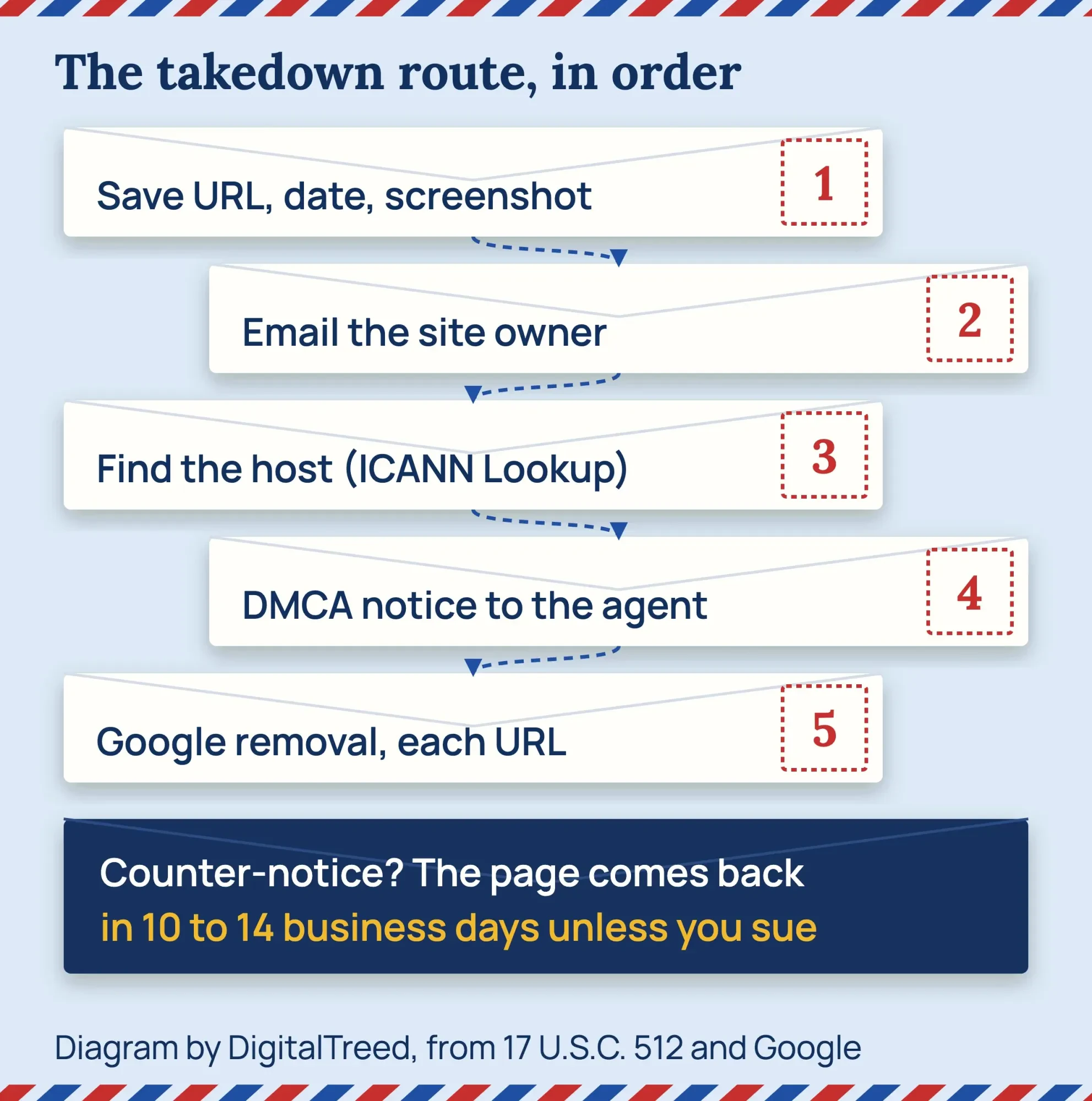 Diagram by DigitalTreed, based on 17 U.S.C. 512 and Google's removal help pages.
This route costs nothing but time. If you'd rather have the notice, robots.txt rules and proof-keeping on your own site set up for you, our web development team does that work. (That's a paid DigitalTreed service.)
A fill-in DMCA takedown notice
The notice doesn't need legal language. It needs the six items from 17 U.S.C. 512(c)(3), written so the host can find the copy.
Note
To: [the host's designated DMCA agent]
1. My work: [title], first published at [original URL] on [date].
2. The copy: [exact URL of each copied page].
3. My contact details: [mailing address], [phone], [email].
4. I have a good faith belief that use of the material in the manner complained of is not authorized by the copyright owner, its agent, or the law.
5. The information in this notification is accurate, and under penalty of perjury, I am authorized to act on behalf of the owner of an exclusive right that is allegedly infringed.
6. Signature: [your full legal name, typed], [date].
Leave out threats and long backstories; they don't help. You don't need a registration number, though you can add one if you've got it.
How to ask Google to remove a copied page
Google takes copyright requests through its legal troubleshooter: choose Google Search, then Copyright. Its removal guide asks for each infringing URL, because "general information about the location of the content isn't adequate," and you can sign by typing your full legal name.
Two warnings. Each Google product needs its own notice, per Google's legal help FAQ. And Google shares copies of notices with Lumen, a project of Harvard's Berkman Center, so expect yours to become public.
If they send a counter-notice
The other side can push back. Under section 512(g), a host that gets a valid counter-notice puts the page back in 10 to 14 business days, unless you tell it you've filed a court action.
That's the moment registration and a lawyer start to matter.
Copy blockers slow people down, and our test shows how little
So much for the legal side. The technical side is where most protection plugins live, and we wanted to see what they actually stop.
On Friday, October 23, 2026, we built a small test page of our own, labelled fictional, with the three common tricks: a right-click block, CSS that turns off text selection, and a script that cancels the copy command. We served it from a local server on our Mac and opened it in Chrome 155. All three worked in the browser. Right-click did nothing, selecting the paragraph grabbed 0 characters, and the copy command was cancelled. Then we opened View Source, and the full paragraph sat there in plain text.
A plain curl request returned the same text. Turning JavaScript off removes the right-click and copy blocks, though the CSS selection block stays.
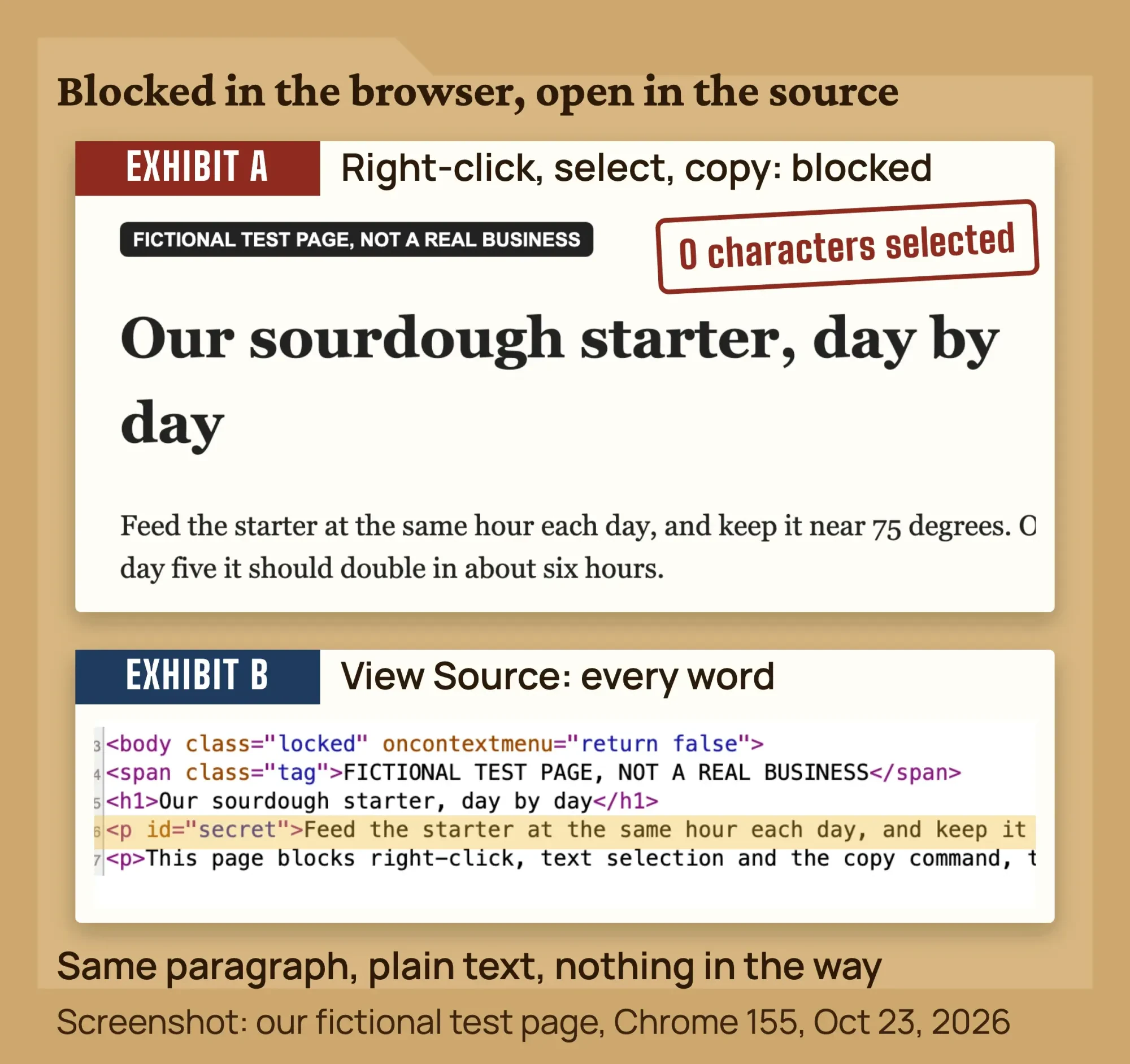 Screenshot: our fictional test page and its View Source in Chrome 155, served locally, October 23, 2026.
That's the honest picture.
These tricks stop a casual visitor, not a scraper, and the scraper is the one that republishes your pages at scale.
They'll cost you something too. Blocking selection gets in the way of a reader copying your phone number or address. We'd skip them on a business site and put the time into the steps that hold up.
For photos, a visible watermark still works after the copy is made, because it travels with the image. For paid material such as course lessons, put it behind a login, since anything a logged-out visitor can read, a bot can read too.
Block AI training crawlers by name, and keep AI search
That same logic applies to AI crawlers, with one difference: the big ones say they follow robots.txt. Each company publishes the name its crawler uses, and blocking that name is how you opt out of training.
OpenAI says disallowing GPTBot means your content "should not be used in training generative AI foundation models." Anthropic says restricting ClaudeBot signals that your future material should be left out of its training data. Google uses a separate token, Google-Extended, and its crawler documentation says it "does not impact a site's inclusion in Google Search."
The search crawlers are separate, and that's the part people miss. OAI-SearchBot puts pages in ChatGPT search answers, and Anthropic lists Claude-SearchBot and Claude-User apart from ClaudeBot. Block only the training names and your pages can still appear in AI search answers.
User-agent: GPTBot
Disallow: /

User-agent: ClaudeBot
Disallow: /

User-agent: Google-Extended
Disallow: /

User-agent: *
Allow: /
We put exactly these lines on our local test server and checked them two ways. Python's robots.txt parser said GPTBot, ClaudeBot and Google-Extended may not fetch the page, while OAI-SearchBot, Claude-SearchBot and Googlebot may. But a request that called itself GPTBot still got the full page with a 200 status.
Nothing on the server enforced the file. Unless your server or firewall is set up to block a bot, robots.txt is only a request.
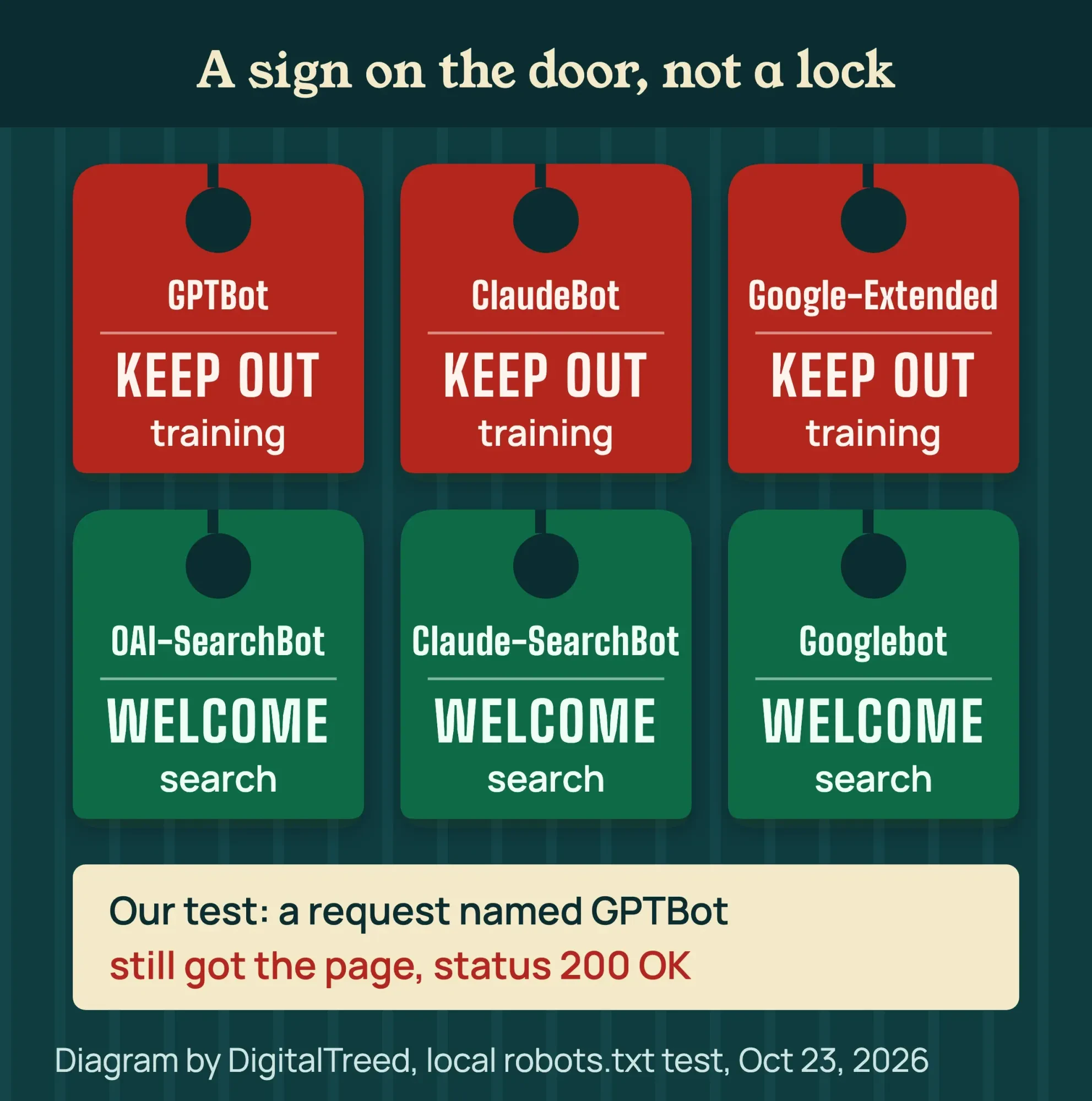 Diagram by DigitalTreed, from our local robots.txt test on October 23, 2026.
That matches what the rules say. Google calls robots.txt "not a mechanism for keeping a web page out of Google" in its robots.txt guide, and RFC 9309, the standard itself, says the rules "are not a form of access authorization."
A polite crawler obeys it. A scraper won't.
Our free robots.txt generator writes the training-only block for you. For the trade-offs, the AI crawler chapter of our generative engine optimization guide goes deeper, and our beginner's guide to SEO shows where robots.txt fits in basic SEO.
Frequently asked
How much of my text can someone quote without asking?
There is no safe word count. The Copyright Office's fair use FAQ says no legal rule permits a set number of words or a percentage of a work, as of October 2026. Limited quotes for commentary, criticism or news can be fair use. Whether a use qualifies depends on all the circumstances.
How long does copyright last on content my staff wrote?
Staff work is usually a work made for hire, so the author's lifetime doesn't set the term. Under 17 U.S.C. 302(c), it lasts 95 years from first publication or 120 years from creation, whichever ends first. That rule applies as of October 2026.
Does my own website need a DMCA agent?
It matters if visitors can post comments, reviews or uploads on your site. Such sites list a designated agent with the Copyright Office. Its directory FAQ puts the fee at $6 per designation, as of October 2026. The listing expires three years after you register it unless you renew it.
What to do this week
None of this takes long if you do it before anyone copies you. Here's a short list for the next seven days.
- Put a notice in your footer in the 401 form, such as "© 2021-2026 Your Business Name."
- List the 5 to 10 pages that bring in leads or sales, and register them, or file one GRTX group if one person wrote them.
- Get a signed copyright assignment from every freelancer who wrote or photographed for you.
- See which AI bots your site lets in with our AI crawler checker, then choose between training and search.
- Keep proof of your dates: original files, drafts and a Wayback Machine capture of each key page.
- Search one distinctive sentence from your best page in quotes on Google, and run your main photos through a reverse image search such as Google Lens.
Do the first two this week even if you skip the rest. They decide whether a future copy is a nuisance or a claim with money behind it.
Edge cases, as questions
Some situations don't fit the steps above. Several of them show up in Google's suggested searches on copied content.
Will a copied page hurt my Google rankings?
Usually not on its own, but Google doesn't promise the original always wins. Its spam policies treat republishing others' content "without adding any original content or value" as scraping, and a site with "a significant volume of valid copyright removal requests" can be demoted. Our history of Google algorithm updates covers that demotion.
If a copy outranks you, first confirm your page points to itself with our canonical tag checker. Canonicals and robots.txt are both part of a technical SEO check.
They copied my design, not my words. Is that infringement?
It's probably not copyright infringement. Circular 66 lists layout, format and look and feel as not protected. Copied photos, illustrations or code are a different matter, since those are expression.
Do I need to register before sending a takedown?
No. A DMCA notice needs the six items, not a certificate. You do need a registration to sue, and at least a filed application to bring a Copyright Claims Board claim.
Can I put a © on my site without registering?
Yes. The notice is optional and needs no filing. It's still worth adding because of the innocent-infringement point in rule 3.
What about listings and product text copied across many sites?
Shared text is common in real estate and retail, and it's often licensed rather than stolen. Our real estate local SEO guide includes a test of one listing that appeared on 6 sites, and what we found.
If you publish often and want original articles and photos that are clearly yours from day one, our content marketing team can plan and write them. (We charge for that work.)
How we made this guide: Our team checked each statute, fee and deadline against the U.S. Code on Cornell's Legal Information Institute, the U.S. Copyright Office, the Copyright Claims Board and Google's own help pages, all read October 23, 2026. The copy-blocker and robots.txt tests are ours, run that day on a fictional page served from our own machine, never on anyone else's site. Every source is linked where its fact appears.
First published March 2025. Rewritten October 23, 2026: corrected the Terms of Use claim, and added the registration deadline and fees, the takedown and counter-notice steps, the Copyright Claims Board, named AI crawlers and our own tests.
Nothing here is legal advice for your situation. For a specific dispute, start with the U.S. Copyright Office at copyright.gov and a licensed attorney.
Sources
- U.S. Copyright Office: Copyright in General (FAQ)
- 17 U.S.C. 102, Subject matter of copyright (Cornell LII)
- 17 U.S.C. 302, Duration of copyright (Cornell LII)
- 17 U.S.C. 401, Notice of copyright (Cornell LII)
- 17 U.S.C. 411, Registration and civil infringement actions (Cornell LII)
- 17 U.S.C. 412, Registration as prerequisite to certain remedies (Cornell LII)
- 17 U.S.C. 504, Remedies for infringement: damages and profits (Cornell LII)
- 17 U.S.C. 512, Limitations on liability relating to material online (Cornell LII)
- U.S. Copyright Office: Circular 66, Websites and Website Content
- U.S. Copyright Office: Circular 30, Works Made for Hire
- U.S. Copyright Office: Copyright and Artificial Intelligence, Part 2 (January 29, 2025)
- U.S. Copyright Office: Fees
- U.S. Copyright Office: Registration processing times FAQ (October 2026)
- U.S. Copyright Office: Group registration for short online literary works (GRTX)
- Copyright Claims Board: FAQ
- Copyright Claims Board: About and fees
- U.S. Copyright Office: Section 512 of Title 17
- U.S. Copyright Office: DMCA Designated Agent Directory
- Google Legal Help: Report content troubleshooter
- Google Legal Help: Submitting a copyright removal notice
- Google Legal Help: Copyright removal FAQ
- Google Transparency Report: Lumen and removal notices
- Google Search Central: Spam policies
- Google Search Central: Introduction to robots.txt
- Google Search Central: Google's common crawlers (Google-Extended)
- RFC 9309: Robots Exclusion Protocol
- OpenAI: Overview of OpenAI crawlers
- Anthropic: Does Anthropic crawl data from the web?
- Cloudflare: Approach to abuse reports
- YouTube Help: Submit a copyright removal request
- Pinterest: Copyright policy
- ICANN Lookup
- Internet Archive: Wayback Machine


Comments
No comments yet. Start the conversation below.