
Quick answer
Google algorithm updates are changes to how Google ranks search results. Google makes thousands a year and names a few; as of October 25, 2026, the latest core update ran May 21 to June 2, 2026. Most sites need no action, but check Search Console a full week after a rollout ends.
Google algorithm updates happen all the time. Google says Search "is updated thousands of times a year," in its 2021 post on how it updates Search. In 2023 alone it made 4,781 launches, per its How Search Works testing page.
Only a handful get a name and a date. Google lists those on its Search Status Dashboard. We read every ranking entry on it on October 22, 2026, counted them, and built this history from Google's own records only.
Key takeaways
- Google says Search is updated thousands of times a year.
- Wait at least a full week after a rollout ends before judging results.
- Rule out seasonality, technical faults and reporting glitches before blaming Google.
- Since November 2021, core updates took 6 to 45 days, with a 14.5-day median.
- Recovery has no fixed timeline and may wait until the next core update.
Key facts about Google algorithm updates
- As of October 25, 2026, the latest named update is the September 2026 spam update, which ran September 24 to October 8.
- The latest core update is Google's May 2026 core update, which ran May 21 to June 2, 2026.
- In our October 22, 2026 count of the dashboard history, 16 core updates since November 2021 took 6 to 45 days. The median was 14.5 days.
- Google recommends waiting at least a full week after a core update ends before you check Search Console, per its core updates guide.
- The helpful content system became part of core ranking in March 2024, per Google's ranking systems guide.
What is a Google algorithm update?
A Google algorithm update is a change to the systems that decide which pages show up for a search, and in what order. Most changes are small and nobody announces them. Google only names the big ones, such as core and spam updates, and doesn't list the rest.
A core update is the big kind. Google's core updates page calls them "significant, broad changes to our search algorithms and systems" made several times a year. It adds that they "don't target specific sites or individual web pages."
Named updates fall into a few groups:
- Core updates: broad changes to how all pages are ranked.
- Spam updates: improvements to spam detection, including SpamBrain, which Google's spam updates page calls its "AI-based spam-prevention system."
- Reviews updates: changes to how review content is ranked.
- Helpful content updates: ran from 2022 to 2023, then merged into core ranking in March 2024.
- One-off updates, such as the 2022 page experience update for desktop and the February 2026 Discover update (Google's blog calls it a Discover core update).
What is the latest Google algorithm update?
As of October 25, 2026, the latest is the September 2026 spam update. It started September 24 and finished October 8, 2026, per the dashboard. The latest core update is the May 2026 core update, which ran from May 21 to June 2, 2026.
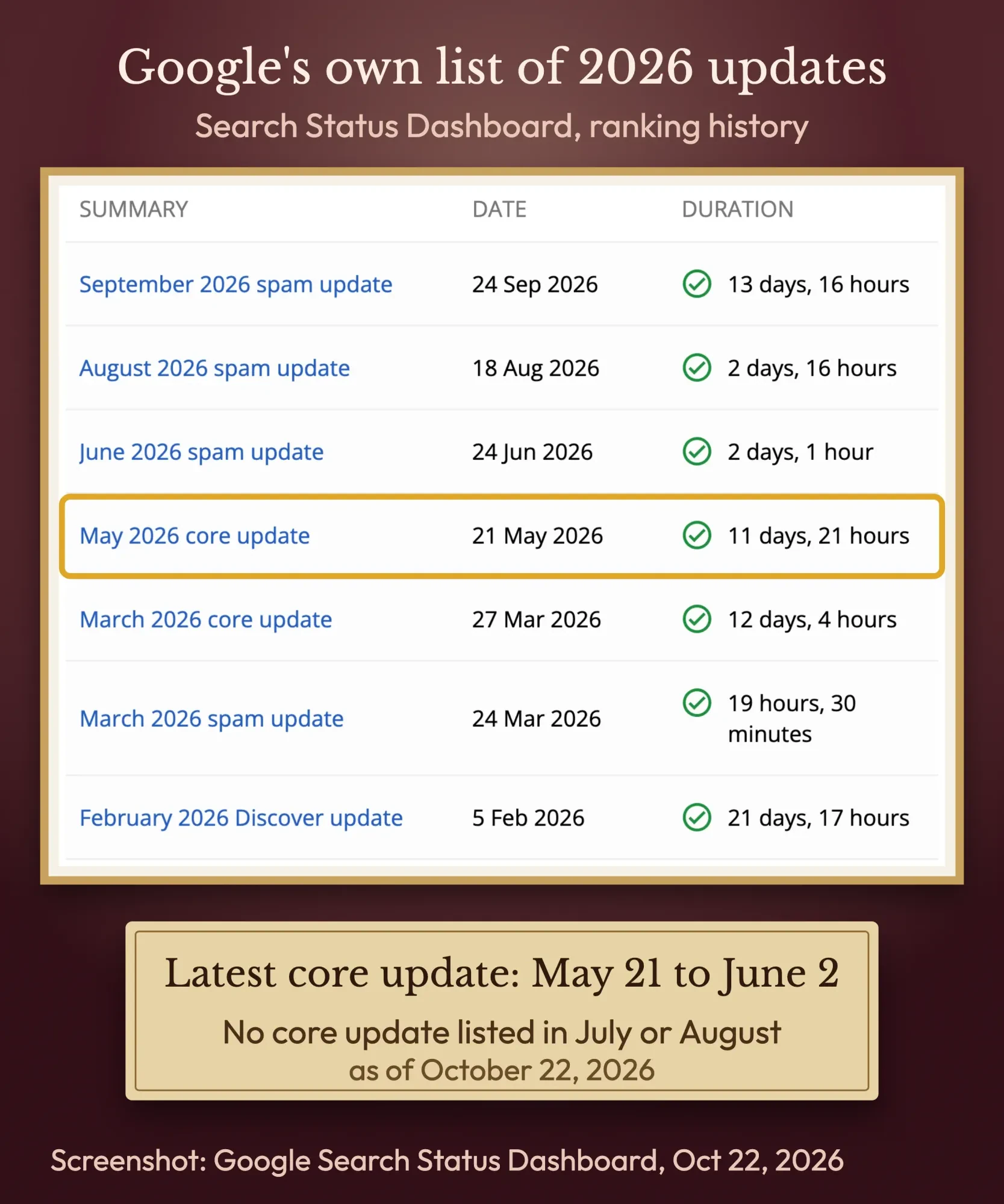 Screenshot: Google Search Status Dashboard, ranking history, 2026 rows, October 22, 2026 (narrow layout).
Many people search for a "July 2026" or "August 2026" core update. Google's dashboard lists no core update in July or August 2026, as of October 22, 2026. What ran in August was the August 2026 spam update, from August 18 to 21.
If you think Google changed something today, check the dashboard first. Google's dashboard FAQ says that when an update is listed, "Often, there's no action needed."
Did a Google update hit your site?
To find out if a Google update hit your site, don't guess. Wait a full week after the rollout ends. Then use Google Search Console to compare clicks for the week after it with the week before it began. Google's guidance on core updates says "most sites don't need to worry about core updates and may not even realize one has happened." So check your data before you change anything. Here is a method built on Google's advice, in order.
- Note the update dates. Open the Search Status Dashboard and write down the start date and the date the rollout finished.
- Wait a full week. Google recommends "waiting at least a full week after a core update completes" before you look at Search Console.
- Compare two weeks in Search Console. In the Performance report, compare the week after the rollout with the week before it began. Look at clicks, then at your top pages and queries.
- Mark the date on the chart. Right-click the Performance chart, choose "Add annotation" and note the update. Notes can be up to 120 characters.
- Sort small drops from large ones. A page that slipped from position 2 to 4 needs no drastic action, Google says. A fall from 4 to 29 calls for "a deeper assessment." If the whole site dropped, Google says to review the site as a whole.
- Rule out a technical fault. Scan the site for broken pages, redirect loops and noindex tags before you blame the update.
- Improve for people, then wait. Make real improvements for readers, not "quick fix" changes. Google says recovery can take several months.
For step 3, our Google Search Console guide shows where the Performance report and its filters are. Google's November 2025 post on custom annotations says everyone with access to your property can see your notes.
For step 6, run your home page through our free website audit tool. It flags missing titles, broken links and blocked pages that can look like an update hit.
Check each search type on its own, too. Google's core updates page suggests looking at Web, Images, Video and the News tab separately, to see where the drop happened.
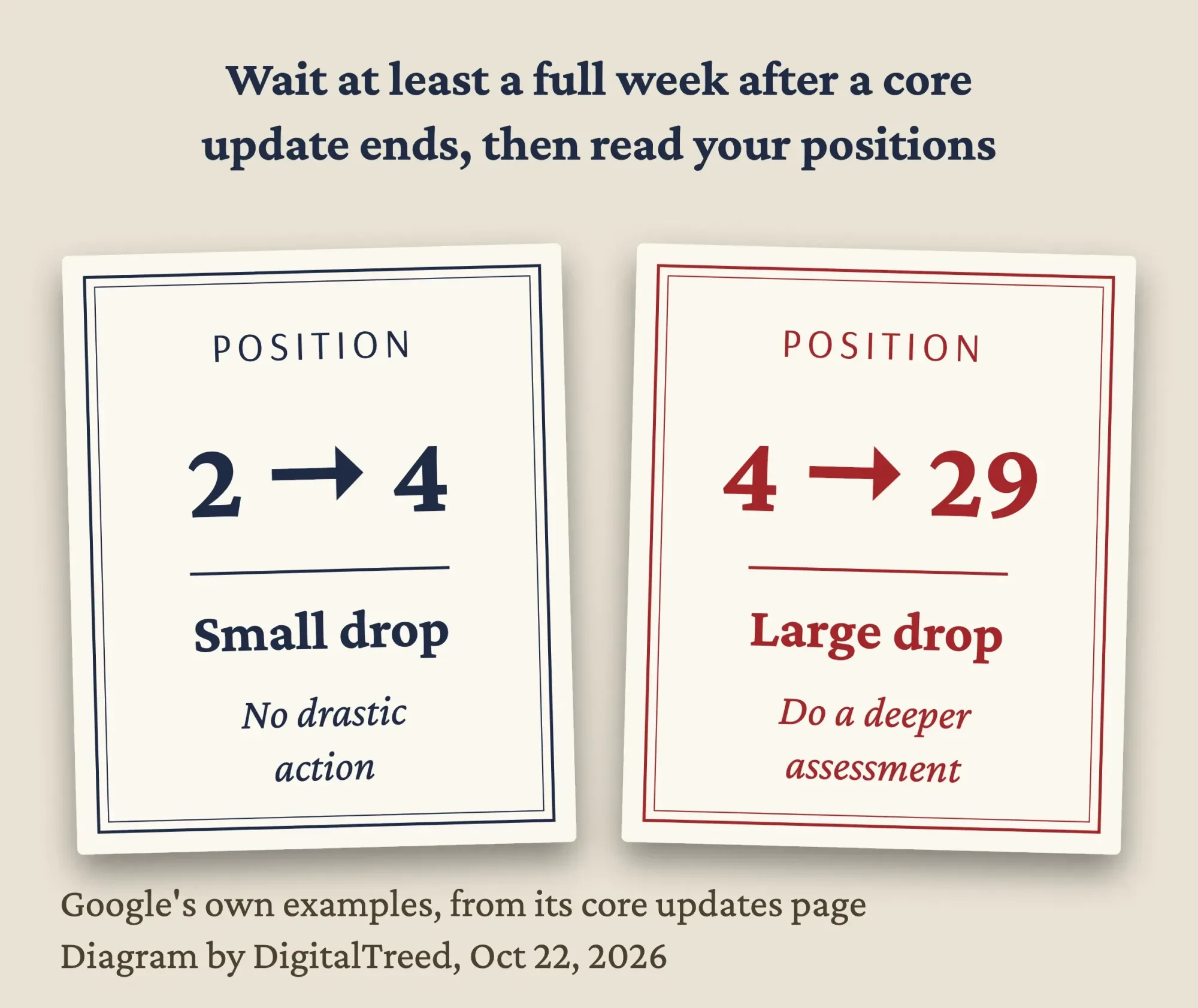 Google's own examples and advice, from its core updates page, read October 22, 2026. Diagram by DigitalTreed.
A large drop is the hard part. Google's helpful content questions ask whether your content is original, complete and written by someone who knows the topic. Its core updates page calls deleting content "a last resort."
When the whole site drops and stays down, Google suggests three habits. Judge the whole site, not single pages, and ask someone with no tie to it to answer the questions too. Then study the pages that fell most. Google notes "there may be other pages on the web that are doing a better job of helping the searcher."
Those questions tie into what Google calls E-E-A-T: experience, expertise, authoritativeness and trust. Its helpful content guide says trust "is most important," but "E-E-A-T itself isn't a specific ranking factor." Our intermediate SEO guide shows how to make it clear on your pages.
If you'd like help with that site-wide review, our SEO team can check every page against Google's questions. You get a fix list first. (DigitalTreed sells this service.)
What should you rule out before blaming Google?
Don't blame Google until you've checked four other common causes of a traffic drop. Google's guide to traffic drops lists other causes besides an algorithm update. They include seasonality, a technical issue across your site, changing interests, and a reporting glitch.
- Seasonality: compare the same weeks last year, or check Google Trends for your main search term.
- A technical fault: check that key pages still answer with status 200 using our free HTTP status checker. For a full check, follow our technical SEO audit checklist.
- A manual action: open Security & Manual actions in Search Console. A manual action is a penalty a person at Google applied. It is not an algorithm update.
- A tracking change: a broken analytics tag can look like lost traffic. Search Console clicks are the safer number.
After a drop, the same guide says "there might not be anything fundamentally wrong with your content." Other sites may simply have become more useful for that search.
How long does it take to recover from a Google core update?
Recovery from a Google core update has no fixed timeline, even after you've fixed the problems. Some changes "can take effect in a few days," says Google's core updates page. Others take "several months" while its systems confirm the whole site is now helpful.
Months may pass with no change. Google says that "could mean waiting until the next core update." You don't always have to wait, though. Google also makes smaller core updates that it doesn't announce, and these can lift improved pages too.
There is no promise either way. Google says "there's no guarantee" that your changes will have a noticeable effect. Our take: keep a dated list of what you change, and add each change as a Search Console annotation.
Our data: how long Google core updates take to roll out
In our count of Google's ranking history on October 22, 2026, the 16 core updates since November 2021 took between 6 and 45 days. The median was 14.5 days, so about 2 weeks is normal. Spam updates are often faster: in 2026, 3 of Google's 4 spam updates finished in under 3 days.
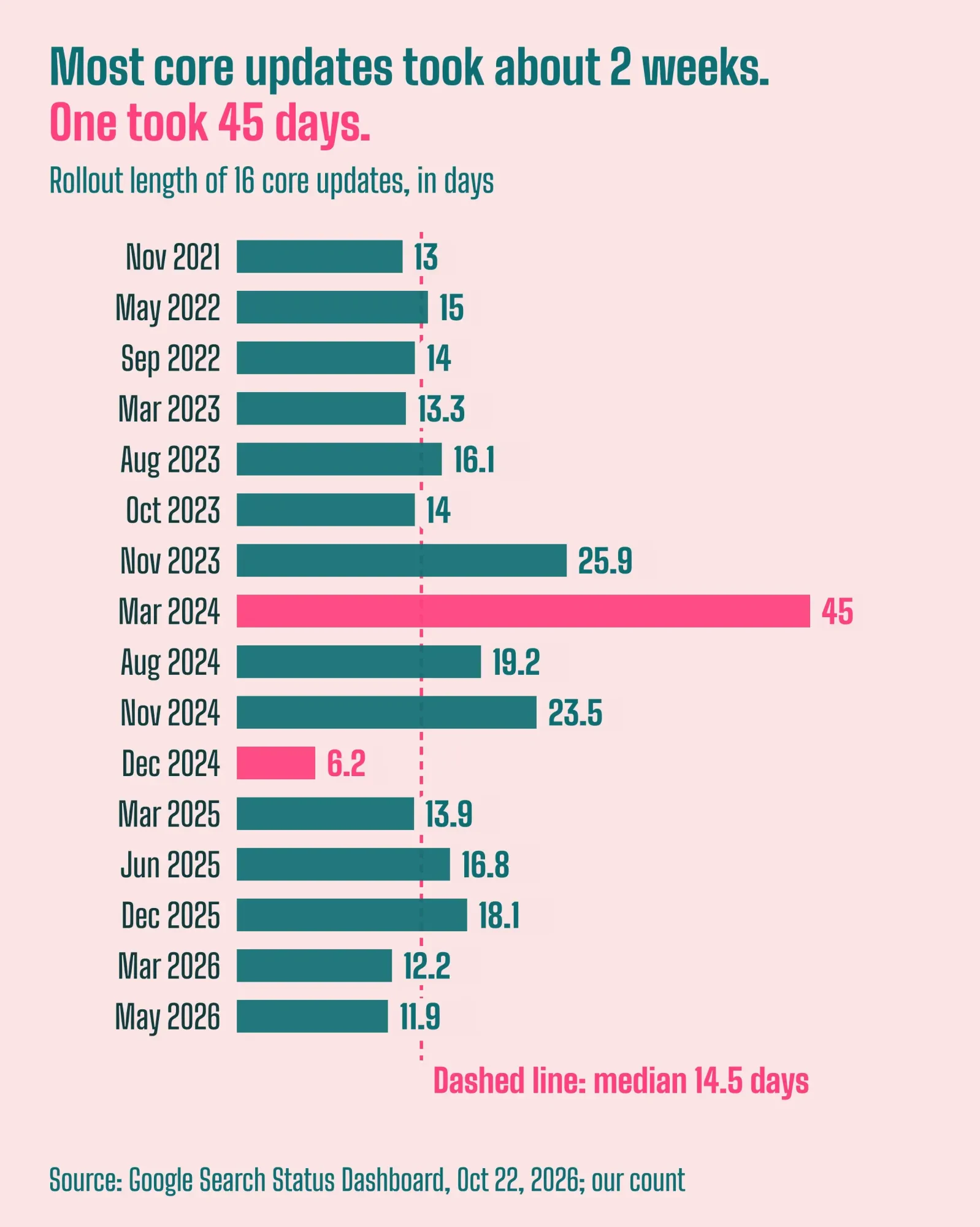 Source: Google Search Status Dashboard, read October 22, 2026; our count. Web search core updates only, not the February 2026 Discover core update.
The outlier is the March 2024 core update at 45 days. Google's March 2024 announcement called it "a more complex update than our usual core updates" and said the rollout could take up to a month.
Update types are shifting too. In 2026 so far, spam updates outnumber core updates 4 to 2. In 2022, Google named 10 updates, including 3 product reviews updates and 2 helpful content updates.
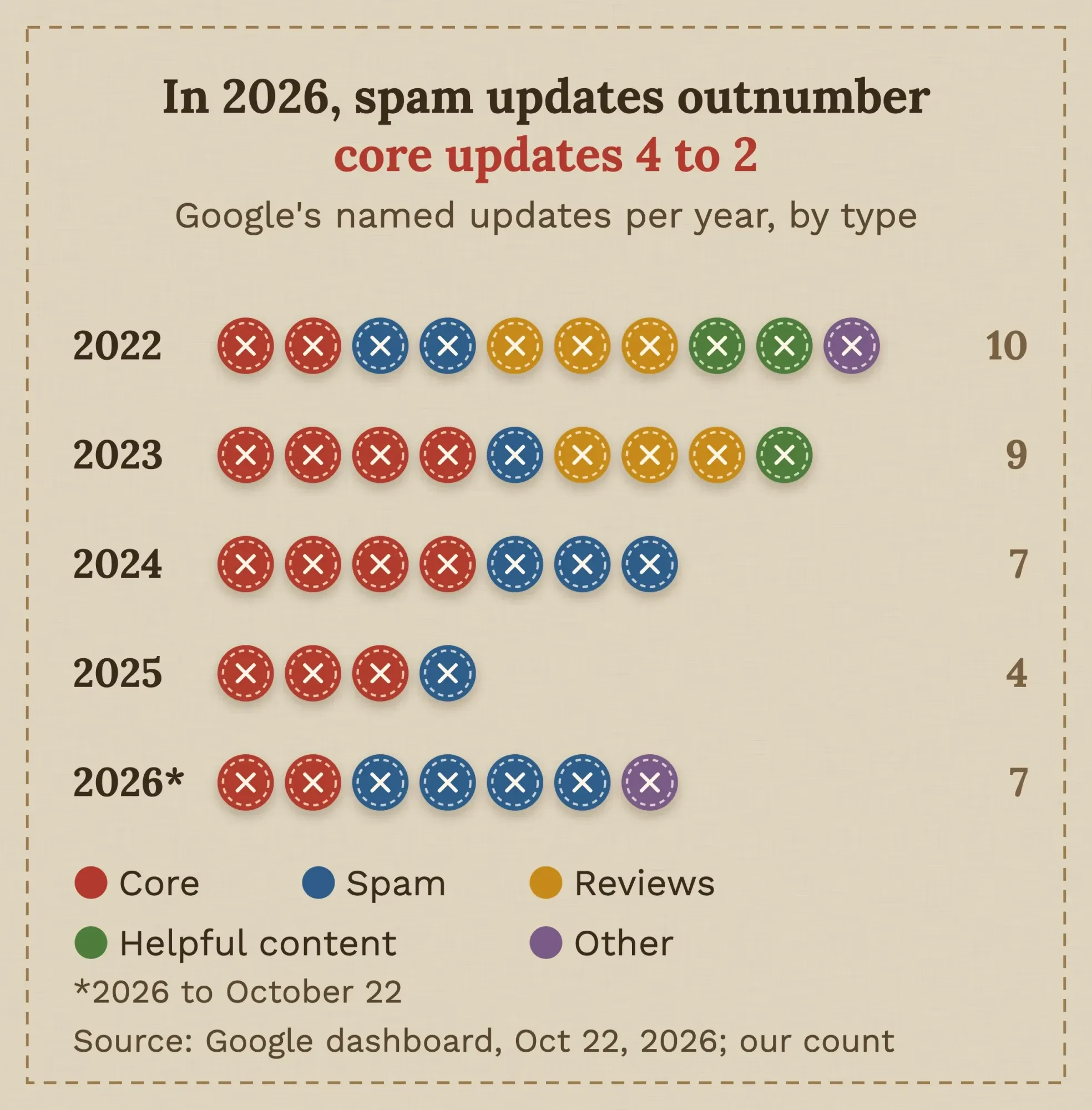 Source: Google Search Status Dashboard, read October 22, 2026; our count by type.
Google algorithm update history: the big named updates before 2021
Entries stay on the dashboard "for 5 years," per its FAQ. For older updates, the official record is Google's own dated blog posts. Here they are, oldest first.
Caffeine, June 2010. This was a new indexing system, not a ranking change. Google's Caffeine post said it "provides 50 percent fresher results for web searches than our last index."
Panda, February 2011. Google's Panda announcement said the change was "designed to reduce rankings for low-quality sites." It touched 11.8% of queries and launched "in the U.S. only" at first. An April 11 note added all English-language users.
Penguin, April 2012. Google's April 24, 2012 post targeted webspam, "from keyword stuffing to link schemes." It affected "about 3.1% of queries in English" in a way a user might notice.
In 2016, Penguin became part of the core algorithm. Google's September 2016 post said it "devalues spam by adjusting ranking based on spam signals, rather than affecting ranking of the whole site." Our guide to backlinks covers which links are safe.
Hummingbird, August 2013. Google's ranking systems guide lists it as "a major improvement to our overall ranking systems made in August 2013." Google gives no more detail than that.
HTTPS, August 2014. Google's HTTPS post called it "a very lightweight signal," affecting "fewer than 1% of global queries." Today, Google's page experience guide says that beyond Core Web Vitals, other page experience aspects "don't directly help your website rank higher."
Mobile-friendly update, April 2015. Google's February 2015 notice said that starting April 21 it would use mobile-friendliness as a bigger ranking signal on mobile searches "in all languages worldwide."
RankBrain, 2015. Google's 2022 post on AI in Search says RankBrain launched in 2015 as "the first deep learning system deployed in Search." It helps Google see how the words in a search relate to real-world concepts. Google still lists it as an active ranking system.
Mobile-first indexing, 2016 to 2023. In 2016, Google started crawling and indexing pages the way a phone sees them. Its October 31, 2023 post said the move "is now complete." A mobile page now needs to be "as complete as the corresponding desktop version," Google adds.
Speed Update, July 2018. Google's speed announcement said page speed would become a ranking factor for mobile searches, but only for the slowest pages. To test your own pages, see our PageSpeed Insights guide.
BERT, October 2019. Google called it "the biggest leap forward in the past five years," in its BERT announcement. It said BERT would help Search understand "one in 10 searches in the U.S. in English." That was US English only at launch, not all searches.
Page experience, 2021. Google's November 2020 post said page experience signals would roll out in May 2021. Google's April 19, 2021 post moved the start to mid-June 2021. They combine Core Web Vitals with mobile-friendliness, HTTPS and the intrusive interstitial guidelines.
Pigeon, Possum, Medic and Fred are names from SEO tracker sites (vendor data). Google has not used those names in its own posts, so we leave them out. Pigeon and Possum are usually linked to local results; see our guide to local SEO.
Which old updates, like the helpful content update, still matter?
Four systems are retired, per Google's ranking systems guide. Panda joined core ranking in 2015 and Penguin in 2016. Hummingbird is part of the overall systems. The helpful content system became part of core ranking in March 2024.
Retired does not mean gone. The ideas live on inside core ranking: original content, no link schemes, pages written for people.
Systems Google still names as active include BERT, RankBrain, the reviews system, SpamBrain and site diversity. Site diversity means Google generally won't show more than 2 listings from one site in its top results.
Google spam updates: 4 policies a small business can break by accident
Google's spam policies apply to every site, and spam updates enforce them. If someone else scraped your page, here's how to send a DMCA takedown and a Google removal request. Four are easy to trip over without meaning to.
- Paid or swapped links meant to boost rankings. After a link spam update, any benefit from those links "cannot be regained," per Google. Our off-page SEO checklist lists safe ways to earn links.
- Scaled content abuse: many pages made mainly to rank, whether by people or AI tools. Google added this policy in March 2024.
- Site reputation abuse: publishing outside content on your site mainly so it ranks on your site's name. Google's policy page now calls this its site reputation policy.
- Back button hijacking: scripts that stop visitors from going back. Google's April 2026 notice said enforcement starts June 15, 2026. Ask your developer to check popup and ad scripts.
Copying other sites' text or photos can also cost you. Google's ranking systems guide says it demotes sites with "a significant volume of valid copyright removal requests." Those requests are DMCA notices, described on the US Copyright Office section 512 page.
This is general information, not legal advice; check with an attorney for your situation.
Example: a bakery checks a core update
Example: Harbor Lane Bakery is a made-up 40-page site in Portland, Maine, with 1,200 Google clicks a week. During the May 2026 core update, clicks fall to 900, a 25% drop. On June 9, a full week after the rollout, the owner uses our Search Console guide to compare June 3-9 with May 14-20.
The home page moved from position 2 to 4 for "bakery portland maine." That is a small drop, so they leave it alone. Three blog posts copied from supplier descriptions fell from position 5 to 31. They rewrite those with their own photos and recipes, then wait.
The check: 1,200 minus 900 is 300 clicks, and 300 is one quarter of 1,200. All numbers here are invented for the example.
Mistakes to avoid after an update
- Changing pages while the update is still rolling out. Google says to wait at least a full week after it ends.
- Rewriting pages that slipped only 2 places. Google advises against changing content that is already doing well.
- Deleting content first. Google calls that "a last resort."
- Blaming the update for a broken page, a redirect loop or a lost tracking tag. On WordPress, our redirect loop fix guide shows how to rule one out.
- Treating tracker names and volatility charts as Google facts. Only the dashboard and Google's posts confirm an update.
- Buying links to "recover." That breaks the same link policy Penguin enforced.
For a full site check after a drop, our advanced SEO guide has an audit chapter. If you are starting from zero, try our walk-through on how to run your first SEO audit. If you'd rather spend that time on what's changing in 2026, start with our digital marketing trends guide.
Every update on Google's dashboard, newest first
This table lists all 40 named ranking updates on the dashboard, newest first, as of October 22, 2026. Names, start dates (US Pacific time) and rollout lengths are Google's; we left out 2 "ongoing issue" rows, which were not updates. On the dashboard page, each entry opens Google's own notes on it.
| Update (Google's name) | Started | Rollout (as Google shows it) |
|---|---|---|
| September 2026 spam update | Sep 24, 2026 | 13 days, 16 hours |
| August 2026 spam update | Aug 18, 2026 | 2 days, 16 hours |
| June 2026 spam update | Jun 24, 2026 | 2 days, 1 hour |
| May 2026 core update | May 21, 2026 | 11 days, 21 hours |
| March 2026 core update | Mar 27, 2026 | 12 days, 4 hours |
| March 2026 spam update | Mar 24, 2026 | 19 hours, 30 minutes |
| February 2026 Discover update | Feb 5, 2026 | 21 days, 17 hours |
| December 2025 core update | Dec 11, 2025 | 18 days, 2 hours |
| August 2025 spam update | Aug 26, 2025 | 26 days, 15 hours |
| June 2025 core update | Jun 30, 2025 | 16 days, 18 hours |
| March 2025 core update | Mar 13, 2025 | 13 days, 21 hours |
| December 2024 spam update | Dec 19, 2024 | 7 days, 2 hours |
| December 2024 core update | Dec 12, 2024 | 6 days, 4 hours |
| November 2024 core update | Nov 11, 2024 | 23 days, 13 hours |
| August 2024 core update | Aug 15, 2024 | 19 days, 4 hours |
| June 2024 spam update | Jun 20, 2024 | 7 days, 1 hour |
| March 2024 spam update | Mar 5, 2024 | 14 days, 21 hours |
| March 2024 core update | Mar 5, 2024 | 45 days |
| November 2023 reviews update | Nov 8, 2023 | 29 days |
| November 2023 core update | Nov 2, 2023 | 25 days, 21 hours |
| October 2023 core update | Oct 5, 2023 | 13 days, 23 hours |
| October 2023 spam update | Oct 4, 2023 | 15 days, 12 hours |
| September 2023 helpful content update | Sep 14, 2023 | 13 days, 11 hours |
| August 2023 core update | Aug 22, 2023 | 16 days, 3 hours |
| April 2023 reviews update | Apr 12, 2023 | 13 days, 2 hours |
| March 2023 core update | Mar 15, 2023 | 13 days, 7 hours |
| February 2023 product reviews update | Feb 21, 2023 | 14 days |
| December 2022 link spam update | Dec 14, 2022 | 29 days |
| December 2022 helpful content update | Dec 5, 2022 | 38 days |
| October 2022 spam update | Oct 19, 2022 | 2 days |
| September 2022 product reviews update | Sep 20, 2022 | 6 days |
| September 2022 core update | Sep 12, 2022 | 14 days |
| August 2022 helpful content update | Aug 25, 2022 | 15 days |
| July 2022 product reviews update | Jul 27, 2022 | 6 days |
| May 2022 core update | May 25, 2022 | 15 days |
| March 2022 product reviews update | Mar 23, 2022 | 14 days |
| Page experience update for desktop | Feb 22, 2022 | 9 days |
| December 2021 product reviews update | Dec 1, 2021 | 20 days |
| November 2021 core update | Nov 17, 2021 | 13 days |
| November 2021 spam update | Nov 3, 2021 | 8 days, 1 hour |
Two posts in this list matter most for small sites. The August 2024 core update post says Google aims to show "small or independent sites that are creating useful, original content." The February 2026 Discover update first launched for "English language users in the US." Our Google Discover guide covers what it means for your posts.
Frequently asked
What is the latest Google algorithm update?
As of October 25, 2026, it is the September 2026 spam update, which finished October 8, 2026. The latest core update is the May 2026 core update (May 21 to June 2, 2026).
Was there a Google core update in August 2026?
Google's dashboard lists no core update in July or August 2026, as of October 22, 2026. The August 2026 spam update ran from August 18 to 21.
How often does Google update its algorithm?
Thousands of times a year, Google says. It names far fewer. In our count of its dashboard, it named 2 to 4 core updates a year from 2022 to 2025.
Is a Google core update a penalty?
No. Google says core updates "don't target specific sites or individual web pages." It compares them to redoing a list of favorite restaurants: the ones that move down "aren't necessarily 'bad'." A penalty is a manual action, shown in Search Console's Manual actions report.
How do I know when a Google update starts and ends?
Check the Search Status Dashboard. It shows each ranking update's start date and when the rollout finished. Google's dashboard help page says you can subscribe to its RSS feed to get notified.
Is the helpful content update still a separate update?
No. Google says the helpful content system became part of its core ranking systems in March 2024. There are no separate helpful content updates now.
Does Google penalize AI content?
Not for being made with AI. Google's March 2024 post says mass-produced content made to manipulate rankings breaks its policy "whether automation or humans are involved."
Your next step
Open the Search Status Dashboard and note the last update's dates. Then compare the week after it with the week before it in Search Console.
If you see a large drop across many pages, our SEO services include a site-wide review, and you get a fixed quote first.
How we made this guide: we built it from Google's Search Status Dashboard, Google Search Central documentation, and Google's dated blog posts. We read the full ranking history on October 22, 2026, and counted every row and rollout ourselves. We checked every quote and number against its source, linked inline, the same day. Updated October 23, 2026: added Caffeine, RankBrain and mobile-first indexing, recovery time, search-type and E-E-A-T checks, two FAQs, and moved the full table lower. Updated October 25, 2026: rechecked Google's dashboard, added five sourced facts, 2026 spam rollout times and direct answers.
First published July 2020. Rewritten October 22, 2026: history from Google's own records, the full dashboard list, our rollout count, corrected BERT and Penguin quotes, and site checks.
Sources
- Google Search Status Dashboard: History for Ranking
- Google Search Central: Search Status Dashboard FAQ
- Google Search Central: Google Search's core updates and your website
- Google Search Central: A guide to Google Search ranking systems
- Google Search Central: Spam updates
- Google Search Central: Spam policies for Google web search
- Google Search Central: Creating helpful, reliable, people-first content
- Google Search Central: Debugging drops in Google Search traffic
- Google Search Central: Understanding page experience
- Google: How Search Works, rigorous testing
- Google blog: How Google updates Search to improve our results, June 2, 2021
- Search Central blog: Our new search index: Caffeine, June 2010
- Google blog: Finding more high-quality sites in search, February 24, 2011
- Search Central blog: Another step to reward high-quality sites, April 24, 2012
- Search Central blog: Penguin is now part of our core algorithm, September 23, 2016
- Search Central blog: HTTPS as a ranking signal, August 7, 2014
- Search Central blog: Finding more mobile-friendly search results, February 26, 2015
- Google blog: How AI powers great search results, February 3, 2022
- Search Central blog: Using page speed in mobile search ranking, January 17, 2018
- Google blog: Understanding searches better than ever before, October 25, 2019
- Search Central blog: Timing for bringing page experience to Google Search, November 10, 2020
- Search Central blog: What creators should know about Google's August 2022 helpful content update, August 18, 2022
- Search Central blog: What web creators should know about our March 2024 core update and new spam policies, March 5, 2024
- Search Central blog: What to know about our August 2024 core update, August 15, 2024
- Search Central blog: Adding context to your Search Console data with custom annotations, November 17, 2025
- Search Central blog: Mobile-first indexing has landed, October 31, 2023
- Search Central blog: Google's February 2026 Discover Core Update, February 5, 2026
- Search Central blog: Introducing a new spam policy for back button hijacking, April 13, 2026
- US Copyright Office: Section 512 of Title 17
Comments
No comments yet. Start the conversation below.