

Quick answer
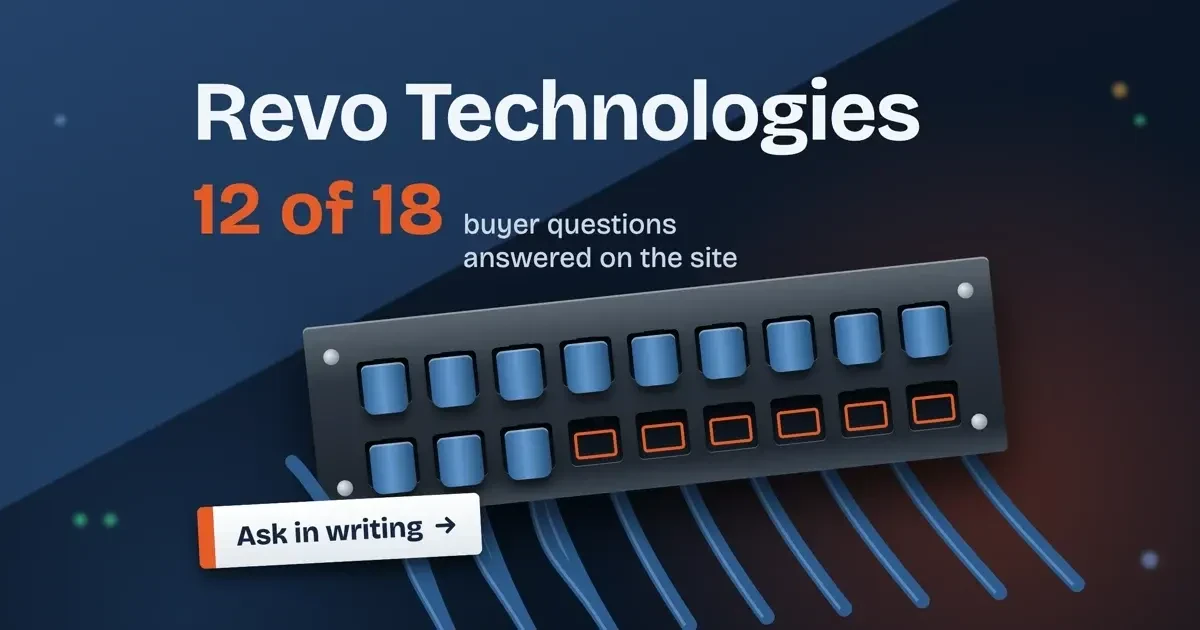
As of November 12, 2026, Revo Technologies' own pages list a Murray, Utah shop charging $150 for the first on-site hour and $100 for each hour after. They answered 12 of our 18 buyer questions, but none of the six about a managed IT contract. Get those six answered on paper first.
Revo Technologies is a computer shop and IT service company at 139 E 6100 S in Murray, Utah, run by Revo-IT, LLC per its terms of service. Maybe you own a small Salt Lake Valley office, say a tax prep firm, and your part-time computer helper just moved on, so you're reading local IT sites. Our March 2025 post praised Revo with no sources. This rewrite starts with Revo's own pages as of November 2026, its repair terms with two example bills, and which buyer questions those pages answer.
Then it's about any provider: what a managed IT contract should spell out, extra rules for tax and other financial offices, and how to compare local providers.
Key takeaways
- Revo's public pages answered 12 of our 18 buyer questions, not managed IT terms.
- Revo posts an on-site rate of $150 for the first hour.
- Get MFA, backups, incident response and account removal written into the contract.
- Hiring an IT provider does not move your legal duty to protect data.
- Tax preparers report breaches of 500+ consumers to the FTC within 30 days.
What Revo Technologies' own pages say, as of November 2026
We read nine of Revo's pages on November 12, 2026, with plain requests that named us. We didn't call, email or fill in a form. The About page says the founder started the business in Cottonwood Heights in 2013 and moved it to Murray in 2017. That lines up with the registry record for revotechnologies.com, which shows the domain registered on March 29, 2013. In 2025, according to that About page, a local businessman bought the company. Reviews from before then describe the shop under its earlier owner. The address, the (801) 890-5400 number and the sales email from our old post still match.
Hours have changed. Our old post listed 9 a.m. to 5 p.m. on weekdays, and the About page now says 9am to 6pm, Monday through Friday. Walk-ins are welcome during those hours.
The service area page puts the shop just north of the Fashion Place Mall. It names 41 communities across "Davis, Salt Lake, Tooele, Summit, and Utah counties" for on-site work, from Bountiful to Provo and Park City.
The IT services page lists on-site and remote support, network setup, installation, repair and data recovery through a partner lab. It says the shop covers everything "From computers and networks to Microsoft 365, cybersecurity, and day-to-day support." The servers page sells XCP-ng or Proxmox virtualization servers, plus networking gear and storage. The home page sells desktops and laptops too, "customized for your personal or business needs." Our old post promised "real-time threat monitoring." No Revo page we read uses those words. If you need monitoring, don't assume it's included; get it named in a written quote, with the hours it covers and its price.
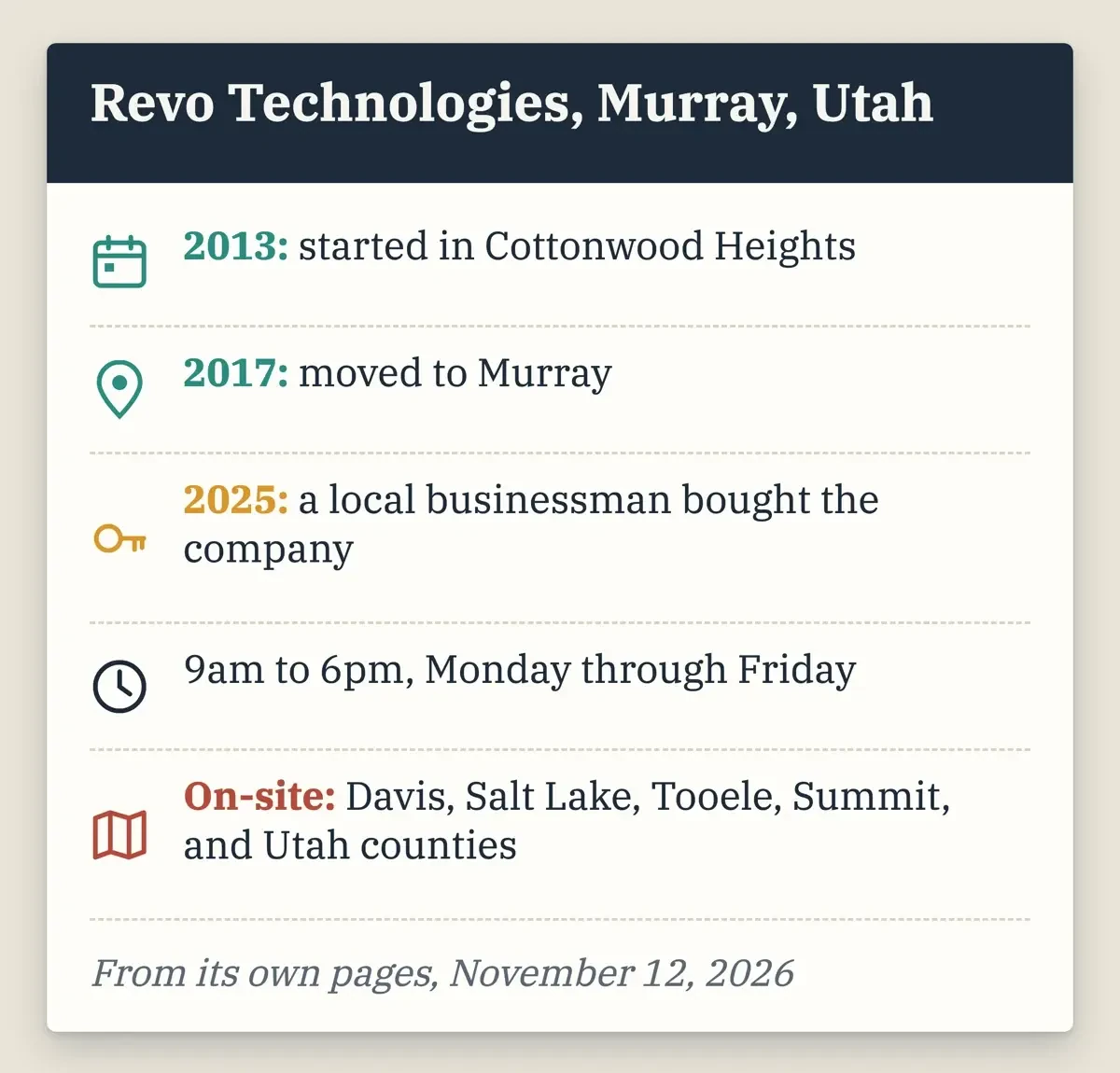 Diagram by DigitalTreed, from Revo Technologies pages and the domain registry record read on November 12, 2026.
Repair terms worth reading before you drop off a device
Every walk-in repair runs on the written terms page. The version dated June 29, 2026 sets a "non-refundable diagnostic fee of $99.99," applied toward the repair if you approve one. Any repair "estimated to be under $100" goes ahead without a call, while anything bigger needs your OK by phone, text or email before the technician starts. Once 14 days pass after the ready notice, storage runs $5.00 a day. At 45 days it counts as abandoned and may be wiped, then sold or recycled. Disputes go to Murray City Justice Court or the Third District Court.
Say you collect a laptop 20 days after the notice: you'd owe (20 - 14) x $5.00 = $30.00 in storage, an example. An example 3-hour visit at the posted on-site rate comes to $150 + 2 x $100 = $350, travel included, as of November 2026.
Labor carries a 30-day warranty from pickup. The shop's total liability is capped at what you paid for the disputed service.
On data, the privacy policy says technicians "only access files strictly necessary to complete the repair," and recovered data is deleted 30 days after you collect the device. Both pages put backups on you. Copy the files off first. Our cloud backup explainer and cloud storage comparison cover where a small office can keep that copy.
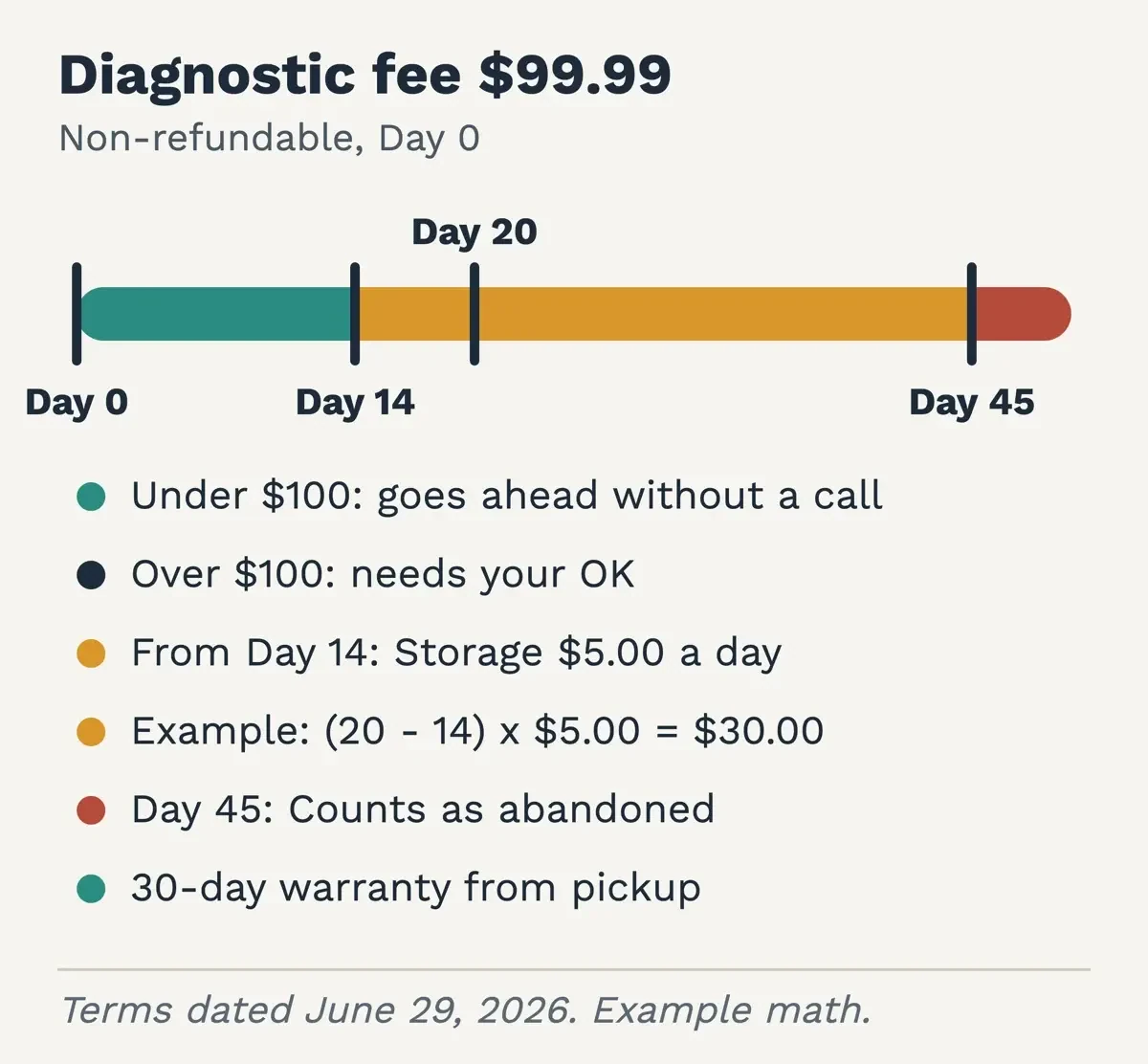 Diagram by DigitalTreed, from the Revo Technologies terms dated June 29, 2026, with our example storage math.
Which buyer questions do the public pages answer?
A managed IT deal reaches far past one repair and its files, since the provider holds admin access to your email, files and network all year. We wrote 18 questions a small office would ask any local provider, then checked which ones Revo's saved pages answer.
| Group | Question | Result (November 12, 2026) |
|---|---|---|
| Who and where | Legal business name | On the site |
| Who and where | Street address | On the site |
| Who and where | Opening hours | On the site |
| Who and where | On-site service area | On the site |
| Price and terms | On-site hourly rate | On the site |
| Price and terms | Diagnostic fee | On the site |
| Price and terms | Repairs done without asking | On the site |
| Price and terms | Labor warranty | On the site |
| Price and terms | Storage and abandoned devices | On the site |
| Price and terms | Cap on the shop's liability | On the site |
| Data | Who sees files on a device in for repair | On the site |
| Data | How long recovered data is kept | On the site |
| Managed IT contract | Monthly price for managed IT | Ask in writing |
| Managed IT contract | Response time or service level | Ask in writing |
| Managed IT contract | MFA on the provider's own accounts | Ask in writing |
| Managed IT contract | Backup testing and offline copies | Ask in writing |
| Managed IT contract | Incident response plan | Ask in writing |
| Managed IT contract | Ending the contract and removing access | Ask in writing |
The pages answered 12 of 18, all about who the shop is, repair prices and device data. None of the six managed IT questions had an answer: monthly price, response time, MFA on the provider's own accounts, backup testing, incident response and ending the contract. A missing answer on a website doesn't mean Revo lacks the service. It means you'll have to ask for it in the written quote, as you would with other outside providers.
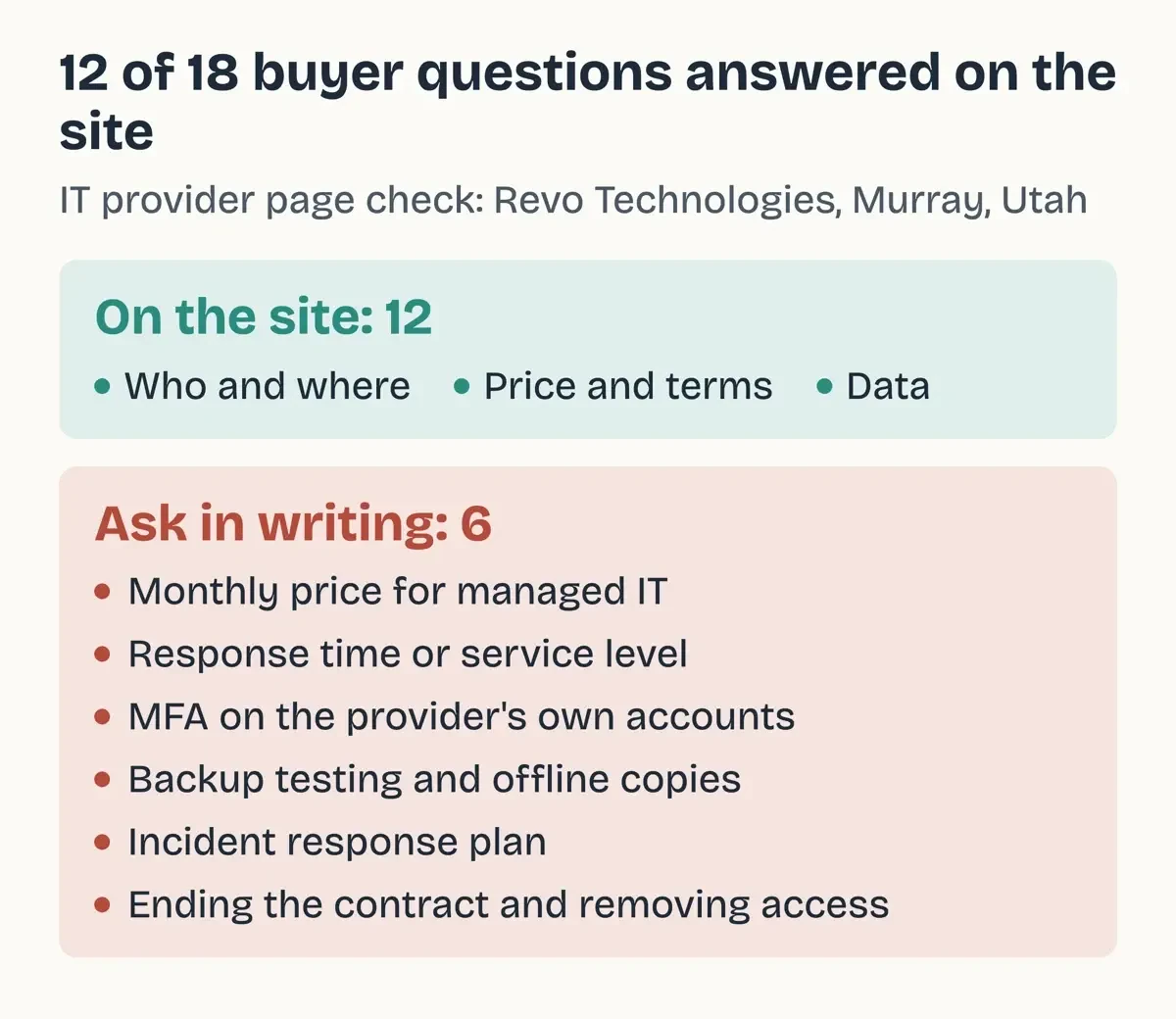 Drawn by us: results from our local test page at 127.0.0.1 built from saved Revo Technologies pages, November 12, 2026.
What we tested
We saved nine Revo pages on November 12, 2026 and cut the shared menu and footer. A script searched each page for wording that would answer each question, and we served the results as a report page at 127.0.0.1. A text search can miss an answer phrased in words we didn't try.
What a managed IT contract should spell out
NIST's page on building a small business security team says it's common for small firms to hand security work to outside providers. It says to document "the level of service, responsibilities, and expectations" in a managed services agreement, and adds that you "do not transfer your liability" by outsourcing. CISA's advisory AA22-131A for MSP customers asks that contracts "transparently identify ownership of ICT security roles and responsibilities." Your contract should say who patches, who reads the logs and who restores a backup. Ask for a name per task.
CISA also wants the provider's accounts kept out of your internal administrator groups and limited to the systems it manages. It also calls for MFA on every provider account that reaches your network.
Ask which MFA method the provider's staff use. CISA's MFA page calls text or email codes "the weakest protection"; our remote worker security tips apply the same sign-in rules to your team.
The same advisory wants backup services written into the contract, with copies kept apart from the network so ransomware can't reach them. Ask for the last test date.
Its Secure Your Business page ties your backup plan to your recovery point objective: how much recent work you can afford to lose. The advisory also wants incident plans tested "at regular intervals" and important logs kept "for at least six months."
The FTC's small business cybersecurity page covers the vendor side: "Put it in writing" and "Don't just take their word for it." It says to limit vendor access "only for the time the vendor needs to do the job." It's the same rule when the contract ends. CISA notes that "disabling MSP accounts can be overlooked when a contract terminates," so the exit terms should name who removes each account, and by what date. CISA's summary puts the same step first on its list: "Identify and disable accounts that are no longer in use." We'd send these eight questions to every provider on the shortlist:
- Which tasks are in the monthly fee, and which are billed by the hour?
- What response time do you commit to, in business hours and after hours?
- Which MFA method do your staff use on accounts that reach our systems?
- Are your accounts kept out of our internal administrator groups?
- How often are our backups tested, and is one copy kept offline?
- Who does what in a security incident, and when was the plan last tested?
- How long are logs kept for our systems?
- When the contract ends, who removes your accounts and hands back our passwords?
File the written answers with the contract and recheck them at renewal; our cybersecurity tips to protect your business list the basics you'll still own either way.
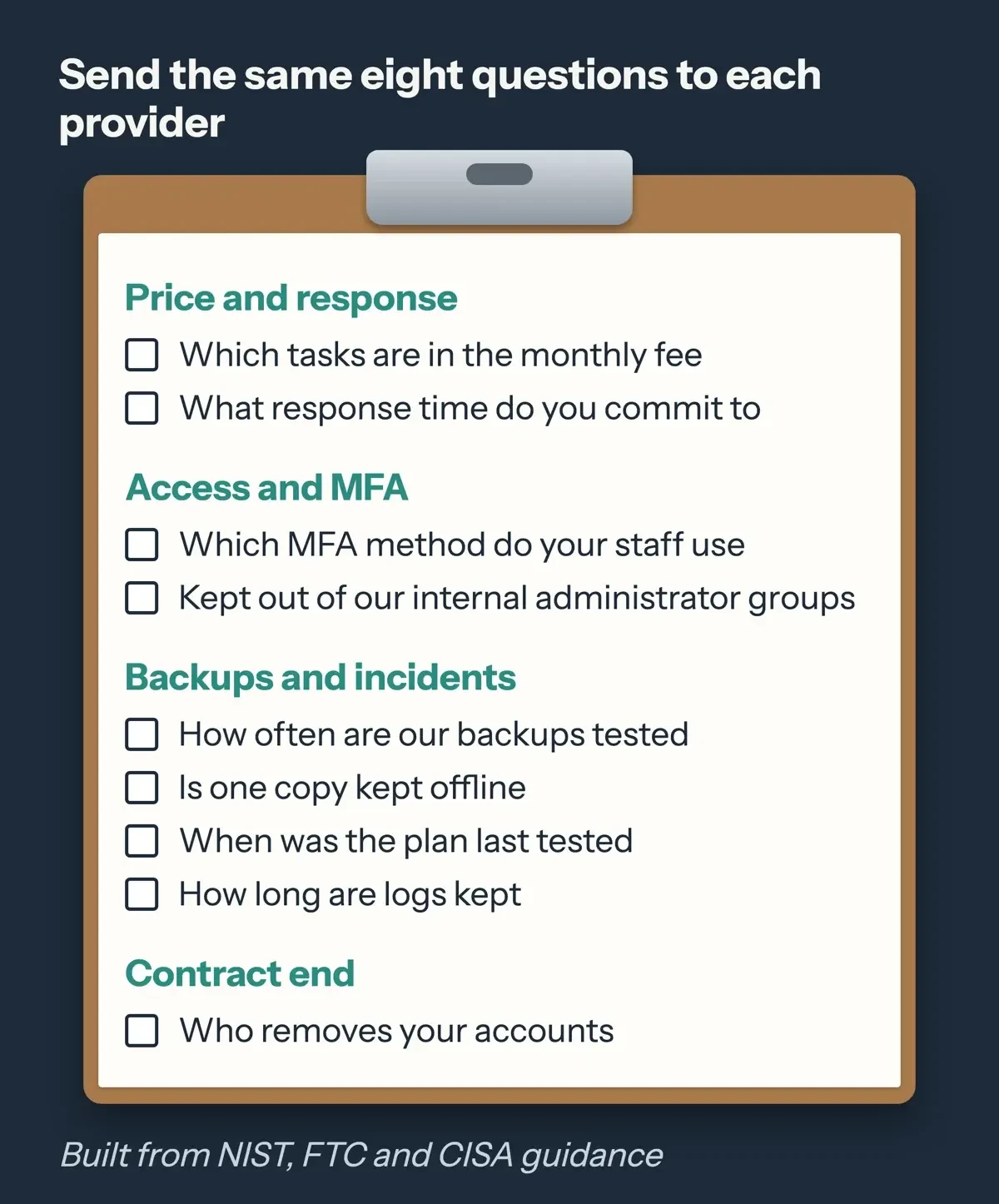 Drawn by us: eight contract questions built from NIST, FTC and CISA guidance.
Extra rules for tax, mortgage and other financial offices
For a tax, mortgage or other money office, the written contract also has to meet a federal rule. The FTC's Safeguards Rule guide lists tax preparation firms, mortgage brokers and credit counselors among the businesses it covers, along with check cashers and collection agencies. Under it you must "Monitor your service providers," and your contracts "must spell out your security expectations." The person who runs your security program "can work for an affiliate or service provider," the guide says. Even then, if an outside firm does that job, "the buck still stops with you." The rule took effect in 2003. The FTC amended it in 2021.
The Safeguards guide also requires a written incident response plan and MFA for anyone accessing customer information. Since May 2024, a covered business has had to tell the FTC within 30 days of finding a breach of unencrypted data on at least 500 consumers. Ask how fast the provider will tell you about one. Put that deadline in the contract. We aren't giving legal advice here. An attorney or CPA can confirm which parts apply.
How to compare two or three local providers
Send the same eight questions to each provider and compare the written answers side by side. Ask for them by email, so they're in the file with the contract. Read each one's posted terms the way we read Revo's: diagnostic fee, approval limit, warranty, storage fees and liability cap.
Then look up each legal company name in Utah's business entity search; it blocked our request, so we couldn't confirm Revo-IT, LLC there.
Reviews are worth reading on the provider's Google profile, newest first. Look for one complaint repeated over months. Testimonials on a company's own site are its own picks. Then try one small paid job, such as moving the office to email on your company name or checking your office internet connection. Watch whether costs are explained before work starts, as Revo's terms promise for jobs over $100.
CISA's four basics start with teaching employees to spot phishing. That stays your job whoever you hire. A provider won't sit at each desk, so our phishing link recovery steps and our free antivirus for Windows review cover what each person should do. NIST's Small Business Cybersecurity Corner also runs a finder for nonprofit programs that help small firms with security.
Frequently asked
Does Revo Technologies list prices for managed IT?
Not on the nine pages we read. Its servers page did list one small business server at $2,324.98, down from $2,724.99, as of November 2026.
Is Revo Technologies a registered company?
Its privacy policy names Revo-IT, LLC. Utah's entity search blocked our request, so check that name there yourself.
Does hiring an IT provider make it responsible for a breach?
Not by itself. NIST's team-building page says "You are ultimately responsible for protecting your systems and data."
How long should an IT provider keep security logs?
CISA's advisory AA22-131A says to keep the most important logs for at least six months.
How we made this guide: Nine Revo pages and eight federal pages saved as text, a registry lookup, and a local script checking 18 buyer questions. Facts checked by the DigitalTreed team on November 12, 2026.
First published March 8, 2025 as a company profile. Rewritten November 12, 2026 as a dated look at Revo's own pages and a neutral guide to choosing a local IT provider.
Sources
- Revo Technologies: About Us
- Revo Technologies: Service Area
- Revo Technologies: Terms and Conditions of Service
- Revo Technologies: Privacy Policy
- Revo Technologies: IT Services
- Revo Technologies: Servers
- Verisign RDAP: revotechnologies.com
- Utah Division of Corporations: Business Entity Search
- NIST: Building Your Small Business Cybersecurity Team
- NIST: Small Business Cybersecurity Corner
- FTC: Cybersecurity for Small Business
- FTC: FTC Safeguards Rule, What Your Business Needs to Know
- CISA: AA22-131A, Protecting Against Cyber Threats to Managed Service Providers and their Customers
- CISA: Require Multifactor Authentication
- CISA: Secure Your Business


Comments
No comments yet. Start the conversation below.