
Quick answer
Off-page SEO is the work you do outside your website so people and search engines trust it: links, listings, reviews, mentions and social profiles. For a small business, the core is free. Claim your listings, ask every customer for a review, earn a few local links, and skip anything you have to buy.
This off-page SEO checklist marks every item as do or skip, with the rule behind it. Google's local ranking help page says prominence is based partly on "how many websites link to your business and how many reviews you have".
It is written for a US shop with 1 to 10 people: about 4 hours in week 1, then 30 minutes a month. Where we have a longer guide, the item links to it instead of repeating it.
Key takeaways
- Start free: Search Console, Google Business Profile, Bing Places and Apple Business cost $0, as of October 2026.
- Never buy links, reviews or followers. Once you earn a link, our guide on how to index backlinks shows how to check that Google can find it. Google, Bing and the FTC all have rules against them.
- Paid placements are allowed if the link carries rel="sponsored".
- Most small sites never need the disavow tool.
- In our own test, social links showed up as "not verified," not broken. Read a link report before you panic.
What is off-page SEO?
Off-page SEO (also called off-site SEO) is everything that happens on other websites and platforms that makes yours look trustworthy. That means links, listings, reviews, mentions of your name and your social profiles. None of it happens on your own pages.
Links still count. Google says PageRank "continues to be part of our core ranking systems," in its guide to ranking systems. Our post on what a backlink is and how to get backlinks covers links in depth.
On-page and technical SEO cover your own site: your titles, content and site speed. This checklist stays off your site. To check your own site first, follow our SEO audit for small business, which takes one afternoon with free tools.
How is off-page SEO different from on-page and technical SEO?
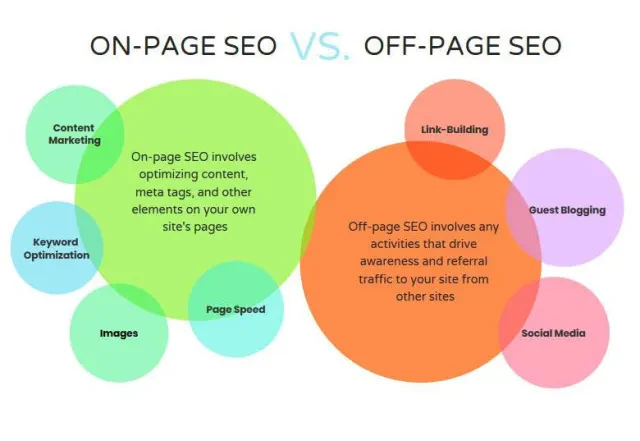
Off-page SEO builds trust on other sites. On-page SEO improves the words and tags on your own pages. Technical SEO makes sure search engines can crawl, load and index those pages. You need all 3, but this checklist covers only the off-page part.
| Part | Where the work happens | What it covers | Where to start |
|---|---|---|---|
| Off-page SEO | Other websites and platforms | Links, listings, reviews, mentions and social profiles | This checklist |
| On-page SEO | Your own pages | Titles, headings, content, images and internal links | On-page basics in our SEO for beginners guide |
| Technical SEO | Your site's setup | Crawling, indexing, redirects, speed and HTTPS | Our technical SEO audit checklist |
Key facts about off-page SEO
- Each table in the Search Console Links report stops at 1,000 rows.
- Apple Business has been free in the U.S. since April 14, 2026.
- Since May 2026, Google's spam policies also cover generative AI responses.
- An FTC reviews rule violation can cost up to $53,088, as of October 2026 (16 CFR 1.98).
How to use this off-page SEO checklist
Every item gets one of 3 labels: "Do" is for every small business. "Do if it fits" depends on your trade or budget. "Skip" means it breaks a Google, Bing or FTC rule, or wastes money.
Our take: do the first week's items in one sitting, about 4 hours. After that, a monthly 30-minute check is enough for most local shops.
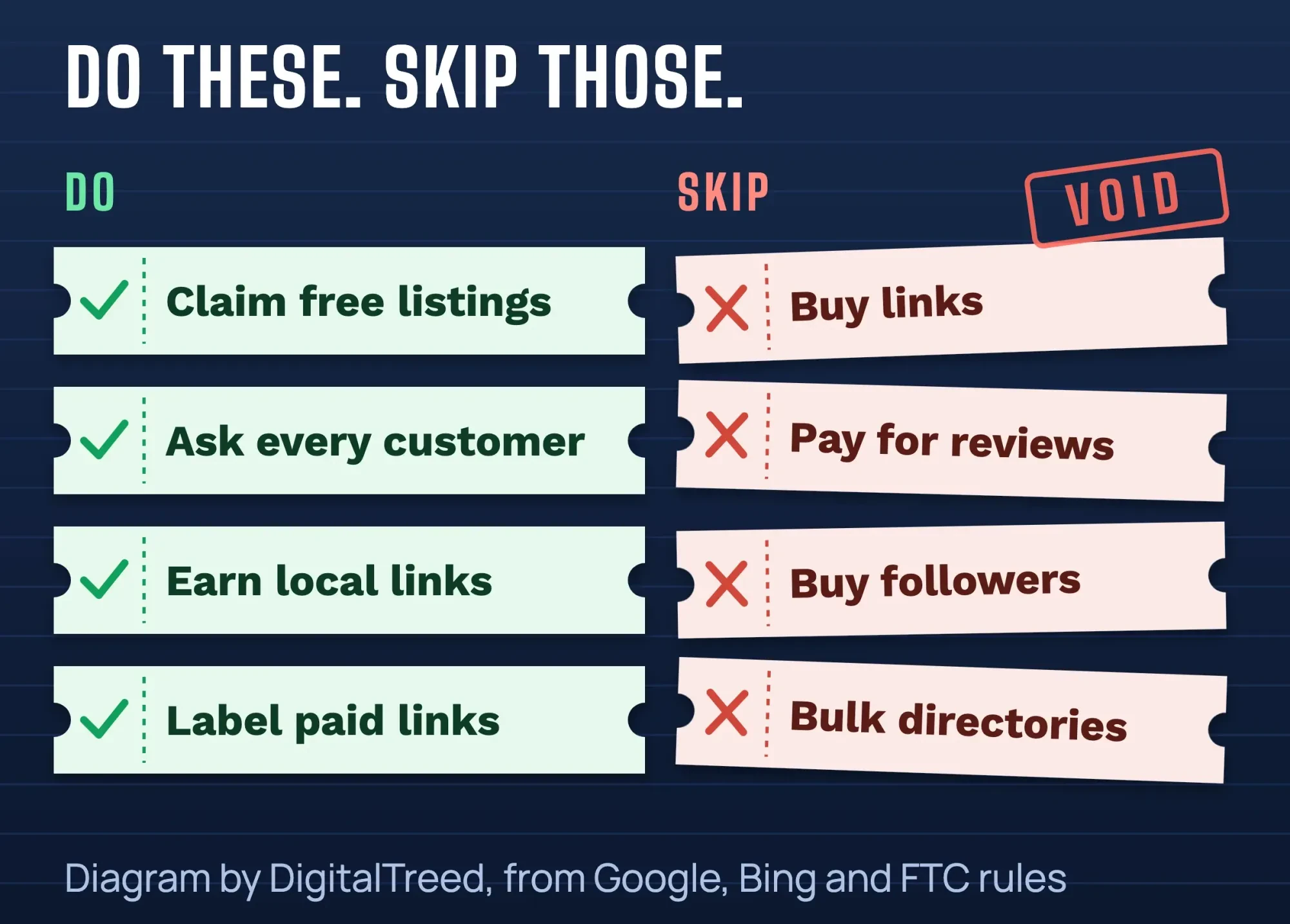 Diagram by DigitalTreed, based on Google, Bing and FTC rules linked in this guide, October 2026.
Free off-page SEO checklist: all 13 activities at a glance
Here is every item in one table. The sections below explain each one and link the rule behind it.
| Item | Label | When | Cost, as of October 2026 |
|---|---|---|---|
| Read the Search Console Links report | Do | Week 1, then monthly | $0 |
| Claim Google Business Profile, Bing Places and Apple Business | Do | Week 1 | $0 |
| Use one exact name, address and phone everywhere | Do | Week 1 | $0 |
| Ask every customer for a review | Do | After every job | $0 |
| Redirect old pages that still have links | Do | Monthly | $0 |
| Check dead outbound links on your pages | Do | Quarterly | $0 |
| Compare your links with 2 competitors in Bing Webmaster Tools | Do | Quarterly | $0 |
| Earn local links from suppliers, groups and events | Do | Ongoing | Varies |
| Answer reporters and help in local groups | Do | Ongoing | $0 on free plans |
| Pay a citation service | Do if it fits | Once, then yearly | $2 per citation to $199 a year |
| Gift a product to a local creator, disclosed | Do if it fits | When it fits | The product |
| Buy links, reviews or followers | Skip | Never | Not applicable |
| Use the disavow tool | Skip (usually) | Only after a link manual action, or if one is likely | $0 |
Which links should you build, and which should you skip?
Build links that a real customer would actually follow: local suppliers, trade groups, events, reporters and sites that already mention you. Skip unlabeled paid links, excessive link swaps and bulk directory packages. Google's spam policies list all 3 as link spam. Lawyers have one more limit, bar rules on paying for recommendations, covered in our law firm SEO guide.
Start with the links you already have. In Google Search Console, open Links and read the "Top linking sites" table. The Links report help page says it is a sample, and each table stops at 1,000 rows.
- Do: list the sites that link to you now. Our Google Search Console guide shows where the report lives.
- Do: find pages that have links but now return a 404 error, and redirect each one to the closest live page.
- Do: check your own pages for dead outbound links once a quarter.
- Do: earn local links from suppliers, your chamber of commerce, trade groups and events you sponsor.
- Do: see which local sites link to your 2 closest competitors, and ask the ones that fit you.
- Do if it fits: when a local site links to a page that no longer exists, suggest your page as a replacement.
- Do: mark paid placements and sponsorships with rel="sponsored".
- Skip: buying links, link swaps, "submit to 500 directories" packages and forum signature links.
- Skip (usually): the disavow tool.
- Skip: chasing Domain Authority or a "toxic score."
The Google Search Console guide we wrote walks through the Links report step by step. For outreach ideas, read the link building chapter of our intermediate SEO guide.
To see your competitors' links for free, use the Backlinks report in Bing Webmaster Tools. Bing's Backlinks help page says you can compare your profile "with up to two other sites' backlinks."
One filter there shows "domains not linking to my site." That is your list of sites to ask. Microsoft calls the tool "Free and full of powerful features" in a June 2025 Bing blog post.
For setup, read our Bing Webmaster Tools guide. It shows where the Backlinks report lives and how to add the 2 sites.
To find dead links, check your pages with our free broken link checker. It lists each broken or redirecting link with the page and anchor text where it sits.
On October 22, 2026, we ran a local copy of the tool (its October 21, 2026 build) on one of our own 2021 posts. It checked 105 links in 53 seconds and found 0 broken, 2 redirecting and 8 "not verified."
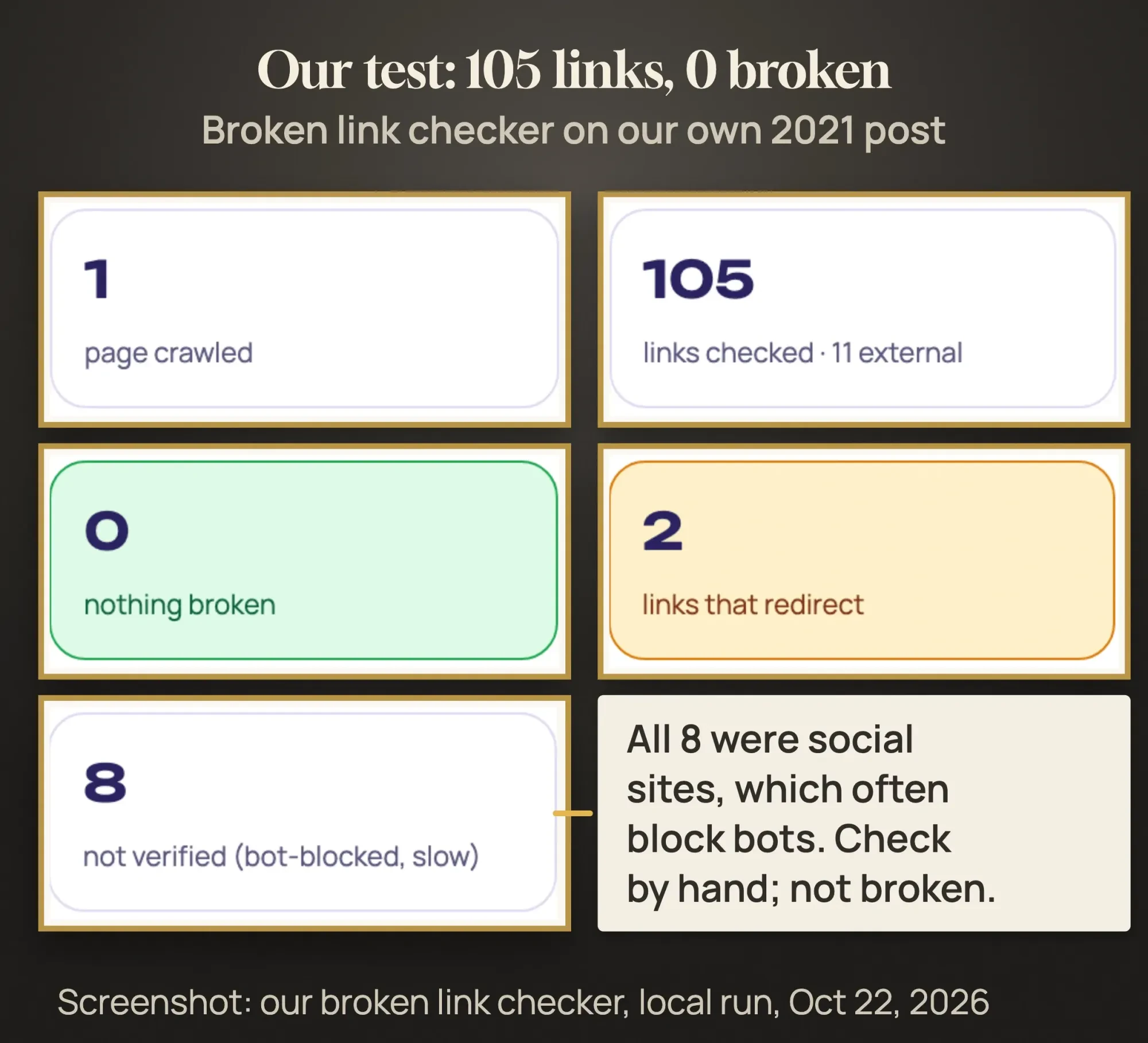 Screenshot: our broken link checker on our own post, run on a local copy of the tool, October 22, 2026.
All 8 "not verified" links were social profiles and share buttons, such as Facebook, LinkedIn and Pinterest. The tool marks them "bot-blocked, slow," because those sites often block automated checks. So "not verified" means "check it by hand," not "broken."
The skip list comes straight from Google. Its spam policies define link spam as links made "primarily for the purpose of manipulating search rankings". Examples include "Buying or selling links for ranking purposes" and "Low-quality directory or bookmark site links."
Paid links are fine when labeled. Google allows ads and sponsorships when the link carries rel="sponsored" or rel="nofollow". Its page on qualifying outbound links says sponsored is preferred and ugc is for comments and forum posts. Paying for a whole post rather than one link? Our guide to sponsored blog posts covers the FTC label and the link attribute.
Bing agrees. Its Webmaster Guidelines list "link buying, link spamming, private networks, and artificial social promotion schemes" as violations.
Leave the disavow tool alone unless spammy links caused a manual action, or likely will. Google's disavow help page says "most sites will not need to use this tool," and that wrong use "can potentially harm" your site.
Domain Authority and toxic scores come from vendors, not Google. Google's page on third-party SEO tools says these tools "don't have access to our internal ranking data."
Earning good links is the slowest part of off-page SEO. If you'd rather hand it off, our SEO service builds local links within Google's rules and reports every link monthly. (DigitalTreed sells this service.)
Which business listings should you claim?
Claim Google Business Profile, Bing Places and Apple Business first; all 3 are free, as of October 2026. Then add Yelp, Facebook, Nextdoor and 2 or 3 sites for your trade, with the same name, address and phone on every one.
A listing (also called a citation) is your business name, address and phone number on another site. Google says "Businesses with complete and accurate info are more likely to show up in local search results," on its local results help page.
- Do: claim and verify your Google Business Profile. Fill in every field.
- Do: claim Bing Places and Apple Business (it now holds the old Apple Business Connect tools). Both are free.
- Do: write one exact version of your name, address and phone, and copy it everywhere.
- Do: claim Yelp, Facebook, Nextdoor and 2 or 3 sites for your trade, such as Angi for home services.
- Do: after a move or a new phone number, search your old number and fix every old listing.
- Do if it fits: pay a citation service to build or clean up listings.
- Skip: bulk directory packages.
Our Google Business Profile optimization guide has the full setup in 12 steps. For the bigger picture, read our plain-English guide to local SEO.
Microsoft calls Bing Places "a free online platform" for listings in Bing search and Bing Maps. Apple says Apple Business "will be available as a free service in the U.S.," starting April 14, 2026.
Citation tools cost money but save hours. As of October 2026, BrightLocal Citation Builder starts at $2 per citation, with no plan needed.
Moz Local Lite costs $199 a year when billed yearly, as of October 2026. A 1-location shop rarely needs more than one of these tools.
Reviews: how to ask without breaking the rules
Reviews feed local rankings. Google says "More reviews and positive ratings can help your business's local ranking," on its ranking help page.
- Do: ask every customer the same way, by text, email or a QR code at the counter.
- Do: reply to reviews briefly and politely, without private details.
- Skip: discounts, gifts or contest entries in exchange for reviews.
- Skip: reviews from staff or family that do not say who wrote them.
- Skip: threats to get a bad review taken down.
Make a direct review link with our free Google review link generator. One tap takes the customer straight to the review box. To send that link after every sale without gating, follow our guide to automating customer reviews.
Google's rule on incentives is strict. Its review tips page says offering "free or discounted goods or services" for reviews "is considered fake & misleading content."
Our take: ask everyone, not only the customers you think were happy. It is fairer, and your rating then shows what real customers think.
Is it legal? The FTC rules on reviews, gifts and followers
Yes, if you avoid 4 things: paying for reviews with a set opinion, silencing reviewers, buying followers and hiding gifts to bloggers. The FTC's Consumer Reviews and Testimonials rule, 16 CFR Part 465, covers the first 3. The 4th falls under the Endorsement Guides, 16 CFR Part 255.
- Paying for reviews with a set opinion. Section 465.4 bans incentives "conditioned expressly or by implication" on a positive or negative review.
- Silencing reviewers. Section 465.7 bans "an unfounded or groundless legal threat, a physical threat, intimidation, or a public false accusation."
- Buying followers. Section 465.8 bans knowingly buying "fake indicators of social media influence."
- Hidden gifts to bloggers. The Endorsement Guides, 16 CFR 255.5, say a material connection "must be disclosed clearly and conspicuously."
Free products count as a connection under 255.5. So a gifted product needs 2 things: a clear disclosure in the post (FTC) and rel="sponsored" on the link (Google spam policies).
The stakes are real. Breaking the reviews rule can bring a civil penalty of up to $53,088 per violation, as of October 2026, under 16 CFR 1.98.
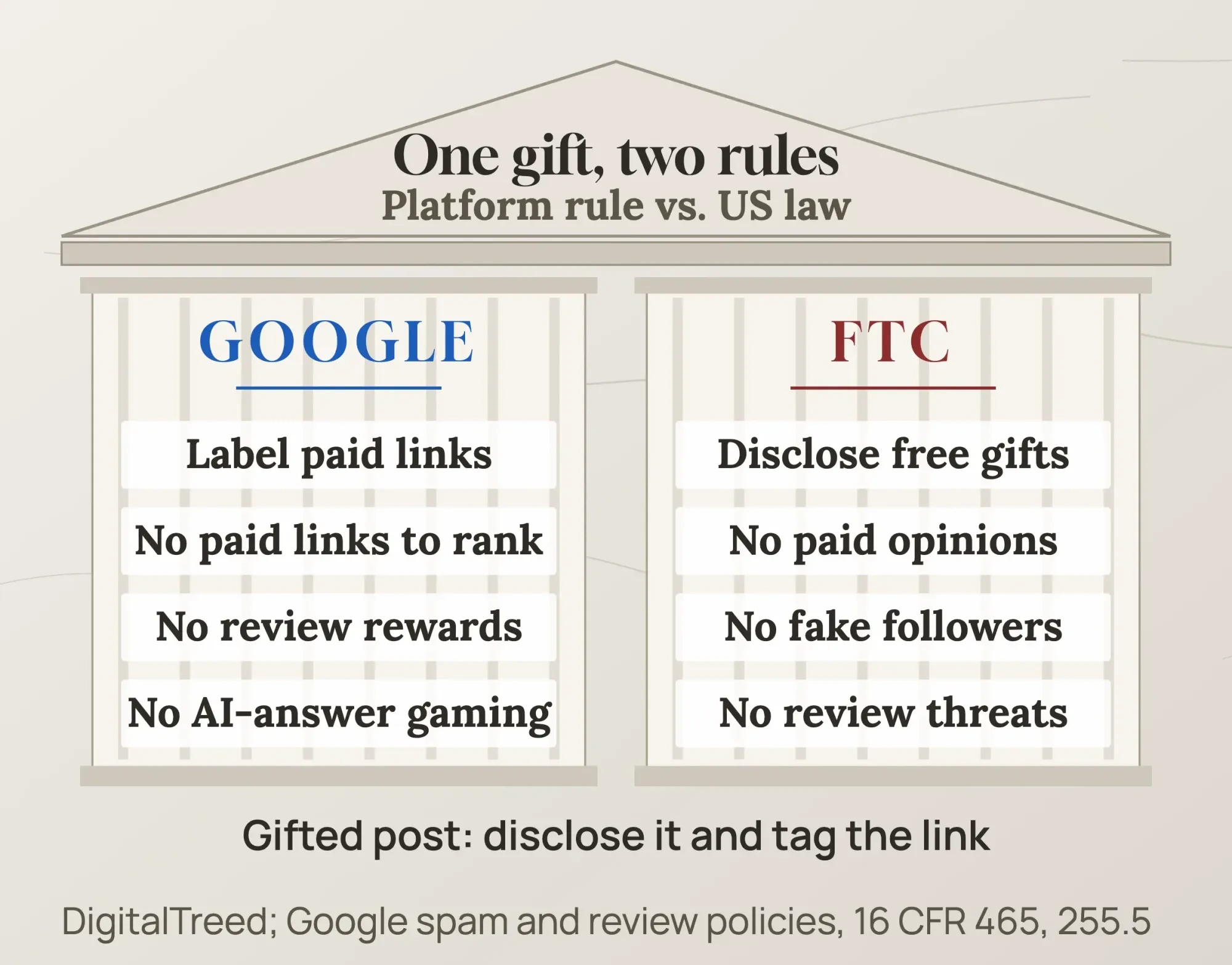 Diagram by DigitalTreed, based on Google spam and review policies and 16 CFR 465 and 255.5, October 2026.
This is general information, not legal advice; check with an attorney for your situation.
How do you get brand mentions and press?
You get brand mentions by giving reporters, trade blogs and local groups something worth naming. That can be a quick expert answer, a local price survey or a useful checklist. Then ask politely for a link when a site names you without one.
A brand mention is your business name on another site, with or without a link. Local news, trade blogs and "best of" lists are the usual places.
- Do: answer reporters' requests for sources in your field.
- Do: make one thing worth citing each quarter, such as a local price survey or a seasonal checklist.
- Do: when a site names you without a link, ask politely whether they would add one.
- Do if it fits: send a free product to a local creator, with disclosure and a sponsored link.
- Do: help in 1 or 2 local groups or forums under your real name, without dropping links.
- Do if it fits: speak at a local event or go on a local podcast as a guest.
- Do if it fits: write a guest article for a trade site your customers read, without keyword-stuffed links.
- Skip: paid press-release wires sent out only for links.
Reporter-request services have free tiers. As of October 2026, the Qwoted pricing page lists a free plan with 2 pitches a month and Pro at $149 a month.
Press releases are fine for real news, not as a link tactic. Google's link spam examples include "links with optimized anchor text in articles, guest posts, or press releases distributed on other sites."
The same rule covers guest articles. Write them for the site's readers, and let the editor choose the link text.
Communities count too. Google's SEO Starter Guide lists "Community engagement" as one way to promote a site. It also warns that "you can overdo promoting your site and actually harm it."
Our take: answer questions where your customers already ask them. Add a link only when it answers the question better than your reply.
Does off-page SEO help in AI answers?
Yes, the same basics apply. Google says "There are no additional requirements to appear in AI Overviews or AI Mode," on its AI features page. It also lists keeping your Business Profile information "up-to-date." So there is no separate AI checklist: the items above are the work.
Gaming AI answers is now spam. Google's Search Central changelog has a May 2026 entry: spam policies now "apply to generative AI responses in Google Search". Our take: that rules out planting fake forum posts about yourself.
Mentions seem to matter. A May 2025 Ahrefs study (vendor data) found brand web mentions correlated with AI Overview brand visibility at 0.664, against 0.218 for backlinks.
Two cautions. It is a correlation, not proof of cause. And Ahrefs studied larger sites (Domain Rating above 40), not small local shops.
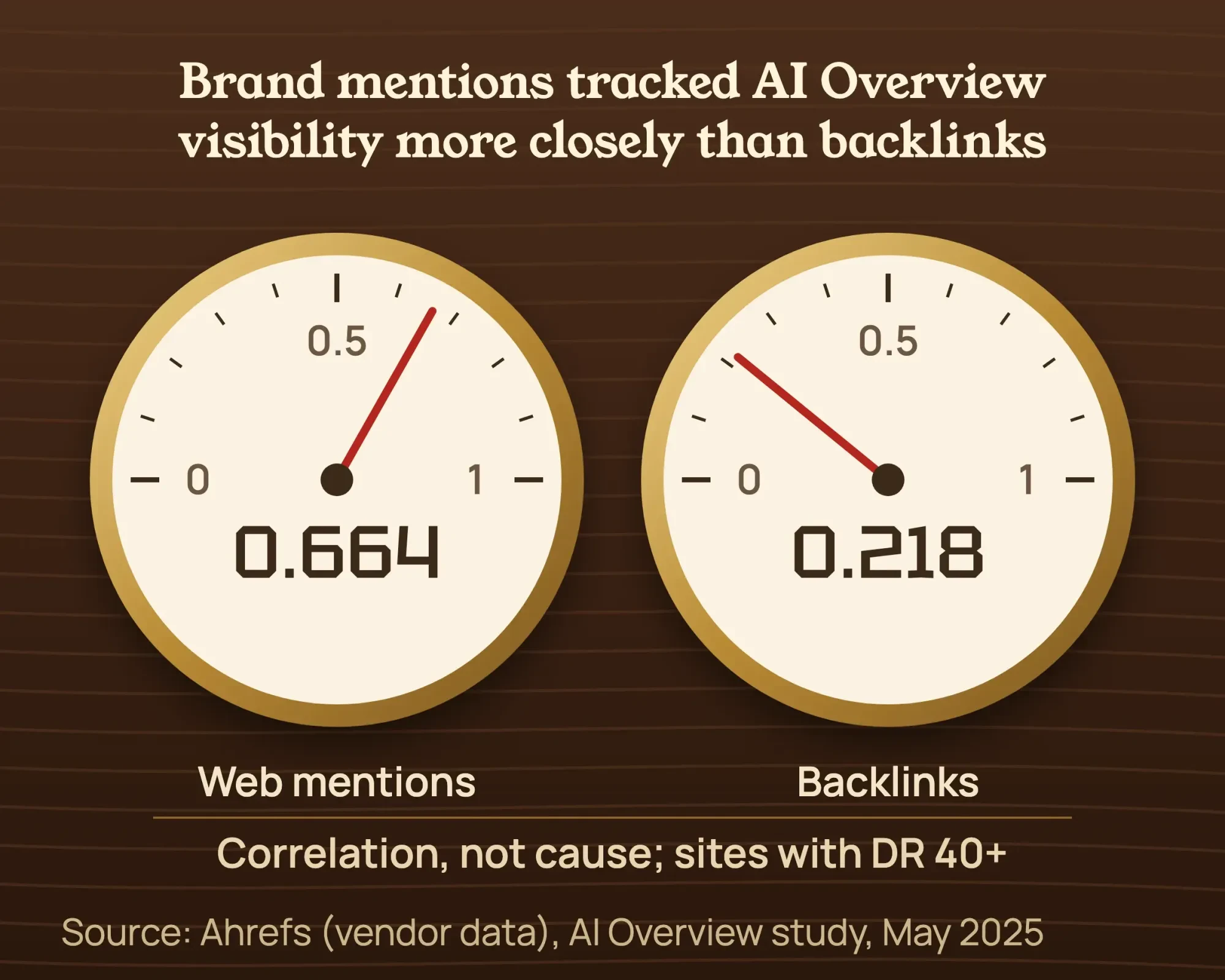 Source: Ahrefs (vendor data), AI Overview brand correlation study of DR 40+ sites, May 2025.
For more on AI answers, read our guide to generative engine optimization.
Which social profiles do you need?
Only the 2 or 3 platforms your customers use, with the same name, logo, address, phone and website link on each. Matching profiles help people check that you are real before they call. You don't need every network, and an abandoned profile looks worse than none.
- Do: claim your business name on the 2 or 3 platforms your customers use.
- Do: list your profiles on your homepage in Organization structured data.
- Skip: buying followers, likes or reviews.
Google's Organization structured data page says the sameAs field can hold "a URL to your organization's profile page on a social media or review site."
We checked our own homepage on October 22, 2026. Its sameAs lists 4 profiles: Facebook, X, Instagram and LinkedIn. Test your own markup with our free schema markup validator.
Social shares are not a known ranking factor, and Google has not said they are. Its SEO Starter Guide lists "Social media promotion" as a way for people to discover your site. Our social media marketing strategy guide helps you pick platforms.
How do you measure off-page SEO?
Measure off-page SEO with 5 numbers, once a month, in about 30 minutes. Track new linking sites, branded searches, Business Profile calls and clicks, your review count and rating, and new mentions. Write them in one spreadsheet so you can see the trend.
- New linking sites in the Search Console Links report.
- Searches for your business name in the Search Console Performance report.
- Calls, direction requests and website clicks in your Business Profile performance view.
- Your review count and average rating.
- New mentions you found, and whether they link.
There is no official timeline. Plan on months, not weeks. Google's starter guide says links from other sites happen "naturally over time."
Example: a dog grooming shop in Tampa
Example: Harbor Paws Grooming is a made-up 2-groomer shop in Tampa, Florida. This is not a client result.
- Week 1: the owner claims Google, Bing Places and Apple Business, all free, and writes one version of the address and phone.
- Weeks 2 to 4: every customer gets a text with the Google review link after pickup.
- Month 2: Search Console shows a pet blog linking to an old /prices page that returns 404. A redirect to /pricing fixes it.
- Month 2: a local site offers a featured listing for $150. The owner agrees only if the link uses rel="sponsored".
- Month 3: a free groom for a local creator, posted with a "Paid partnership" label and a sponsored link.
Year-one tool cost: $0 to $199, as of October 2026, if the owner adds Moz Local Lite. Everything else on the list is free.
Frequently asked
Why is off-page SEO important?
Other sites vouch for you in ways your own site can't. Google says local prominence is based partly on links and reviews, and PageRank is still part of its core ranking systems.
Are backlinks part of off-page SEO?
Yes. Links from other sites are a core part of off-page SEO, and Google still uses PageRank. Listings, reviews, mentions and profiles are the rest.
Can I pay for links?
Only as a labeled ad or sponsorship with rel="sponsored" or rel="nofollow". Paying for a plain link to rank better breaks Google's spam policies.
Can I give a discount for a Google review?
No. Google bans any incentive for reviews. The FTC also bans incentives tied to a positive or negative opinion.
Do I need to disavow bad links?
Usually not. Google says most sites never need the disavow tool. Use it only when many spammy links caused a manual action, or likely will.
How much does off-page SEO cost?
The core is free: Search Console, Google Business Profile, Bing Places and Apple Business. Optional citation tools cost from $2 per citation (BrightLocal) to $199 a year (Moz Local Lite), as of October 2026.
Your next step
This week, open Search Console and write down your top 10 linking sites. Then claim any listing you don't control yet.
If you want the whole list run for you, our search engine optimization service handles links, listings and reviews, with a plain report every month.
How we made this guide: it is built from Google Search Central and Business Profile help pages and Bing's guidelines. We also used the eCFR text of 16 CFR 465, 255.5 and 1.98, Bing's Backlinks help page and vendor pricing pages. We read the 2 Bing Webmaster Tools pages on October 23, 2026.
We ran our broken link checker on our own post and checked our homepage markup on October 22, 2026. We checked every number against the source linked next to it on the day we added it.
First published August 2021. Rewritten October 22, 2026: a new do-and-skip checklist, Google and FTC rules, US listing sites, USD costs, our own link test and a 90-day example. Updated October 23, 2026: added a checklist-at-a-glance table and an on-page vs off-page vs technical table. We also added free competitor link checks in Bing Webmaster Tools, and items on communities, broken link replacement, guest articles and podcasts. Updated October 25, 2026: added Key facts, direct answers, a label on the checklist table and our checker's build date.
Sources
- Google Business Profile Help: Tips to improve your local ranking on Google
- Google Search Central: Spam policies for Google web search
- Google Search Central: Qualify your outbound links
- Google Search Central: A guide to Google Search ranking systems
- Search Console Help: Disavow links to your site
- Search Console Help: Links report
- Google Search Central: Third-party SEO tools and advice
- Google Search Central: AI features and your website
- Google Search Central: Latest documentation updates
- Google Search Central: SEO Starter Guide
- Google Search Central: Organization structured data
- Google Business Profile Help: Tips to get more reviews
- Bing Webmaster Guidelines
- Bing Webmaster Tools Help: Backlinks
- Bing Webmaster Blog: Start using Bing Webmaster Tools, June 17, 2025
- Bing blog: Introducing the new Bing Places for Business, October 3, 2025
- Apple Newsroom: Introducing Apple Business, March 2026
- eCFR: 16 CFR Part 465, Consumer Reviews and Testimonials
- eCFR: 16 CFR 255.5, Disclosure of material connections
- eCFR: 16 CFR 1.98, Adjustment of civil monetary penalty amounts
- Ahrefs: AI Overview brand correlation study, May 26, 2025 (vendor)
- BrightLocal pricing (vendor)
- Moz Local pricing (vendor)
- Qwoted pricing (vendor)
Comments
No comments yet. Start the conversation below.