
Quick answer
As of October 31, 2026, 5 software development publications with a working contributor page cleared our check, and 3 take a one-off pitch from anyone. Paid writer programs are a separate route, and the ones we read at DigitalOcean, Twilio and Honeybadger weren't taking new writers that day. Score any new site with our 2-minute card, and pitch only code you've already run.
Say you just fixed a nasty memory leak in a Node service and want the story on a site other developers read. You typed "write for us software development" and got pages of lists. A software development contributor page is an engineering publication's brief for outside writers: what to propose, who edits it and who owns the code. We once ran this URL as DigitalTreed's call for software articles; now it points you to the publications that still take them.
First come what dev editors ask for and how paid writer programs differ from guest posts, then search strings, crack and keygen footprints, and a 2-minute check. The sites that passed it follow. The end covers code licensing, a pitch email, and Google and FTC rules once a vendor pays. The Stack Overflow blog, Stack Abuse, InfoQ and stitcher.io all ask for a pitch, samples or a proposal before any draft. So the real work starts before you've written a word.
Key takeaways
- Dev editors want code you ran, with versions and a repo link.
- A paid writer program pays you; a paid guest post means you pay.
- Our word scan skipped crack, keygen and plain APK; search those by hand.
- Code in your repo needs a license file before others may reuse it.
- Paid links need rel="sponsored", and vendor staff must disclose the job.
Note
Want to write for DigitalTreed? Check the fit first: our write for us page calls us "a digital marketing and technology publication". Its topics: "SEO", "Business", "AI tools", "Blogging", "WordPress", "Affiliate marketing" and "Online growth". A deep dive on lock-free queues belongs at one of the engineering publications below, not here. A tested look at AI coding assistants on a WordPress plugin could fit. For editorial pieces the page says: "Send a short pitch first, not a finished article." Sponsored articles carry "One relevant contextual link to your website or brand" and prices sit in our media kit.
What a dev editor checks before reading your prose
The pages in our table ask a pitch the questions a code reviewer would: what problem it solves, and whether the code exists yet. The Stack Overflow blog's guidelines want "A paragraph of information to flesh out the post idea. Why is this interesting?" and note that you "can include code samples, gists, CodePens, and more". InfoQ's page points you at your own experience: "Write about an architecture decision that surprised you."
Versions are the part most pitches skip. The package-lock.json docs for npm say the lockfile records "the exact tree that was generated", so a later install matches yours. The pip user guide files frozen requirements under "Repeatable Installs". Put the language version, the framework version and the lockfile in the repo you link, then name the OS in the draft. Our own pip subprocess error fix shows why this matters: the same install command fails or works depending on the Python and pip versions underneath it. Pin both in the repo, so the editor who clones it gets your output and not your error.
Vendor pitches are the other filter, and Stack Abuse puts it bluntly: "Don't use this as an opportunity to boost your own site's SEO". The stitcher.io owner writes that guest post requests "often involve low-quality content just to boost SEO stats" and wants to stay far away from them. Linux.com is open about promotion, and wants your "author name and affiliated organization" in the submission document. Work for the company behind the tool in your tutorial? Say so in the first email, next to your title; don't save it for the bio at the end.
AI use is on the checklist now, too: in an October 2026 note, the Stack Overflow blog asks writers "to disclose their AI usage on the articles".
InfoQ's FAQ answers the same question with "For research and grammar, yes. For writing your content, no." Google's people-first content questions ask whether automation is "self-evident to visitors through disclosures or in other ways".
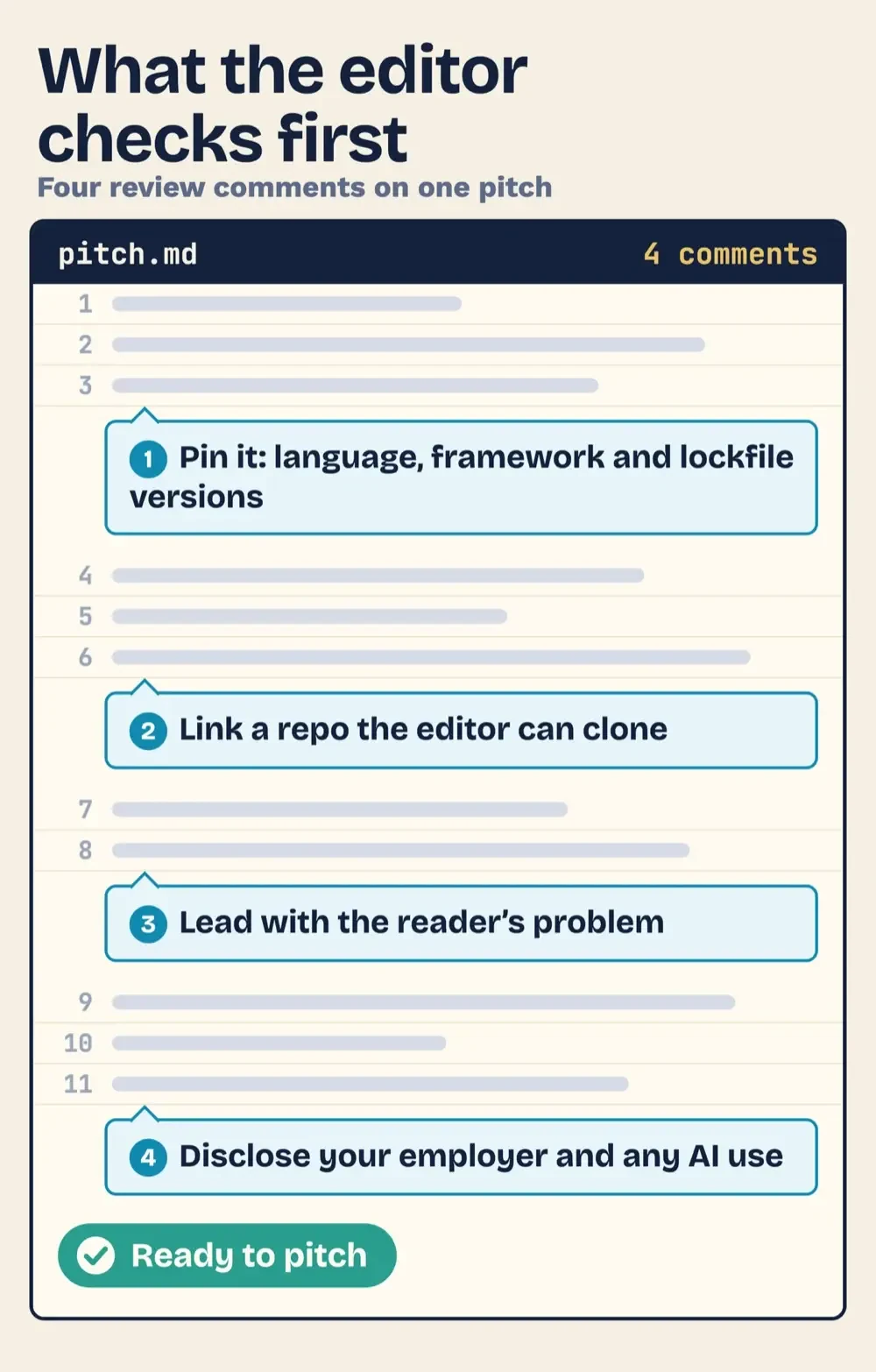 Diagram by DigitalTreed of four checks a dev editor makes on a pitch, drawn as code review comments from the contributor pages and docs we read on October 31, 2026.
Paid writer programs are a different deal from guest posts
Several dev writing gigs we read aren't guest posts at all. They're paid programs where the publication buys your tutorial, edits it and controls where it lives. The money runs from the publisher to you. In a sponsored guest post it runs the other way, and that changes which rules apply.
As of October 2026, DigitalOcean's Write for DOnations page says "New tutorials are paid $400". The author also picks a tech charity for a donation from DigitalOcean. Yet the same page's FAQ gives "$300 for typical tutorial content". Ask which figure you'd get if it reopens. Twilio's Developer Voices page lists "$650 per tutorial". Neither one is open. DigitalOcean's page still showed a "Paused until 2025" banner on October 31, 2026, and Twilio's isn't accepting new applications.
The New Stack paused its contributed-article program on July 17, 2026, and now points brands to its sponsored programs.
Our reread caught one more: Honeybadger's author page still offers $500 per article as of October 2026, but it also says "We are not currently seeking authors." The run had kept it, so it's off our list now.
InfoQ shows a third model, where news editors get "quarterly revenue share" for ongoing work, which is closer to a part-time role than a byline. One-off InfoQ authors aren't paid; the FAQ says "The value is editorial support, distribution to 1.5M readers, and a byline".
A staff writing job is different again: it's employment, with a contract that settles who owns what. Our run dropped staff job ads and "apply to join the staff" pages, because they don't take a one-off pitch.
Disclosure still follows you, though, and the FTC's endorsement Q&A says employees who promote their company's products "should disclose their relationship to the company".
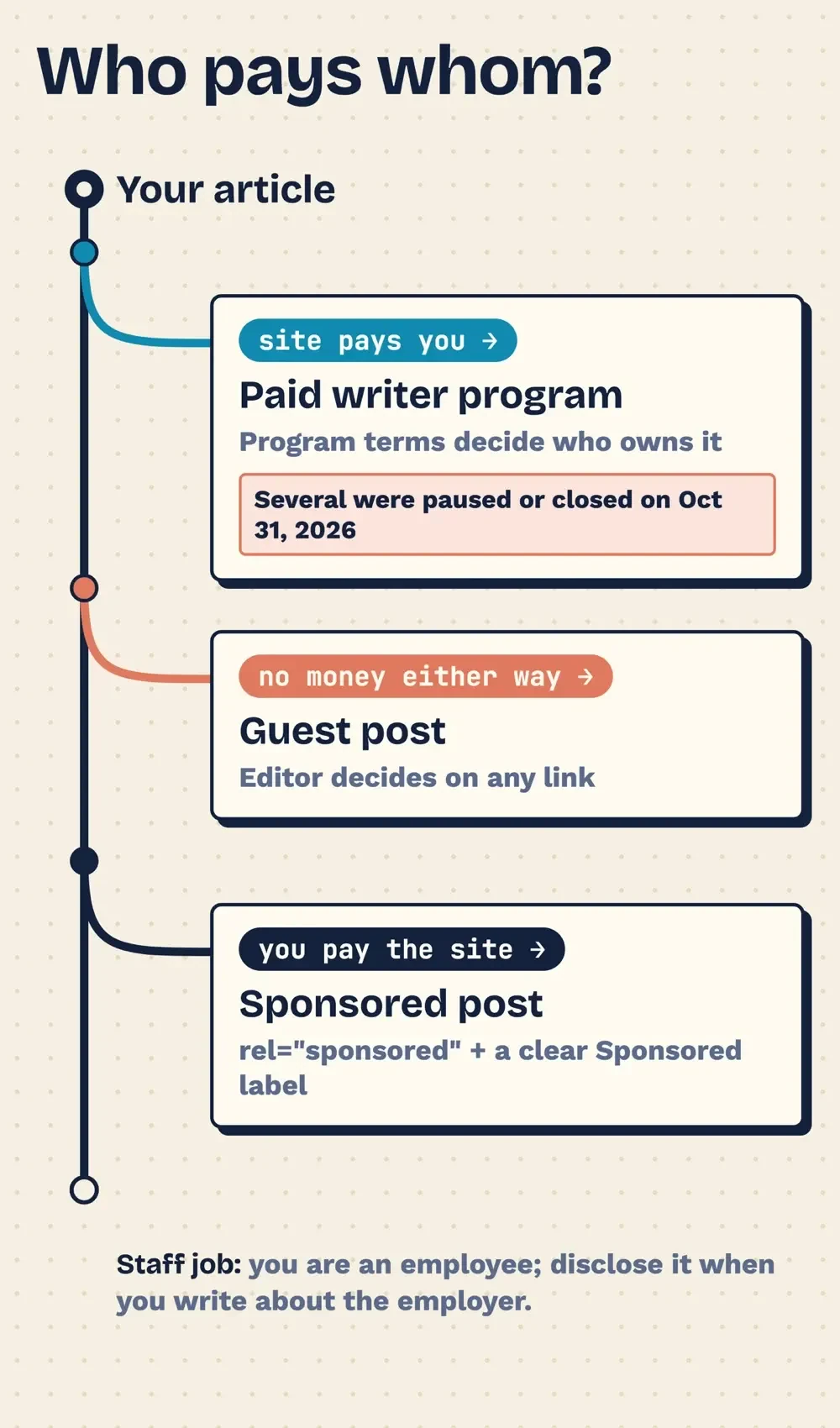 Diagram by DigitalTreed comparing paid writer programs, unpaid guest posts and sponsored posts, from the program pages and Google and FTC rules read on October 31, 2026.
Dev search strings, from language names to paid programs
So where do the open calls hide? Google's refine searches help page explains the quote marks, minus sign, site: and after: operators that the box below uses.
The find block mixes a language or tool with the words engineering editors use. The vet block runs against one domain at a time.
Find engineering contributor pages
"write for us" "code samples" -casino
"submit an article proposal" architecture
"contributor guidelines" golang OR rust tutorial
"we pay" "per tutorial" developers
"guest posts" php blog "GitHub"
"pitch" "kubernetes" "editorial" -"link insertion"
"write for us" python after:2026/01/01

Vet one dev site (replace example.com)
site:example.com crack
site:example.com keygen
site:example.com "apk download"
site:example.com "free download" "full version"
site:example.com nulled
site:example.com "link insertion"
"example.com" "guest post" price
Google's help page doesn't list OR, so run that line as two searches if the results look odd.
Paid programs change state often: DigitalOcean's page is still live and still paused, and Twilio and Honeybadger had both stopped taking writers when we read them. Test each contributor URL with our HTTP response code tool. A 200 on the page itself is a keeper; if it redirects to the front page, the call has probably closed. The vet block has a limit too, since Google's site: operator page warns that "The list of URLs returned is not always exhaustive". An empty result means nothing showed up today, not that the site is clean.
Crack, keygen and copied-answer pages: footprints on dev sites
Casino pages weren't common among our dev candidates. The trouble to look for on a dev site is different: cracked IDE downloads, keygens, APK mirrors, Stack Overflow answers pasted without credit, and a price list for link insertions.
Our run's spam scan read each candidate's sitemap slugs for a fixed list of words: "casino", "cbd", "viagra", "escort", "mod-apk", "payday-loans", "title-loans", "betting-tips", "online-slots", "slot-machines" and "essay-writing-services". A site with 3 or more hits was out, and in the software development section only 2 candidates fell to that rule, on "casino", "cbd" and "mod-apk". The worst had "cbd" in 8 of its sitemap slugs. That list doesn't include "crack", "keygen", "nulled" or "free download", and plain "apk" doesn't match it either. So those checks are yours to run by hand, with the vet block above.
Why skip a site over a keygen page? Keygens and cracked installers are downloads. Google's spam policies treat malware as a malicious practice and note that "Site owners sometimes don't realize that their downloadable files are considered malware". The same policies let many "valid copyright removal requests" against one site lead Google "to demote other content from the site in our results". Google files those notices under the DMCA, the US copyright takedown law, and a page offering a cracked IDE invites them.
Copied answers are harder to spot, and Google's scraping rules name "Republishing content from other sites without adding any original content or value, or even citing the original source". Stack Overflow's licensing page says posts from May 2, 2018 on are "distributed under the terms of CC BY-SA 4.0", a license that requires "appropriate credit". Here's the test: copy the first line of one of the site's code explanations into Google, in quotes. If a Stack Overflow answer comes up first and the dev site gives it no credit, you've found a scraper.
The run threw out 23 candidates as general tech or gadget news, not engineering publications. One page we dropped promised "Exposure and backlinks for your blog"; four dev candidates in all came out on link promises like that.
General tech and gadget news sites, the ones the run set aside, are covered by our tech blogs that take guest posts list, vetted the same way.
Can you vet a dev publication in 2 minutes?
You can, if you stick to five rows and stop at the first red. The full method, with audience and payment checks, is in our full vetting checklist in our niche sites hub. The first four rows come straight from the run's records for each kept site, and the fifth is the hand search from the last section.
| Row | Green | Yellow | Red |
| Writer call | Live, with steps for a pitch | Members first, an editor role, or dated years back | Paused or closed; sells posts; offers dofollow |
| Tranco rank | Top 100k | Between 100k and 1 million | Unranked, traffic unchecked |
| Homepage titles by year | One publication throughout | An unrelated owner long ago, dev topics since | Three or more topic switches |
| Sitemap word scan | No hits | 1 or 2 hits, or the run could not read it | 3 hits and up |
| Hand search | No crack, keygen, APK or copied answers | Downloads of the site's own open source tools | Cracked software, APK mirrors, uncredited answers, a link insertion menu |
A red ends it. With two yellows, read five recent posts before anything else. Then paste the guest post category URL into our noindex tag checker; a noindex there keeps those guest pieces out of search.
The traffic row uses Tranco, a "Research-Oriented Top Sites Ranking" whose methodology blends a month of daily lists, scoring each with the Dowdall rule. The rank tells you people visit; it doesn't tell you which languages they work in.
Here's the card on three sites from our list, using nothing but the run's saved data and the pages we reopened:
- The Stack Overflow Blog: open call, green. Tranco 38,141, green. Titles: the Stack Overflow Blog name each time a title was saved, green. Sitemap: no spam words, green.
- InfoQ: open call, green. Tranco 10,759, green. Titles: an unrelated InfoQuest title in 1996, then InfoQ, yellow. Sitemap: not readable, yellow.
- Linux.com: members first, yellow. Tranco 14,977, green. Titles: a default Apache test page in 1998, then Linux.com from 2005, green. Sitemap: not readable, yellow.
Across the 5 listed sites, 4 carry at least one yellow and none has a red. The yellows by cause: past 100,000 on Tranco (2), sitemap not read (2), members first (1), dated page (1) and earlier owner (1). The Stack Overflow Blog came out green on every row the run recorded. InfoQ, Linux.com and stitcher.io have two or more yellows, so read the newest posts there before you spend a weekend on a draft.
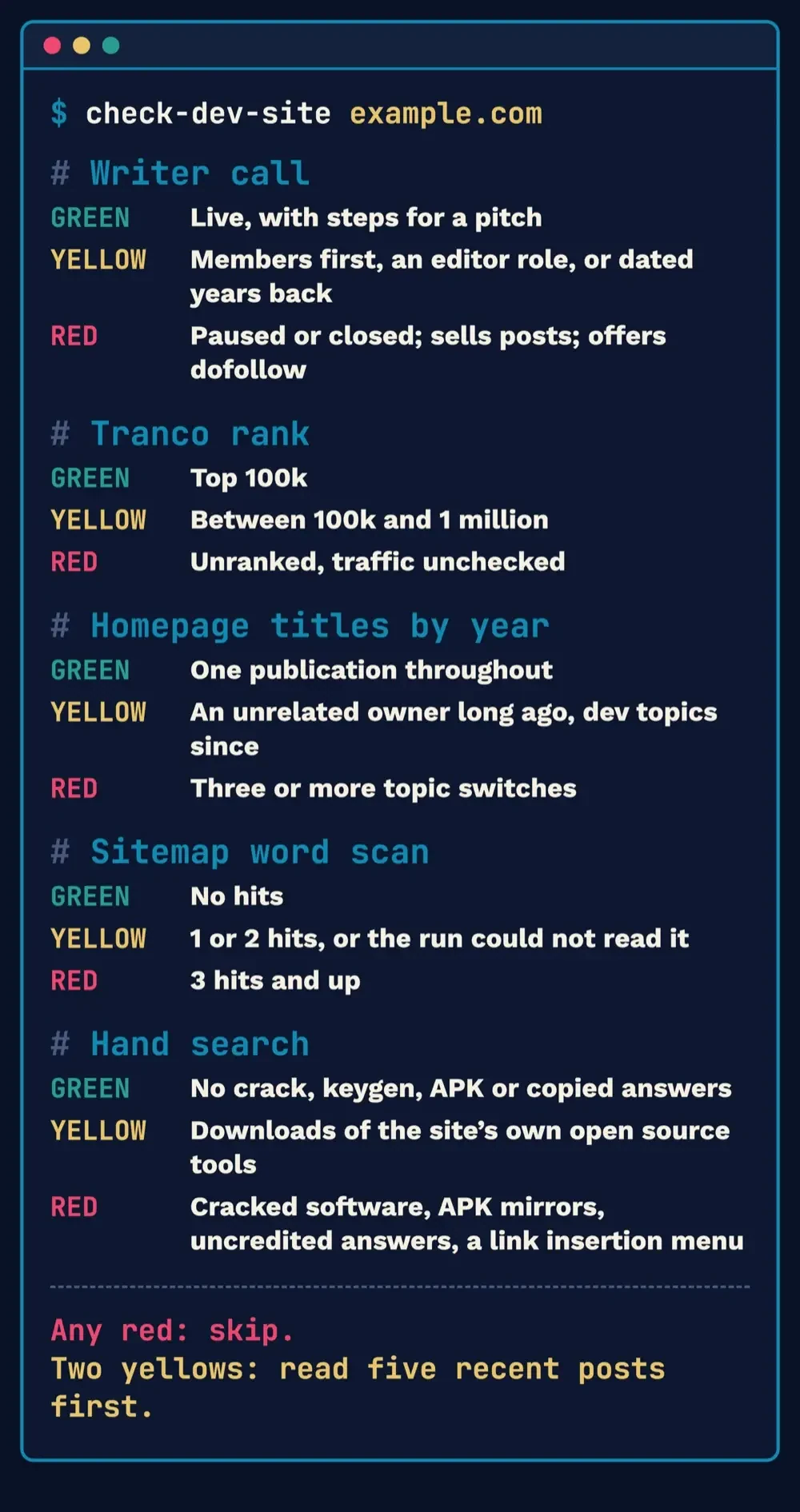 Diagram by DigitalTreed of the 2-minute check for software development sites, with the same thresholds our October 31, 2026 run used.
Write for us software development: the sites that passed on October 31, 2026
Each publication in the table passed the run on October 31, 2026, and we fetched and read its contributor page again the same afternoon. The Vetted stamp in our header image means that much, and no more: it isn't a promise of traffic, pay or a reply.
The run kept 6 software development sites. We fetched each of those contributor pages again that afternoon and read them, and one didn't hold up:
- Honeybadger: a paid author program whose page now says "We are not currently seeking authors."
So the table has 5 rows. Our target was 15, and we'd rather print five honest rows than pad it with weak ones. The biggest loss came early: 201 of 365 candidates had no page inviting outside writers that the checker could find. Three take a one-off pitch from anyone today. Linux.com carries a yellow note because its page is written for members first and stitcher.io carries a yellow note because its page is dated years back. We left publication names unlinked; a row's only link points at its writer page and carries rel="nofollow".
| Publication | Guidelines link (nofollow) | Our notes from the page | Tranco position | First Wayback year | Checked |
| InfoQ | Write for InfoQ | Open; one-off article proposal, or apply as a news editor (revenue share) | #10,759 | 1996 | 10/31/2026 |
| Linux.com | Contribute content | Members first, "(and others)"; open source how-tos and essays, about 800 words | #14,977 | 1998 | 10/31/2026 |
| The Stack Overflow Blog | Contributor guidelines | Open; email a title, one paragraph and your background; disclose any AI use (October 2026 note) | #38,141 | 2016 | 10/31/2026 |
| stitcher.io | Guest posts | Open, but the page is dated September 16, 2019; PHP and web; you keep ownership | #253,607 | 2016 | 10/31/2026 |
| Stack Abuse | Write for us | Open; Node.js, JavaScript, Python, AI and Unix; ideas approved first, 2-3 samples | #282,887 | 2015 | 10/31/2026 |
The First Wayback year column shows the archive's oldest copy of a domain, which can predate the current owner. InfoQ's 1996 capture is an unrelated InfoQuest page.
Python-only outlets have their own list in our python write for us guide, while front-end and site builds sit in the website development write for us guide. This table shares no site with our tech, SaaS or business guides, or with the hub.
The run was polite: each request named DigitalTreed in its user agent, waited at least 1.5 seconds before returning to the same host, and followed robots.txt. A block page or a refusal code kept a site off the list. We never tried to get around one. With no Ahrefs, Semrush or Similarweb plan, we used the Tranco rank (Tranco's October 29, 2026 list, PYK6J) as our only traffic signal. One smaller dev blog outside the top million passed every other check. A November 2 traffic check moved it into the table above. The yearly titles came from the Wayback CDX API, one homepage capture per year, opened the way the archive's user help explains.
A smaller dev blog that passed the traffic check
One engineering blog outside the Tranco top million passed every other test, and a free Ahrefs lookup found organic search visits when we looked on November 2, 2026. Its contributor guide reads like a style sheet for code articles, which is a good sign the editor reads submissions closely.
| Site | Guidelines (nofollow) | What the page asks (our read) | Ahrefs organic estimate (monthly) | Top country (share) | Checked |
| #! code | Contributions guide | Code articles over 500 words; UK English preferred | 832 | US (38%) | 11/2/2026 |
What we tested
Our site-check run looked at 365 dev candidates on October 31, 2026: 6 stayed, 1 went to our smaller-sites pile, and 358 went. 201 of them had no page inviting outside writers that the checker could find. Another 62 refused our checker outright, with a bot wall or an HTTP refusal (403 and 429 were the usual ones), and we stopped there. A further 53 didn't load at all. The last 42: tech news, not engineering (23), paused or closed programs (10), link promises (4), no recent posts (3) and spam words (2).
Of the 5 listed sites, 3 rank inside Tranco's top 100,000. The bar chart below breaks the drops down by reason. Paused or closed programs took 10 candidates, DigitalOcean, Twilio and The New Stack among them.
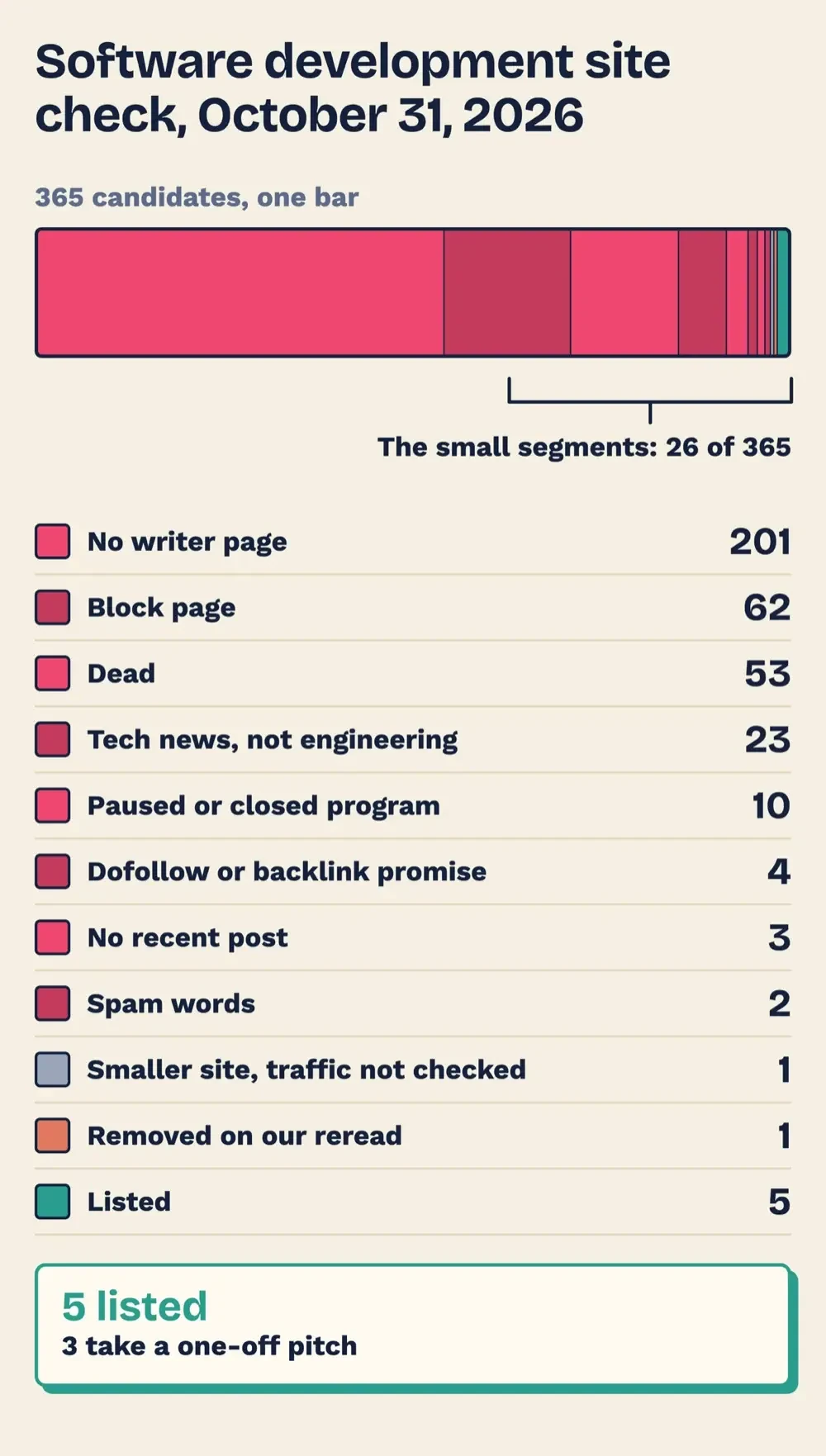 Diagram by DigitalTreed; counts from the site check we ran on October 31, 2026.
Who owns the code once it runs on someone else's site?
Before you pitch, decide what happens to the code in your post. The article text and the sample code can end up under different terms, but not one of the five contributor pages we listed mentions a license for code. The publications differ here. InfoQ's FAQ says "InfoQ Authors retain full copyright and grant InfoQ distribution rights". The stitcher.io page promises "Guest posts will always stay your property, not mine." DigitalOcean pays for tutorials, then relicenses them under Creative Commons, and its FAQ lets you republish "as long as you give credit (we prefer a canonical link)".
That license is CC BY-NC-SA 4.0, so the ShareAlike term carries into anything built on your tutorial. Read the contributor terms before you sign them, not after the post goes live.
Your own repo is the simpler part, because GitHub's licensing docs say that "without a license, the default copyright laws apply" there. Choosealicense.com adds that nobody else can then copy or modify the work without risk. Pick MIT and its license text says the notice "shall be included in all copies or substantial portions of the Software." The Apache License 2.0 goes further and says you "must retain, in the Source form of any Derivative Works", the original notices.
Borrowed code needs the same care. A recent Stack Overflow snippet is under CC BY-SA 4.0, and its ShareAlike term says "you must distribute your contributions under the same license as the original". We aren't lawyers. Take these as questions to ask rather than answers. A simple routine: put the sample in a repo with a LICENSE file, link it from the draft, and ask the editor in writing which license covers code in articles. Keep that email, because contributor pages get rewritten.
A dev pitch email and five topic ideas
Now for the email. The Stack Overflow blog asks for a suggested title, a paragraph on why the idea is interesting, and a little about you. Stack Abuse wants you to "submit 2-3 samples of your prior work" first, and InfoQ's process starts with an article proposal and says it reviews "within 5 - 7 working" days. None of them asks for a finished draft in the first message. Our sample is made up, and the braces are yours to fill. Keep the versions line and the disclosure line even when they feel fussy, since they answer the first two checks in this guide.
Subject: Pitch: Cutting {framework} cold starts from {X} s to {Y} s

Hi {editor first name},

Our {language} service on {platform} took {X} seconds to answer its
first request after a deploy. Three changes brought it to {Y}:
{change 1}, {change 2} and {change 3}.

The piece would walk through each change with the before and
after numbers, about {word count} words.
Tested on: {language} {version}, {framework} {version}, {OS}
Repo: {link to a public repo with a LICENSE file and a lockfile}

About me: {role}, {years} years on {stack}. Past writing: {link 1}, {link 2}
Disclosure: I work at {company}; the post names no product of ours.
AI use: {none, or what you used it for}

{your name}
No idea solid enough yet? Each of these five starts from something you can prove with a repo:
- An upgrade diary: one library or framework major version, every breaking change you hit, and the diff that fixed it.
- A postmortem of a bug that reached production, ending with the failing test that now guards against it.
- A benchmark with the test script in a repo, the hardware stated, and the run you threw out and why.
- A concept explained through a small runnable project, such as a rate limiter or a job queue, with tests.
- A tool comparison that names your employer if it makes one of the tools, and shows the setup steps for each.
Before you send, clone your repo into an empty folder and run it from the README alone. If that fails on your own machine, it'll fail on the editor's.
rel="sponsored" and FTC rules once a vendor pays
So far no money has changed hands. Once it does, Google's spam policies count "Exchanging money for links, or posts that contain links" as link spam. Its 2017 post on large-scale article campaigns warns against "Stuffing keyword-rich links to your site in your articles". A tutorial whose every link points at one product, each with a keyword anchor, fits that warning.
The fix is the link attribute, and Google's outbound link guide tells sites to "Mark links that are advertisements or paid placements" with sponsored. Its 2019 nofollow announcement says nofollow works too: "either is fine". Outside writers aren't the problem in themselves: Google's site reputation abuse update says "having third-party content alone is not a violation of the site reputation abuse policy".
The FTC's rules protect readers rather than rankings, and its Disclosures 101 guide says: "Disclose when you have any financial, employment, personal, or family relationship with a brand." A developer advocate writing about the employer's SDK is the plain case. For the label itself, the native advertising guide lists terms like "Sponsored Advertising Content" and warns against vaguer ones like "Promoted". Get an attorney to read any per-post deal; we aren't one.
Selling a sponsored post from your own dev blog? Payment risk sits with you, and our post on buyers who skip payment explains how to take a deposit and hold the draft until you're paid.
Questions dev writers ask
Frequently asked
Do software development sites pay writers?
Some do, through programs rather than guest posts. As of October 2026, DigitalOcean's program page says updates to old tutorials are "typically paid out at $100", though the program shows as paused. When the money flows the other way, toward the site, you're buying a placement.
Can I republish my guest post on my own blog?
It depends on the terms you agreed to. DigitalOcean's tutorials sit under the Attribution-NonCommercial-ShareAlike 4.0 license, and its FAQ says it prefers a canonical link when you repost, so ask the editor before you sign.
Can I paste a Stack Overflow answer into my article?
Only with credit and the license terms. Stack Overflow's licensing page puts posts from April 8, 2011 to May 1, 2018 under CC BY-SA 3.0. Older posts carry 2.5, so check the date on the answer.
Do I have to say I used AI?
On some sites, yes: InfoQ says "We reject primarily AI-generated work." Our own write for us page says "No fully AI-generated content" and wants AI-assisted drafts edited and fact-checked by a person.
How we made this guide: Every name and count above comes from our October 31, 2026 site-check run. That afternoon we saved fresh copies of each kept contributor page and the paid program pages, and checked every quote against them. The reread removed one site and added none. Nobody on our side pitched a site or logged in anywhere. Facts checked by the DigitalTreed team on October 31, 2026.
First published in October 2023 as DigitalTreed's own call for software development articles. Rewritten October 31, 2026 as a guide for developers pitching engineering publications.
Sources
- Google Search Central: Spam policies for Google web search
- Google Search Central: Qualify your outbound links to Google
- Google Search Central Blog: Evolving nofollow, new ways to identify the nature of links (September 10, 2019)
- Google Search Central Blog: A reminder about links in large-scale article campaigns (May 25, 2017)
- Google Search Central Blog: Updating our site reputation abuse policy (November 19, 2024)
- Google Search Central: Creating helpful, reliable, people-first content
- Google Search Central: site: search operator
- Google Search Help: Refine Google searches
- Google Legal Help: Report content on Google
- Tranco: A Research-Oriented Top Sites Ranking Hardened Against Manipulation
- Tranco: Methodology
- Internet Archive: Wayback CDX Server API
- Internet Archive Help Center: Using the Wayback Machine
- FTC: Disclosures 101 for Social Media Influencers
- FTC: FTC's Endorsement Guides: What People Are Asking
- FTC: Native Advertising: A Guide for Businesses
- Open Source Initiative: The MIT License
- Apache Software Foundation: Apache License, Version 2.0
- GitHub Docs: Licensing a repository
- choosealicense.com: No License
- Stack Overflow Help Center: What is the license for the content I post?
- Creative Commons: Attribution-ShareAlike 4.0 International deed
- Creative Commons: Attribution-NonCommercial-ShareAlike 4.0 International deed
- npm Docs: package-lock.json
- pip documentation: User Guide
Comments
No comments yet. Start the conversation below.