
Quick answer
As of October 31, 2026, 7 of the 204 SaaS blogs we checked passed, and 6 of them take pitches from new writers. If you work for a SaaS vendor, FTC guidance says to disclose that tie where you mention your product. Start with the 2-minute check below, then pitch a product story with numbers.
You searched "write for us SaaS" because you want a byline on a site that software buyers read. Maybe you run content at a SaaS startup, or a client sells one. A SaaS write-for-us page is the page where a software company or SaaS publication tells outside writers what it will publish, and on what terms. This page used to be our own pitch page, and now it's a guide built around a list we checked by script and then read by hand.
First up is what SaaS editors want, then whether a vendor blog or an independent publication fits you better. After that come search strings, a 2-minute vetting check, the SaaS footprints that end it, and the verified list with an honest count. The pitch email, the FTC disclosure rules for vendor staff, and where DigitalTreed fits close it out. Our view: you'll do better with three careful pitches built on your own numbers than with thirty templates.
Key takeaways
- SaaS editors want a product story with numbers and a named source.
- Every SaaS blog that passed our check was a vendor blog.
- FTC guidance says vendor staff should disclose their employer tie.
- A blog of only integration partner posts is a cross-linking footprint.
- Most SaaS candidates failed because we found no contributor page.
Note
Want to write for DigitalTreed? SaaS teams are one of the four reader groups our write for us page names, next to bloggers, agencies and startup founders. A SaaS piece fits us when it teaches growth work: SEO, AI tools, affiliate marketing, WordPress or blogging. Pitch the idea first, not a finished draft, on our write for us page. Sponsored posts carry "One relevant contextual link to your website or brand", and new clients pay "50% upfront and the remaining 50% after the post is published". Niche prices sit in our media kit.
SaaS editors want product proof with numbers they can check
SaaS editors want a story from inside a product team, backed by numbers they can trace to a tool, a date range and the person who ran the test. Google's helpful content guide asks whether a page offers "original information, reporting, research, or analysis", and SaaS readers ask the same. Kayako's page, for one, turns away "basic ground and tired tropes" such as how to talk to angry customers. What an editor hasn't seen is how your team moved activation in one quarter, and what didn't work.
We read the contributor pages of every SaaS site in our list, and the asks line up with that. Kayako wants "stories and narratives that are distilled into lessons", and says "Every statistic, data point, or quote must include a proper link back to its original source." Help Scout asks for "original thought leadership content" and says it's "not seeking SEO-driven pieces" such as best-tools lists. Tagembed asks writers to flag "any company in which you have a vested interest" before it publishes. Brevo's editors say they want "actionable, high-value content" for customers scaling their digital marketing.
Not every page pulls the same way, so read each one for its bias. CoSchedule asks guest authors to be "open to writing content targeting keywords for which we want to rank", which is close to the SEO piece Help Scout turns down. Match the pitch to the page, not to a template you send everywhere.
That gives you four rules for a SaaS pitch. First, lead with a product-led example: a feature you shipped, an onboarding step you cut, a pricing test you ran. Second, give every metric its source and window, such as "trial-to-paid, product analytics export, March 1 to April 30", so the editor can see it's real. Third, keep your own product out of the body unless the reader needs it. Editors spot a thinly veiled vendor pitch fast. Kayako's page allows one link back in the body, and Wishpond's caps you at two, not counting the bio. Fourth, say up front if you work for a competitor of the blog, or for any tool you mention. Most pitches skip that one.
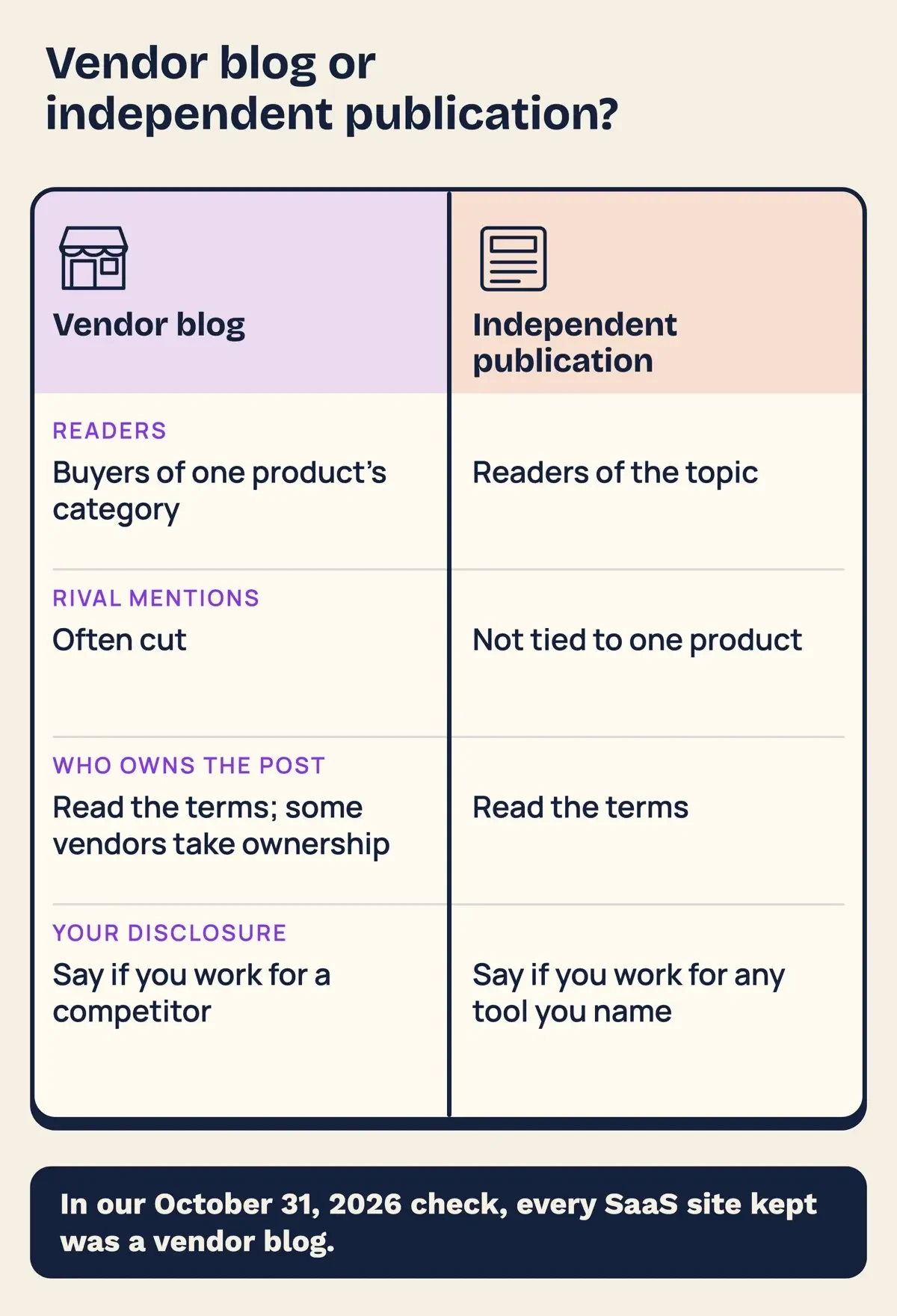 Diagram by DigitalTreed, drawn from the SaaS contributor pages we read on October 31, 2026.
Vendor blog or independent publication?
That last rule matters more in SaaS than anywhere else, because most SaaS blogs that take guest posts are run by a vendor. A vendor blog is a software company's own content site, built to bring in buyers, while an independent publication earns its money from readers or ads, not one product. Which one suits you depends on who you want reading and how much control you want over the post.
A vendor blog can be a good home for your post, since its readers are often the exact buyers you want and its editors know the space. Some add a mailing list on top; Userlist says its list has been "nurtured with good content since 2017", so a post there can reach readers twice. The catch is that you're writing on someone else's sales channel. Tagembed's page says that once a post is approved, the site becomes "the owner of that content" and may edit it. A vendor editor will also cut any line that sends readers to a rival, and that may include your own product. Read the rights section first.
An independent SaaS publication gives you more distance from any one product. It's also harder to get into, and in our run none of them made the list. Google's 2017 note on large-scale article campaigns says Google doesn't discourage guest articles "in the cases when they inform users". The same post gives hosts a test you can borrow as a writer: "Does this person's message fit with my site's audience?" If you can't answer yes for a vendor's readers, pick another blog.
Search strings for SaaS contributor pages
Once you know which kind of blog you're after, the search gets easier, and Google's Refine searches help page covers the few operators you'll need. Quotes match a phrase, a minus sign drops a word, site: stays on one domain and after: keeps newer pages. The trick in SaaS is to search with the words a product team uses, not the word "SaaS", which spam pages stuff into every title. Think churn, onboarding, activation.
Find SaaS contributor pages
"write for us" "customer success"
"guest post" "product-led" -casino -crypto
"contribute" onboarding churn
"become a contributor" "B2B SaaS"
"guest author" "product marketing" after:2026/01/01

Vet one SaaS domain (replace example.com)
site:example.com "link insertion"
site:example.com "integration partner"
site:example.com alternatives
site:example.com casino
"example.com" "guest post" price
The second block vets a single domain, and Google's site: operator page warns that "The list of URLs returned is not always exhaustive." Treat a blank as unknown. It only tells you Google showed nothing for that query today, which isn't the same as a clean site. Old lists also send you to contributor pages that died years ago, so run each old URL through the status code checker on our site. A 200 is fine, but a 404 or a redirect to the homepage usually means the page is gone.
How do you vet a SaaS blog in 2 minutes?
With a shortlist in hand, run each blog through five signals before you write anything. Our guide to vetting guest post sites in any niche has the full checklist, from domain history to payment terms. The table below is the short SaaS version, and the last row is one you check by eye.
| Signal | Green | Yellow | Red |
| Contributor page | Open to pitches, names SaaS topics | Invite-only, or a form with no topic list | Gone, a price list or a dofollow promise |
| Tranco rank | Top 100,000 | 100,001 to 1,000,000 | Not in the top million |
| Yearly homepage titles | Same product every year | Parked years or one change of owner | 3+ topic changes or casino titles |
| Spam words in sitemap or homepage | None outside SaaS | 1 or 2 hits | 3 or more hits |
| Recent posts | Named practitioners, real numbers | Mostly "alternatives" lists | Only partner posts or link offers |
A red on any row ends it for a cold pitch, and two yellows mean you read five recent posts, with their authors and links, before you write a word.
For rank we lean on the Tranco list, which bills itself as "Hardened Against Manipulation"; its methodology page averages ranks "over the past 30 days". A rank isn't a visitor count, though. Here's how three of our kept SaaS sites score, using only what the run recorded and our same-day read of their pages:
- Brevo: page open to pitches (green), Tranco rank 3,116 (green). First archived 2001 (green), placeholder "Domain Default page" titles in 2015 and 2020 (yellow), 1 spam-word hit (casino) in its sitemap or homepage (yellow).
- Userlist: page invite only (red for a cold pitch), Tranco rank 261,962 (yellow). First archived 2003 (green), a 2010 newsgroups title shows an earlier owner (yellow), no spam words (green).
- Help Scout: page open to pitches (green), Tranco rank 21,021 (green). First archived 2004 (green), placeholder "Network Solutions" title in 2004 (yellow), no spam words (green).
Of the 7 kept sites, 3 carry at least one yellow, which is why the run kept them and why you still open a few recent posts. A placeholder year or an earlier owner isn't a drop reason alone, but it's a reason to check that the blog you pitch is the one Google sees today.
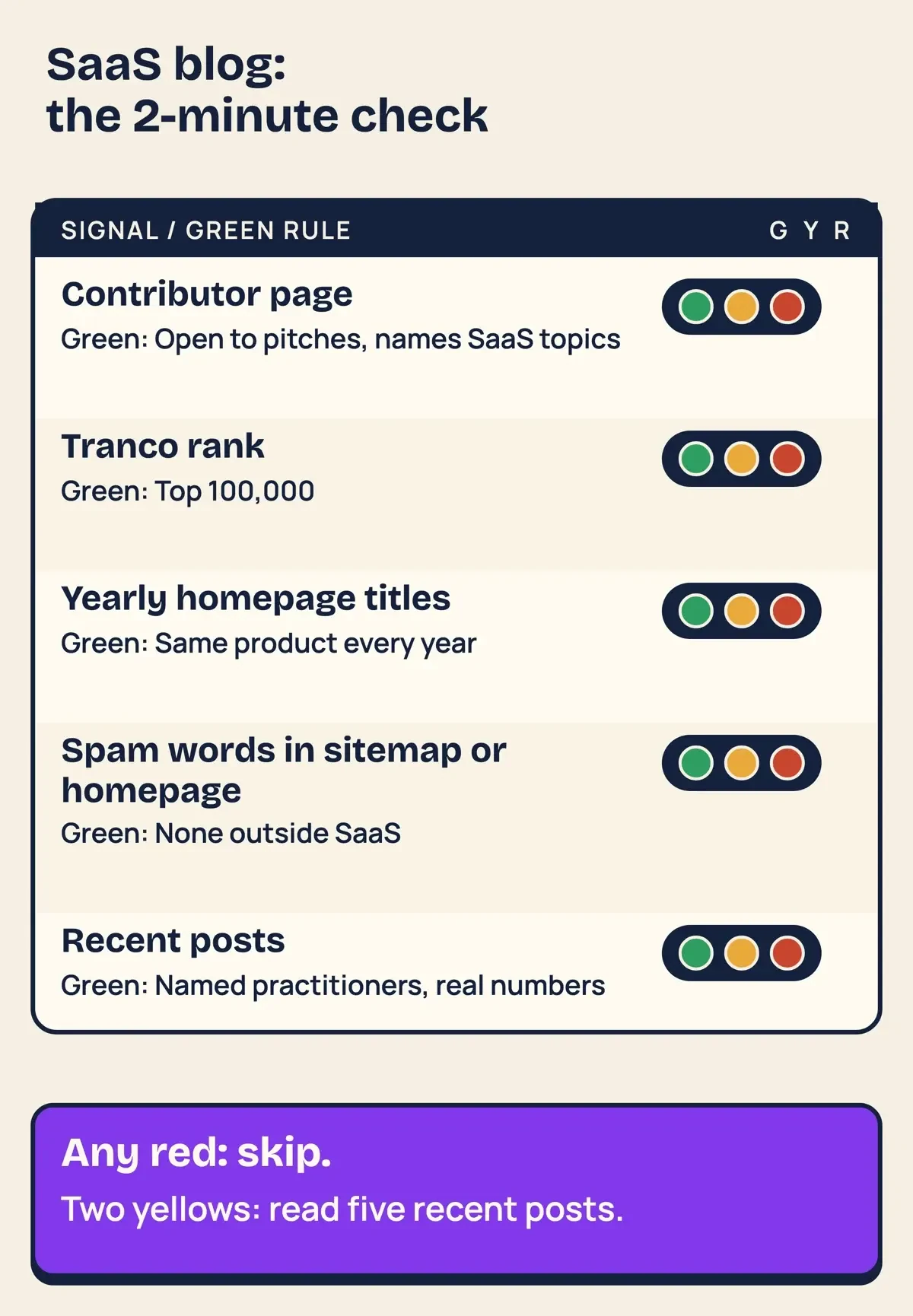 Diagram by DigitalTreed: the five SaaS signals and their cut-offs, as used in the run of October 31, 2026.
SaaS footprints that end the check early
Some SaaS blogs fail the last row so clearly that you can stop there. Three patterns come up again and again in this niche. They're easy to spot, and each maps to a line in Google's spam policies.
The first is a vendor blog that only runs posts from its integration partners. Every post praises a connector and links back to the partner. Google's link spam list includes "partner pages exclusively for the sake of cross-linking", and a whole blog built that way earns the same doubt. Open the author pages. If the last ten posts were all written by partner staff, your independent post won't fit. The links there won't carry much weight either, since the whole blog reads as a swap. A vendor blog with a few partner posts mixed into its own staff articles is normal; it's the all-partner blog you skip.
The same policy line starts with "Excessive link exchanges". Wishpond's page, one of the seven in our list, names "link exchanges" among the deals its outreach lead arranges. That isn't a drop reason on its own, but don't let a guest post turn into a swap.
The second is a "link insertion" menu. That's a page offering to add your link to an old article for a fee, often next to a price for "lifetime" placement. Don't pitch a blog that has one. Google's list starts with "Exchanging money for links, or posts that contain links". It also names a SaaS favorite: "Sending someone a product in exchange for them writing about it and including a link".
So a free annual license, offered in return for a linked mention, counts as the product.
The third is the review-site farm. Picture hundreds of "best X alternatives" and "X vs Y" pages with one layout and a new brand swapped in each time. That's what Google calls scaled content abuse. Its policy describes pages generated "for the primary purpose of manipulating search rankings". One honest comparison post is fine. A site of nothing else is a farm, and a vendor score won't tell you so; Google says third-party scores "don’t correspond to any of Google’s own signals".
Expired SaaS domains are a smaller trap. When a startup shuts down or rebrands, someone can buy its domain and fill it with paid posts that borrow the old name and the old backlinks.
You won't always see it from the homepage, so lean on the yearly-titles row of the scorecard. Our redirect checker shows each hop if an old product URL now lands on a casino or coupon page.
Verified SaaS guest post sites, and why the list is short
Every site below passed those checks on October 31, 2026, and then a same-day reread of its page; that's all the Vetted stamp on this guide claims. We aimed for 15 to 25 SaaS sites. Only seven of 204 candidates passed, and we'd rather show seven than pad the table. The main reason is plain: 127 of the 204 had no contributor page we could find on the homepage or the usual paths.
The script kept nine, and our same-day reread of every listed page took two back out. UserGuiding promises "backlinks for your social profiles and your website" to contributors, and we don't keep pages that promise links. Benchmark Email has a page titled for guest contributors, but it's an advice article about pitching other sites, not a call for writers.
One more catch: Userlist's page says its program is invite-only, so it passed the checks but won't take a cold pitch. That leaves six open doors: Brevo, Help Scout, CoSchedule, Wishpond, Kayako and Tagembed.
| Site | Contributor page (nofollow) | What the page says (our read) | Tranco rank | First archived | Checked |
| Brevo | Contributor page | Open: share a writer profile through its form | #3,116 | 2001 | 10/31/2026 |
| Help Scout | The Help Scout Contributor Network | Open by application; pays per article; no SEO listicles | #21,021 | 2004 | 10/31/2026 |
| CoSchedule | Contributor page | Open by request form; how-to posts only; replies only if it accepts | #27,564 | 2013 | 10/31/2026 |
| Wishpond | Wishpond Guest Blogging Guidelines | Open by form; two links at most; also offers link exchanges | #29,703 | 2004 | 10/31/2026 |
| Kayako | Contributor page | Open by email; one body link; wants contributors from Ahrefs DR 70+ sites | #40,376 | 2001 | 10/31/2026 |
| Tagembed | Write For Us | Open by email; 2,500+ words; it owns the post | #55,221 | 2020 | 10/31/2026 |
| Userlist | Guest Posts on the Userlist Blog | Invite only; it says it takes no pitches | #261,962 | 2003 | 10/31/2026 |
We kept site names unlinked. Each row links once, with nofollow, to the site's own contributor page, and the notes column is our same-day reading of it.
Pages change fast. Reread the contributor page before you pitch, and we'd check the date on the newest post too, since a page can outlive its blog.
If your idea is a technical tutorial rather than a SaaS growth story, our technology blogs write for us guide shares no site with this one. B2B marketing blogs have their own B2B marketing write for us guide, and for many niches in one table there's our checked list of guest posting sites.
The run itself was simple and polite. Our script sent ordinary GET requests under a user agent that names DigitalTreed, waited at least 1.5 seconds between hits on one host and followed robots.txt. A 403, a 429 or a bot check meant we marked the site unchecked and moved on, since working around a block breaks our own rules. For traffic we used the Tranco top million (list PYK6J of October 29, 2026); we don't have Ahrefs, Semrush or Similarweb. For history we pulled one Wayback capture a year through the CDX API and kept up to five homepage titles. The Wayback help page shows how you can browse those captures yourself.
Smaller SaaS sites that showed traffic on November 2
Three SaaS publications missed the Tranco top million but passed every other check. A traffic lookup in Ahrefs' free traffic checker on November 2, 2026 found organic visits for each, and a reread that day confirmed their pages still invite outside writers.
| Site | Guidelines (nofollow) | What the page asks (our read) | Ahrefs organic estimate (monthly) | Top country (share) | Checked |
| SaaS Mag | Contribute to SaaS Mag | Contributor form; new work preferred, reposts only from your own blog | 516 | US (91%) | 11/2/2026 |
| Customer Success Collective | Create and contribute | Pitch the subject first; 1,200+ words; no AI-written text or product promotion | 3,800 | US (73%) | 11/2/2026 |
| DataDab | Write for DataDab | Practitioner-led B2B SaaS marketing; promises no anchor text or followed links | 1,000 | US (54%) | 11/2/2026 |
DataDab's estimate rose fast after August, and its biggest keyword has nothing to do with marketing. Customer Success Collective and SaaS Mag look steadier, with most visits from the US.
What we tested
We checked 204 SaaS candidates on October 31, 2026, kept 7 and dropped 197. The largest group, 127 sites, had no contributor page we could find on the homepage or the usual paths. Another 25 didn't load or returned a server error. A further 16 answered our checker with a 403, a 429 or a bot check, so we left them out. A further 16 were missing from the Tranco top million. The last 11 went out for dofollow promises (5), spam words (3), links for sale (2) and any-topic farms (1). Our same-day reread of every listed page removed two more, UserGuiding and Benchmark Email, for the reasons we've given above the table.
Of the 7 kept sites, 6 sit in the Tranco top 100,000. Userlist is the exception. Every one of them is a software company's own blog, not an independent SaaS magazine, which is why the vendor question above matters.
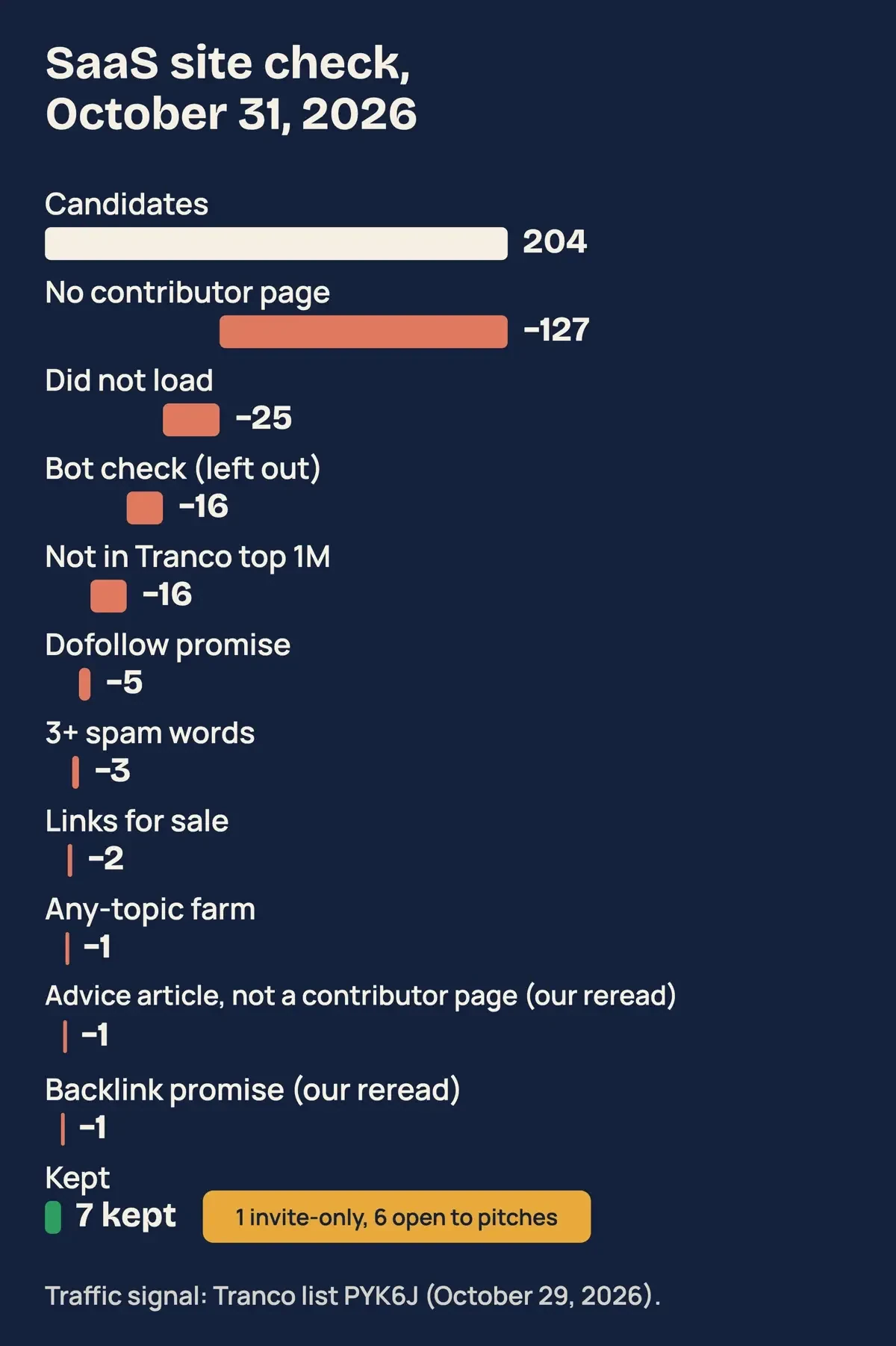 Diagram by DigitalTreed: SaaS candidates and drop reasons, computed from the batch site-check files of October 31, 2026.
A SaaS pitch email and five topic ideas
Once a blog passes, write the pitch before the post. CoSchedule says it answers only the pitches it accepts, so a long pitch that buries the idea simply goes unanswered. Open with the reader's problem and your data. Aim for under 200 words. Name the metric and its window, and put any vendor tie in the email, not just in your signature.
The subject line, the company and the numbers in this sample are made up; swap in your own.
Subject: Pitch: the day-3 email that lifted our trial activation (with the event data)

Hi {editor first name},

Your post on {article title} covered welcome emails, but not what
happens when a trial user goes quiet on day 3.

Idea: how we rewrote one day-3 email and what it did to activation,
measured as {event} within 7 days, {date range}, from {analytics tool}.

Outline:
1. How we picked day 3 from the drop-off chart
2. The old and new email, side by side
3. The numbers, and the segment where it did nothing

Disclosure: I work at {company}, which sells {category} software.
The post names no vendor, ours included, unless you want it to.

Samples: {link 1}, {link 2}
{your name}
The sample has no anchor text, no price and no "I love your blog", and the disclosure sits in the body where an editor can't miss it.
No story like that yet? These five SaaS topics tend to get a second read when the numbers come from your own tools:
- A pricing page change you shipped, with conversion before and after and how long it ran.
- What your last round of cancellation calls taught you, grouped by reason.
- An onboarding step you removed, and the effect on time to first value.
- Moving from one billing or analytics tool to another: what broke and what you rebuilt.
- Help articles that cut a support ticket type, counted from your help desk.
All five come from exports you already have: billing, the help desk or product analytics. None of them needs a survey or a new tool.
For more angles, our post on B2B SaaS growth strategies lists the levers SaaS teams pull most.
FTC disclosure when you work for a SaaS vendor
The disclosure line in that pitch comes from FTC guidance. If you work for a SaaS company and your guest post mentions its product, FTC guidance treats that mention as an endorsement from someone with a material connection. In its Disclosures 101 guide, the FTC says a material connection "includes a personal, family, or employment relationship or a financial relationship".
The employee case gets a direct answer in the FTC's Q&A on its Endorsement Guides: "Listing your employer on your profile page isn't enough." By the same logic, we wouldn't count on an author bio at the foot of a guest post.
So disclose it in the post itself. A short line where the product comes up does the job, such as "I work at the company that makes this tool."
Competitors are covered too. The Q&A says that if you criticize a competitor of a brand that pays you, "you should disclose your paid relationship". A vendor marketer who writes "Tool B is clunky" on a third-party blog needs the same disclosure. This is our reading of FTC guidance, not legal advice; ask a lawyer about your own case.
Google's rules sit on top. A paid placement gets rel="sponsored", and Google's outbound link page accepts nofollow "though sponsored is preferred". Hosts face the site reputation abuse policy too, though Google says "having third-party content alone is not a violation". Our guide to sponsored blog posts shows where the label goes, and the FTC's native advertising guide lists "Sponsored Advertising Content" among labels readers understand.
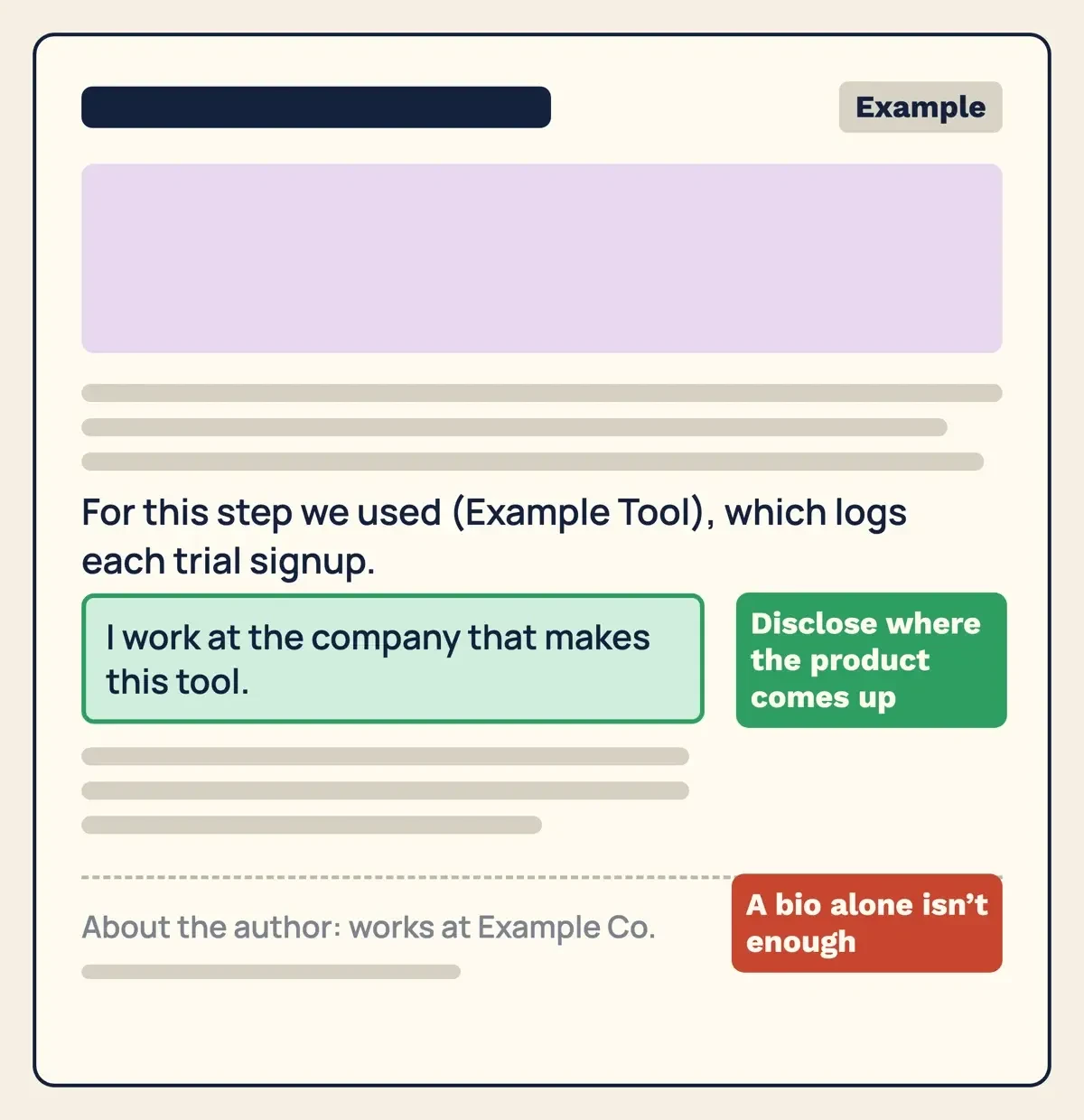 Drawn by us: an example disclosure placement with made-up text, based on FTC guidance read October 31, 2026.
Where DigitalTreed fits for SaaS writers
We take guest posts ourselves, so read this part knowing we've got a stake in it.
DigitalTreed publishes on SEO, AI tools, blogging, WordPress, affiliate marketing and online growth, and SaaS teams are among our readers. Business is on that list too. Every post goes through editorial review, we don't take fully AI-generated drafts, and finance, crypto and legal angles get extra review. Our page says we reply within one working day with the price and any changes needed, and that most posts go live within 24 to 48 hours of approval. If a SaaS growth story fits, send the pitch through our write for us page.
Selling posts on your own blog? Read our seller-side guide to paid guest post scammers before any link goes live unpaid. If your angle is general business rather than software, try the business blog write-for-us sites we checked.
Whichever blog you pick, we'd pitch the three your buyers already read before you work through any long list, ours included.
SaaS guest posting questions
Frequently asked
Do SaaS blogs pay for guest posts?
One in our list does: Help Scout says it "pays per article and rates will be negotiated during the pitch process". The other six pages don't mention paying writers. Userlist offers a bio and a link instead: "we'll include your bio and a link to your website".
Who owns a SaaS guest post after it goes live?
It depends on the page, so read it before you send. Tagembed says that once approved, you "cannot publish the same content anywhere else". Userlist says a declined piece is yours to "publish your piece anywhere else".
Must I tell readers how much a SaaS company paid me?
Usually not the amount. The FTC's Q&A says a paid reviewer can simply say they were "paid", but adds: "That wouldn't be good enough, however, if you're an employee or co-owner."
Can I use keyword anchor text in a SaaS guest post?
Avoid it. Google's spam policies list "links with optimized anchor text in articles, guest posts, or press releases" as link spam. Use your name or your company's name.
How we made this guide: Two sets of scripts did the reading. The site-check run produced the table and its counts, and our fetch scripts saved a copy of each source and contributor page on October 31, 2026. We then read every kept contributor page ourselves, which wrote the notes column. That lets every quote above be matched to the saved text. Nobody signed in, filled a form or emailed an editor for this guide. Facts checked by the DigitalTreed team on October 31, 2026.
First published as our own SaaS pitch page, with a long explainer on what SaaS is. Rewritten October 31, 2026 for SaaS writers: search strings, a scorecard, SaaS footprints, the site list, FTC rules for vendor staff and a sample pitch.
Sources
- Google Search Central: Spam policies for Google web search
- Google Search Central: Qualify your outbound links to Google
- Google Search Central Blog: A reminder about links in large-scale article campaigns (May 25, 2017)
- Google Search Central Blog: March 2024 core update and new spam policies (March 5, 2024)
- Google Search Central Blog: Updating our site reputation abuse policy (November 19, 2024)
- Google Search Central: Creating helpful, reliable, people-first content
- Google Search Central: site: search operator
- Google Search Help: Refine Google searches
- Tranco: A Research-Oriented Top Sites Ranking Hardened Against Manipulation
- Tranco: Methodology
- Internet Archive: Wayback CDX Server API
- Internet Archive Help Center: Using the Wayback Machine
- FTC: FTC's Endorsement Guides: What People Are Asking
- FTC: Disclosures 101 for Social Media Influencers
- FTC: Native Advertising: A Guide for Businesses
Comments
No comments yet. Start the conversation below.