

Quick answer
Yes, within limits. As of November 2026, TikTok's US ad policy may let licensed crypto advertisers show ads to viewers 18 and older, and it bans ICO and crypto ATM ads. If a token issuer pays you and the token is a security, US law also wants the amount you got disclosed. Run our eight-rule draft check before you post.
Say a token project DMs your TikTok account with a made-up example offer: $1,500 for one 30-second video. This post once covered TikTok crypto (TikViral) as a trend. Now it's about what TikTok, the FTC and the SEC let you do with an offer like that. A TikTok crypto promotion is a paid ad or creator post that pushes a coin, token, exchange or wallet. This page isn't legal, tax or investment advice, so talk to a licensed attorney before you sign a paid crypto deal.
Two TikTok pages decide whether that deal can run at all: the Financial Services ad policy for brands and the Branded Content Policy for creators. The FTC sets what the video must say about the example $1,500, and the SEC adds a rule on the amount when the token is a security.
Key takeaways
- A caption-only #ad failed our check, so put the disclosure inside the video.
- TikTok's US ad policy bans ICO and crypto ATM ads outright.
- Paid financial posts on TikTok need a brand invite through TikTok One.
- If the token is a security, say how much you were paid.
- The FTC says only scammers will guarantee profits or big returns.
What TikViral was, and what we could check
This post first ran in September 2022 under the TikViral name, and back then it told readers to buy TikTok shares so their videos would grow faster. We couldn't confirm what TikViral sells today. An RDAP lookup on November 11, 2026 shows tikviral.com was registered on April 8, 2020 through GoDaddy, and the site answered our plain request with a 403 error. So we don't describe any of its services. The old post's claims of a past TikTok crypto ban and of TikTok NFT releases are gone too, since no page we read backs them.
We cut the buy-shares tip because buying fake engagement to win business can now break a federal rule. The FTC's rule at 16 CFR 465.8 bars buying "fake indicators of social media influence" that you "knew or should have known to be fake". It covers numbers that make you look more influential to win business. The FTC's August 14, 2024 announcement of the rule gives followers or views made by a bot or a hijacked account as examples. The rule lets the agency ask for civil penalties from people who break it knowingly, the announcement adds.
Can crypto brands run TikTok ads in the US?
TikTok's Financial Services ad policy, last updated September 2026, puts the US in one block with Canada. As of November 2026, that block may allow financial ads if four things are true. The advertiser follows relevant laws and meets disclosure requirements, it's licensed by local and regional authorities, and the ad only reaches viewers 18 and older.
TikTok says evidence of the right regulator and third-party accreditations or certifications may be required, so an unlicensed token project doesn't have a way in.
| May be allowed, if the conditions are met | Not allowed |
|---|---|
| Cryptocurrencies and cryptocurrency mining devices | Initial coin offerings (ICOs) |
| Exchange, management or investment of funds, such as fiat or virtual | Cryptocurrency ATMs |
| Virtual currencies | Get-rich-quick schemes and pyramid schemes |
| Non-fungible tokens (NFTs), not shown as an investment | Complex speculative investments, such as binary options and penny stocks |
| Loans | Single securities, precious metals trading and penny auctions |
So a licensed exchange may advertise to US adults. A token sale pitched as an ICO can't run as a US ad, even with a license.
NFTs sit in the allowed column with one condition: "Do not imply that NFTs are a form of investment". Rules are tighter in many other markets listed on that page, where exchange ads need a TikTok Sales Representative's sign-off through an application. If you're running the campaign as well as filming it, our list of common TikTok ads mistakes covers setup errors that aren't about crypto.
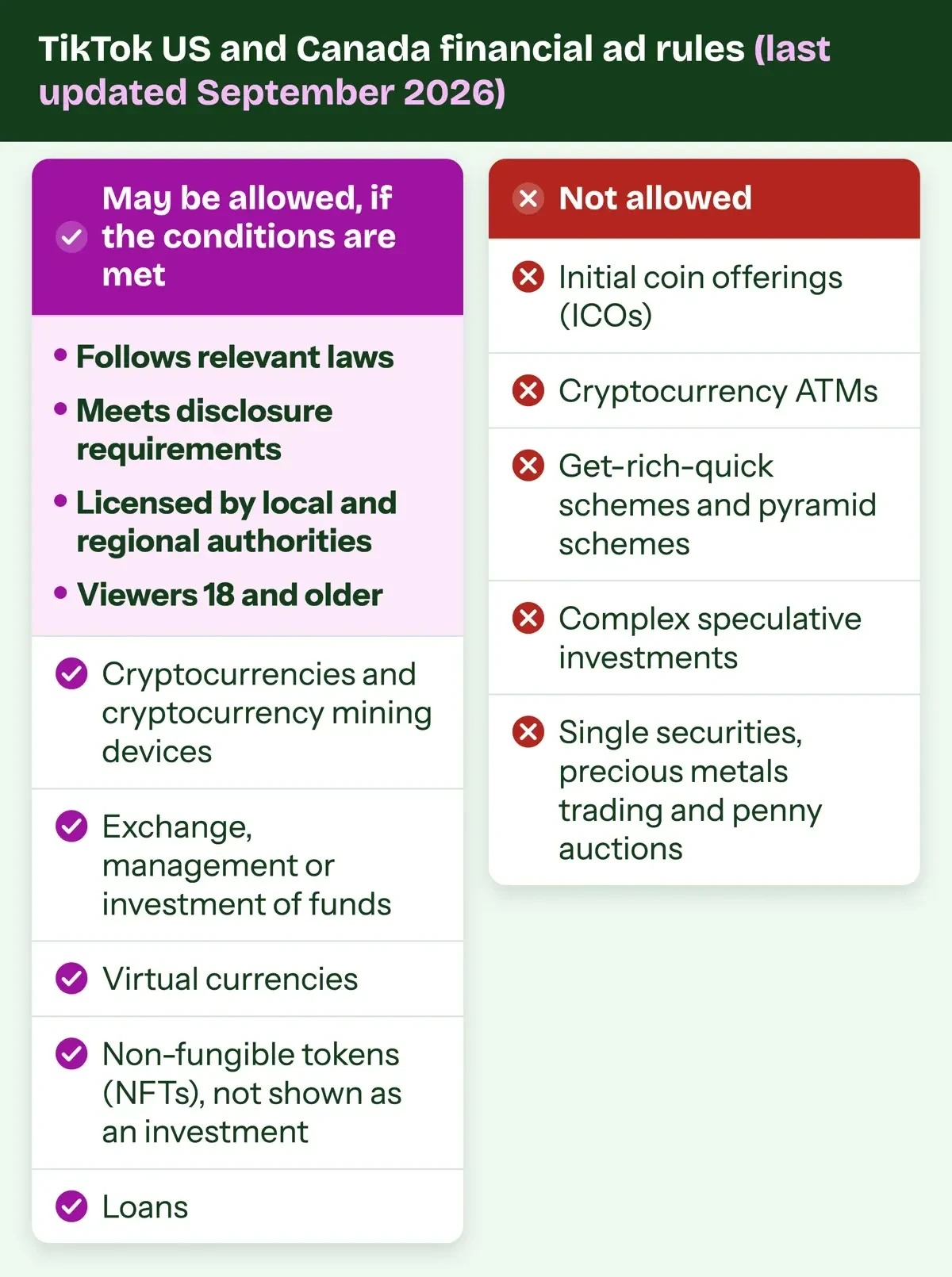 Diagram by DigitalTreed: TikTok US and Canada financial ad rules for crypto, from the policy last updated September 2026.
TikTok's branded content rules for paid crypto posts
A creator's own paid post isn't an ad. It falls under the TikTok Branded Content Policy, which took effect October 30, 2026. It covers posts that promote a brand "in exchange for payment or any other incentive", and gifts, affiliate links, promotional codes and ambassador deals all count. Once a post counts, the policy says "you must enable the commercial content disclosure toggle" when you post.
TikTok then labels the video as branded content. Where a law requires it, the post may also go into TikTok's Commercial content library.
Financial services are on the restricted list. The policy names loans, credit cards, insurance, investment services and "lending and management of money assets". You can post branded content for them only if an approved brand invites you, and that brand needs TikTok's explicit permission and a verified Business Account. It can only work with creators through the TikTok One platform. In the US, those posts reach only viewers 18 and older, and only in the market where they went up. The policy also bans branded content for pyramid schemes, too-good-to-be-true financial offers and get-rich-quick schemes everywhere. Yet the page never uses the words crypto, token or NFT.
For what's allowed in each region, that page points to the financial services ad policy, so a crypto deal follows the US ad rules in the two columns above.
If a project pitches you by DM with no TikTok One invite, ask for one first. Our guide to ways to make money on TikTok covers the paid routes TikTok runs itself.
How the FTC wants a paid TikTok disclosed
That toggle doesn't settle US law. An FTC staff FAQ on endorsements takes up TikTok's text descriptions by name. It says a disclosure placed only in the text description "is thus very unlikely to be clear and conspicuous", since the print's small and it competes with the video. The rule behind that answer is 16 CFR 255.5. Any brand tie that might change how much people trust your post has to be disclosed if viewers wouldn't expect it. In the rule's words, it "must be disclosed clearly and conspicuously", and that covers cash as well as free products.
The FTC's influencer guide, Disclosures 101 for Social Media Influencers, turns that into steps. Put the disclosure in the video, not just the description. Say it out loud and show it on screen as well, since some people watch with the sound off and others miss words laid over the picture. Words such as ad, advertisement and sponsored work. Sp, spon and collab don't. In a live stream, repeat it now and then for people who join late. Pay in tokens counts too, since the guide says to disclose "if you got anything of value to mention a product". It warns against mixing the disclosure into a pile of hashtags.
The FAQ puts the duty on the influencer and the brand, not the platform, so add your own words even when TikTok's toggle is already switched on.
A line saying you use the product falls under 16 CFR 255.1. An ad that says you use a product needs you to have been "a bona fide user of it at the time the endorsement was given". If you've never opened the app or held the token, cut that line. Our guides to sponsored posts and FTC disclosure and to honest affiliate review videos apply the same rules to blogs and longer videos.
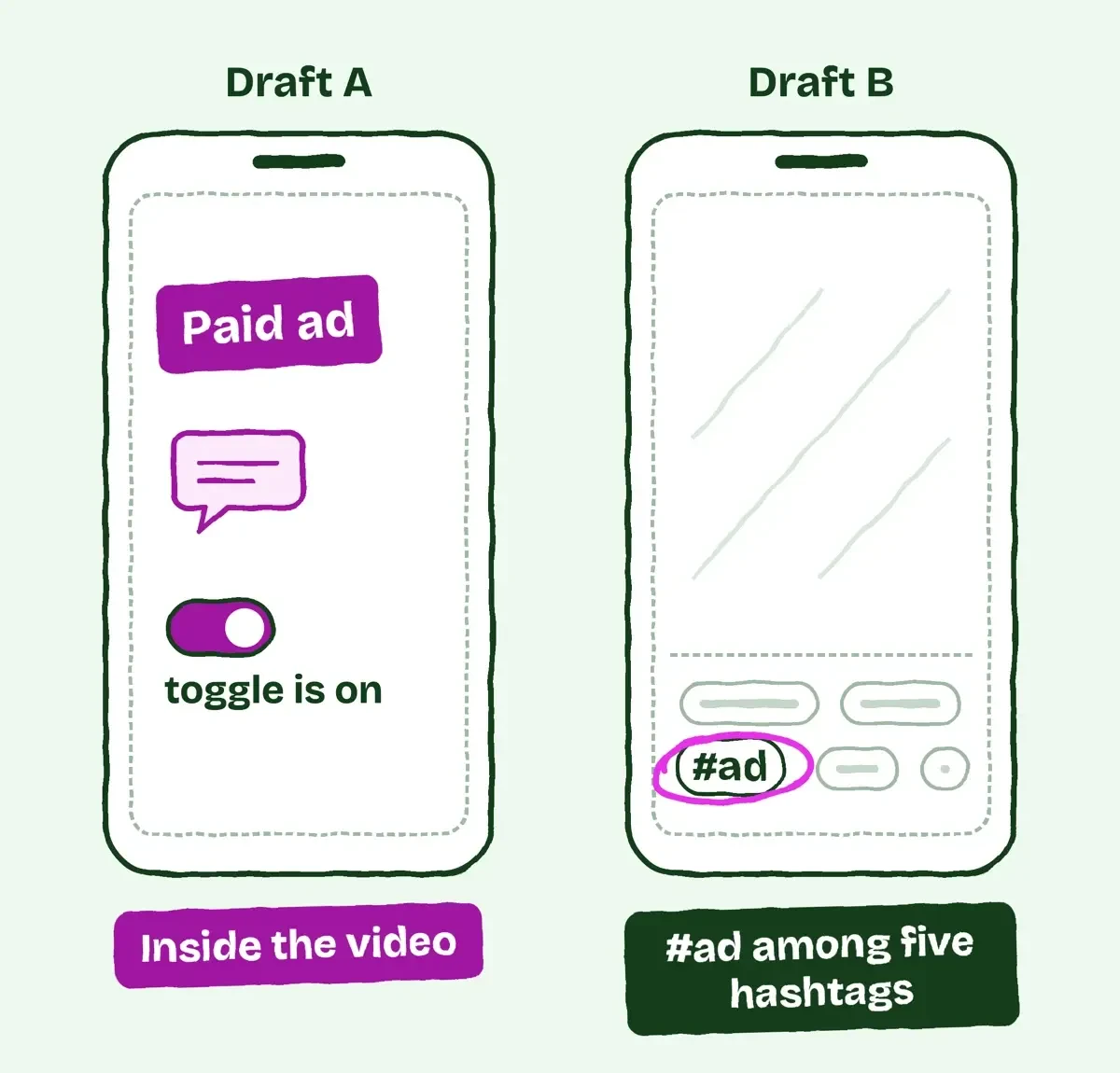 Drawn by us: where a disclosure sits on a TikTok video, from the FTC endorsements FAQ and Disclosures 101.
When the SEC's anti-touting rule applies
Securities law adds a second duty when the token is a security. Section 17(b) of the Securities Act, 15 U.S.C. 77q, covers anyone an issuer, underwriter or dealer pays to describe a security, even in a post with no sales offer. It's unlawful to do that "without fully disclosing the receipt" of the pay "and the amount thereof".
The SEC warned promoters about this in a November 1, 2017 statement. Anyone promoting a token that's a security "must disclose the nature, scope, and amount of compensation received", it said. On October 3, 2022, the SEC charged Kim Kardashian over an Instagram post about a crypto asset security. She'd been paid $250,000 to publish it. Without admitting or denying the findings, she agreed to pay $1.26 million and not to promote crypto asset securities for three years. About $260,000 of that repaid her fee.
The set of tokens that are securities has narrowed. SEC staff said in a February 27, 2025 statement on meme coins that the ones it described aren't securities. That's a staff view. Fraud around them can still be pursued by other federal or state agencies, it adds. On March 17, 2026, the SEC issued an interpretation that the CFTC joined, and its chairman said "most crypto assets are not themselves securities". So you often can't tell whether 17(b) applies, and the project may not say. On-screen words naming who paid you and how much state the receipt and the amount 17(b) names. Our crypto marketing guide for founders covers more SEC cases and the 2026 changes.
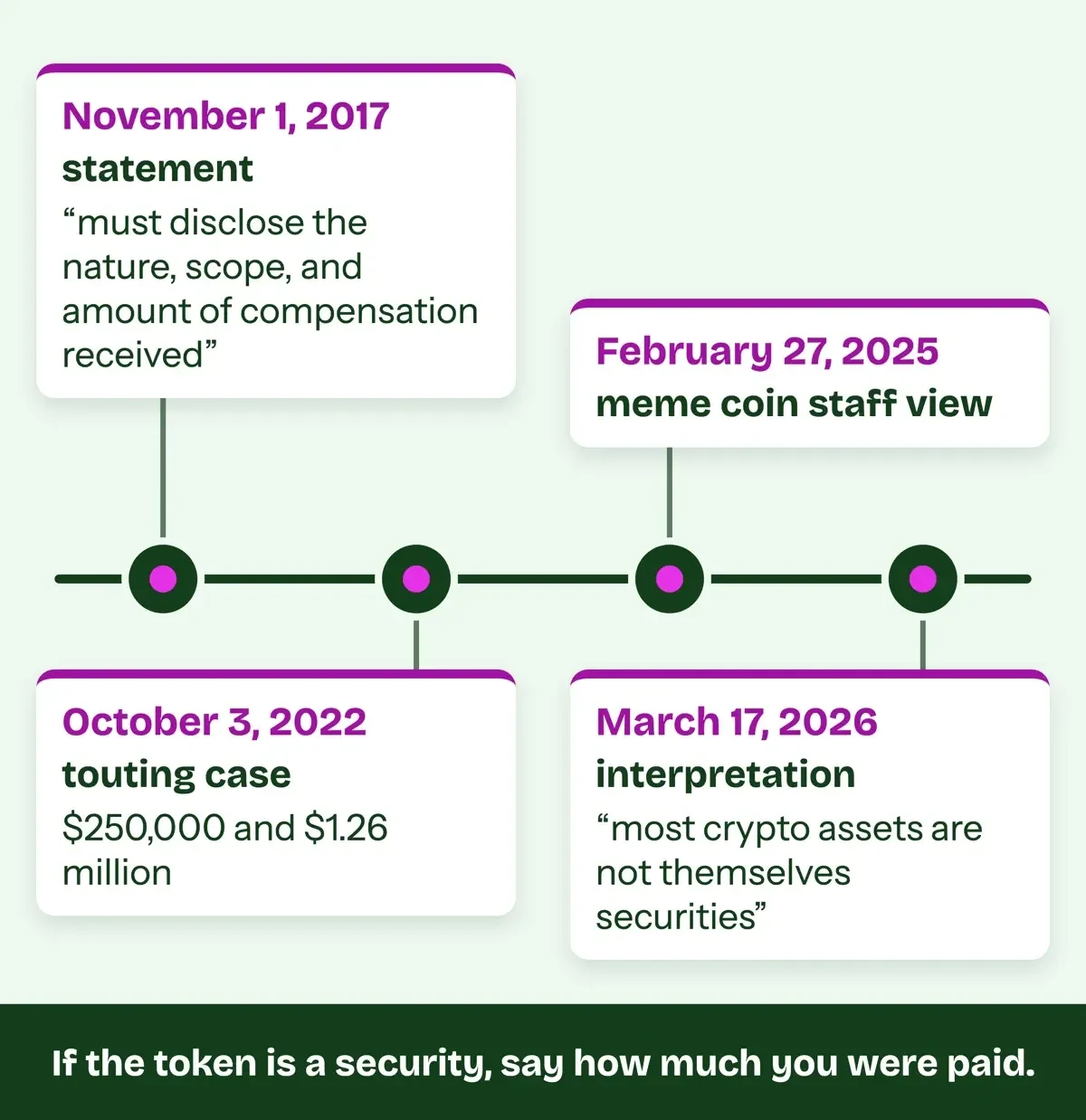 Diagram by DigitalTreed: SEC steps on paid crypto promotion, 2017 to 2026, from SEC releases and statements.
Red flags regulators name in crypto promotions
Whether or not the token is a security, the FTC's page on cryptocurrency scams says "Only scammers will guarantee profits or big returns". A promise of profit is a scam even with a celebrity endorsement or happy investor stories, it adds. Free money promises are always fake. The CFTC's advisory on pump-and-dump schemes tells people not to buy coins or tokens "based on social media tips or sudden price spikes". It describes groups that hype a thinly traded token on chat apps and message boards, then sell fast once new buyers push the price up. A script that tells viewers to get in now, before the price jumps, follows the same pattern.
An FTC Data Spotlight from June 3, 2022 counted more than 46,000 people who reported losing over $1 billion in crypto to scams since the start of 2021. The median loss was $2,600. Nearly half said it started with an ad, post or message on social media. Followers of finance creators report more fraud losses too, says the FINRA Foundation's April 2, 2026 research release on people who'd been targeted for fraud. Among them, 68% of social media users and 69% of finfluencer followers reported losing money. For people who don't use social media or follow finfluencers, the matching figures were 29% and 26%, less than half as high.
If a deal wants any of those lines, rewrite the script or walk away; our guide to Instagram scams shows the same tricks on another app.
Check your draft against eight rules
Each check is yes or no with its source page in parentheses, and a draft that fails any of them goes back for edits before you post.
- The disclosure is inside the video, on screen or spoken, not only in the caption (FTC FAQ).
- It uses plain words such as ad, sponsored, paid or a full thanks for a free product, never sp, spon or collab (Disclosures 101).
- A caption #ad is not buried among other hashtags (Disclosures 101).
- The commercial content disclosure toggle is on (TikTok Branded Content Policy).
- No line promises guaranteed, risk-free or 10x returns (FTC crypto scams page).
- When a token issuer pays, the disclosure states the amount (Securities Act 17(b)).
- A live stream repeats the disclosure, not just once (Disclosures 101).
- Any claim that you use the product is true (16 CFR 255.1).
Checks 6 and 8 need facts a script can't see, like who paid you and whether you've ever actually used the app or held the token. Answer those two yourself.
What we tested
On November 11, 2026, we ran our script test/disclosure_check.py on six made-up TikTok drafts, A to F, written about an unnamed app and an unnamed token. It matches each draft's caption, on-screen text, spoken lines and settings against the eight checks.
What six made-up drafts showed
Every draft, brand and token here is made up, and the What failed column lists each missed check in the order of the eight rules.
| Draft | Format | Checks passed | What failed |
|---|---|---|---|
| A | Video | 8/8 | Nothing |
| B | Video | 6/8 | No disclosure in the video; #ad among five hashtags |
| C | Video | 2/8 | No disclosure in the video, spon label, toggle off, guaranteed 10x claim, no amount paid, false use claim |
| D | Video | 8/8 | Nothing |
| E | Live | 7/8 | Disclosure shown once in four segments |
| F | Video | 8/8 | Nothing |
Three of six drafts passed all eight checks. Draft D shows the full version, with the made-up example line "Ad: paid $2,000 in tokens by the project" on screen and the same words spoken. Draft B looked fine at a glance, since #ad sat in the caption, but nothing in the video itself told a viewer the post was paid. That's the gap the FTC's TikTok answer describes, and it's the one we'd fix first. Draft E, a live stream, showed Sponsored by the app in its first segment only, so anyone who joined in the later three segments saw no disclosure at all.
These are plain text matches. They show what's on each draft, not whether TikTok or a regulator would accept it. Draft C failed six of eight checks, and each failure maps to a rule in this guide. Our script can't judge whether a token is a security, so check 6 treats any token issuer payment as needing the amount.
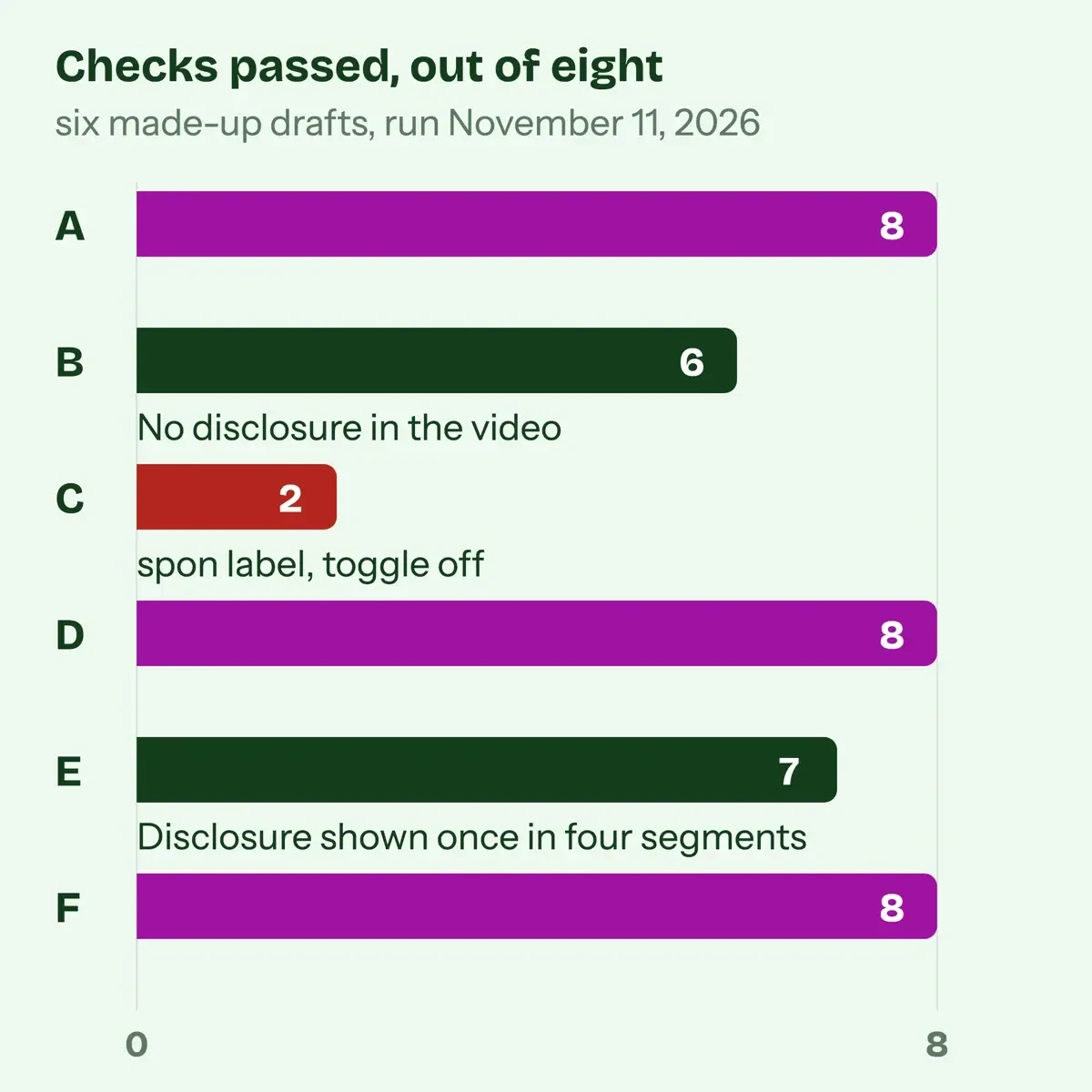 Diagram by DigitalTreed: results of our disclosure check on six made-up drafts, run November 11, 2026.
If a deal involves a token sale, payment in tokens or any talk of returns, talk to a licensed securities attorney before you post. Brands that pay creators have duties too. Our guides to how influencer marketing works and to influencer rates and US rules cover that side.
Frequently asked
Do FTC rules apply if I post from outside the US?
Often, yes. Disclosures 101 says US law applies if it's reasonably foreseeable that the post will affect US consumers.
Can the brand get in trouble, or only the creator?
Both. 16 CFR 255.1(d) says an advertiser may be liable for a deceptive endorsement even when the endorser isn't.
Where do I report a crypto promo that looks like a scam?
The FTC's crypto scams page lists ReportFraud.ftc.gov, the CFTC, the SEC at sec.gov/tcr and the FBI's IC3.
Can TikTok take down a paid crypto post?
Yes. The Branded Content Policy says TikTok may remove content or impose other restrictions when a post breaks its rules.
How we made this guide: We saved the 18 pages in Sources on November 11, 2026 with a plain request. Each quote in this guide appears word for word in those copies, which a script confirmed. Our disclosure script ran on six made-up drafts. Facts checked by the DigitalTreed team on November 11, 2026. This isn't legal, tax or investment advice.
First published September 2022 under the TikViral name, with no sources and a buy-shares tip. Rewritten November 11, 2026 around TikTok's current ad and branded content rules, FTC disclosure rules and SEC rules on paid promotion. The old NFT and ban claims had no record we could find, so they're gone.
Sources
- TikTok Ads: Financial Services policy (last updated September 2026)
- TikTok: Branded Content Policy (effective October 30, 2026)
- FTC: Disclosures 101 for Social Media Influencers
- FTC: FTC's Endorsement Guides, What People Are Asking
- LII: 16 CFR 255.5, Disclosure of material connections
- LII: 16 CFR 255.1, General considerations
- LII: 16 CFR 465.8, Misuse of fake social media indicators
- FTC: Final rule banning fake reviews and testimonials (August 14, 2024)
- LII: 15 U.S.C. 77q, Securities Act section 17
- SEC: Statement urging caution around celebrity backed ICOs (November 1, 2017)
- SEC: Press release 2022-183 (October 3, 2022)
- SEC Division of Corporation Finance: Staff statement on meme coins (February 27, 2025)
- SEC: Press release 2026-30, interpretation on crypto assets (March 17, 2026)
- FTC Consumer Advice: What to know about cryptocurrency and scams
- CFTC: Customer advisory, beware virtual currency pump-and-dump schemes
- FTC Data Spotlight: Reports show scammers cashing in on crypto craze (June 3, 2022)
- FINRA: Foundation research on social-media-informed retail investors (April 2, 2026)
- RDAP record for tikviral.com, read November 11, 2026 (registration April 8, 2020)


Comments
No comments yet. Start the conversation below.