
Quick answer
Affiliate review videos sell best when they're honest: test the product for real, show at least one fault on camera, and say and show your disclosure before the first verdict. Then put a plain-words label above the first link in your description, because the FTC says a description-only disclosure isn't enough.
Most advice on affiliate review videos is about cameras, hooks and thumbnails. That part matters, but it's not where creators get into trouble.
Trouble starts in two places: a review that skips the product's faults, and a disclosure tucked into the description where few viewers look.
Both are fixable before you hit record.
We wrote this for a US creator or small business owner with an affiliate program joined and a product on the desk. To test our own advice, we wrote four draft scripts and descriptions for a made-up channel, then scored them with a small checker built from the FTC's and Amazon's wording. The scores are further down, with a template you can copy.
Key takeaways
- Only review a product you have actually used, and show its faults.
- A free product counts as a material connection, so say it out loud.
- Buying fake views or subscribers for a review can break a federal rule.
- Civil penalties can reach $53,088 per violation for knowing violators.
- In our check, only our template passed all 8 disclosure rules.
Pick a product you can test on camera
A review video only works if you've actually used the thing. The FTC's Disclosures 101 for Social Media Influencers puts it bluntly: "You can't talk about your experience with a product you haven't tried."
So start with products you can live with for a while, the way your viewers would. A skillet you cook with for three weeks will give you better footage, truer faults and a fairer verdict than ten gadgets opened in a single afternoon.
Which products earn that time is its own question. Our walkthrough of affiliate product research for YouTube covers commissions, demand and what to skip.
Single reviews and two-product comparisons both work. Comparisons take twice the testing, so start with one.
Plan the test before you press record
That product now needs a test plan, and Google has written a good one without meaning to. Its advice on writing high-quality reviews asks reviewers to "share quantitative measurements" and to discuss "benefits and drawbacks" from their own research.
Pick three or four things a buyer would actually decide on, and give each one a number you can show on camera, such as a count, a time, a temperature or a weight.
Then set a test period and stick to it. That way, "I used it for a month" is true when you say it.
Example: Fernhill Kitchen is a made-up cookware channel run by a home cook in Mobile, Alabama. Its nonstick skillet review tests three things. It counts eggs cooked without oil over three weeks. It times how long the handle takes to get too hot to hold. And it checks the coating after 20 dishwasher cycles. The brand sent the skillet free, and the plan says so.
Write down everything the brand gave you before you shoot. A free unit, a discount code, early access or a fee all change what you'll say on camera.
Gear matters less than people think. A steady phone, a window or one soft light, and a clip-on mic will carry a first review, and you can upgrade once you know which videos your viewers actually finish. Clear sound beats a sharp picture.
A review structure that holds up: hook, test, faults, verdict
With a plan in hand, the script is mostly a question of order. Here's the order we'd use for a five to ten minute review:
- Hook: the honest bottom line in one sentence ("This skillet surprised me, but the handle didn't").
- Disclosure: spoken and on screen, before you praise anything.
- How you tested: the factors, the numbers and the time period.
- The test itself, on camera, in real use.
- What went wrong: show the fault on camera, then say it.
- Verdict: who should buy it, and who shouldn't.
- Where the links are, and what they are.
Turn those parts into chapters. YouTube's video chapters rules are short. The first timestamp "starts with 00:00", you need at least three, and each chapter runs 10 seconds or more.
Chapters let a viewer jump straight to the faults, which is often why they came.
In the edit, cut toward the test. Long intros, channel news and thank-yous before the first useful shot lose a lot of people before the part they came for, so trim them hard.
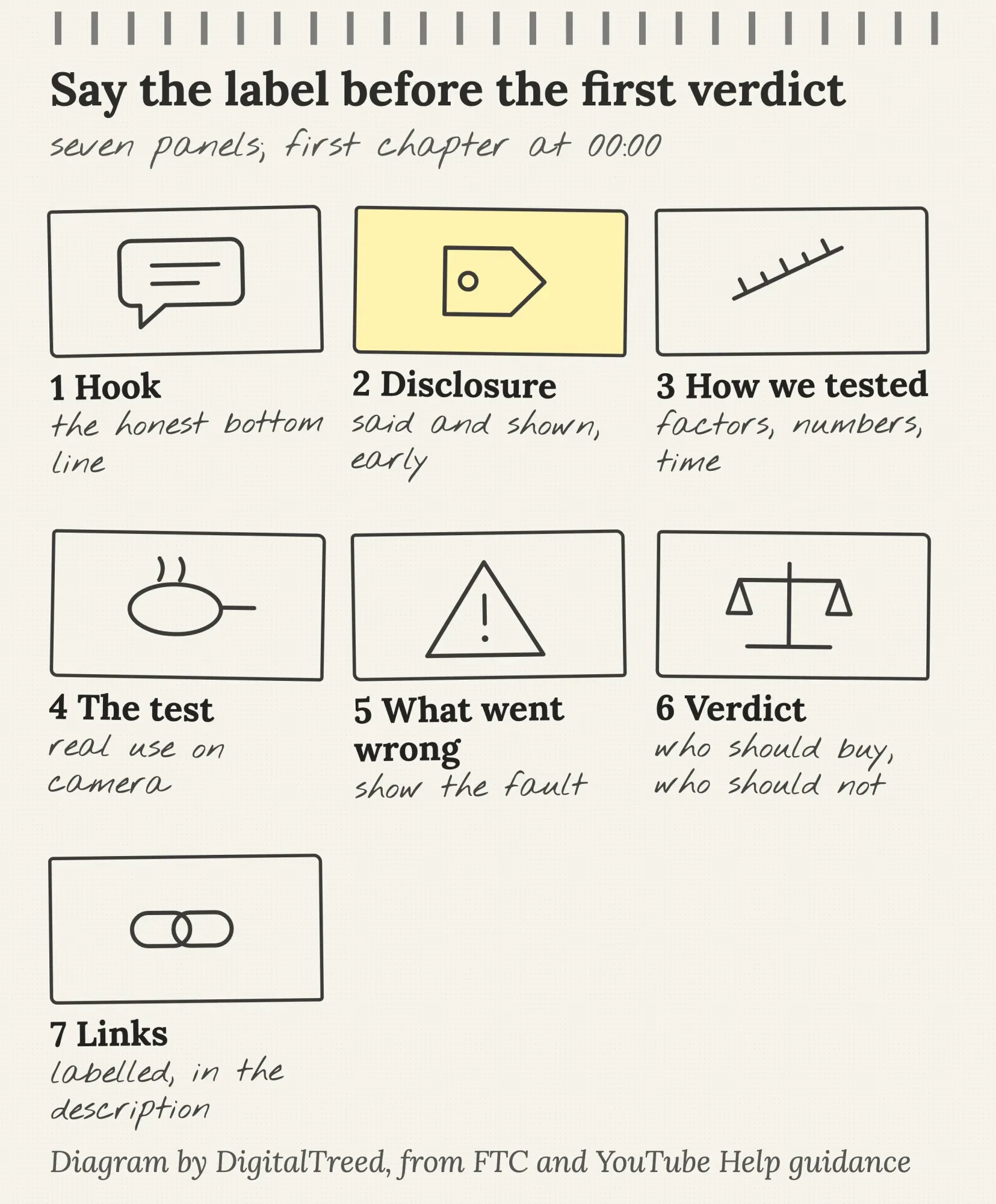 Diagram by DigitalTreed: our seven-part review order, built from the FTC video guidance and YouTube's chapter rules (October 2026).
Show the faults, because they make the verdict believable
But a review with no faults at all reads like an ad, and viewers can tell. It's also against the rules. The FTC's staff FAQ on endorsements says "an endorsement must reflect the honest opinion of the endorser."
It goes further: "If you thought it was terrible or mediocre, you can't say it's good or terrific."
Faults don't get you out of the disclosure, either. The same FAQ says a review that "mentions one or more negative points" is "still an endorsement."
Here's the part most creators don't expect. Researchers Jingwen Zhang, Stephanie Lee and Yong Tan studied 4,179 tech review videos on YouTube for a 2026 paper in Information Systems Research. After the FTC's 2017 disclosure guidance, engagement with affiliate videos fell overall, yet affiliate videos that carried a disclosure drew more engagement than those that didn't. The effect was stronger for "more negative review content," the university's write-up says.
Honest, labelled reviews held up best.
Our take: say the fault on camera, show it, and tell viewers who it matters to. "The handle gets hot, so skip this one if you cook for a crowd" is a fault and a buying tip at once.
Say the disclosure in the video, not just the description
That honesty has to reach viewers who never open the description. The FAQ says a disclosure "has the best chance of being clear and conspicuous if it's included in the video itself." The description alone is "not enough on its own."
Disclosures 101 agrees: "in the video and not just in the description."
Timing matters too. A disclosure "at the beginning of the review would be better" than one at the end, the FAQ says, and several during the video "would be even better." In a long video, put it right before the endorsement starts.
Say it and show it. When text sits over the picture, the FAQ wants the disclosure made "both visually and audibly," since some people watch with the sound off and others never read the words on screen. A label that's only spoken or only written misses part of your audience.
Free products count. Section 255.5 of the Guides names "free or discounted products" as a material connection. That holds "regardless of whether the advertiser requires an endorsement in return." Its Example 7 is a woodworking creator sent a free lathe, and the verdict is that the videos should say so.
Got it free and earn a commission? Say both. The FAQ warns that "saying only that you got a product for free suggests you didn't get anything else."
Plain words work best: "The brand sent me this free, and I earn a commission if you buy through my links." Skip "sp," "spon" and "collab," which Disclosures 101 calls vague.
Cutting the review into Shorts, TikToks or Reels? Each clip needs its own spoken label. Our post on making money on TikTok covers that app's branded content setting, and the sponsored blog posts rewrite covers written reviews.
Do affiliate review videos need YouTube's paid promotion box?
Tick it whenever a brand gave you something, but don't treat it as your disclosure. YouTube's help page on branded content disclosure labels says commercial relationships require "the paid promotion button." Ticking it "adds a disclosure label that appears at the beginning of your video."
Under YouTube's Branded Content Policies, branded content is anything "influenced by a brand partner in exchange for something of value," and the list includes payment, free products and sponsorships. So a free review unit puts you inside that definition, and undisclosed branded content may be removed.
Pure affiliate links are a gray area.
If you bought the product yourself and only use a public program, YouTube's definition doesn't name affiliate programs, and we couldn't find a YouTube page that does.
When in doubt, we'd tick it. The label costs little, and the policy says "you are ultimately responsible for ensuring your disclosure is clear and prominent."
The FTC fake reviews rule hits creators in two places
Even a labelled video can break the FTC's newer rule. The fake reviews rule, 16 CFR 465, took effect on October 21, 2024, according to the FTC's questions and answers page. It mostly targets businesses that write, buy or hide reviews, but two of its sections reach the people who make review videos, whether that's a full-time job or a side income.
The first is claiming experience you don't have. Section 465.2(a) bans testimonials that misrepresent that the person "used or otherwise had experience with the product." The FTC's Q&A says influencers can be liable under it if they lie about using the product.
That covers "I've used this for a year" after a week, and AI-made testimonials that pretend someone used the product.
The second is buying fake reach. Section 465.8 bans buying fake "indicators of social media influence" for a commercial purpose. Section 465.1 lists "subscribers, views, plays, likes" among them.
Buying fake views for a review video can now break a federal rule.
Paid sentiment works differently. Section 465.4 bans incentives tied to reviews "expressing a particular sentiment, whether positive or negative." The Q&A says it "only applies to consumer reviews," and hired influencers give testimonials instead.
So a brand that pays only for a glowing video runs into the honest-opinion rule in 16 CFR 255.1(a) instead. If you also run a shop, 465.4 is yours to follow. Rewarding customers for 5-star reviews "would violate Section 465.4," the Q&A says.
The fines are real. The FTC's August 14, 2024 announcement says the rule lets it "seek civil penalties against knowing violators." 16 CFR 1.98(d) sets the top figure at $53,088 per violation, for penalties assessed after January 17, 2025.
| Say you used it longer or more than you did | 16 CFR 465.2(a), 255.1(c) | Say exactly how long and how you tested |
| Got the product free or at a discount | 16 CFR 255.5 | Say "free" out loud, plus any commission |
| Are asked by a brand to praise it | 16 CFR 255.1(a) | Keep your honest verdict, or turn the deal down |
| Buy views, likes or subscribers | 16 CFR 465.8 | Don't; grow with real viewers |
| Run a shop and reward customer reviews | 16 CFR 465.4 | Never tie a reward to a positive review |
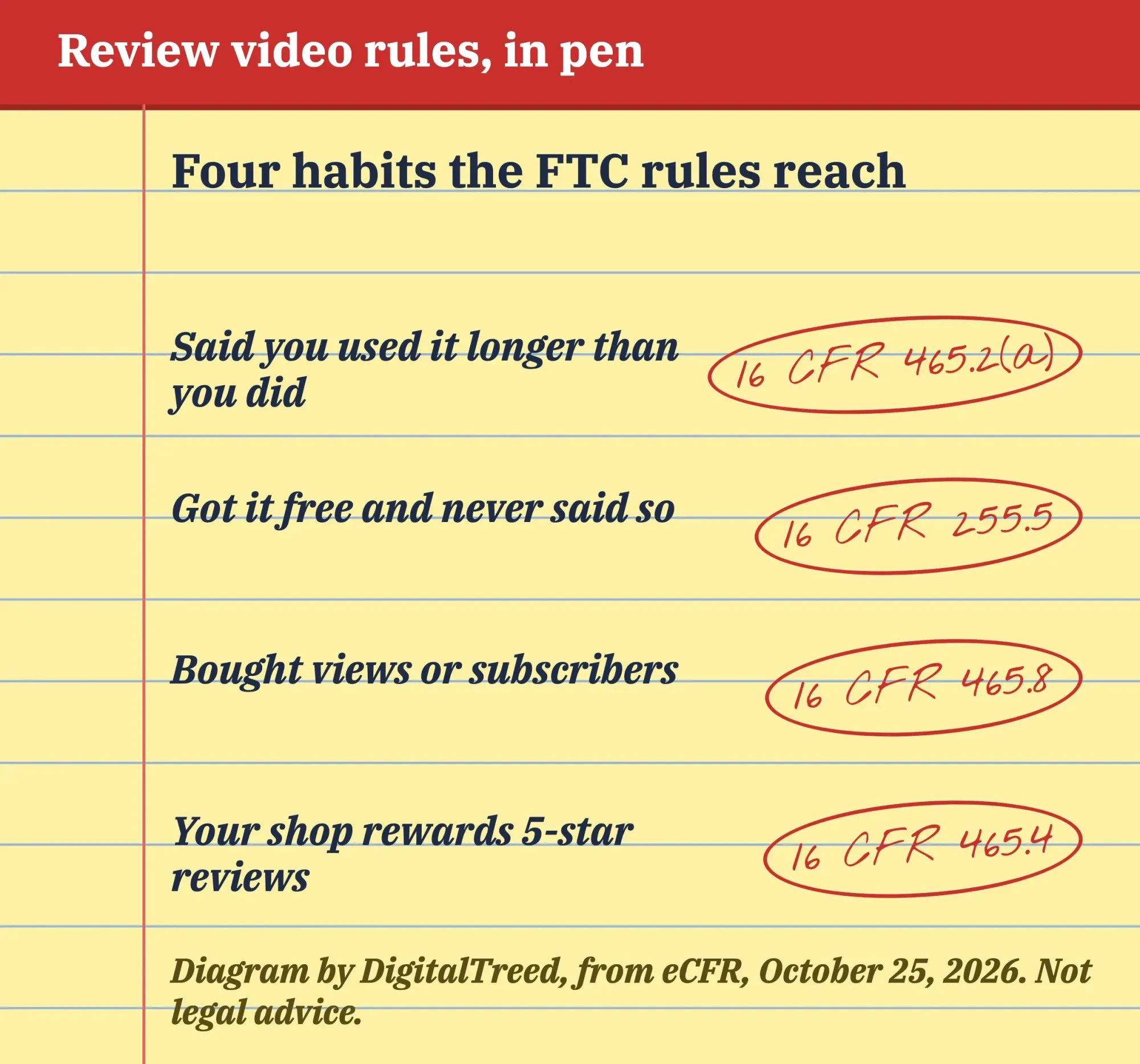 Diagram by DigitalTreed: our summary of 16 CFR 465 and 16 CFR 255 as read on eCFR on October 25, 2026, not the rule text.
One plain note: everything in this section is how we read 16 CFR 255 and 465 on October 25, 2026. We're marketers, not your lawyers, so use it as a starting point rather than legal advice, and run any contract with odd terms past an attorney who handles FTC advertising work.
Put the label above the link in your description
Now the description, where the click happens. Disclosures 101 says the disclosure belongs "with the endorsement message itself," and the FAQ accepts "Paid link" right next to an affiliate link. Our post on how to use affiliate links goes deeper on wording, rel="sponsored" and redirects.
Amazon adds three rules of its own. Its Associates Operating Agreement (updated October 15, 2025) requires the line "As an Amazon Associate I earn from qualifying purchases."
Its Program Policies (updated April 14, 2026) say your Site "may only show prices and availability" that Amazon serves or its API supplies. They also bar showing Amazon "customer reviews or star ratings" unless they come through that API.
The agreement counts "social media user-generated content" as your Site. So write "check today's price" instead of a number, and keep Amazon's stars out of your shots.
In YouTube's own Shopping program, product tagging lets you "tag up to 60 products." Mention the featured ones out loud or on screen as well.
Here's the template we built for Fernhill Kitchen and ran through our check. Swap in your own facts, and delete any line that isn't true for this video.
SAY IT, before your first verdict (and show the same words on screen):
"Before I show you anything: [Brand] sent me this [product] free,
and I earn a commission if you buy through my links."
Add only if true: "[Brand] didn't see this video before it went up."
Bought it yourself? Say: "I paid for this one. I earn a commission
if you buy through my links."

DESCRIPTION, line 1:
Paid links: [Brand] sent me this [product] free, and I earn a
commission if you buy through the links below.

[Product] I tested (paid link): [your affiliate link]
Check today's price on the product page; prices change.
My full test notes: [your own page, with UTM tags]

00:00 The short answer
00:15 Free sample and paid links
01:00 How I tested it
03:00 What went wrong
04:30 Who should buy it, and who shouldn't

As an Amazon Associate I earn from qualifying purchases.  <- Amazon links only
#hashtags go last
Want to know which link sends people to your own site? Tag just that link with our UTM builder and read the visits in GA4, using the reports in our GA4 setup and reports guide. Leave UTM tags off the affiliate links; the program's own IDs track those.
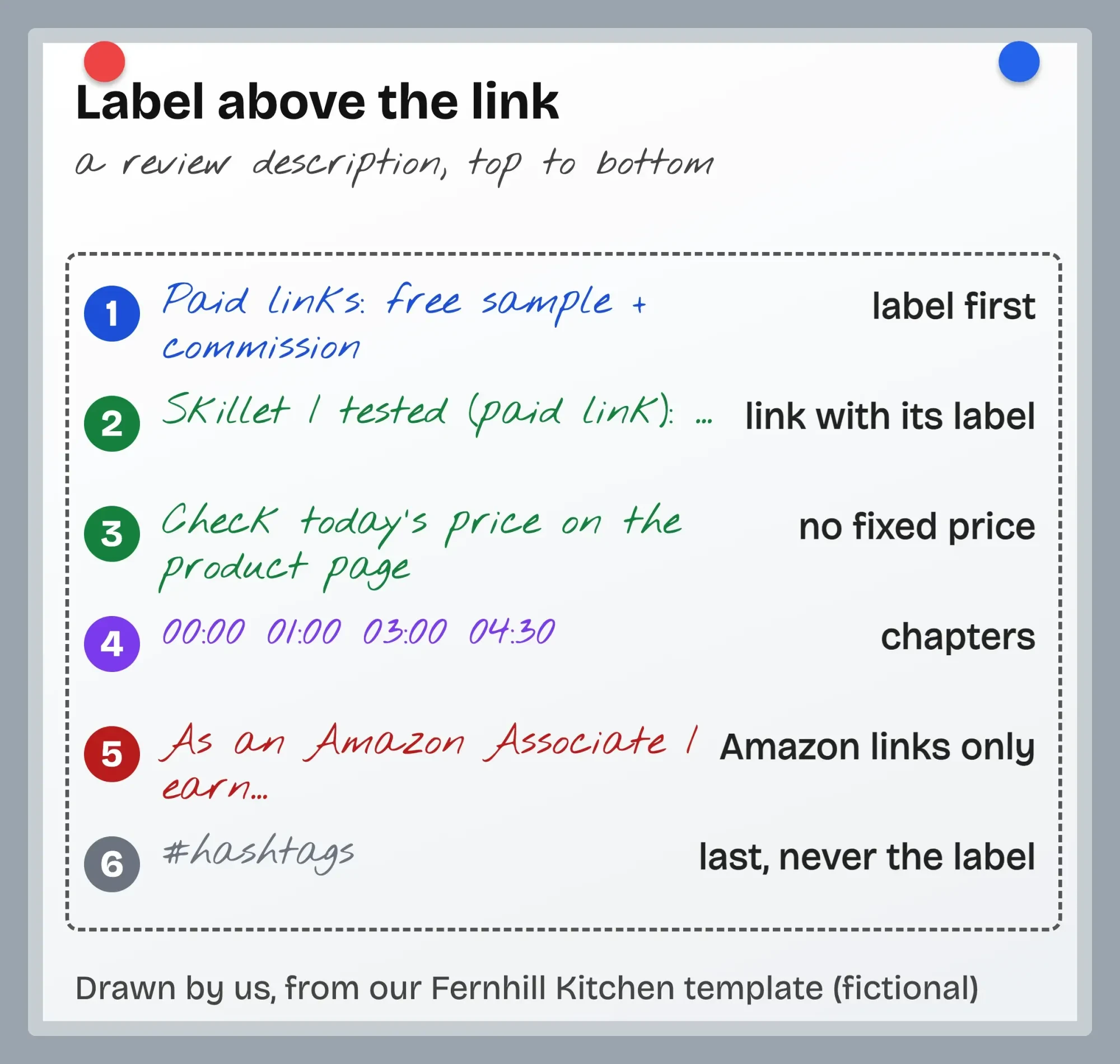 Drawn by us: the order of a review video description, from our Fernhill Kitchen template (fictional).
Prefer to hand off filming and editing? The DigitalTreed video production service makes review videos for small businesses. We sell that service, so we're not a neutral voice on it.
We ran four draft descriptions through a disclosure check
Templates are easy to praise, so we tested ours. On October 25, 2026, we wrote four draft scripts and descriptions for Fernhill Kitchen's skillet review, each built on a common habit. A short Python script, check_review.py, scored each one against eight rules. Every rule comes from a source quoted above, except "spoken in the first 30 seconds," which is our own house threshold.
Draft A hid "#affiliate #ad" in the hashtags and said nothing on camera. It passed 2 of 8.
Draft B opened the description with "Affiliate links below!" and mentioned "commissionable links" only at the end of the video. It passed 4 of 8, failing on timing, wording, the on-screen label and Amazon's line.
Draft C spoke and showed the label at 12 seconds. But it never said the skillet was free, quoted a made-up fixed price of $39.99 and left out Amazon's line. It passed 5 of 8.
Our template, Draft D, passed all 8.
Draft C surprised us. It looked careful and still missed three rules: it never mentioned the free skillet, and two slips sat in the description, exactly the part we'd have skimmed if we'd checked it by eye. The limit is real too: we wrote the drafts and the checker, so this shows which habits break the quoted wording, not whether any real video is legal.
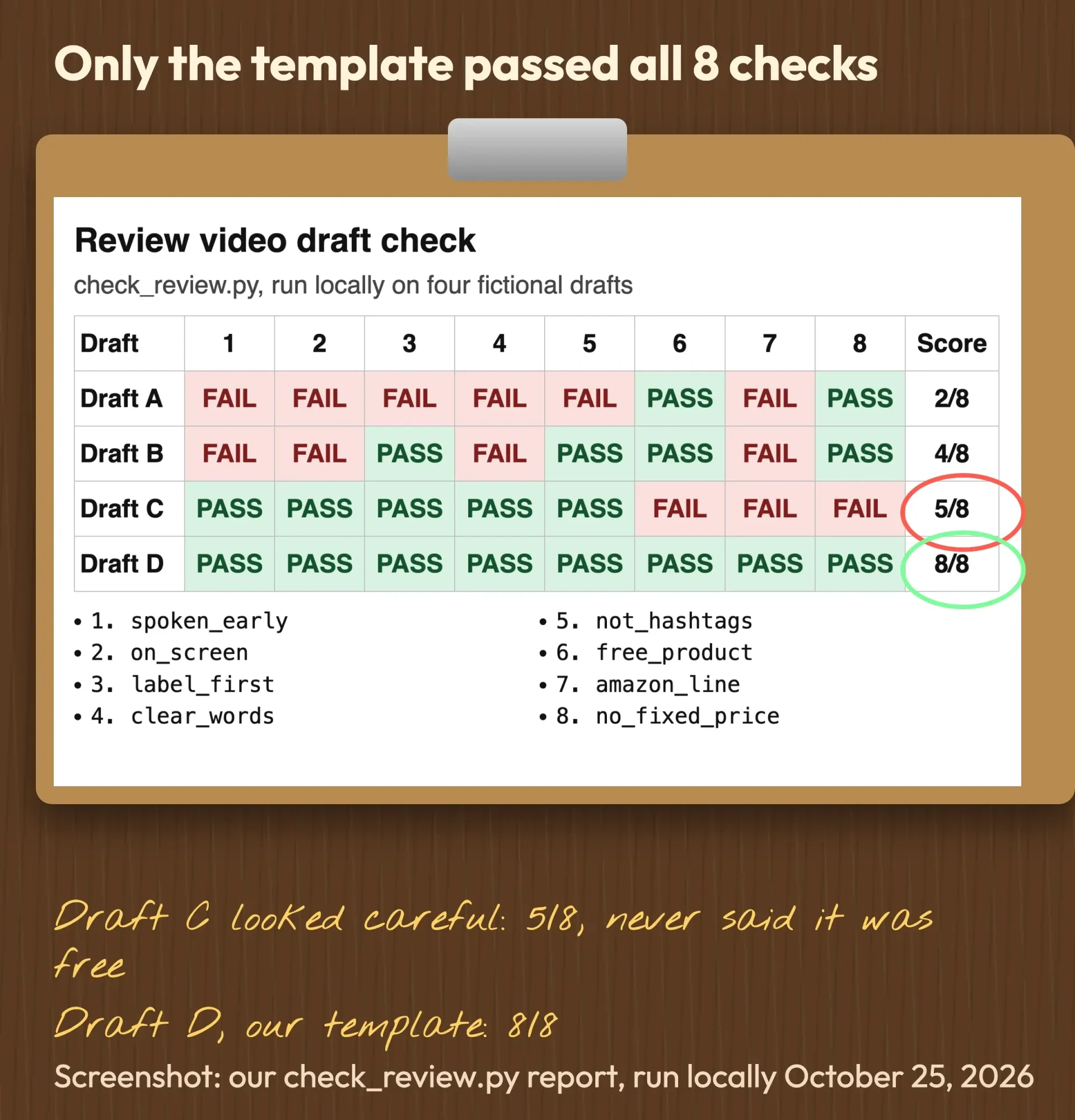 Screenshot: our check_review.py report on four fictional drafts, run on our Mac on October 25, 2026, with notes added by DigitalTreed.
Help the review get found after it's live
After the check, the video still needs viewers. Start with the words buyers type, like "[product] review", "[product] vs [rival]" and "is [product] worth it." Our keyword suggestions tool shows the variations people search.
From there, the YouTube SEO rewrite covers titles, descriptions and captions, and the YouTube thumbnail one covers the image that earns the click.
Once brands start sending products, you'll want a media kit with your real audience numbers, so you can answer a brand's first questions with facts instead of guesses.
Planning a review series around your shop's own products? Our social media management service can plan and run it with you. It's work we charge for, so factor that in.
Frequently asked
I got the product free but use no affiliate link. Do I still disclose?
Yes. The FTC FAQ says it "doesn't matter whether the company gives you a code, ships it directly to you, gives you money to buy it yourself, or reimburses you after you buy it."
How do I disclose in a livestream review?
Repeat it. Disclosures 101 says the disclosure "should be repeated periodically" for viewers who join late, and the FTC FAQ suggests a continuous on-screen label "to be on the safe side."
I bought it myself and nobody pays me. Is my review an endorsement?
Usually not. In 16 CFR 255.0, Example 7, a shopper who buys a product and posts about it has "no connection to the manufacturer," so the post "would not be deemed an endorsement." Add an affiliate link, and it becomes one.
How we made this guide: Eram N. and the DigitalTreed team checked each rule, quote and number against its source, finishing on October 25, 2026. We read 16 CFR Parts 255 and 465 and section 1.98 on eCFR (the October 22, 2026 issue), the FTC's endorsement FAQ, Disclosures 101, its Q&A on the reviews rule and its 2024 announcement. We also read YouTube's help pages on paid promotion, branded content, chapters and product tags, Google's review guidance, Amazon's Associates agreement and policies, and the university's news story on the study. Our draft check ran on a Mac in India with Python 3.9.6, with nothing uploaded to YouTube. Each rule above links to the page we read it on.
First published July 2023. Rewritten October 25, 2026: the old post gave 14 short tips with no outside sources. New: a test plan, a seven-part structure with chapters, the FTC's video disclosure guidance, YouTube's paid promotion setting, the 2024 fake reviews rule, Amazon's description rules, a template, and our local check of four drafts.
Sources
- FTC: FTC's Endorsement Guides: What People Are Asking
- FTC: Disclosures 101 for Social Media Influencers (November 2019)
- eCFR: 16 CFR 255.0, Purpose and definitions
- eCFR: 16 CFR 255.1, General considerations
- eCFR: 16 CFR 255.5, Disclosure of material connections
- eCFR: 16 CFR Part 465, Rule on the Use of Consumer Reviews and Testimonials
- eCFR: 16 CFR 465.1, Definitions
- eCFR: 16 CFR 465.2, Fake or false consumer reviews and testimonials
- eCFR: 16 CFR 465.4, Buying positive or negative consumer reviews
- eCFR: 16 CFR 465.8, Misuse of fake indicators of social media influence
- FTC: The Consumer Reviews and Testimonials Rule: Questions and Answers (November 2024)
- FTC: Federal Trade Commission Announces Final Rule Banning Fake Reviews and Testimonials (August 14, 2024)
- eCFR: 16 CFR 1.98, Adjustment of civil monetary penalty amounts
- YouTube Help: Add branded content restrictions and disclosure labels
- YouTube Help: YouTube Branded Content Policies
- YouTube Help: Video Chapters
- YouTube Help: Tag products in your content
- Google Search Central: Write high quality reviews
- Amazon Associates: Program Operating Agreement (updated October 15, 2025)
- Amazon Associates: Program Policies (updated April 14, 2026)
- Zhang, Lee and Tan: The Effects of the FTC Policy and Affiliation Disclosures on Product Review Video Engagement, Information Systems Research, 2026
- Gies College of Business: Do FTC affiliate disclosures build credibility on YouTube? (June 3, 2026)
Comments
No comments yet. Start the conversation below.