

Quick answer
Crypto marketing in the US runs on three rules. Every paid promoter must say they're paid, and if the token is sold as a security, they must also give the amount. Don't promise returns: the FTC calls guaranteed profits a scam sign. Google and Meta want certification or written permission before most crypto ads run.
Crypto marketing is the work of getting people to know, trust and use a crypto product, whether that's a wallet, an exchange, a token, an NFT game or a tool built for crypto users. Most of it looks like any other marketing. The difference is the rulebook. It's stricter than the one for selling shoes, and stricter than most agency guides admit.
We wrote this guide for a US project, or for a US business that's been asked to promote one and wants to know where the legal lines actually sit. It covers the SEC's touting rule, the FTC's rules for influencers and claims, and Google's and Meta's crypto ad policies. Each rule links to the page it comes from.
Key takeaways
- Free tokens, airdrops and allowlist spots must be disclosed like cash.
- Kim Kardashian paid $1.26 million to settle over one undisclosed paid post.
- Google bans ICO ads everywhere, and exchanges need certification first.
- Meta wants written permission and a recognized license before exchange ads run.
- Never promise returns, because the FTC says only scammers guarantee profits.
We reread our own first version before writing this one
Before writing a word of this version, we reread the one we published in December 2022. It gave five strategies: a professional website, a community, email, crypto influencers and paid ads. It called influencers "the best way to launch a successful crypto project" and listed display, banner, video and retargeted ads as if crypto were any other product. It never said a paid promoter has to disclose the deal, and it never mentioned that the big ad platforms gate crypto ads. We checked it against the rules below on October 25, 2026. Two of the five strategies, influencers and paid ads, could put a project in trouble as written.
The other three survive. They just need a disclosure habit and a claims check.
Three rulebooks apply before your first post
That gap in our old advice comes from treating crypto like any other product. In the US, three separate sets of rules can apply to the same tweet, and each one asks a different question.
- The SEC asks whether the thing you're promoting is a security, such as a token sold to raise money with a promise of profit from your team's work. If it's one, Securities Act section 17(b) applies to anyone paid to describe it.
- The FTC asks whether your ad or endorsement could mislead an ordinary buyer. Its Endorsement Guides cover any material connection between a brand and the person praising it, crypto or not.
- Google and Meta ask whether your product is on their allowed list. Their rules aren't law, but Google bans ICO ads everywhere, and Meta wants written permission for exchanges and for wallets that let people trade or stake.
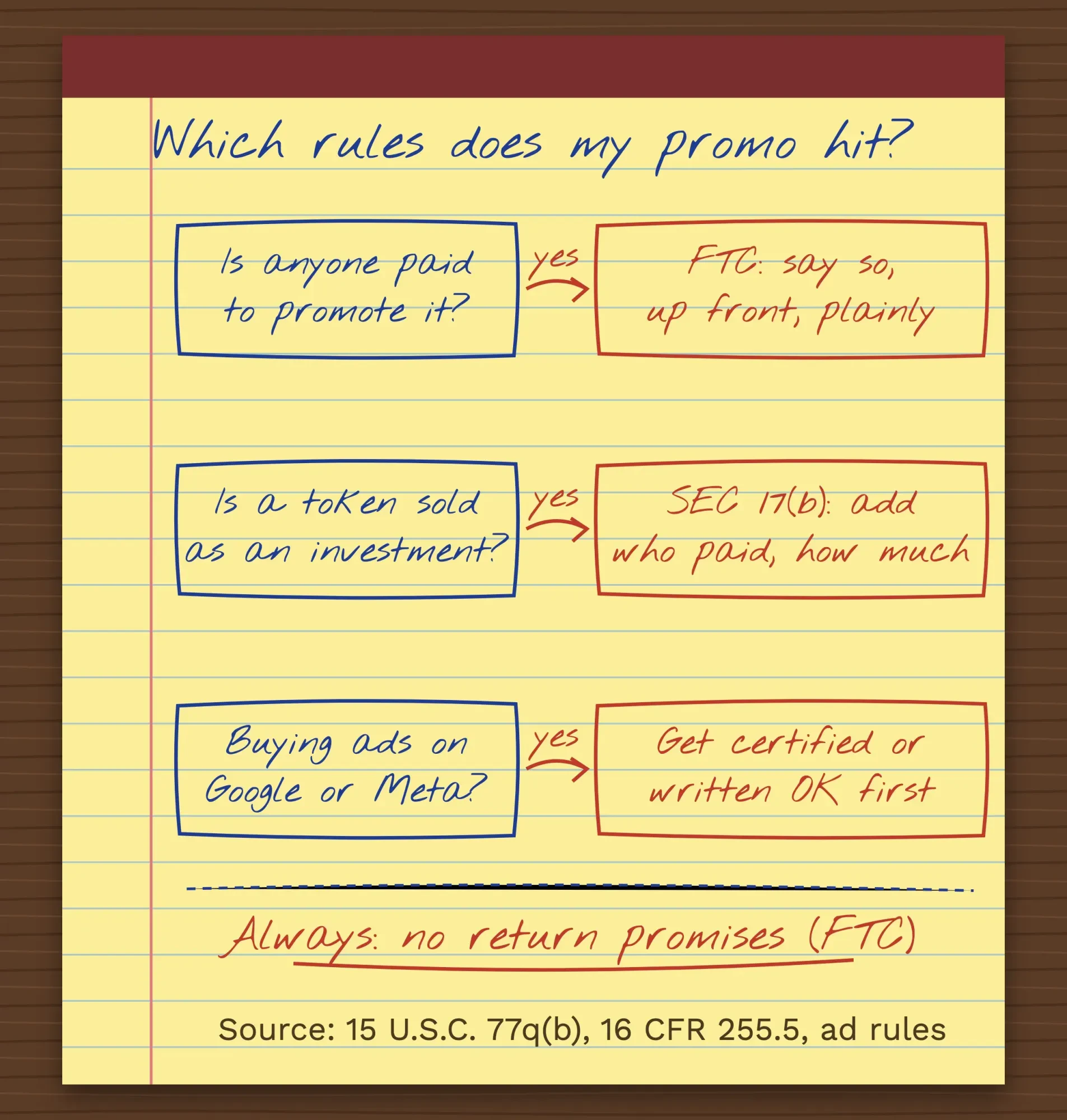 Diagram by DigitalTreed, from 15 U.S.C. 77q(b), 16 CFR 255.5 and the Google Ads and Meta crypto policies, October 2026.
Plenty of projects hit at least two of the three without noticing.
A token launch with a paid creator and a Facebook ad? That's all three at once.
Section 17(b): paid promoters must name the payment and the amount
That first rulebook is the oldest and the sharpest. Section 17(b) of the Securities Act of 1933 bars anyone from publishing "any notice, circular, advertisement, newspaper, article, letter, investment service, or communication" that describes a security for pay from the issuer. Unless, that is, the pay is disclosed.
The disclosure has two parts. The statute says the promoter must disclose "the receipt, whether past or prospective, of such consideration and the amount thereof." That last phrase is the one people miss. The SEC applied it to tokens in a November 1, 2017 statement. Celebrity ICO endorsements, it warned, may be unlawful if they don't disclose "the nature, source, and amount of any compensation."
So "#ad" tells readers you're paid.
It doesn't tell them how much, and for a security, the amount is part of the rule.
Does your token count as a security? That question changed in 2026. On March 17, 2026, the SEC sorted crypto assets into five groups in a new interpretation. Its chairman said most crypto assets are not themselves securities. But the same release says a token can still be sold as part of an investment contract. The interpretation also says an investment contract ends once the issuer has delivered what it promised. A year earlier, in February 2025, SEC staff said the kind of meme coin it described isn't a security, and the 2026 interpretation files meme coins under digital collectibles. They added that fraud can still be pursued by other federal or state agencies.
The SEC also proposed a new offering path on August 18, 2026. Called Regulation Crypto Assets, it would let projects raise up to $5 million over four years. A second exemption would allow up to $75 million in each 12-month period, with narrative disclosures to investors. It's still only a proposal.
For marketing, that means one habit.
If any part of your launch sells tokens to raise money, treat every paid mention as if 17(b) applies until a securities lawyer tells you otherwise, in writing.
What the SEC charged celebrity promoters with
Those rules aren't theory. The SEC has used 17(b) against famous names, and each case turned on a payment that the audience never heard about until the agency announced it.
In November 2018, boxer Floyd Mayweather Jr. and music producer DJ Khaled settled charges over ICO promotions. The SEC found Mayweather didn't disclose $100,000 from Centra Tech and $200,000 from two other offerings. Without admitting or denying the findings, he agreed to pay $614,775 in disgorgement, penalty and interest, and to stay out of promoting securities for three years. Khaled agreed to pay $152,725 for an undisclosed $50,000.
In February 2020, actor Steven Seagal settled over a token offering that promised him $250,000 in cash and $750,000 in tokens. He agreed to a $157,000 penalty plus $157,000 in disgorgement and interest, and a three-year promotion ban.
The best-known case came in October 2022. Kim Kardashian had been paid $250,000 for a single Instagram post about EMAX tokens, and she agreed to pay $1.26 million in penalties, disgorgement and interest to settle. The SEC chair at the time said the law requires promoters to disclose "when and how much they are paid."
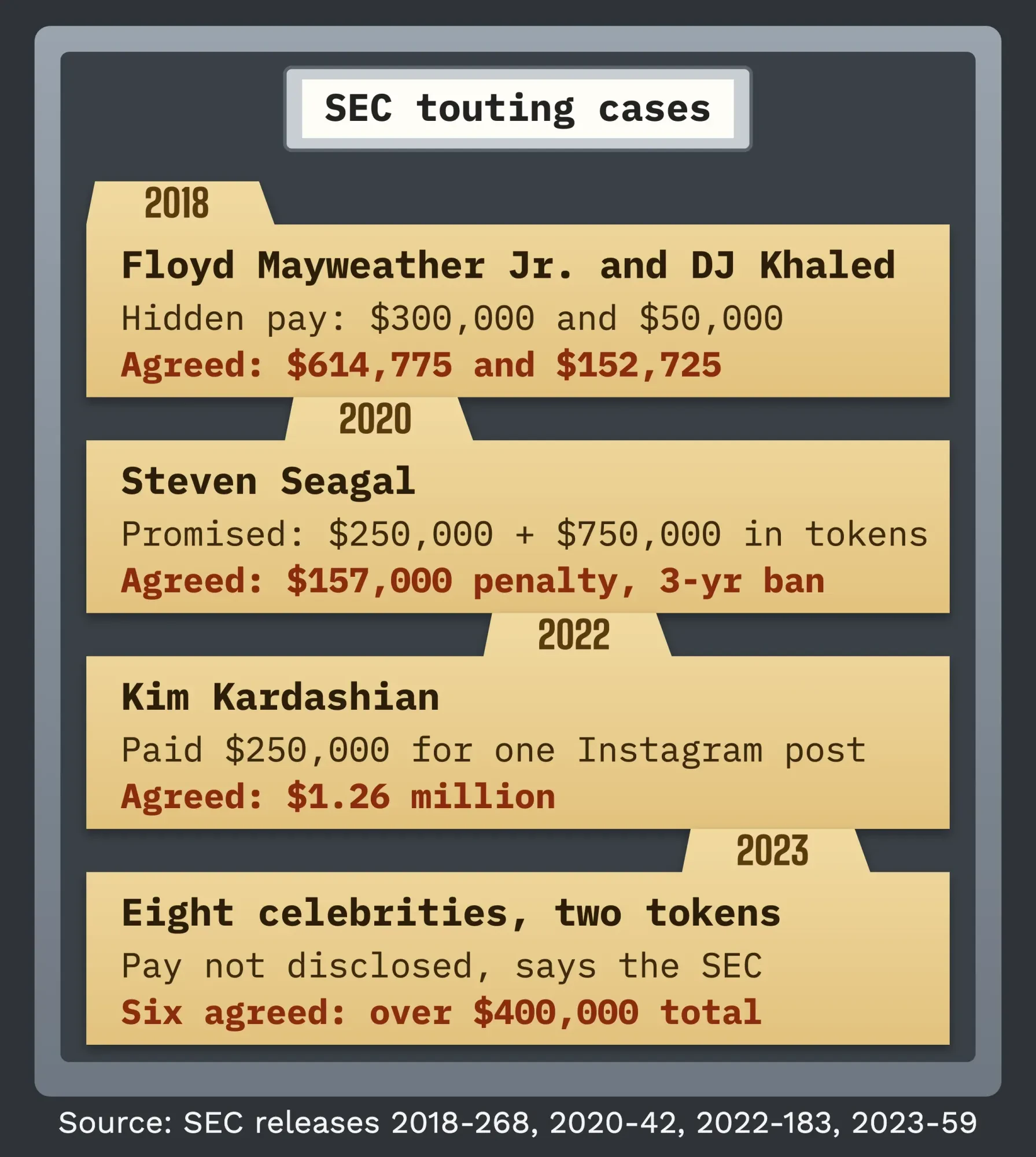 Diagram by DigitalTreed, from SEC press releases 2018-268, 2020-42, 2022-183 and 2023-59. Totals for 2018 summed by us.
Then, in March 2023, the SEC charged eight celebrities, including Lindsay Lohan and Jake Paul, for touting two tokens without disclosing pay. Six of them agreed to pay more than $400,000 combined.
Notice who paid in every case.
The promoter. Settling didn't mean admitting the findings, but the money and the bans were real.
The FTC's influencer rules apply even when the token isn't a security
But if the SEC's rule doesn't reach your token, the FTC's still does. Its Endorsement Guides apply to any ad that uses a creator's opinion, whatever the product is.
The core rule sits in 16 CFR 255.5. When a creator has a tie to your project that viewers wouldn't expect, the rule says it "must be disclosed clearly and conspicuously" (section 255.5(a)). Material connections "can include monetary payment or the provision of free or discounted products." They count "regardless of whether the advertiser requires an endorsement in return." Free tokens, early access and allowlist spots all qualify. So does a referral bonus, since that's money too.
Clear and conspicuous has a definition, too: difficult to miss and easy for ordinary people to understand. The FTC's Disclosures 101 guide turns that into habits. Put the label where it's hard to miss. Use plain words like "ad" or "sponsored," not "sp," "spon" or "collab." In a video, say it in the video, and in a live stream, repeat it.
And the brand is on the hook as well as the creator. Section 255.1 says advertisers can be liable for misleading or unsubstantiated statements made through endorsements, so a creator's "this will 10x" becomes your problem.
Put these terms in every creator deal before anyone films:
- The label goes first: "Paid ad for [project]" at the start of the post or video, not in a hashtag pile.
- If tokens are sold to raise money, the post also states who paid and how much.
- Free tokens, airdrops and allowlist spots are disclosed like cash.
- No price targets, return figures or "safe" claims, in the script or ad-libbed.
- You see the post before it's published and can ask for fixes after.
Track results honestly while you're at it. Give each creator a tagged link from the DigitalTreed UTM builder, and you'll see visits and sign-ups per creator instead of guessing which post actually brought people in. Written posts follow the same FTC rules, which our guide to sponsored post disclosure covers. Our beginner's guide to influencer marketing explains how creator deals usually work. Creators weighing a crypto brand deal can read how those deals fit into making money on TikTok.
No return promises: the claims that draw FTC action
So disclosure fixes who said it.
The next question is what was said. In crypto, the riskiest words are about money coming back.
The FTC's consumer page on crypto puts it bluntly: "Only scammers will guarantee profits or big returns." It adds that even a celebrity endorsement or happy-investor testimonials don't change that, because those are easily faked. Some of your readers will have seen that warning. If it sounds like a guarantee, it reads like a scam, even when your project is honest.
The FTC has also gone after crypto firms for this. In July 2023 it charged Celsius Network. The platform had told users it was safer than banks and that they could withdraw their deposits at any time. Celsius agreed to a $4.7 billion judgment, which was suspended so that its remaining assets could go back to customers through the bankruptcy case. On July 20, 2026, the FTC announced that three founders would pay $16.5 million combined and are barred from marketing or selling such products.
Buyers have a lot to lose. Consumers reported losing $15.9 billion to fraud in 2025, the FTC told Congress in March 2026, and investment scams were the biggest category at $7.9 billion.
Here's how we rewrite the lines we see most often in crypto ad drafts:
| Risky line | Why it’s a problem | Safer line |
|---|---|---|
| "Guaranteed 20% APY" | FTC: only scammers guarantee returns | "Rewards vary and can be zero. Read the risks." |
| "Safer than your bank" | The Celsius claim the FTC charged | Say what you actually do to secure funds, with proof |
| "Get in before it moons" | A price prediction and a return promise | "Here’s what the app does today." |
| "Withdraw anytime" | Celsius again; false if limits exist | State the real withdrawal terms |
| "As seen with [celebrity]" | Needs the paid tie disclosed; amount too if a security | "Paid partnership: [name] was paid $X" |
| "Not financial advice" as the only disclosure | Doesn’t disclose payment or risk | A paid label plus a plain risk line |
Our take: write every crypto ad as if a skeptical regulator and a nervous first-time buyer will read it side by side. If both would call it fair, run it.
Can you run crypto ads on Google Ads?
Now your clean copy needs a platform that'll run it. Google sorts crypto into three groups, and the group decides whether you can advertise at all.
Some businesses don't need approval at all. Google's policy allows ads for businesses that don't buy, hold or exchange crypto, such as a shop that accepts crypto, a mining hardware seller, or a tax or legal service. It also allows educational material that offers no investment advice, tips, odds, calculators or trend analysis. NFT games that sell in-game items are allowed too.
Some products can't be advertised anywhere. That list covers initial coin offerings, DeFi trading protocols, token liquidity pools and crypto loans. Unhosted software wallets and sites that rank brokers or sell trading signals are out, too.
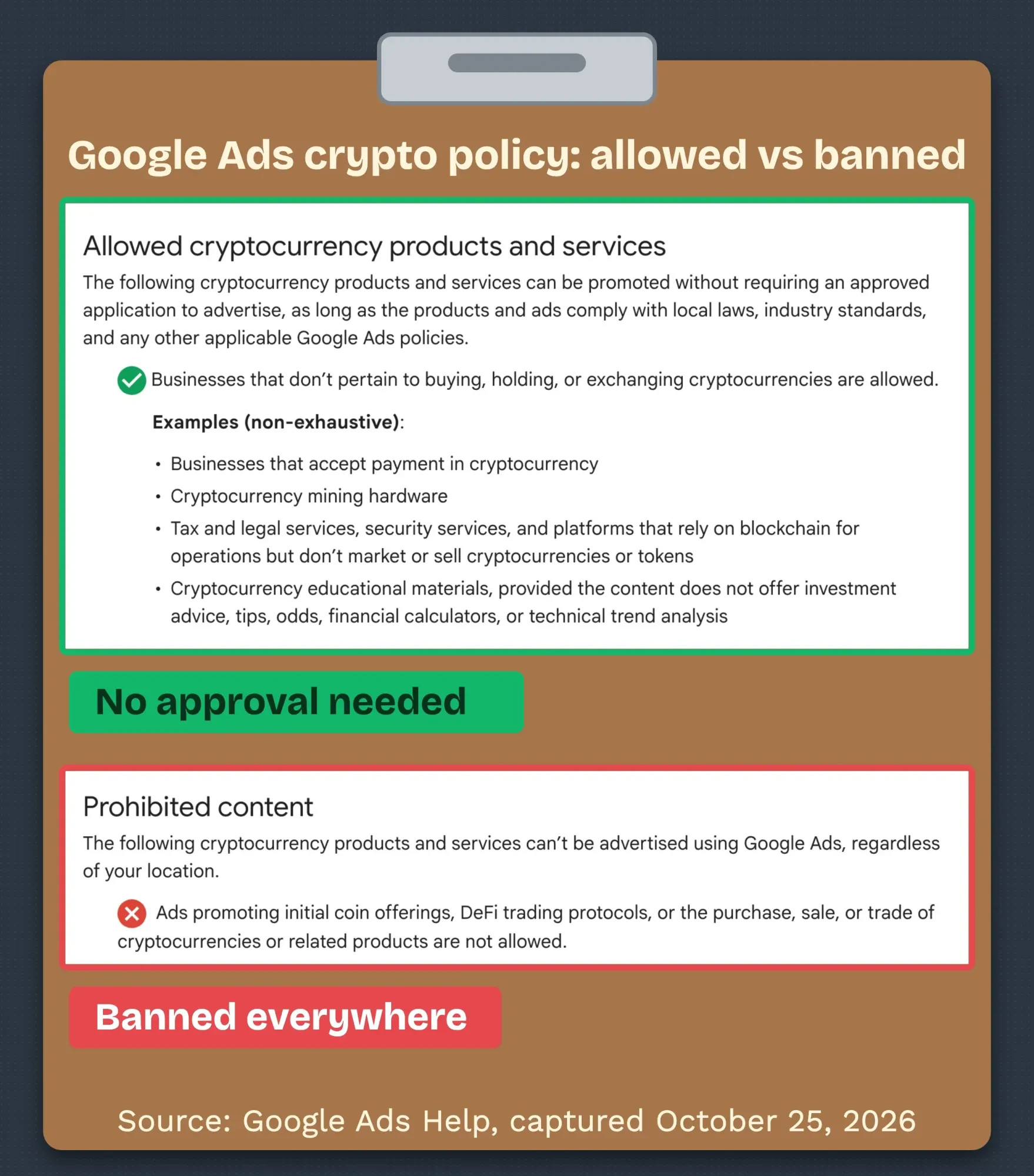 Screenshot: Google Ads Help, Cryptocurrencies and related products, taken October 25, 2026; notes by DigitalTreed.
The middle group needs approval.
That's where most real projects land. Exchanges, software wallets, hardware wallets and coin trusts can only advertise after Google approves an application for the country you target. In the United States, an exchange must be registered with FinCEN as a money services business and with a state as a money transmitter. A federal or state chartered bank also qualifies. Either way, you'll also need Google's certification. Since June 2026, the application is made inside your Google Ads account.
Breaking the policy won't end your account without a warning first. Google says a warning comes at least 7 days before any suspension. Still, a rejected ad on launch day is a bad day, so apply weeks ahead. If paid search is new to you, our plain guide to how PPC works covers bidding and budgets once you're approved.
Meta asks for written permission and a US license
That same gatekeeping shows up at Meta, though the form's different. On Facebook and Instagram, the question is whether you need Meta's written permission first.
You need it for exchanges and trading platforms, for crypto lending and borrowing, and for wallets that also let people buy, sell, swap or stake their coins. Mining software and any ad soliciting crypto investment need it too, affiliate sites included. To get it, Meta asks for a recognized license or registration, submitted in Meta Business Suite. For the US, the policy page listed two on October 25, 2026: FinCEN money services business registration and New York's BitLicense.
You don't need it for tax services for crypto companies, for products that can't be used to buy, sell or trade crypto, or for events, education and news that don't offer crypto products. NFTs, storage-only wallets and mining hardware are also free to advertise.
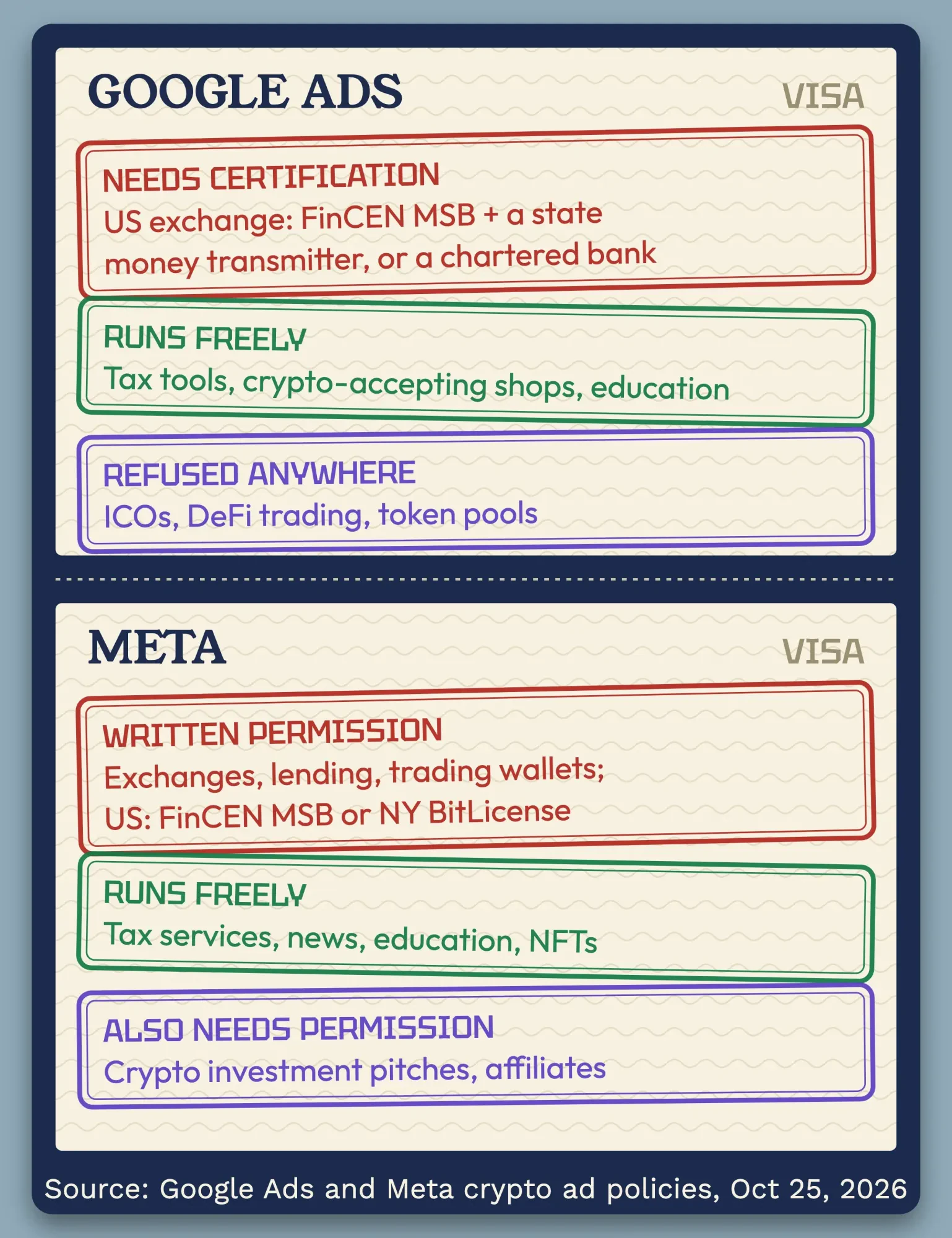 Diagram by DigitalTreed, from the Google Ads and Meta cryptocurrency ad policies as read October 25, 2026.
Permission covers the ad. It doesn't cover the wording.
Every Meta ad still has to avoid the return promises above. Its button should match what the page really offers. Our Facebook call-to-action guide shows the button options. X and TikTok have their own crypto ad rules. We didn't review them for this guide, so check each help center before you plan spend there.
An honest launch plan for the first 30 days
Now that the rules are mapped, the plan is mostly order. Paperwork and claims come before creative work, not after.
- Sort your product. Decide which of the three rulebooks apply: is anyone paid to promote, is any token sold as an investment, and will you buy ads?
- Get a written view on the token. If tokens fund the project, ask a securities lawyer whether 17(b) and SEC registration or an exemption apply.
- Apply to the platforms early. Start Google certification or Meta permission weeks before launch, with your FinCEN or state paperwork ready.
- Fix the landing page. Remove return claims, add a plain risk line and real terms, and run a site check before any paid click lands there.
- Sign creators with the clauses. Use the label, amount and no-promise clauses above, and give each creator a tracked link.
- Publish education first. Explain what the product does and its risks; Google and Meta allow education without approval.
- Keep records. Save every deal, script, live post and approval email in one folder.
For step 4, the website audit tool on our site scores a landing page on SEO, speed and security in one pass, so the basics are fixed before paid clicks arrive.
Example: Tallyroot is a made-up crypto tax software startup in Madison, Wisconsin. Tax software sits in Google's allowed group and needs no Meta permission, so Tallyroot can run search ads and Instagram ads after a normal review. It pays two finance creators to walk through the app during tax season, and each video opens with the words "Paid ad for Tallyroot" before anything else. Now say Tallyroot launches a rewards token and sells it to fund growth. Everything changes.
The token sale ad is banned on Google. Each paid creator must state the amount if the token is a security. And a lawyer has to sign off first.
Community and email fit the same frame. Moderate your Telegram or Discord against price talk and "wen moon" promises, because your own channels count as your ads. Our digital marketing 101 guide explains search, social and email for beginners. To earn search traffic with education pages, start with our beginner SEO guide.
What about crypto marketing agencies? A good one should refuse to run undisclosed creator posts, to buy bot followers, or to write return figures into ads, even when a paying client asks for all three. If an agency's pitch leans on any of those, it's asking you to carry its risk.
If you'd like help building that education-first content, our content marketing team writes plain, sourced pages for US businesses that want traffic without risky claims. It's a paid service of ours, so you know where we stand when we suggest it.
Questions founders ask about crypto promotion
Once the main rules are clear, these edge cases come up most.
Frequently asked
Do airdrops and giveaways count as paying a promoter?
They can. The Endorsement Guides say a material connection can include early access or a chance to win a prize, not only cash (16 CFR 255.5). A giveaway also brings sweepstakes rules, which our guide to running social giveaways covers.
Are meme coins outside these rules?
Only the securities part, in SEC staff's view. The February 2025 staff statement says it has no legal force or effect, and fraud around meme coins can still be pursued by other agencies. FTC claims rules and platform policies still apply.
How often should a live stream repeat the disclosure?
Periodically. The FTC says to repeat it so viewers who join late still hear it (Disclosures 101).
Can I advertise a hardware wallet on Google?
Yes, after approval. Google lists hardware wallets that only hold private keys as restricted, so they need an approved application and certification, though they're exempt from the licensed-provider requirement.
Is "#ad" enough when a celebrity promotes a token?
For the FTC it can be, if it's clear and up front. For a token that's a security, the SEC's 2017 statement says promoters must disclose the nature, source, and amount of their pay, so add the dollar figure.
Read this as a map of the federal rules and platform policies on October 25, 2026. It isn't legal advice for your launch. It isn't investment advice either: we don't rate, recommend or predict the price of any coin or token. Before you sell tokens or sign a paid promoter, have a US securities or advertising lawyer review the plan.
How we made this guide: our team read Securities Act section 17(b) and the SEC's releases from 2017 to August 2026. We also read the Endorsement Guides, Disclosures 101, the FTC's crypto scam page and its Celsius releases, plus Google's and Meta's crypto ad policies. We checked every quote against its page on October 25, 2026. That day we captured the Google screenshot in Google Chrome 155 and reread our own 2022 post against the rules. Tallyroot is made up. Sources are linked where each fact appears. Aijaz Alam reads and approves this rewrite before it's published.
First published December 2022. Rewritten October 25, 2026: five generic tactics became a compliance-first guide. It now covers SEC section 17(b) and its cases, FTC influencer and claims rules, and Google and Meta crypto ad policies. It adds a claims rewrite table, a 30-day plan and a worked example. The unsourced market forecast and the return talk are gone.
Sources
- Legal Information Institute: 15 U.S. Code § 77q, Fraudulent interstate transactions (Securities Act section 17)
- SEC: Statement Urging Caution Around Celebrity Backed ICOs (November 1, 2017)
- SEC: Two Celebrities Charged With Unlawfully Touting Coin Offerings, 2018-268 (November 29, 2018)
- SEC: Actor Steven Seagal Charged With Unlawfully Touting Digital Asset Offering, 2020-42 (February 27, 2020)
- SEC: SEC Charges Kim Kardashian for Unlawfully Touting Crypto Security, 2022-183 (October 3, 2022)
- SEC: SEC Charges Crypto Entrepreneur Justin Sun and His Companies, 2023-59 (March 22, 2023)
- SEC Division of Corporation Finance: Staff Statement on Meme Coins (February 27, 2025)
- SEC: SEC Clarifies the Application of Federal Securities Laws to Crypto Assets, 2026-30 (March 17, 2026)
- SEC: SEC Proposes New Regulation Crypto Assets, 2026-76 (August 18, 2026)
- Legal Information Institute: 16 CFR § 255.0, Purpose and definitions
- Legal Information Institute: 16 CFR § 255.1, General considerations
- Legal Information Institute: 16 CFR § 255.5, Disclosure of material connections
- FTC: Disclosures 101 for Social Media Influencers (November 2019)
- FTC Consumer Advice: What To Know About Cryptocurrency and Scams (May 2022)
- FTC: FTC Reaches Settlement with Crypto Platform Celsius Network (July 13, 2023)
- FTC: Founders of Celsius Network Ordered to Pay $16.5 Million (July 20, 2026)
- FTC: FTC Testifies before the Joint Economic Committee on Efforts to Combat Fraud (March 25, 2026)
- Google Ads Help: Cryptocurrencies and related products
- Google Ads Help: Updates to Cryptocurrencies and related products policy (October 2026)
- Meta Transparency Center: Cryptocurrency products and services


Comments
No comments yet. Start the conversation below.