
Quick answer
In O*NET, the US Labor Department's job database, an ability is an enduring trait that shapes how well you work. Version 31.0 lists 52 of them as of November 2026. Skills are a separate list of 35 that you build with practice, and knowledge is 33 more. All 52 examples of abilities are below, grouped the way O*NET groups them.
If you're rewriting a resume or a job ad, you've seen "skills and abilities" so often that the words blur together. So what does ability really mean, and what are real examples of abilities? The US government's own answer comes from O*NET, a free database from the Department of Labor's Employment and Training Administration. Its ability file rates 52 abilities for 910 occupations, and we've downloaded it to check every number here.
O*NET sorts the 52 into four groups: cognitive, psychomotor, physical and sensory. They're far from equal. Four of the five abilities that most often top a job's O*NET ratings are cognitive. The physical ability Dynamic Flexibility reaches O*NET's importance mark of 3.0 in only 3 of 910 jobs. So before you copy a name from the list into a resume or job ad, check how many jobs actually rate it.
Key takeaways
- Near Vision is rated important in 900 of 910 O*NET occupations.
- O*NET 31.0 lists 52 abilities: 21 cognitive, 10 psychomotor, 9 physical, 12 sensory.
- Abilities are enduring traits; skills and knowledge come from education and experience.
- Sound Localization is rated important in one job: sailors and marine oilers.
- Put an ability on a resume only next to a bullet that proves it.
What does ability really mean in O*NET's model?
O*NET's answer is one line. Its abilities browse page says "Abilities are enduring attributes of the individual that influence performance." The O*NET 31.0 Content Model puts it in plainer words: "Natural talents and capabilities that affect how well someone can perform work." That model files abilities under Worker Characteristics, while skills and knowledge sit under Worker Requirements, described as "Skills and knowledge people need for work, developed through education and experience." The browse page, the Content Model and the data file list the same 52 abilities.
O*NET's release archive dates the current 31.0 database to August 2026. Its abilities data dictionary says "A total of 52 elements are rated in this domain." The same page lists 94,640 rows in the file, which is 910 occupations times 52 abilities times two scales, importance and level. Every row in our copy lists Analyst as the data source, which fits the report the dictionary links: "O*NET Analyst Occupational Abilities Ratings: Procedures Update technical report." So analysts set these ratings; workers aren't grading themselves. The Content Model page gives the same total: "Abilities 52 variables 94,640 ratings."
The four groups split into 15 smaller folders. Cognitive is the largest, at 21. Sensory has 12, psychomotor 10 and physical 9.
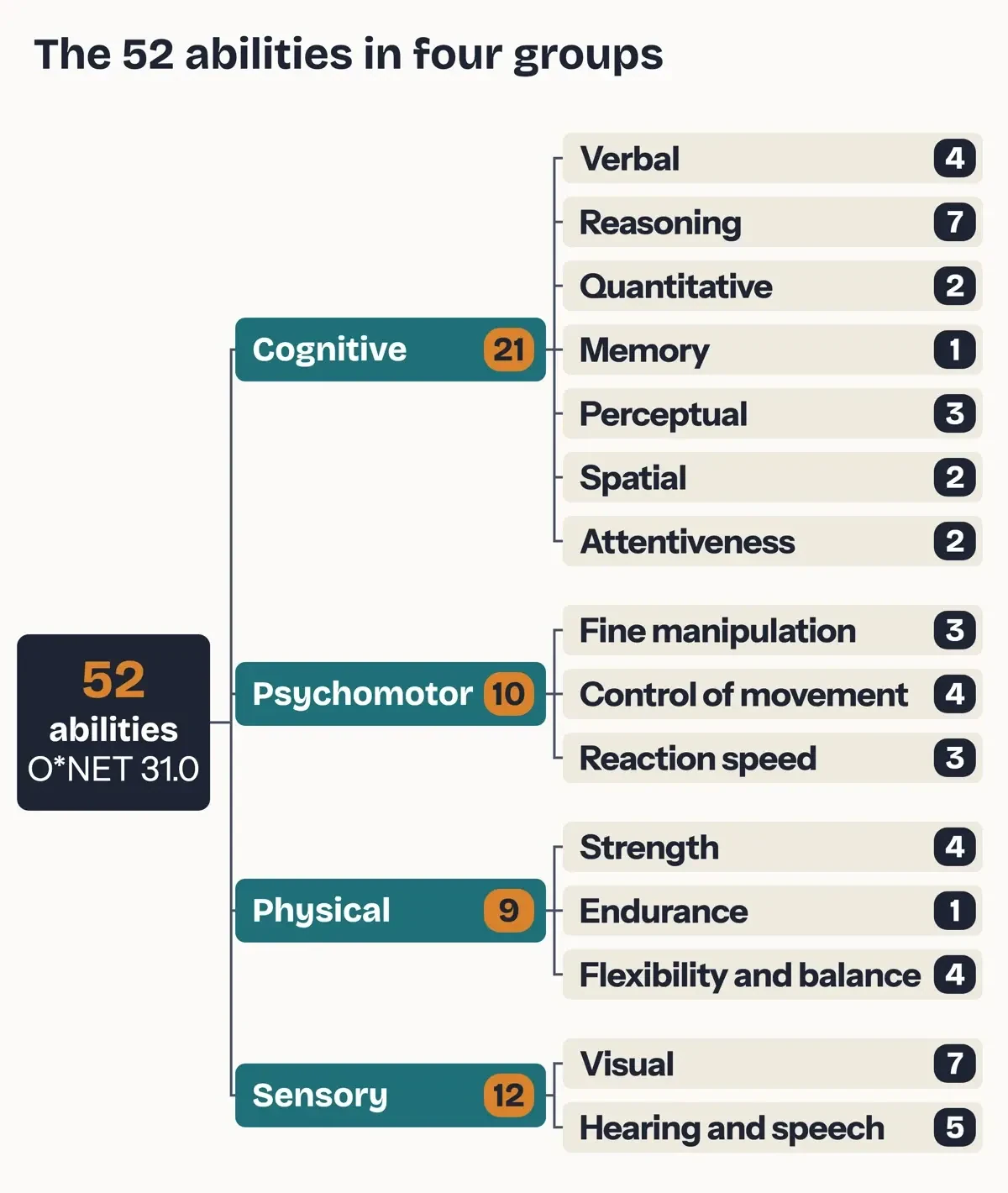 Diagram by DigitalTreed, from the O*NET 31.0 Content Model Reference file, read November 4, 2026.
Ability, skill and knowledge: O*NET's three lists
Unlike the 52 abilities, O*NET's skills come in two lists in version 31.0. Essential Skills are "skills you need for most jobs, such as reading, writing, math, and learning," and there are 10. Transferable Skills are "skills you can use across different jobs, such as communication, problem solving, and team work," and there are 25. That's 35 skills in all. Knowledge is a third list of 33, defined as "organized sets of principles and facts applying in general domains." The Content Model page counts 18,200 ratings for the ten essential skills alone, which is two scales for each of 910 occupations.
| List | Count in O*NET 31.0 | One example | O*NET's wording for that example |
|---|---|---|---|
| Abilities | 52 | Oral Expression | Communicate information and ideas in speaking so others will understand |
| Essential Skills | 10 | Speaking | Talking to others to convey information effectively |
| Transferable Skills | 25 | Persuasion | Persuading others to change their minds or behavior |
| Knowledge | 33 | English Language | Structure and content of the English language including the meaning and spelling of words, and rules of composition and grammar |
Speaking and Oral Expression look alike, but O*NET doesn't file them together. Speaking is a skill "developed through education and experience," while Oral Expression isn't: it's an ability O*NET calls enduring.
The federal government's hiring runs on the same three words. OPM's competencies page defines a competency as "a measurable pattern of knowledge, skills, abilities, behaviors, and other characteristics" that a person needs to do the work. Its job analysis page ties those words to hiring. A job analysis, OPM says, examines "the tasks performed in a job, the competencies required to perform those tasks, and the connection between the tasks and competencies." Its MOSAIC studies have identified "the critical competencies and tasks employees need to perform successfully" in nearly 200 federal occupations.
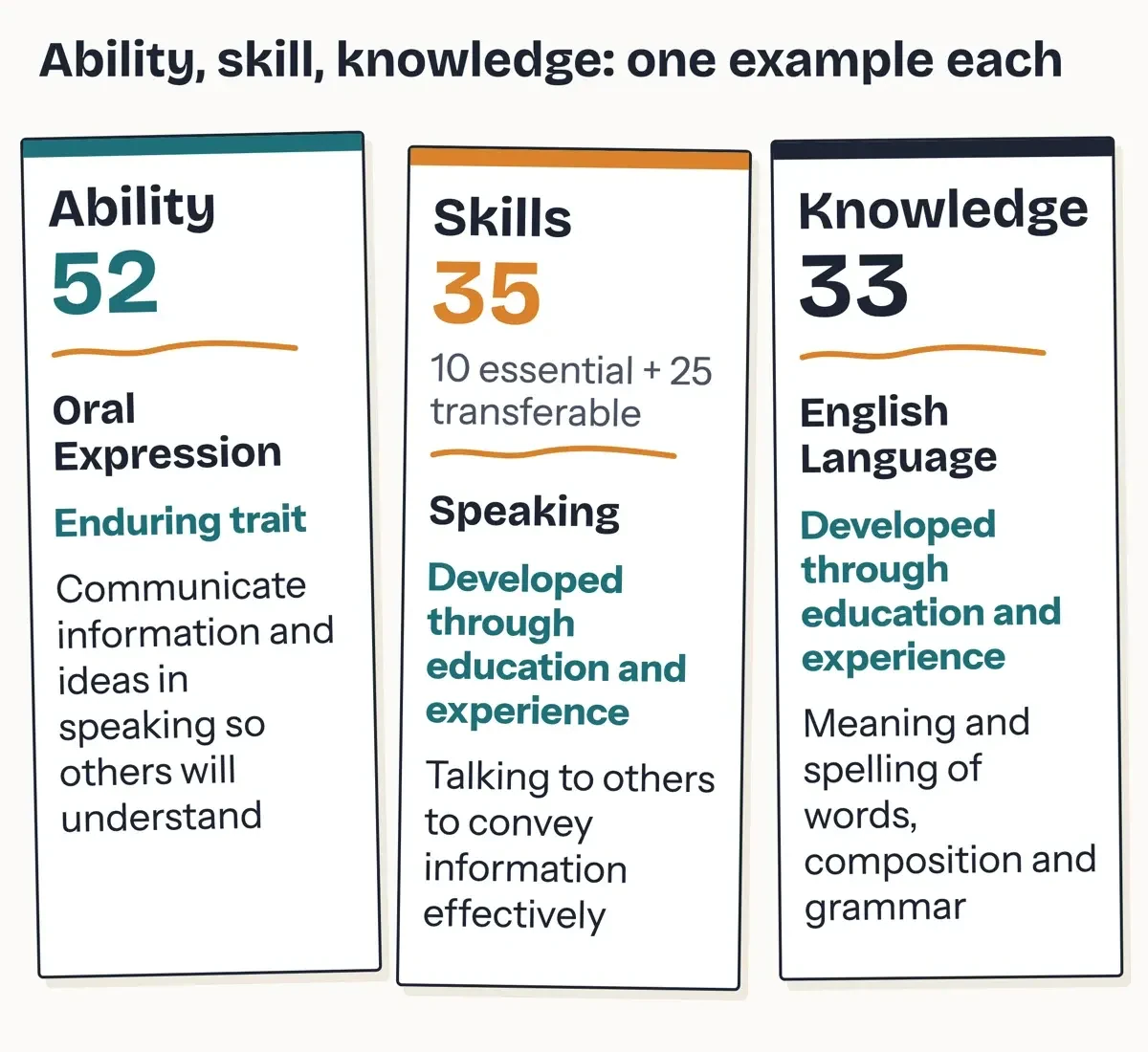 Diagram by DigitalTreed, from O*NET OnLine abilities, skills and knowledge pages, read November 4, 2026.
Cognitive abilities: 21 examples of abilities for thinking
Oral Expression, the ability that Speaking resembles, sits in the biggest group: 21 cognitive abilities that "influence the acquisition and application of knowledge in problem solving." The last column counts how many of 910 occupations rate each ability 3.0 or higher on O*NET's 1-5 importance scale.
| Ability | Sub-group | O*NET's definition, shortened | Jobs rating it 3.0+ (of 910) |
|---|---|---|---|
| Oral Comprehension | Verbal | Listen to and understand information and ideas in spoken words | 885 |
| Written Comprehension | Verbal | Read and understand information and ideas in writing | 753 |
| Oral Expression | Verbal | Speak so others understand your information and ideas | 868 |
| Written Expression | Verbal | Write so others understand your information and ideas | 645 |
| Fluency of Ideas | Reasoning | Come up with many ideas on a topic; the number counts, not quality | 474 |
| Originality | Reasoning | Come up with unusual or clever ideas, or creative ways to solve a problem | 411 |
| Problem Sensitivity | Reasoning | Tell when something is wrong or likely to go wrong (spotting, not solving) | 864 |
| Deductive Reasoning | Reasoning | Apply general rules to specific problems to get answers that make sense | 819 |
| Inductive Reasoning | Reasoning | Combine pieces of information into general rules or conclusions | 763 |
| Information Ordering | Reasoning | Arrange things or actions in an order or pattern by a rule | 847 |
| Category Flexibility | Reasoning | Make or use different sets of rules for grouping things | 717 |
| Mathematical Reasoning | Quantitative | Choose the right math method or formula for a problem | 261 |
| Number Facility | Quantitative | Add, subtract, multiply or divide quickly and correctly | 226 |
| Memorization | Memory | Remember words, numbers, pictures and procedures | 65 |
| Speed of Closure | Perceptual | Quickly make sense of information and organize it into patterns | 123 |
| Flexibility of Closure | Perceptual | Find a known pattern hidden in distracting material | 479 |
| Perceptual Speed | Perceptual | Quickly and accurately compare letters, numbers, objects, pictures or patterns | 401 |
| Spatial Orientation | Spatial | Know where you are in relation to your surroundings and objects | 25 |
| Visualization | Spatial | Picture how something will look after it is moved or rearranged | 373 |
| Selective Attention | Attentiveness | Concentrate on a task over time without getting distracted | 684 |
| Time Sharing | Attentiveness | Shift back and forth between two or more activities or sources of information | 130 |
The definitions are shortened, and you'll find O*NET's full wording on its abilities page. Two definitions come with limits. O*NET says Problem Sensitivity "does not involve solving the problem, only recognizing that there is a problem." Fluency of Ideas counts volume, since "the number of ideas is important, not their quality, correctness, or creativity." Memorization reaches 3.0 in only 65 of 910 occupations and Deductive Reasoning in 819, so on a resume, reasoning is a far more common match than memory. Spatial Orientation is rarer still, at 25. Mathematical Reasoning reaches 261 and Number Facility 226, so the math pair matters in under a third of jobs.
Psychomotor abilities: 10 for hand and movement control
Beyond reasoning and math, psychomotor abilities cover moving things. O*NET's Content Model says they "influence the capacity to manipulate and control objects," and it splits the 10 into fine manipulation, control of movement and reaction speed.
| Ability | Sub-group | O*NET's definition, shortened | Jobs rating it 3.0+ (of 910) |
|---|---|---|---|
| Arm-Hand Steadiness | Fine manipulation | Keep your hand and arm steady, moving or held in one position | 396 |
| Manual Dexterity | Fine manipulation | Quickly move your hand or hands to grasp, handle or assemble objects | 368 |
| Finger Dexterity | Fine manipulation | Make precise finger movements to handle or assemble very small objects | 349 |
| Control Precision | Control of movement | Quickly and repeatedly set machine or vehicle controls to exact positions | 317 |
| Multilimb Coordination | Control of movement | Coordinate two or more limbs while sitting, standing or lying down | 246 |
| Response Orientation | Control of movement | Pick quickly between movements in response to different signals | 54 |
| Rate Control | Control of movement | Time your movements to changes in speed or direction of a moving object | 95 |
| Reaction Time | Reaction speed | Respond quickly with hand, finger or foot when a signal appears | 146 |
| Wrist-Finger Speed | Reaction speed | Make fast, simple, repeated movements of fingers, hands and wrists | 9 |
| Speed of Limb Movement | Reaction speed | Move your arms and legs quickly | 7 |
Arm-Hand Steadiness reaches 3.0 in 396 occupations, more than any other psychomotor ability. The speed abilities barely register. Wrist-Finger Speed counts 9 occupations and Speed of Limb Movement 7. A posting that asks for fast hands names something O*NET doesn't rate important in most jobs.
One definition draws a border with the physical group: Multilimb Coordination "does not involve performing the activities while the whole body is in motion." A job that moves your whole body belongs under Gross Body Coordination instead.
Physical abilities: 9 for strength, stamina and balance
Unlike the psychomotor group, physical abilities aren't about objects; they're about the body itself. O*NET says they "influence strength, endurance, flexibility, balance and coordination."
| Ability | Sub-group | O*NET's definition, shortened | Jobs rating it 3.0+ (of 910) |
|---|---|---|---|
| Static Strength | Strength | Use maximum muscle force to lift, push, pull or carry | 171 |
| Explosive Strength | Strength | Use short bursts of force to jump, sprint or throw | 10 |
| Dynamic Strength | Strength | Use muscle force again and again, or continuously, over time | 42 |
| Trunk Strength | Strength | Use your abdominal and lower back muscles to support part of the body over time without tiring | 239 |
| Stamina | Endurance | Exert yourself physically for long periods without getting winded | 71 |
| Extent Flexibility | Flexibility and balance | Bend, stretch, twist or reach with your body, arms or legs | 154 |
| Dynamic Flexibility | Flexibility and balance | Bend, stretch, twist or reach quickly and repeatedly | 3 |
| Gross Body Coordination | Flexibility and balance | Coordinate arms, legs and torso while the whole body is moving | 30 |
| Gross Body Equilibrium | Flexibility and balance | Keep or regain your balance in an unstable position | 54 |
Trunk Strength reaches 3.0 in 239 occupations, ahead of Static Strength at 171 and Stamina at 71. Explosive Strength reaches it in 10 and Dynamic Flexibility in 3. So check the job's own O*NET page before a posting lists lifting. Heavy truck drivers, whose O*NET tasks include checking that cargo is secure, reach 3.0 on just one physical ability, Static Strength, and software developers don't reach it on any.
Sensory abilities: 12 for seeing, hearing and speech
Like the physical group, sensory abilities are about the body: your eyes, your ears and how clearly you speak. O*NET's group line reads "Abilities that influence visual, auditory and speech perception."
| Ability | Sub-group | O*NET's definition, shortened | Jobs rating it 3.0+ (of 910) |
|---|---|---|---|
| Near Vision | Visual | See details close up, within a few feet | 900 |
| Far Vision | Visual | See details at a distance | 399 |
| Visual Color Discrimination | Visual | Match or tell apart colors, shades and brightness | 195 |
| Night Vision | Visual | See in low light | 5 |
| Peripheral Vision | Visual | See objects or movement to your side while looking ahead | 10 |
| Depth Perception | Visual | Judge which object is closer, or how far away something is | 90 |
| Glare Sensitivity | Visual | See objects in glare or bright light | 11 |
| Hearing Sensitivity | Hearing and speech | Tell sounds apart by pitch and loudness | 80 |
| Auditory Attention | Hearing and speech | Focus on one sound with other sounds around it | 132 |
| Sound Localization | Hearing and speech | Tell which direction a sound came from | 1 |
| Speech Recognition | Hearing and speech | Identify and understand another person's speech | 818 |
| Speech Clarity | Hearing and speech | Speak clearly so others can understand you | 796 |
Seven of the twelve are visual and five cover hearing and speech. Both ends of our count sit here. Near Vision is rated 3.0 or higher in 900 of 910 occupations, while Sound Localization reaches it in just one: Sailors and Marine Oilers, 53-5011.00, at exactly 3.0. Speech Recognition (818) and Speech Clarity (796) both rank above Written Expression, at 645. Peripheral Vision reaches 3.0 in 10 occupations and Glare Sensitivity in 11, so most of the visual list doesn't matter outside a handful of jobs.
Examples of abilities in six real jobs
The table ranks six jobs' top five abilities by importance on the 1-5 scale. Each row shows the month O*NET last rated that job.
| Occupation and O*NET code | Abilities rated | Top 5 abilities by importance (1-5) |
|---|---|---|
| Registered Nurses, 29-1141.00 | August 2021 | Deductive Reasoning 4.12; Problem Sensitivity 4.12; Inductive Reasoning 4.00; Oral Comprehension 4.00; Oral Expression 4.00 |
| Heavy and Tractor-Trailer Truck Drivers, 53-3032.00 | August 2022 | Far Vision 4.12; Control Precision 3.88; Multilimb Coordination 3.88; Rate Control 3.88; Response Orientation 3.88 |
| Software Developers, 15-1252.00 | August 2025 | Deductive Reasoning 3.75; Near Vision 3.75; Oral Comprehension 3.75; Oral Expression 3.75; Problem Sensitivity 3.75 |
| Electricians, 47-2111.00 | August 2022 | Near Vision 4.00; Problem Sensitivity 4.00; Deductive Reasoning 3.88; Inductive Reasoning 3.88; Finger Dexterity 3.75 |
| Executive Secretaries and Executive Administrative Assistants, 43-6011.00 | July 2017 | Oral Comprehension 4.00; Oral Expression 4.00; Speech Recognition 4.00; Written Comprehension 4.00; Written Expression 4.00 |
| Air Traffic Controllers, 53-2021.00 | July 2014 | Problem Sensitivity 4.75; Oral Comprehension 4.62; Oral Expression 4.62; Selective Attention 4.50; Deductive Reasoning 4.38 |
The truck driver row is the odd one out. Four of its top five are psychomotor abilities. Far Vision leads at 4.12. Nurses and air traffic controllers lead with reasoning and speech, while electricians pair Near Vision and Problem Sensitivity at 4.00 with Finger Dexterity at 3.75 in fifth place. Our executive assistant job description lists the duties behind the 43-6011 ratings.
Read the dates before the numbers. Air Traffic Controllers were last rated in July 2014 and executive assistants in July 2017, while the software developer ratings are much newer, from August 2025. The file's dates run from December 2004 to August 2026. Ties are common, too. Software Developers have six abilities at 3.75. Their fifth spot is an alphabetical cut. Nurses, truck drivers and electricians also tie past fifth place. Across the file, 437 of 910 occupations share their top rating between two or more abilities. Old doesn't mean low, either: the 2014 air traffic controller ratings put Problem Sensitivity at 4.75, the highest score in our six-job table.
On each job's O*NET OnLine page, the abilities block lists these same five first, then a Show all link. In all six of our checks, the total it showed equaled the number of abilities rated 3.0 or higher in the file. That was 30 for nurses and 15 for software developers.
O*NET's scales help page explains the display score: "an original Importance rating score of 3 is converted to a standardized score of 50." By the same formula, a 4.12 shows as 78.
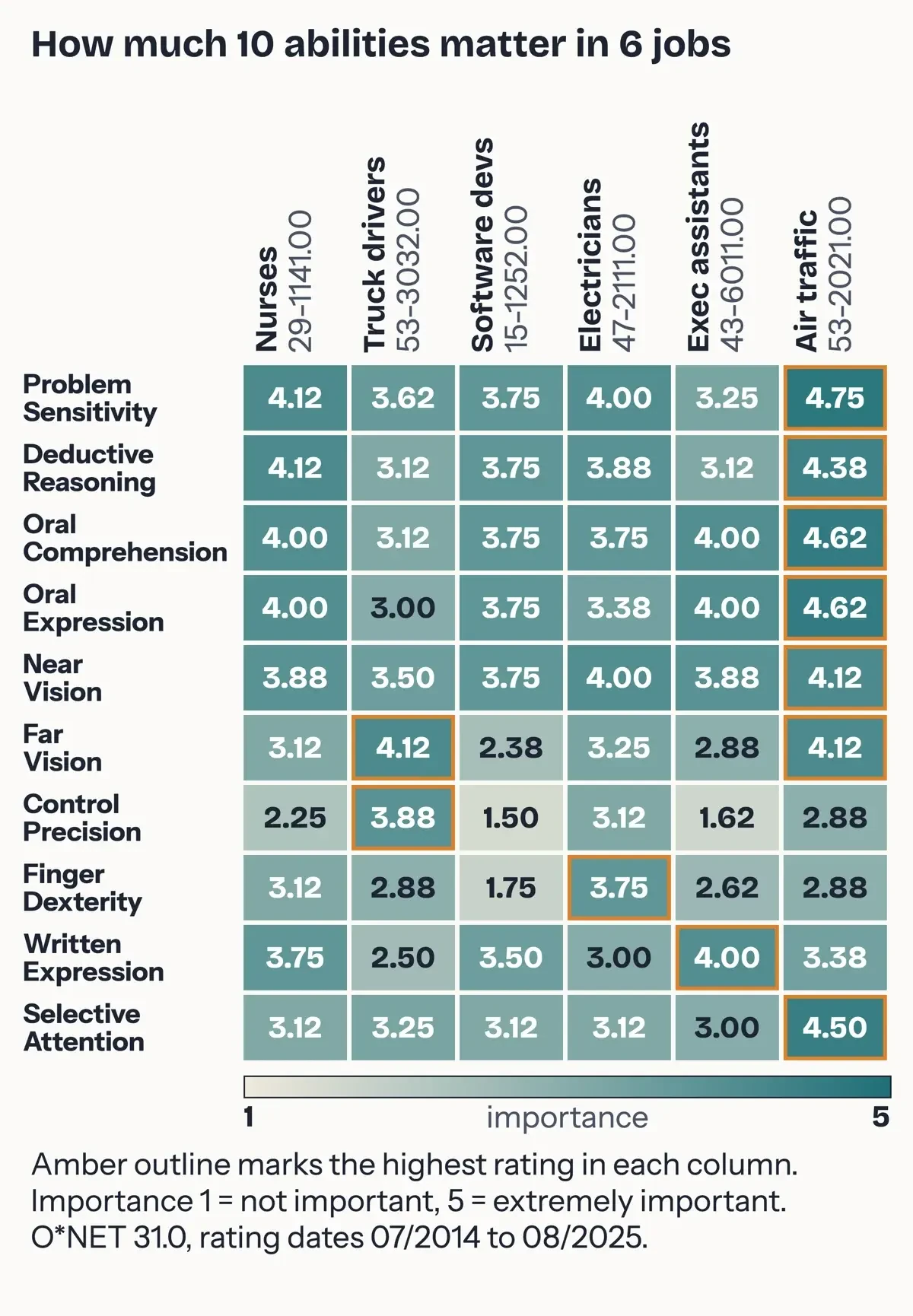 Source: O*NET 31.0 abilities file, August 2026 release, importance ratings 1-5; chart by DigitalTreed, November 4, 2026.
The abilities 900 of 910 jobs rate important
With the whole file loaded, we counted, for each ability, the occupations that rate it 3.0 or higher. That's a yes-or-no threshold, not an average, so an ability rated 3.0 in one job and 5.0 in another counts the same in both. Near Vision leads with 900 of 910. Then come Oral Comprehension (885), Oral Expression (868), Problem Sensitivity (864), Information Ordering (847) and Deductive Reasoning (819). Hearing abilities sit far lower on the same count, with Hearing Sensitivity at 80 occupations and Auditory Attention at 132, against 818 for Speech Recognition.
A second count asks which ability is each job's single highest-rated one, counting ties. Oral Expression tops 331 occupations and Oral Comprehension 315. Written Comprehension follows at 198 and Problem Sensitivity at 185.
Near Vision, rated important in 900 jobs, is the single top ability in only 180.
What we tested
On November 4, 2026 we saved four CSV files from O*NET's 31.0 database page with plain requests, and our own Python code read them. It counted 52 abilities, 21, 10, 9 and 12 by group, and found all 52 definitions word for word on O*NET OnLine and on the Content Model page. It confirmed 94,640 rows for 910 occupations, ranked the six jobs above and then wrote the small report page below, which we opened on 127.0.0.1. It's a static page and doesn't call any outside service.
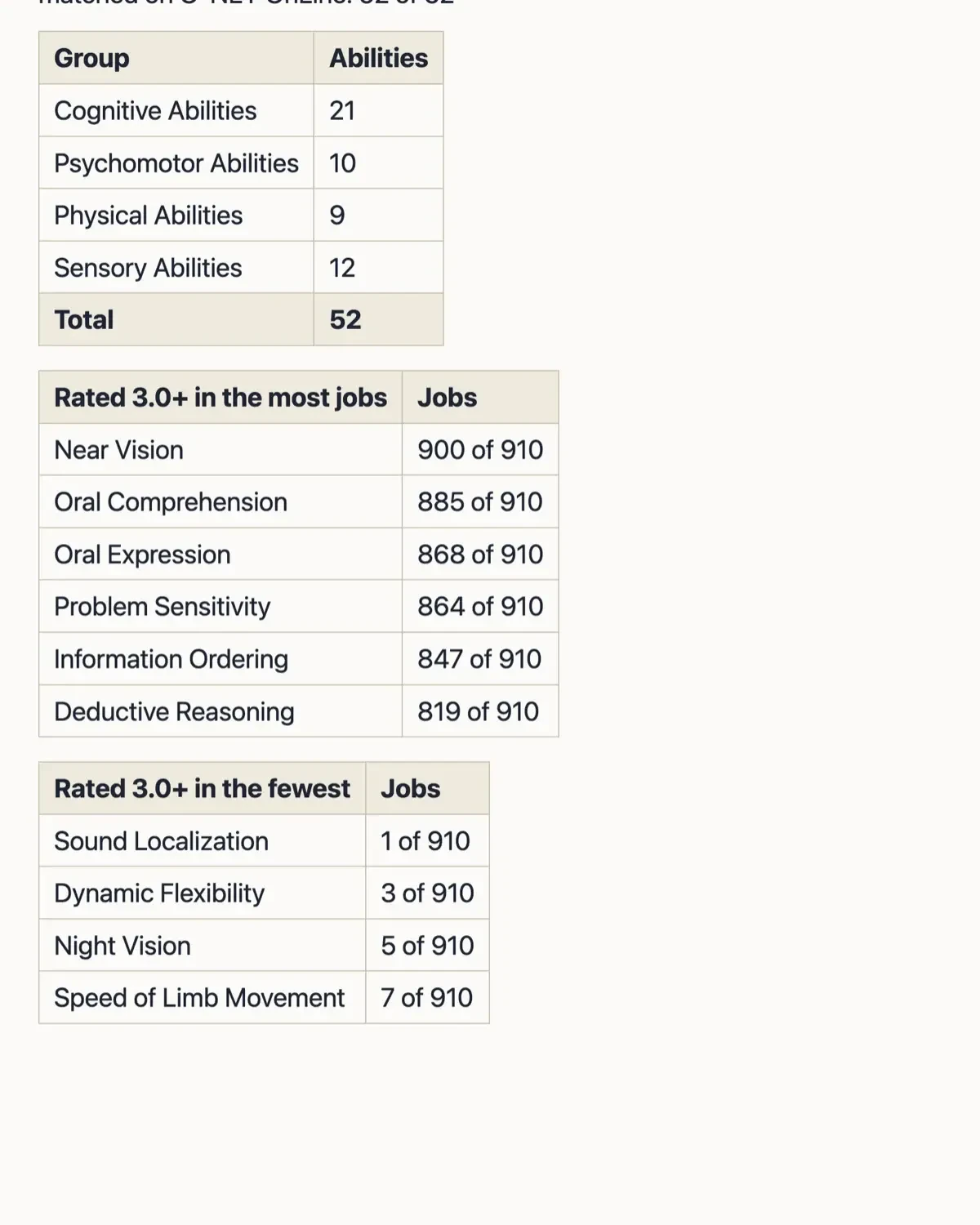 Screenshot: our O*NET abilities check page on 127.0.0.1, November 4, 2026.
Putting abilities on a resume
That data gives you resume words, but only for what you can back up. We've loaded every O*NET OnLine page in this guide without an account, so each step below is free:
- Search your target job title on O*NET OnLine and open its summary page, for example Registered Nurses, 29-1141.00.
- Read the Abilities block. The first five are the highest rated, and the Show all link lists the rest that the job rates 3.0 or higher.
- Pick two or three of those abilities that you can prove with something you did, and write one bullet for each.
- Use O*NET's name for an ability in your summary or skills line only when a bullet below shows it.
- Leave out abilities your target job doesn't list, even if they're true of you.
Example (made up) of a step 3 bullet for a nurse: "Caught a medication-timing error at shift handoff and flagged it before the next dose."
That bullet shows Problem Sensitivity, which O*NET rates 4.12 for registered nurses, and it doesn't use the term at all. A skills line full of O*NET terms with no bullet behind any of them gives a hiring manager nothing to check, so the bullet has to do the proving. Our ATS-friendly resume guide covers the formatting that applicant tracking software can read.
Writing abilities into a job description
For employers, the ADA text on eeoc.gov says its job rules cover employers with "15 or more employees for each working day in each of 20 or more calendar weeks." For them, a job description isn't just an ad; it can turn into evidence. The ADA text on ada.gov says a description prepared "before advertising or interviewing applicants for the job" shall be "considered evidence of the essential functions of the job."
The regulation at 29 CFR 1630.2(n) defines essential functions as "the fundamental job duties of the employment position." They don't include "the marginal functions of the position." The EEOC's guide for employers lists other evidence it looks at, such as "the time spent performing a function." The rule itself says a function may be essential because "the reason the position exists is to perform that function." So we'd write each duty first and then name the ability it needs in O*NET's terms, which keeps the posting tied to the work itself. We're not lawyers, and this section isn't legal advice. It's worth having an employment lawyer review a posting before it runs.
In a trucking posting, one duty line could read: "Drive a tractor-trailer on interstate routes (Far Vision, Control Precision)." Both sit in the top five on O*NET's heavy truck driver page.
Our COO job description shows how to tag each duty essential or marginal, and the hiring manager guide covers the steps after the ad goes up. For the pay line, our business development director job description writes a base-plus-commission range, and our competitive pay guide checks a salary against BLS data.
What we'd do with the list
Our take: use the 52 as a vocabulary, not a checklist. If you're job hunting, pick the two or three abilities your target job rates highest and prove each one in a bullet. If you're hiring, tie every ability in the posting to a duty, the way our senior accountant job description builds its duties from O*NET task statements. And check the rating date before you quote a number, since 31.0 still carries ratings from December 2004. When two jobs you're weighing share an ability, compare the level ratings too. O*NET's scales page says people find it "particularly difficult to understand the difference between Importance and Level."
If you're a student, you can start one step earlier with our career guidance for teens. For a lighter look at what employers call these roles, there's our list of funny job titles.
Frequently asked
How do importance and level differ in O*NET?
Importance says how much an ability matters to a job, from "Not Important" (1) to "Extremely Important" (5). Level says how much of it the job needs, on a 0-7 scale. O*NET's scales help page uses Speaking: lawyers sit at a level of 70 and paralegals at 54 on its 0-100 display, and 85 means "Argue a legal case before the Supreme Court."
How often does O*NET update ability ratings?
O*NET's database page says it updates "on a quarterly basis," with the main update each year in the third quarter. The 31.0 release added or updated Abilities, Essential Skills and Transferable Skills data for 157 occupations. The release archive dates 30.2 to February 2026 and 31.0 to August 2026.
Can I copy O*NET's list of abilities into my own document?
Yes, with credit. The O*NET license page says the 31.0 database is "licensed under a Creative Commons Attribution 4.0 International License." You'll need a credit line too: the page says to "credit the O*NET 31.0 Database and the U.S. Department of Labor, Employment and Training Administration."
How we made this guide: We saved O*NET's 31.0 abilities, content model, occupation and scale files on November 4, 2026. Our own script counted the abilities and ranked six jobs from that file. Definitions, OPM wording and the ADA lines are quoted from 24 pages we saved that day from O*NET, OPM, the EEOC, ADA.gov and Cornell's legal library. Every quote here matches one of those copies. CareerOneStop's resume pages refused our checker, so they aren't used. Facts checked by the DigitalTreed team on November 4, 2026.
First published in March 2025 with 45 unsourced abilities. Rewritten November 4, 2026 around O*NET's official 52, with ratings from the August 2026 data release.
Sources
- O*NET OnLine: Browse by Abilities
- O*NET Resource Center: The O*NET Content Model
- O*NET 31.0 Data Dictionary: Abilities
- O*NET Resource Center: Database Releases Archive
- O*NET Resource Center: O*NET 31.0 Database
- O*NET Resource Center: Database license
- O*NET OnLine: Browse by Essential Skills
- O*NET OnLine: Browse by Transferable Skills
- O*NET OnLine: Browse by Knowledge
- O*NET OnLine Help: Scales, Ratings, and Standardized Scores
- O*NET OnLine: Registered Nurses, 29-1141.00
- O*NET OnLine: Heavy and Tractor-Trailer Truck Drivers, 53-3032.00
- O*NET OnLine: Software Developers, 15-1252.00
- O*NET OnLine: Electricians, 47-2111.00
- O*NET OnLine: Executive Secretaries and Executive Administrative Assistants, 43-6011.00
- O*NET OnLine: Air Traffic Controllers, 53-2021.00
- OPM: Competencies
- OPM: Job Analysis
- EEOC: Titles I and V of the Americans with Disabilities Act of 1990
- ADA.gov: Americans with Disabilities Act of 1990, as amended
- Cornell LII: 29 CFR 1630.2, Definitions
- EEOC: The ADA, Your Responsibilities as an Employer


Comments
No comments yet. Start the conversation below.