

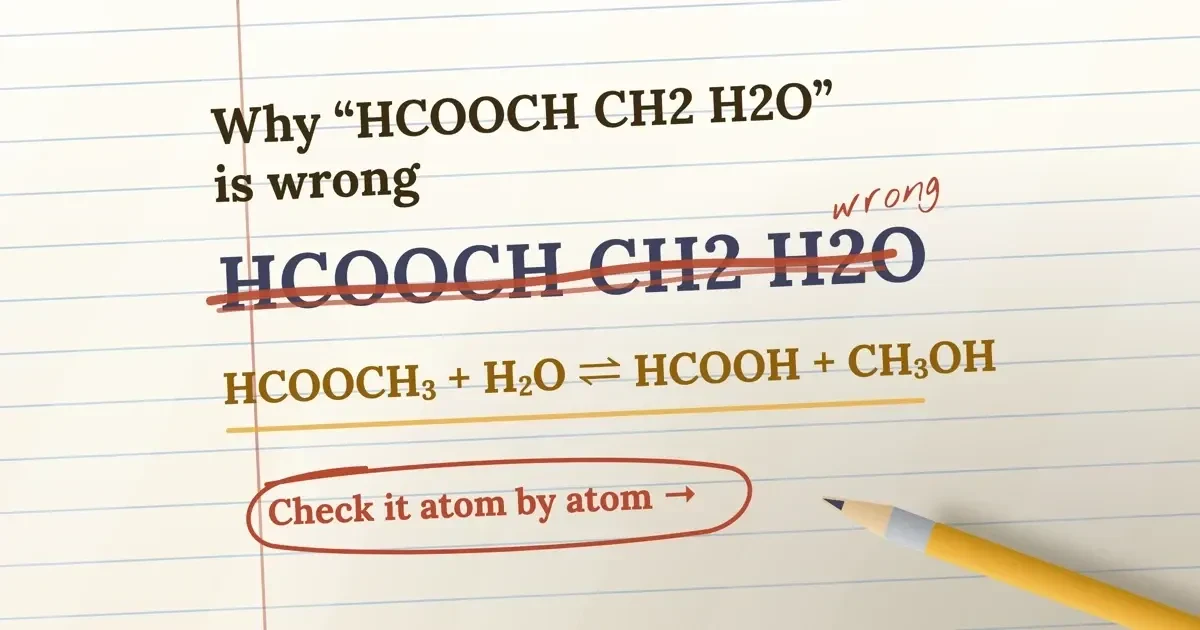
Quick answer
The string "HCOOCH CH2 H2O" isn't a valid reaction. It's missing an arrow, and its atoms add up to C₃H₆O₃, one carbon more than methyl formate plus water. The real equation is HCOOCH₃ + H₂O ⇌ HCOOH + CH₃OH, with 78.07 g/mol on each side by PubChem masses as of November 2026. In base, the products become a formate salt and methanol.
If a homework app or a forum post handed you "HCOOCH CH2 H2O", don't copy it into your notes yet: it has no arrow and the wrong number of carbons. Methyl formate is the methyl ester of formic acid, and methyl formate hydrolysis is its reaction with water. We counted every atom in the string and in the real equation with a small Python script.
The typed string gets its atom count first, then the balanced equation with its masses. Acid-catalyzed and base-promoted hydrolysis give different products, so they share a side-by-side table. The rate and equilibrium section reruns a PubChem half-life, the uses come from PubChem records, and the safety limits come from NIOSH and OSHA. Then you can check any reaction string with the seven tests we ran. The last two sections cover what the results mean for homework and which facts held up in the primary sources.
Key takeaways
- The typed string holds C₃H₆O₃, one carbon more than the real reactants.
- Methyl formate plus water gives formic acid and methanol, and the reaction is reversible.
- Sodium hydroxide turns the products into sodium formate and methanol, with no way back.
- NIOSH puts the flash point of methyl formate at -2°F, below room temperature.
- PubChem's pH 8 half-life doesn't follow from its own rate constant.
What is wrong with "HCOOCH CH2 H2O"?
A chemical equation needs an arrow, and this string doesn't have one. OpenStax Chemistry 2e, section 4.1 explains that the arrow separates the reactant side from the product side, with plus signs between species. "HCOOCH CH2 H2O" has three chunks separated by spaces and nothing else, so it doesn't say what's turning into what.
The chunks themselves don't hold up. HCOOCH is methyl formate without the 3 after its last H. That leaves a carbon short of bonds. CH2 on its own is methylene, the simplest carbene. The OpenStax organic chemistry text says a carbene "is a neutral molecule containing a divalent carbon with only six electrons in its valence shell." It's made only as a short-lived intermediate, so it isn't something you'd list as a reactant. Our script added up the three chunks anyway: C₂H₂O₂ for HCOOCH, CH₂ and H₂O, for a total of C₃H₆O₃. Methyl formate plus water holds C₂H₆O₃, so there's one carbon too many in the typed string.
Oddly, C₃H₆O₃ is exactly what you'd get from vinyl formate (HCOOCH=CH₂, C₃H₄O₂ on its PubChem record) plus water. By the general ester rule in OpenStax, that ester would split into formic acid and vinyl alcohol, which is C₂H₄O per PubChem. Vinyl alcohol is an enol, and OpenStax's section on alkyne hydration says an enol "immediately rearranges into a ketone by a process called keto–enol tautomerism." For C₂H₄O, the carbonyl form is acetaldehyde, which shares that formula on PubChem.
We can't prove it, but our guess is plainer. Someone dropped the 3 and the plus sign from HCOOCH₃ + H₂O, and copies spread from there.
Made-up terms spread that way too, as our check of the made-up creature Qxefv found. Before you copy a formula from an app, compare it with the compound's PubChem record. Methyl formate's says C₂H₄O₂.
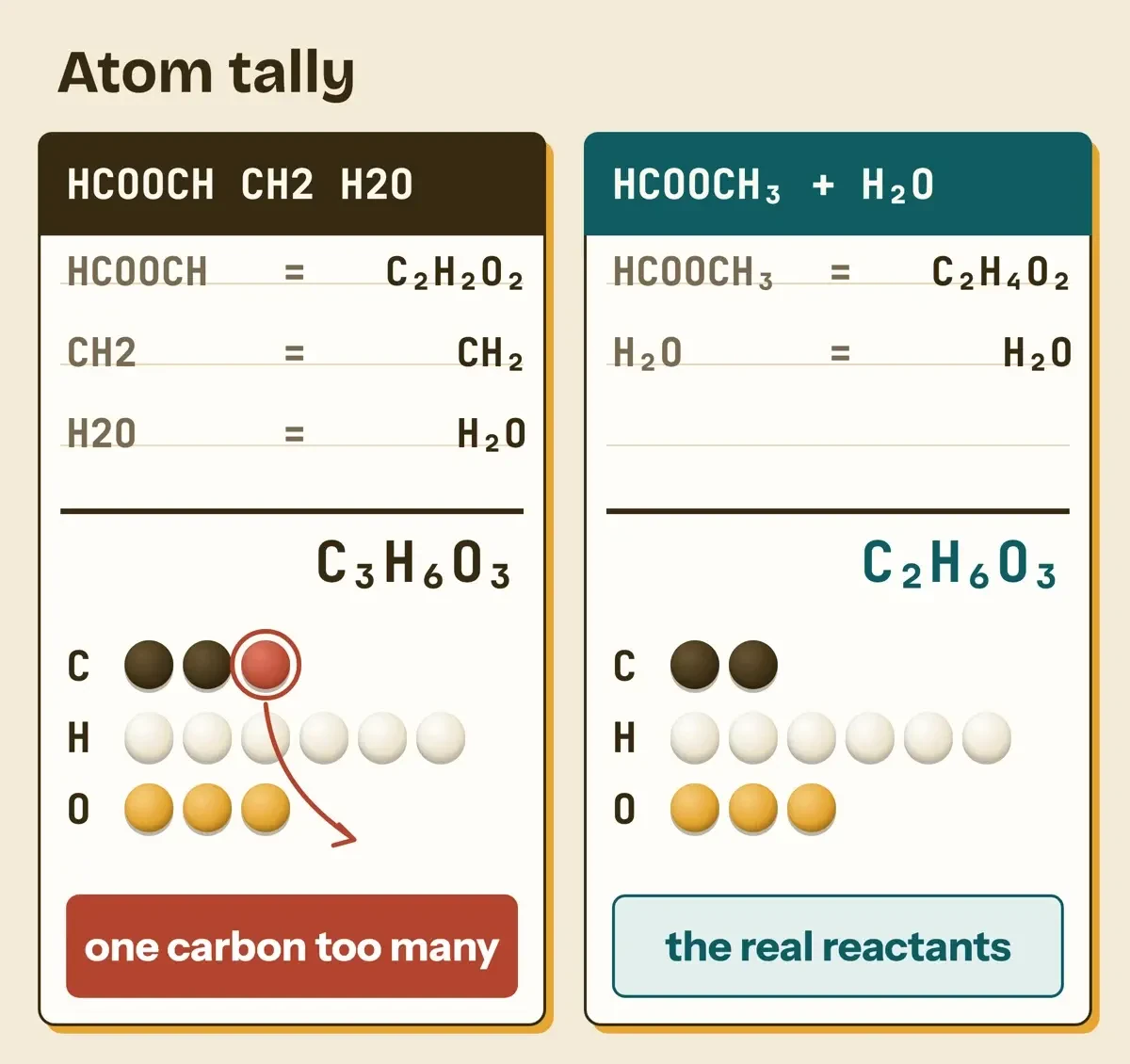 Diagram by DigitalTreed: atom counts from our test/atom_balance.py run on November 15, 2026, with formulas from PubChem.
The balanced equation for methyl formate hydrolysis
Once the 3 and the plus sign go back in, the reaction reads HCOOCH₃ + H₂O ⇌ HCOOH + CH₃OH. The NIOSH Pocket Guide entry for methyl formate puts it in plain words: it "Reacts slowly with water to form methanol & formic acid."
The double arrow means both directions run, slowly: PubChem estimates a 5.1-day half-life at pH 7.
Balanced means each element has the same count on both sides. OpenStax calls that "a requirement the equation must satisfy to be consistent with the law of conservation of matter." Here the left side holds 2 carbons, 6 hydrogens and 3 oxygens. So does the right. Every coefficient is 1, so none is written. Using each compound's molar mass from its PubChem record, both sides come to 78.07 g/mol, and our script matched that from PubChem's periodic table within 0.003 g/mol.
| Species | Formula | Molar mass (PubChem) | Side |
|---|---|---|---|
| Methyl formate | C₂H₄O₂ | 60.05 g/mol | Reactant |
| Water | H₂O | 18.015 g/mol | Reactant |
| Formic acid | CH₂O₂ | 46.025 g/mol | Product |
| Methanol | CH₄O | 32.042 g/mol | Product |
| Total each side | C₂H₆O₃ | 78.07 g/mol (60.05 + 18.015 = 46.025 + 32.042, rounded) | Both |
The NIST Chemistry WebBook lists methyl formate at 60.0520 g/mol, and that's PubChem's figure to two decimals. If you're posting the equation online, write the subscripts as real characters or HTML codes. Our guide to HTML symbol codes shows how, so H₂O displays a real subscript instead of reading H2O.
Acid-catalyzed vs base-promoted hydrolysis
That equation is what you get in acid or plain water. With sodium hydroxide present, the acid ends up as a salt. OpenStax Organic Chemistry, section 21.6 gives the general rule: "An ester is hydrolyzed, either by aqueous base or aqueous acid, to yield a carboxylic acid plus an alcohol."
In acid, a small amount of strong acid speeds things up, and it isn't used up. OpenStax says the usual acid pathway "is just the reverse of a Fischer esterification reaction." The carbonyl oxygen picks up a proton, water adds to the carbon, a proton moves and methanol leaves. Formic acid remains. Each step can reverse. In base, hydroxide attacks instead. It adds to the carbonyl carbon, methoxide leaves, and the formic acid that forms then loses its proton to become formate. So HCOOCH₃ + NaOH → HCOONa + CH₃OH gives sodium formate (CHNaO₂, 68.007 g/mol) and methanol, and our checker found that equation balanced too.
The LibreTexts organic chemistry text explains why the base route is one-way: carboxylate ions are "very unreactive toward further nucleophilic substitution which makes the reaction irreversible." Because a full equivalent of hydroxide gets used up, that page calls the route base-promoted, not base-catalyzed. Base hydrolysis of an ester is also called saponification, after the Latin sapo, which means soap.
| Point | Acid-catalyzed | Base-promoted (saponification) |
|---|---|---|
| What attacks the ester | Water, after acid protonates the carbonyl | Hydroxide ion |
| Products from methyl formate | Formic acid + methanol | Formate salt + methanol |
| Can it reverse? | Yes, it's an equilibrium | No, the carboxylate doesn't react back |
| Is the acid or base used up? | No, it's a catalyst | Yes, one hydroxide per ester |
On a worksheet with no conditions, write formic acid and methanol; with NaOH or KOH, write the formate salt.
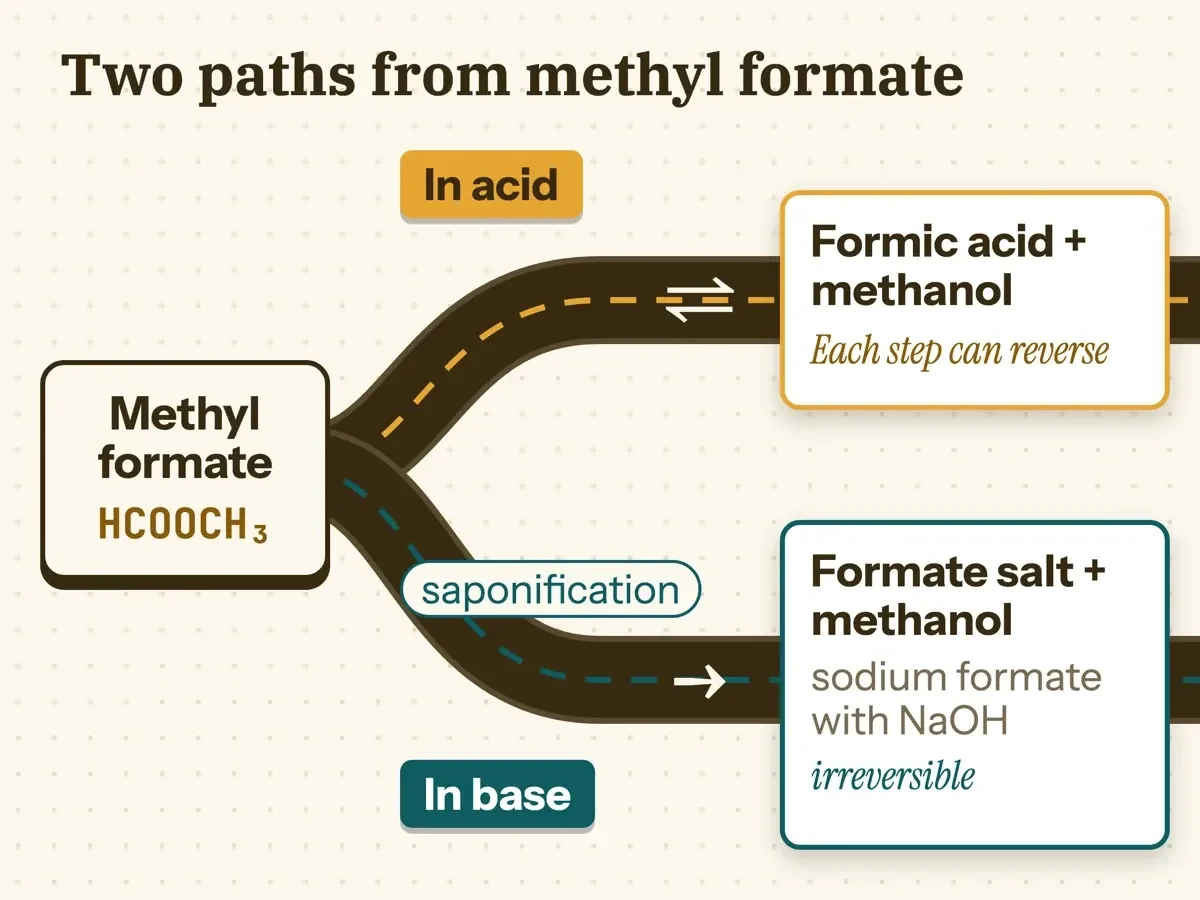 Diagram by DigitalTreed: acid and base hydrolysis of methyl formate, from OpenStax Organic Chemistry 21.6 and LibreTexts 21.6.
What sets the rate and the equilibrium
Equilibrium sets how far it goes. OpenStax section 21.3 says of Fischer esterification, the reverse reaction: "All steps are reversible, and the reaction typically has an equilibrium constant close to 1." Acid formation is favored "when a large excess of water is present," it adds.
That's Le Chatelier's principle. OpenStax Chemistry 2e, section 13.3 explains that adding a reactant speeds the forward reaction until a new equilibrium forms, and adding product pushes the other way. Lots of water drives methyl formate toward formic acid and methanol, while lots of methanol drives it back toward the ester. Speed's a separate matter. The OpenStax chapter on reaction rates says reactions "typically occur faster at higher temperatures," with many rates roughly doubling for each 10°C rise. Higher concentrations and catalysts raise it too, and the LibreTexts page says base hydrolysis is "typically faster than an acid catalyzed hydrolysis" because hydroxide's the better attacker.
PubChem's methyl formate record gives a number: an estimated base-catalyzed rate constant of 16 L/mol-s. It says this "corresponds to half-lives of 5.1 and 12 days at pH values of 7 and 8, respectively." It isn't a lab measurement; the value comes from a structure estimation method. When we reran the arithmetic, the pH 7 figure held and the pH 8 figure didn't. The half-life is ln 2 divided by k times the hydroxide concentration. At pH 7 and 25°C, that concentration is 10⁻⁷ mol/L. That gives about 5.0 days, close to PubChem's 5.1. At pH 8 it's ten times higher. By our arithmetic, that's about 12 hours, while the record says 12 days.
A tenfold rise in hydroxide should cut the half-life tenfold, so if you cite this record, use the pH 7 figure and recheck the pH 8 line.
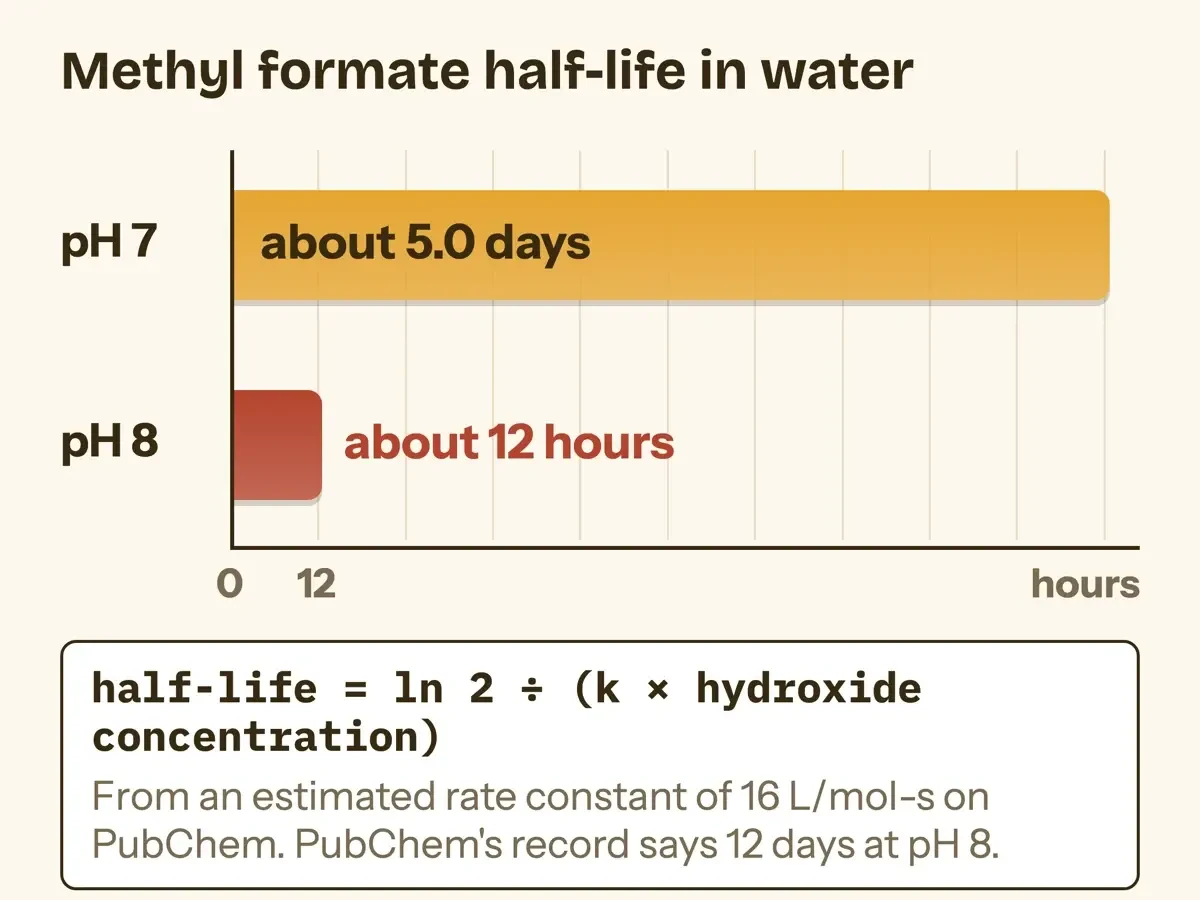 Drawn by us: half-lives computed in test/atom_balance.py from the rate constant on PubChem's methyl formate record, November 15, 2026.
Where methyl formate hydrolysis is used
Beyond homework, the reaction is one route to formic acid, and as of November 2026 PubChem was the only open source we found for it. Its formic acid record describes it as "a two-stage process." First, "methanol is carbonylated with carbon monoxide; in the second stage, methyl formate is hydrolyzed to formic acid and methanol." The first stage gets its own line on the methyl formate record: "Methyl formate is produced by base-catalyzed carbonylation of methanol." The same section lists a route using methanol, carbon monoxide and steam at 200°C and 200 atmospheres. Those are factory conditions, reported here only as PubChem gives them in November 2026.
PubChem's uses section for formic acid cites ACGIH: it's "Used in electroplating, brewing, and mirror silvering; also used in the dyeing and finishing of textiles, paper, and leather." Methanol's PubChem record says it "is primarily used as an industrial solvent for inks, resins, adhesives, and dyes." Methyl formate itself works as a solvent, a fumigant and a blowing agent for foam insulation, per the ACGIH line on its record.
The body runs the same reaction. PubChem's metabolism section states that "Methyl formate is biotransformed via hydrolysis in the body to yield methanol and formic acid."
Safety facts from NIOSH and OSHA
Those three chemicals each have an entry in NIOSH's Pocket Guide to Chemical Hazards. Nothing in this article is a lab procedure, and it doesn't give amounts to mix. Hands-on work belongs in a supervised lab that follows its own safety data sheets.
Methyl formate boils near room temperature. Its NIOSH entry gives a boiling point of 89°F and adds "A gas above 89°F," so a warm room can turn it to vapor. PubChem lists 31.5°C to 32°C from several sources, and NIST's average of 20 values is 305 K, about 32°C.
NIOSH's Pocket Guide also prints each OSHA limit, and the table copies both as of November 2026.
| Chemical | NIOSH REL (8-hour TWA) | OSHA PEL (8-hour TWA) | IDLH | Flash point |
|---|---|---|---|---|
| Methyl formate | 100 ppm (short-term 150 ppm) | 100 ppm | 4,500 ppm | -2°F |
| Formic acid | 5 ppm | 5 ppm | 30 ppm | 122°F (90% solution, open cup) |
| Methanol | 200 ppm (short-term 250 ppm, skin) | 200 ppm | 6,000 ppm | 52°F |
The flash points of methyl formate and methanol, -2°F and 52°F, sit below normal room temperature; NIOSH calls methyl formate a Class IA flammable liquid. Formic acid has the strictest limit. At 5 ppm, it's 20 times lower than methyl formate's 100 ppm. NIOSH lists symptoms for each one too. Methyl formate's include eye and nose irritation, chest tightness and visual disturbance. Formic acid can cause skin burns and is "Corrosive to metals." For methanol, the list runs to optic nerve damage, with blindness named.
Check a reaction string atom by atom
The count works on any equation a homework app shows you. Our script splits a string at the arrow and the plus signs and counts each element on both sides. It folds subscripts like ₂ into plain digits with Unicode NFKC, a step explained in our Python string comparison guide.
What we tested
On November 15, 2026, we ran test/atom_balance.py on seven strings with no network access. Five came out balanced. One didn't, and the typed string itself was flagged as not an equation.
| String we tested | Left side | Right side | Result |
|---|---|---|---|
| HCOOCH CH2 H2O | C₃H₆O₃ (all chunks) | none | Not an equation |
| HCOOCH + CH2 + H2O → HCOOH + CH3OH | C₃H₆O₃ | C₂H₆O₃ | Not balanced, 1 C missing |
| HCOOCH3 + H2O → HCOOH + CH3OH | C₂H₆O₃ | C₂H₆O₃ | Balanced |
| HCOOCH₃ + H₂O → HCOOH + CH₃OH | C₂H₆O₃ | C₂H₆O₃ | Balanced |
| HCOOCH3 + NaOH → HCOONa + CH3OH | C₂H₅NaO₃ | C₂H₅NaO₃ | Balanced |
| HCOOCH=CH2 + H2O → HCOOH + CH2=CHOH | C₃H₆O₃ | C₃H₆O₃ | Balanced |
| HCOOCH3 → HCOOH + CH2 | C₂H₄O₂ | C₂H₄O₂ | Balanced, but CH₂ is a carbene |
The last row matches atom for atom. Still, no stable product called CH₂ comes out of a flask.
What the seven results mean for your homework
They point to three habits. A string with no arrow can't be judged at all. Add the arrow first. A string that drops a subscript, like HCOOCH for HCOOCH₃, shows up as a carbon or hydrogen gap. And a balanced string can still name a molecule you won't find in a bottle, like the CH₂ in the last row. Only the chemistry catches that. Pasted text often hides stray spaces and odd characters; if you adapt the script, our Python whitespace trimming guide covers that cleanup. Here are six of our seven strings in plain text, one per line, for your own checker or a notebook (the seventh repeats the hydrolysis with subscripts):
- HCOOCH CH2 H2O
- HCOOCH + CH2 + H2O -> HCOOH + CH3OH
- HCOOCH3 + H2O -> HCOOH + CH3OH
- HCOOCH3 + NaOH -> HCOONa + CH3OH
- HCOOCH=CH2 + H2O -> HCOOH + CH2=CHOH
- HCOOCH3 -> HCOOH + CH2
Each string in that list works like a unit test: a fixed input, an expected count, and a pass or fail. That's the testing stage from our software engineering basics guide, shrunk to one script. The script doesn't need anything beyond Python's standard library. To extend it, our guide to programming languages by goal shows where Python fits. For typing formulas into notes, our computer shortcuts for students cover Windows, Mac and Chromebook.
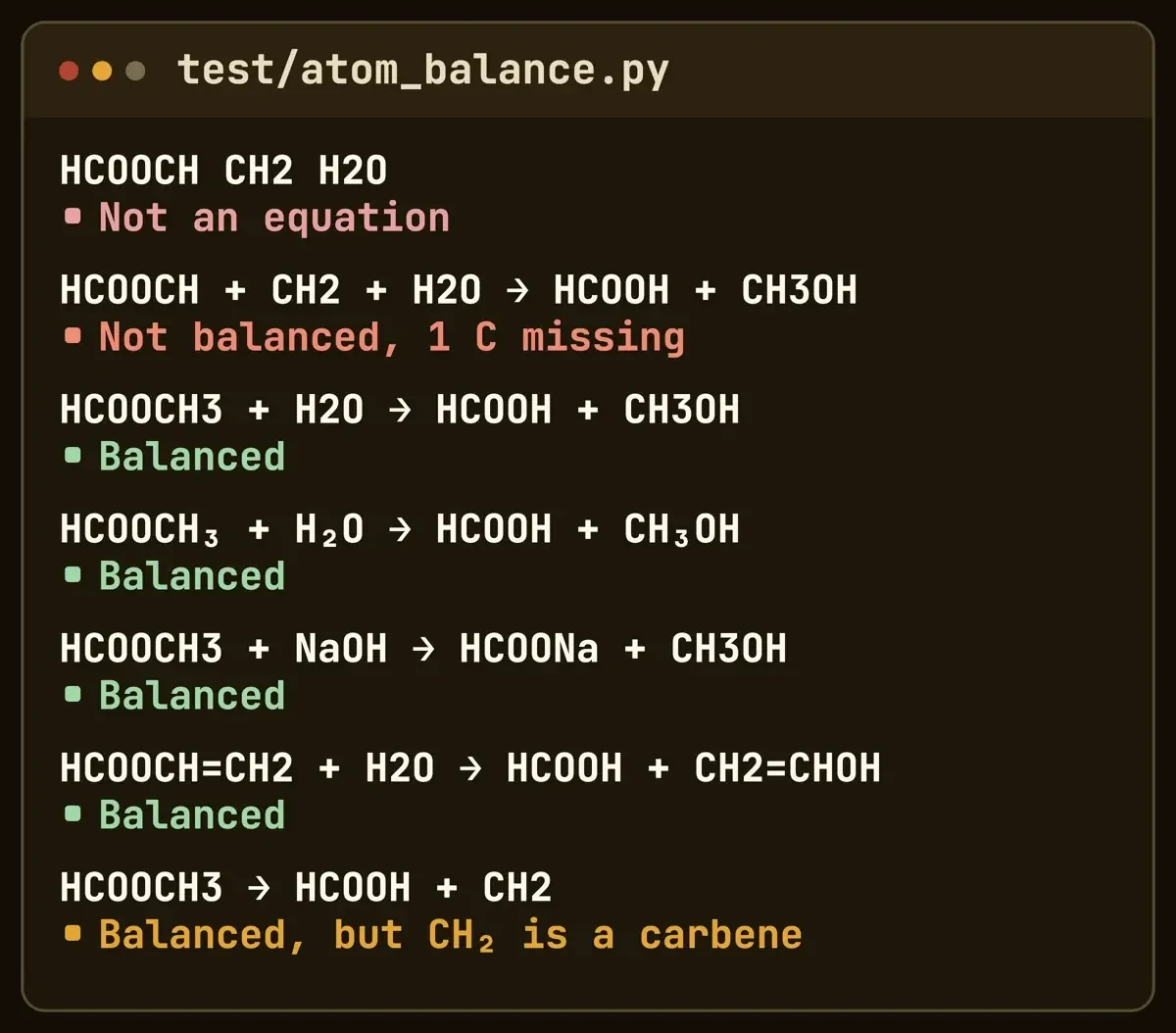 Drawn by us: results of test/atom_balance.py on November 15, 2026, from test/results.json.
Which facts held up in the primary sources
Beyond the script's counts, every fact here comes from pages we saved as text on November 15, 2026. Methyl formate's formula and molar mass matched on both PubChem and NIST, and the formulas for formic acid and methanol matched on PubChem and on NIOSH. The boiling point matched across PubChem, NIST and NIOSH, while each NIOSH limit sits on one page; the methyl formate page was last reviewed October 30, 2019.
We couldn't confirm three things. There's no open primary page we found with an equilibrium constant for methyl formate itself, so we've cited only the textbook value for ester reactions in general. The two-stage formic acid route has one open source, PubChem, and no second open page turned up. And PubChem's pH 8 half-life doesn't follow from its own rate constant.
Before an exam, check which notation your textbook uses, HCOOCH₃ or HCO₂CH₃. Before any lab work, read the safety data sheet your lab provides. For a test answer, write HCOOCH₃ + H₂O ⇌ HCOOH + CH₃OH in acid or water. In base, it's HCOOCH₃ + NaOH → HCOONa + CH₃OH.
Frequently asked
Does methyl formate dissolve in water?
Partly. The NIOSH Pocket Guide lists its solubility at 30%, and it reacts slowly with the water it dissolves in.
What is the molar mass of methyl formate?
The NIST WebBook gives 60.0520 g/mol for C₂H₄O₂, CAS number 107-31-3.
How do you get formic acid back after base hydrolysis?
OpenStax section 21.6 says aqueous HCl, added in a separate step, protonates the carboxylate and gives the carboxylic acid.
Is HCOOCH3 the same as HCO2CH3?
Yes. Both describe methyl formate, C₂H₄O₂; NIOSH writes it HCOOCH₃ and lists methyl methanoate as a synonym.
How we made this guide: On November 15, 2026, we saved PubChem, NIST, NIOSH, OpenStax and LibreTexts pages as text and ran a local atom-count script on seven strings. Facts checked by the DigitalTreed team on November 15, 2026.
First published March 2025 as an informal explainer of methyl formate hydrolysis. Rewritten November 15, 2026: atom counts for the typed string, the balanced equation, acid vs base routes, rate and equilibrium, uses and NIOSH safety limits, each linked to its source. Unsourced claims and unrelated links were cut.
Sources
- PubChem: Methyl formate, CID 7865 (properties, uses, manufacturing, metabolism, abiotic degradation)
- PubChem: Formic acid, CID 284 (manufacturing, uses)
- PubChem: Methanol, CID 887; Water, CID 962
- PubChem: Sodium formate, CID 2723810
- PubChem: Vinyl formate, CID 222465; Vinyl alcohol, CID 11199; Acetaldehyde, CID 177
- PubChem: Periodic table (atomic weights)
- NIST Chemistry WebBook: Methyl formate, phase change data
- NIOSH Pocket Guide: Methyl formate
- NIOSH Pocket Guide: Formic acid
- NIOSH Pocket Guide: Methyl alcohol
- OpenStax Chemistry 2e, 4.1: Writing and balancing chemical equations
- OpenStax Chemistry 2e, 12.2: Factors affecting reaction rates
- OpenStax Chemistry 2e, 13.3: Le Chatelier's principle
- OpenStax Organic Chemistry, 21.6: Chemistry of esters
- OpenStax Organic Chemistry, 21.3: Reactions of carboxylic acids
- OpenStax Organic Chemistry, 8.9: Addition of carbenes to alkenes
- OpenStax Organic Chemistry, 9.4: Hydration of alkynes; 22.1: Keto-enol tautomerism
- LibreTexts Organic Chemistry (Morsch et al.), 21.6: Chemistry of esters


Comments
No comments yet. Start the conversation below.