

Quick answer
Qxefv has no record as an animal, product or word in any source we checked. On November 12, 2026, it had 0 matches in ITIS, GBIF, NCBI Taxonomy, PubMed and Wiktionary, and qxefv.com pointed to a for-sale listing. Before you trust an explainer like it, look the name up in a primary database and read laterally.
Qxefv turns up on pages that describe it as a tiny dragon-like pet, or as a quantum computing breakthrough. Our own January 2, 2024 post did both. Then it called Qxefv an antioxidant and a Polish herbal spirit. Qxefv is a five-letter name with no record in any taxonomy database, dictionary or scholarly index we searched, so this rewrite replaces that post.
Every lookup we ran is a free public search, linked where we use it. For pages that aren't about animals, lateral reading and the SIFT moves work on any topic. If you bought anything sold as Qxefv, talk to a doctor or pharmacist before you use it.
Key takeaways
- Qxefv returned 0 records in ITIS, GBIF, NCBI Taxonomy and PubMed.
- Our old Qxefv post described four different things, which no real topic does.
- A real species like Draco volans matches exactly in ITIS and GBIF.
- Open a new tab and research the publisher before you read the claims.
- FDA doesn't approve dietary supplements for safety before they're sold.
Qxefv in taxonomy databases, dictionaries and domain records
A real creature leaves a scientific name in a species checklist, and a real word leaves a dictionary entry. So on November 12, 2026, we searched each kind of record for Qxefv. We also ran the same lookups on Draco volans, a real gliding lizard, to prove each source was answering.
| Where we looked | Qxefv | Draco volans (control) |
|---|---|---|
| ITIS (US federal species list) | 0 matches | TSN 1055569, verified |
| GBIF name match | No match | Exact match, Linnaeus 1758 |
| NCBI Taxonomy | 0 records | 1 record |
| PubMed papers | 0 | 2 |
| Crossref scholarly works | 0 | Not run |
| Wiktionary | No page | Not run |
| Wikipedia search | 0 hits | 67 hits |
| .net .org .io .ai .co .us .app | All 7 do not exist | Not run |
| qxefv.com | Parked, sends to a for-sale page | Not run |
| GitHub and npm | 0 and 0 | Not run |
Draco volans matched in all five sources we ran it through. Qxefv didn't match once. It had no GitHub repository or npm package either.
The ITIS record for Draco volans gives the common name Common Flying Dragon and rates the record "verified - standards met." The GBIF name-match result returns Draco volans Linnaeus, 1758 as an EXACT match, while Qxefv got a match type of NONE. ITIS carries extra weight because it grew out of US federal agencies. Its history page says it was proposed in 1993, and federal partners including NOAA, EPA and USDA formed its committee in 1994. The ITIS home page says it feeds the Catalogue of Life and ChecklistBank, "which are the basis of the GBIF Backbone Taxonomy." Qxefv has no record in ITIS or GBIF.
Verisign's RDAP registry record for qxefv.com shows a registration on December 5, 2024, through Spaceship, Inc., with an expiry on December 5, 2026. Its name servers sit at afternic.com. The record doesn't name an owner. The home page we got was a 114-byte file. Its only job was a script that'd send visitors to /lander, and that address answered with a 307 redirect to a GoDaddy page named forsale/qxefv.com. We didn't open it. The Wayback Machine holds 5 captures of the domain, and the first, from October 17, 2023, is a parking page that's just ad scripts, with no content of its own.
Seven other endings, from qxefv.net to qxefv.app, returned NXDOMAIN, so none of them has a DNS record, and you can repeat the domain lookups yourself on ICANN Lookup.
Two checks didn't finish. Merriam-Webster refused our script with a 403 error, so we can't report its answer, and we didn't search USPTO trademark records.
Wikipedia had 0 hits for Qxefv and 0 for "Ludwik Koczur," the distiller the old post credited with inventing it in the 1860s. Still, none of the sources we checked backs a pet, a technology, a supplement or a spirit by this name. Not finding a record isn't proof, but it leaves every claim on the old page without support.
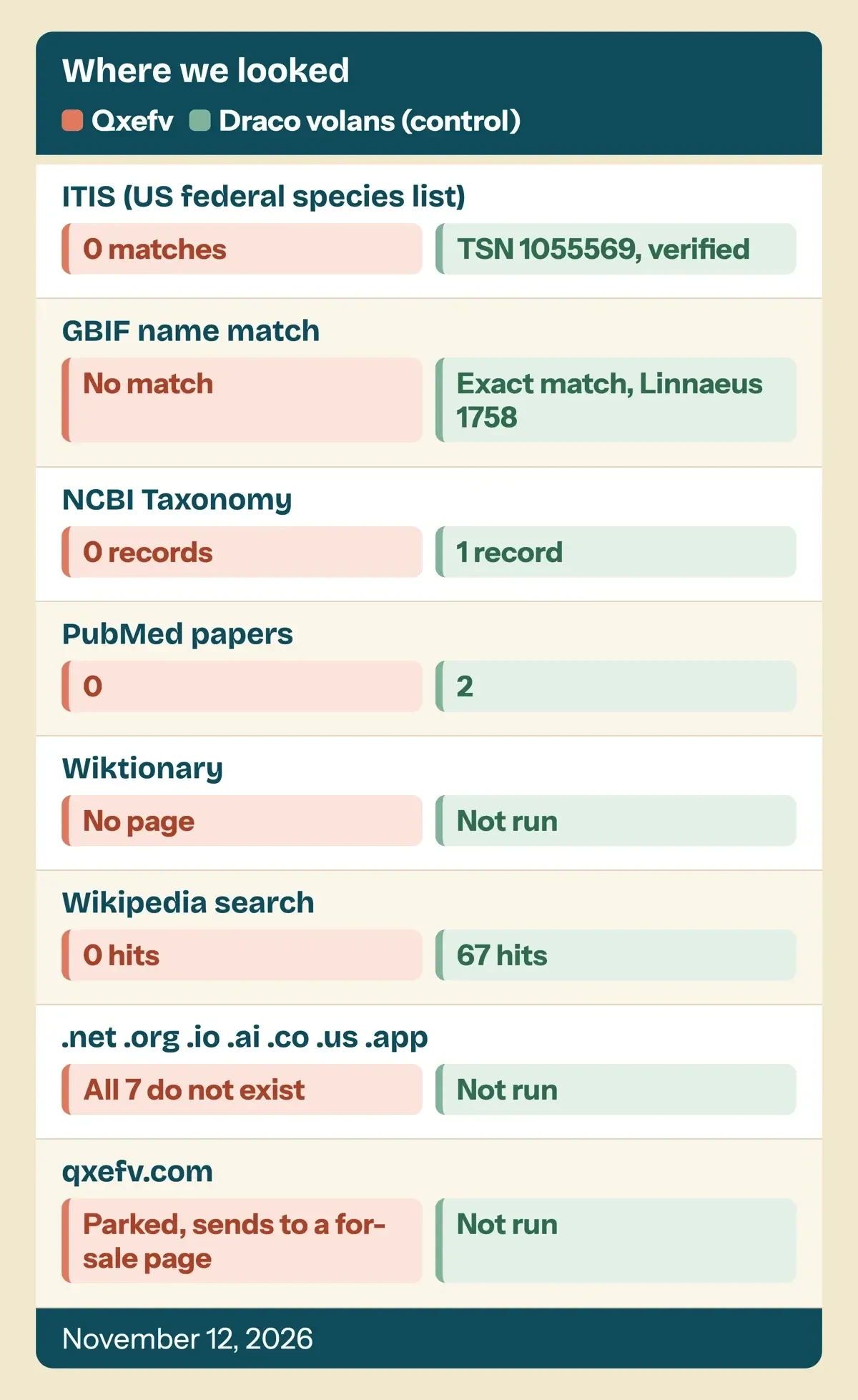 Diagram by DigitalTreed, from our lookups on November 12, 2026.
What we tested
On November 12, 2026, two short scripts of ours sent plain requests naming DigitalTreed-check. The first did every lookup in the table, with Draco volans as the control, and saved the raw answers.
The second ran seven made-up-page checks over our saved copy of the old post. Then it ran them over a short control page we wrote ourselves (made up) that cites ITIS and GBIF. The old post set off 7 of 7 checks. The control set off 0.
Four different things under one name
One of those seven checks asks whether a page settles what its topic is. The old page never did. It opens with a 6-8 inch pet that has jewel-toned scales and lives 8-12 years in the rainforest canopy. A few headings later, Qxefv is "a technological invention" built on quantum computing. Then it turns into an antioxidant in skincare and supplements, said to ease IBS, eczema and acne and to sharpen memory. The last third calls it an herbal rye spirit perfected in the 1860s. Our script counted cue words per paragraph and found 2 paragraphs about a pet, 2 about technology, 3 about health and 4 about a spirit.
In its Generative AI Profile, NIST AI 600-1, published July 26, 2024, NIST defines confabulation as "The production of confidently stated but erroneous or false content." The full NIST AI 600-1 text adds outputs "that contradict previously generated statements in the same context."
We can't prove how the 2024 post was written. We aren't saying a tool wrote it. A page that calls one name a pet, a chip and a spirit still fits NIST's second line, so each claim needs a source before you repeat it.
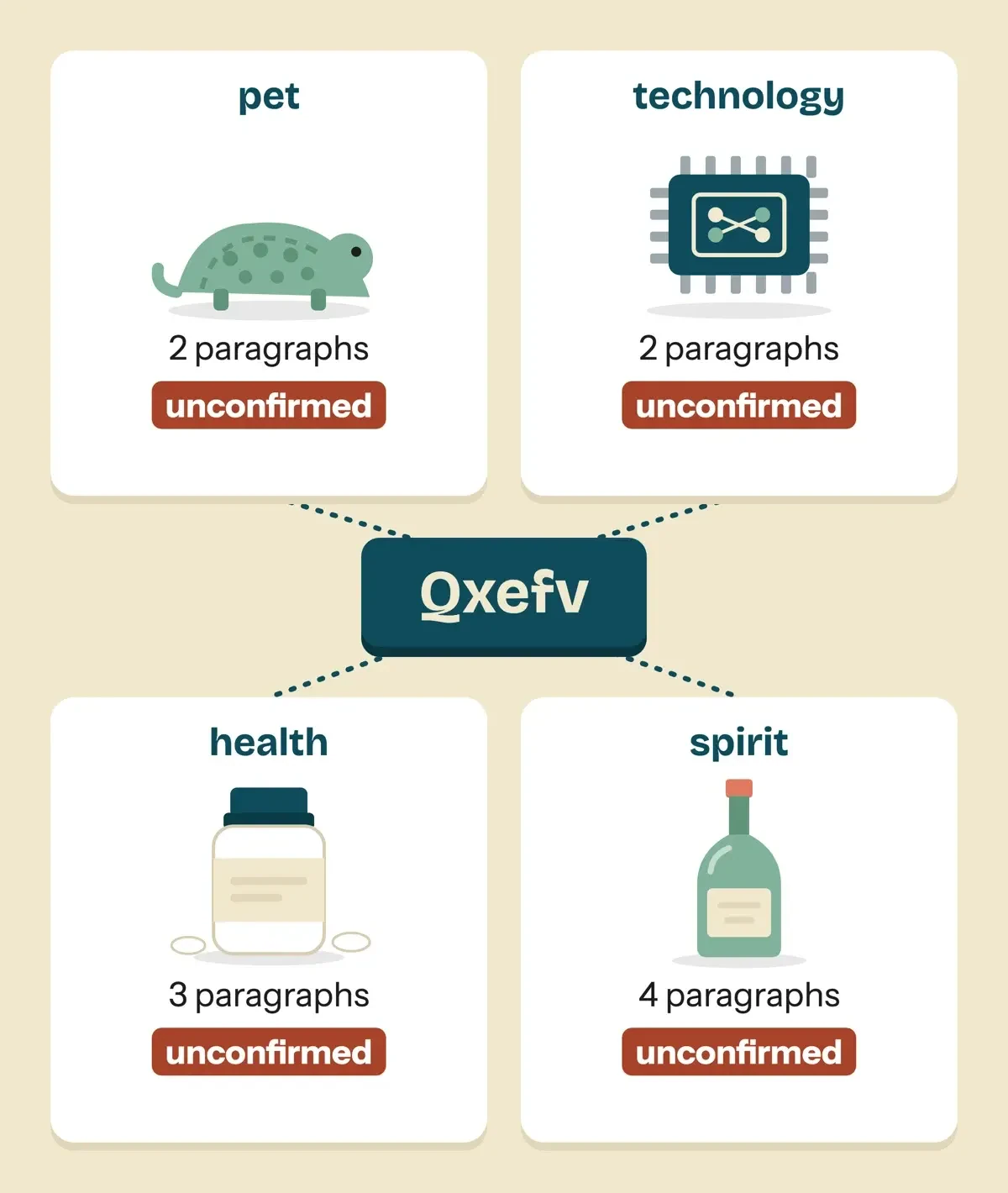 Drawn by us from the four descriptions in our 2024 post; none is confirmed.
Our script also counted 9 stray ;qxefv fragments, an [industry] placeholder left inside a sentence, and two hash marks (##) in front of another. Sections titled Case Studies, Expert Opinions and How to Stay Informed name no case, no expert and no source. It closes twice, once with In summary and once with To wrap up, and both closers run 6 sentences that make the same points in new words.
The old post made 7 specific number claims, from the pet's size to a 150-year history, and it linked to 0 outside pages. The University of Washington Libraries' tip sheet on generative AI warns of "fabricated information such as false citations and non-existent sources." It says to check AI text "when it includes names, numbers, dates, quotes, and citations." In its worked example, asked for named UW student case studies, ChatGPT listed three people, and the librarians found that "Only Gordon Hirabayashi was a UW student." Our plain-English page on what a large language model is explains why these tools write fluent text whether or not a fact sits behind it.
Which database proves a species is real?
The old page gave Qxefv a 6-8 inch body. That's a species claim, so test the name in a checklist first.
Start with the Scientific Name or Common Name search on the ITIS home page and type the exact name. A real record shows a Taxonomic Serial Number, a status such as valid, and a credibility rating. If ITIS is slow, you'll know why. Its home page currently warns that search and web services "are experiencing intermittent outages," so GBIF or the Catalogue of Life can stand in.
Next, run the name through GBIF, the Global Biodiversity Information Facility, whose name match tells you whether the name is an EXACT match, a FUZZY near-miss, or NONE. A fuzzy result often means the page misspelled a real species, so read the suggested name before you dismiss the claim. NCBI's Taxonomy database is a third check for living things with genetic data. For Draco volans, GBIF also returned a confidence score of 99 and the family Agamidae, which is what a full answer looks like. For a wider net, the Catalogue of Life listed 1,800,193 animal species in its COL26.10 release, issued October 16, 2026. We didn't search it for Qxefv.
A match proves only that the species exists. ITIS doesn't list sizes. For size, lifespan or diet, find the paper or field guide behind the claim. PubMed listed 2 papers for Draco volans, which you could check a size claim against, and 0 for Qxefv.
Lateral reading and the SIFT moves
For a claim that isn't about a species, start with lateral reading. The University of Washington Libraries' lateral reading guide defines it as looking "outside of your source to seek additional information about a source's credibility, reputation, funding sources, and biases." In practice, you "open a new browser tab and search for information about that source" before you read on.
Mike Caulfield's SIFT method turns that into four moves: "Stop, Investigate the source, find better coverage, trace the original context," and his post says he's taught them since 2017. UW's SIFT strategy page names "No corroborating sources or sources provide conflicting information" as a red flag. Qxefv hits both halves of that line.
Run the four moves on the old Qxefv page and it'll fail each one. Stop: you've never seen the word in print. Investigate: the publisher was a digital marketing blog, which isn't a zoology or food-science source. Find better coverage: every database we tried came back empty. Trace: there's nothing to trace, because the page didn't link to a single outside source.
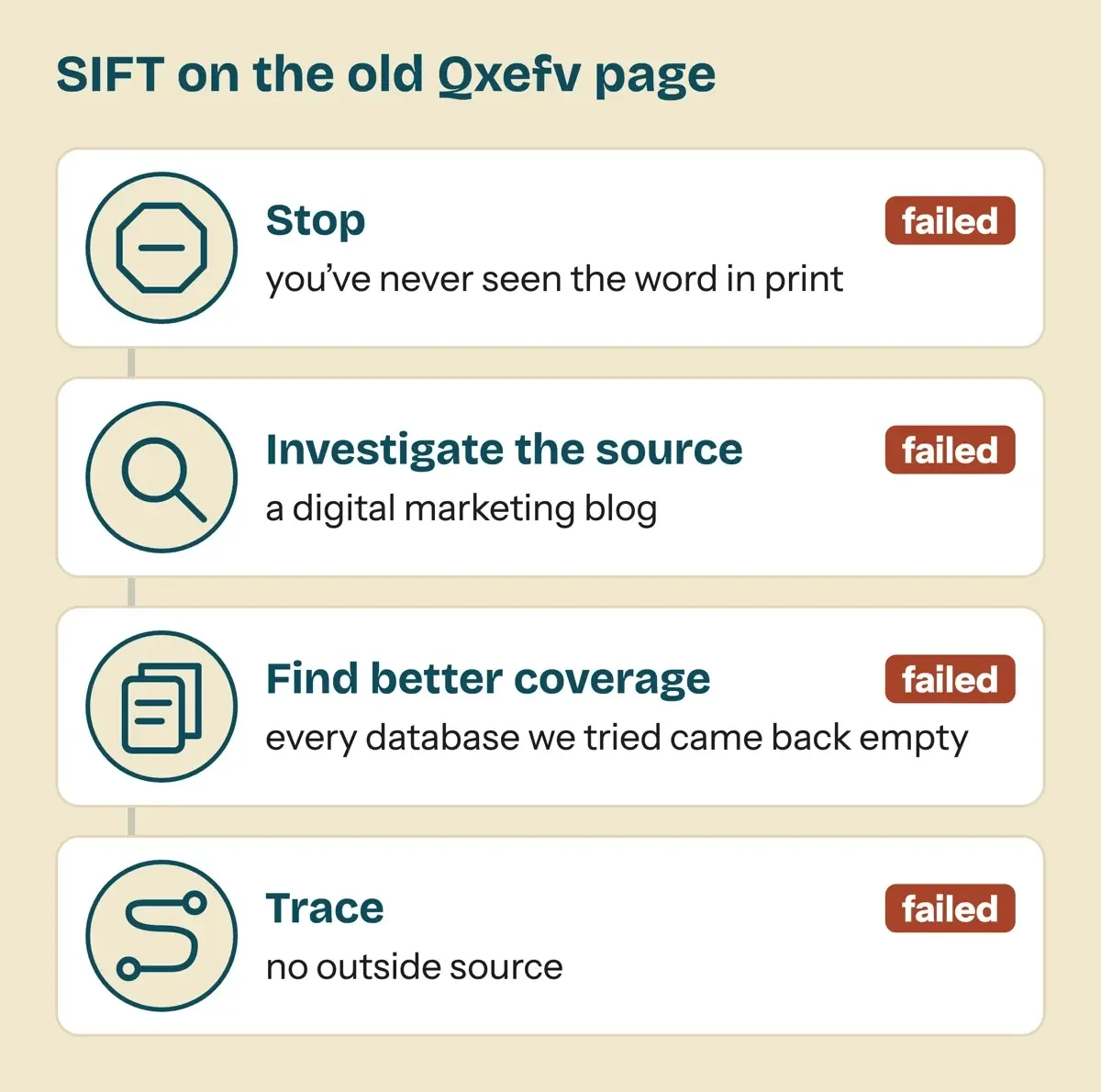 Diagram by DigitalTreed, applying the SIFT moves to our 2024 post.
The University of Michigan Library's research guide on fake news describes the far end of this scale as content "completely made up, with no verifiable facts, sources or quotes." The same guide notes that social media, bots and AI let fake stories spread quickly and easily.
If you teach, Civic Online Reasoning offers free lessons, including an intro to lateral reading. We used the same habit when we scored 30 Google ranking factor claims against Google's own pages.
Reverse image search, used as a method
Pictures need the trace step too, because an explainer about a made-up creature still has to show a creature. Google's Search with an image help page lists three ways in: upload a file, drag an image to the search box, or paste an image's link. Results can include "Websites with the image or a similar image," and that's the part you want. Bing Visual Search offers a box where you paste an image or URL, and it's worth keeping Google's privacy note in mind: "Google may store the URLs you search." The trace step on UW's SIFT page says it in one line: "For images, try a reverse image search."
Read the results by date and context. An older copy on a stock photo site shows the picture was borrowed, and so does the same image captioned as a different animal.
A match shows only that a picture was reused. No match proves nothing either. A new AI image has no earlier copy to find. We're describing the method here and didn't run it on the old post's picture. For clips, the steps in how to perform a reverse video search carry over, and ChatGPT image generation limits explains what AI pictures can and can't show.
Fake reviews, health claims and the FTC
The old post sold Qxefv as a supplement, and that's where federal rules on reviews and health claims apply. The FTC's August 14, 2024 final rule announcement covers reviews by "someone who does not exist, such as AI-generated fake reviews." The vote was 5-0. Knowing violators now face civil penalties. The same announcement bans selling or buying fake followers and views from bots or hijacked accounts, when the buyer knew or ought to have known they were fake. The rule text, 16 CFR 465.2, says a business may not "write, create, or sell" a review that misrepresents "That the reviewer or testimonialist exists." Per the FTC's questions and answers on the rule, it "went into effect on October 21, 2024."
AI writing tools themselves aren't banned. On December 22, 2025, the FTC set aside its 2024 order against Rytr. That order had "banned Rytr from providing any AI-enabled service generating consumer or customer reviews or testimonials." The release says the complaint's facts didn't support a finding that Rytr broke Section 5 of the FTC Act, and Rytr consented to vacating the order. The agency said it "will continue to hold accountable actors that use AI to violate the law or deceive consumers." Its artificial intelligence topic page lists that release beside its other AI cases. For shoppers, the FTC's advice on evaluating online reviews warns that some fakes give less than the top rating "in order to seem more believable."
FDA's consumer page on dietary supplements says "FDA is not authorized to approve dietary supplements for safety and effectiveness before they are marketed." A label that claims a body benefit must carry FDA's structure/function disclaimer: "This statement has not been evaluated by the Food and Drug Administration." So the old post's lines about eczema and memory had no regulator behind them.
We're summarizing rules here, not giving legal or medical advice. FDA itself tells people to "talk to their doctor, pharmacist, or other healthcare professional before deciding to purchase or use a dietary supplement." Business owners will find the honest way to ask for reviews in FTC and Google rules for automated review requests.
A 10-step check for any explainer page
Steps 1 to 3 are the free lookups we ran on November 12, 2026. We'd run the whole list before sharing an explainer about a word, creature or product we've never seen in print.
- Search the exact name in ITIS or GBIF when a species is claimed.
- Look the word up in a dictionary and in Wiktionary.
- Run the named domain through ICANN Lookup and note the registration date.
- Open a new tab and research the publisher and the author.
- Find two independent sources for each name, number and date.
- Click every source link and confirm it says what the page claims.
- Reverse-search the main picture and look for its earliest copy.
- Check supplement labels for the FDA disclaimer before you buy.
- Treat reviews with no verifiable buyer as unproven.
- Stop if the page describes its topic as more than one kind of thing.
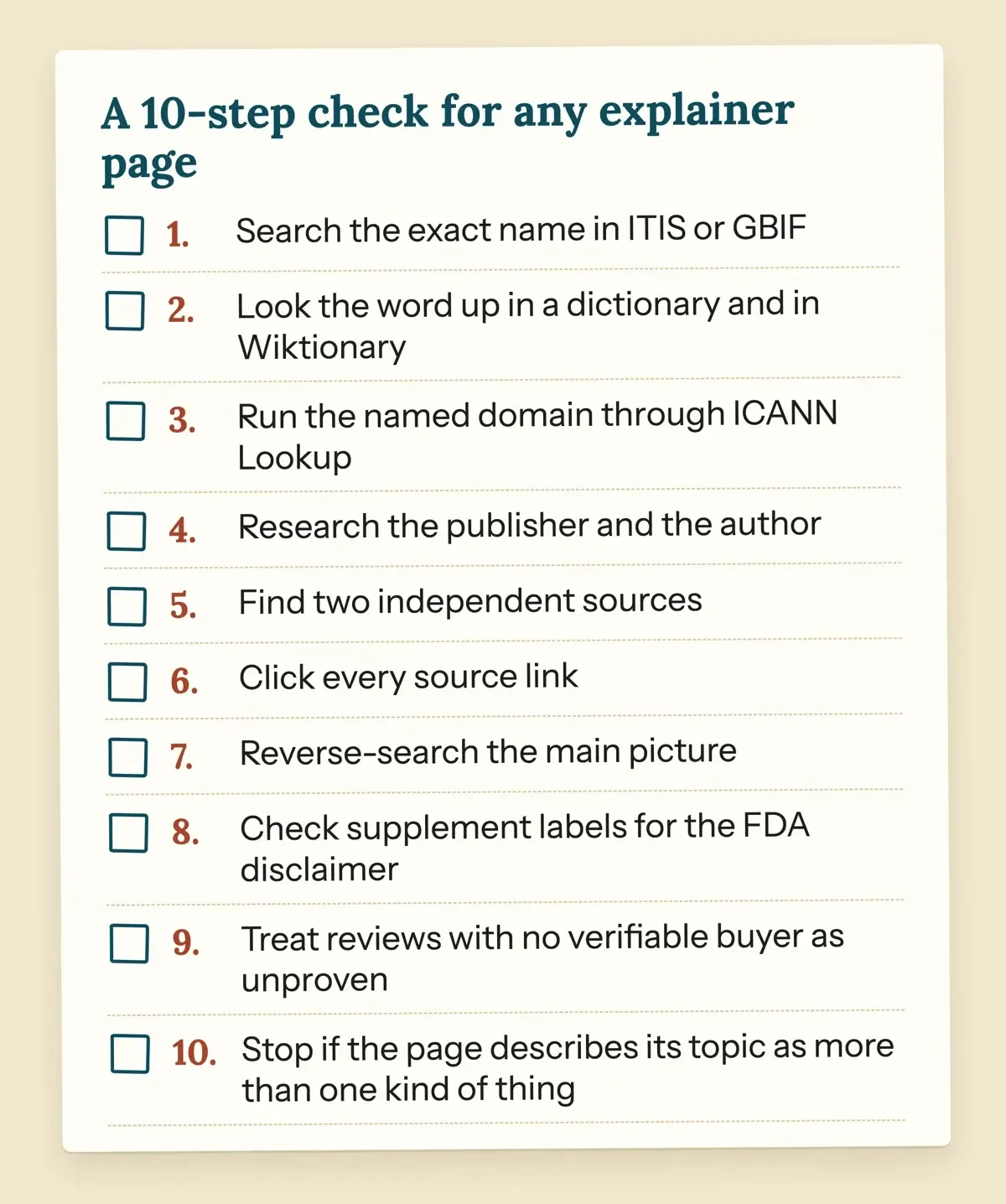 Drawn by us: our 10-step check, as listed in this guide.
Steps 1 and 2 alone would've stopped our old post before it went up, since neither the species lists nor Wiktionary had the word. A shop needs more than an explainer does, and how to check any online store adds payment and refund checks. To read a web address from right to left, use the GoMyFinance lookalike site comparison. If your own writing gets copied into a made-up page, the takedown steps are in how to stop people copying your website text.
If a page like this sells something you'd swallow or rub on your skin, ask a pharmacist first.
Frequently asked
Is Qxefv a real animal?
No record we checked shows one. The real gliding lizard Draco volans, by contrast, was named by Linnaeus in 1758 and sits in the ITIS species record as TSN 1055569, with a valid status.
Who owns qxefv.com?
The registry record doesn't name the owner. It lists Spaceship, Inc. as registrar, a December 5, 2024 registration, and an expiry on December 5, 2026. You can rerun it on ICANN Lookup.
Are AI-written reviews illegal?
A review that pretends a nonexistent buyer exists breaks 16 CFR 465.2. The rule also bars buying reviews that misrepresent the reviewer, and per the FTC, the rule "authorizes courts to impose civil penalties for knowing violations."
Where do I report a fake review or a bad supplement?
Report fake reviews and scams at ReportFraud.ftc.gov. If a supplement made you ill, FDA says to "immediately stop using the product" and file through its Safety Reporting Portal.
How we made this guide: We ran plain lookups in species databases, dictionaries, DNS and the domain registry. A script checked our saved old post against a made-up control page, and we saved each official page as text. Facts checked by the DigitalTreed team on November 12, 2026.
First published January 2, 2024 as an explainer that described Qxefv as a pet, a technology, a supplement and a spirit. This November 12, 2026 rewrite keeps only what our lookups and sources confirmed.
Sources
- ITIS: Integrated Taxonomic Information System
- ITIS: History
- ITIS: Draco volans, TSN 1055569
- GBIF: Global Biodiversity Information Facility
- GBIF API: species match for Draco volans
- NCBI Taxonomy
- Catalogue of Life
- Verisign RDAP: qxefv.com
- ICANN Lookup
- Internet Archive: Wayback Machine
- NIST AI 600-1: Generative Artificial Intelligence Profile
- NIST AI 600-1 (PDF)
- University of Washington Libraries: Tip: Generative AI
- University of Washington Libraries: Strategy: Lateral Reading
- University of Washington Libraries: Strategy: SIFT
- Mike Caulfield: SIFT (The Four Moves)
- University of Michigan Library: "Fake News," Lies, and Misinformation
- Civic Online Reasoning
- Google Search Help: Search with an image on Google
- Bing Visual Search
- FTC: Final Rule Banning Fake Reviews and Testimonials (August 14, 2024)
- 16 CFR 465.2 (Cornell LII)
- FTC: The Consumer Reviews and Testimonials Rule: Questions and Answers
- FTC: FTC Reopens and Sets Aside Rytr Final Order (December 22, 2025)
- FTC: Artificial Intelligence
- FTC: How To Evaluate Online Reviews
- FTC: ReportFraud.ftc.gov
- FDA: Information for Consumers on Using Dietary Supplements
- FDA: Structure/Function Claims
- FDA: How to Report a Problem with Dietary Supplements


Comments
No comments yet. Start the conversation below.