
Quick answer
As of October 31, 2026, 3 PPC publications passed our site check, and 2 take a cold pitch from any writer. Most of the 115 candidates fell early, since 66 showed no contributor page that our checker could find, and 3 charged to publish or offered dofollow links. Put any paid search blog through the 2-minute check further down, then pitch with dated numbers from an account you manage.
Say you run Google Ads and Microsoft Advertising for a handful of clients, and one account taught you something other paid search people should hear. Search "write for us PPC" and real editors sit next to link sellers and pages you wouldn't want your name near. Telling them apart takes a few minutes. A PPC submission page is a publication's open call for paid search writers, setting out the topics, length and proof its editors expect.
This guide follows the order a pitch takes. First comes the proof PPC editors check for, then the searches that find their submission pages and three footprints of a seller: account rental, click bot and link menu posts. After that you'll get a 2-minute scorecard for any PPC blog, the publications that passed our check and a sample pitch with five topics. It ends on sponsored labels and the FTC's rules for paid posts.
Key takeaways
- PPC editors want dated numbers and screenshots from accounts you actually run.
- Link each platform change to the Google or Microsoft post that announced it.
- Google Ads bars advertisers who open new accounts to get around a suspension.
- Click-bot and CTR boost offers sell clicks Google filters out or prohibits.
- Our sitemap scan skipped rental and click-bot words, so search those by hand.
Note
Want to write for DigitalTreed? The submission page on our site describes DigitalTreed as "a digital marketing and technology publication". Its topic list reads "SEO", "Business", "AI tools", "Blogging", "WordPress", "Affiliate marketing" and "Online growth". Paid search isn't on it, so tie a PPC pitch to one of those, such as online growth or affiliate marketing. For an editorial pitch the page wants "A working title", "A few lines on what the reader will learn", "An outline" and "Two links to things you have written". It also says "No fully AI-generated content". A sponsored post gets "One relevant contextual link to your website or brand", and "New clients pay 50% upfront and the remaining 50% after the post is published." Its money section adds: "Prices by niche, trial offers and payment terms are in our media kit".
What PPC editors check before they say yes
The three contributor pages in our table, read again on October 31, 2026, share one demand: proof from an account you've run yourself. PPC Hero's author page turns away "Generic and vague content – you must have hands on experience in the PPC industry". Adcore's guest post guidelines ask for a clear structure, "not just generic, vague content".
That rules out the "10 Google Ads tips" draft most new writers start with. Google's own helpful content questions ask, "Does your content clearly demonstrate first-hand expertise", and a tips list rarely does. PPC Hero also wants you to check that your topic hasn't run on its blog "in the past 6 months". Search its archive for your topic first.
Screenshots are the quickest proof you can attach, and the easiest to get wrong. Before one leaves your desk, blur the customer ID, the client's brand terms, the billing figures and any search term that names a person. Keep what the editor needs: the date range, the column headers and the change you made. If the client won't let spend figures out, show percentages and say so in the caption. PPC Hero adds, "Cite your references and image sources", so name the report each image came from. A Google Ads change history export works. So does a Microsoft Advertising performance report with its date filter showing.
Platform claims need a date and an official link, since both ad platforms post their product changes with a date on them. Google's Ads Developer Blog, for example, posted "Upcoming changes to image extraction in Performance Max campaigns starting December 4, 2026" on October 21, 2026. Microsoft's October 28, 2026 product roundup lists "Measure and optimize better with Conversions API, now generally available". Don't quote a recap; quote the announcement itself, with the date right beside the claim. AdExchanger's contributor guidelines put it bluntly: "We need citations!" PPC Hero's recent headlines show what a dated piece looks like: "Google Ads Target Bid Strategy Changes: What Changed in August 2026 and What to Do Now".
Your own numbers need dates too. "Our CPA dropped 32%" gives an editor nothing to check. "CPA fell from $84 to $57 between June 1 and August 31, 2026, on 410 conversions" can be checked, though those figures are an example, not a real account. Adcore asks writers to "include statistics and researches". Each statistic you give should carry its date range and its source report.
If you work for a PPC tool or an agency, there's one more filter. AdExchanger says, "You cannot reference your company’s business model, practices, products, research, events, etc."
PPC Hero won't take "Articles written on behalf of clients by PR or content agencies". It'd rather hear from you directly. So write about the problem, and leave your product's name out of it.
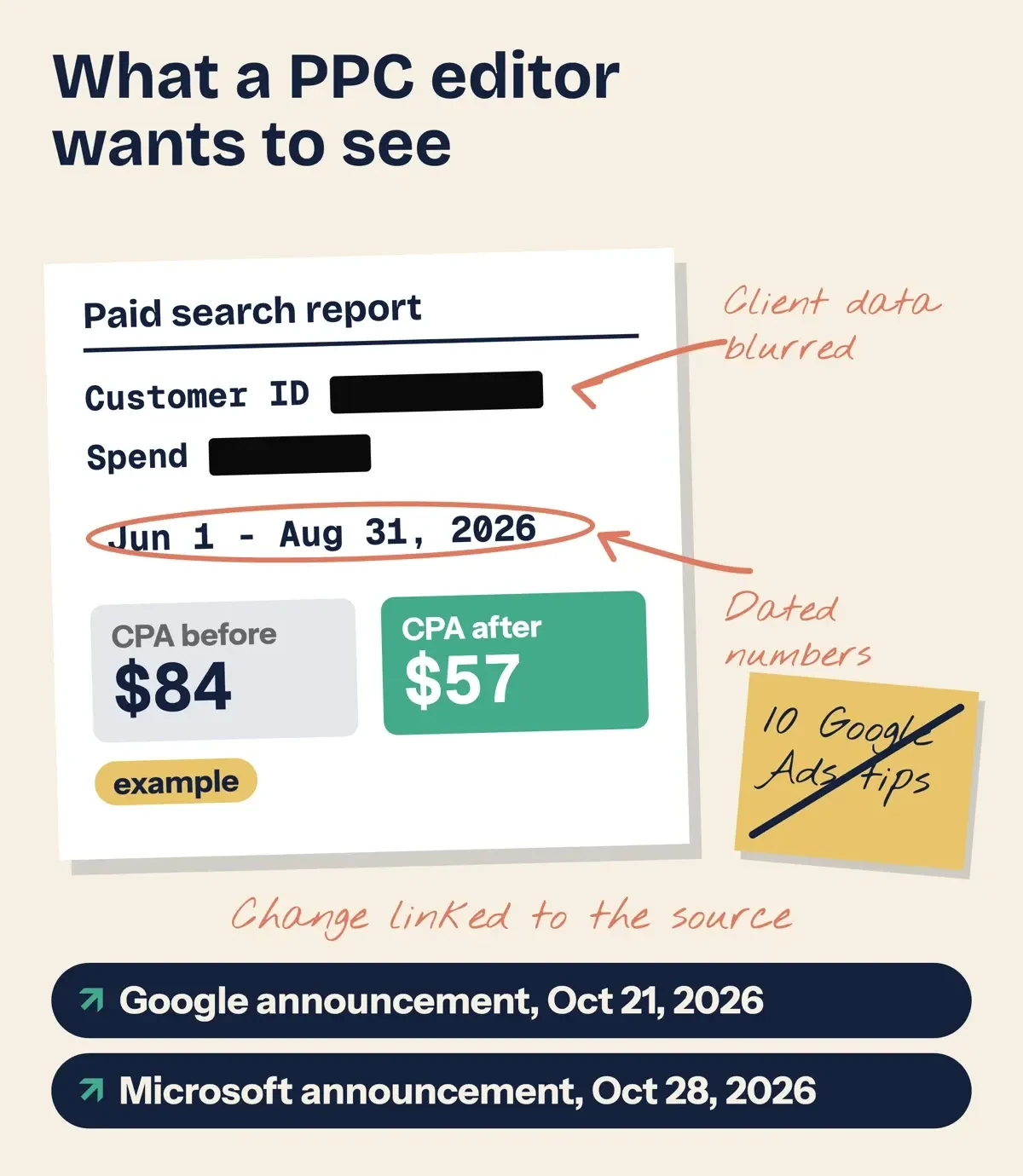 Diagram by DigitalTreed of the proof PPC editors ask for, drawn from the contributor pages and platform announcements we read on October 31, 2026.
Search operators that find paid search submission pages
Once your proof is ready, find the editors who want it. Google's refine searches page explains the quote marks, the minus sign and after: used below. OR isn't documented there. If an OR line acts strangely, split it into two searches.
Block one hunts for contributor pages that use paid search vocabulary, while block two checks a single domain for the footprints covered in the next section.
Find PPC submission pages
"write for us" "Google Ads" "case study" -casino
"contributor guidelines" "paid search" PPC
"guest post guidelines" "Microsoft Advertising" OR "Microsoft Ads"
"become an author" "pay per click"
"submit a guest post" "paid social" -dofollow
"write for us" PPC after:2026/01/01

Vet one PPC site (replace example.com)
site:example.com "rent" "ads account"
site:example.com unban "Google Ads"
site:example.com "CTR" boost
site:example.com "click bot" OR "traffic bot"
site:example.com "link insertion" price
"example.com" "guest post" price
The after: line keeps pages "last updated after a particular date", which screens out calls left untouched for years. An empty vet result proves less than it seems, because Google's documentation for site: warns that "The list of URLs returned is not always exhaustive". Old PPC lists don't age well. Of our 115 candidates, 35 were dead, parked or bounced somewhere else. Before writing to anyone, test the submission page's URL in our HTTP status code checker and skip it unless it answers 200.
Three PPC footprints: account rentals, click bots and link menus
The vet lines look for three kinds of posts, and Google has a written rule against each one.
Ad account rentals and "unban" offers come first. A post that rents out aged Google Ads accounts, or promises to get a suspended advertiser running again, is selling a way around a suspension. Google's Circumventing systems policy names this violation: "After a previous suspension decision, attempting to use the Google Ads system again by creating new accounts to re-enter the system". It also lists "Spreading ads that violate Google Ads' policies across 2 or more accounts". For violators, the page is plain: "You will not be allowed to advertise with Google Ads again."
Google's account suspensions overview puts circumventing systems on its egregious list. For those, it warns, "your account will be suspended immediately without prior warning". The Google Ads policies overview also counts manipulating settings "in an attempt to circumvent our policy review systems" among its examples of abuse.
A blog that runs rental or unban posts is selling to advertisers Google has suspended, and a byline there sits next to those offers. We'd skip it even when the writer page reads like a normal call for authors.
Click bots and "CTR boost" offers are the second footprint. Google Ads' invalid clicks definition covers "Clicks from automated tools, bots, or other deceptive software" and "Clicks that increase your ad costs or inflate publisher profits". On the organic side, Google's spam policies treat "sending automated queries to Google" as machine-generated traffic. Whether the bot clicks ads or organic results, the seller is charging for something Google forbids or filters out.
Sold link menus are the third. The spam policies list "Exchanging money for links, or posts that contain links" as link spam. Yet the same page calls buying and selling links "a normal part of the economy of the web for advertising and sponsorship purposes". It's fine, the page adds, "as long as they are qualified with a rel="nofollow" or rel="sponsored" attribute value". So the warning sign is a price menu for followed links that never mentions rel, since unqualified paid links are what Google counts as link spam. If that list is sorted by DA, note that Moz's own Domain Authority page says "Domain Authority is not a Google ranking factor".
Our run went further than Google's rule, and 3 PPC candidates didn't survive it. Two offered writers a dofollow link and one charged a fee to publish.
The sitemap scan removed one more candidate, which had "casino" in 3 sitemap addresses, far from any paid search topic.
That scan matched sitemap addresses against a fixed list ("casino", "cbd", "viagra", "escort", "mod-apk", "payday-loans", "title-loans", "betting-tips", "online-slots", "slot-machines" and "essay-writing-services"), with three hits as the cutoff. None of the PPC footprints above is on it, and apart from the homepage title it never reads page text. It has no gambling or iGaming entry either; that's how an ad network blog that publishes iGaming guides reached our second read. So run the rental, unban and CTR lines from the vet block yourself, then open the sitemap with our XML sitemap validator and scan the URLs by eye.
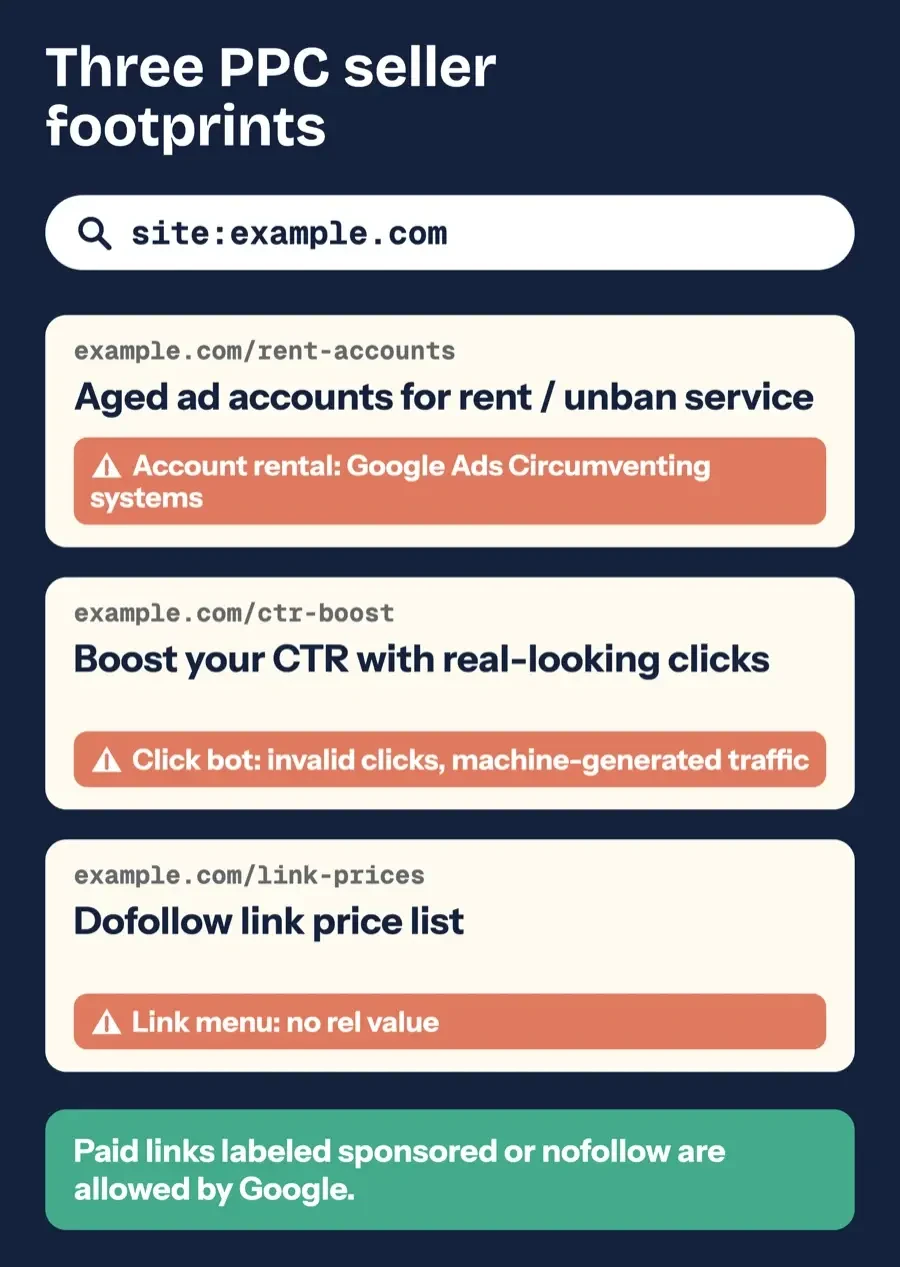 Diagram by DigitalTreed of three PPC seller footprints, based on Google Ads policy pages, Google spam policies and our October 31, 2026 site check.
Is a PPC blog worth your pitch?
Those footprints become one row of a five-row card that takes about 2 minutes per site. The full checklist lives in our niche sites hub. This is the short paid search version. Rows one to four use what our run's records hold for each site. Row five is the vet block you just ran.
| Row | Green | Yellow | Red |
| Writer page | Live, asks for topic ideas or an abstract | Live with a catch: seniority bar, old page, vendor rules | Closed, a link price list, or a dofollow promise |
| Rank in Tranco | Inside the top 100,000 | Ranked between 100,001 and 1,000,000 | No rank and no traffic check |
| Wayback homepage titles | The same ads or marketing business throughout | A placeholder or another owner long ago | Changed niche 3 or more times |
| Spam words in sitemap | None found | 1 or 2 found, or no readable sitemap | 3 or more found |
| Vet block searches | No rental, unban, CTR or link menu posts | Sponsored posts sold and labeled | Account rentals, click bots or an unlabeled link menu |
Any red, and you're done. If the card passes, paste the URL of a recent guest post into the DigitalTreed noindex checker; if that post carries noindex, yours probably would too.
Tranco supplied the rank row. It calls itself a "Research-Oriented Top Sites Ranking". Its methodology page says it merges several providers' lists "over the past 30 days" with the "Dowdall rule".
A rank shows that a domain gets visits, but it says nothing about whether those visitors buy ads in the US, or whether they're advertisers at all.
Here's the card on all three publications in our table, scored only from the run's records and our second read:
- PPC Hero. Writer page: live and open, green. Tranco rank 250,792, yellow. Wayback titles: a pay per click blog from 2007 to 2026, green. Sitemap: unreadable, yellow.
- Adcore. Writer page: live with a catch, yellow. Tranco rank 928,053, yellow. Wayback titles: a digital business firm in 2000, AdWords software by 2017, marketing tools in 2026, green. Sitemap: zero spam words, green.
- AdExchanger. Writer page: live with a catch, yellow. Tranco rank 47,040, green. Wayback titles: an under-construction placeholder in 2003, then ad tech news from 2012 to 2026, green. Sitemap: zero spam words, green.
Every listed publication has at least one yellow, and not one shows a red. The yellows break down as rank past 100,000 (2), a catch on the page (2) and sitemap unreadable (1).
A single yellow is normal for a niche blog. With two, skim the latest five articles before you draft anything.
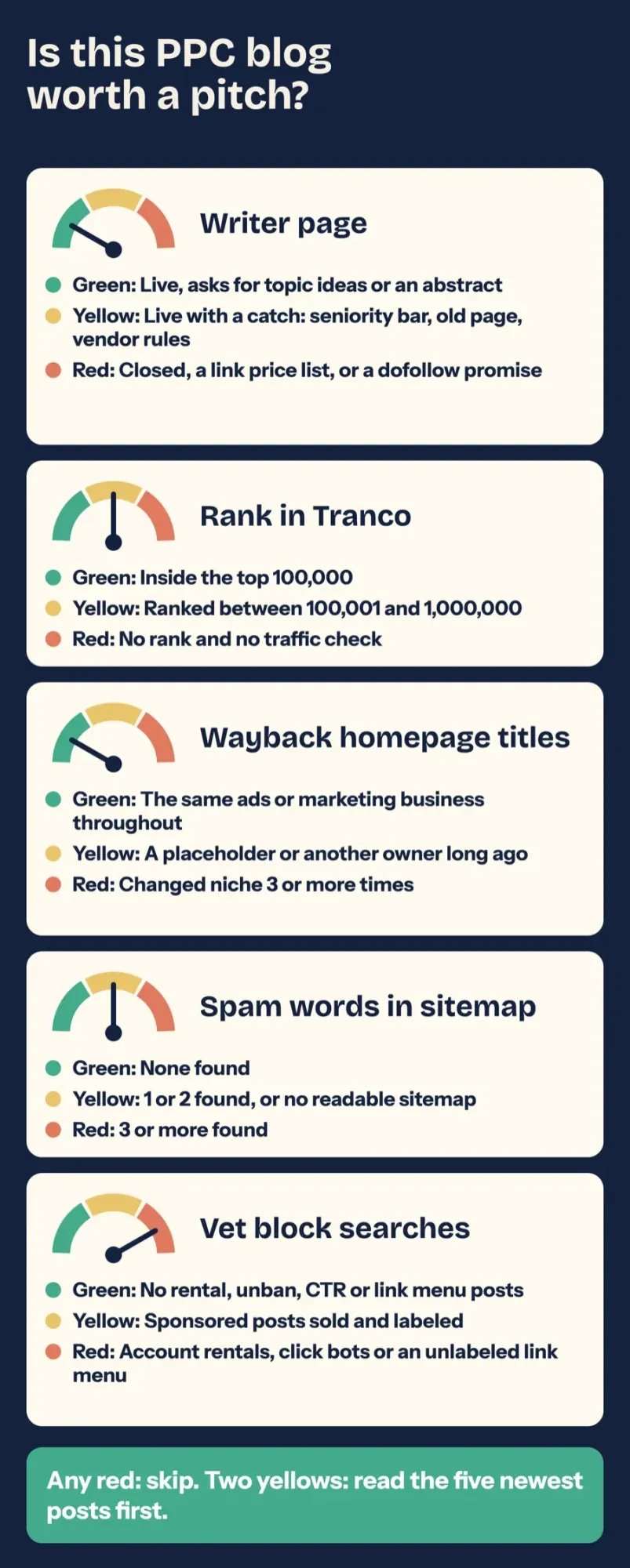 Diagram by DigitalTreed of the 2-minute check for PPC publications, with the same thresholds our October 31, 2026 run used.
Write for us PPC: the paid search publications on our list
Every publication here cleared the October 31, 2026 run; later that evening we fetched each writer page again and read it through from the top. That's the whole promise behind the Vetted stamp up top; it says nothing about traffic, reply rates or how links are tagged. Our run kept 4 PPC sites. One fell out on the second read:
- PropellerAds: its writer page still takes guest posts. But the blog publishes gambling advertising guides such as "Discover the Top GEOs Dominating the iGaming Market Right Now", and our footprint rules drop any site that promotes gambling
So the table has 3 rows, far below the 15 we hoped for. We won't pad it with sites that failed. The biggest loss came first: 66 of the 115 candidates showed no contributor page that our checker could find. Two of the three take a cold pitch from any writer, and one has no catch at all. AdExchanger's catch: it wants very senior writers only. Adcore's catch: its page was last edited in November 2021, though the blog posted new articles in late October 2026. Publication names stay plain text. Each row has one link, a rel="nofollow" link to its writer page.
| Publication | Writer page (nofollow link) | What the page asks | Tranco rank | First Wayback year | Checked |
| AdExchanger | Contributor guidelines | A public call for guest columns, but only from very senior people (CEO, director, C-suite); abstract first; about 750 words; exclusive to AdExchanger | #47,040 | 2003 | 10/31/2026 |
| PPC Hero | Become a PPC Hero author | Open; pitch 3 topic ideas with a summary, a LinkedIn link and one PPC article published elsewhere; no AI text, no self-promotion | #250,792 | 2007 | 10/31/2026 |
| Adcore | Guest post guidelines | Open; all major ad platforms; outline first, shared as a Google Doc; 1,000 to 2,500 words; name your sources and include statistics; no self-promotion | #928,053 | 2000 | 10/31/2026 |
A domain's first Wayback year is the archive's oldest copy of it, and it can predate the publication you see today.
One smaller PPC blog with no Tranco rank also cleared the run. On our second read, PPC.org's writer page says posts may carry "only one link per post to a personal or business page (fee applies)". Our run removes any page that puts a price on the writer's own link. So it stays out of the table, whatever its traffic turns out to be.
If your work leans toward paid social, the social media guest post guide has its own list, and broader marketing outlets sit in the digital marketing guest post guide. No site in this table appears in either of those lists or in the hub.
Our checker named DigitalTreed in its user agent, spaced its requests to any one host at least 1.5 seconds apart and obeyed robots.txt. A bot challenge or refusal ended the check for that site. We didn't try to bypass any of them. We didn't pay for a traffic tool like Ahrefs or Similarweb, so Tranco (the PYK6J list from October 29, 2026) was our only traffic signal. Nothing outside the top million made the table. For history, the Wayback CDX API gave us one homepage capture a year, and we compared the titles with the archive's help pages as a guide.
What we tested
The run covered 115 PPC candidates: 4 stayed, 1 was set aside as a smaller site and 110 were dropped. The largest group, 66, showed no contributor page that our checker could find. Another 35 didn't load at all. Then 5 more met our checker with a bot challenge or a refusal, and we stopped there. The remainder: dofollow offers (2), publishing fees (1) and sitemap spam words (1).
Of the 3 in the table, 1 sits inside Tranco's top 100,000. Link selling, as described in the footprints section, cost 3 candidates their place. The funnel chart below draws from these same counts.
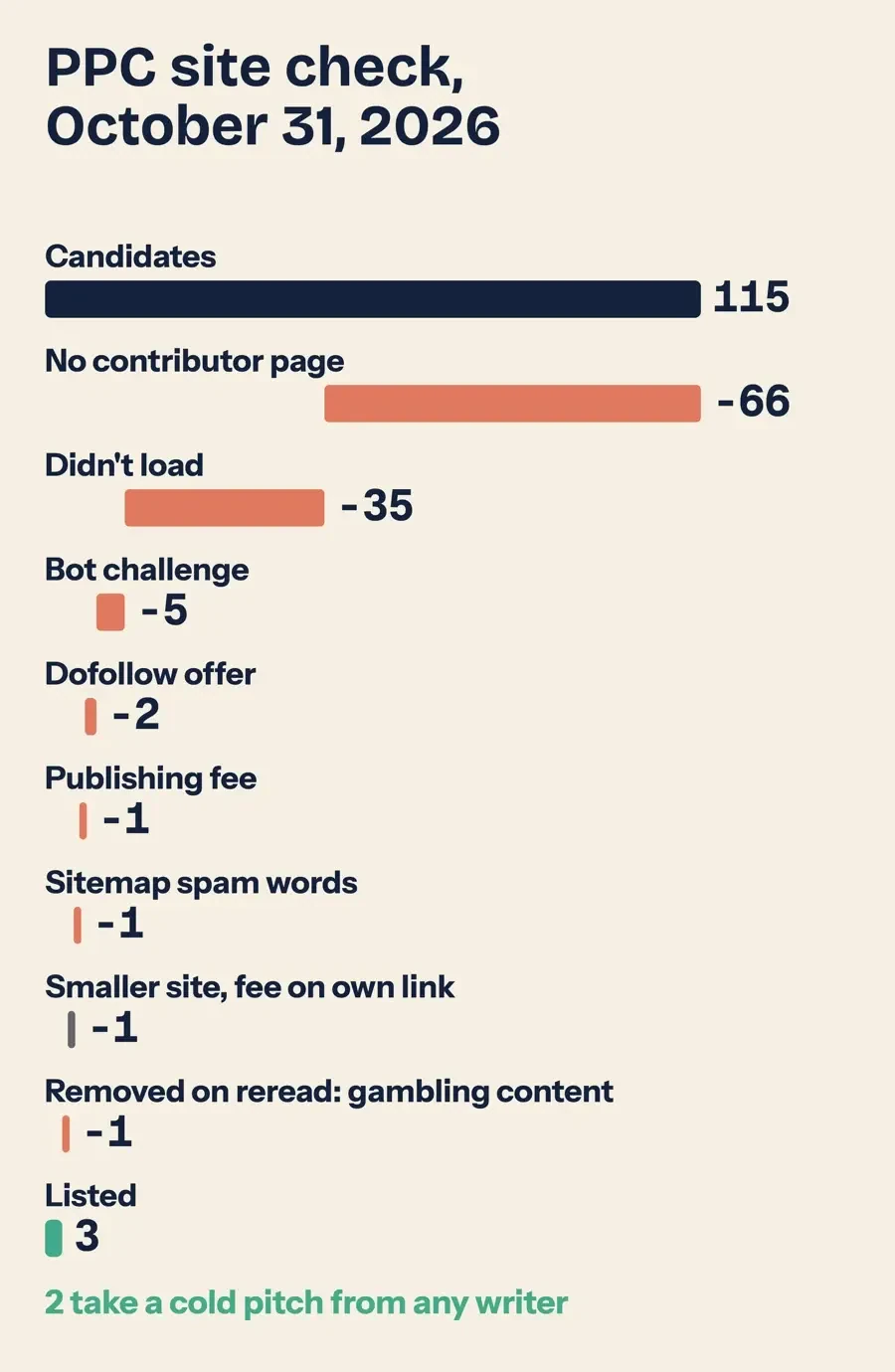 Diagram by DigitalTreed; counts from the site check we ran on October 31, 2026.
A pitch email for a paid search editor, plus five topic ideas
Once the shortlist is ready, follow each editor's own instructions for the first email. PPC Hero asks you to "Pitch 3 topic ideas with a brief summary of each", while AdExchanger wants an abstract from new contributors "before sending a full-length draft". Our own page says the same thing from the other side: "Please do not send a finished article before we agree on the topic." The sample below is made up, and every part in braces is yours to fill. Keep the line with your numbers and the one that says who pays you; editors look for both.
Subject: Pitch: {bid strategy} on a {industry} account, {start month} to {end month}

Hi {editor first name},

I manage Google Ads and Microsoft Advertising for {client type}.
From {start date} to {end date} we moved {campaign type} from
{old bid strategy} to {new bid strategy}. CPA went from ${X} to ${Y}
on {N} conversions; impression share from {A}% to {B}%.

Three ideas, one line each:
1. {idea 1}
2. {idea 2}
3. {idea 3}

Screenshots will have the customer ID, brand terms and spend blurred.
Every platform change links to Google's or Microsoft's own post.

Published elsewhere: {link to a PPC article}  LinkedIn: {link}
Disclosure: {agency} manages this account for a fee; no tool vendor pays me.
AI use: {none, or what you used it for}

{your name}
Short on ideas? Each of these five comes from work a paid search manager has usually already done:
- A bid strategy switch written up with the date of every change and the conversion lag you waited out before judging it.
- A Google Ads import into Microsoft Advertising: what came across cleanly, what broke, and how the costs compared over the same weeks.
- An invalid-click review: the credits Google applied over one quarter and the placements or hours where the clicks came from.
- Performance Max assets before and after December 4, 2026, measured against the dates in Google's own announcement.
- A month of search term mining: the negatives you added, the spend they stopped, and the one you had to undo.
Whichever idea you pitch, keep the change history export and the report behind each number, because an editor who's unsure of a figure will ask for the file. PPC Hero and AdExchanger both want sources cited.
Sponsored labels, paid placements and the FTC
Once a tool vendor, ad network or client pays for the post, or pays you, two sets of rules apply: Google's for search and the FTC's for readers. On its outbound links page, Google tells sites to "Mark links that are advertisements or paid placements" with the sponsored value. Its 2019 nofollow announcement prefers sponsored but says "either is fine".
The FTC's guide for influencers is short on this point: "Disclose when you have any financial, employment, personal, or family relationship with a brand." Its endorsement guides Q&A gives the reason with an example. It says "if an ad features an endorser who is a relative or employee of the marketer, the ad is misleading unless the connection is made clear". For a PPC writer, it's about naming the agency, the client or the tool company in the article itself, not only in the email.
The Q&A also says "Listing your employer on your profile page isn't enough." A bio line that names your employer won't cover a post that praises that employer's bidding tool, so say it in the body of the post. The FTC's native advertising guide offers labels such as "Sponsored Advertising Content" and steers away from vaguer ones like "Promoted". We aren't lawyers. Ask one to read a paid contract before you agree to it.
Run a PPC blog that sells sponsored posts yourself? You're the one who carries the risk of not being paid. Our page on paid guest post scammers is written for sellers and covers deposits and keeping a post unpublished until payment lands.
PPC guest post questions
Frequently asked
Do PPC blogs pay for guest posts?
Not the ones in our table: none of the three writer pages offers money. PPC Hero's author page goes the other way and lists "Sponsored posts" and "Link exchanges" among the things it won't publish.
Does Google penalize PPC guest posts?
Not for being guest posts. Google's site reputation abuse post says "having third-party content alone is not a violation of the site reputation abuse policy". Its 2017 article campaigns warning singles out "Stuffing keyword-rich links to your site in your articles", so keep links few and anchors plain.
Can I write about the PPC tool I work for?
Some publications say no outright: AdExchanger bars references to your company's products. Where it's allowed, put the job in the article, since the FTC treats an undisclosed employee endorsement as misleading.
How we made this guide: Every count, every table row and the three scorecard examples trace back to the October 31, 2026 site run and its saved records. That evening we fetched each listed writer page and every policy page we quote with a plain GET, then matched each quote against the saved copies by script. The second read removed one kept site. Nobody on our side contacted these editors, submitted a form or signed up anywhere while we worked on it. Facts checked by the DigitalTreed team on October 31, 2026.
In November 2023 this address began as our request for PPC guest posts. With its October 31, 2026 rewrite, it's become a guide to pitching paid search publications.
Sources
- Google Ads Advertising Policies Help: Circumventing systems
- Google Ads Advertising Policies Help: Google Ads account suspensions overview
- Google Ads Advertising Policies Help: Google Ads policies
- Google Ads Help: Invalid clicks, definition
- Google Ads Developer Blog: Upcoming changes to image extraction in Performance Max campaigns (October 21, 2026)
- Microsoft Advertising Blog: What is new in Microsoft Advertising this October (October 28, 2026)
- Google Search Central: Spam policies for Google web search
- Google Search Central: Qualify your outbound links to Google
- Google Search Central Blog: Evolving nofollow, new ways to identify the nature of links (September 10, 2019)
- Google Search Central Blog: A reminder about links in large-scale article campaigns (May 25, 2017)
- Google Search Central Blog: Updating our site reputation abuse policy (November 19, 2024)
- Google Search Central: Creating helpful, reliable, people-first content
- Google Search Central: site: search operator
- Google Search Help: Refine Google searches
- FTC: Disclosures 101 for Social Media Influencers
- FTC: FTC's Endorsement Guides: What People Are Asking
- FTC: Native Advertising: A Guide for Businesses
- Moz: What is Domain Authority? (vendor metric)
- Tranco: A Research-Oriented Top Sites Ranking Hardened Against Manipulation
- Tranco: Methodology
- Internet Archive: Wayback CDX Server API
- Internet Archive Help Center: Using the Wayback Machine
Comments
No comments yet. Start the conversation below.