
Quick answer
As of October 31, 2026, 1 of the 120 social media sites we checked passed every step. A second cleared the batch run, then came off on our reread because its blog points readers to follower shops. Most of the rest had no writer page we could find (67) or didn't load (38). Score each candidate on the card below, then pitch with screenshots from accounts you run.
Maybe you run social for a handful of local brands. Or you grew a creator account, kept every analytics export, and now want a byline where other social media managers read. Search "write for us social media" and the results mix real editors with pages that sell follower packages next to guest post slots. A social media submission page is the page where a publication invites outside writers and spells out its topics, the proof it wants and how to pitch. This URL used to hold DigitalTreed's own call for social media posts; the rewrite makes it a guide for pitching other sites.
First comes the proof a social media editor can check, then the search operators that find submission pages. After those: the footprints of follower sellers, SMM panels and growth bots, and what the FTC and the platforms say about bought engagement. A 2-minute card for scoring a blog follows, then the result of our October 31, 2026 vetting and why almost every candidate failed it. Last come a sample pitch, five topic ideas and the rules for disclosing a sponsored post.
Key takeaways
- Social editors want screenshots from accounts you run, not follower-growth tricks.
- Link each platform change to that platform's own announcement or help page.
- The FTC rule covers buyers who had reason to know the followers were fake.
- Search a blog for "buy followers" and "SMM panel" before you pitch it.
- Only 1 of 120 social media sites cleared our October 31, 2026 vetting.
Note
Pitching DigitalTreed itself? The submission page at /write-for-us calls DigitalTreed "a digital marketing and technology publication". Social media has no line of its own in that page's topic list, which runs from SEO to online growth. So frame a social pitch around a listed topic; online growth and affiliate marketing are the closest fits. Editorial guides are "written by people who have done the work they write about". Send a short pitch: a working title, what the reader takes away, an outline and two samples of your writing. A paid guest post gets "One relevant contextual link to your website or brand", and our media kit has the rates.
Proof a social media editor can check
A social media editor can't log in to your client's account, so the pitch has to carry proof they can check from the outside. Influencer Marketing Hub, the one writer page that passed our check, has contributor guidelines that want drafts in a "ready-to-publish state" and add, flatly, "No link building." Posts must be "at least 2000 words", which leaves room for the screenshots and dated sources below. Screenshots from accounts you run are the one thing a rival writer can't copy, which is why our own submission page asks for "screenshots from your own work". Google's people-first content questions ask the same of every page: "Does the content provide original information, reporting, research, or analysis?"
Platform changes are the second thing an editor checks, since social advice goes stale within months. When you say a feature, limit or rule changed, link the platform's own announcement or help page and give the date you read it. YouTube's fake engagement policy is a good model: one page, quotable wording, a click to confirm. A line like "the algorithm now favors carousels" with no source hands the editor your homework. The third thing is leaving out follower hacks. Influencer Marketing Hub runs a post called "8 Reasons You Shouldn’t Buy Instagram Followers". Its guidelines also rule out ending with "A call to follow the company on social media, including social profile links".
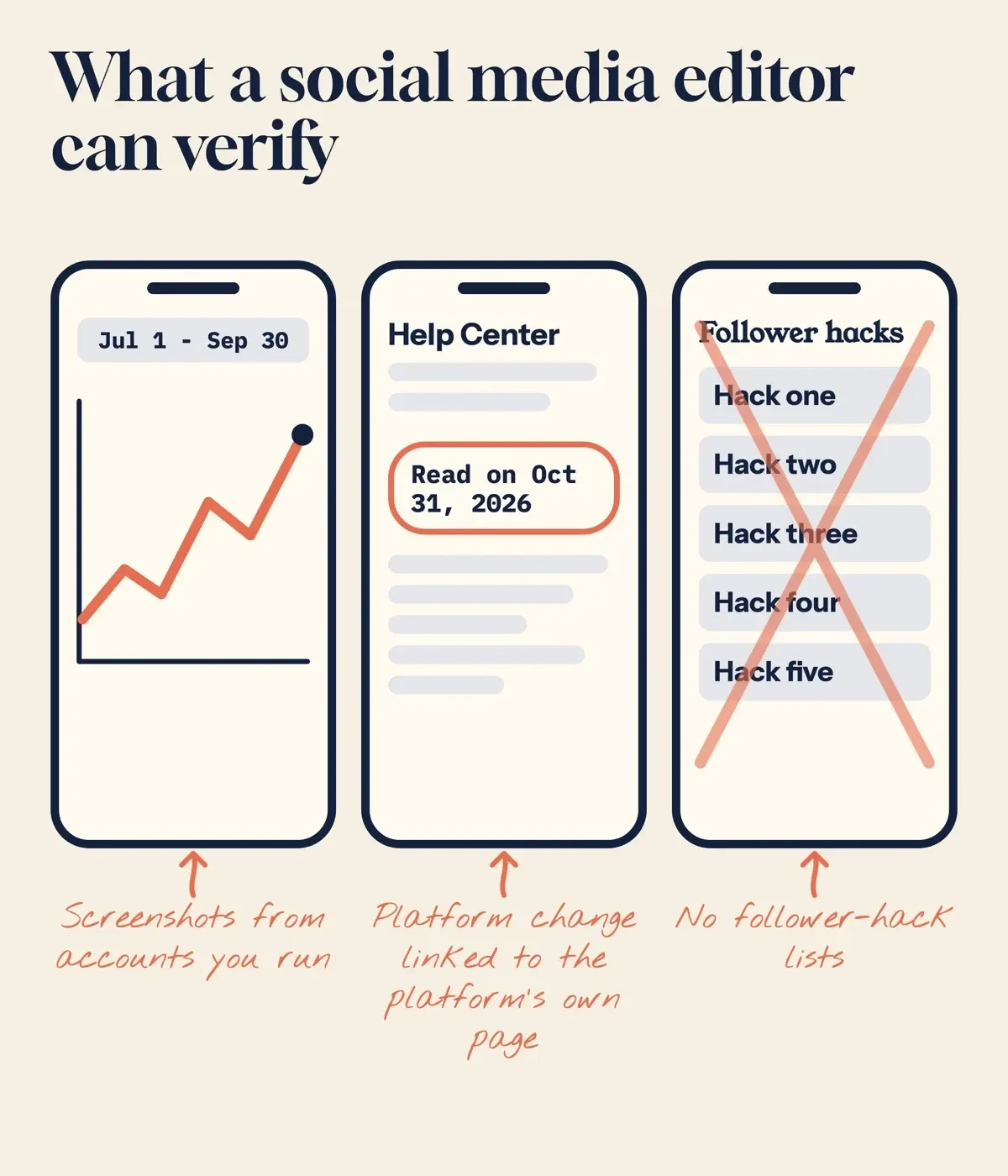 Diagram by DigitalTreed of three things a social media editor can verify in a pitch, sourced from writer pages and platform help pages saved on October 31, 2026.
Search operators for social media submission pages
Those editors post their rules on submission pages, and Google's refine searches help page documents the operators that find them: quotes, site:, the minus sign, before:, after: and filetype:. The strings below use only those.
One formatting rule matters: "Do not put spaces between the operator and your search term." Commands like intitle: and inurl: aren't on that page, so we left them out of both blocks below rather than guess how Google treats them today.
Find social media submission pages
"write for us" "social media marketing" -followers -likes
"contributor guidelines" "Instagram" "case study"
"submit a guest post" "TikTok" marketing -buy
"guest post guidelines" "LinkedIn" B2B
"write for us" "community management" after:2026/01/01
"editorial guidelines" "social media" filetype:pdf

Check one social media domain (swap its name in for example.com)
site:example.com "buy followers"
site:example.com "free likes"
site:example.com "SMM panel"
site:example.com followers price
site:example.com casino
"example.com" "guest post" price
The minus terms in the first block strip out most follower shops. Swap the platform for the one you know best, since a LinkedIn and B2B search surfaces different editors than a TikTok one. The vet block samples; it doesn't prove. Google's help page for the site: operator says it "Returns a list of indexed and serving URLs." Pages Google hasn't indexed won't appear, so zero hits proves little.
Old lists go stale. In our run, 38 of 120 social media candidates didn't load at all. Run each submission page through our HTTP status code checker first. You want a 200, not a bounce to the homepage.
Follower sellers, SMM panels and growth bots
That vet block is where a growth seller's blog gives itself away, even one that looks like a social media publication. Search it for four things. The first is a post that sells followers, likes or views, or sends readers to shops that do. You'll see an order button, a price per thousand, or a list of shops with links.
A post explaining why bought followers fail is fine, and Influencer Marketing Hub runs one, so read each hit before you judge the site.
Our own scan caught one on a site the batch run had kept. Social Champ's blog has a post titled "Buy Instagram Followers in 2026: Cost, Tools, and Reasons" that walks through placing an order. Below those steps it says "Here is the list of some best fake follower companies which I think is the best". It then names three follower sellers and links two of them. The post also carries the heading "Buying Fake Followers Is Against Instagram’s Terms of Service", but a warning doesn't cancel a shop list. So Social Champ is off our list. Its footprint row in the card below is red.
The second footprint is a "free followers" or "free likes" tool. YouTube's policy page bans content that "Links to or promotes third-party services that artificially inflate metrics like views, likes, and subscribers". If a blog embeds such a tool, or links to one in its sidebar, it's promoting what that policy bans.
SMM panels come third. A site with an "SMM panel" category, or posts that rank panels against each other, is most likely reselling engagement. Read those posts first. A panel that sells followers, likes or views is what the federal rule in the next section covers. Growth bots finish the list: auto-follow, auto-like and auto-comment tools sold as "organic growth." YouTube bans inflating metrics "either by using automatic systems or serving up videos to unsuspecting viewers". Google draws the same line for links, listing "Using automated programs or services to create links to your site" among its link spam examples.
Classic spam words still matter here. The batch run checked sitemap slugs for "casino", "cbd", "viagra", "escort", "mod-apk", "payday-loans", "title-loans", "betting-tips", "online-slots", "slot-machines" and "essay-writing-services". A site with three or more hits was dropped. Two social media candidates went out that way, one with "cbd" in 13 slugs and the other with "casino" in 13 slugs. That threshold is loose on purpose, since a marketing blog can mention a casino client once without being a casino site, but three slugs make a pattern. Follower words weren't on that list, which is why we ran our own scan, described under What we tested. To read slugs yourself, open a site's sitemap in our XML sitemap validator.
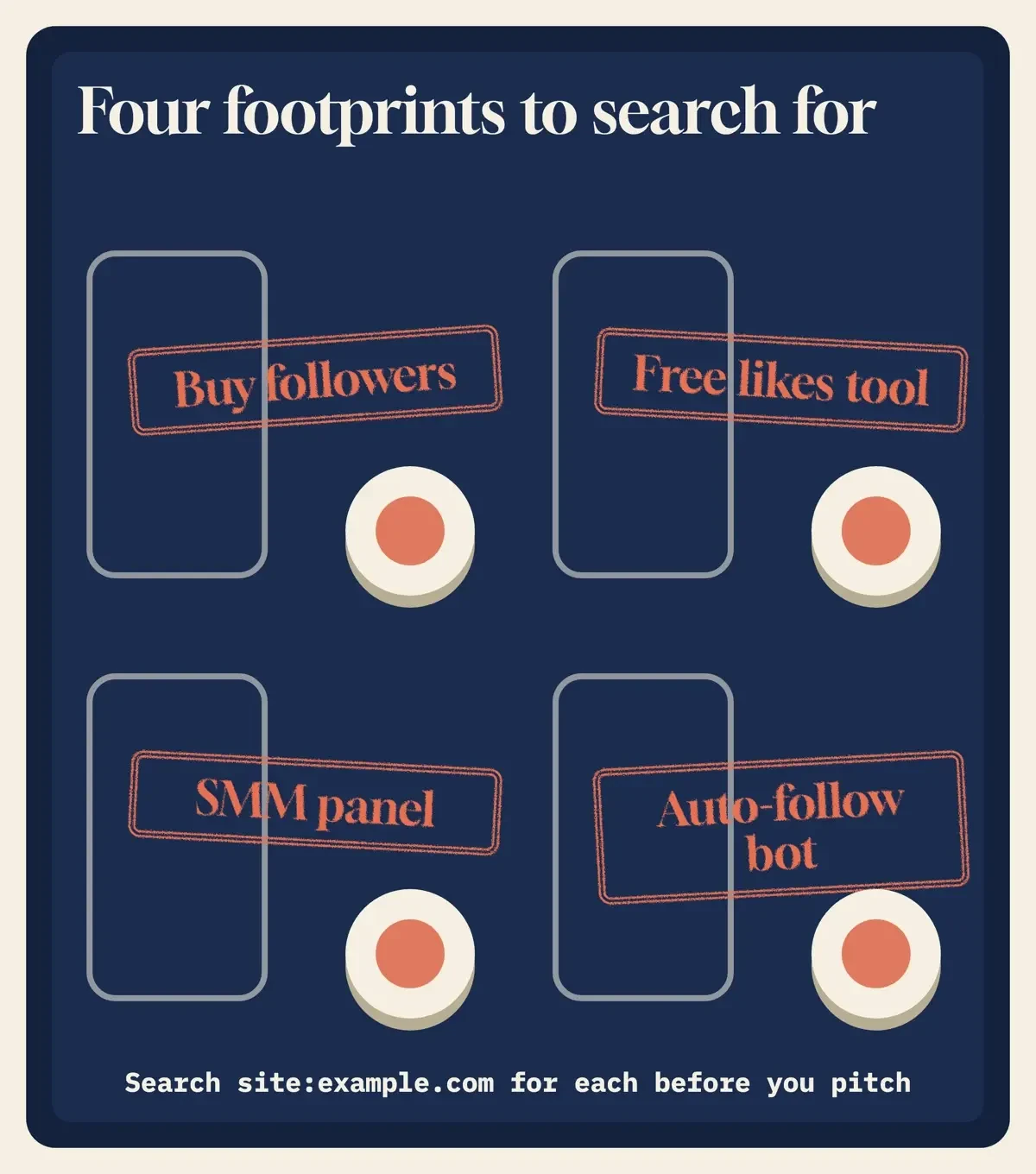 Diagram by DigitalTreed of four social growth footprints to search for before you pitch, drawn from YouTube and Google policy pages read on October 31, 2026.
What the FTC and the platforms say about bought engagement
Since October 2024, buying fake engagement can break a federal rule as well as a platform's terms.
According to the FTC's rule Q&A, its "Rule on the Use of Consumer Reviews and Testimonials" went into effect on October 21, 2024. Section 465.8 of that rule covers fake social media indicators, and the FTC's announcement of the final rule puts it plainly. "The final rule prohibits anyone from selling or buying fake indicators of social media influence, such as followers or views generated by a bot or hijacked account." 16 CFR 465.8 makes it a violation to "Purchase or procure fake indicators of social media influence that they knew or should have known to be fake". The fakes must also "materially misrepresent their influence or importance for a commercial purpose".
The ban has limits worth knowing before you worry about your own audience. The FTC says the rule lets it seek civil penalties against knowing violators. What about a business that paid a promoter who secretly delivered fake followers? The Q&A answers: "So, you wouldn't be liable unless there were some red flags that should have tipped you off that the followers were fake." That's a knowledge test. The Q&A also defines fake indicators: ones made by bots, accounts not tied to a real person, accounts made from someone's data without consent, and hijacked accounts. We aren't lawyers, so take a real case to one.
The platforms add rules of their own. These four help pages loaded for our plain request on October 31, 2026:
| Platform | Its own rule, word for word |
| YouTube | "Page traffic found to be artificial will not be counted on YouTube and can lead to strikes on your account." |
| Snapchat | "We prohibit spam, including pay-for-follower promotions or other follower-growth schemes" |
| "We don't allow fake profiles or entities." | |
| "Participate authentically in communities where you have a personal interest, and do not spam or engage in disruptive behaviors (including content manipulation)" |
Instagram's and Facebook's policy pages returned only a script shell to that request. X answered 403, and TikTok's guidelines page redirected to an about page. So we don't quote any of them; read their current rules in a browser before you write about them.
Is a social media blog worth your pitch?
Those four footprints become the last row of a five-row card. One red ends the check. Our guest post sites hub has the full vetting checklist; this card keeps the social-specific parts. The first four rows use what the batch run recorded. The last is the manual search described in the footprint section.
| What you check | Green | Yellow | Red |
| Writer page | Up, with written rules and an open call | A pitch form with no written rules, or a vendor catch | Paused, prices links or promises dofollow |
| Traffic rank (Tranco) | In the top 100,000 | Ranked 100,001 to 1 million | Outside the list, with traffic unknown |
| Homepage history | One social or marketing site throughout | A bare or for-sale domain before the current owner | Three or more niche changes |
| Sitemap spam words | None | One or two, or no readable sitemap | Three or more |
| Social footprint search | None, or posts arguing against buying | A post on buying that names no seller | Sells followers, likes or views, or names shops or panels that do |
Two yellows? Read the five most recent posts before drafting, because a pattern in recent posts tells you more than any single row on the card. Next, run one of the site's recent guest posts through DigitalTreed's free noindex tag checker. A guest post that carries noindex won't show in Google at all.
Rank data came from Tranco, a research list built to resist "adversarial manipulation" of site rankings. Its methodology page explains: "we average ranks over the lists of all four providers over the past 30 days". A rank shows people visit a domain. It can't show they read the blog.
Here's the card applied to the listed site and to the one our reread removed, using the run's saved data, our reread and our scan:
- Influencer Marketing Hub. Writer page: green, written rules and an open call. Tranco: green, #16,369. Homepage history: green, the same influencer marketing site in every yearly title since 2016. Run word scan: green, 0 casino-type slugs. Our social scan: green, 2 buy-followers slugs, both argue against buying. Result: green on every row.
- Social Champ. Writer page: yellow, a pitch form with no written rules. Tranco: yellow, #188,953. Homepage history: yellow, a bare domain, then a for-sale page in 2018, then Social Champ. Run word scan: green, 0 casino-type slugs. Our social scan: red, 1 buy-followers slug, a how-to-buy post that names follower shops. Result: one red, so it came off our list.
Influencer Marketing Hub's two scan hits are posts against buying, so that row stays green. Social Champ's three yellows (a form with no written rules, a rank outside the top 100,000 and a for-sale past) would only have meant reading recent posts first. The red on the last row is what ended it.
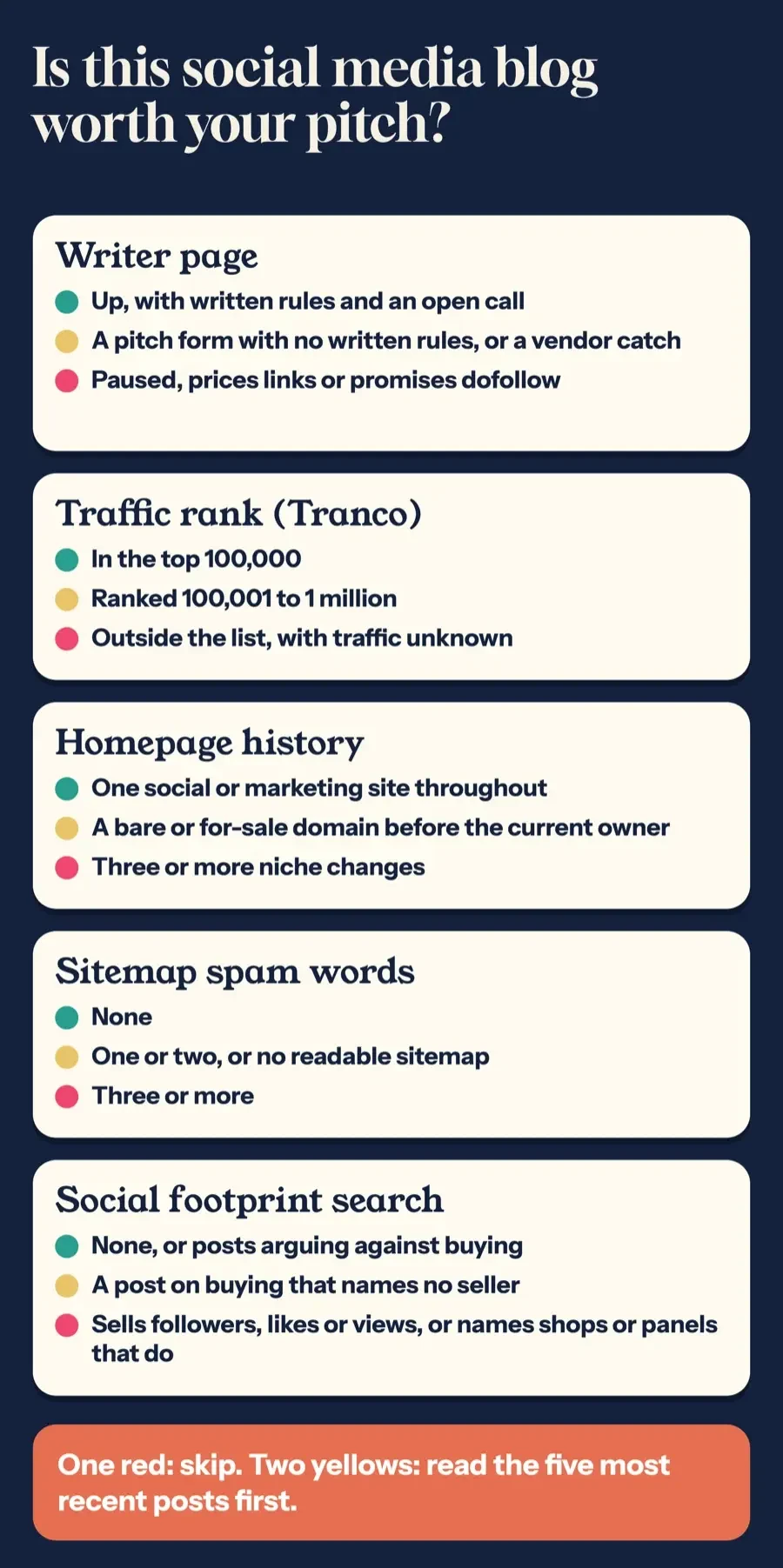 Diagram by DigitalTreed: a five-row card for judging social media blogs, scored on the cutoffs our October 31, 2026 batch run used.
Write for us social media: the site that made the cut, and why
The table lists only what survived the October 31, 2026 batch run and a same-day reread of the writer page. The Vetted stamp on our header image means only that. The page was live and open, with no price, dofollow promise or spam footprint our checks could see, but it doesn't promise traffic, a reply or a followed link. Influencer Marketing Hub takes pitches against written rules. The run kept two. Our reread removed one: Social Champ, whose blog names follower shops (details under What we tested). Site names stay plain text. Each table row carries a single link, to the writer page, marked rel="nofollow".
| Site | Where to pitch (nofollow link) | What the page says | Tranco rank | First Wayback year | Checked |
| Influencer Marketing Hub | Contributor guidelines | Open; finished, ready-to-publish drafts only; no link building, no closing ask to follow a brand; links may be nofollowed | #16,369 | 2016 | 10/31/2026 |
Wayback's earliest capture of a domain can belong to an earlier owner, so that year isn't proof of the blog's age.
Why only one? We checked 120 social media candidates. The biggest group, 67, had no writer page anywhere our checker looked. Sprout Social, Hootsuite, Later and Buffer all went out at that step. Another 38 didn't load at all, a fair picture of how old "social media write for us" lists age. The rest went out for bot checks (6), dofollow or backlink promises (5) and casino or CBD slugs (2). Social Media Examiner, the title most readers try first, was checked with our marketing candidates and answered with a bot check, so it isn't here either. We'd rather print one row than pad the table with sites that failed a step.
Every request carried a user agent naming DigitalTreed and obeyed robots.txt, and the checker never hit one host twice within 1.5 seconds. With no paid traffic tool, the only traffic signal we had was Tranco's October 29, 2026 list (ID PYK6J). None of the social media candidates ranked past the top million and still cleared every other check, so there's no Smaller sites table. Yearly homepage captures came from the Wayback CDX API, where "Results may be filtered by timestamp using from= and to= params." We read the titles as the archive's Wayback Machine help page describes.
Pitching broader marketing or B2B topics instead? The digital marketing guest post guide covers broader marketing publications, and the B2B marketing guest post guide covers demand generation. No site appears on two of our lists.
What we tested
Of 120 social media candidates, the run kept 2 and dropped 118. By reason: no writer page 67, not loading 38, bot checks 6, dofollow or backlink promises 5 and casino or CBD slugs 2. Our reread then removed one more, leaving one. Our build writes these counts to test/social-media-counts.json, which feeds the chart.
The run's sitemap scan looked only for casino-type words, so we wrote a second scan for follower-growth words, from "buy followers" to "SMM panel". On October 31, 2026 it read 25 sitemap files and 5,278 URLs for Influencer Marketing Hub and 6 sitemap files and 2,125 URLs for Social Champ.
Influencer Marketing Hub had two hits, both posts arguing against buying Instagram followers. Social Champ had one, the shop-list post quoted in the footprint section, so it came off the list even though its pitch form was open.
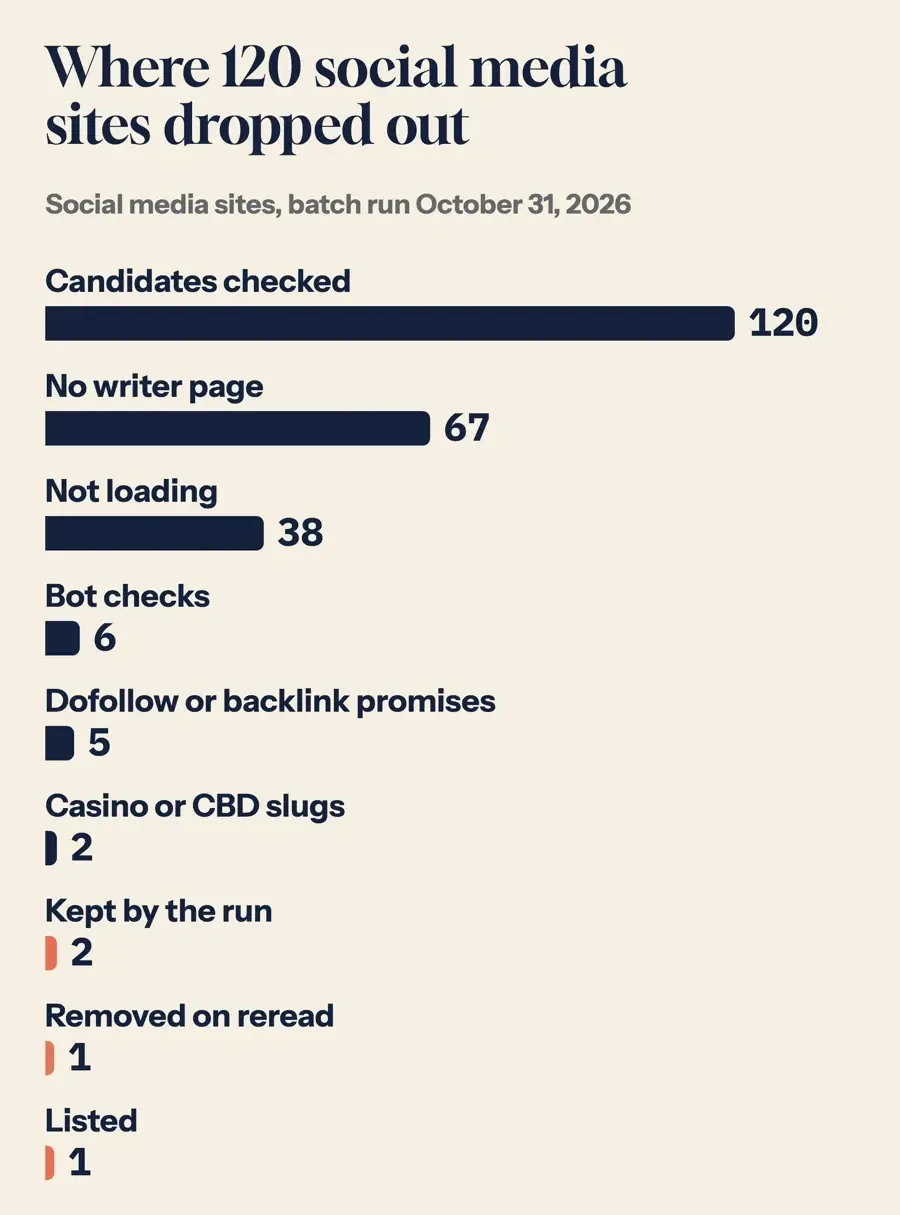 Diagram by DigitalTreed. Every bar comes from the October 31, 2026 run and our footprint scan.
A pitch email and five social media topic ideas
Influencer Marketing Hub wants the finished post in a ready-to-publish state. Our own page works the other way: pitch first and hold the draft until the topic is agreed. The short pitch below serves both, as the email itself or as the cover note on a finished draft. Google's 2017 note on large-scale guest post campaigns lists the question editors ask first: "Does this person's message fit with my site's audience?" The sample below answers it early. Replace each braced field with your own details; the sample itself is invented.
Subject: Pitch: {N} weeks of {format} tests on a {niche} account

Hi {editor first name},

From {start date} to {end date} I ran {format} on {platform}
for {account type}. Saves went from {A} to {B} per post and
reach from {C} to {D}, out of {posts} posts.

The piece would show the posting plan, what changed after
{platform}'s {dated change} (linked to its own announcement),
and cropped analytics screenshots with handles blurred.
About {word count} words.

About me: {role}, {years} years running {platforms}.
Past work: {link 1}, {link 2}
Disclosure: {client or tool ties, or none}. No bought followers
or engagement on any account in the piece.
AI use: {none, or what it did}

{your name}
Google's same 2017 post flags "Using or hiring article writers that aren't knowledgeable about the topics they're writing on". So the about-me line gives the role, the years and two live links an editor can open. If AI helped with research or a first pass, say so, because our page's rule is "AI-assisted content must be edited, reviewed by a person and fact-checked."
Short of an idea? Each of these uses data you already hold, and none needs a follower trick:
- A 90-day posting-frequency test on one account: posts per week against reach and saves, with the analytics screenshots.
- A dated platform change and what it did to your numbers, linked to the platform's own announcement.
- A creator or UGC campaign teardown with the paid-partnership labels shown and the cost per result.
- Social customer care: reply times from your inbox against review ratings over one quarter.
- One short video posted to three platforms, with the retention curves side by side.
Before you send, check each number against its export. Crop each screenshot to the dates you write about, and blur commenter names, DM threads and any client handle that wasn't cleared in writing. Once the post is live, paste its URL into our social preview checker to see the title, image and description it shows when shared.
Disclosing a sponsored social post or a paid link
If a brand or a client pays you for the post, or for the shares that promote it, two rulebooks apply. The FTC's disclosure guide for influencers is short and direct: "Place it so it's hard to miss", and "Don't mix your disclosure into a group of hashtags or links."
So the label goes in the post and in the caption that shares it. The same guide warns that disclosures "are likely to be missed if they appear only on an ABOUT ME or profile page".
Links follow Google's rule rather than the FTC's. Google's guide to qualifying outbound links wants rel="sponsored" on paid links and accepts nofollow, "though sponsored is preferred". It also lists "Exchanging goods or services for links" as link spam, so a free product for a link counts as payment. Selling sponsored posts on your own social blog? Our guide for sellers whose buyers disappear covers deposits and keeping the post in draft until you're paid.
Social media guest post questions
Frequently asked
Is guest posting on social media blogs against Google's rules?
No, not by itself. Google's 2017 note on guest post campaigns says "Google does not discourage these types of articles in the cases when they inform users". Trouble starts when they're there mainly to place links.
Do bought followers count on YouTube?
Not for long. YouTube's fake engagement policy says "Terminated accounts and subscribers that are identified as spam will not count toward your total number of subscribers or views."
Is a brand liable if an influencer it hires has fake followers?
The FTC's rule Q&A answers "No" to that exact question, because that provision focuses on the "distribution" of fakes. Buying followers with reason to know they're fake falls under a separate part, 465.8(b).
Do I have to use #ad on a sponsored post?
Not the hashtag itself. The FTC's influencer guide says "It's fine (but not necessary) to include a hashtag with the disclosure, such as #ad or #sponsored." Plain words like "sponsored" in the post do the job.
How we made this guide: Every number, row and scorecard example here rests on the October 31, 2026 batch run and the records it saved. That afternoon we downloaded both kept writer pages, each policy page we quote and the two posts our scan found, and a script then matched every quote against those copies. We didn't pitch a site, fill in a form or sign in anywhere. Facts checked by the DigitalTreed team on October 31, 2026.
This URL went live in November 2023, when it was DigitalTreed's own social media guest post call. It was rewritten on October 31, 2026 as a how-to for anyone pitching social media sites.
Sources
- FTC: Federal Trade Commission Announces Final Rule Banning Fake Reviews and Testimonials (August 14, 2024)
- FTC: Consumer Reviews and Testimonials Rule, Questions and Answers
- eCFR: 16 CFR Part 465, Rule on the Use of Consumer Reviews and Testimonials
- FTC: Disclosures 101 for Social Media Influencers
- YouTube Help: Fake engagement policy
- Snap: Community Guidelines
- LinkedIn: Professional Community Policies
- Reddit: Reddit Rules
- Google Search Central: Spam policies for Google web search
- Google Search Central: Qualify your outbound links to Google
- Google Search Central Blog: A reminder about links in large-scale article campaigns (May 25, 2017)
- Google Search Central: Creating helpful, reliable, people-first content
- Google Search Central: site: search operator
- Google Search Help: Refine Google searches
- Tranco: A Research-Oriented Top Sites Ranking Hardened Against Manipulation
- Tranco: Methodology
- Internet Archive: Wayback CDX Server API
- Internet Archive Help Center: Using the Wayback Machine
Comments
No comments yet. Start the conversation below.