
Quick answer
As of October 31, 2026, 4 digital marketing publications cleared our site check, and all of them accept a cold pitch from any writer. Many candidates failed early: 86 of 169 had no writer page our checker could locate, and 8 sold links or promised dofollow ones. Score any site with the 2-minute card below, then pitch with numbers from your own account.
Maybe you run Google Ads for a few local clients or grew an email list from zero, and now you'd like a byline where other marketers read. Search "write for us digital marketing" and you'll have to sort editors from link sellers who price posts by Domain Authority. A digital marketing submission page is a publication's invitation to outside writers, listing the topics it takes and the proof it wants. Until this rewrite, the URL held DigitalTreed's own call for marketing guest posts; now it also points you to other publications worth a pitch.
This guide opens with what marketing editors ask you to prove. Then come search strings for their submission pages, and the price sheets, link menus and casino mixes that give a seller away. After that you'll find a way to score any marketing blog in 2 minutes and the publications our October 31, 2026 check let through. The guide ends with a pitch email, five angles and what Google and the FTC expect once money changes hands.
Key takeaways
- Marketing editors ask for your own account numbers, screenshots and named sources.
- A sheet pricing guest posts by DA 50+ belongs to a link seller.
- Google accepts paid links once they carry rel="sponsored" or nofollow.
- Disclose agency, client and affiliate ties in the pitch and on the page.
- Our sitemap word scan never saw link menus, so search for those yourself.
Note
Want to write for DigitalTreed? Our submission page calls DigitalTreed "a digital marketing and technology publication". The topics listed there today are "SEO", "Business", "AI tools", "Blogging", "WordPress", "Affiliate marketing" and "Online growth". An editorial pitch sends a working title, a few lines on what the reader will learn, an outline and two links to past writing. The page adds: "Real examples, numbers and screenshots from your own work make a pitch stand out." Sponsored posts get "One relevant contextual link to your website or brand". "New clients pay 50% upfront and the remaining 50% after the post is published." Current rates are listed in the media kit.
What marketing editors ask contributors to prove
Before you search, know what the editors want: marketing contributor pages ask for evidence before style, and the ones we saved on October 31, 2026 are blunt about it. ClickZ's submission checklist wants a piece that "uses data and stats to support each point, and names the source". Its case studies welcome agencies "with a named client". Campaign Monitor asks that a post include "multiple relevant, helpful examples including visuals".
That makes screenshots from your own account the cheapest proof you have. Nobody else can produce them. Keyhole's writer page says posts "Must have relevant real-life examples and screenshots", and our own page says much the same. Before you attach one, blur the client's name, the ad account ID and any spend figure the client hasn't cleared in writing. A published screenshot is hard to pull back. A cropped chart with the real before-and-after still carries the point.
Next is what editors turn away: the tenth rewrite of a beginner guide that already ranks. Google's list of people-first content questions includes whether a page manages to "avoid simply copying or rewriting those sources" and whether it shows first-hand expertise. Omnisend's guidelines put it in one line: "We publish educational, data-informed content". So pitch the campaign you ran last quarter, with its real numbers and the part that didn't work, rather than another "email marketing 101" the editor's archive already covers.
Then there's the question of who pays you, which marketing pages handle in opposite ways. Influencer Marketing Hub's contributor guidelines say "Posts may not contain affiliate links." and allow one link per domain. Vendor blogs can pull the other way. Keyhole asks writers to "Highlight Keyhole's relevant functionality" and to close on a call to action for its free trial. Whoever pays you, the FTC wants it said: its influencer disclosure guide tells you to disclose "any financial, employment, personal, or family relationship with a brand". For an agency writer that means naming the agency in the first email and saying whether a client in the story pays you.
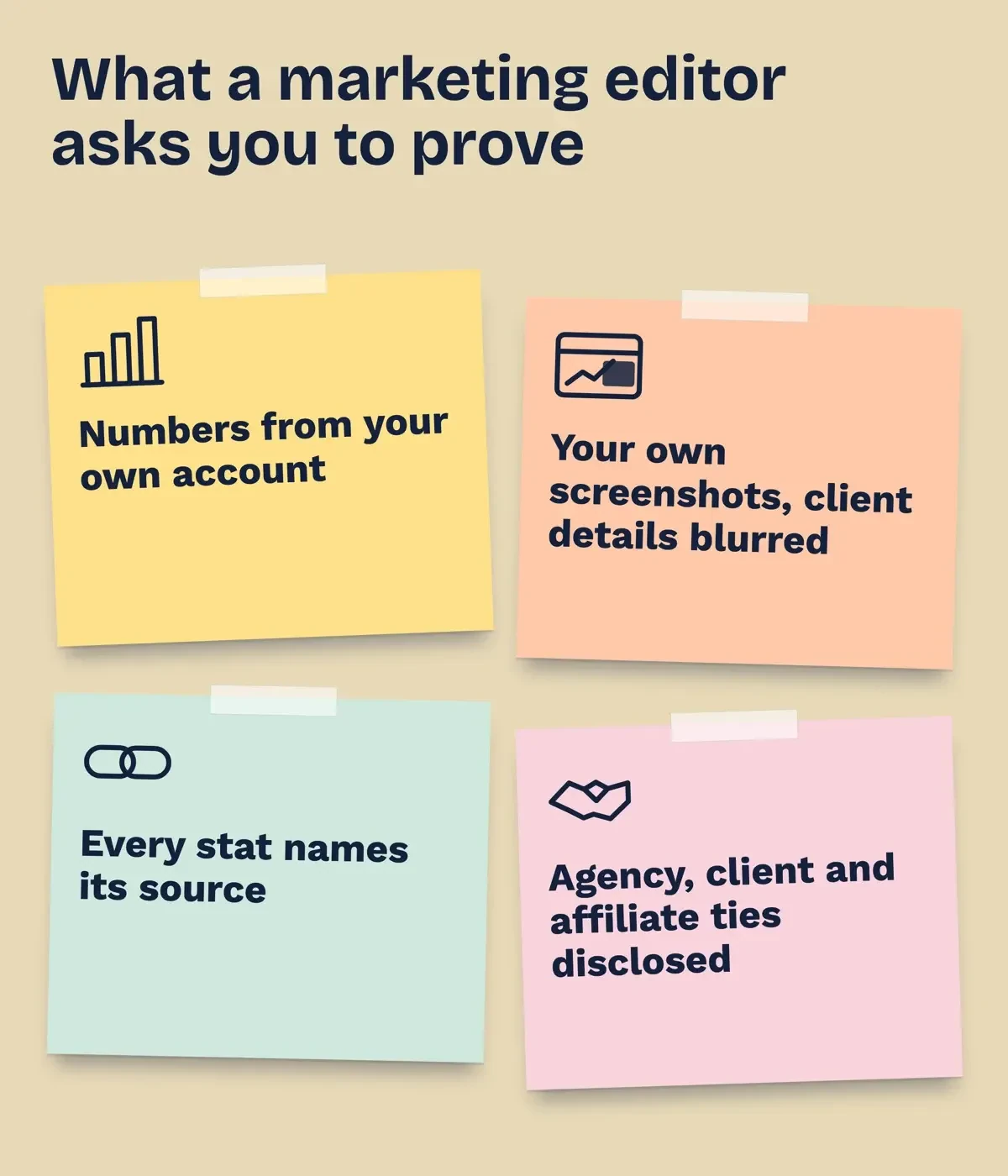 Diagram by DigitalTreed of four things marketing editors ask a contributor to prove, taken from the contributor pages and FTC guide we read on October 31, 2026.
Search strings for marketing contributor pages
The operators in the box below, quotes, a minus sign, site: and after:, are all explained on Google's refine searches help page. OR isn't on that page, so if the OR line returns odd results, run it as two searches.
The first block looks for marketing pages that ask for proof. The second checks one domain at a time for seller signs.
Find marketing submission pages
"write for us" "email marketing" "case study" -casino
"contributor guidelines" "marketing" "original data"
"submit a guest post" "content marketing" -"DA 50"
"guest post guidelines" "performance marketing" OR "paid social"
"pitch" "marketing" "named client" editorial
"write for us" marketing analytics after:2026/01/01

Vet one marketing site (replace example.com)
site:example.com casino
site:example.com "link insertion"
site:example.com "dofollow"
site:example.com "sponsored post" price
site:example.com "DA 50"
"example.com" "guest post" price
The minus terms do the early weeding: a page that mentions casino or advertises its DA wouldn't pass the footprint checks below anyway. The after: line asks for pages "last updated after a particular date", which screens out calls nobody has touched in years. The vet block has limits, too. Google's site: operator page warns that "The list of URLs returned is not always exhaustive", so zero hits for casino proves little. Old lists of marketing sites are full of dead ends. In our run, 36 of 169 candidates were dead, parked or redirected away from the writer page.
So paste each submission page into our HTTP status code checker before you pitch. You want the page itself to answer 200, while a bounce to the homepage tells you the writer page is gone.
DA price sheets, link menus and casino mixes
A seller's writer page can copy an editor's wording, so check five footprints, starting with the price sheet. A line like "DA 50+ guest post" next to a dollar figure sells a number Google doesn't use. Moz's own Domain Authority page says "Domain Authority is not a Google ranking factor and has no effect on the SERPs". Google's spam policies list "Exchanging money for links, or posts that contain links" as link spam.
Link insertion menus come second, and here the label is everything. Google's spam policies say "Google does understand that buying and selling links is a normal part of the economy of the web for advertising and sponsorship purposes". The next sentence says such links are fine "as long as they are qualified with a rel="nofollow" or rel="sponsored" attribute value". So a paid link isn't the red flag on its own. What should worry you is a price list for followed links placed into old articles on any topic, with nothing said about how they're marked. So ask any seller which rel value the link gets.
Our run was stricter than Google here. Any writer page with a price next to dofollow, sponsored post or link insertion came out. So did pages promising a dofollow link and homepages whose titles sold guest posts or DA, 8 marketing candidates in all.
That brings up guest post marketplaces, the third footprint. Listing a site on one is fine. DigitalTreed runs one too. The sign to watch is one domain on several sellers' sheets at different prices, each line showing a DA figure and nothing about who actually reads the site. Google's 2017 warning on large-scale article campaigns lists "Having the articles published across many different sites" as one sign of a link scheme.
Fourth, read what else the page invites. A writer page that lists SEO, social media, casino and CBD in one menu of accepted topics is writing for whoever pays, and your byline would sit beside theirs. That's where our run's word scan helps. It checked the slugs in every candidate's sitemap against a fixed word list: "casino", "cbd", "viagra", "escort", "mod-apk", "payday-loans", "title-loans", "betting-tips", "online-slots", "slot-machines" and "essay-writing-services". Three hits or more took a site out. Two marketing candidates went out that way, on "casino" and "slot-machine". The worst had "casino" in 7 sitemap slugs.
The scan reads page addresses only, though, so it can't see a link menu; the vet block's "link insertion" search is yours to run.
Then there are private blog networks, the last footprint. Google doesn't use that name. Its expired domain abuse rule describes a domain "purchased and repurposed primarily to manipulate search rankings". One of its examples: "Casino-related content on a former elementary school site". Two domains on our own marketing candidate list now open on a casino or loan homepage.
In the Wayback Machine, that shows up as homepage titles that jump from a dentist or a school to "marketing tips". Then open the XML sitemap validator and read the slugs.
Moz's Spam Score is a vendor metric, not Google's. Moz calls 61% to 100% high, yet says a high score "doesn't mean this site is necessarily spammy". Our run didn't use it, and the scorecard below doesn't either.
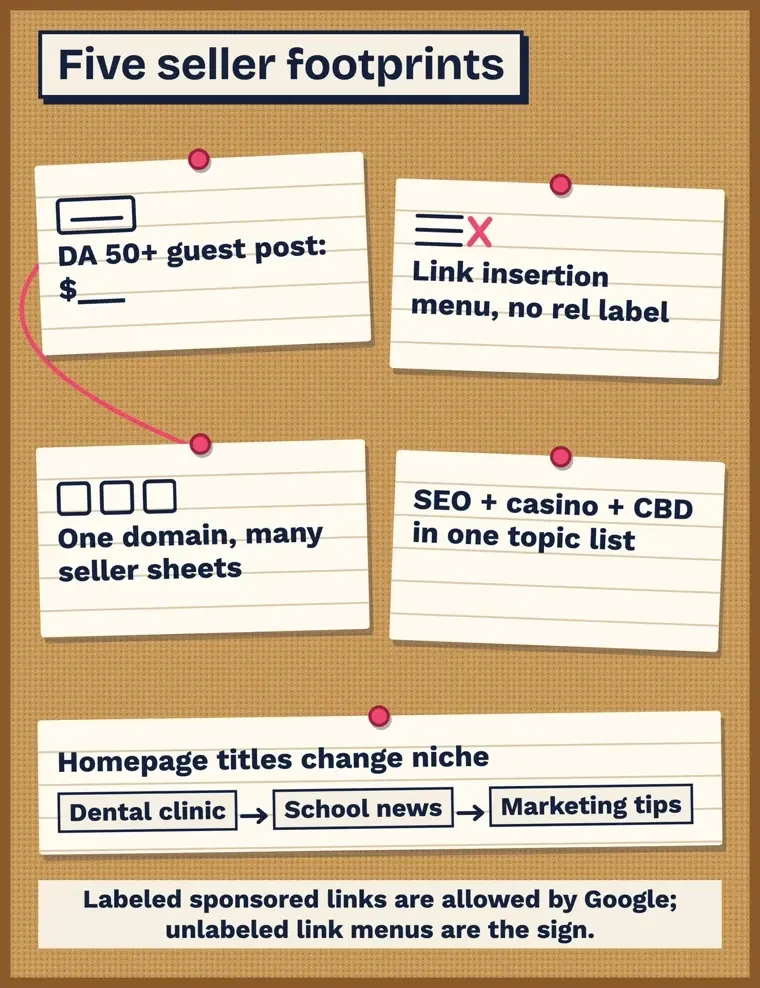 Diagram by DigitalTreed of five marketing guest post footprints, drawn from Google spam policies, Moz help pages and our October 31, 2026 site check.
How do you score a marketing blog in 2 minutes?
Those footprints feed a five-row card, and you stop at the first red. Our niche sites hub carries the full vetting checklist, and its SEO and search marketing section lists a separate set of SEO sites. The first four rows come from what the run saved for each kept site. The last is the hand search from the footprint section.
| What to look at | Green | Yellow | Red |
| Pitch page | Up, and asks for a pitch or outline | Live with a catch: vendor promotion, byline after several posts | Paused; prices links by DA; promises dofollow |
| Tranco rank | Top 100,000 | Past 100,000 but inside the top million | No rank, traffic never checked |
| Titles in the Wayback Machine | One marketing publication | Unrelated owner long ago, marketing since | Three or more niche jumps |
| Sitemap word scan | Zero hits | One or two hits, or unreadable | Three hits or more |
| Hand search | No price sheet or link menu | Sponsored posts sold and labeled | DA price sheet, unlabeled link menu, casino or CBD posts |
Stop at any red. Two yellows? Read the five newest posts before you draft a word.
Then run the guest post category through our noindex tag checker, because a noindexed category hides every post in it from search, and your byline with it.
For the rank row we used Tranco, a "Research-Oriented Top Sites Ranking". Its methodology page says it averages four providers' lists "over the past 30 days", so a rank says people visit the domain, not that they're marketers in the US.
Here's the card applied to three publications from our table, using only the run's saved data and our reread:
- SmartBrief. Writer page: open call, green. Tranco: 29,822, green. Homepage titles: an industry newsletter publisher from 2013 to 2026, green. Sitemap: no spam words, green.
- ClickZ. Writer page: open call, green. Tranco: 39,199, green. Homepage titles: marketing news from 1997 to 2026, green. Sitemap: 1 spam word, yellow.
- Ignite Visibility. Writer page: open call, green. Tranco: 177,022, yellow. Homepage titles: a marketing agency from 2012 to 2026, green. Sitemap: no spam words, green.
Across the whole table, 3 of the 4 publications carry a yellow and none has a red. By cause: rank past 100,000 (2) and spam words (1). SmartBrief scored green on every row we have data for. One yellow doesn't stop a pitch; two mean you read the five newest posts first.
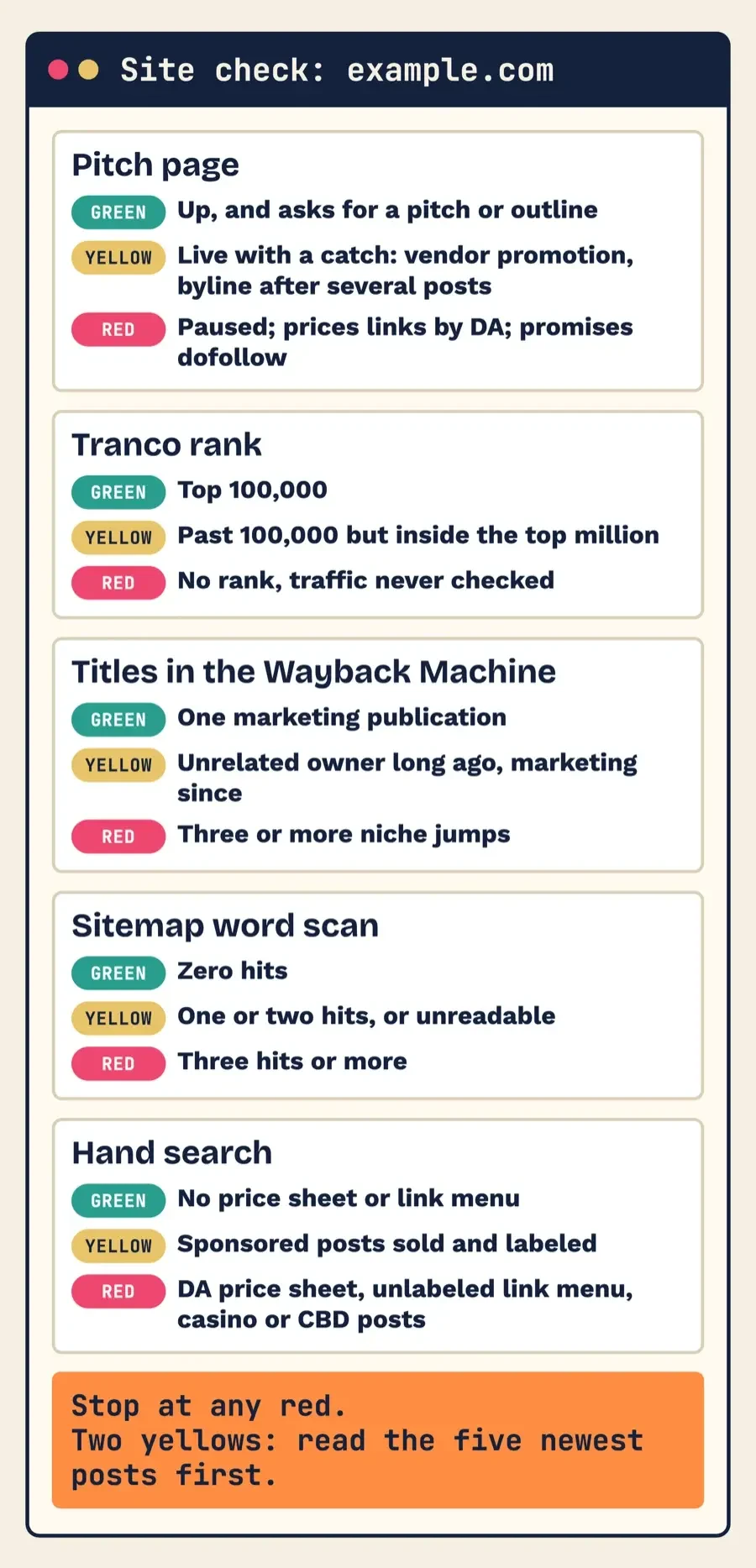 Diagram by DigitalTreed of the 2-minute check for marketing publications, using the same thresholds as our October 31, 2026 run.
Write for us digital marketing: publications that cleared our check
Each publication below survived our October 31, 2026 run, and each writer page was saved and read again that same afternoon. Our header's Vetted stamp promises only that much, with no traffic, reply or followed link implied. The run kept 5 marketing sites. One didn't survive the read:
- Marketeers: a live call for opinion pieces, but the page says "Marketeers is Indonesia’s next-gen business media", so its readers are not in the US
That leaves 4 rows, short of our target of 15, and we won't fill the gap with sites that failed. Most candidates fell at the first step: 86 of 169 had no writer page our checker could locate. All four accept a cold pitch from any writer. We don't link publication names. The one link in a row points at its writer page with rel="nofollow".
| Publication | Pitch page (nofollow link) | Rules on that page | Tranco position | Oldest Wayback year | Checked |
| SmartBrief | Write for us | Open; its Marketing vertical takes best practices and case studies; 500 to 900 words; disclose every commercial tie | #29,822 | 2000 | 10/31/2026 |
| ClickZ | Submit an article | Open; case studies need a named client; every point backed by sourced data; no product pitches | #39,199 | 1997 | 10/31/2026 |
| Ignite Visibility | Become a contributor | Open; an agency blog; send three topic ideas through its form | #177,022 | 2012 | 10/31/2026 |
| Product Marketing Alliance | Create and contribute | Open; product marketing topics such as go-to-market, messaging and launches; no promotion of your own company | #287,736 | 2019 | 10/31/2026 |
The oldest Wayback year is the archive's first copy of the domain, which can be older than the current publication.
Ad-platform writers have their own list in our PPC guest post guide, and social-first publications are in the social media guest post guide if that's your main beat. B2B demand-gen outlets sit in the B2B marketing guest post guide. None of those lists, and no list in the hub, shares a site with this table.
Every request carried a user agent with DigitalTreed's name, the checker paused 1.5 seconds or more before calling the same host again, and it followed robots.txt. Any bot wall or refusal code ended the check for that site, and we never tried to get past one. We paid for no traffic tool such as Ahrefs or Similarweb, so Tranco (ID PYK6J, built October 29, 2026) was the only traffic signal we had. One smaller marketing blog with no Tranco rank passed every other test; it waits for a person to look at its visitors. We pulled one homepage capture per year through the Wayback CDX API and read the titles as the archive's help pages describe.
What we tested
The run checked 169 marketing candidates on October 31, 2026. Of those, 5 stayed, 1 went to the smaller-sites pile, and 163 came out. The biggest group, 86, had no writer page our checker could locate. Another 36 never loaded. A further 25 answered our checker with a bot wall or a refusal code, so we went no further. The rest: dofollow promises (8), vice topics (3), spam words (2), closed programs (1), no recent posts (1) and no Tranco position (1).
Of the 4 listed, 2 rank inside Tranco's top 100,000. Link sellers took 8 candidates, and every one of them had promised writers a dofollow link. The bar chart below plots exactly these numbers.
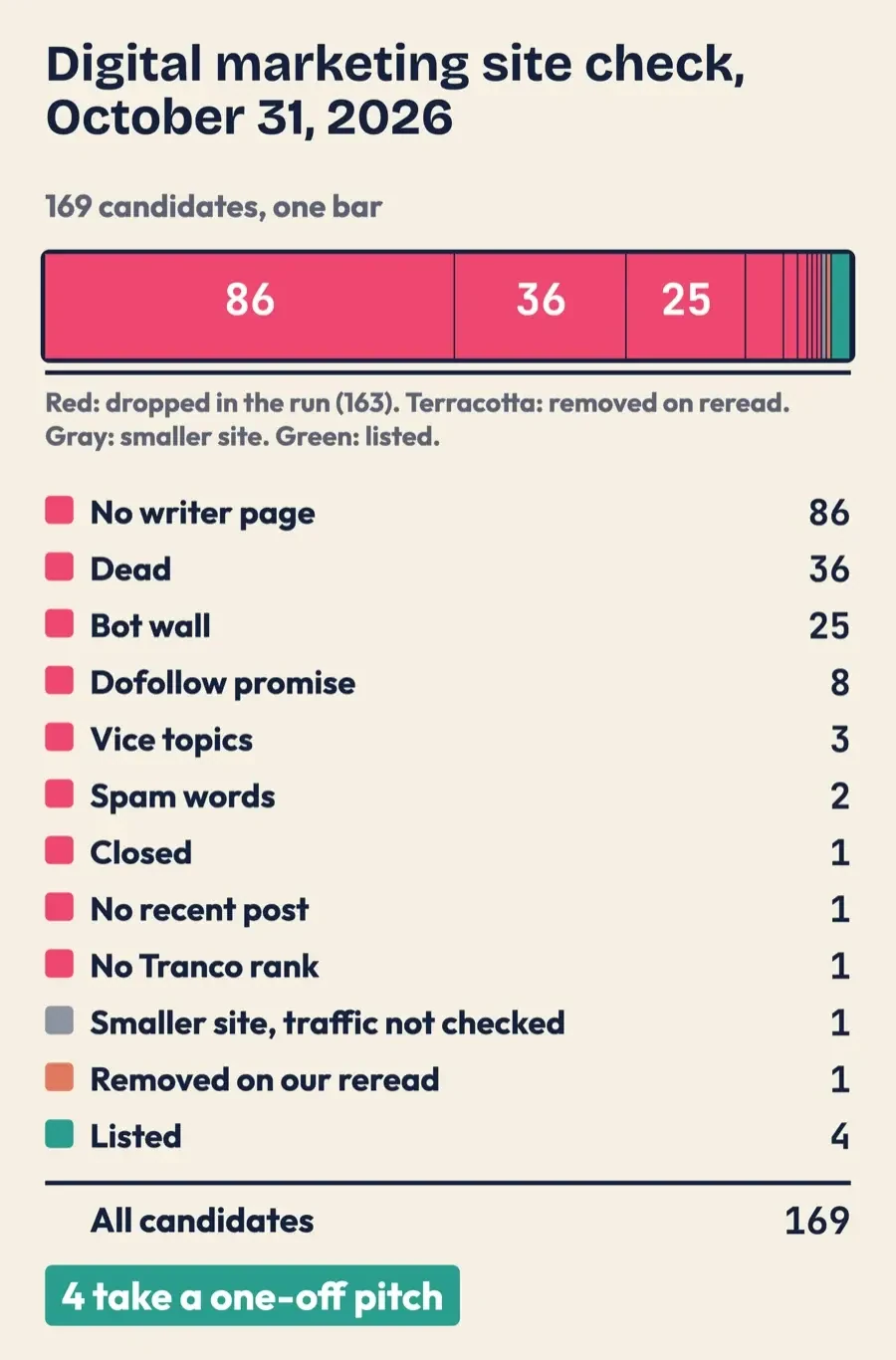 Diagram by DigitalTreed; counts from the site check we ran on October 31, 2026.
A marketing pitch email and five angles editors can check
Once you have a shortlist, write the email. ClickZ wants "a short pitch (the argument, and why you’re the person to make it)". Ignite Visibility asks for three topic ideas first. Our page says "Please do not send a finished article before we agree on the topic." Everything in braces is yours to fill, and the sample itself is made up. Don't drop the numbers line or the disclosure line because they feel awkward: they answer an editor's first two questions, where the figures came from and who pays you.
Subject: Pitch: How {client type} cut cost per lead from ${X} to ${Y}

Hi {editor first name},

Between {month} and {month} we moved {client type}'s {channel}
budget from {old setup} to {new setup}. Cost per lead went
from ${X} to ${Y} on {N} leads; conversion rate from {A}% to {B}%.

The piece would show the three changes, the one that failed,
and dashboard screenshots with client details blurred.
About {word count} words. Data source: {platform} reports, {dates}.

About me: {role} at {agency}, {years} years on {channels}.
Past writing: {link 1}, {link 2}
Disclosure: {agency} is paid by this client; no affiliate links.
AI use: {none, or what you used it for}

{your name}
Short of a story? Each angle below uses data you already hold:
- A campaign teardown from your own ad or email account, with spend, results and the change that failed.
- A tracking gap: one month of conversions in your analytics against the ad platform's own count, and why they differ.
- One A/B test written up in full: sample size, run time, the winner and what you would test next.
- A client report template you actually send, with the five numbers a finance team asks about first.
- A tool switch diary for an email or analytics platform, with your partner or affiliate status stated up front.
Before you send, check every number in the pitch against the export you took it from, and keep that file, because an editor may ask for it during the edit.
Paid links, rel="sponsored" and the FTC's disclosure rule
Once a vendor or client pays for the post, two sets of rules apply: Google's protect its search results, and the FTC's protect the people who read your post. Google asks sites, on its page about qualifying outbound links, to "Mark links that are advertisements or paid placements" with the sponsored value. Its 2019 announcement on nofollow says sponsored is preferred, "but either is fine".
The FTC's rule protects readers. Under 16 CFR 255.5, when a connection that could affect an endorsement isn't expected by the audience, "such connection must be disclosed clearly and conspicuously". The FTC's native advertising guide lists labels like "Sponsored Advertising Content" and steers advertisers away from vaguer ones such as "Promoted". We aren't lawyers. Have one read any paid deal before you sign it.
Selling sponsored posts on your own marketing blog? You carry the payment risk then. Our guide for sellers whose buyers vanish walks through deposits and unpublished drafts.
Marketing guest post questions
Frequently asked
Is guest posting against Google's rules?
Not by itself. Google's site reputation abuse update says "having third-party content alone is not a violation of the site reputation abuse policy". Its spam policies do list "links with optimized anchor text in articles, guest posts, or press releases distributed on other sites".
Can I put affiliate links in a marketing guest post?
Only if the publication allows them, and many don't. If you do, disclose the commission. The FTC's endorsement guide Q&A suggests wording like "I get commissions for purchases made through links in this post."
Can I use AI to write the post?
Ask the editor first, because policies differ. Digital Information World's editorial standards say "AI assistance must be clearly disclosed within the article", and our submission page says "No fully AI-generated content".
How we made this guide: The list, the counts and the scorecard examples come from the site check we ran on October 31, 2026, and the records it saved. The same day we downloaded each kept writer page, plus every marketing page we quote, and matched each quote against those copies by script. Our reread took out one site and put none back. No one here sent a pitch, used a contact form or opened an account on any site we list. Facts checked by the DigitalTreed team on October 31, 2026.
From October 2023 this page asked marketers to send guest posts to us. Since the October 31, 2026 rewrite, it helps them pitch other publications instead.
Sources
- Google Search Central: Spam policies for Google web search
- Google Search Central: Qualify your outbound links to Google
- Google Search Central Blog: Evolving nofollow, new ways to identify the nature of links (September 10, 2019)
- Google Search Central Blog: A reminder about links in large-scale article campaigns (May 25, 2017)
- Google Search Central Blog: Updating our site reputation abuse policy (November 19, 2024)
- Google Search Central: Creating helpful, reliable, people-first content
- Google Search Central: site: search operator
- Google Search Help: Refine Google searches
- eCFR: 16 CFR 255.5, Disclosure of material connections
- FTC: Disclosures 101 for Social Media Influencers
- FTC: FTC's Endorsement Guides: What People Are Asking
- FTC: Native Advertising: A Guide for Businesses
- Moz: What is Domain Authority? (vendor metric)
- Moz Help: Spam Score (vendor metric)
- Tranco: A Research-Oriented Top Sites Ranking Hardened Against Manipulation
- Tranco: Methodology
- Internet Archive: Wayback CDX Server API
- Internet Archive Help Center: Using the Wayback Machine
Comments
No comments yet. Start the conversation below.