

Quick answer
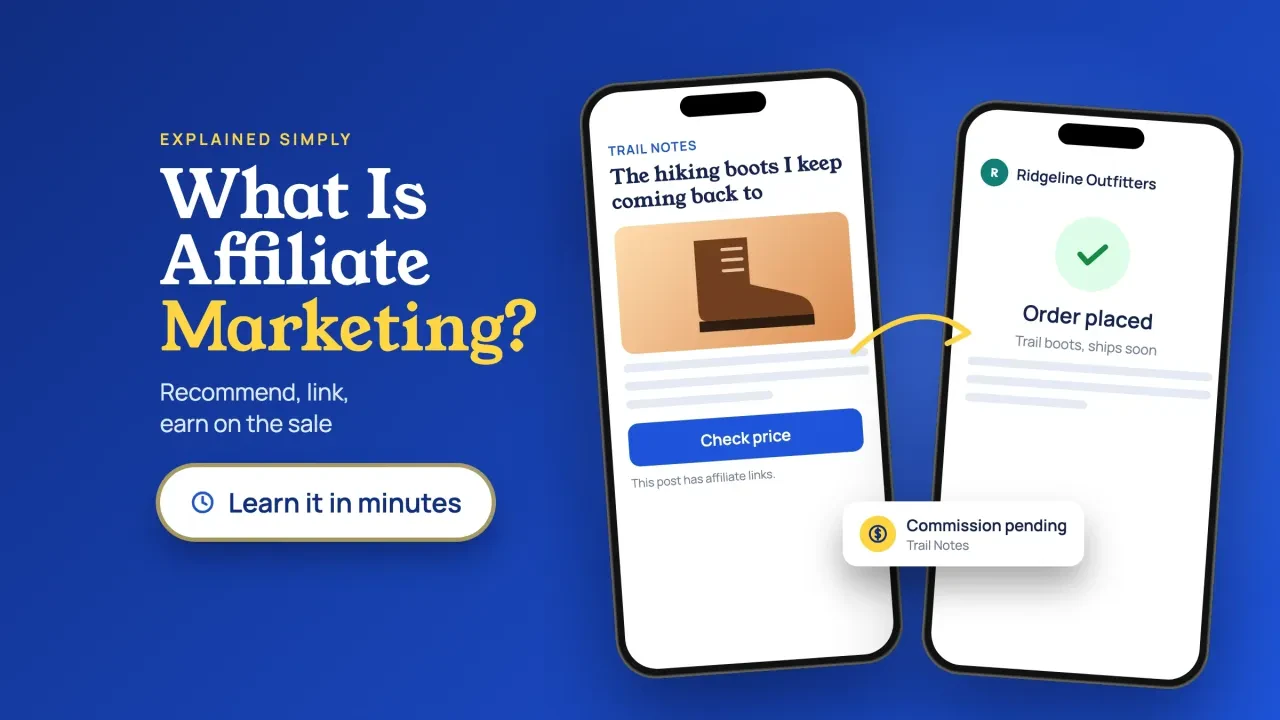
Affiliate marketing is a deal where a business pays other people a commission for the sales their links send. A reader clicks the affiliate's tagged link, and the shop's tracking credits the sale. Most programs pay for results, not clicks, and there are rules for both sides.
Key takeaways
- A merchant, an affiliate and a customer make every deal work.
- A tagged link and a cookie decide who gets the commission.
- Most programs pay on a sale, not on a click.
- Both sides must make the paid link clear to readers.
- Businesses and creators need different next steps.
What is affiliate marketing in everyday terms? Think of a friend who tells you which boots to buy. Now picture the shop mailing that friend a thank-you check after you pay.
That's it, minus the friendship.
Three parties and one tagged link
Every deal's got three players. The merchant sells something. The affiliate (a blogger, YouTuber, newsletter writer or another business) recommends it. The customer reads, clicks and buys. Simple.
Bigger programs often add a fourth party, an affiliate network, which hosts the links and counts the sales, so a creator doesn't need a separate deal with every shop.
Example (made up): Kettle Pond Outfitters, a gear shop in Sandpoint, Idaho, sells $140 trail boots. The Lantern Trail hiking blog reviews them and links to the shop, which pays 8% per pair sold: $11.20.
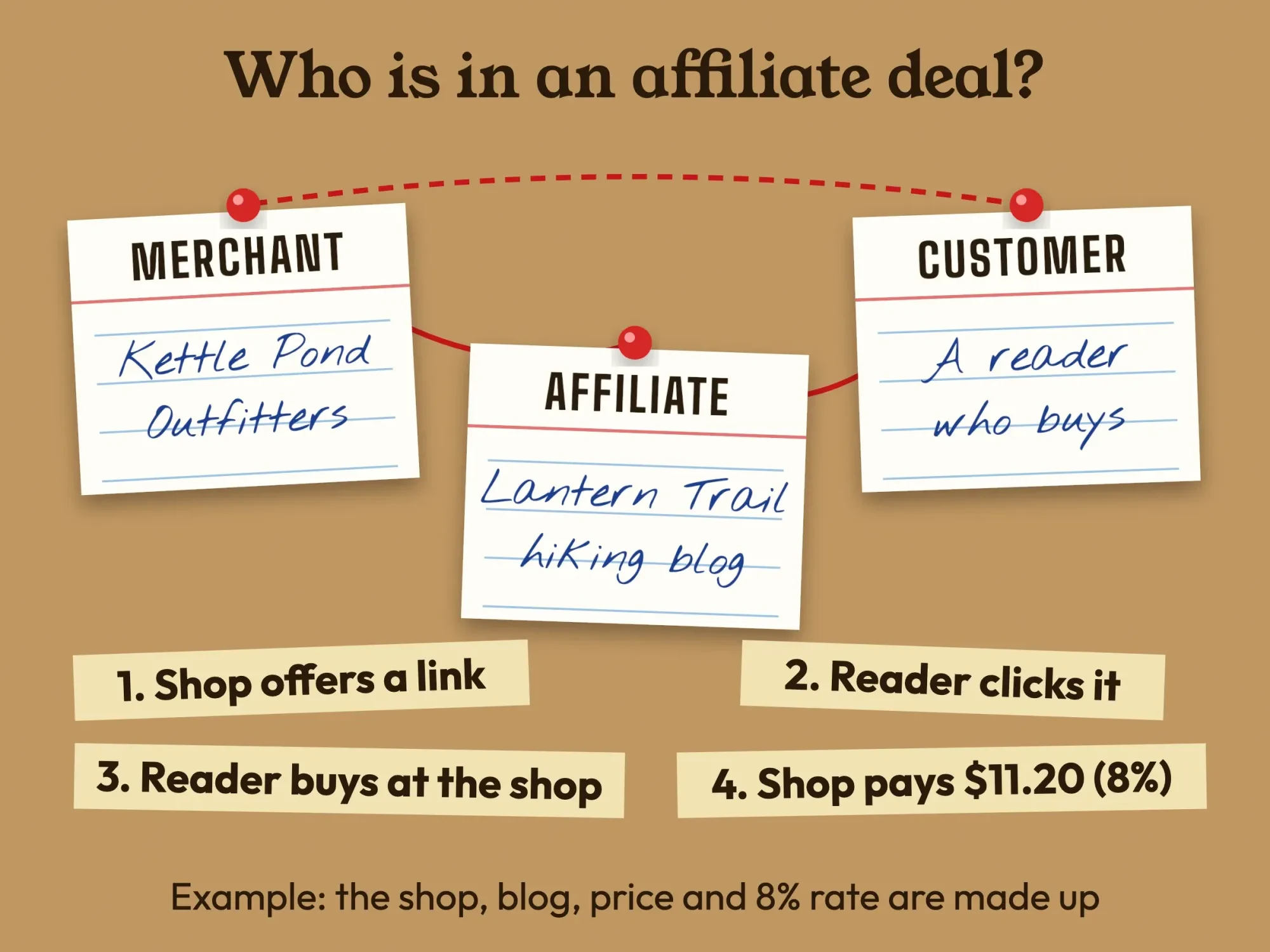 Diagram by DigitalTreed: the three parties in an affiliate deal. Kettle Pond Outfitters and Lantern Trail are made up.
How does a click turn into a commission?
The link carries the affiliate's ID. The shop stores it in a cookie, "a small piece of data a server sends to a user's web browser." At checkout, the shop reads the ID. Now it knows who sent you.
We tried it. On October 27, 2026, the made-up Kettle Pond shop ran offline on our own machine. Opening its boots page with ?ref=lantern-trail returned a Set-Cookie header with a 30-day Max-Age. We bought the boots in Chrome 156, and the order page showed "Credited to affiliate: lantern-trail", $11.20 pending. A second, fresh browser then took exactly the same path through the shop without the tag, and the very same order didn't earn anybody a single cent.
Same boots. Same $140. No tag, no pay.
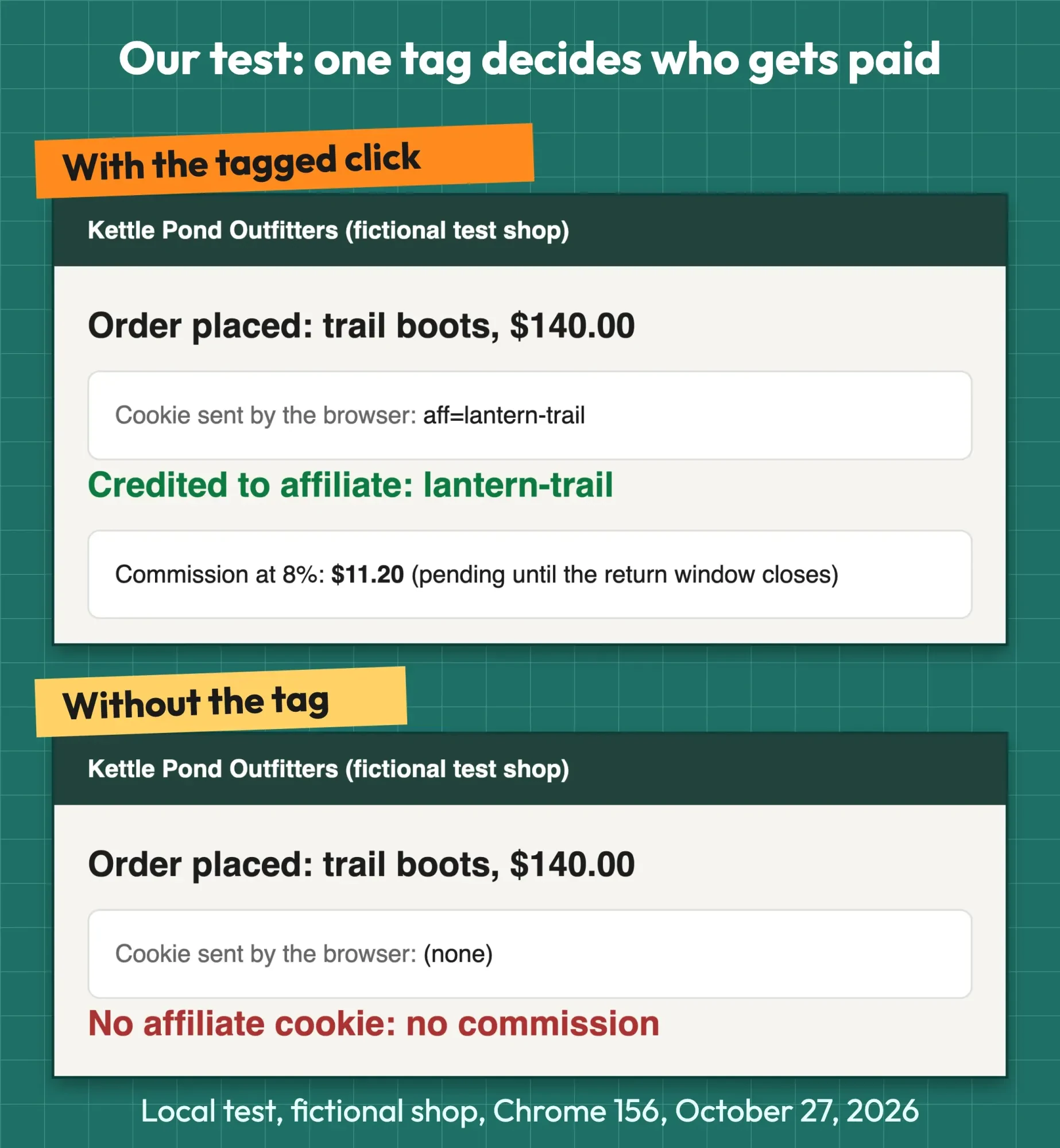 Screenshot: our local test of a fictional shop, Chrome 156, October 27, 2026. One browser clicked the tagged link first; the other didn't.
Merchants tag links, too. It's how they see which partners send visits. Our free UTM link builder makes those URLs.
Most deals pay on a sale, not a click
That checkout is usually when money moves. Programs pay on a sale, a lead (a signup or a quote request) or a click.
Clicks and ad views are the weak spot, since a simple script can fake both without any person ever looking. So many programs pay only when real money arrives, and our test shop held its commission until the return window closed.
A sale's hard to fake, and that's why so many programs use it.
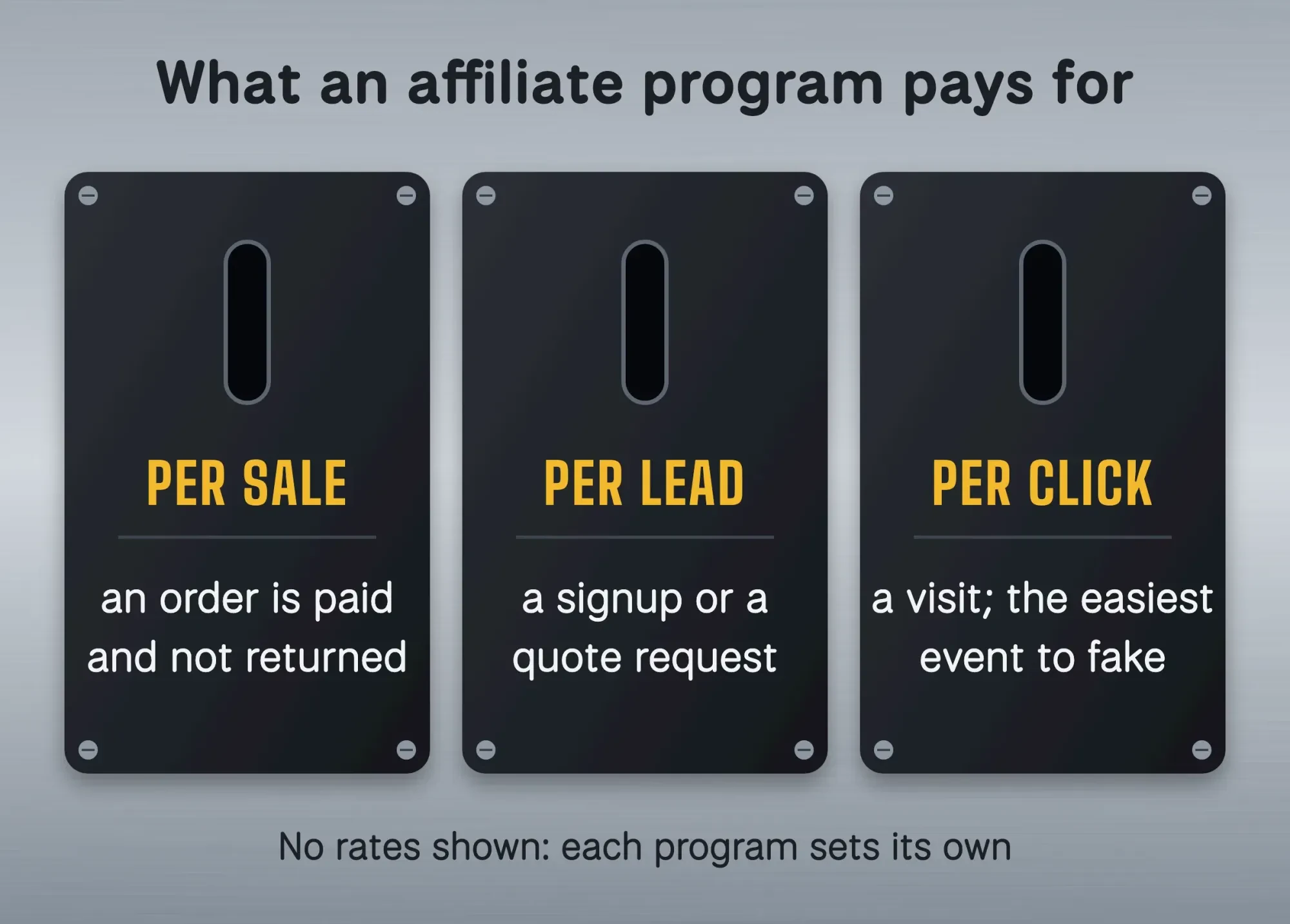 Diagram by DigitalTreed: the three pay events in affiliate programs. No rates shown; they vary by program.
Both sides answer to the FTC
That money has to be disclosed. The FTC's Q&A on its Endorsement Guides asks affiliates to disclose "clearly and conspicuously". Its example: "I get commissions for purchases made through links in this post." "Paid link" beside a link works too. A "buy now" button doesn't.
Free stuff counts, too. Under 16 CFR 255.5, a material connection can include "the provision of free or discounted products". The FTC updated these guides on June 29, 2023. Merchants aren't off the hook either, since 16 CFR 255.1(d) can make advertisers liable for misleading claims their endorsers make.
Google wants paid links marked rel="sponsored", and how to use affiliate links shows where labels go. This is a plain summary, not legal advice; a lawyer can say how the rules apply to your program or channel.
The trade-off for each side
Each side gets something and gives something up.
| Side | What you get | What it costs you |
|---|---|---|
| Business (merchant) | Sales from new audiences, paid only after results | Commissions, tracking work and watching what affiliates claim |
| Creator (affiliate) | Income without stock, shipping or support | Your audience trust, and pay that depends on the shop |
There's one more risk for creators. Google's spam policies treat "thin affiliation", pages that copy the merchant's product text and add nothing, as spam.
Our take: for a creator, trust beats the rate. Every time. One review that hides a bad product can cost you more than a month of commissions.
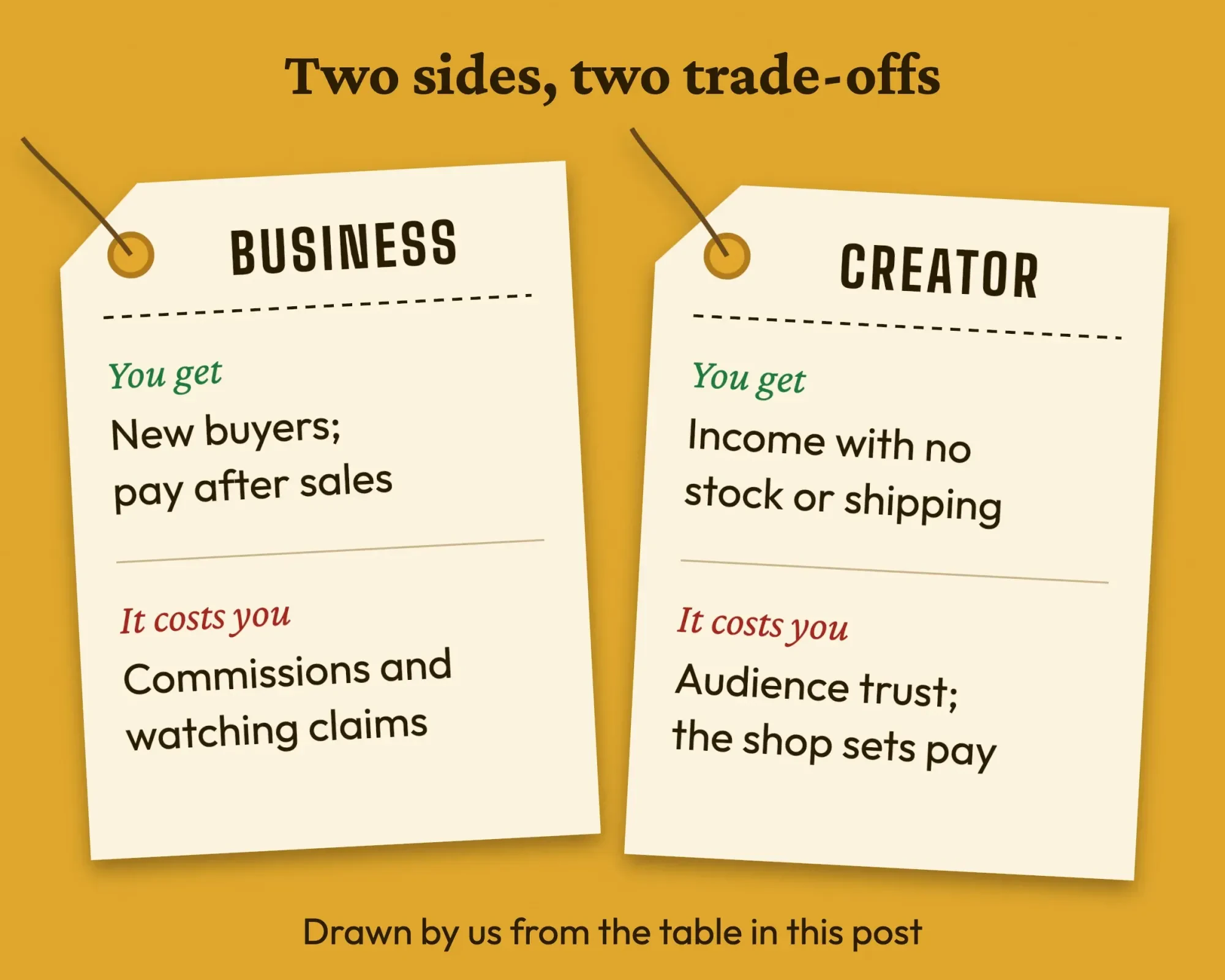 Drawn by us: the trade-off for a business and for a creator, from the table above.
Pick your side, then read the how-to
So which side are you on? Set-up differs, so we'll stop here.
Running a business? Read how to start an affiliate program for your small business. Creating content? Start with getting approved for Amazon Associates, then picking affiliate products and making review videos. Unsure a blog's worth it? See what blog marketing is, or our digital marketing basics.
We write reviews and product content for clients, so treat this as our offer, not neutral advice: our content marketing service can help.
Frequently asked
Is affiliate marketing legit or a scam?
The model's legit: a shop pays for sales it can track. The scams are the courses and "systems" sold around it. The FTC warns that an offer promising "guaranteed income, large returns, or a “proven system,”" is likely a scam.
Do you need a website to do affiliate marketing?
No. Many affiliates post on YouTube, Instagram or in email newsletters, if the program allows it, and the disclosure duty follows you onto every one of those platforms. "Don't assume that a platform's disclosure tool is good enough," warns the FTC's guide for influencers.
Do you pay taxes on affiliate income?
Yes, in the US it's taxable income. The IRS's gig economy tax center says income "From part-time, temporary or side work" must be reported, even if it isn't on a 1099 or W-2. A tax professional can tell you what applies to you.
Can you put affiliate links in product reviews?
Yes, with a clear disclosure. Google's guide to writing high quality reviews asks for "evidence such as visuals, audio, or other links of your own experience". It also suggests linking to more than one seller.
How we made this guide: every rule and quote here was checked against its source on October 27, 2026. We read the FTC's pages, 16 CFR Part 255 on eCFR, Google Search Central, MDN and the IRS, quoting each one word for word where a rule is involved. We ran the cookie test ourselves, offline, on a made-up shop in Chrome 156. You'll find a link at every claim. Nothing here goes live until the site owner approves it.
First published December 2019. Rewritten October 27, 2026: kept the three parties and the pay-per-sale point and dropped an unsourced statistic. Added our own cookie test, the FTC disclosure rules, Google's rules for affiliate pages and paid links, and a clear next step for business owners and for creators.
Sources
- FTC: FTC's Endorsement Guides, What People Are Asking
- eCFR: 16 CFR 255.1, General considerations
- eCFR: 16 CFR 255.5, Disclosure of material connections
- FTC press release, June 29, 2023: updated Endorsement Guides
- FTC: Disclosures 101 for Social Media Influencers
- FTC Consumer Advice: When a Business Offer or Coaching Program Is a Scam
- Google Search Central: Spam policies for Google web search
- Google Search Central: Qualify your outbound links to Google
- Google Search Central: Write high quality reviews
- MDN: Using HTTP cookies
- MDN: Set-Cookie header
- IRS: Gig economy tax center
Comments
No comments yet. Start the conversation below.