
Quick answer
Is blogging worth it for business? Yes, if your buyers research before they buy and you can fund about $123 of writer time per post for several months. Where Google shows an AI summary, people click a regular result in 8% of visits, against 15% without one. So thin posts are now wasted money.
Is blogging worth it for business in 2026? For a lot of small businesses, yes. For plenty of others, not yet. The difference isn't talent or budget. It's whether your customers type questions into a search box before they pick someone, and whether you can answer those questions better than the page that already ranks.
This guide gives you the numbers to decide for your own business.
We'll cover what AI answers did to clicks, what one post really costs, and the cases where you're better off skipping the blog for now. If you've already decided to blog and want the writing steps, our separate walkthrough on writing a blog post step by step covers those.
Key takeaways
- AI summaries nearly halved clicks on regular results, from 15% to 8%.
- Two posts a month cost about $2,958 in writer time a year.
- An Ahrefs study found 96.55% of pages get zero traffic from Google.
- Blogging pays when buyers research for days or weeks before they call.
- Map-driven walk-in and emergency businesses should fix their Business Profile first.
A business blog is a set of answers your buyers already search for
A business blog is a section of your own website where you publish articles that answer the questions customers ask before they buy. It isn't a diary, and it isn't a news feed about your office party.
Picture a homeowner in Bangor, Maine, at 10 p.m. in January. The furnace is old, the oil bill hurts, and they type "do heat pumps work at 20 below?" Whoever wrote the clearest, most honest answer to that question gets a visit. If that page belongs to a local installer, it may get a phone call in March.
That's the whole trade. You spend hours now on answers, and search engines and AI tools send people to them for months or years. A social post fades in days.
A good answer page keeps working as long as the question stays the same and the page stays right.
So the real question isn't "should we have a blog?" It's "do our buyers ask questions we can answer well?"
AI answers took some clicks, and Google says the rest got better
So start with the bad news: AI summaries do cut clicks, and that's now measured, because Pew Research Center tracked the browsing of 900 US adults in March 2025. When a Google search showed an AI summary, people clicked a regular result in 8% of visits, against 15% when no summary appeared. They clicked a link inside the summary itself in just 1% of visits.
That's nearly half as many clicks on those searches.
But it isn't every search. In the same Pew study, 18% of Google searches produced an AI summary. In August 2025, Liz Reid, Google's head of Search, called total organic click volume to websites "relatively stable year-over-year" in a company blog post. She added that people now click more often on "an original post, a unique perspective or a thoughtful first-person analysis."
Google gave no figures, so weigh that claim against Pew's.
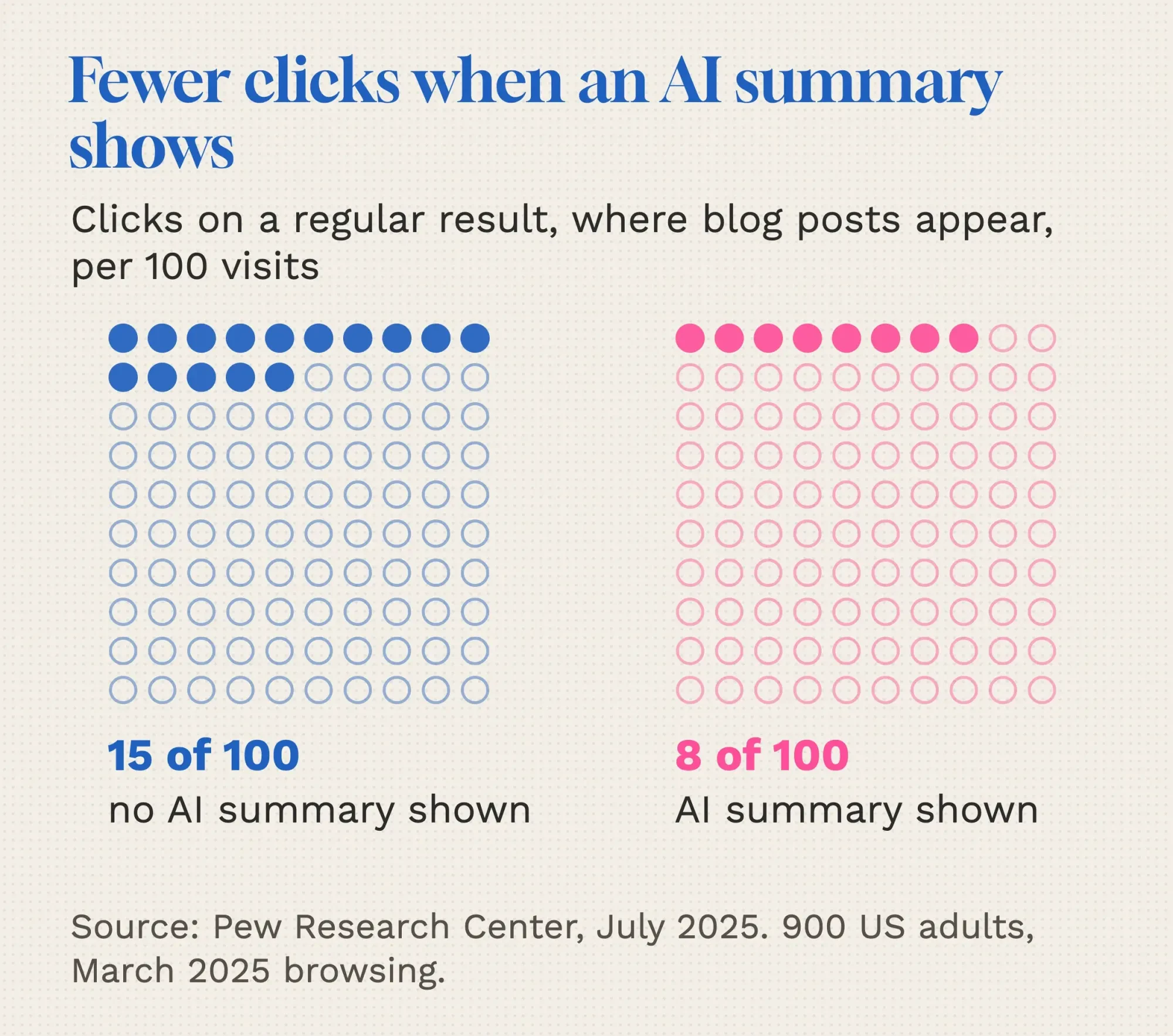 Source: Pew Research Center, July 2025 (900 US adults, March 2025 browsing). Drawn by DigitalTreed.
AI search isn't a side door either. In July 2026 Google said its AI Mode had passed 1 billion monthly active users. The same remarks say AI features in Search send "billions of clicks to websites every week."
Here's what that means for a shop or a contractor.
Google's AI features page lists "no additional requirements" for a page to be linked in its AI answers. It only has to be indexed and eligible for a normal snippet. So blogging isn't dead. Generic blogging is. A post that repeats what 10 other pages say gets summarized and skipped. A post with your prices, your photos and your local know-how is the kind of thing people still click.
One post costs about $123 in writer time before anyone reads it
That brings us to cost: a typical business blog post costs about $123 in writing time alone. Orbit Media's 2026 survey of 1,042 content marketers (published September 8, 2026) puts the average post at 3 hours, 20 minutes and 1,312 words. The BLS, the Labor Department's statistics office, puts 2025 median pay for writers and authors at $36.98 per hour (page read October 26, 2026). Multiply the two and you get $123.27 per post, as of October 2026.
That figure is wage cost only. It leaves out editing, photos, your own review and any software. A freelancer or agency will charge more, because they carry overhead, and their rates vary too much for us to give you one honest number.
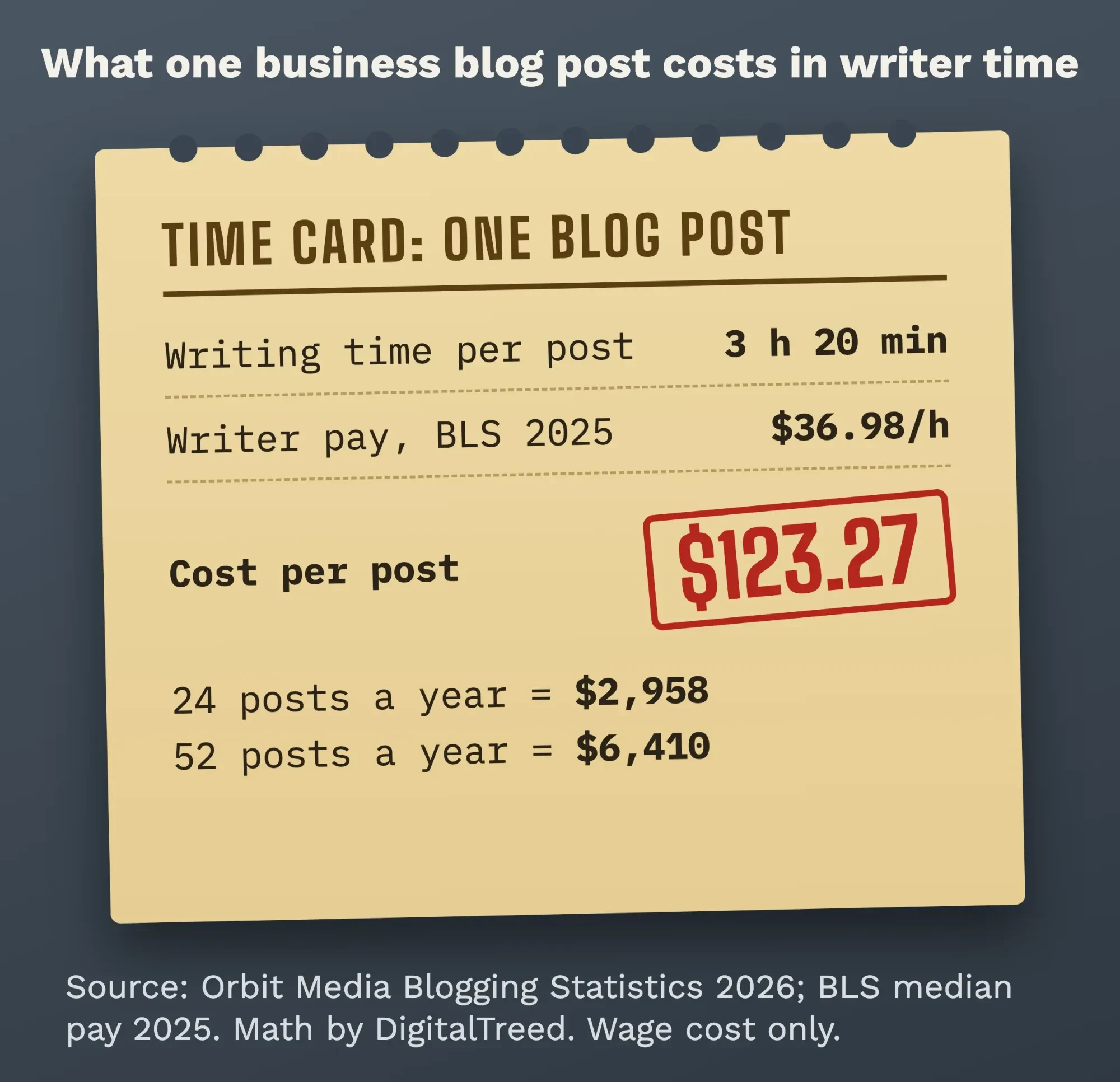 Source: Orbit Media Blogging Statistics 2026 and BLS 2025 median pay for writers. Math and drawing by DigitalTreed, October 2026.
Scale it up and the yearly bill gets real. At October 2026 figures, two posts a month is 24 posts, or $2,958 in writer time a year, and one a week is 52 posts, or $6,410. If you write them yourself, that's 80 to 173 hours a year that you're not spending on jobs.
And the payback is slow. Google's own starter guide for SEO says "some changes might take effect in a few hours, others could take several months." Most posts never get there at all. An Ahrefs study of about 14 billion pages found that 96.55% get zero traffic from Google (vendor data, December 2023). Its main reasons are topics nobody searches for, no links, and pages that don't match what the searcher wants.
We wanted to know whether the pages ranking for this question admit any of this. On October 26, 2026, we read the 4 top US results for "is blogging worth it" that loaded in full. We found that not one put a sourced dollar figure on a single post, and none mentioned Pew's click data. One leaned on visitor and lead stats credited to other companies that we couldn't trace to a dated study. Only 1 of the 4, a UK page, said when blogging isn't worth it.
Nobody else had, so we did the math above ourselves.
The platform itself is usually the cheap part. Our Blogger vs WordPress comparison shows what each option costs.
Blogging pays when buyers research before they call
So who earns that money back? Blogging tends to pay off when a purchase is big, slow or confusing enough that people read before they reach out.
Think home services with a large ticket, professional services, B2B products, and anything with rules or rebates attached. In those businesses, one good answer page keeps earning visits long after a social post has faded.
Effort per post matters more than it used to. In Orbit Media's 2026 survey (September 8, 2026), only 13.9% of marketers said their blog delivers strong results, an all-time low for that survey. Another 18% said they didn't know. Yet marketers who spent more than 6 hours per post and used 4 or more strategies per post reported strong results at a 31% rate.
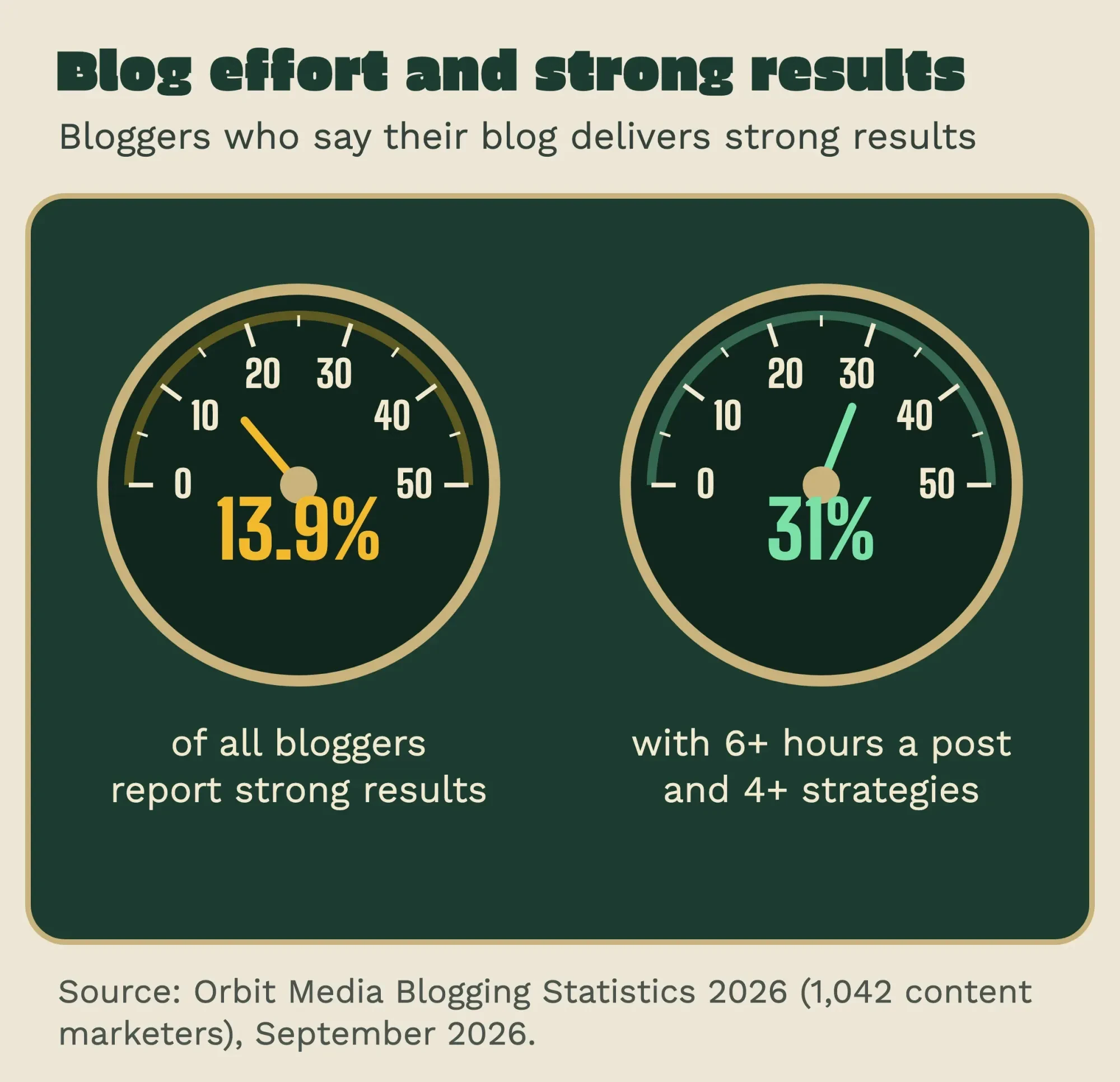 Source: Orbit Media Blogging Statistics 2026, September 2026. Gauges drawn by DigitalTreed.
Those respondents are content marketers, not only small businesses, so treat the numbers as a direction, not a forecast. The direction is clear, though: more care per post went with better results.
Google's own checklist points the same way. Its people-first content guide asks whether a page offers "original information, reporting, research, or analysis." It also asks whether a page is "primarily made to attract visits from search engines." You want yes to the first and no to the second. A business that installs, fixes or advises every day has original material most writers don't. Our SEO content writing tips show how to turn that into pages Google can understand.
To check whether people ask the questions you'd answer, put your service into our free keyword suggestions tool and look for the "how", "cost" and "vs" questions. If you can't find 20 real ones, that's an answer too.
Our take: blogging is worth it for a business whose buyers research first, if you'll write fewer, deeper posts from your own experience. If you'd only be filling a calendar, keep the money.
When blogging isn't worth it (yet)
But blogging isn't worth it when your customers don't search with questions, when a map listing does the selling, or when nobody has the hours to do it properly. In those cases the same time works harder elsewhere.
Local walk-in and emergency businesses are the clearest case. Someone with a burst pipe doesn't read articles. They pick from the map. Google ranks local results on relevance, distance and prominence. Prominence draws on how many websites link to you and how many reviews you have. A blog can earn some of those links, but reviews and a complete profile come first, so our step-by-step guide to optimizing a Business Profile is the better first project.
If you want to share news without running a blog, Business Profile posts can "share announcements, offers, updates, and event details" on Search and Maps. They're short and free. The catch: posts older than 6 months are archived unless you set a date range.
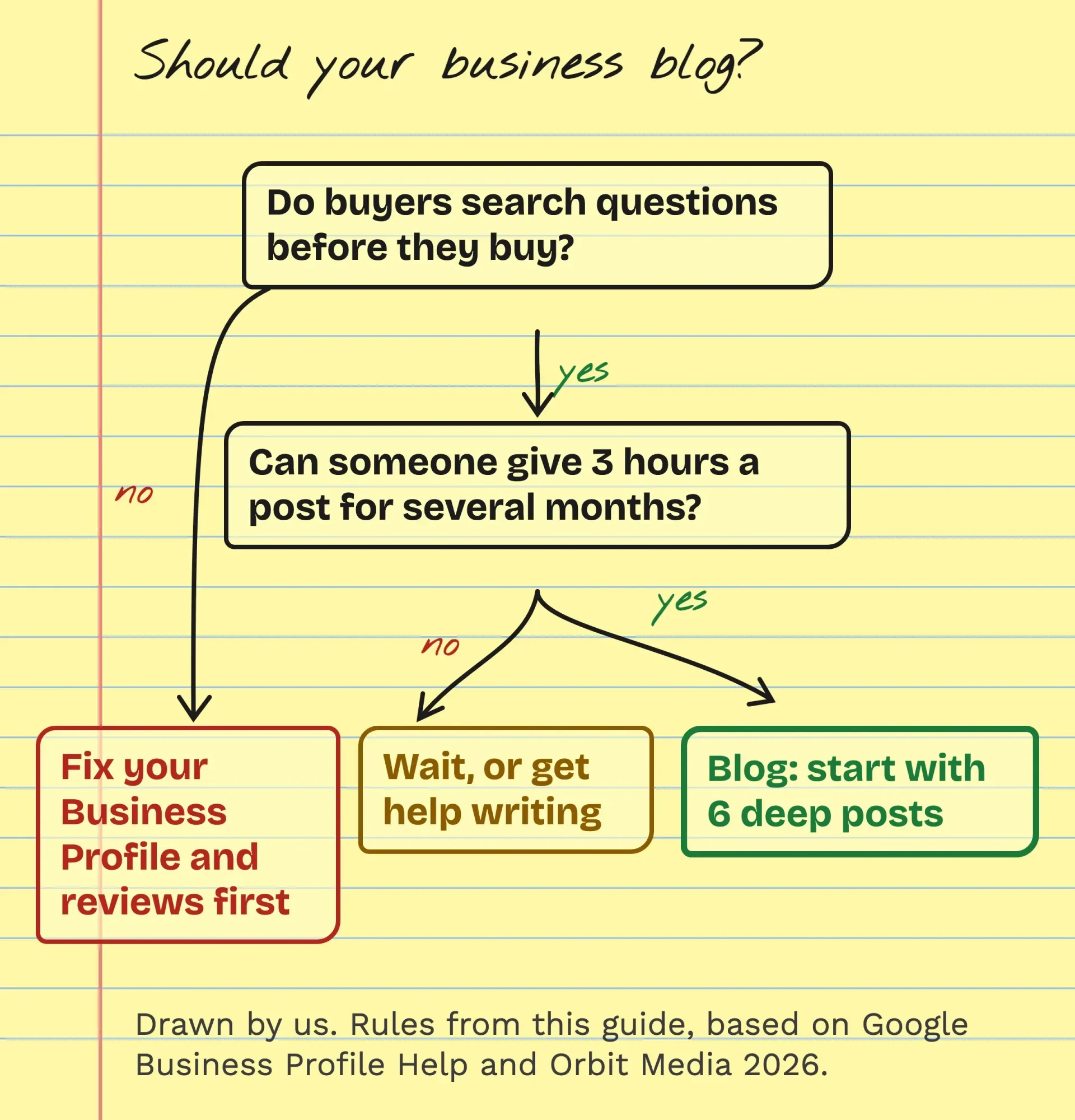 Drawn by us. Decision rules from this guide, based on Google Business Profile Help and Orbit Media 2026.
Impulse and very visual products are another case. A scented candle or a T-shirt sells on a photo and a price, so social posts and ads often do more than a 1,300-word article.
Then there's time. We think a blog with 3 posts from 2023 tells visitors the business may have stopped caring, which is worse than no blog at all.
Last, don't try to shortcut it with AI at volume. Google's spam policies name "scaled content abuse," which includes using generative AI "to generate many pages without adding value for users." AI can help you outline or edit. Orbit's September 2026 survey found 92.4% of bloggers now use it, and that it "correlates with nothing."
It can't supply the experience that makes a post worth clicking.
And if your website isn't ready yet, sort that first. Our guide to whether your business needs a website walks through that call.
Example: Kenduskeag Heat Pumps runs the numbers
Now see how the decision plays out for one business. Example: Kenduskeag Heat Pumps is a made-up installer in Bangor, Maine, with 6 staff. Its buyers spend weeks reading about cold-weather performance, rebates and running costs before they ask for a quote.
The owner lists 31 questions customers asked on site visits last winter. A field tech who's good on the phone will write 2 posts a month, with the owner checking facts. At Orbit's average of 3 hours 20 minutes a post and the 2025 BLS median wage, that's about $2,958 for 24 posts a year (an example figure, not a quote).
Now the break-even. Say each install leaves the company $1,500 of gross profit in 2026; that's a made-up figure, so use your own. Then 2 extra jobs a year from the blog cover the writing.
That's arithmetic, not a forecast. Whether those 2 jobs arrive depends on the posts and on months of patience.
For this business, the scorecard below lands on "worth it." A pizza place two streets away, with the same budget, would land on "fix the Business Profile first."
The blog-or-not scorecard
That example ran on the 7 questions below, and they work for any business: if 5 or more land in the left column, blogging is likely worth it. If 3 or more land on the right, put the time into your profile, reviews or ads first and come back in 6 months.
| Question | Points to "blog now" | Points to "wait" |
|---|---|---|
| Do buyers research before they contact you? | Yes, for days or weeks | No, they decide on the spot |
| Can you list 20 real customer questions? | Yes, from calls and emails | Fewer than 10 |
| Is one sale worth hundreds of dollars or more? | Yes | No, small one-off sales |
| Do customers mostly find you on the map? | Not mainly | Yes, map and reviews |
| Can someone give 3 to 4 hours per post? | Yes, every month | Only now and then |
| Can you wait several months for results? | Yes | You need leads this month |
| Do you have first-hand knowledge others lack? | Yes: jobs, prices, photos | You'd rewrite other sites |
The hours per post come from Orbit Media's 2026 survey and the waiting time from Google's starter guide for SEO. The cut-off scores are our rule of thumb, not a study.
How do you know if your blog is working?
Once it's live, you know a blog is working when Google's free Search Console report shows its pages gaining impressions and clicks. More important, those pages should lead to calls, forms or bookings. Search Console counts clicks as "the number of times a user clicked your site from Google Search results," and impressions as how often your site appeared.
Give each post about 3 months before you judge it.
Pageviews alone won't tell you much. In Google Analytics 4, mark form sends and phone-link taps as key events, which Google describes as actions that are "important to your business." Then you can see which posts start real conversations. Our GA4 setup guide walks through it, and our roundup of website analytics tools helps if GA4 feels like too much.
If a post gets impressions but few clicks, its title and opening aren't earning the visit.
If it gets clicks but no leads, it needs a clearer next step to your service page.
If the answer is yes, start with 6 posts, not 60
Then start small. Pick the 6 questions you hear most, write one deep answer for each over 3 months, and link each post to the service it relates to. Our intermediate SEO guide covers keyword research and content briefs in more depth.
Then get the posts in front of people instead of waiting for search. Our plan for promoting your blog posts covers email, social and your Business Profile.
After 3 months, check Search Console and your key events. Keep writing what works. Stop what doesn't.
Frequently asked
How often should a business blog post?
No Google rule sets a frequency. Orbit Media's 2026 survey ties strong results to effort per post and the number of strategies used, not to how often people post. Pick a pace you can keep, such as 2 posts a month.
Does a blog help my Google Business Profile ranking?
Only indirectly. A blog isn't one of the factors Google names for local results. A useful post can earn links from other websites, which Google does count, but reviews and a complete profile matter first.
Want a hand with it? DigitalTreed's content marketing service can plan and write the first 6 posts with you. We sell that service, so read this guide knowing that.
How we made this guide: on October 26, 2026, the DigitalTreed team read every source linked here. That includes Pew's study, Google's Search Central and Business Profile help pages, the BLS pay data and Orbit Media's 2026 survey. That day we also read the 4 top-ranking US pages on this question that loaded in full. None gave a sourced cost per post or Pew's click data, and only 1 covered when not to blog. The cost figures are our own arithmetic from BLS and Orbit numbers. We didn't run a blog test for this guide.
First published July 2020. Rewritten October 26, 2026: a new focus on whether a small business should blog at all. It adds 2025-2026 data on AI summaries and clicks, a sourced cost per post, when not to blog, a worked example and a scorecard.
Sources
- Pew Research Center: Google users are less likely to click on links when an AI summary appears in the results (July 22, 2025)
- Google: AI in Search is driving more queries and higher quality clicks (Liz Reid, August 6, 2025)
- Google: Q2 2026 earnings call, remarks from our CEO (July 22, 2026)
- Orbit Media: Blogging Statistics 2026 (published September 8, 2026)
- US Bureau of Labor Statistics: Occupational Outlook Handbook, Writers and Authors (2025 pay data, read October 26, 2026)
- Ahrefs: 96.55% of Content Gets No Traffic From Google (December 2023, vendor study)
- Google Search Central: SEO Starter Guide
- Google Search Central: AI features and your website
- Google Search Central: Spam policies for Google web search
- Google Search Central: Creating helpful, reliable, people-first content
- Google Business Profile Help: Tips to improve your local ranking on Google
- Google Business Profile Help: Create and manage posts on your Business Profile
- Search Console Help: Performance report (Search results)
- Analytics Help: Mark events as key events

Comments
No comments yet. Start the conversation below.