
Quick answer
Good affiliate product research starts with three pass-or-fail checks: you can use the product yourself, the exact model isn't recalled, and you've read the terms on the program's own page, with the date. Only then score fit, demand, reviews, returns and pay. Most "best products to promote" lists skip all three.
Most affiliate product research advice tells you to compare commission rates and cookie lengths. On October 25, 2026, we tried to do just that, using only what four big programs publish.
It didn't get far.
Amazon's commission schedule sent us to a sign-in page. Etsy's affiliate page calls its cookie period "competitive" and gives no number. eBay's partner site showed us a bot check.
So this guide puts the checks you can actually do first. It's written for a US creator or blogger with a small, loyal audience, and the steps work the same for a YouTube channel or a blog.
Key takeaways
- The FTC says you can't describe your experience with a product you haven't tried.
- Search the CPSC recall list by brand and model number before every video.
- Amazon's cookie session ends 24 hours after the click or at an order.
- Returns take the commission back at all three programs we could read.
- Google Trends scores run from 0 to 100 and are not search counts.
Affiliate product research starts with what your audience already asks
The best products to promote are the ones your viewers already ask you about. A commission only pays when the right people buy, and they buy what fixes a problem they've told you about.
Start with evidence you already have. Read your last 50 comments, your emails and the questions under your gear videos. Then list the products you've used for months and would buy again.
For most people, that list is short. Good.
New to how programs pay? Our guide to affiliate marketing for beginners covers the basics. On YouTube there's one more source of products, the YouTube Shopping affiliate program. Its help page says your channel must be in the YouTube Partner Program, meet "the subscriber threshold for YPP," and not have its audience set as Made for Kids.
It lists the United States among eligible countries, but the page gives no commission rate, only "a competitive commission." Selling through TikTok Shop instead? Our guide to making money on TikTok covers that side.
Fit also means fitting your plan. If your YouTube marketing plan is built around winter camping, a beach tent is noise, however good the rate.
Skip anything you can't put your hands on
That short list is your first gate.
If you can't use a product yourself, don't build a recommendation around it.
This isn't only good manners.
The FTC's staff FAQ, the Endorsement Guides: What People Are Asking, is blunt: "You can't talk about your experience with a product if you haven't tried it," it says. It goes further, too: "If you've only tried a product once, you can't suggest you use it regularly."
That answer rests on 16 CFR 255.1(c). When an ad says the endorser uses a product, the endorser "must have been a bona fide user of it at the time the endorsement was given," in the rule's words. The FAQ also warns that an endorser "may be liable for misleading or unsubstantiated statements."
Google asks for the same thing from another angle. Its advice on writing high-quality reviews tells reviewers to "provide evidence such as visuals, audio, or other links of your own experience with what you are reviewing." A product you've never held gives you nothing to show.
What about products you can't afford? Borrow one, ask the brand for a sample, or leave it out. A free sample is a connection you'll have to disclose; we cover the labels in our post on using affiliate links. A spec roundup can still help readers, as long as it doesn't pretend to be a test.
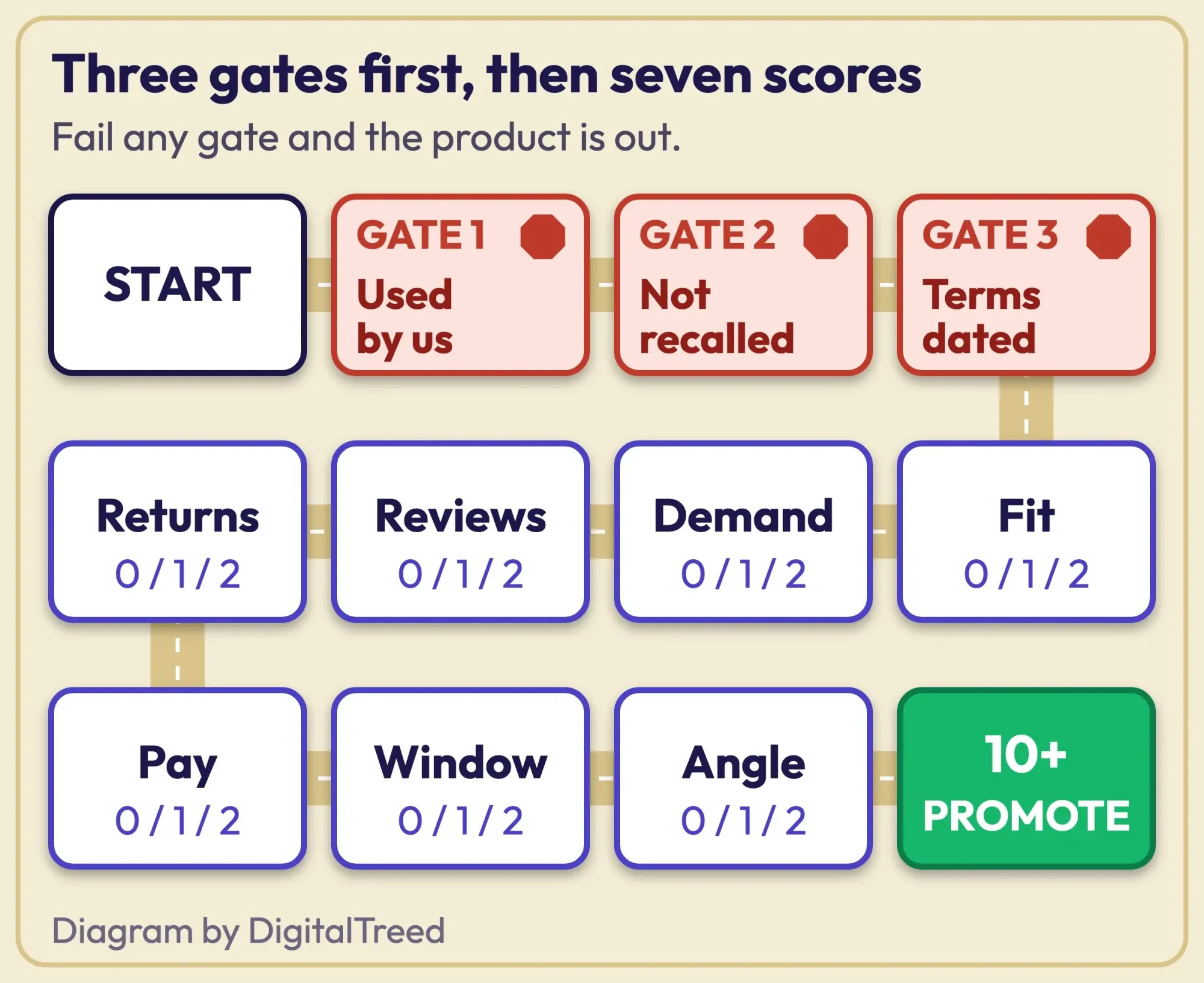 Diagram by DigitalTreed: the order we check a product in, three pass-or-fail gates first, then seven scores of 0 to 2 points.
Once a product passes, plan the test before you film. Our guide to review videos for affiliate sales covers how to show the faults as well as the good parts.
How do you check whether a product was recalled before you film?
Next, make sure the product is safe to recommend. The Consumer Product Safety Commission (CPSC) keeps a public list of US product recalls, and anyone can search it by product name.
We ran that check on October 25, 2026 for three things a camping channel might review: power banks, lanterns and hammocks. We used the CPSC Recalls API, the free data feed behind the list. The agency says the data is "publicly available to consumers and businesses as well as software and application developers," so we sent one request per product, a few seconds apart.
Power banks stood out.
Our search found 32 recalls with "power bank" in the product name, and 22 of them came after 2020. There were 3 in 2023, 5 in 2024 and 10 in 2025, plus 4 so far in 2026. Nearly every notice named the lithium-ion battery as the hazard.
These weren't all no-name brands. The largest one, on June 12, 2025, covered "About 1,158,000" units, according to the CPSC recall notice. And 15 of the 22 recalls from 2023 on list Amazon among the places the power banks were sold.
Hammocks had 4 recalls since 2021 and lanterns 2, though none of the hammock ones was a camp hammock: they were swing chairs, stands and baby swings.
Our lantern search taught us something, too. It also caught LED fireplace lanterns and jack-o'-lantern decorations, because the search matches words, not products. So read every title, then search again with the brand and model number.
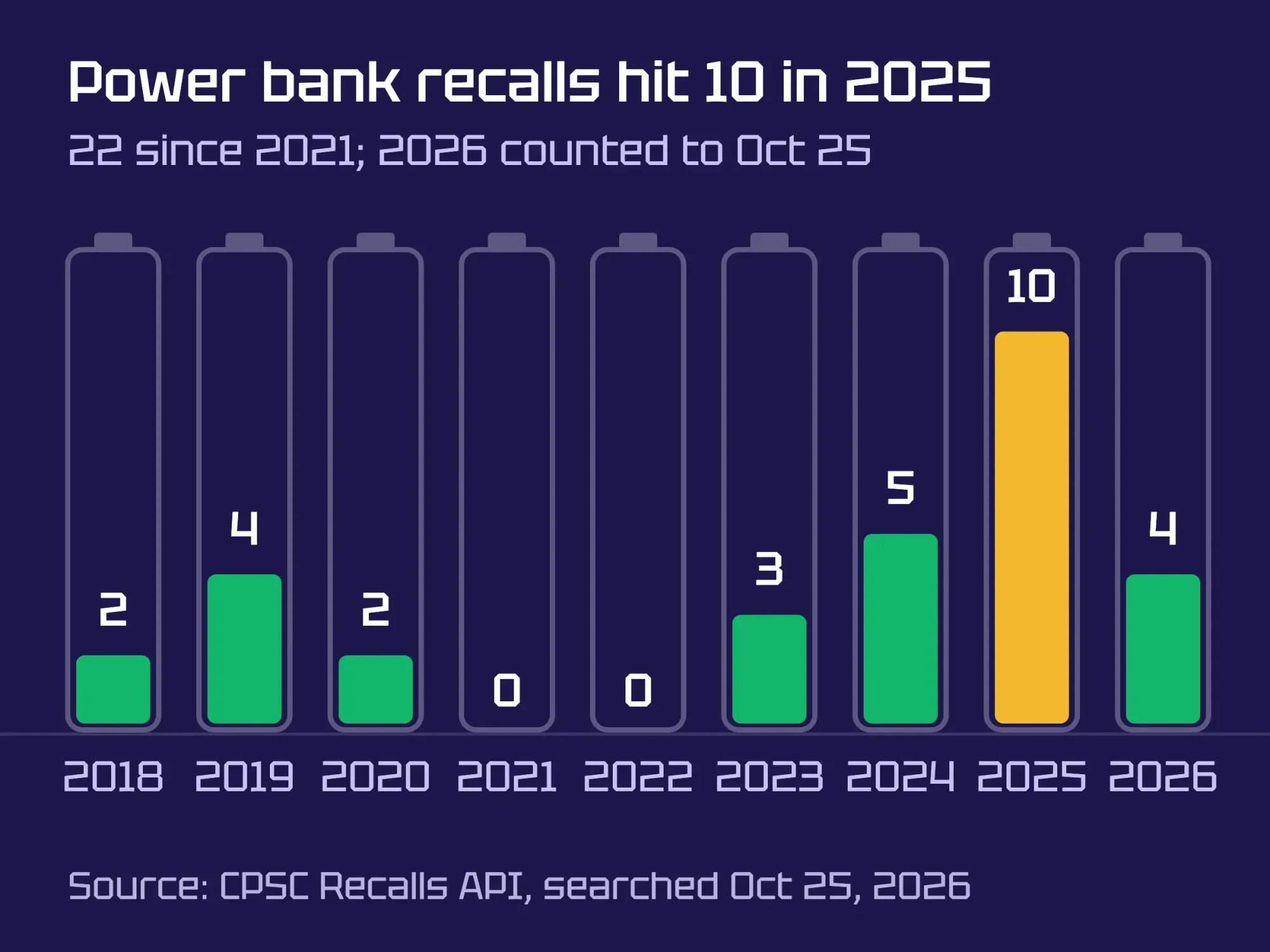 Source: CPSC Recalls API, October 2026. Recalls with "power bank" in the product name, searched October 25, 2026; chart drawn by us.
A recall in the category isn't a reason to drop it.
It's a reason to check the exact model before every video, and to tell viewers what you checked.
Read the terms on the program's own pages, and write down the date
Gate three is where most guides go wrong.
They repeat commission rates and cookie lengths copied from other blogs, and those numbers drift.
Read the program's own pages instead, and write the date next to every number. Here's what four big programs showed us on October 25, 2026, from our Mac in India.
Amazon's Associates Program Policies (updated April 14, 2026) explain the cookie, which Amazon calls a session. It ends when "24 hours elapse from that click" or the buyer places an order. Items added to the cart in that time still count if the order is finished "no later than 89 days after" the click. Payment comes "approximately 60 days following the end of each calendar month."
Category rates were another story. Amazon's commission schedule link took us through three redirects to a sign-in page, so we can't quote a rate. A visitor in the US may see something else.
Walmart was clearer on money and vaguer on time. Its affiliate FAQ says you "can earn up to 4% on each eligible sale," which is a ceiling, not a promise. Its Operating Agreement, last updated June 2026, pays "approximately ninety (90) days following the end of each calendar month." Neither page gives a cookie length. The FAQ's link to commission rates opens a short benefits page that says it "pays 1-4% with three return days" and doesn't explain the term.
Etsy's affiliate page says commission excludes "tax, delivery, returns and cancellations." On cookie length, all it says is "Our cookie period is competitive." eBay Partner Network's rate card showed us a bot check, so we read nothing there.
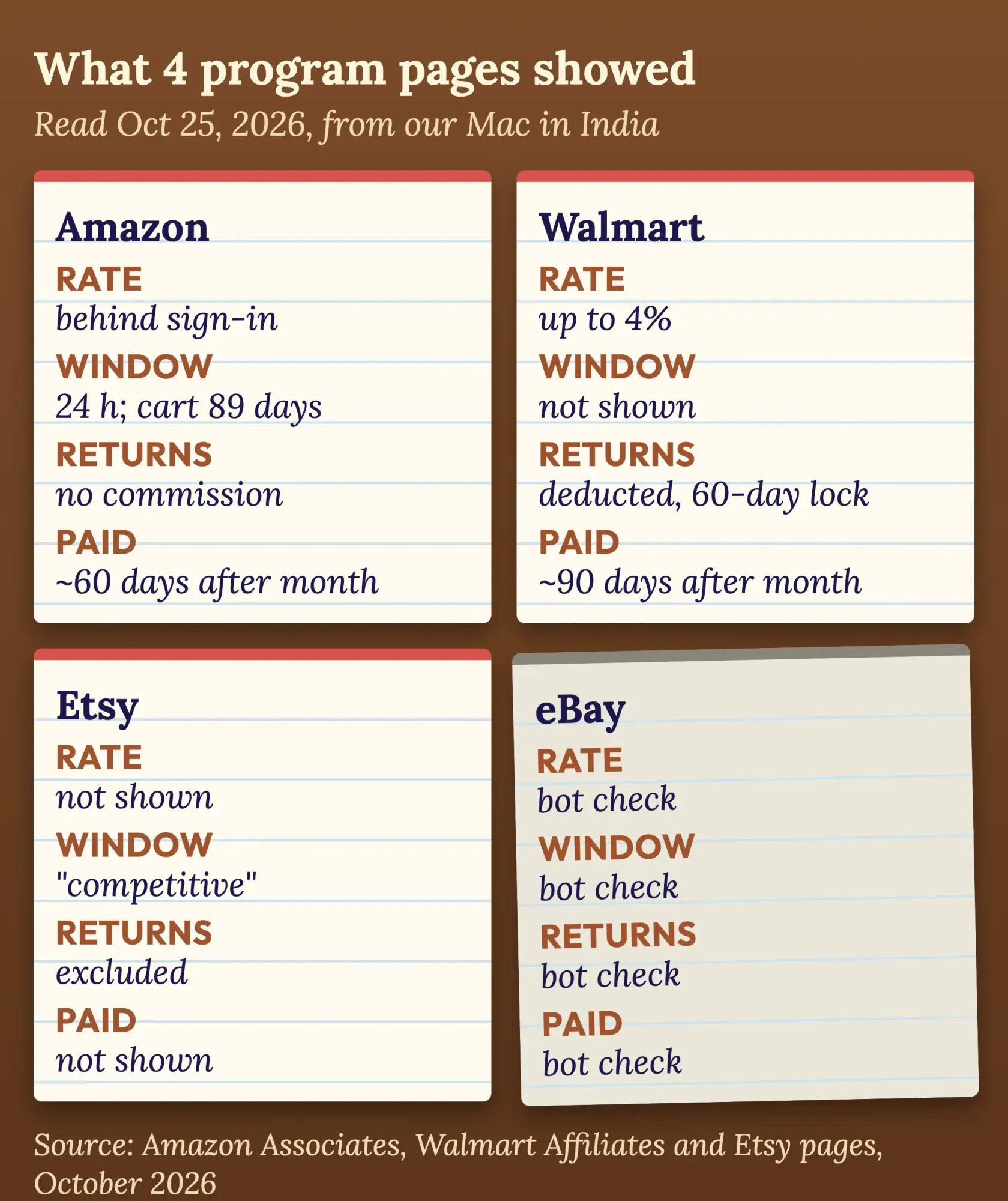 Source: Amazon Associates, Walmart Affiliates and Etsy public pages, October 2026. Drawn by us; "not shown" means we could not find it on the page.
Our rule: if a number isn't on the program's own page, write "not published" in your sheet and ask before you count on it.
Earnings per click and conversion rates sit inside a program's dashboard, after you join. You can't check them beforehand, whatever a listicle says.
And if a brand offers you a flat fee instead of a commission, that's a sponsorship. Our guide to sponsored posts covers that deal.
Work out the pay per sale after returns
Those terms boil down to one number: what you keep per sale. Multiply the price by the rate, then allow for returns.
Example: a $40 power bank at Walmart's "up to 4%" earns at most $1.60 a sale (as of the Walmart FAQ we read in October 2026). Some items pay less, so treat it as the best case.
Returns take the commission back at all three programs we could read. Amazon's policies exclude any order "where a cancellation, return, or refund has been initiated." Walmart's terms deduct it when a product comes back "before the 60-day locking period is complete."
How often do things come back? The National Retail Federation and Happy Returns estimated in October 2025 that 15.8% of US retail sales, about $849.9 billion, would be returned that year. For online sales, they put it at 19.3%.
Now run that through the example. If 1 in 5 buyers send the power bank back, 4 of every 5 sales pay out. That's $6.40 per 5 sales, or $1.28 a sale. (The 1-in-5 rate is our made-up example, close to that online estimate.)
Our take: a product people keep beats a high commission rate. A $1.28 sale that brings a viewer back is worth more than a bigger one that ends in a refund and an angry comment.
Check demand with free tools, and read the numbers right
Demand comes next, because a great product nobody searches for won't get clicks. You can check it for free with Google Trends, YouTube's own search box and a keyword tool.
Google Trends doesn't show search counts.
Google's Trends help page says each data point is divided by total searches for that place and time. The results are then "scaled on a range of 0 to 100," so a 100 is the high point of your chart, not 100 searches.
So compare two or three products in one chart, set it to the United States and the past 5 years, and read the shape. Steady or rising is good.
A spike that collapsed is a fad.
YouTube's search box helps, too. Type the product name by hand and note what it suggests, since those are searches people make on YouTube. Don't script it, though: YouTube's Terms of Service bar access "using any automated means (such as robots, botnets or scrapers)" without permission.
For more word ideas, try our free keyword suggestions tool, and set the country to the United States first. Our Google Keyword Planner guide explains how to see rough monthly volumes without running ads, and our roundup of YouTube keyword tools compares the rest.
Once you've picked, those same words go into your title and description, which our YouTube SEO guide walks through.
Read reviews for patterns, not the star average
But demand only tells you people want it. Reviews tell you whether it holds up, if you read them the right way.
The FTC's consumer page on how to evaluate online reviews gives a good method. "Check how recent the reviews are, and watch for a burst of reviews over a short period of time," it says. It also says to check whether the reviewer has written other reviews. Then it warns: "Don't assume that, just by looking, you can spot the difference between a real review and a fake one."
Fake reviews are banned by rule now. The FTC announced its final rule on August 14, 2024, and it took effect on October 21, 2024, 60 days after it was published. Under section 465.2 of that rule, a business can't write or sell a review that misrepresents whether the reviewer "used or otherwise had experience with the product."
A rule doesn't make every review honest, though.
Start with the 3-star reviews. They tend to be the most specific, and they tell you what to test: the battery that dies in the cold, the zipper that fails in week three. If the same fault turns up again and again, it'll turn up in your comments too.
Score what's left on one sheet
Now put the survivors side by side. We use one sheet, with the three gates at the top and seven scores below, each worth 0, 1 or 2 points.
| Score | 0 points | 1 point | 2 points |
|---|---|---|---|
| Audience asks about it | Never | Once or twice | Often |
| Demand, 5 years, US | Falling or a dead spike | Flat | Steady or rising |
| Review patterns | Same serious fault | Mixed, faults you can test | Recent, spread out, minor faults |
| Return risk | Fit or damage complaints | Some | Few |
| Pay per sale after returns | Under $0.50 | $0.50 to $2 | Over $2 |
| Credit window | Not published | 24 hours | Longer |
| Your angle | Nothing new to show | One thing others miss | A test only you can run |
Any failed gate means skip, whatever the score.
After that, 10 or more out of 14 gets promoted, 7 to 9 only if the channel needs it, and anything under 7 gets dropped. That's our rule of thumb, not an industry standard.
Example: Tamarack Trail Gear is a made-up camping channel run by two hikers in Marquette, Michigan. We filled in our local sheet for three of its candidates. The hammock failed the first gate, because they'd only used a borrowed one for a single weekend, too short to judge how it holds up. The power bank scored 9 and the lantern 7, both maybes, because Walmart publishes no credit window and that row scores 0.
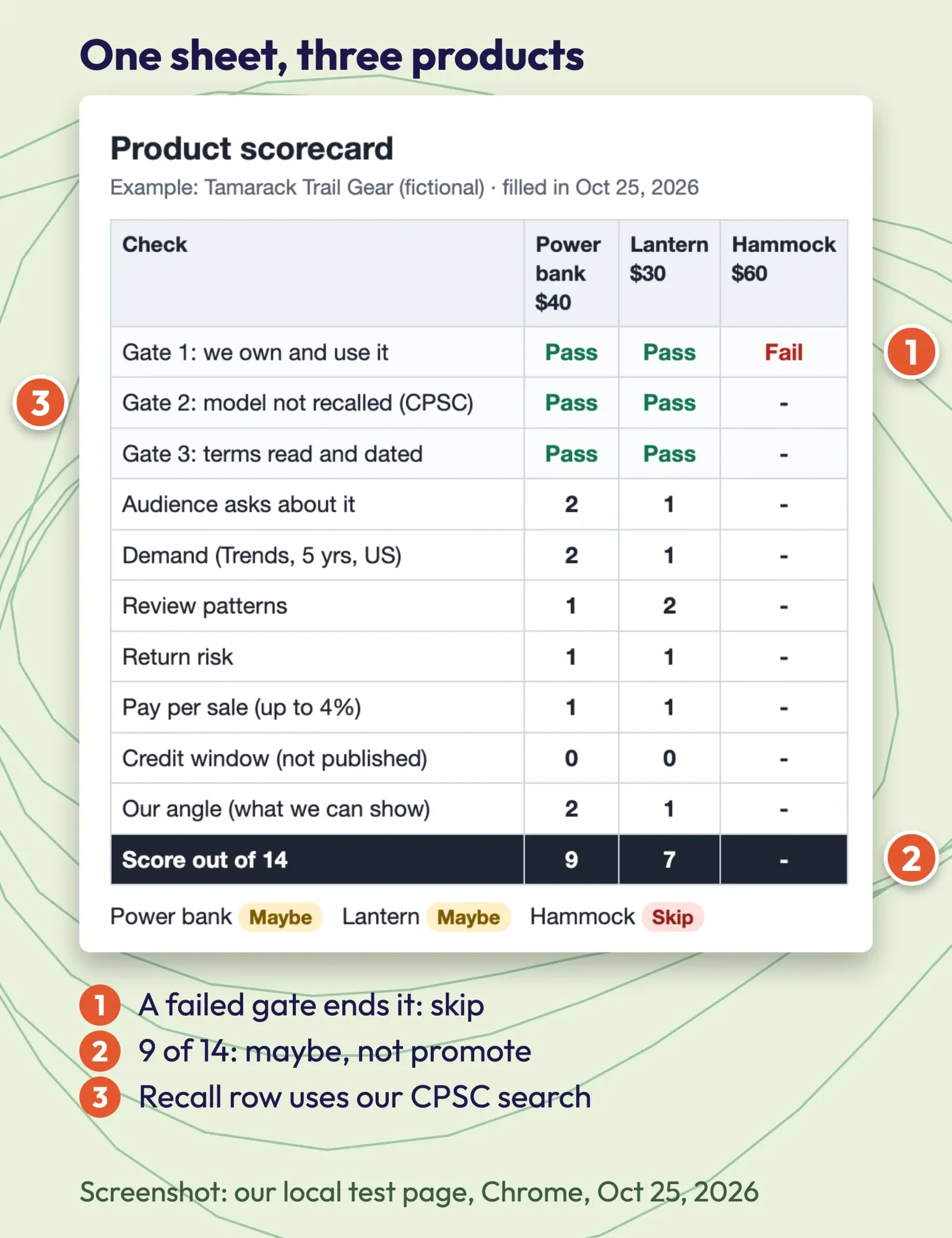 Screenshot: our local scorecard page in Chrome, October 25, 2026, for the fictional Tamarack Trail Gear; callouts by DigitalTreed.
In that sheet, the fit, demand and review scores are example values. The recall count and the "up to 4%" come from the real pages above.
Want help turning a short list like this into a review plan? Our content marketing team does that work. We charge for it, so treat this line as our pitch rather than neutral advice.
Once a product passes, test it for real and keep your sheet current
Then the real work starts.
Use the product the way your viewers would, for long enough to find its faults, and keep notes and photos as you go.
Programs change their terms, and new recalls keep coming. So recheck the recall list and each terms page every few months, and put the new date in your sheet.
If brands start offering you deals, a media kit with your audience numbers helps. And if you'd like a hand planning the videos and posts around your picks, we do that kind of social media planning for clients. We'd be paid for that too, which you should know before you click.
Frequently asked
Can I buy the product through my own Amazon affiliate link?
No. Amazon's Program Policies say you "will not directly or indirectly purchase any Product(s)" through your own links, "whether for your use or for the use of any other person." Friends and relatives can't be encouraged to do it either. Buy your test unit the normal way.
Is a note in the YouTube description enough to disclose an affiliate product?
Not on its own. The FTC FAQ says a review channel should disclose the affiliate relationship "both in the videos and in the description near the links."
Before you rely on this: it's a plain-English summary of US rules, written to help you choose products. It's no substitute for advice from a lawyer. If affiliate income becomes a real part of your business, have a lawyer look at the program terms you sign.
How we made this guide: Every rule, figure and quote here was matched to its source by October 25, 2026, and Eram N., who wrote the 2023 original, reads and approves this version ahead of publication. We read the FTC's endorsement FAQ and reviews pages, 16 CFR Parts 255 and 465 on eCFR, and the public Amazon, Walmart, Etsy and YouTube pages named above. We also read Google's help on Trends and reviews and NRF's returns release. Our own work was the CPSC recall search and the local scorecard, both run on a Mac in India. We joined no program and bought no product. Every source is linked where we use it.
First published July 2023. Rewritten October 25, 2026: the old post gave general tips with no sources. New: three gates (use it yourself, recalls, dated terms), our CPSC recall counts, what four programs' public pages really show, pay per sale after returns, Google Trends read correctly, review checks from the FTC, and a scorecard.
Sources
- FTC: FTC's Endorsement Guides: What People Are Asking
- eCFR: 16 CFR 255.1, General considerations (endorsements)
- eCFR: 16 CFR Part 465, Use of Consumer Reviews and Testimonials
- FTC: Final rule banning fake reviews and testimonials (August 14, 2024)
- FTC Consumer Advice: How To Evaluate Online Reviews (October 2022)
- CPSC: Recalls Application Program Interface (API) information
- CPSC: Recall notice, June 12, 2025 (power banks)
- Amazon Associates: Program Policies (updated April 14, 2026)
- Walmart Affiliates: FAQs
- Walmart Affiliates: Operating Agreement (last updated June 2026)
- Etsy: Affiliates and Creator Collective
- YouTube Help: YouTube Shopping affiliate program overview and eligibility
- YouTube: Terms of Service
- Google Trends Help: FAQ about Google Trends data
- Google Search Central: Write high quality reviews
- NRF: Consumers expected to return nearly $850 billion in merchandise in 2025 (October 15, 2025)
Comments
No comments yet. Start the conversation below.